A fundamental question of sociolinguistics is how social differences among speakers are reflected in their linguistic behavior. In the study of sociolinguistic variation and change, this question has been approached predominantly through “social grouping” (Horvath & Sankoff, Reference Horvath and Sankoff1987:179): that is, assign speakers to previously defined categories, and then correlate those categories with quantitative differences in linguistic behavior. A small set of social categories has been correlated with linguistic variables: sex, age, social class, and ethnicity. All of these categories featured in Labov's pioneering work on Martha's Vineyard (1963) and in New York City (1966) and have been replicated in many studies. As a result, we now have a good descriptive understanding of how each of these categories is implicated in linguistic variation:
• women are more standard for stable variables but more innovative in ongoing change (e.g., Labov, Reference Labov1990; Trudgill, Reference Trudgill1972);
• differences among age groups may reflect ongoing change (“apparent time”; e.g., Labov, Reference Labov1963, Reference Labov1972);
• differences among social classes reflect (overt and covert) prestige (e.g., Labov, Reference Labov1966, Reference Labov1972);
• ethnicity is important in maintaining linguistic boundaries and in participating (or not) in ongoing change (e.g., Labov, Reference Labov1963, Reference Labov1966; Labov, Cohen, Robins, & Lewis, Reference Labov, Cohen, Robins and Lewis1968).
More recently, these traditional social categories have been questioned, re-examined and redefined. “Sex,” based on biological or physiological differences, has been re-examined from the perspectives of gender and sexual identity (e.g., Eckert, Reference Eckert1989, Reference Eckert2000; Podesva, Reference Podesva2006). “Age” and “apparent time” have been shown to interact with “age-grading,” associated with different “life-stages” (e.g., Bailey, Reference Bailey, Chambers, Trudgill and Schilling-Estes2002). “Social class,” a large-scale sociological category, has been deconstructed into smaller-scale groupings, such as social networks (Milroy, Reference Milroy1987b; Milroy & Milroy, Reference Milroy and Milroy1992) and communities of practice (Eckert & McConnell-Ginet, Reference Eckert and McConnell-Ginet1992), or re-conceptualized using alternative theories from sociology (Dodsworth, Reference Dodsworth2005). Although recent work has begun to make problematic the construction and expression of ethnicity (see Fought, Reference Fought2006 for an overview), the emphasis of most of this work remains qualitative and ethnographic (e.g., Harris, Reference Harris2006), often focused on small numbers of speakers (e.g., Mendoza-Denton, Reference Mendoza-Denton2008), whereas large-scale quantitative studies continue to categorize informants ethnically without much explicit discussion of how these categories are decided on or the social theory underlying these categories. In addition, although ethnically marked ways of speaking are assumed to result from the persistence of minority-language transfer, the validity of this assumption has not been tested.
In this paper, we examine the role of ethnicity in linguistic variation. We begin with a critical overview of the treatment of ethnicity in the study of linguistic variation and change, highlighting the two competing requirements of variationist sociolinguistics: socially meaningful explanations of the observed variability and replication of social factors. Reviewing the assumptions of previous studies and comparing them with findings from other social sciences, we argue for an approach that combines the methods of variationist sociolinguistics and social psychology. We describe our application of this approach to a study of English in the multicultural context of Toronto, where ethnically marked speech varieties are attributed to ethnic diversity, settlement patterns in the city, and the influence of minority languages. An important component of our treatment of ethnicity is the quantitative analysis of responses to an ethnic orientation questionnaire. To illustrate the application of our operationalization of ethnicity to variationist analysis, we analyze two well-studied linguistic variables, one stable and one undergoing change, examining whether these variables are conditioned not only by ethnic grouping but also by divisions within those groupings. Our quantitative approach to ethnic orientation provides an additional dimension to the explanation of differences in linguistic behavior among members of the same ethnic group.
ETHNICITY AND LINGUISTIC VARIATION
Ethnicity has been a central preoccupation of the study of language variation and change since the inception of the field. In Labov's (Reference Labov1963) study of Martha's Vineyard, changes in the vowel system were correlated with local ethnic categories. In his work in New York City (Labov, Reference Labov1966), ethnicity played an important role in ongoing changes, sometimes more important than social class (Labov, Reference Labov1972:297). In particular, inner city African Americans did not participate in patterns of the larger speech community (Labov, Reference Labov1972:299). Subsequent research has confirmed that ethnic boundaries may act in maintaining distinct linguistic systems (Poplack & Tagliamonte, Reference Poplack and Tagliamonte1999; Rickford, Reference Rickford1985) and that different ethnic groups may accept incoming variants at different rates (Horvath, Reference Horvath1985; Knack, Reference Knack and Eckert1991; Laferriere, Reference Laferriere1979). Research has also noted the interaction of ethnicity with other social factors, such as socioeconomic class or occupation, gender, level of education, region, and age or generation (e.g., Guy, Horvath, Vonwiller, Daisley, & Rogers, Reference Guy, Horvath, Vonwiller, Daisley and Rogers1986; Horvath & Sankoff, 1987:201; Laferriere, Reference Laferriere1979:612).
If we examine ethnic categorization in studies of language variation and change, we find a preference for what we might call an “objective” or “etic” approach (Mendoza-Denton, Reference Mendoza-Denton, Chambers, Trudgill and Schilling-Estes2002:477): that is, ethnic groups are assumed to exist as real, predefined categories (Isajiw, Reference Isajiw, Bienvenue and Goldstein1985:9). In many studies, ethnic groups are associated with particular languages, such as Spanish in the U.S. (e.g., Fought, Reference Fought2006; Mendoza-Denton, Reference Mendoza-Denton, Chambers, Trudgill and Schilling-Estes2002; Roeder, Reference Roeder2007; Silva-Corvalan, Reference Silva-Corvalan1994), though this association can become tenuous if the community shifts to the majority language, as many immigrant groups to North America have done. Ethnicity is also commonly equated with race (e.g., Bell, Reference Bell1997; Bernstein, Reference Bernstein1993; Fought, Reference Fought, Chambers, Trudgill and Schilling-Estes2002; Hazen, Reference Hazen2002, Reference Hazen2008; Poplack & Tagliamonte, Reference Poplack and Tagliamonte1999; Reaser, Reference Reaser2004; Rickford, Reference Rickford1985; but cf. Labov, Reference Labov, Meyerhoff and Nagy2008:317),Footnote 1 especially in the U.S., where most studies compare white and black (and sometimes Latino) speakers (Fought, Reference Fought, Chambers, Trudgill and Schilling-Estes2002; Rickford, Reference Rickford1999). Outside of the U.S., race-based distinctions may not be salient or may be problematic (e.g., Le Page & Tabouret-Keller, Reference LePage and Tabouret-Keller1985; Reaser, Reference Reaser2004; Walker & Meyerhoff, Reference Walker and Meyerhoff2006). In addition, race-based ethnic groups are often less homogeneous linguistically than is assumed (Baugh, Reference Baugh, Guy, Feagin, Schiffrin and Baugh1996:410, 412; Hinton & Pollock, Reference Hinton and Pollock2000; Horvath & Sankoff, 1987:184; Labov, Reference Labov1972:299) and in situations of frequent interethnic contact, it is not uncommon for racial groups to converge (e.g., Ash & Myhill, Reference Ash, Myhill and Sankoff1986; Wolfram, Reference Wolfram1974) or to make use of linguistic features from the other group (e.g., “crossing” [Rampton, Reference Rampton1995]; cf. Cutler, Reference Cutler1997; Jacobs-Huey, Reference Jacobs-Huey1997). For groups without the “hard” boundaries of language or race, religion is often invoked as a criterion (e.g., Benor, Reference Benor2001; Knack, Reference Knack and Eckert1991; Labov, Reference Labov1966; Laferriere, Reference Laferriere1979; McCafferty, Reference McCafferty2001; Meechan, Reference Meechan1999). Where language, race, or religion cannot be invoked, studies tend to use the criteria of “lineal descent,” “family heritage,” or “family background” (Boberg, Reference Boberg2004; Horvath, Reference Horvath1985; Horvath & Sankoff, Reference Horvath and Sankoff1987; Labov, Reference Labov2001, Reference Labov, Meyerhoff and Nagy2008; Laferriere, Reference Laferriere1979). Under this view, ethnicity is considered “an acquired rather than an achieved characteristic … transmitted … directly from one's parents” (Labov, Reference Labov2001:245–246). Most studies simply refer to the speaker's ethnic background, without further explanation (e.g., Horvath & Sankoff, Reference Horvath and Sankoff1987:188). The preference for an etic or objective approach in variationist sociolinguistics is understandable, given the empirical need to replicate methods across studies, but from the perspective of sociolinguistics (broadly defined) and other social sciences, such “common sense” categories are unmotivated by a coherent social or cultural theory (Cameron, Reference Cameron1995; Harris, Reference Harris2006:3; Milroy, Reference Milroy, Coupland, Sarangi and Candlin2001).
In fact, a comparison of the treatment of ethnicity in variationist research with its treatment in other branches of sociolinguistics and the social sciences reveals a number of problems. The implicit assumption of the etic/objective approach is that ethnicity is shared equally by all members of the ethnic group. However, individuals may have different attitudes and degrees of orientation toward the values and characteristics associated with their respective ethnic group (Buchignani & Letkemann, Reference Buchignani, Letkemann, Berry and Laponce1994; LePage & Tabouret-Keller, Reference LePage and Tabouret-Keller1985). Although the equation of ethnicity and race is also common in popular usage, the two are not isomorphic. Racial (physical) characteristics may be socially salient, and they may help to mark ethnic boundaries (Fought, Reference Fought2006:15), but this is primarily as a result of the cultural and economic status (current or historical) of racial groups (Giles, Reference Giles, Scherer and Giles1979; LePage & Tabouret-Keller, Reference LePage and Tabouret-Keller1985:234; Yinger, Reference Yinger1994:20). Most importantly for our purposes, ethnicity is not always a central aspect of the identities of people categorized as ethnic (Buchignani & Letkemann, Reference Buchignani, Letkemann, Berry and Laponce1994:210; LePage & Tabouret-Keller, Reference LePage and Tabouret-Keller1985:207). In other words, ethnic groupings are neither static nor uniform (Fought, Reference Fought2006:16–17; Zelinsky, Reference Zelinsky2001:44): they change over time, members of the same group may have different ethnic identities, and identities may shift in the same individual according to the social situation (Fought, Reference Fought2006:20; Schiffrin, Reference Schiffrin1994:197).
These considerations underline the importance of taking into account not only external or etic measurements but also subjective or emic approaches to ethnicity (Mendoza-Denton, Reference Mendoza-Denton, Chambers, Trudgill and Schilling-Estes2002:477): that is, casting ethnic identity within the conceptual system of the individual or group under study (De Vos, Reference De Vos, Romanucci-Ross and De Vos1995:45n17). Surveying the literature at the time, Isajiw (Reference Isajiw, Bienvenue and Goldstein1985:16) arrived at the following definition of ethnicity: “an involuntary group of people who share the same culture or … descendants of such people who identify themselves and/or are identified by others as belonging to the same involuntary group.” There are two main points we can derive from this definition. First is the perception of difference by both outsiders and insiders (Ellis, Reference Ellis1999:142; Yinger, Reference Yinger1994:3): thus, names, labels, and stereotypes all serve as ready-made icons of particular ethnic identities (LePage & Tabouret-Keller, Reference LePage and Tabouret-Keller1985:208). Second, members of ethnic groups share qualities or values with others in that group, such as language, religion, race, homeland or origin, culture, interests, and goals (Ellis, Reference Ellis1999:142–143, 147; Yinger, Reference Yinger1994:3–4). To this definition we would add that members participate in shared activities revolving around these common interests and values, such as cultural or religious celebrations, public gatherings, and so on (Ellis, Reference Ellis1999:147; Yinger, Reference Yinger1994:3).Footnote 2 Rather than speaking of ethnicity, we should speak of ethnicities, or degrees of ethnicity, which vary from individual to individual and from situation to situation.
Any study of the role of ethnicity in conditioning linguistic variation must therefore confront two conflicting requirements. First, the empirical requirement of replication means that we need comparable data from each speaker. Second, the inherent subjectivity of ethnic identity means that ethnic categorization of speakers cannot rely (solely) on external measurements, but must also take account of the individuals’ perceptions of their ethnicity. Meeting only one of these requirements will inevitably either result in a loss of explanatory power or detract from comparability of findings across studies. Thus, understanding the role of ethnicity in linguistic variation entails combining subjective/emic and objective/etic approaches to the ethnic categorization of speakers. In the following sections, we present just such a combination of approaches to the study of English in a multiethnic context.
ENGLISH IN A MULTILINGUAL CONTEXT
Multilingualism and English in Toronto
Toronto is argued to be among the most multicultural cities in the world (Anisef & Lanphier, Reference Anisef and Lanphier2003), a claim supported by examining the 2006 census (Statistics Canada, 2006): 46% of its residents were born outside of Canada, and 56% report an ethnic origin other than British, Irish, French, or North American. This ethnic diversity is matched by linguistic diversity: 42% report a mother tongue other than English or French (the two official languages of Canada). Over 70 languages are represented by at least 1,000 mother-tongue claimants, with smaller numbers for dozens of other languages. These languages coexist in a densely populated urban area (5,113,149 inhabitants in 2006), with English as the city's lingua franca.
However, language contact in Toronto is mitigated by historical patterns of settlement. Unlike other large “immigrant” cities, such as New York and Chicago (but like Sydney), Toronto only became a destination for non-British/Irish immigrants on a large scale after the Second World War (Troper, Reference Troper, Anisef and Lanphier2003:21–27). Also mitigating language contact is the tendency for different cultural and linguistic groups to settle in particular neighborhoods (e.g., Bauder & Sharpe, Reference Bauder and Sharpe2002; Bourne, Baker, Kalback, Cressman, & Green, Reference Bourne, Baker, Kalback, Robert and Green1986; Ray, Reference Ray1994; Weinfeld, Reference Weinfeld, Bienvenue and Goldstein1985:73). Such settlement patterns have led to the development of ethnic enclaves in which an individual can live and work almost entirely in a minority language and interact almost exclusively with people of the same ethnic background. This voluntary segregation has been argued to have linguistic consequences. Some have argued that it impedes the acquisition of standard Canadian English and results in “ESL varieties” of English (Chambers, Reference Chambers and Edwards1998:266; Duffy, Reference Duffy2004). In fact, residents of Toronto commonly remark on accents or ways of speaking that identify members of particular ethnic groups. Such “ethnolects” (Carlock & Wölck, Reference Carlock, Wölck, Sankoff and Cedergren1981), it is predicted, will alter the nature of Canadian English (Brinton & Fee, Reference Brinton, Fee and Algeo2001:426; Chambers, Reference Chambers and Edwards1998:271).
How do ethnolects arise? Any differences in linguistic behavior among ethnic groups are usually assumed to result from substrate transfer from the languages originally or still spoken by each ethnic group (e.g., Carlock & Wölck, Reference Carlock, Wölck, Sankoff and Cedergren1981; Chambers, Reference Chambers, Britain and Cheshire2003; Danesi, Reference Danesi1985; Weinfeld, Reference Weinfeld, Berry and Laponce1994:241). This transfer may be transitional, as subsequent generations become native speakers of the majority language (Boberg, Reference Boberg2004:539; Wölck, Reference Wölck, Wei, Dewaele and Housen2002:161), or it may persist as ethnically marked ways of speaking in subsequent generations (Carlock & Wölck, Reference Carlock, Wölck, Sankoff and Cedergren1981; Labov, Reference Labov, Meyerhoff and Nagy2008:316; Wölck, Reference Wölck, Wei, Dewaele and Housen2002:157). This strong interpretation of ethnolects predicts that members of the same ethn(olinguist)ic group should resemble each other in their linguistic behavior (regardless of generation or native-speaker status) while differing from the larger population. However, several considerations vitiate the strong interpretation. First, immigrants tend to acquire English within a few months of arrival in Canada, and minority-language use declines after the second or third generation (e.g., Berry, Reference Berry and Edwards1998; O'Bryan, Reitz, & Kuplowska, Reference O'Bryan, Reitz and Kuplowska1976; Weinfeld, Reference Weinfeld, Bienvenue and Goldstein1985:241). There is also pressure from the larger population to assimilate linguistically. For Canadians who are not visible minorities, a foreign accent is “the characteristic most commonly associated with perceived discrimination or unfair treatment” (Statistics Canada, 2003:21; cf. King & Clarke, Reference King and Clarke2002; Lippi-Green, Reference Lippi-Green1997; Weinfeld, Reference Weinfeld, Bienvenue and Goldstein1985:76; Wölck, Reference Wölck, Wei, Dewaele and Housen2002:158). These considerations, coupled with the Founder Principle (Mufwene, Reference Mufwene2001), according to which founding populations establish the speech patterns adopted by subsequent arrivals, suggest that any effects of ethnolects on mainstream Canadian English may be minimal and are not likely to persist. In fact, children rarely acquire the foreign accent of their parents (e.g., Chambers, Reference Chambers and Milroy2002; Labov, Reference Labov, Meyerhoff and Nagy2008:317), and studies often have difficulty in tracing ethnically marked differences in linguistic behavior directly to the substrate language (Labov, Reference Labov, Meyerhoff and Nagy2008:317–318).
An alternative, weaker interpretation of ethnolects is that they serve to differentiate speakers who wish to convey membership in a particular ethnic group (cf. Wölck, Reference Wölck, Wei, Dewaele and Housen2002:158, 164), with linguistic features that may or may not derive from substrate transfer (Bell, Reference Bell, Bayley and Lucas2007:99–100; Clyne, Eisikovits, & Tollfree, Reference Clyne, Eisikovits, Tollfree, Blair and Collins2001:226). This interpretation predicts that members of ethnic groups will not only be differentiated from the larger population in their linguistic behavior, but will also differ by generation. To our knowledge, neither of these interpretations of ethnolects has been tested empirically.
The “Contact in the City” Project
Whereas local media in Toronto have been paying increasing attention to the effects of minority-language groups on English (e.g., Duffy, Reference Duffy2004; Farley & Listar, Reference Farley and Listar2007; Keung, Reference Keung2004), sociolinguistic research on Canadian English has tended to maintain a focus on British-/Irish-origin populations, purposely excluding other ethnic groups (no doubt reflecting the biases of traditional dialectology; see Chambers [1998] for an overview). Recent research has begun to take account of other populations (e.g., Boberg, Reference Boberg2004; Poplack, Walker, & Malcolmson, Reference Poplack, Walker and Malcolmson2006; Tagliamonte, Reference Tagliamonte2006), but the ethnic dimension of sociolinguistic variation in Canadian English has remained largely uninvestigated. To address this lacuna, we are engaged in a large-scale project to assess Toronto's ethnolinguistic landscape. Our goal is to identify linguistic features associated with the English of different ethnic groups in Toronto and the way in which such features are used, not only by non-native speakers of English, but also by native speakers of English who convey ethnicity (in part) by ways of speaking (Giles, Reference Giles, Scherer and Giles1979).
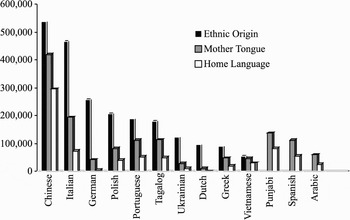
We begin by focusing on the two ethnic groups (other than British/Irish and French) with the most robust demographic representation in the city. Figure 1 shows the results from the 2006 census for ethnic group (other than British/Irish, French, American and Canadian),Footnote 3 mother tongue and home language (other than English and French) (Statistics Canada, 2006). Not only are Italian and Chinese claimed as an ethnic origin by the largest numbers of Torontonians, but their languages are also most frequently claimed as mother tongue among the nonofficial languages.Footnote 4 Although each group shows different patterns of language shift (as indicated by the relative proportion of home language to mother tongue), both Italian- and Chinese-Canadians report a strong sense of ethnic belonging and sustain frequent contact with relatives in their respective countries of origin (Statistics Canada, 2003). The demographic relevance of these groups to our research is matched by the relevance of their associated languages to issues of language transfer. Although Italian is an Indo-European language, it differs from English in a number of phonological respects, such as a preference for consonant-vowel syllables and fewer vowel phonemes (Flege, Munro, & MacKay, Reference Flege, Munro, MacKay, Bayley and Preston1996; Posner, Reference Posner1996). Chinese differs from English not only phonologically (e.g., avoiding word-final consonant clusters) but also grammatically (e.g., distinguishing aspect rather than tense) (Matthews & Yip, Reference Matthews and Yip1994; Norman, Reference Norman1988). Thus, both languages provide interesting linguistic points of contrast with English that lend themselves to language transfer and potential manifestation as ethnolects.
Number of Toronto residents claiming non-official mother tongues, home languages, and ethnic origins other than British/Irish, French, and North American (Statistics Canada, 2006).

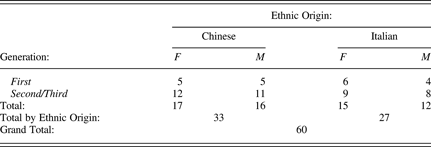
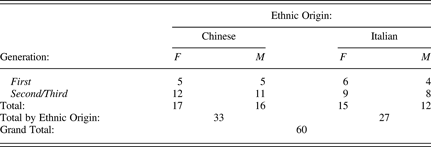
To investigate these hypotheses, we recruited 60 informants, stratified according to ethnic origin, generation, and sex, as shown in Table 1. All first-generation informants, who range in age from 40 to 80 years, arrived in Toronto after the age of 18 years and have spent at least 20 years there. Second-/third-generation informants, who range in age from 17 to 32 years, were born in Toronto (or arrived before the age of 5 years) and have spent their whole lives there (cf. Kiesling, Reference Kiesling2005:6). Because of the history of Chinese settlement in Toronto (Siemiatycki, Rees, Ng, & Rahi, Reference Siemiatycki, Rees, Ng, Rahi, Anisef and Lanphier2003:402–411), we restricted our recruitment of Chinese informants to those who were born in or could trace their ancestry to Hong Kong (or Guangdong [Canton] province in mainland China). We imposed no conditions on the (ancestral) origins of the Italian informants, but because of the nature of Italian settlement in Toronto (Siemiatycki et al., Reference Siemiatycki, Rees, Ng, Rahi, Anisef and Lanphier2003:384–391; Zucchi, Reference Zucchi1988), the majority of informants are of Calabrian or Sicilian background. In order to test the hypothesis that ethnic enclaves lead to differences in linguistic behavior, at the recruitment phase we tried to balance younger informants evenly between those who grew up in neighborhoods with large concentrations of their respective ethnic group and those whose neighborhoods were ethnically more diverse. We also recruited 20 informants, similarly divided in age, as a control group of Toronto's founder-population ethnicities (i.e., English, Scottish, and Irish, henceforth referred to as “British/Irish”).Footnote 5 For these informants, we imposed the rather strict requirement that their ancestry be entirely from the British Isles, and that not only the informants but also their parents (and, wherever possible, grandparents) were born and raised in Toronto.Footnote 6
Stratification of informants of Toronto English corpus by sex, generation and ethnic origin
In collecting linguistic data for analysis, our primary goal is to access the informant's vernacular, in which the least amount of attention is paid to speech (Labov, Reference Labov, Baugh and Sherzer1984; Milroy, Reference Milroy1987a). This consideration raises the issue of the “observer's paradox,” because the presence of an interviewer sets up a situation in which the vernacular may not be used (Labov, Reference Labov1972). To minimize this paradox, we make use of the sociolinguistic interview (Labov, Reference Labov, Baugh and Sherzer1984), which focuses the informant's attention on speech content rather than form, by engaging them in naturalistic conversation on topics of their choice. An additional consideration of the observer's paradox, highly relevant to this research, is the use of ethnically marked linguistic features to distinguish in-group versus out-group status (Clyne, Eisikovits, & Tollfree, Reference Clyne, Eisikovits, Tollfree, Blair and Collins2001:235, Reference Clyne, Eisikovits, Tollfree and Duszak2002; Giles, Reference Giles, Scherer and Giles1979), which means that such features may not be used in situations where the speaker and interlocutor are unknown to each other and/or do not share social characteristics (especially ethnicity; Bailey & Tillery, Reference Bailey, Tillery and Fought2004; Fought, Reference Fought, Chambers, Trudgill and Schilling-Estes2002:454; Rickford & McNair-Knox, Reference Rickford, McNair-Knox, Biber and Finegan1994). Thus, traditional survey methods such as random sampling (e.g., Poplack, Reference Poplack, Fasold and Schiffrin1989; Sankoff & Sankoff, Reference Sankoff, Sankoff and Darnell1973; Tagliamonte, Reference Tagliamonte2006), which may increase the demographic representativeness of the informant sample, may be inappropriate for investigating ethnic markers. For this reason, we additionally attempted to reduce the observer's paradox by employing community members as interviewers (cf. Clyne et al., Reference Clyne, Eisikovits, Tollfree, Blair and Collins2001:235). Undergraduate research assistants at York University who are themselves members of the relevant communities conducted and recorded sociolinguistic interviews, making use of their extended social networks to fulfill the sampling criteria.Footnote 7
This multigenerational approach allows us to establish a baseline for features transferred from the respective minority languages. First-generation speakers, being bilingual but minority-language dominant, are most likely to transfer features of their first language into their English. We compare first-generation speech patterns with those of the second/third generations, who are English-dominant bilinguals or English monolinguals, to determine whether minority-language transfer persists in subsequent generations. We also compare speakers from these ethnic backgrounds with the British/Irish speakers to distinguish between differences due to language transfer and degree of exposure to mainstream English from ongoing changes in Canadian English more generally.
As already noted, we initially categorized the ethnicity of informants according to their lineal descent (e.g., Italian, Chinese) and their enclave status according to the nature of the neighborhood in which they grew up. However, we reiterate that the inherent subjectivity of ethnicity means that such externally defined measures, albeit salient to the researcher, may not be relevant to the informant. Other studies have further subcategorized speakers, either qualitatively or quantitatively, according to measures such as self-reported minority-language use and social networks (Ash & Myhill, Reference Ash, Myhill and Sankoff1986; Baugh, Reference Baugh, Guy, Feagin, Schiffrin and Baugh1996:398; Dubois & Melançon, Reference Dubois and Melançon1997; Edwards, Reference Edwards1992; Fought, Reference Fought1999; Mendoza-Denton, Reference Mendoza-Denton1997; Poplack, Reference Poplack1980), but in situations of racial division or bilingualism with a single pair of languages. Thus, we have no clear guidelines to follow in categorizing informants in this situation.
In the course of the sociolinguistic interviews, informants spontaneously raised topics related to ethnic identity and cultural practice. We might make use of such comments to determine degree of ethnicity (as Poplack et al. [2006] do for degree of bilingualism), but the haphazard nature of these comments makes comparison difficult, because not all of the informants raise exactly the same issues. In order to obtain comparable information from each informant, we adapted questions from studies of ethnic identity in sociology and social psychology (Edwards & Chisholm, Reference Edwards and Chisholm1987; Kalin & Berry, Reference Kalin, Berry, Berry and Laponce1994; Keefe & Padilla, Reference Keefe and Padilla1987) to classify speakers according to their perceived degree of participation in the relevant ethnic group. The Ethnic Orientation (EO) questionnaire (see Appendix), administered at the end of each sociolinguistic interview, addresses several aspects of ethnic identity, organized into eight categories relevant to the definition of ethnicity we discussed earlier (Isajiw, Reference Isajiw, Bienvenue and Goldstein1985:11; Weinfeld, Reference Weinfeld, Berry and Laponce1994:239): ethnic identification; language; language choice; cultural heritage; the ethnic orientation and language practices of the informant's parents and partner; attitudes about the importance of ethnic culture; and experience and perceptions of discrimination. The informants’ responses to the EO questionnaire allow us to systematically examine their (perceived) degree of ethnic orientation.
RESULTS
We begin by discussing our results for the EO questionnaire, which serve as the basis for categorizing speakers for the analysis of linguistic features.
Ethnic orientation
Because our goal in this research is to determine the effect of informants’ EO on their patterns of linguistic behavior, we predict that informants with higher degrees of EO will differ linguistically from speakers with lower degrees of EO. To quantify EO, we began by assigning a score between 1 and 3 to each informant's response to each question in the EO questionnaire, with 1 representing the least engagement in the ethnic group, 3 representing maximum involvement, and 2 an intermediate or mixed response.Footnote 8 For example, for the question on ethnic self-identification, informants who identified themselves as “Canadian” received a score of 1, those who responded “Italian” received a score of 3, and a response of “Italian-Canadian” or “both” received a score of 2. We arrived at a mean EO index score for each informant by averaging their responses across the 35 questions. Statistical tests showed that this index provides a highly reliable scaling (Cronbach's α = .905).
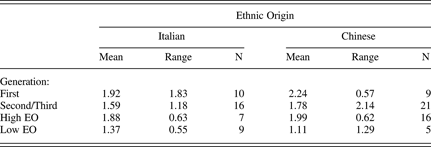
Table 2 shows the average mean EO index scores for each of the ethnic groups, along with the ranges of index scores and the number of speakers in each group.Footnote 9 First, note the salient differences between groups. Overall, scores for the Chinese are higher than for the Italians, and scores for all first-generation speakers are higher than those for second-/third-generation speakers, though the range of scores decreases for Italians and increases for Chinese. Moreover, ethnic differences persist in subsequent generations. The younger Chinese report stronger ethnic orientation than do the younger Italians, though they have a greater range of scores.
Mean ethnic orientation index scores of speakers in Toronto English corpus, with ranges and number of speakers in each group
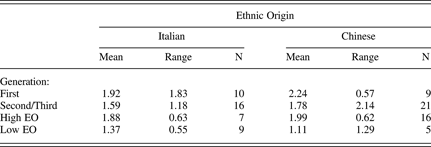
Although, as mentioned earlier, we initially determined enclave status impressionistically, according to the neighborhood in which they grew up, the mean EO index scores allow us to separate speakers by ethnic orientation in a more principled quantitative manner. A series of statistical tests showed that the best scaling reliability was achieved when speakers were divided between those with EO index scores of 1.50 or higher and those with scores below 1.49. Therefore, we designate the former group as “high EO” and the latter as “low EO.” As shown in Table 2, although the high EO and low EO Italians are roughly equal in numbers (n = 7 and n = 9, respectively), the low EO Chinese are in the minority (n = 5) compared with the high EO Chinese (n = 16). The scores for second-/third-generation Chinese overall are higher than those of second-/third-generation Italians, but this difference is true only for the high EO speakers. The difference in mean EO scores between high EO and low EO speakers is greater for the Chinese than for the Italians, with the greatest range of scores in the low EO Chinese.
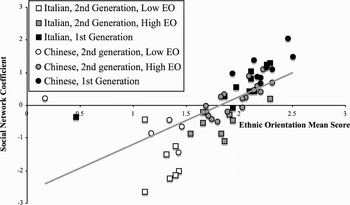
However, we cannot assume that the responses to the 35 questions in the EO questionnaire are completely independent of each other, nor that each question or set of questions contributes equally to the mean EO index. As an additional method of measuring ethnic orientation, we performed exploratory factor analysis to determine whether a smaller number of factors underlay the 35 responses. Principal components analysis reduced the 35 responses to 4 factors. The first factor (accounting for 35% of the variance), which we refer to as a social network score, included questions relating to the speaker's ethnic self-identification, their family and friends, and their knowledge and use of the respective minority language. The second factor (accounting for a further 15% of the variance) included questions related to the speaker's grandparents, and the third and fourth factors (accounting for a further 10% and 9%, respectively) concerned questions related to aspects of perceived discrimination in work and housing, respectively. Further analysis revealed no significant correlation among these four factors. Only one factor correlated significantly with the EO mean score: that of social network (r = .794, p < .001), as illustrated in Figure 2, which provides a scattergram plot of each speaker's mean EO index score (x axis) against their social network score (y axis). This correlation suggests that high EO informants are oriented more toward their ethnic group through their self-identification, their social networks, their language use and their participation in community activities, while low EO informants profess weaker ties to their ethnic group.
Linear correlation of social network coefficients and ethnic orientation mean scores.

In the following sections, we illustrate the effects of these divisions among speakers by analyzing the linguistic and social conditioning of two well-studied linguistic variables. We do not test the strong interpretation of ethnolects directly, by tracing features of substrate transfer from generation to generation (though this is the subject of ongoing research), because this approach would minimize comparability across ethnic groups (and their associated languages). Rather, to maximize comparability, we focus on linguistic variables that occur in all ethnic groups: one stable variable ((t/d)-deletion) and one change in progress (the Canadian Vowel Shift).
Stable variation: (t/d)-deletion
The first linguistic feature we examine is (t/d)-deletion (TD), a stable and well-studied process in which [t] and [d] in word-final consonant clusters are variably deleted (Guy, Reference Guy and Labov1980).Footnote 10 This variable is eminently suited to addressing our research questions, because its linguistic and social conditioning is relevant not only to speech-community membership (Guy, Reference Guy and Labov1980; Tagliamonte & Temple, Reference Tagliamonte and Temple2005) but also to second-language acquisition and ethnic identity (Bayley, Reference Bayley, Bayley and Preston1996; Santa Ana, Reference Santa Ana1992, Reference Santa Ana1996; Wolfram, Reference Wolfram1969). Moreover, the linguistic conditioning of TD involves both phonological and morphological considerations (Guy, Reference Guy and Labov1980, Reference Guy1991; Guy & Boberg, Reference Guy and Boberg1997; Guy & Boyd, Reference Guy and Boyd1990; Labov, Reference Labov, Hinskens, Hout and Wetzels1996; Tagliamonte & Temple, Reference Tagliamonte and Temple2005), two areas in which substrate transfer is likely to be manifested.
From a subsample of 60 interviews (17 Italian, 27 Chinese, 16 British/Irish), we began 15 minutes into each recording and extracted between 50 and 100 consecutive tokens (where possible) of [t] or [d] in a word-final consonant cluster. As in previous studies, we excluded preceding /r/ (as in hard), in which deletion rarely occurs (Guy & Boberg, Reference Guy and Boberg1997), and frequent lexical items such as and, just, kind of, and –n't, which feature (near-)categorical deletion (Wolfram, Reference Wolfram and Preston1993). To further minimize lexical effects, we extracted no more than five tokens of any one lexical type per speaker (Wolfram, Reference Wolfram and Preston1993). These protocols yielded 4,962 tokens. In addition to noting whether [t] or [d] was deleted,Footnote 11 we coded each token for the linguistic factor groups examined in previous studies. The preceding phonological context was coded as nasal (1a), lateral (1b), sibilant (1c), or stop (1d). The following phonological context was coded as consonant (2a), vowel (2b), or pause (2c). The morphological status was coded as monomorphemic (3a), past tense (3b), or semiweak (involving stem change as well as affixation of the past tense suffix) (3c), though for this analysis we exclude the last category because of interaction with the preceding context and remaining lexical effects (Walker, Reference Walker2007, Reference Walker2008). This further reduced the tokens retained for analysis to 4,753.
(1)
a. She was banned from the store. (24/A/26:43)Footnote 12
b. He grabbed him by the ear and tol’ him to shut up. (9/I/50:12)
c. The only big chunk of my mark left was the exam. (43/C/29:08)
d. They never kept within the lines. (22/A/22:55)
(2)
a. That was the wors’ part. (48/C/24:48)
b. They were old, eh. (11/I/26:02)
c. On Bloor Street West … (20/A/33:27)
(3)
a. That's what I fin’, I mean, … (37/C/25:28)
b. I begged for that job. (65/I/39:30)
c. We los’ like two lifeguards. (23/A/22:45)
Each token was also coded for the speaker's sex, generation, ethnic group, and (for second-/third-generation informants) EO status. All of the factor groups were analyzed individually and together using Goldvarb X (Sankoff, Tagliamonte, & Smith, Reference Sankoff, Tagliamonte and Smith2005).
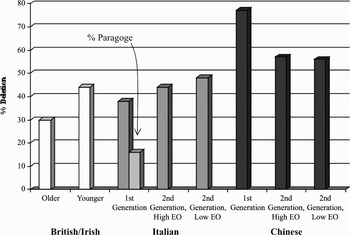
Figure 3 displays the overall rates of deletion for each social group, with speakers divided by ethnic group, generation (for Italian and Chinese), and high/low EO (for second-/third-generation Italian and Chinese). Note that the difference between the British/Irish and the Italians, regardless of generation, is not great. However, this similarity masks a difference between generations, because first-generation Italians avoid word-final consonant clusters not only through deletion but also through paragoge (addition of a word-final vowel), as shown in Figure 3 and illustrated in (4). For comparability across groups, the 306 tokens of paragoge were excluded from the multivariate analysis.
(4) I try to understand-a people. (1/I/28:20)
Rate of (t/d)-deletion (and paragoge) in Toronto English, by ethnic group, generation, and ethnic orientation status.

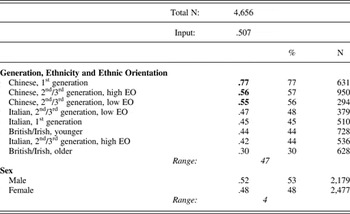
As Figure 3 shows, the greatest difference is between the Chinese informants and all other groups. This difference is confirmed in a multivariate analysis of social factors, shown in Table 3,Footnote 13 in which all Chinese informants favor deletion (though first-generation Chinese informants much more highly) and Italian and British/Irish informants disfavor. However, while the overall rate of occurrence may give an indication of patterns of usage, they may mask differences between the linguistic system(s) underlying the variation, which can only be revealed by a comparison of conditioning by language-internal factors (e.g., Tagliamonte, Reference Tagliamonte, Chambers, Trudgill and Schilling-Estes2002).
Social factors contributing to (t/d)-deletion in Toronto English

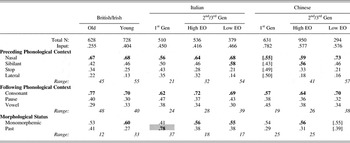
Table 4 shows eight separate multivariate analyses of linguistic factor groups to TD, for each of the social groups shown in Table 3. British/Irish speakers, both old and young, show conditioning similar to that of native English speakers in New York and Philadelphia (Guy, Reference Guy and Labov1980; Guy & Boberg, Reference Guy and Boberg1997). All linguistic factor groups are significant, with deletion favored by preceding nasals and following consonants and disfavored by past-tense forms. If we compare the ranges of factor groups in each run, which give an indication of the relative strength of effect within each multivariate analysis, the phonological effects are much stronger than those of morphological status for both groups of speakers.
Linguistic factors contributing to the occurrence of (t/d)-deletion in Toronto English, by ethnic group, generation, and EO status

[ ] = Factor groups not selected as significant.
In contrast, the results for the first-generation speakers are rather different. Although first-generation Italians exhibit phonological effects parallel to the British/Irish, the effect of morphological status is stronger (range = 37, compared with 21 and 24 for the phonological factor groups), and its effect is exactly the opposite of the British/Irish, with past-tense forms favoring deletion. First-generation Chinese speakers show effects of the following context and morphological status parallel to the British/Irish, but the preceding context is not selected as significant and the morphological status exerts a stronger effect (range = 25, compared with 19). Clearly, first-generation informants do not share the same system of TD with the British/Irish, reflecting their status as second-language speakers of English.
What of the second-/third-generation Italians and Chinese, and the effect of EO status? Across all second-/third-generation groups, the phonological conditioning is largely parallel: preceding nasals favor deletion; preceding stops and laterals disfavor (preceding sibilants have less consistent effects, but their relative ranking with respect to other factors remains constant). Following consonants favor deletion and following vowels and pauses disfavor across all groups (although the relative ranking of vowels and pauses differs between the Italians and Chinese). Past-tense forms disfavor across all groups (though morphological status is not significant for low EO Chinese). The only difference between low and high EO groups appears to be the favoring effect of preceding sibilants.
Therefore, at least as far as this stable linguistic variable is concerned, although speakers may vary in the overall rate of use (a point to which we return in the discussion), the linguistic conditioning of the variation remains largely constant across the second-/third-generation speakers (regardless of EO status) and the British/Irish.
Change in progress: The Canadian Vowel Shift
The second variable we consider is the Canadian Vowel Shift (CVS), a process in which the front lax vowels /ɪ/ and /ɛ/ are variably shifted to phonetic realizations closer to [ɛ] and [æ], respectively, and the low front vowel /æ/ is variably retracted to [a]. First documented by Clarke, Elms, and Youssef (Reference Clarke, Elms and Youssef1995), the CVS has been studied in various locales across Canada (Boberg, Reference Boberg2004, Reference Boberg2005, Reference Boberg2008; D'Arcy, Reference D'Arcy2005; De Decker, Reference De Decker2002; De Decker & Mackenzie, Reference De Decker and Mackenzie1999; Hagiwara, Reference Hagiwara2006; Hoffman, Reference Hoffman1998, Reference Hoffman1999a, Reference Hoffman1999b; Labov, Ash, & Boberg, Reference Labov, Ash and Boberg2006; Meechan, Reference Meechan1999; Roeder & Jarmasz, Reference Roeder and Jarmasz2008). Though there is some dispute about its precise phonetic characterization (e.g., Boberg, Reference Boberg2004, Reference Boberg2005; Hagiwara, Reference Hagiwara2006) and its status as a chain shift (Boberg, Reference Boberg2005; Clarke et al., Reference Clarke, Elms and Youssef1995; Hagiwara, Reference Hagiwara2006), most studies agree that it is an ongoing change. These studies have identified several linguistic and social factors conditioning the CVS. The effect of the manner of articulation of the following phonological context is largely consistent (though later findings differ somewhat from those of Clarke et al. [1995]): for (ɛ)-shifting, laterals favor and obstruents disfavor; for (æ)-retraction, laterals and obstruents favor and nasals disfavor. For social factors, women (especially young women) have been found to lead the CVS (Boberg, Reference Boberg2005; Clarke et al., Reference Clarke, Elms and Youssef1995; De Decker & Mackenzie, Reference De Decker and Mackenzie1999; Hoffman, Reference Hoffman1999a, Reference Hoffman1999b; Meechan, Reference Meechan1999). Boberg (Reference Boberg2004, Reference Boberg2005) are to our knowledge the only other studies of the CVS to investigate ethnicity; Boberg (Reference Boberg2005) found no significant effects for any components of the shift.
First-generation Chinese informants showed no evidence of participation in any aspect of the CVS. Whereas first-generation Italians do “retract” /æ/, we argue that this is more plausibly attributed to language transfer (because Italian has no low front vowel). For comparability, we also excluded tokens from the older British/Irish speakers. We extracted tokens from a subsample of 22 younger speakers. Beginning 15 minutes into the recording, we extracted from each interview 100 tokens (where possible) of each of the 3 vowel phonemes (/ɪ/, /ɛ/, /æ/) in stressed syllables. To minimize lexical effects, we included no more than 7 tokens of any 1 lexical type per speaker. Because we found very low rates of (ɪ)-shifting (0%–13%), we concentrate on (ɛ) (2,270 tokens) and (æ) (2,135 tokens).
Each token was coded impressionistically as shifted or nonshifted, excluding any tokens where agreement between the authors could not be reached.Footnote 14 We also coded for one linguistic factor group, the manner of articulation of the following phonological context, distinguishing among obstruents (5a, 5b), nasals (5c, 5d), and laterals (5e, 5f).
(5)
a. … were expecting these (4/I/38:16)
b. … found a wrapper (12/I/48:32)
c. … my grandparents from England (20/A/47:24)
d. … to rely on your senses more (6/I/48:34)
e. … he was telling everybody (13/I/51:58)
f. … calculus courses and algebra (48/C/13:06)
We also coded for the speaker's sex, ethnic group, and EO status. All of the factor groups were analyzed individually and together using Goldvarb X (Sankoff et al., Reference Sankoff, Tagliamonte and Smith2005).
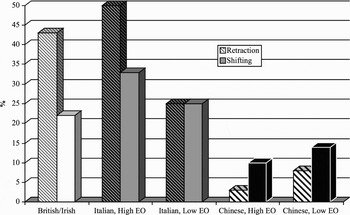
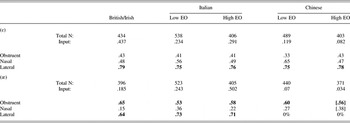
The overall rates for two components of the CVS by ethnic group and EO status are shown in Figure 4. The British/Irish and Italian informants show higher rates of participation for both variables, whereas the Chinese, especially the high EO informants, show very low rates. Table 5 shows the results of a one-level binomial analysis for the linguistic conditioning of the CVS in each ethnic group.Footnote 15 The effects for (ɛ) are fairly consistent across all groups, with following obstruents disfavoring and laterals favoring.Footnote 16 For (æ), the effects are similarly parallel. Obstruents favor and nasals disfavor for all ethnic groups (though not significantly for the high EO Chinese), whereas laterals favor for both the British/Irish group and Italians. However, none of the Chinese informants exhibited (æ)-shifting before laterals.Footnote 17
Rate of (æ)-retraction and (ɛ)-shifting among young speakers of Toronto English, by ethnic group and EO status.

Contribution of following manner to the Canadian Vowel Shift in Toronto English, by ethnic group and EO status

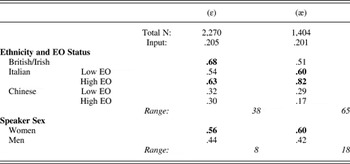
Table 6 displays the results of two multivariate analyses of social factors contributing to the CVS, for (ɛ) and (æ). Although the effect of speaker sex is not very strong, women favor both elements of the shift. The strongest effect is that of ethnicity and EO status, though the patterns for (ɛ) and (æ) are slightly different. British/Irish informants strongly favor (ɛ)-shifting, followed by the high and low EO Italians, with all Chinese informants disfavoring (ɛ)-shifting. For (æ), it is the Italians, particularly the high EO group, who most favor (æ)-shifting.Footnote 18 As with (ɛ), Chinese informants disfavor (æ)-shifting, most strongly in the high EO group.Footnote 19 Thus, for both elements of the CVS investigated here, we find a pattern of stratification, with British/Irish and Italian informants favoring the change and Chinese disfavoring. EO status is important, though the effects for the Chinese and Italian informants differ: high EO Italians favor over low EO Italians, but low EO Chinese favor over high EO Chinese.
Social factors contributing to the Canadian Vowel Shift in younger Toronto English speakers, by ethnic group and EO status (excluding tokens preceding a nasal consonant)

DISCUSSION
The results reported in this study show that different ethnic groups have different degrees of ethnic orientation. Chinese speakers have higher EO scores than the Italian speakers, a pattern that persists across generations. To explain these results, we need to appeal to the larger sociodemographic context. In Toronto, both the Italians and the Chinese have robust demographic representation, good institutional support, and strong ethnolinguistic vitality, all predictors of language maintenance (Giles, Bourhis, & Taylor, Reference Giles, Bourhis, Taylor and Giles1977). However, there are two crucial differences between these communities. First, their timelines of settlement in the city are different: Italian immigration began in earnest after the Second World War, whereas large-scale Chinese immigration is more recent (Siemiatycki et al., Reference Siemiatycki, Rees, Ng, Rahi, Anisef and Lanphier2003). Thus, it seems that the speakers in the more established community (i.e., the Italians) consider themselves more assimilated or integrated. Second, and perhaps interrelated with the previous explanation, the Chinese constitute more of a visible minority than do the Italians. Physical or racial characteristics thus may constitute an additional boundary that impedes linguistic assimilation to other ethnic groups (cf. Statistics Canada, 2003:18), a point to which we will return.
The linguistic analyses provide compelling evidence for language transfer in the first generation. First-generation informants do not show the same linguistic conditioning of TD as native speakers. For the Italians, the most important factor group is morphological status, but the direction of effect is opposite to that of every other social group. Some of the linguistic conditioning for the first-generation Chinese is similar to the other groups, in terms of the following segment and the morphological status, but the preceding segment is not selected as significant and the phonological effect is secondary. First-generation informants also do not participate in the ongoing change of the CVS. Putative retraction of /æ/ among first-generation Italians can more plausibly be attributed to transfer from Italian, which has no low front vowel.
Differences between generations within ethnic groups suggest that language transfer does not persist. For TD, different factor groups are selected as significant across generations within the same ethnic group, and, in most cases, the order of constraints also differs. For the CVS, in contrast to their first-generation cohort, the second- and third-generation Italians participate in this change in progress, as do the Chinese, albeit at lower rates. Overall, the younger Italian and Chinese speakers resemble the British/Irish group in terms of linguistic conditioning. For TD, the linguistic constraints are largely uniform, though there may be some group-internal reranking of phonological constraints, as revealed by differing overall rates of deletion and slight differences in the effects of preceding segment, and there are also discrepancies in the significance of morphological status. There is some evidence for differences in phonological conditioning for the CVS. Following nasals favor (ɛ)-shifting for the high EO Italian and low EO Chinese speakers, while they disfavor (ɛ)-shifting slightly for all other second-generation groups. Neither high EO nor low EO Chinese exhibit (æ)-retraction before laterals.Footnote 20
We hypothesized that speakers with higher degrees of EO would differ linguistically from speakers with lower degrees of EO. Even though EO status does appear to have an effect, it is not straightforward. High EO and low EO speakers exhibit slight differences in the preceding segment for TD, though these differences might be due to different distributions of lexical items in the data for each group (Walker, Reference Walker2007, Reference Walker2008). As for the CVS, there are disparities within groups: high EO speakers differ from low EO speakers in the effect of following nasals on (ɛ)-shifting. There is a high rate of participation by Italians, especially the high EO Italians, which may be due to transfer from Italian, as observed in the first-generation Italians, though ongoing analysis of other components of the phonological system may help to resolve this question. Although we have not tested the strong interpretation of ethnolects directly, it receives little support. Some aspects of the linguistic behavior of the second and third generations may be traced to transfer (such as higher rates of TD in the Chinese speakers and relative degrees of participation in different components of the CVS), but linguistic conditioning is largely parallel across ethnic groups and with the British/Irish group, and simultaneously differs from the first generation, arguing for a shared, native-speaker linguistic system.
We interpret the clear and significant differences within ethnic groups as evidence for the weak interpretation of ethnolects. Rather than tracing ethnolects to imperfect second-language acquisition, substrate transfer, or lack of exposure to mainstream Canadian English, we suggest that a more plausible explanation for the observed effects may lie in ethnic identity. In Toronto, there are a number of “axes of difference” (Kiesling, Reference Kiesling2005:8; Mendoza-Denton, Reference Mendoza-Denton, Chambers, Trudgill and Schilling-Estes2002:492) along which members of different ethnic groups could position themselves: for example, British/Irish versus non-British/Irish, or visible minority versus nonvisible minority. Place of origin (e.g., Italy), or perhaps region of origin (e.g., Mediterranean, including Italy, Greece, and Portugal), may provide additional axes for the expression of ethnic difference. As Johnstone and Kiesling (Reference Johnstone and Kiesling2008:24) pointed out, correlation with social categories is a necessary but not sufficient condition to establish that a linguistic feature serves as a marker of social identity. Confirming this tantalizing suggestion is the subject of ongoing and future research, involving further investigation of other phonological and grammatical features, as well as independent attitudinal analysis. Nevertheless, the correlation between EO status and the overall rates of deletion and participation in (components of) the CVS suggest to us that, though all speakers share the same linguistic system, at least some of them may be using overall rates of use to construct and express ethnic identities.
CONCLUSIONS
In this paper, we have proposed an approach to studying the role of ethnicity in linguistic variation that recognizes the complex subjectivity inherent in ethnicity. We have acknowledged the need to address individual differences among members of ethnic groups while attending to the need to satisfy the requirements of replication. Our method incorporates the insights and methods of work in sociology and social psychology, combining a questionnaire designed to solicit speakers’ orientation toward their ethnic identities with the traditional variationist tool of the sociolinguistic interview. We apply this approach in an initial attempt at understanding the ethnolinguistic landscape of Toronto, an ethnically and linguistically diverse English-dominant city.
Our results show a variety of attitudes toward and identification with particular ethnicities, as revealed in differences in mean EO index scores between ethnic groups. We suggest that these differences can be traced to differences in the timelines of settlement and visible-minority status for the two groups. We find further differences in the mean EO index scores between generations, with the first generation expressing stronger affiliation to their ethnic group. This finding supports the research reported in the Ethnic Diversity Survey (Statistics Canada, 2003).
We might expect substrate transfer to figure prominently in the establishment of ethnolects. In fact, we do see evidence of substrate transfer in the first generation. However, the bulk of the evidence shows that substrate transfer does not persist. Younger Italian- and Chinese-Canadians pattern largely like their British/Irish-Canadian cohorts in terms of linguistic conditioning. Linguistically, the biggest difference between ethnic groups is the rate at which they use a stable variable such as TD and their participation in an ongoing change such as the CVS. However, some differences in phonological conditioning may indeed reflect interaction with other features that could be traced to language transfer. Given that the differences we see among ethnic groups are more a question of degree than of kind, they may be implicated in marking ethnic identity. Ongoing work in other non-visible-minority and visible-minority communities in Toronto (e.g., Filipino, Greek, Portuguese, Punjabi, Vietnamese) will help to resolve this hypothesis. Most importantly, even speakers within the same ethnic group and generation express differing degrees of ethnic orientation, as revealed in the ranges of mean EO index scores. Linguistically, this distinction among speakers is manifested most strongly in rates of use than in linguistic conditioning. If the hierarchy of constraints indicates membership in the linguistic system (Tagliamonte, Reference Tagliamonte, Chambers, Trudgill and Schilling-Estes2002), then these speakers largely share the same system; what differs is their overall rate.
Taken together, these results suggest that ethnolinguistic variation in a multilingual, multiethnic community has less to do with imperfect acquisition of the majority language and more to do with the way in which speakers actively construct and express ethnic identity. In line with recent variationist research that stresses the agentive nature of linguistic behavior (Eckert, Reference Eckert2000; Mendoza-Denton, Reference Mendoza-Denton, Chambers, Trudgill and Schilling-Estes2002; Schecter & Bayley, Reference Schecter and Bayley2002), we speculate that the speech community makes available a pool of linguistic features which are associated with (or come to be associated with) particular social distinctions and values (see Eckert, Reference Eckert2008; Mufwene, Reference Mufwene2008; Podesva, Reference Podesva2006; Silverstein, Reference Silverstein2003). Whether these features are already extant or are introduced into the pool through first-generation immigrants, speakers adopt and use these features strategically in ethnolinguistic variation.
APPENDIX
Sample Ethnic Orientation Questionnaire
Ethnic identification:
1. Do you think of yourself as Italian, Canadian, or Italian-Canadian?
2. Are most of your friends Italian?
3. Are people in your neighborhood Italian?
4. Are the people you work with Italian?
5. When you were growing up, were the kids in your school Italian? Were your friends? The kids in your neighborhood?
Language:
1. Do you speak Italian? How well? How often?
If no: Can you understand Italian?
2. Where did you learn Italian? At home? In school?
3. Do you prefer to speak Italian or English?
4. Do you prefer to read and write in Italian or English?
Do you read Italian magazines and newspapers? Which ones?
5. Do you prefer to listen to the radio or watch TV in Italian or English?
Language choice:
1. What language does your family speak when you get together?
2. What language do you speak with your friends?
3. What language do you speak when you're talking about something personal? When you're angry?
4. Did/do you speak to your parents in Italian? Your grandparents?
5. Do you speak to your children/grandchildren in Italian?
Cultural heritage:
1. Where were you born?
If in Italy: How old were you when you came here? How long have you lived here?
If in Canada: Have you ever been to Italy? When? For how long?
2. Where did you go to school?
Parents:
1. Do your parents think of themselves as Italian, Canadian, or Italian-Canadian?
2. Do/did your parents speak Italian? English? And your grandparents?
3. How old were your parents when they came to Canada? Your grandparents?
Partner:
1. Is your husband/wife/boyfriend/girlfriend Italian?
2. Does she/he think of her/himself as Italian, Canadian, or Italian-Canadian?
3. Does she/he speak Italian? Do you speak Italian to her/him?
Italian culture:
1. Should Italian-Canadian kids learn Italian? Italian culture?
2. Would you rather live in an Italian neighborhood?
3. Should Italians only marry other Italians?
Discrimination:
1. Have you ever had a problem getting a job because you're Italian?
2. What about renting an apartment or buying a house?
3. Were you treated differently by your teachers in school?
4. Have you ever been treated badly because you're Italian?
5. Is there a lot of discrimination against Italians?