Policies shaping the availability of firearms in the United States have been racialised at least since the prohibition of gun ownership for both free and enslaved Black Americans after the Nat Turner Rebellion in Virginia in 1831 (Cramer Reference Cramer1994). There are similarly strong ties to sex, with, for example, “castle doctrine” laws dating back to the 18th century implemented with gendered notions of the need for men to protect their families and property (Carlson and Goss Reference Carlson and Goss2017). Despite these roots, the studies of American attitudes over policies determining gun availability rarely touch on race and gender explicitly, and, when they do, they tend to focus racial animus motivating white Americans’ preferences for firearm availability, ostensibly for themselves. No study has examined how the race or gender of a firearm’s possessor shapes attitudes over availability. In other words, we have some idea of how race or racial threat influences white Americans’ general preferences for firearm availability or their desire to own guns themselves, but we do not know if there is also a direct race and/or gender bias in their preferences for whom else should be granted access to firearms.
Here, we present results from an experiment showing white Americans’ preferences for firearm availability are strongly conditioned by whether a hypothetical gun owner is Black or white and whether they are a man or a woman. In general, white Americans are most supportive of gun availability when the potential owner is a white woman and least supportive when the potential owner is a Black man. The magnitude of the race–gender effect we uncover is substantial – even comparable to the difference between Democratic and Republican preferences for gun availability. We also discover interesting variation between partisan (or ideological) subgroups and between women and men. These findings underscore the importance of thinking about the complicated role identity groups play in shaping Americans’ policy positions (McConnaughy and White Reference McConnaughy and White2011) which are, in turn, critical to understanding incentives for legislative action, strategies for regulatory design, and the policy decisions ultimately made by the government. Our results complement the literature arguing that the composition (and likely reaction) of affected social groups should be taken into consideration when crafting policy (Schneider and Ingram Reference Schneider and Ingram1993) and contribute to scholarship connecting policy preferences to out-group animus in general and anti-Black racism in the United States in particular (e.g. Alesina et al. Reference Alesina, Miano and Stantcheva2018; Lee and Roemer Reference Lee and Roemer2006, respectively).
Further, our findings present a plausible explanation for seemingly odd choices made by interest groups, particularly those advocating for gun availability, complementing previous research by Merry (Reference Merry2020). This helps us understand, for example, the National Rifle Association’s (NRA) relative silence in the aftermath of the killing of Philando Castile in July 2016 – a Black man legally carrying a gun who was shot to death by a police officer during a routine traffic stop, despite peacefully complying with the officer’s demands (Selk Reference Selk2017). Of course, it cannot be forgotten that the right to possess firearms is enshrined in the United States Constitution and our findings, therefore, present strong evidence for racial and gender bias in white Americans’ preferences for the provision of Constitutional rights.
Firearm policy attitudes
Modern gun control policy originated with Ronald Reagan’s signing of California’s Mulford Act in 1967, a proposal that was a direct response to the Black Panther Party’s armed police patrols (Leonardatos Reference Leonardatos1999; Pearson Reference Pearson1995). This policy also motivated the scholarly study of public attitudes towards gun control, which generated a fairly detailed description of the demographic, personal interest, cultural, and partisan correlates of support for such policies. African-Americans, those with higher education and income, urban dwellers, and those in the Northeast versus the South are more likely to support restrictions on gun ownership (Gimpel Reference Gimpel1998; Kleck Reference Kleck1996; Smith Reference Smith1980). Women also tend to be more supportive of gun control (Fiorina et al. Reference Fiorina, Abrams and Pope2005, 101; Goss Reference Goss2017; Shapiro and Mahajan Reference Shapiro and Mahajan1986), as are groups with lower rates of gun ownership (Kleck Reference Kleck1996; but see Ludwig et al. Reference Ludwig, Cook and Smith1998).
In addition to demographics, simple self-interest has a clear and pronounced effect on gun control attitudes. Wolpert and Gimpel (Reference Wolpert and Gimpel1998) find that gun owners’ support for gun control policies depends on the extent to which the policies would directly affect them. Policies such as a mandatory waiting period for new purchases were more supported than policies such as an outright ban on handguns. Likewise, evidence suggests that those who fear they will be victims of gun crime are more supportive of gun control (Smith Reference Smith1980).
The third explanation is cultural. Opposition to gun control is part of “gun culture” (Merry Reference Merry2020; Spitzer Reference Spitzer2015), which is particularly important when examining rural identity and the urban/rural divide (Primm et al. Reference Primm, Regoli and Hewitt2009). Rather than gun control attitudes being driven by factual information on the efficacy of such policies, individuals engage in “cultural cognition” (Kahan and Braman Reference Kahan and Braman2006) – they have cultural predispositions to believe such policies will be helpful or harmful to society (in one way or another).Footnote 1 These beliefs are likely held fast by motivated reasoning, such that an argument about the efficacy of gun control policy is filtered through these pre-existing cultural commitments (Kahan and Braman Reference Kahan and Braman2003; but see Cook and Ludwig Reference Cook and Ludwig2003).
Of course, preferences over gun control are also fundamentally partisan. Support for stricter gun control is significantly higher in Democratic-leaning states than in Republican-leaning ones, at 64 and 52%, respectively (Fiorina et al. Reference Fiorina, Abrams and Pope2005, 44) and, over the past decades, partisan differences have only increased alongside heightened polarisation (Abramowitz Reference Abramowitz2010; Fiorina et al. Reference Fiorina, Abrams and Pope2005; Levendusky Reference Levendusky2009). Indeed, our own data suggest that Republicans are 20% more supportive of gun availability than Democrats, and, as a result, much of the variation in attitudes on gun control can be accounted for by taking individuals’ partisan loyalties into account. As we will show, however, race and gender primes still figure prominently into gun control attitudes both across and within partisan groups.
The studies we describe above approach the issue of gun control from one of two explanatory frameworks. Scholars have either assessed public support for gun control laws with a specific emphasis on broad ideological or cultural explanations for gun attitudes, or they have focused on inward-facing behavioral preferences such as the self-interest in owning a gun. However, an important third type of explanation has been under-explored – how the targets of gun control policies affect Americans’ preferences.
Scholars have found that the perceived beneficiary of a policy can have drastic effects on their support for said policy. This has been found across a wide range of policy domains. For example, Mettler (Reference Mettler2011) finds that Americans’ support for popular tax policies – such as the mortgage interest deduction or the earned income tax credit – depends on which Americans are perceived to benefit most from the policy. When Americans learn, for example, that the mortgage interest deduction provides the greatest benefit to more affluent Americans, support for that policy drops significantly. These effects have been echoed in research on support for welfare, which has revealed widespread racial and gender bias induced by the perceived beneficiaries of welfare policy (e.g. Cassese and Barnes Reference Cassese and Barnes2018; Gilens Reference Gilens2009).
This work follows a long tradition of scholarship that suggests “group interest” thinking is prevalent throughout Americans’ political attitudes (Converse Reference Converse1964, 17). Most Americans will tend to think in general terms about how policies will affect relevant, recognisable groups, and then assess their support based on their direction of affect (positive or negative) towards that group and how that policy will affect (help or harm) the group (Dawson Reference Dawson1995; Green et al. Reference Green, Palmquist and Schickler2002; Huddy Reference Huddy2004; Iyengar et al. Reference Iyengar, Sood and Lelkes2012; Theiss-Morse Reference Theiss-Morse2009; Winter Reference Winter2008). If the group associated with a policy shifts, individuals will adjust their evaluations accordingly. For example, opiate use was once dominated by urban minority communities, and there was strong support for punitive drug policies. Over the past several decades, opiate use has shifted to be more prominent amongst white Americans (Cicero et al. Reference Cicero, Ellis, Surratt and Kurtz2014), which has coincided with a push for more lenient drug policies amongst white Americans.
In the case of gun policy, laws do not directly target specific demographic groups, though most Americans tend to associate gun ownership with white Americans living in rural areas (Kahan and Braman Reference Kahan and Braman2006) – the Americans who are actually most likely to own a gun – which may hinder our ability to detect patterns of race or gender bias in gun policy preferences without directly targeting groups (or individual stand-ins) in the instrument. Of course, this may still mean that gun policy is racialised, but that the pattern of racialisation has shifted over the last several decades. If white Americans are primed to think of non-white gun owners, they may be thinking of them as a potential threat from which they need to protect themselves, leading to increase in support for gun control. Establishing such a relationship requires scholars to use an empirical approach that directly measures patterns of race or gender bias in ways that simple survey items cannot. Below, we present the results of a randomised survey experiment that provides us with a direct test of the impact of race and gender groups on gun attitudes.
Racialised and gendered policy attitudes
Our general expectation is that white Americans will be most supportive of gun availability for white women and least supportive of gun availability for Black men.Footnote 2 A substantial literature has argued that many white Americans’ attitudes towards African-Americans are driven by a sense of group threat (Blalock Reference Blalock1967; Blumer Reference Blumer1958; Sidanius and Pratto Reference Sidanius and Pratto2001). The racial threat hypothesis predicts a white backlash against African-Americans when they pose threats to the existing economic, political, and social order, yet in many ways, the threat of crime is likely the most salient potential threat. This is due to the continued strength of the historical stereotype of African-American men as violent. Indeed, “[t]he idea of Black criminality was crucial to the making of modern urban America” (Muhammad Reference Muhammad2011, 272), and research has found that Black crime is the strongest predictor of social control policies such as over-policing (Eitle et al. Reference Eitle, D’Alessio and Stolzenberg2002). These stereotypes of Black male criminality are routinely reinforced as television news coverage drastically over-represents African-American criminals, leading to shifts in whites’ attitudes towards crime and punishment (Dixon Reference Dixon2008; Entman Reference Entman1992; Gilliam and Iyengar Reference Gilliam and Iyengar2000; Hurwitz and Peffley Reference Hurwitz and Peffley1997) including ostensibly race-neutral policies (Peffley and Hurwitz Reference Peffley and Hurwitz2002). This development of a connection between racial attitudes and race-neutral policies has often been dubbed the “racialization” of policy (e.g. Tesler Reference Tesler2012).
In much the same way that policies can become racialised, they can also become gendered. This is especially true for policies with a direct impact on women. For example, elite rhetoric during the healthcare reform debate in the 1990s structured the public’s attitudes towards reform on the basis of gender attitudes, with those holding gender-egalitarian views more supportive of healthcare reform (Winter Reference Winter2008). It is important to note, however, that gender and racial attitudes usually work in concert rather than in isolation. Although gender attitudes have consistently been linked to support for generous healthcare policies, support is similarly structured by racial attitudes (Zhu and Wright Reference Zhu and Wright2016). Similarly, in the domain of childcare (often considered a “women’s issue”), cues about the race of mothers can affect support for more generous subsidies (Cassese and Barnes Reference Cassese and Barnes2018).
This interaction between gender and racial attitudes is likely to be particularly pronounced for the issue of gun control because stereotypes of African-Americans’ violence and danger have been socially constructed on not just racial, but also gender lines. Ongoing research suggests that stereotypes of Black violence are actually stereotypes of Black male violence. Stereotypes of African Americans as violent or aggressive are indeed triggered when people think of African-Americans, but as McConnaughy and White (Reference McConnaughy and White2011) show through clever manipulation of a gendered race prime, when Americans think of African-Americans in these contexts, they are thinking of Black men.
In contrast to Black men, women are often stereotyped as warmer, less aggressive, and generally conflict-avoidant (Bauer Reference Bauer2015; Eagly and Steffen Reference Eagly and Steffen1986; Schneider et al. Reference Schneider, Holman, Diekman and McAndrew2016), which may increase a perceived need for their protection. Further, these stereotypes are likely to increase in salience when threat is primed. For example, research shows that benevolent sexist attitudes are exacerbated by fears of crime (Phelan et al. Reference Phelan, Sanchez and Broccoli2010) and that contemporary attitudes towards women’s gun ownership tend to reinforce concerns about crime and female vulnerability (Carlson Reference Carlson2014). The implication is that support for firearm availability should increase when the prospective owner is a woman. However, this may not apply equally across racial groups because white women are significantly more likely to be the target of benevolent sexist attitudes than are Black women (McMahon and Kahn Reference McMahon and Kahn2016). As a result, support for women’s gun ownership as a means to protect them from the crime may be largely restricted to white women.
This leads us to our specific expectation that white Americans will be most supportive of gun availability for white women and least supportive of gun availability for Black men. More generally, we also expect support for availability to be greater for white relative to Black potential owners and greater for female relative to potential male owners. Of course, we also expect there to be consistent variation in support for gun control across demographic and political groups, as has been found in previous research. All else equal, women, African-Americans, Democrats, and those without a gun in the home should be more likely to support gun control, but these factors are not our primary focus.
Data and methods
We investigate the role of race and gender in shaping policy attitudes using an experiment embedded in a nationally representative sample of 3,000 Americans referred to our survey by Survey Sampling International.Footnote 3 The survey was administered between 29 January 2016 and 5 February 2016. After culling the sample of incomplete and corrupted responses, we are left with 2,536 total observations. Balance statistics (reported in the Appendix) show that the randomizsation of our treatment successfully eliminated significant demographic differences across treatment groups. Our primary theoretical and empirical focus is on the white Americans in our sample (n=1,918), but we report results for all demographic groups in our results below.
To prime race and gender while eliciting gun control/availability attitudes, we asked respondents to evaluate the following statement: “[Connor/DeShawn/Ebony/Molly] believes owning a handgun would keep [him/her] and [his/her] family safe. Should [Connor/DeShawn/Ebony/Molly] be able to purchase a handgun?”Footnote 4 The use of names to prime race is well established in the social sciences, and we use two names that are strongly associated with African-Americans and two names strongly associated with whites (Bertrand and Mullainathan Reference Bertrand and Mullainathan2004; Butler and Broockman Reference Butler and Broockman2011; Butler and Homola Reference Butler and Homola2017; DeSante Reference DeSante2013).Footnote 5 After reading the experimental prompt, respondents then indicated support or opposition to the prime’s ability to purchase a handgun using a 5-point scale with the descending options “yes, of course,” “perhaps,” “I’m not sure,” “perhaps not,” and “certainly not.” Our hypotheses are supported if respondents are more willing to allow Molly to purchase a gun than Connor, DeShawn, and Ebony, and, if respondents are less willing to allow DeShawn to purchase a gun than Connor, Ebony, and Molly. More generally, we expect more support for the female primes than the male primes (Ebony and Molly > Connor and DeShawn) and also more support for the white primes than the Black primes (Connor and Molly > DeShawn and Ebony).
In many ways, this is a difficult test of our hypotheses. Previous studies have detected subtle framing effects on gun policy opinion with news frames about mental health and mass shootings (Haider-Markel and Joslyn Reference Haider-Markel and Joslyn2001; McGinty et al. Reference McGinty, Webster and Barry2013). But these studies are focused on particular policies – gun restrictions for those suffering from serious mental health problems, high capacity magazine bans, and concealed carry – that tend to be less polarising than support for “gun rights” or “gun control” more generally (Doherty et al. Reference Doherty, Kiley and Jameson2015). General attitudes on gun control amongst Americans are remarkably well-established. Question wording has been found to have only a very limited influence on shifting attitudes (Schuman and Presser Reference Schuman and Presser1977) and even relatively strong frames have only modest effects on attitudes and are generally moderated by partisanship and prior attitudes (Haider-Markel and Joslyn Reference Haider-Markel and Joslyn2001). Our prompt was worded generally in order to tap into these more stable, lasting attitudes on gun rights, creating a higher bar to the recovery of robust evidence for our arguments.
Results
We separate our analysis into two sections. First, we present the results of our experiment, focusing on crossgroup comparisons to demonstrate the significance of our treatments and explore group differences in response to them. In the second section, we present the results of a fully specified regression model to contextualise the magnitude of our treatment effects against more commonly discussed covariates like partisanship, ideology, and gun ownership.
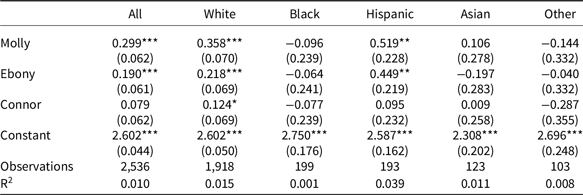
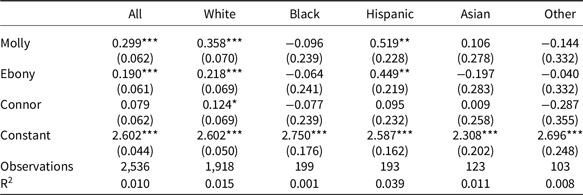
Table 1 presents our treatment effects for all respondents across racial groups – white, Black, Hispanic, Asian/Pacific Islander, and other/decline – where the baseline treatment category is DeShawn and positive coefficients indicate stronger support for gun ownership for a particular prime relative to DeShawn on our 5-point (0–4) scale. For ease of interpretation, we estimate effects via ordinary least squares, but we note that pair-wise comparison, Tukey tests, and ordered probit models (available in the Appendix) produce substantively similar results. Note that our sample includes considerably fewer non-whites. Because of this smaller sample size for non-whites and our corresponding lack of statistical precision for those groups, we refrain from interpreting our results for members of non-white groups. We encourage future research to replicate our results with robust samples of non-white populations.
Respondent preferences for gun availability conditioned on race/gender of the buyer. DeShawn is the baseline category
*p<0.1; **p<0.05; ***p<0.01, two-tailed test.
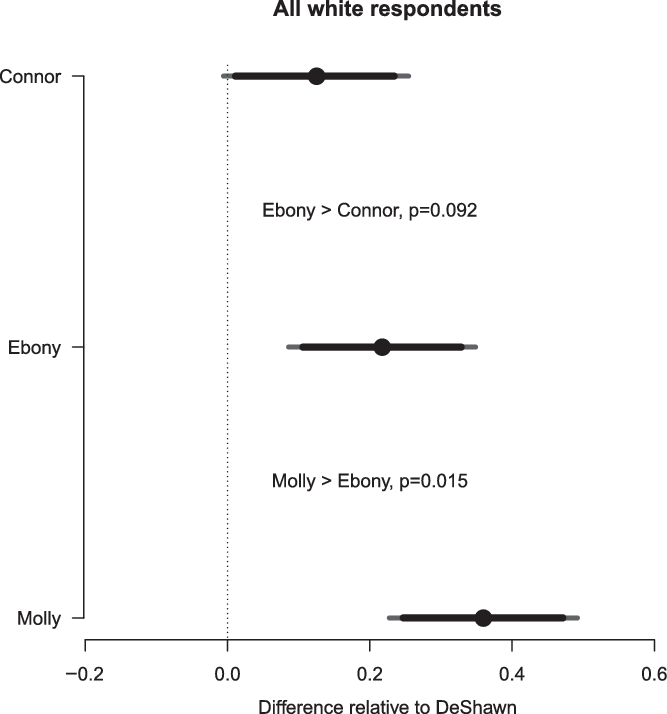
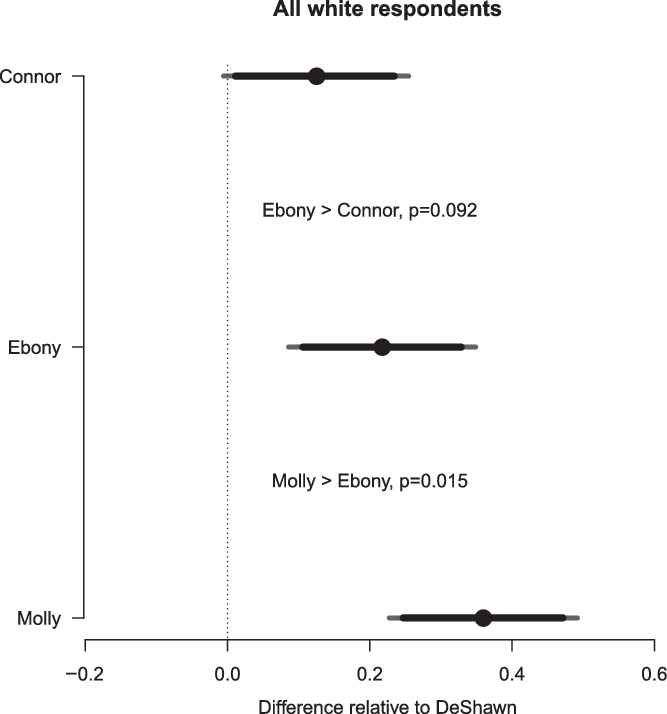
The results in Table 1 provide strong support for our central expectations that white Americans’ support for gun availability will be weakest when the potential owner is a Black man (DeShawn, the baseline category) and strongest when the potential owner is a white woman (Molly). Figure 1 presents the results for all white respondents in more detail, plotting the effect of each treatment relative to DeShawn on the x-axis – where the light band shows the 95% credibility interval in a two-tailed test and the dark band shows the 95% credibility interval in a one-tailed test – as well as the probability of the ranking between the non-DeShawn treatments. The figure shows that all treatments elicit higher levels of white Americans’ support for gun availability than the DeShawn treatment. It also shows that Molly’s ability to purchase a firearm is preferred to Ebony’s and Ebony’s ability is preferred to Connor’s. The rank-ordering of the average treatment effect (ATE) of Molly > Ebony > Conner > DeShawn is very stable. Non-parametric bootstrapping shows that if we randomly sample just 1,000 observations, the probability of recovering this rank-ordering in support is almost 0.7, where the naïve probability of recovering any particular rank-ordering of four random numbers is just 0.042. In other words, the probability of the ATE rank-ordering Molly > Ebony > Conner > DeShawn being a product of chance is effectively 0.Footnote 6 This result, which supports our central hypotheses, is firmly “in the data” and powerful evidence of a gender–race effect in support for gun availability.
Effect decomposition for all white respondents.
If we aggregate our treatments to racial (Connor and Molly v. DeShawn and Ebony) or gender (Ebony and Molly v. Connor and DeShawn) groups, the data reveal that gun ownership is supported for white treatments significantly more than for Black treatments (p=0.01). The difference between gender groups is even greater, with gun ownership supported for women significantly more than for men (p<0.01). Thus, our more general expectation about differences in support for gun availability between Black and white potential owners and between male and female potential owners are clearly supported by the experimental results. It is important to note, however, that our treatments were intentionally race–gender primes, and it is impossible to disentangle those effects. That is, aggregating the DeShawn and Ebony effects does not create a gender-neutral race effect; it merely sums gender-specific effects within one of our two racial categories. We encourage our colleagues to design new instruments in future research that may be able to decompose the effects of race and gender.
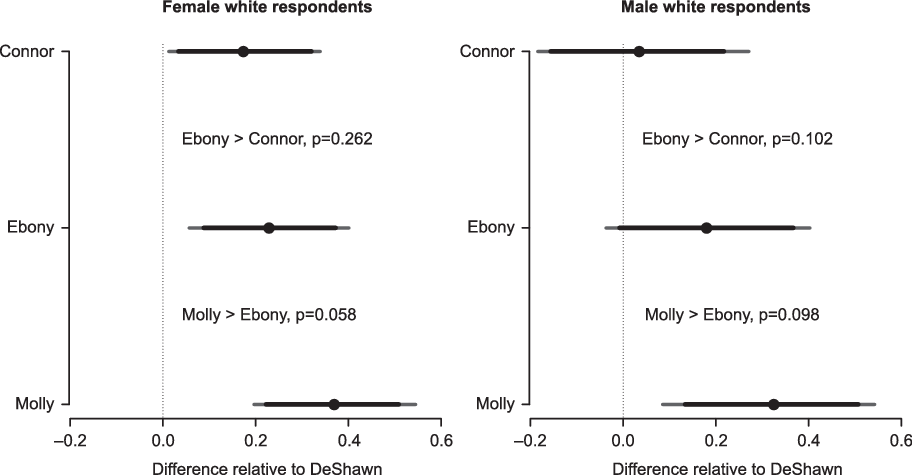
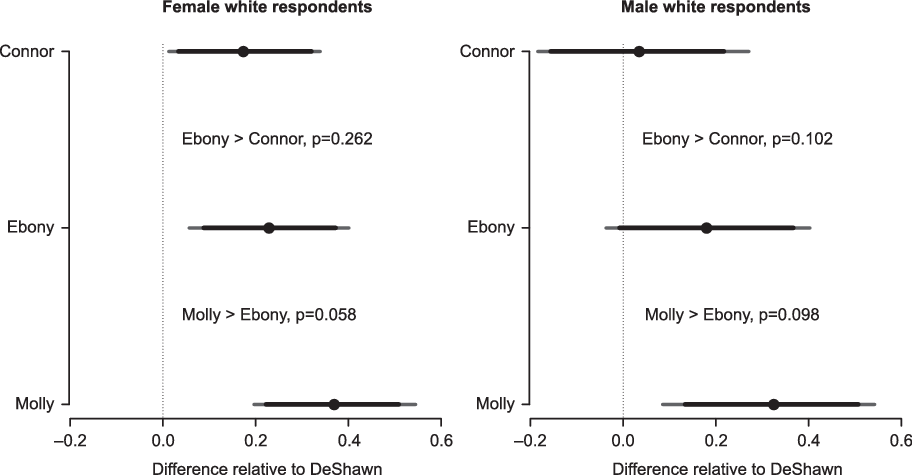
We now examine differences in treatment effects for white Americans by gender and partisanship by analysing the subgroups separately. Beginning with gender, Figure 2 shows the ATE for all treatments relative to DeShawn and also gives the probability of ranking across non-DeShawn treatments, dividing the sample by gender. Both groups exhibit clear differences in support based on the primes. For white women, there is a clear race–gender effect. White women are less supportive of DeShawn purchasing a gun than all other treatments, but the difference between Connor and Ebony is negligible (p=0.28). White women are more supportive of Molly’s gun ownership than DeShawn, Connor, or Ebony, and this difference nears or exceeds traditional levels of statistical significance (p=0.00, p=0.01, p=0.06, respectively). White men also exhibit a race–gender effect. They are significantly more likely to support handgun availability when the purchaser is Molly than when it is Connor or DeShawn (p<0.01, p<0.01); they are also more supportive of gun availability for Ebony than they are for DeShawn or Connor (p=0.06, p=0.10). Together these findings suggest that, for whites, the race and gender of a potential gun purchaser matter in their support for gun availability. For white women, there is a clear opposition to African-American men buying a handgun when compared to women of both races and male coethnics. White men, on the other hand, are more supportive of white women being able to purchase a firearm than they are of men of either race, and do not seem to differentiate between themselves and Black men, and only marginally differentiate between Black and white women.
Effect decomposition for white respondents by gender.
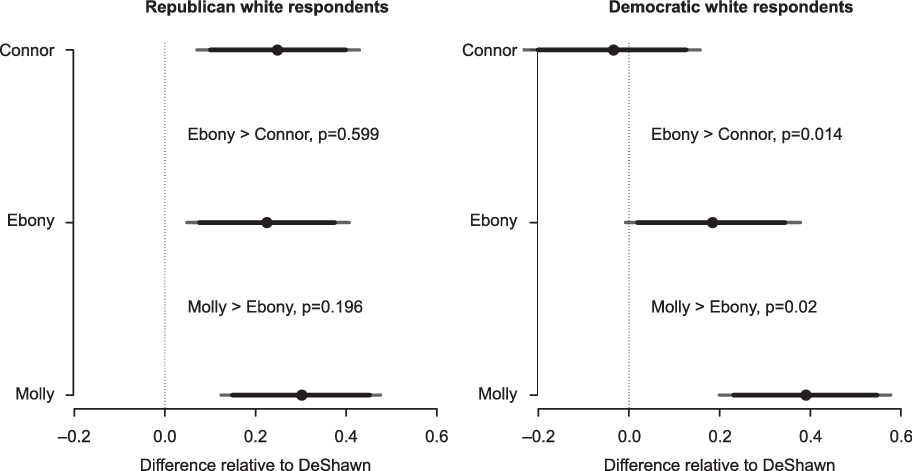
Because contemporary gun control attitudes are largely partisan, Figure 3 replicates this comparison for Republicans and Democrats. As the figure shows partisanship is associated with interesting variations in treatment effects.Footnote 7 White Republicans exhibit a very clear race–gender effect in the form of a Black male penalty. DeShawn received significantly lower support for handgun ownership than white men, white women, and Black women (p<0.01 for each), and this effect remains in statistical models accounting for gender and gun ownership effects. We also note that this is the only group for whom Connor’s ability to purchase a gun is supported more than Ebony’s, though the difference falls short of traditional levels of statistical significance. Indeed, none of the non-DeShawn treatments are statistically differentiable from one another, implying that, for white Republicans, there is no differentiation apart from separating out Black men from everyone else.
Effect decomposition for white respondents by partisanship.
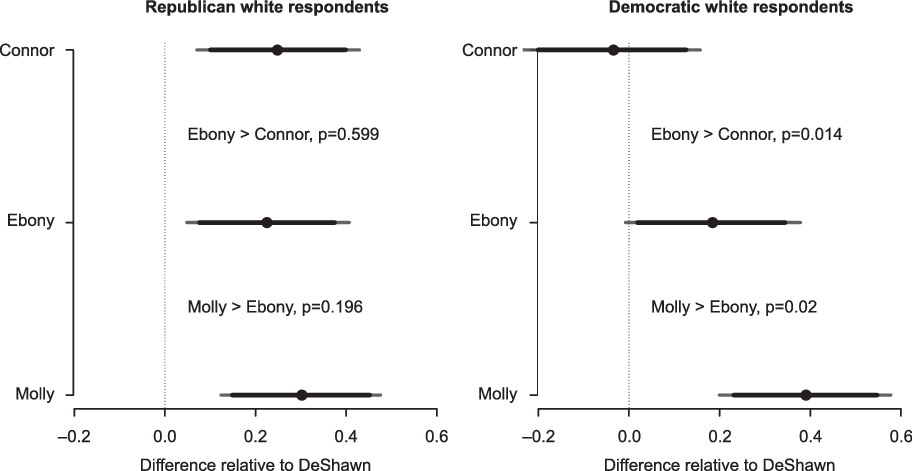
For white Democrats, there is also a clear race–gender effect, but a very different one. Molly is significantly more supported in purchasing a gun than any other treatment. Further, Ebony elicited significantly higher support than either masculine name, but still significantly less support than Molly. Support for firearm availability for DeShawn and Connor is effectively identical, suggesting that white Democrats have a clear preference for gun availability for women relative to men, but are especially supportive of gun availability for white women in particular.
These differences in white Democratic and Republican reactions to the race–gender prime are interesting and suggest alternative processing mechanisms. The uptick in support for gun availability when primed with women, and white women in particular, for white Democrats may suggest a deviation from baseline levels of support for protective purposes – the notion of women being able to protect themselves from potential threat results in an increase of typically lower baseline support for gun availability. Conversely, white Republicans’ response to the primes suggests exclusionary intent. That, when primed to think of a Black man, white Republicans’ typically higher baseline support for gun availability is decreased in order to prevent Black men from accessing firearms. In other words, low levels of white Democratic support for gun availability can be coaxed upward when primed with stereotypically vulnerable populations, and high levels of white Republican support for gun availability can be coaxed downward when primed with Black men.
Contextualisation
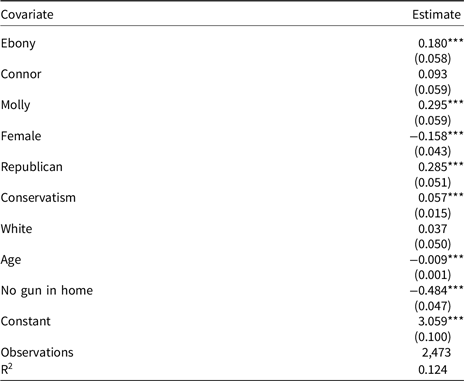
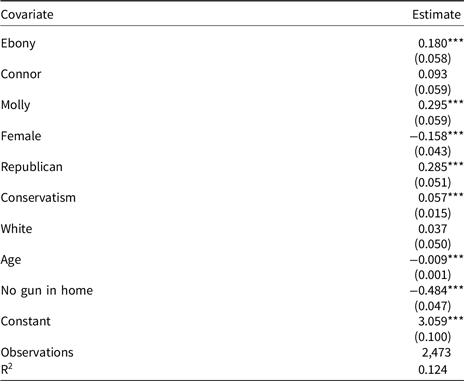
Here, we estimate a more fully specified regression model for all respondents (not just whites), including our treatment as well as the demographic covariates to contextualise the effect of our gender–race prime. This allows for a direct comparison of the substantive significance of our treatment compared to other variables known to influence support for gun availability. The model includes respondent gender, partisanship, conservatism (1–7-point ideological self-placement with higher numbers indicating more conservative self-placements), race (white or otherwise), age (in number of years), and whether or not there is a firearm in the home in which the respondent lives. The model is shown in Table 2 – note that all variables less conservatism (1–7) and age (18–96) are binary.
Full model for effect size comparison
*p<0.1; **p<0.05; ***p<0.01.
We begin by comparing the effect of our experimental prime to the effect of changing from Democratic to Republican identification. The average treatment effect of the Molly relative to DeShwn prime is 0.295, whereas the average effect of a shift from Democratic to Republican identification is 0.285. This means that, on average, the effect of the Molly prime is roughly equivalent to the effect of partisanship and the two are statistically indifferentiable. Comparing the raw responses show similarly negligible differences in effect size. Aggregating over treatments, Republicans support gun availability in 73% of their responses and Democrats are supportive in 56% of theirs. Aggregating over respondents, 72% of those receiving the Molly treatment support gun availability and 59% of those receiving the DeShawn treatment support gun availability. This means that, all else equal, the effect of priming a respondent with a white female name versus a Black male name is roughly equivalent to the effect of an individual’s party identification. We believe that this is a very significant discovery.
Our average treatment effects compared to ideological self-placement are similarly large. Comparing the effect of the Molly prime relative to DeShawn to the effect of a two-unit change in ideological self-placement (substantively equivalent to a change from the median Democratic placement of 3 to the median Republican placement of 5) reveals that the average effect of the Molly prime is 280% (132%, 537% CI) the effect of the two-unit change in ideological self-placement (0.295 versus 0.114). Further, we are certain with probability p<0.01 that the Molly effect is larger than the two-unit change in ideological self-placement and certain with probability p=0.05 that the Molly effect is larger than a three-unit change in ideological self-placement.
Finally, we turn to an important predictor of gun control attitudes – self-interest. We compare our treatment effects to the effect of having a gun in the home (a proxy for individual gun ownership). The effect of the Molly prime relative to DeShawn is 62% (37%, 94% CI) the effect of living in a home with a gun relative to one without (mean 0.483). This means that, all else equal, the effect of the race–gender prime on support for gun availability is over half the observed difference in support between gun owners and non-owners.
Discussion
Our findings provide clear empirical evidence that gun policy has not escaped its heritage as a deeply racial issue. Consistent with theoretical expectations, our findings show that many white respondents are much less supportive of the ability of African-Americans to purchase handguns than they are of white Americans. In this regard, our results comport with findings from Filindra and Kaplan’s (Reference Filindra and Kaplan2016) innovative work on race and gun control attitudes. In their experiment, race was primed prior to generic gun control preference items, leading those respondents high in racial resentment to modify their opinions. Our experiment incorporates the racial prime into the gun control preference question and we find differences in attitudes amongst all white respondents regardless of racial resentment. Thus, the finding that gun control attitudes are significantly “racialized” is robust to different experimental approaches.
We have also gone beyond the focus of existing research on race, and in doing so found a striking pattern: attitudes towards gun ownership and gun control are deeply gendered.Footnote 8 Previous literature established that men and women differ in their support for gun control. But we find that the effect of gender runs deeper. When evaluating the right to buy a firearm, the average white American is much more supportive of women owning guns than men. This holds true across both gun owners and non-gun owners, and for both men and women. And although white Republicans do not exhibit higher support for female handgun owners across white primes, we do observe this pattern for white Democrats in particular, and the relationship is strong enough to hold when pooling the party groups.
More complicated is the simultaneous dynamic of race and gender, and we believe this is the key empirical contribution of our article. Consistent with theoretical accounts of race-gendered policy attitudes, rather than simply being a product of race, or of gender, individuals’ support for handgun ownership is affected by both the race and gender of the potential owner. For white Americans, there is a clear trend for white women to be much more supported in their right to buy a gun than are men. Black men are generally less supported in their right to buy a firearm than are women, and, for Republican identifiers, support for gun rights for Black men are is significantly lower than for white men and women of both races. There are several areas where future research could expand on our empirical results. Though we are confident of our findings, we were not able to investigate whether underlying respondent tendencies towards racism moderated the response to our racial primes – as in Filindra and Kaplan (Reference Filindra and Kaplan2016), for example – due to data constraints. We hope that our colleagues may pursue this moving forward. Along similar lines, future work should explore whether attitudes towards relevant political groups, particularly the NRA, could condition response to the sorts of primes employed here. And, relatedly, future work could examine if such political groups appear to advocate differently for gun owners depending on their race and gender.
Our work also has important implications for future research in public opinion. We have presented very strong experimental evidence that white Americans’ policy attitudes are profoundly influenced by whom is likely to be affected by the policy. Support for gun rights varies depending on whether individuals are primed to think about potential gun owners as African-American versus white, and as men versus women. This evidence bears significant implications not only for understanding the formation of policy attitudes, but also for the molding of policy support. Policy attitudes do not occur in a vacuum; when asked to answer a typical survey question such as “What do you think is more important – to protect the rights of Americans to own guns, or to control gun ownership,” individuals will be influenced by the groups they are thinking about in reference to that policy.Footnote 9 When thinking about Black men as gun owners, more people will likely support efforts to control gun ownership. When thinking about white women as gun owners, more people will likely see the value in protecting the right to own guns. Scholars should delve deeper into how attitudes about affected groups influence policy opinions and how sticky these group associations are. Even in our current highly-polarised time, people’s support for something as straight-forward as the constitutionally protected ability to possess a firearm is affected by the groups brought to mind when making the evaluation.
In this way, our work may have important policy implications. Understanding whom Americans envision as gun owners is critical for explaining whether policymakers, interest groups, and ordinary citizens will accept restrictions on, or protections for, gun ownership. On 13 March 2020, police executed a no-knock raid on Breonna Taylor’s apartment in Louisville, KY. Responding to what he believed were intruders, her partner Kenneth Walker fired a single shot at police. In the ensuing moments, police shot and killed Taylor, and Walker was subsequently arrested and charged with attempted murder and assault. As was the case in the killing of Philando Castile, prominent gun rights organisations such as the NRA remained essentially silent. This is consistent with our findings: African-Americans in general, and Black men in particular, do not comport with whom white Americans tend to support as gun owners. It is therefore no surprise that gun rights organisations are less vociferous in their defense of Black gun owners’ Second Amendment rights. On the other hand, white women are viewed particularly sympathetically as gun owners. And because women gun owners are more politically active than comparable men (Middlewood et al. Reference Middlewood, Joslyn and Haider-Markel2019), a growth in the numbers of women gun owners could fundamentally shift Americans’ attitudes towards gun rights, as well as how interest groups advocate for/against gun control policy (Merry Reference Merry2020). This only underscores the importance of future research in the group-based nature of Americans’ policy positions.
Data availability statement
Replication materials are available in the Journal of Public Policy Dataverse at: https://doi.org/10.7910/DVN/58L2CZhttps://doi.org/10.7910/DVN/58L2CZ.
Supplementary material
To view supplementary material for this article, please visit https://doi.org/10.1017/S0143814X20000288
Acknowledgements
We would like to thank Scott Althaus, Tiffany Barnes, Nichole Bauer, Mirya Holman, Leonie Huddy, Diana O’Brien, Brittany Perry, Jessica Trounstine, and Rick Wilson for their helpful comments, as well as three anonymous reviewers and the Journal of Public Policy editorial team. Any remaining errors are the authors’ responsibility.