Introduction
Differences in learning mechanisms between monolingual and bilingual infants have been reported in several domains including attention/visual discrimination (Comishen, Bialystok & Adler, Reference Comishen, Bialystok and Adler2019; Sebastián-Gallés, Albareda-Castellot, Weikum & Werker, Reference Sebastián-Gallés, Albareda-Castellot, Weikum and Werker2012), acquisition of words (Byers-Heinlein & Werker, Reference Byers-Heinlein and Werker2009; Mattock, Polka, Rvachew & Krehm, Reference Mattock, Polka, Rvachew and Krehm2010), cognitive flexibility (Kovács & Mehler, Reference Kovács and Mehler2009; Poulin-Dubois, Blaye, Coutya & Bialystok, Reference Poulin-Dubois, Blaye, Coutya and Bialystok2011), and declarative memory (Brito & Barr, Reference Brito and Barr2012; Singh et al., Reference Singh, Fu, Rahman, Hameed, Sanmugam, Agarwal, Jiang, Chong, Meaney and Rifkin-Graboi2015). Cognitive differences between monolinguals and bilinguals have been called into question and attributed to inadequate measurement (Paap & Greenberg, Reference Paap and Greenberg2013) or the absence of potential mediators or moderators like socioeconomic status (SES; Morton & Harper, Reference Morton and Harper2007). Most of these critiques have been directed towards research involving older children and adults, with studies focused primarily on executive function skills.
In studies of adults, cognitive differences observed in bilinguals vs. monolinguals have frequently been attributed to the need to monitor language surroundings and inhibit one language in order to speak another (Bialystok, Craik & Luk, Reference Bialystok, Craik and Luk2012; Green & Abutalebi, Reference Green and Abutalebi2013). Of course, this inhibitory control process is unlikely to explain bilingual differences in infant cognition. Rather, studies from the infancy period suggest that perceiving and processing sounds from multiple native languages early in life – and the socio-ecological need to adapt to the surrounding linguistic environment – may differentially affect specific attention and learning mechanisms (Antovich & Graf Estes, Reference Antovich and Graf Estes2018; Bialystok, Reference Bialystok2017; Brito, Reference Brito2017; Brito, Grenell & Barr, Reference Brito, Grenell and Barr2014; Costa & Sebastián-Gallés, Reference Costa and Sebastián-Gallés2014).
Werker (Reference Werker2012) identifies two aspects of bilingual language acquisition that may help to explain why attention and learning may be different for children growing up in linguistically diverse households. First, bilingual infants grow up surrounded by fluid streams of language where they must distinguish between languages and minimize interference across languages. Second, bilingual caregivers do not speak more to their infants than monolingual caregivers; therefore, bilingual infants must learn to recognize two languages while receiving reduced exposure to each language individually. Due to these differences in linguistic environments, bilingual infants may adapt by selectively attending to or learning differently than monolingual infants. For example, all infants effortlessly acquire sentence structure in the absence of explicit information about grammar. In the case of bilingual infants, however, this task sometimes takes on added complexity, as when infants must learn languages with conflicting word orders (i.e., English: “I go to the garden” vs. Japanese: “I garden to go”). In past studies, monolingual infants did not demonstrate the use of prosodic properties as a bootstrapping cue for word order (Yoshida, Iversen, Patel, Mazuka, Nito, Gervain & Werker, Reference Yoshida, Iversen, Patel, Mazuka, Nito, Gervain and Werker2010), but Gervain and Werker (Reference Gervain and Werker2013) demonstrated that bilingual infants, who were exposed to at least 25% of each language, use multiple prosody cues (pitch and duration) in order to learn from their linguistic environment. The authors suggest that bilingual infants must flexibly adapt to the environmental cues around them and may learn to exploit additional relevant cues to successfully navigate their languages.
This ability to use additional relevant cues from the environment may help to explain memory differences observed between monolingual and bilingual infants. Singh and colleagues (Reference Singh, Fu, Rahman, Hameed, Sanmugam, Agarwal, Jiang, Chong, Meaney and Rifkin-Graboi2015) tested 54 monolingual and 60 bilingual 6-month-olds, matched on maternal education and income, on a nonlinguistic visual habituation task – a basic task of information encoding and retrieval. All infants were born in Singapore, and bilingualism was defined as having at least 25% exposure to a second language, whereas monolingualism was defined as being exposed to at least 90% of a single language. Results demonstrated that bilingual infants outperformed their monolingual peers in both efficiency of habituation to and visual recognition memory of stimuli. Researchers suggested that bilingual infants may employ the ability to rapidly form internal memory representations of novel stimuli, and that the successful acquisition of two languages may necessitate the frequent use of broad cognitive abilities that may be useful in other burgeoning skills (Singh et al., Reference Singh, Fu, Rahman, Hameed, Sanmugam, Agarwal, Jiang, Chong, Meaney and Rifkin-Graboi2015).
Exposure to multiple languages has ties to memory flexibility as well. Tulving and Thomson's encoding specificity hypothesis (Reference Tulving and Thomson1973) states that a memory of an event will only be recalled if the cues at the time of retrieval match the same cues previously seen at the time of the original encoding. Past studies have shown that, early in life, even slight changes in the stimuli or context at the time of memory retrieval can disrupt memory performance (Barr & Brito, Reference Barr and Brito2013; Borovsky & Rovee-Collier, Reference Borovsky and Rovee-Collier1990; Hayne, Reference Hayne, Munakata and Johnson2006; Herbert & Hayne, Reference Herbert and Hayne2000; Learmonth, Lamberth & Rovee-Collier, Reference Learmonth, Lamberth and Rovee-Collier2004). As infants develop, they are better able to retrieve memories despite changes in cues and context, thereby allowing learning to be generalized to novel situations (Eichenbaum, Reference Eichenbaum1997). For example, previous research demonstrated that monolingual infants were unable to generalize memory of a 3-step imitation procedure across two distinct puppets (a yellow duck and a black/white cow) at 18-months, whereas they could do so 3 months later at 21-months (Hayne, Macdonald & Barr, Reference Hayne, Macdonald and Barr1997). Brito and Barr (Reference Brito and Barr2012) replicated this task with 18-month-old infants and found that bilinguals outperformed monolinguals on this memory generalization task. Specifically, 9 out of 15 bilingual infants were able to generalize across perceptual cues after a 30-minute delay, whereas only 1 out of 15 monolinguals infants were able to do so. In a subsequent study, this finding was replicated among 18-month-old infants who had been exposed to either rhythmically similar (e.g., Spanish & Catalan) or rhythmically different (e.g., Spanish & English) languages (Brito et al., Reference Brito, Sebastián-Gallés and Barr2015). Further, greater memory generalization by bilinguals has been shown in infants as young as 6-months of age (Brito & Barr, Reference Brito and Barr2014), as well as in 24-month-olds after a much more challenging delay of 24-hours instead of 30 minutes (Brito et al., Reference Brito, Grenell and Barr2014).
Bilingual differences in learning and memory across perceptual stimuli may perhaps be a by-product of early experiences, following the need to exploit additional cues within the linguistic environment, and thus resulting in adaptive modulation of attention to novelty. Hayne (Reference Hayne, Munakata and Johnson2006) argues that age-related changes in memory flexibility can be accounted for by both gradual experiential developmental change and neural maturation: as infants are presented with more opportunities to encode information in a variety of contexts, they begin to take advantage of a wider range of retrieval cues and are able to flexibly retrieve memories. Indeed, infants exposed to multiple languages experience more varied speech patterns than monolinguals and are presented with more opportunities to encode information in a variety of language contexts. As such, bilingual infants may use multiple cues to support language learning (Gervain & Werker, Reference Gervain and Werker2013). Within this variable linguistic environment, bilingual infants may learn to exploit additional visual cues, resulting in differences in memory retrieval performance. This is consistent with previous studies demonstrating that memory generalization can be enhanced in young infants by exposing them to different stimuli or to different contexts during the original encoding phase (Amabile & Rovee-Collier, Reference Amabile and Rovee-Collier1991; Barr, Marrott & Rovee-Collier, Reference Barr, Marrott and Rovee-Collier2003; Greco, Hayne & Rovee-Collier, Reference Greco, Hayne and Rovee-Collier1990; Herbert, Gross & Hayne, Reference Herbert, Gross and Hayne2007; Rovee-Collier & DuFault, Reference Rovee-Collier and Dufault1991).
Although on average bilingual children outperform monolingual children on memory generalization, within-group differences have also been observed. This variability in memory generalization skills within bilingual groups may be partially explained by the relative exposure to the different languages. Brito and Barr (Reference Brito and Barr2012) reported that greater percent exposure to the second language (i.e., bilinguals with more balanced language exposure) was associated with better memory generalization scores, whereas vocabulary knowledge was unrelated to memory generalization. At both 18- and 24-months of age, infants exposed to three languages from birth (trilinguals) performed similarly to monolingual infants and did not demonstrate memory generalization (Brito et al., Reference Brito, Grenell and Barr2014; Brito et al., Reference Brito, Sebastián-Gallés and Barr2015). It is possible that there is a threshold of language exposure necessary (Cat, Gusnanto & Serratrice, Reference Cat, Gusnanto and Serratrice2018; Cummins, Reference Cummins1976; Cummins, Reference Cummins1979) in order to successfully use multiple perceptual cues during memory retrieval.
A notable limitation of previous studies examining links between bilingualism and memory generalization – and more broadly of studies reporting links between bilingualism and cognitive development in general – is that samples were not socioeconomically diverse. Some researchers have argued that bilingual cognitive advantages, particularly for cognitive control, were the result of confounding factors, such as SES, and that controlling for SES would attenuate differences between monolinguals and bilinguals (e.g., Morton & Harper, Reference Morton and Harper2007). This line of reasoning may be plausible in countries like Canada where bilingual families often have higher incomes than monolingual families (Christofides & Swidinsky, Reference Christofides and Swidinsky2010). Within the United States, however, there is significant overlap between dual-language learners and children of immigrants (Castro-Vázquez, Reference Castro-Vázquez2009), with language minority families more likely to experience socioeconomic hardship.
It is imperative to examine the role of SES within the context of bilingual learning, as socioeconomic disparities have been correlated with neurocognitive functioning in multiple domains, including attention, language, memory, self-regulation, and socio-emotional processing (Noble, Norman & Farah, Reference Noble, Norman and Farah2005; Raizada, Richards, Meltzoff & Kuhl, Reference Raizada, Richards, Meltzoff and Kuhl2008; Stevens, Lauinger & Neville, Reference Stevens, Lauinger and Neville2009; Sheridan, Sarsour, Jutte, D'Esposito & Boyce, Reference Sheridan, Sarsour, Jutte, D'esposito and Boyce2012; Kim, Evans, Angstadt, Ho, Sripada, Swain, Liberzon & Phan, Reference Kim, Evans, Angstadt, Ho, Sripada, Swain, Liberzon and Phan2013). Furthermore, these differences have been shown to emerge early in life. For example, Noble and colleagues (Reference Noble, Engelhardt, Brito, Mack, Nail, Angal, Barr, Fifer and Elliott2015a) reported socioeconomic disparities in both language and memory skills emerging by 21-months of age, with children of highly educated parents outperforming children whose parents were the least educated. Characteristics of the home environment, including literacy resources and parent-child interactions, partially accounted for disparities in language, but not memory (Noble, Engelhardt, Brito, Mack, Nail, Angal, Barr, Fifer & Elliott, Reference Noble, Engelhardt, Brito, Mack, Nail, Angal, Barr, Fifer and Elliott2015a).
SES-related differences in the home language environment have been associated with language outcomes for both monolingual and bilingual children (Place & Hoff, Reference Place and Hoff2011; Ramírez-Esparza, Garcia-Sierra & Kuhl, Reference Ramírez-Esparza, García-Sierra and Kuhl2017). Studies have indicated that children from lower-SES households may experience less child-directed speech and engage in fewer turn-taking conversations relative to their higher SES peers (Gilkerson, Richards, Warren, Montgomery, JGreenwood, Oller, Hansen & Paul, Reference Gilkerson, Richards, Warren, Montgomery, Greenwood, Oller, Hansen and Paul2017; Hoff, Reference Hoff2003; Hoff, Reference Hoff2006; Hoff-Ginsberg, Reference Hoff-Ginsberg1998; Huttenlocher, Waterfall, Vasilyeva, Vevea, & Hedges, Reference Huttenlocher, Waterfall, Vasilyeva, Vevea and Hedges2010; Rowe, Reference Rowe2008, but see also Johnson, Avineri & Johnson, Reference Johnson, Avineri and Johnson2017). However, it is not clear how socioeconomic factors and related differences in the home language environment may account for, or interact with, memory differences following exposure to multiple languages.
Present study
Past reports suggest that both bilingualism (Brito & Barr, Reference Brito and Barr2012; Brito et al., Reference Brito, Grenell and Barr2014; Brito et al., Reference Brito, Sebastián-Gallés and Barr2015) and socioeconomic background (Noble et al., Reference Noble, Engelhardt, Brito, Mack, Nail, Angal, Barr, Fifer and Elliott2015a) are associated with differences in memory development in infancy. The current study thus set out to answer two questions. First, are bilingualism and SES associated with independent, or interacting, differences in specific types of memory? To answer this question, groups of monolingual and bilingual 18-month-old toddlers from both lower- and higher-SES households were tested on measures of cued recall, memory generalization, and working memory. Second, is the variability in memory scores explained by SES or other characteristics, such as the home language environment? To answer this question, associations between language input in the home and memory measures were explored.
Methods
Participants
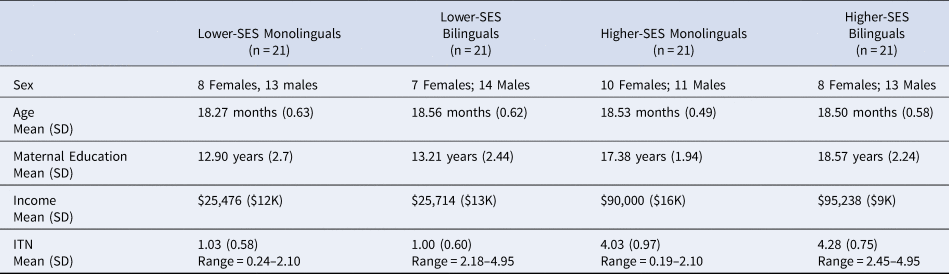
Our sample included 92 toddlers (M age = 18.51 months, SD = 0.66; 56 males) recruited from community events and posting flyers in local neighborhoods in New York City. All caregivers gave their informed consent prior to their inclusion in the study. To be included in the study, toddlers had to be born after 36 weeks of gestation and have no history of or signs of developmental delay. Five toddlers were excluded from the analyses due to video equipment failure (n = 3) or infant fussiness (n = 2). There were 21 infants recruited into each of the following four groups: lower-SES monolinguals, higher-SES monolinguals, lower-SES bilinguals, higher-SES bilinguals. SES categorization for families was determined using family income; see Table 1 for summary of socio-demographic information.
Demographic Information

Note: ITN = income-to-needs (calculated by dividing household income by the poverty threshold for the size of the family). ITN of 1 would be at the poverty threshold for that household size.
As standard in measures of deferred imitation, a no-demonstration baseline control group of infants was recruited to examine infants’ spontaneous production of the target actions during the declarative memory task (see procedure for more information). Eight infants (M = 18.8 months, 5 males) were tested in this baseline control group. Twelve 18-month-olds who had participated in a baseline control condition with identical stimuli and procedures from a previous study (Barr, Muentener, Garcia, Fujimoto & Chavez, Reference Barr, Muentener, Garcia, Fujimoto and Chávez2007) were also included in these analyses to increase the sample size of the baseline group. There were no significant differences between the two baseline control groups with respect to deferred imitation scores (M new = 0.75, SDnew = .38; M old = .75, SD old = .50; p > .05).
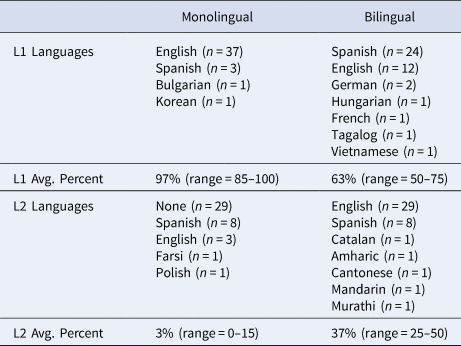
Bilingual children were defined as those who had been exposed to two languages on a daily basis from birth and received at least 25% exposure to each of their languages (Pearson, Fernández & Oller, Reference Pearson, Fernández and Oller1993). A child's language exposure was measured by an adapted version of the Language Exposure Questionnaire (Bosch & Sebastián-Gallés, Reference Bosch and Sebastián-Gallés2001) to obtain specific estimates of the child's exposure to each language from all possible language partners (e.g., parents, grandparents). Average first language (L1) exposure for the monolingual group was 97% (some children were minimally exposed to a second language via a secondary caregiver). Average L1 exposure for the bilingual group was 63%; range of second language (L2) exposure for the bilingual group was between 25% and 50%. See Table 2 for description of languages and language percent exposure for each group. Past studies examining the influence of multilingualism on memory generalization have found bilingual advantages are not dependent on exposure to specific language pairs (Brito & Barr, Reference Brito and Barr2012; Reference Brito and Barr2014; Brito et al., Reference Brito, Grenell and Barr2014), and therefore type of language was not controlled for.
Description of Languages

Apparatus
Deferred imitation
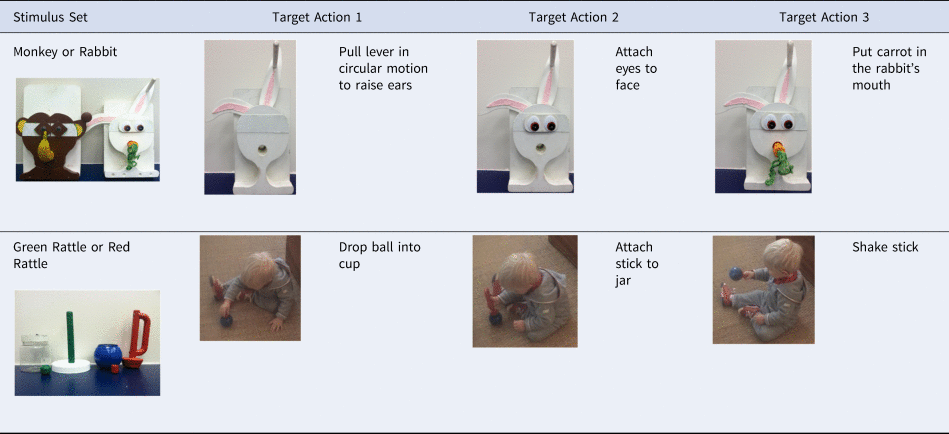
The stimuli for the cued recall and memory generalization tasks were identical to the ones used in previous studies of deferred imitation and memory at 24-months of age (Herbert & Hayne, Reference Herbert and Hayne2000). There were two types of stimuli (an animal and a rattle) with two versions of each type. The stimuli were constructed so that the same three target actions could be performed with each version of each stimulus, see Table 3.
Target actions for each stimuli set at 24-months

Note: Same target actions were completed with the alternate stimulus. For the monkey a banana was used in the 3rd step; for the green rattle the ball was pushed through into the cup.
The stimuli for the rabbit consisted of two plastic eyes (3 x 2 cm) with eyelashes attached to a 9 x 6 cm piece of plywood with Velcro on the back, a 12-cm orange wooden carrot with green string attached to the top, and a white circle of wood (the head, 15 cm in diameter) mounted horizontally on a white rectangular wooden base (30 x 20 cm). A 3-cm diameter hole was drilled at the bottom of the head, and a 5 x 15 cm piece of Velcro was attached to the top of the head. Two white “ears” (20 x 5 cm) decorated with stripes of pink felt were hidden behind the head. A 10-cm wooden stick attached to the top of the right ear allowed the ears to be pulled up from behind the head in a circular motion to a point above the head. The stimuli for the monkey consisted of two plastic eyes (2.5 cm in diameter) that were attached to a piece of brown plywood in the shape of two diamonds joined at the center (11.5 cm in width, 6.5 cm in height), with brown Velcro on the back; a 20.5-cm yellow plastic banana; and a brown wooden base (22 x 38 cm). A 4-cm hole was drilled at the bottom of the head, and a 5 x 18 cm piece of brown Velcro was attached to the top of the head. Two brown ears (3.5 x 7 cm) decorated with a piece of yellow felt were hidden behind the head. A 3-cm lever with a wooden button (3.5 cm in diameter) on the top, attached to the right ear, allowed the ears to be pulled up from behind the head in a circular motion to the side of the head.
The stimuli for the green rattle consisted of a green stick (12.5 cm long) attached to a white plastic lid (9.5 cm in diameter), with Velcro attached to the underside of the lid; a round green bead (3 cm in diameter x 2.5 cm in height); and a clear plastic square cup with Velcro around the top (5.5 cm in diameter x 8 cm in height). The opening of the plastic cup (3.5 cm in diameter) was covered with a 1 mm black rubber diaphragm, with 16 cuts radiating from the center. The stimuli for the red rattle consisted of a red D-shaped handle (gap between stick and handle = 1.5 x 8 cm) attached to a red wooden stick (12.5 cm long) with a plug on the end, which fitted into a blue plastic cup with a hole cut in the top (4 cm in diameter); and a red wooden bead.
Working memory
Working memory (WM) refers to the ability to hold information in mind and update this information while executing a task (Morris & Jones, Reference Morris and Jones1990; Smith & Jonides, Reference Smith and Jonides1998). For the working memory task, the Hide the Pots (Bernier, Carlson & Whipple, Reference Bernier, Carlson and Whipple2010) task was used. Three distinctly colored opaque cups (red, blue, and green), a small black and white ball, and a box were used for this task. All three cups fit inside the box in a straight line with equal spacing between them and a hinge attached a lid to the box in order to easily open and close the box.
Parental-report measures
The primary caregiver was asked to complete a questionnaire assessing parental education, family income, as well as parental report assessments of language and attention/executive control. The MacArthur Communicative Development Inventory: Words and Gestures (MCDI) was given to measure children's productive vocabulary (Fenson, Pethick, Renda, Cox, Dale & Reznick, Reference Fenson, Pethick, Renda, Cox, Dale and Reznick2000). Due to the wide variety of languages, language-specific vocabulary measures were not feasible. For the bilingual children, the caregiver was asked to fill out the same form for all languages, marking the words the child could produce and in which language (e.g., for a Spanish–English bilingual child: English, Spanish, or both). Words for both languages were combined for children exposed to multiple languages. Finally, the Very Short Form of the Children's Behavior Questionnaire (CBQ-VSF: Putnam & Rothbar, Reference Putnam and Rothbart2006) was given in order to assess the following three scales: attentional focus (sustained duration of orienting or resistance to distraction), attentional shifting (ability to transfer attention from one activity/task to another), and inhibitory control (capacity to stop, moderate, or refrain from a behavior under instruction).
Home language environment
To measure the home language environment, a subsampleFootnote 1 of parents was given the LENA digital language processor (DLP) and two specially designed t-shirts to take home with them after the lab visit. The LENA system (LENA Research Foundation, Boulder, CO) is an automated vocalization analysis device that can audio-record the child's language environment for up to 16 hours. A recent study has reported strong reliability and validity of the LENA speech identification algorithms with over 75% accuracy for both adult and child speech in English (Gilkerson et al., Reference Gilkerson, Richards, Warren, Montgomery, Greenwood, Oller, Hansen and Paul2017). Other studies have validated the LENA algorithms in languages other than English, including Spanish (Weisleder & Fernald, Reference Weisleder and Fernald2013), Mandarin (Gilkerson, Zhang, Xu, Richards, Xu, Jiang, Harnsberger & Topping, Reference Gilkerson, Zhang, Xu, Richards, Xu, Jiang, Harnsberger and Topping2015), French (Canault, LeNormand, Foudil, Loundon & Thai-Van, Reference Canault, Le Normand, Foudil, Loundon and Thai-Van2015), Korean (Pae, Yoon, Seol, Gilkerson, Richards, Ma & Topping, Reference Pae, Yoon, Seol, Gilkerson, Richards, Ma and Topping2016), and Dutch (Busch, Sangen, Vanpoucke & Wieringen, Reference Busch, Sangen, Vanpoucke and Wieringen2017).
The parent was instructed to have the child wear the DLP (within the shirt pocket) for one full weekend day when the typical caregivers were present (within 2 weeks of the lab visit). The average number of days between lab visit and LENA home recording was 8.98 days (SD = 9.40). Once the DLP was returned, the recording was uploaded to a computer and analyzed by the LENA software. The software derives three primary measures: adult word count (number of words spoken near the child), child vocalizations (number of sounds made by the child), and conversational turns (number of back and forth vocalizations by an adult and the target child within 5 seconds). The LENA software also provides percentages of the types of sounds that the child could be exposed to during the day, including TV/electronic sounds, silence, meaningful speech, and distant speech. These variables were used to clean the data for the presence of naps and other irregularities within the recordings. Similar to previous studies (Romeo et al., Reference Romeo, Segaran, Leonard, Robinson, West, Mackey, Yendiki, Rowe and Gabrieli2018), the family's highest hourly total of adult words, child vocalizations, and conversational turns were separately obtained for subsequent analyses in order to minimize differences due to length of recording.
The subsample of LENA recordings included half of the total sample (n = 42), with some parents declining to participate (n = 8) and some devices not being returned or returned without audio (n= 10). Out of the 42 audio recordings an additional six recordings were also excluded due to insufficient recording length (any recordings less than 8 hours, n = 6), resulting in 18 recordings for the monolingual group (8 lower-SES, 10 higher-SES) and 19 recordings for the bilingual group (9 lower-SES, 10 higher-SES).
Procedure
All protocols were approved by the university Institutional Review Board. Stimuli and deferred imitation procedures were identical to Brito et al. (Reference Brito, Grenell and Barr2014) except that a 30-minute delay was used between deferred imitation demonstration and test, rather than a 24-hour delay. For the deferred imitation tasks, during the demonstration of the target actions children sat on the floor with the caregiver, across from the experimenter. The experimenter performed the three target actions with one version of each stimulus type, and the entire demonstration lasted approximately 60 seconds. The experimenter did not describe the stimuli or the target actions, and the child was not allowed to touch the stimuli. After each target action, the experimenter said a short phrase to keep the infant engaged in the task (Action #1: Look at this, Action #2: What was that, Action #3: One more time).
After a 30-minute delay, children were tested with one set of stimuli that had been used in the original demonstration (cued recall) and one set of stimuli that was perceptually different from the one seen during demonstration but required the same target actions (generalization). For example, for the cued recall condition the infant would be shown the red rattle during the demonstration phase and the red rattle at the test session, whereas for the generalization condition the infant would be shown the monkey toy during the demonstration phase and the rabbit toy at the test session. The two types of stimuli (rattle or animal) and the order of presentation at test (cued recall or generalization) were counterbalanced across children. During the test, children were given the first set of stimuli and the experimenter encouraged the child to interact with the stimuli for 60 seconds from the time the child first touched the stimuli. Children were then given the second set of stimuli and another 60 seconds to interact with that stimulus. For the group of children in the baseline control condition, they were not shown the demonstration of the target actions. Rather, the baseline group was simply given each stimulus type, one at a time without a demonstration, to assess the spontaneous production of the target actions.
Next, the working memory task was completed. During the practice trials, the infant watched as the experimenter placed a small ball under one of the three cups. The experimenter then encouraged the infant to retrieve the ball by saying, “Can you get the ball?” Once the infant retrieved the ball, the experimenter praised the infant then placed the ball under a different cup. There was a total of three practice trials so that the infant understood the rules of the task, even without the addition of verbal instructions. All children retrieved the ball at least once during the practice trials. The test trials were identical to the practice trials, except that after the experimenter placed the ball under one of the cups, the box was closed for 2 seconds. After the 2 second delay, the experimenter opened the box and once again encouraged the infant to retrieve the ball with the same verbal prompt. Each trial required the infant to hold the location of the ball in memory and each subsequent trial required the infant to update his/her memory of the new location. Like the practice trials, there were a total of three test trials.
Coding
Deferred imitation
For both cued recall and generalization, one coder scored each videotaped test session during the 60s test period for each stimulus type. The number of individual target actions produced during the 60s after the child first touched the stimuli was summed to calculate the imitation score (range = 0–3) for each stimulus type. For example, for the rattle task, if the child only puts the ball in the cup within 60 seconds, they would receive a score of 1. For the animal task for the same child, if they pull the ears up, put the eyes on the animal, and feed the animal, then the child would receive a score of 3, see Table 3. Each child had a separate imitation score for the cued recall condition (stimuli identical from demonstration to test session) and memory generalization condition (stimuli perceptually different from the demonstration to test session). A second independent coder scored 35% of the deferred imitation videos to determine reliability of the ratings; there was an inter-rater reliability kappa of 0.91.
Working memory
For the Hide the Pots task, each infant was given a score between 0–3 based on the number of trials in which the child selected the correct cup on the first search attempt. Additionally, the number of times the infant chose the cup that was selected on the previous trial (perseveration) and the number of times the infant started to choose an incorrect cup but then switched to the correct cup (correction) was also calculated. Perseveration scores had a range from 0 to 2 and correction scores had a range from 0 to 3. A second independent coder scored 35% of the videos to determine reliability of the ratings; there was an inter-rater reliability kappa of .94.
Results
A preliminary analysis examining associations between sex and imitation performance yielded no main effects for any of the outcomes of interest (working memory, cued recall, or memory generalization); therefore, in the following analyses data were collapsed across this variable.
Working memory
A 2 (SES) × 2 (language status) ANOVA yielded no significant main effects for SES (p = 0.79) or bilingualism (p = 0.76) on Hide the Pots score and no interaction (p = .34) between the variables, see Figure 1. Additionally, no differences were found by language status or SES for perseveration or correction scores.
Memory scores across different SES and language groups. Significant differences were only found for the memory generalization task.

Declarative memory
Declarative memory outcomes were analyzed independently to examine differences between the five groups: four groups that received the demonstration (monolingual lower-SES, monolingual higher-SES, bilingual lower-SES, bilingual higher-SES), and the baseline no-demonstration control group. Deferred imitation is operationally defined as performance by the experimental groups that significantly exceeds performance by the baseline control group. For children in the deferred imitation baseline control group, a within-subjects t-test indicated no differences in performance by stimulus type (animal vs. rattle); as such, these scores were averaged across each participant to create the baseline score.
Cued recall
For the cued recall condition, a one-way ANOVA yielded a significant difference between the five groups, F(4, 99) = 7.04, p < .001, η2 = .22. A post-hoc Student Newman-Keuls (SNK, p < .05) analysis across all five groups indicated that the monolingual lower-SES (M = 1.68, SD = 0.97), monolingual higher-SES (M = 2.00, SD = 0.95), bilingual lower-SES (M = 1.81, SD = 0.87), and bilingual higher-SES (M = 1.95, SD = 0.97) groups all significantly exceeded the performance of the baseline control group (M = 0.75, SD = 0.44), suggesting that, as expected, all four groups were able to recall the target actions after a 30-minute delay when the stimuli were identical from encoding to retrieval (Figure 1). Examining only the experimental groups, a 2 (SES) x 2 (language status) ANOVA indicated no main effects of SES (p = 0.25) or bilingualism (p = .82) on cued recall scores and no significant interaction between the two variables (p = .64).
Memory generalization
For the memory generalization condition, a one-way ANOVA yielded a significant difference between the five groups, F(4, 99) = 6.82, p < .001, η2 = .22. A post-hoc Student Newman-Keuls (SNK, p < .05) analyses indicated that both the bilingual lower-SES (M = 1.52, SD = 0.60) and bilingual higher-SES (M = 1.62, SD = 0.92) significantly outperformed both monolingual groups (lower-SES: M = 0.76, SD = 0.89; higher-SES: M = 0.86, SD = 0.79) and the baseline control group (M = 0.75, SD = 0.44), suggesting that only the bilingual groups were able to recall the target actions after a 30-minute delay when the stimuli were perceptually distinct from demonstration to test (Figure 1). Examining only the experimental groups, a 2 (SES) x 2 (language status) ANOVA indicated a main effect of bilingualism on memory generalization scores (F(1, 80) = 18.55, p < .001, η2 = .19.), but no main effect of SES (p = 0.59) or bilingualism x SES interaction (p = .94).
Home language environment
To investigate whether the amount of exposure to the second language (%L2) was related to memory generalization scores, a bivariate correlation between %L2 and memory generalization scores was conducted. To ensure an adequate distribution, this analysis included any infant (monolingual or bilingual) who heard a second language at least 10% of their day (n = 45). This yielded a significant correlation between %L2 and memory generalization scores, r = .34, p = .01.
A subsample of participants had usable LENA recordings (Monolinguals = 18, Bilinguals = 19) and main effects of SES and bilingualism were assessed. There were no significant associations between SES or bilingualism and adult word count, child vocalization count, or conversational turns (p's > .39). Examining the data continuously, there were also no significant correlations to family income, maternal education, or memory scores and any of these LENA measures (p's > .12).
Other covariates of interest
In an attempt to identify potential mediators that may help to explain the association between bilingual status and memory generalization scores, exploratory analyses were run examining other covariates of interest that have reportedly been linked with either bilingualism or SES. There were no significant differences by SES or bilingual status with MCDI vocabulary (p's > 0.11). Examining differences in attention/executive control, there was a significant difference by bilingual status for the measure of attentional focus, F(1, 77) = 4.00, p = .04, η2 = .05, on the Children's Behavior Questionnaire Very Short Form (CBQ-VSF). Running bivariate correlations examining associations between CBQ subscales and memory scores across both monolingual and bilingual samples, only the CBQ measure of attentional focus (CBQ-AF) was correlated with memory generalization scores, r = .32, p = .003. When running the same correlations separately by bilingual status, no significant correlations were yielded for monolinguals but there was a significant correlation between CBQ-AF and memory generalization scores, r = .32, p = .04, for bilinguals. There were no other significant SES or bilingual differences for any of the other CBQ-VSF measures (p's > 0.33).
Discussion
The results from the current study replicate and significantly extend previous findings reporting associations between early exposure to multiple languages and memory generalization abilities (Brito & Barr, Reference Brito and Barr2012; Brito et al., Reference Brito, Grenell and Barr2014; Brito et al., Reference Brito, Sebastián-Gallés and Barr2015). As in past studies, bilingual 18-month-olds outperformed their monolingual peers on a memory generalization task – a task that required the infant to retrieve memories despite a perceptual change in stimuli. Bilingual infants demonstrated flexibility in generalizing across perceptual cues from the learning phase to memory retrieval. Extending previous results with infants at 24-months of age (Brito et al., Reference Brito, Grenell and Barr2014), there were no differences between monolingual and bilingual 18-month-olds on measures of working memory or cued recall.
Importantly, this study tested memory skills with infants stratified by both language status (bilingual/monolingual) and SES (high-income/low-income) to examine any interacting effects of these two contextual factors. Results indicated that bilingual infants from both lower- and higher-income households were better able to generalize across cues than monolingual infants in either income group. This is important, as findings where children from disadvantaged backgrounds outperform more advantaged peers on any developmental measure are rare (see Frankenhuis & Nettle, Reference Frankenhuis and Nettle2020).
Although bilingual infants scored higher on memory generalization than monolinguals, within-group variability was apparent. No associations were found between bilingual memory generalization scores and home language scores, as assessed via LENA recordings, but higher percent exposure to the second language was correlated with higher memory generalization scores. While we found no evidence of the quantity of language input within the home explaining variability in memory generalization scores, individual differences in selective attention to stimuli, related to the linguistic environment, could still possibly explain these findings. For example, Antovich and Graf Estes (Reference Antovich and Graf Estes2018) tested monolingual and bilingual 14-month-olds’ abilities to segment speech using transitional probability cues within two artificial languages. When presented separately, monolinguals could successfully segment speech streams by language, but, when the languages were interwoven, thereby increasing the cognitive load, monolinguals failed at this task. Bilingual infants, however, were able to learn from both contextual conditions. These results are very much in line with other studies demonstrating distinct neural patterns by monolingual and bilingual 4.5-month olds, reflecting different attention strategies to discriminate between languages (Garcia, Guerrero-Mosquera, Colomer & Sebastián-Gallés, Reference Garcia, Guerrero-Mosquera, Colomer and Sebastián-Gallés2018). The ability to track different linguistic cues may require bilingual infants to frequently engage in various aspects of attentional control and flexibility.
Our exploratory analyses found correlations between memory generalization scores and parent-reported attentional focus scores on the Children's Behavior Questionnaire Very Short Form (CBQ-VSF). Comishen et al. (Reference Comishen, Bialystok and Adler2019) have recently reported evidence of increased attentional control and flexibility for bilingual infants at 6-months of age. In that eye-tracking study, infants participated in a cueing task where they had to recognize high probability associations between cues and the location of a target. The percentage of correct anticipatory eye movements to the target was calculated. Both monolingual and bilingual 6-month-olds could learn the association between the cue and target location, but only the bilingual infants were able to learn that the same cue could also predict a new location. Relatedly, Kuipers and Thierry (Reference Kuipers and Thierry2013) examined attention allocation differences by presenting monolingual and bilingual 2-year-olds with a spoken word and a picture that either matched or didn't match the meaning of the spoken word. There were no differences between groups when the word and picture matched. During mismatch conditions, however, bilingual infants showed greater pupil dilation (suggesting distributed attention) and a distinct pattern of neural activity reflective of diminished effort involved in semantic integration (decrease in N400 amplitude), whereas monolingual infants showed the exact opposite pattern. The authors suggested that, unlike bilinguals, attention to unexpected stimuli may hamper integration processing for monolinguals. It is possible that, for bilingual infants, this capacity to handle attention to unexpected stimuli may be a consequence of having to attend to and process multiple unpredictable language cues during every day experiences.
Better attention abilities, specifically selective attention skills, may also help to explain why bilingual differences were found for memory generalization, but not for cued recall or working memory. Selective attention is the ability to focus on relevant cues while simultaneously ignoring irrelevant or distracting information (Bialystok, Reference Bialystok1992; D'Angiulli, Herdman, Stapells & Hertzman, Reference D'Angiulli, Herdman, Stapells and Hertzman2008) This is vital for learning and memory as selective attention regulates what information is chosen for learning, and the individual's ability to ignore irrelevant or distracting information affects how well this information is remembered. Within bilingual environments, where the need to control attention is absolutely necessary for daily functioning and critical for successful language learning, selective attention abilities have been reported to be enhanced as early as 6-months of age (Comishen et al., Reference Comishen, Bialystok and Adler2019) and bilingual children and adolescents have shown enhanced neural signatures of attentional control relative to monolinguals (Arredondo, Hu, Satterfield & Kovelman, Reference Arredondo, Hu, Satterfield and Kovelman2016; Krizman, Skoe, Marian & Kraus, 2014). Both monolinguals and bilinguals successfully remembered from the cued recall task – only when there was a change in stimulus, increasing interference, did the monolinguals’ performance weaken. We speculate that increased selective attention abilities, ignoring distracting elements and focusing on the mitten, could potentially lead to successful performance by the bilingual infants, but more research is needed to specifically test this hypothesis.
In a study investigating separate associations of SES and bilingualism on cognitive skills, Calvo and Bialystok (Reference Calvo and Bialystok2014) tested a group of socioeconomically diverse 6- to 7-year-old children and reported main effects of both SES and dual-language exposure on language and executive function (EF). Higher SES was linked to better performance on language and EF tasks, and bilingualism was negatively associated with language scores but positively associated with EF. Bilingual children made fewer errors on the flanker task and recalled more items on the WM task, irrespective of SES level. Hartanto, Toh and Yang (Reference Hartanto, Toh and Yang2018), in a sample of 18,200 children (tracked from ages 5 to 7) from a wide range of socioeconomic backgrounds, also reported associations among SES, bilingualism and EF. Specifically, bilingualism buffered against the negative impact of socioeconomic disadvantage on EF and self-regulation. Future studies should examine how early differences in attention, specifically selective attention or attentional control, are related to deviations in bilingual memory and EF/self-regulation trajectories.
The current study is the first to investigate independent effects of SES and bilingualism during infancy with a socioeconomically diverse sample of participants. As SES disparities in attention, language, and memory skills have been reported during childhood (Noble et al., Reference Noble, Norman and Farah2005; Noble, Houston, Brito, Bartsch, Kan, Kuperman, Akshoomoff, Amaral, Bloss, Libiger, Schork, Murray, Casey, Chang, Ernst, Frazier, Gruen, Kennedy, Van Zijl, Mostofsky, Kaufmann, Kenet, Dale, Jernigan & Sowell, Reference Noble, Houston, Brito, Bartsch, Kan, Kuperman, Akshoomoff, Amaral, Bloss, Libiger, Schork, Murray, Casey, Chang, Ernst, Frazier, Gruen, Kennedy, Van Zijl, Mostofsky, Kaufmann, Kenet, Dale, Jernigan and Sowell2015b; Raizada, Richards, Meltzoff & Kuhl, Reference Raizada, Richards, Meltzoff and Kuhl2008; Stevens, Lauinger & Neville, Reference Stevens, Lauinger and Neville2009), it is somewhat surprising that SES differences were not found in any of the memory measures. In the current study, higher-SES monolinguals and bilinguals did score higher than both lower-SES groups on the cued recall measure, albeit with a small effect size (η2 = .02), which was not statistically significant. Previous research reported socioeconomic disparities in memory development by 21-months of age, but not at 15-months of age (Noble et al., Reference Noble, Engelhardt, Brito, Mack, Nail, Angal, Barr, Fifer and Elliott2015a); it is therefore possible that socioeconomic disparities in memory emerge between 18 and 21 months. Previous work has reported differences in cognitive flexibility during infancy (Clearfield & Niman, Reference Clearfield and Niman2012), but studies reporting SES differences in working memory have been with older children (Hackman, Gallop, Evan & Farah, Reference Hackman, Gallop, Evans and Farah2015).
Although careful considerations were made toward recruiting and testing a diverse sample of monolingual and bilingual infants, this study is not without its limitations. The main finding of bilingualism linked to memory generalization scores has again been replicated, but larger sample sizes may be needed to uncover interactions between variables of interest that may moderate this association. Only a smaller subsample of families was able to participate in the home language environment assessment and the null finding may simply reflect inadequate power to detect effects. Additionally, while the home language environment may help to explain the variability in language exposure, assessing measures that tap into the harmful elements of the environment (e.g., chaos in the home, maternal stress) may help to clarify the multiple pathways through which SES can impact neurocognitive functioning. Finally, all three memory tasks relied on paradigms with a restricted range of scores (0–3); future studies should examine bilingual differences in memory across a wider range of tasks and methodologies (e.g., EEG, fNIRS).
Bilingual infants have been shown to be better at learning from multiple cues within cognitively challenging tasks (Comishen et al., Reference Comishen, Bialystok and Adler2019; Gervain & Werker, Reference Gervain and Werker2013; Antovich & Graf Estes, Reference Antovich and Graf Estes2018); the current study adds to previous research demonstrating learning differences between monolingual and bilingual children and provides support that this effect is not impacted by SES at this age. Spear (Reference Spear, Sarris and Parducci1984) argued that what infants learn and remember is dependent on the ecological challenges posed to them by their environment and the need to successfully adapt to these challenges. He further reasoned that within this framework what individuals of different ages choose to encode for learning changes over time. The challenges posed to an infant within a multilingual environment may require the bilingual child to selectively attend to and encode for learning differently than a monolingual child, and these differences, within a typically developing population, may be more dependent on age, task, and amount of dual-language exposure than other demographic moderators. Examining the role of multiple language exposure during infancy, while the child is still gaining proficiency in different languages and the amount of exposure across languages is more easily characterized, may be beneficial in understanding the dynamic influences on learning trajectories for monolingual and bilingual children.
Acknowledgements
We are grateful to all the families who participated in this research and to Karina Kozak, Daianna Rodriguez, Cynthia Rodriguez, Jen Lee, Erin Holahan, and Maritza Morales for their invaluable help in collecting and coding data. This study was supported by the Columbia Population Research Center Seed Grant to NHB & KGN as well as the Robert Wood Johnson Foundation Seed Grant, and NICHD R00-HD086255 to NHB.