1. Introduction
Fault breccia is a common product along upper crustal fault zones, particularly in the top few kilometres of crust, where the potential for dilational strain increases the range of breccia formation processes. Enhanced permeability created in breccia zones is important in channelling crustal fluids, sometimes metalliferous or hydrocarbon-rich. Yet there is no simple non-genetic classification of fault breccias available to the field geologist. In this paper, we review available classifications, before discussing three criteria for distinguishing breccias: the absence of primary cohesion, the amount of matrix or cement, and proportion of clasts. We then propose a revised definition of fault breccia based primarily on clast size. We also support a calibrated subdivision of fault breccias using terminology from the cave-collapse literature.
2. Available non-genetic classifications
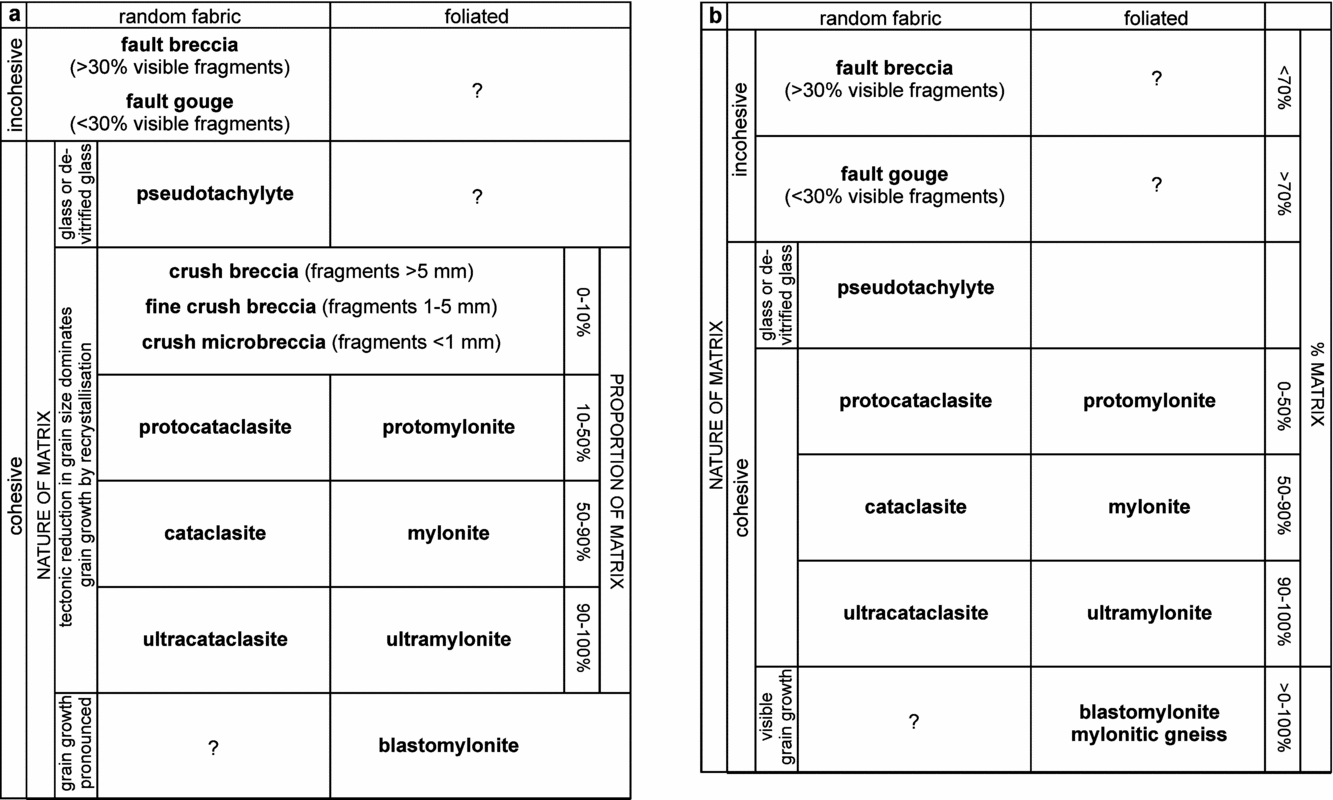
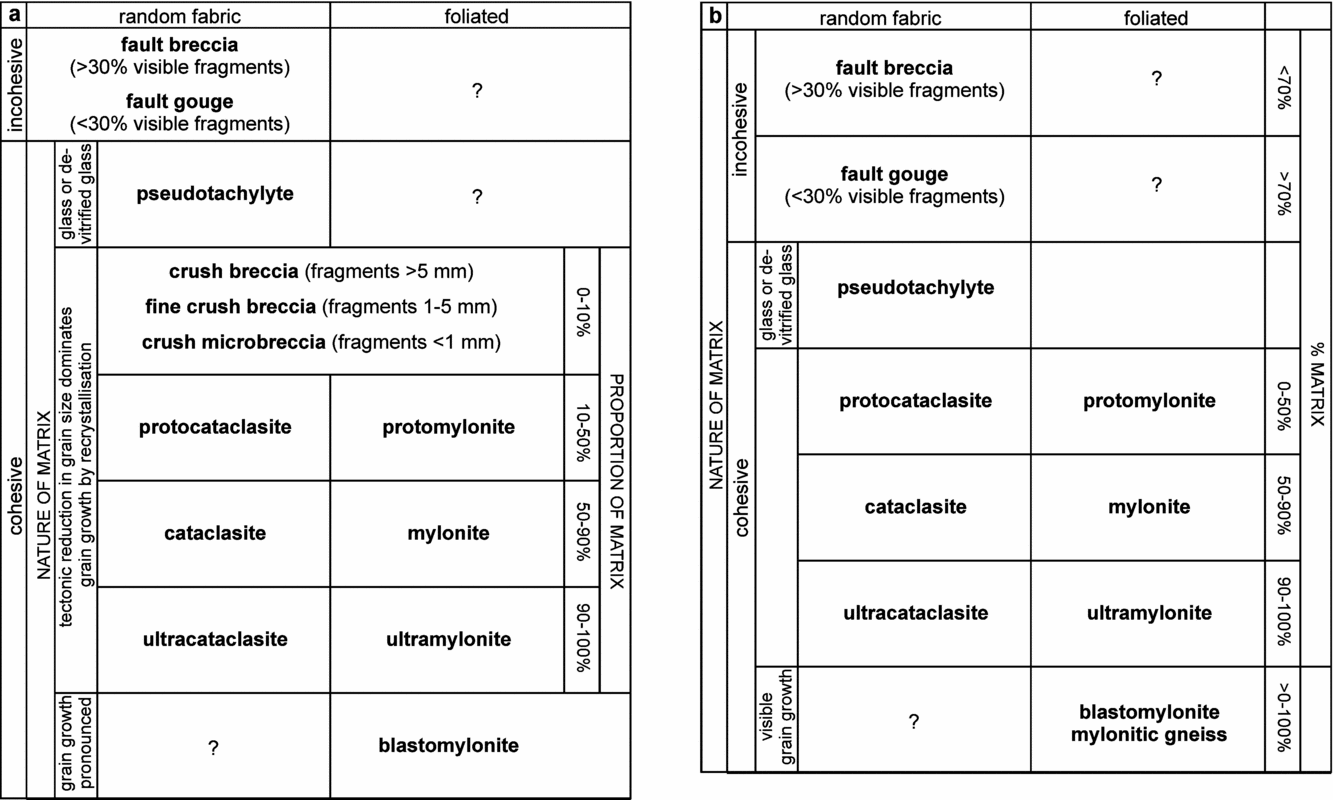
The most influential classification of fault rocks (Fig. 1a) is that of Sibson (Reference Sibson1977), derived from precursors by Spry (Reference Spry1969) and Higgins (Reference Higgins1971). This classification uses primary cohesion (that is, cohesion at the time of fault movement) and the presence of foliation as the main discriminants. Fault breccia and gouge are regarded as primarily incohesive (with the implication that they may be secondarily cemented). Cohesive fault rocks are mostly divided into ‘random-fabric’ cataclasites and foliated mylonites. However, cohesive ‘crush breccias’ appear as the lowest-matrix components of both the cataclasite and mylonite series.
(a) Classification of fault rocks by Sibson (Reference Sibson1977) compared with (b) a revision by Killick (Reference Killick2003).
Sibson's (Reference Sibson1977) scheme was intended as a textural, and essentially non-genetic, classification. However, it was already being recognized (Hatcher, Reference Hatcher1978) that the mylonite–cataclasite distinction had mechanistic implications, with mylonites dominantly formed by crystal plastic rather than cataclastic deformation. The lively debate on this topic is peripheral to the fault breccia issue, except that it highlights the preference of some authors (e.g. White, Reference White1982; Snoke, Tullis & Todd, Reference Snoke, Tullis and Todd1998) for a non-genetic classification, and others (e.g. Wise et al. Reference Wise, Dunn, Engelder, Geiser, Hatcher, Kish, Odom and Schamel1984; Schmid & Handy, Reference Schmid, Handy, Müller, McKenzie and Weissert1991; Jébrak, Reference Jébrak1997) for a mechanistic classification of fault rocks. The issue was thoroughly discussed by Snoke, Tullis & Todd (Reference Snoke, Tullis and Todd1998), who urged the continued use of a Sibson-type classification for the field geologist, whilst recognizing that the definitive distinction of mylonite from cataclasite might require microscopic investigation. This pragmatic approach is supported in the present paper.
A modification of Sibson's (Reference Sibson1977) scheme by Killick (Reference Killick2003) involves the removal of the ‘crush breccia’ category of cohesive breccias, and their inclusion within the term proto-cataclasite (Fig. 1b). A similar modification is incorporated in the schemes of the North American Geologic-map Data Model Science Language Technical Team (Reference Soller2004) and of Brodie, Fettes & Harte (Reference Brodie, Fettes, Harte, Fettes and Desmonds2007).
This review of classifications omits mention of a number of genetic schemes for fault breccia, most influential of which are probably Sibson's (Reference Brodie, Fettes, Harte, Fettes and Desmonds1986) subdivision into attrition, crush and implosion breccias, and Jébrak's (1997) attempt to discriminate amongst hydrothermal breccias using their particle size distributions.
3 Primary cohesion?
The criterion that fault breccias should lack primary cohesion (Higgins, Reference Higgins1971; Sibson, Reference Sibson1977) has caused some difficulty:
(a) Even Higgins (Reference Higgins1971) and Sibson (Reference Sibson1977) recognized that some tectonic breccias may have retained some primary cohesion, and separated them as crush breccia (Sibson, Reference Sibson1977). Cohesive fault breccias are widely recognized as a fault rock category (e.g. Wise et al. Reference Wise, Dunn, Engelder, Geiser, Hatcher, Kish, Odom and Schamel1984; Passchier & Trouw, Reference Passchier and Trouw1996; Brodie, Fettes & Harte, Reference Brodie, Fettes, Harte, Fettes and Desmonds2007).
(b) Whilst some authors (Schmid & Handy, Reference Schmid, Handy, Müller, McKenzie and Weissert1991; Passchier & Trouw, Reference Passchier and Trouw1996; Robertson, Reference Robertson1999; North American Geologic-map Data Model Science Language Technical Team, Reference Soller2004) have retained the original reference to primary cohesion, others (Snoke, Tullis & Todd, Reference Snoke, Tullis and Todd1998; Killick, Reference Killick2003; Brodie, Fettes & Harte, Reference Brodie, Fettes, Harte, Fettes and Desmonds2007) have implied that the criterion is the lack of present cohesion in the fault rock. This latter condition would substantially reduce the number of recognized ‘fault breccias’ as opposed to crush breccias or cataclasites.
(c) Even if the original definition is adhered to, it is difficult or impossible to tell in the field whether any present cohesion was essentially ‘primary’ – for instance through incremental pressure solution (diffusive mass transfer) or cementation in sub-critical fractures – or was acquired through post-faulting processes.
Our proposed fault-rock scheme omits cohesion as an important criterion. All coarse-grained fault rocks qualify as fault breccia. In deference to current practice, we retain the term fault gouge for fine-grained fault rocks that are incohesive at the present outcrop. ‘Incohesive’ has been defined by Brodie, Fettes and Harte (Reference Brodie, Fettes, Harte, Fettes and Desmonds2007) as ‘. . . capable of being broken into component granules with fingers or with the aid of a pen-knife’. There is the possibility that some fault gouges are weathered versions of formerly cohesive fault rocks.
4 Matrix or cement?
Closely related to the issue of breccia cohesion is the distinction between cement and matrix between breccia clasts. Matrix is defined here as any fine-grained particulate material – how fine is discussed in Section 5 – whether produced by local fragmentation of larger particles or by introduction of more exotic sediment. Cement is defined as crystalline material grown in place, either as infill of void space or as a replacement of clasts or matrix. The term infill (Taylor, Reference Taylor1992) can be applied to any post-faulting void-filling cement or matrix.
Early analyses of brecciation (e.g. Spry, Reference Spry1969; Higgins, Reference Higgins1971) perhaps overemphasized the importance of matrix-rich breccias in which ‘. . . cataclastic detritus is progressively comminuted by fracture and rotational attrition’ (Sibson, Reference Sibson1977). The comparable importance of low-matrix, cemented, ‘implosion’ breccias rather than just ‘attrition’ or ‘crush’ breccias, was advertised by Sibson (Reference Brodie, Fettes, Harte, Fettes and Desmonds1986 and subsequent papers), and the dilatant component of some cataclasis has been stressed by Schmid & Handy (Reference Schmid, Handy, Müller, McKenzie and Weissert1991) and Snoke, Tullis & Todd (Reference Snoke, Tullis and Todd1998). The extensive record of cemented hydrothermal breccias in the mineral-deposits literature was summarized by Jébrak (Reference Jébrak1997) and examples from less-mineralized fault zones cited by Tarasewicz, Woodcock & Dickson (Reference Tarasewicz, Woodcock and Dickson2005).
Given the common difficulty of telling the proportion of cement to matrix in the field, our fault rock scheme uses this parameter only as a secondary, optional criterion for classifying fault breccias.
5 Clast or matrix?
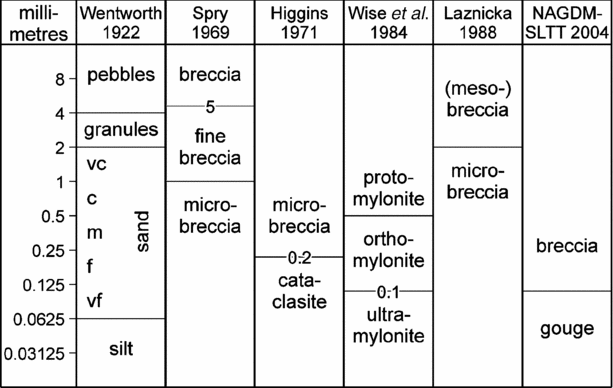
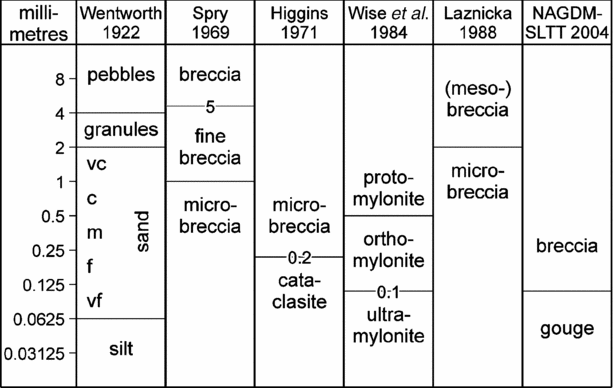
Most classifications of fault rocks use the proportions of ‘fragments or clasts’ – here used as alternatives without any genetic connotation – and ‘matrix’ as important criteria. However, less often do these papers specify the relevant size limits. An exception was Spry (Reference Spry1969), who gave fragment sizes for tectonic breccia as >5 mm, for fine breccia as 1–5 mm, and for microbreccia as <1 mm (Fig. 2), limits taken over for the cohesive ‘crush breccia’ series of Sibson (Reference Sibson1977). By implication of Spry's figure 8 and Sibson's table 1 these authors saw cataclasites and mylonites as finer than microbreccia. Higgins (Reference Higgins1971) stated a limit of 0.2 mm for the microbreccia–cataclasite transition, and also for the fault breccia–gouge transition, though his table 1 implies a larger limit. Qualitatively, Higgins characterized fault breccias as having at least 30% by volume of fragments ‘visible to the naked eye’. Wise et al. (Reference Wise, Dunn, Engelder, Geiser, Hatcher, Kish, Odom and Schamel1984) suggested clast-size limits for the protomylonite–mylonite transition at 0.5 mm and for the mylonite–ultramylonite transition at 0.1 mm (Fig. 2). If these sizes are mapped onto the cataclasite series – as in most recent classifications (e.g. Killick, Reference Killick2003), then fault breccias are coarser than 0.5 mm. Laznicka (Reference Laznicka1988) regarded all breccias, fault breccias included, as coarser than 2 mm. By contrast, the North American Geologic-map Data Model Science Language Technical Team (Reference Soller2004) review has suggested a 0.1 mm transition from fault breccia to gouge, presumably because it is about the limit of clast visibility with the naked eye (that is without a hand lens). The scheme of the IUGS Subcommission for the Nomenclature of Metamorphic Rocks (Brodie, Fettes & Harte, Reference Brodie, Fettes, Harte, Fettes and Desmonds2007) did not include clast-size suggestions, but equated fault breccias with ‘coarse-grained cataclasites’.
Some grain-size criteria relevant to fault rocks.
In summary, there is a range of conflicting definitions of clasts (including porphyoclasts in mylonites) and matrix. A central problem is the criterion of clasts in breccias as being ‘visible to the naked eye’ (e.g. Higgins, Reference Higgins1971; Sibson, Reference Sibson1977; Snoke, Tullis & Todd, Reference Snoke, Tullis and Todd1998; Robertson, Reference Robertson1999). If this criterion is taken to mean ‘visible to the naked eye at hand specimen scale’ then it implies a clast size down to about 0.0625 mm, the sand–silt boundary, or 0.1 mm, the phyllite–slate boundary (North American Geologic-map Data Model Science Language Technical Team, Reference Soller2004). This ∼0.1 mm size is indeed appropriate as the boundary between clasts and matrix in a mylonite or cataclasite (e.g. Wise et al. Reference Wise, Dunn, Engelder, Geiser, Hatcher, Kish, Odom and Schamel1984). However, it seems too fine for the clast–matrix distinction in fault breccias. A survey of fault-rock photos on the internet and in recent literature (e.g. Snoke, Tullis & Todd, Reference Snoke, Tullis and Todd1998; Clark & James, Reference Clark and James2003; Koša et al. Reference Koša, Hunt, Fitchen, Bockel-Rebelle, Roberts, Ahr, Harris, Morgan and Somerville2003) suggests that the term ‘fault breccia’ (as opposed to microbreccia) is typically used for rocks with clasts much larger than 0.1 mm. ‘Clasts’ seem to be those ‘visible at outcrop scale’ or ‘macroscopically visible clasts’ (Killick, Reference Killick2003). We support the view of Laznicka (Reference Laznicka1988) that 2 mm is a more appropriate threshold for the size of common clasts in fault breccias. Importantly, fault breccias would then have an analogous clast-size definition to breccias in sedimentary or volcanic rocks (Wentworth, Reference Wentworth1922; White & Houghton, Reference White and Houghton2006). This compatibility is crucial in settings where breccias form by an uncertain mix of processes (e.g. Laznicka, Reference Laznicka1988; Woodcock, Omma & Dickson, Reference Woodcock, Omma and Dickson2006). ‘Fault breccia’ would also be restored to a meaning closer to that defined by Spry (Reference Spry1969).
6 A revised classification of fault rocks
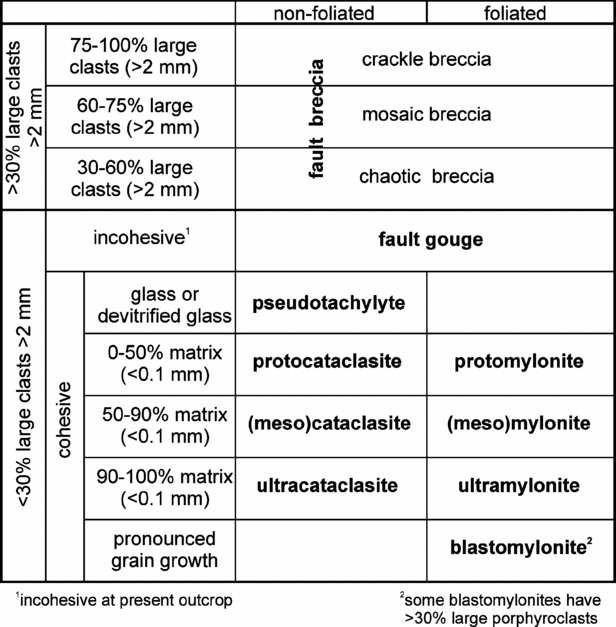
Our revised classification of fault rocks (Fig. 3) uses clast size as the primary criterion for designating a fault breccia. At least 30% of the rock volume must be ‘large’ clasts, those defined here as greater than 2 mm in diameter. On this definition, fault breccias can be cohesive or incohesive, and can have large clasts set in any combination of small clasts (0.1 to 2 mm), fine-grained matrix (less than 0.1 mm) or crystalline cement. Although fault breccias typically lack a strong foliation, their clasts are commonly neither randomly aligned nor randomly distributed (Blenkinsop, Oliver & Cihan, Reference Blenkinsop, Oliver and Cihan2007). The criterion that fault breccias must have a random fabric is therefore removed in the present scheme. The subdivision of fault breccias is discussed in Section 7.
A revised classification of fault rocks.
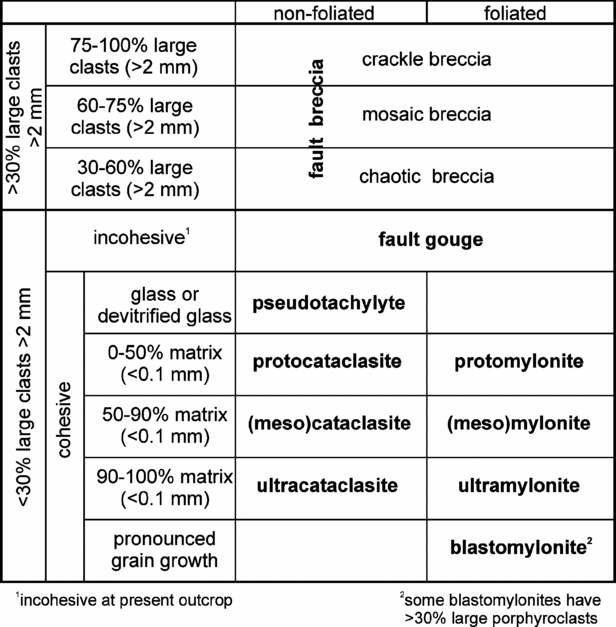
Fine-grained fault rocks are those having less than 30% of their volume as large clasts (>2 mm) (Fig. 3). Our subdivision follows that of Killick (Reference Killick2003) after Sibson (Reference Sibson1977), except as follows:
(a) The size boundary between ‘small clasts’ (including porphyroclasts) and ‘matrix’ is set at 0.1 mm as suggested by Wise et al. (Reference Wise, Dunn, Engelder, Geiser, Hatcher, Kish, Odom and Schamel1984). This size is effectively the limit of resolution of individual components with the naked eye (without a hand lens) in hand specimen.
(b) Cataclasites or mylonites with 50–90% matrix can optionally be prefixed by ‘meso’ (Brodie, Fettes & Harte, Reference Brodie, Fettes, Harte, Fettes and Desmonds2007), which is preferred to ‘ortho’ (Wise et al. Reference Wise, Dunn, Engelder, Geiser, Hatcher, Kish, Odom and Schamel1984).
(c) Fault gouge is a fine-grained fault rock that is incohesive at present-day outcrop. It may or may not be foliated.
It is important to emphasize that this revision of Sibson's (Reference Sibson1977) fault-rock classification is intended to be non-genetic, in harmony with current practice (e.g. Snoke, Tullis & Todd, Reference Snoke, Tullis and Todd1998; Brodie, Fettes & Harte, Reference Brodie, Fettes, Harte, Fettes and Desmonds2007). It uses criteria that can be applied in the field or in hand specimen. Its use accepts that, for instance, some rocks classified as mylonites in the field might, in thin section, prove to be deformed mainly by cataclastic mechanisms, and might be genetically termed ‘foliated cataclasites’.
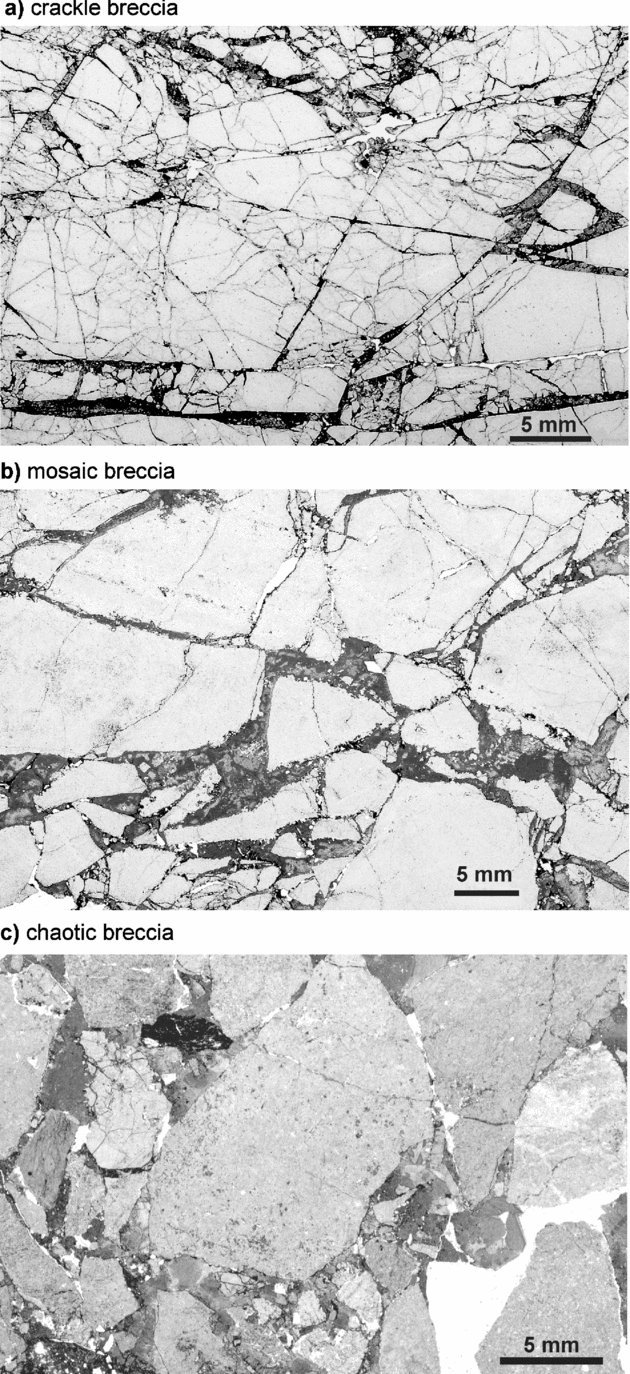
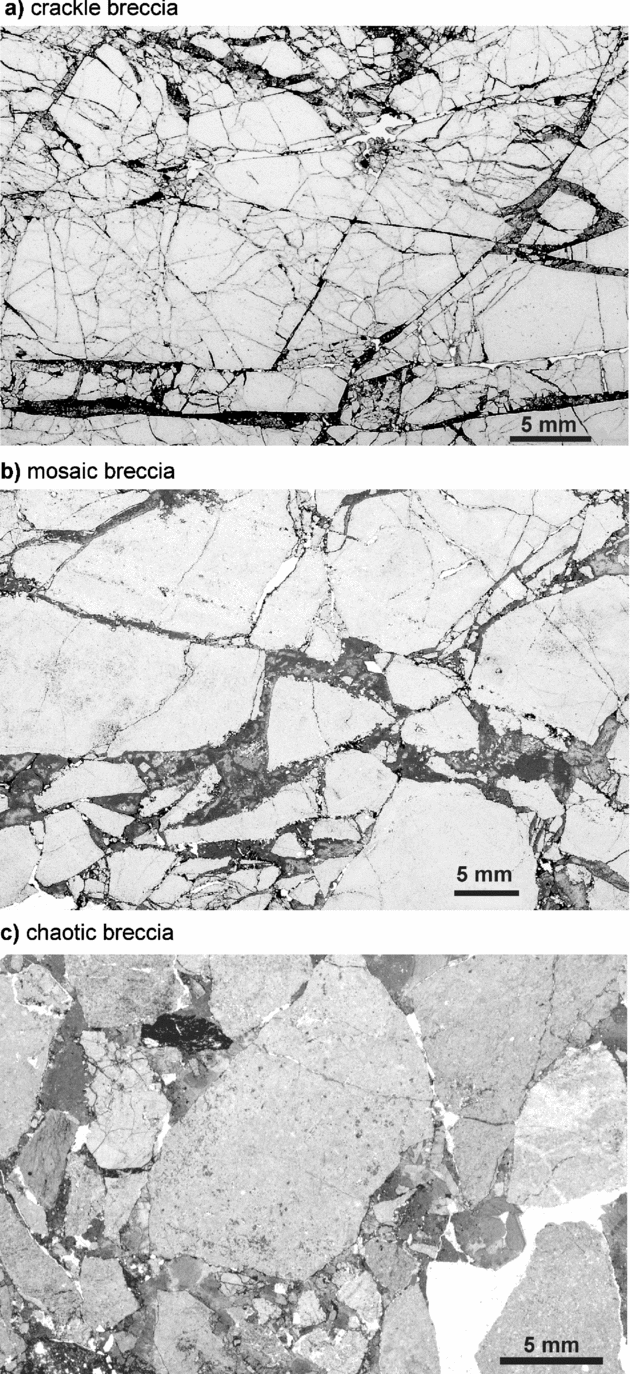
Examples of (a) crackle breccia, (b) mosaic breccia and (c) chaotic breccia. All samples are thin sections from the Dent Fault Zone, NW England, viewed in transmitted light. All have light coloured clasts in a carbonate cement artificially darkened by a stain of alizarin red-S and potassium ferricyanide.
7 A subdivision of fault breccias
Our proposed classification of fault breccias (Figs 3, 4) contains three main subdivisions – crackle, mosaic, and chaotic breccia – depending on how well the clasts fit together. Crackle breccias have clasts separated by thin seams of cement or matrix, and the clasts are little rotated with respect to each other (Fig. 4a). Clasts in mosaic breccias show more separation and rotation, but still show some fitting to adjacent clasts (Fig. 4b). In chaotic breccias (Fig. 4c), clasts are more strongly rotated and have lost any geometric fit to formerly adjacent clasts. Tests by Mort & Woodcock (Reference Mort and Woodcock2008) suggest that clast area as a percentage of total area is a good proxy for the crackle–mosaic–chaotic breccia spectrum, and that bounds at 75% and 60% clasts are appropriate (Fig. 3). However, the progression of any one breccia volume through this textural spectrum may vary and may be incomplete, so that, for instance, it is common for clasts in chaotic breccias to be themselves composed of crackle or mosaic breccia.
The crackle, mosaic, and chaotic breccia classification was developed in the cave-collapse literature (e.g. Loucks, Reference Loucks1999). A variant of it (with rubble breccia used in place of chaotic breccia) was used by Laznicka (Reference Laznicka1988) for breccias in general. One usage of this scheme for fault breccias was by Koša et al. (Reference Koša, Hunt, Fitchen, Bockel-Rebelle, Roberts, Ahr, Harris, Morgan and Somerville2003), although they proposed the use of the terms ‘tight’ and ‘loose’ for fault breccias, and crackle and mosaic collapse breccias, respectively. However, they admit that the distinction between these two origins often relies on recognizing the macroscopic geometry of a planar fault zone, rather than on the character of the fault rock itself. We therefore advocate the retention of the terms crackle, mosaic, and chaotic for fault breccias.
8 Graphical displays of the fault-rock classification
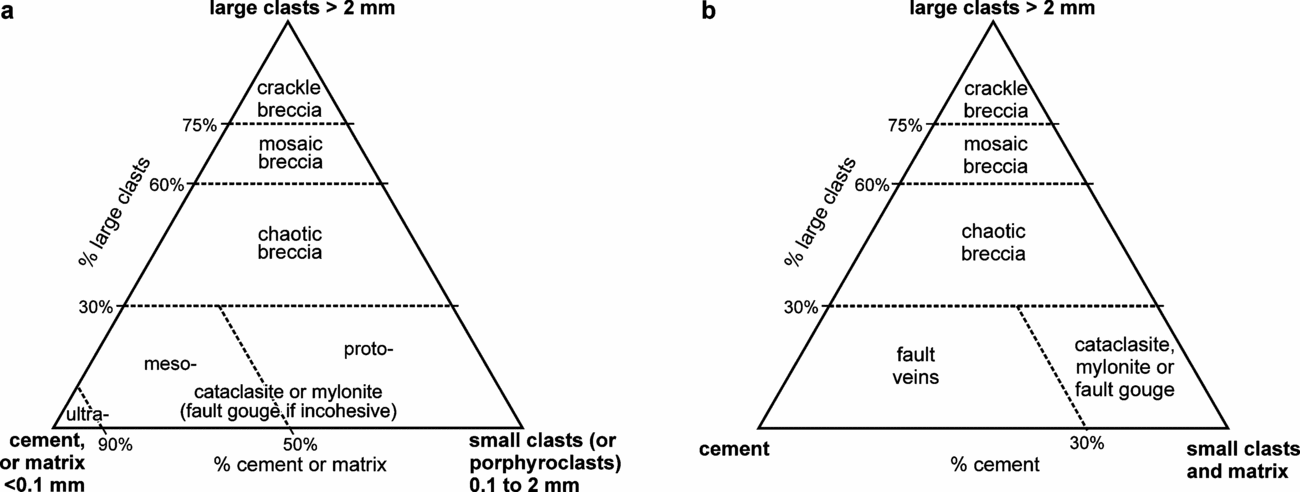
Our proposed fault-rock scheme can be displayed graphically on a ternary diagram of large clasts, small clasts, and matrix or cement (Fig. 5a). The 75% and 60% large clast lines delimit the fields of crackle, mosaic and chaotic breccia. The 30% large clasts line separates the breccia series from the cataclasite or mylonite series, or gouge if incohesive. Cataclasites and mylonites are subdivided according to percentage of matrix.
Ternary diagrams showing the two alternative graphical displays of the proposed fault rock classification.
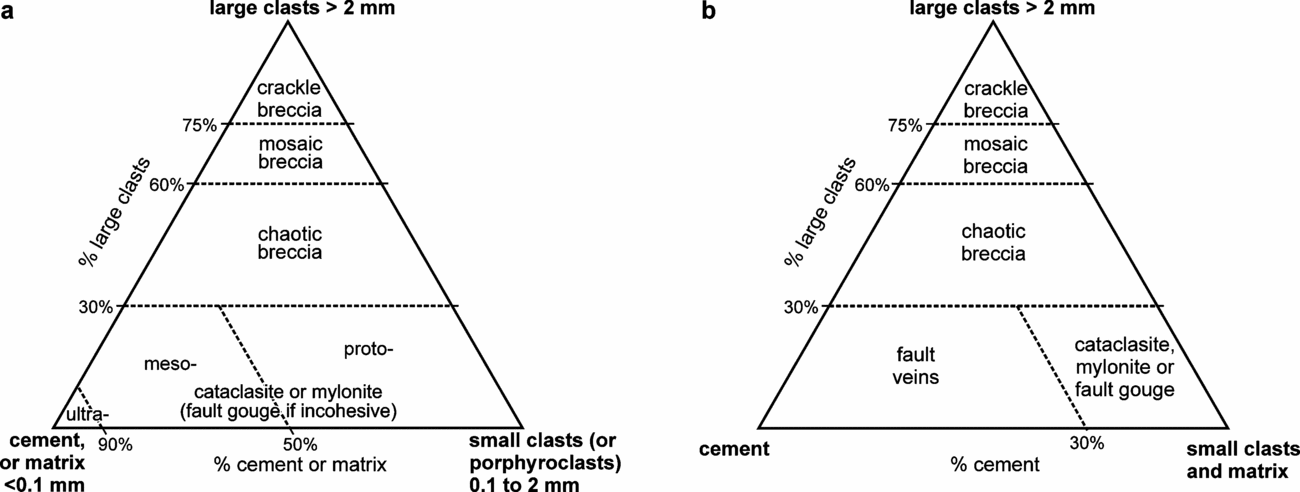
An alternative ternary diagram (Fig. 5b) combines matrix with small clasts rather than with cement. This representation has been used previously by Laznicka (Reference Laznicka1988) for breccias in general, by Loucks (Reference Loucks1999) for cave breccias, and by Woodcock, Omma & Dickson (Reference Woodcock, Omma and Dickson2006) for fault void breccias. It allows breccias with fine-grained matrix to be distinguished from those with crystalline cement, though no distinguishing terms are proposed. Below the 30% large clasts line, fault veins plot near the cement corner, whereas cataclasite, mylonite or fault gouge plot near the small clasts and matrix corner. The appropriate dividing line between these two categories is debatable; 30% cement is arbitrarily chosen. The difficulty of distinguishing cement from matrix in the field has already been discussed, and will limit the applicability of the diagram.
9 Summary
It is proposed that fault breccia is better defined by its coarse grain size than by its lack of cohesion at the time of faulting. Accordingly, fault breccia is defined as having at least 30% of its volume being clasts larger than 2 mm in diameter, a definition which approximates usage for sedimentary rocks. On this definition, fault breccia can be cohesive or incohesive, foliated or not, and can contain small clasts, fine-grained matrix or a crystalline cement in any relative proportion. Fine-grained fault rocks, with less than 30% of clasts or porphyroclasts larger than 2 mm, mainly comprise the mylonite and cataclasite series. However, the term fault gouge is retained for fine-grained material that is incohesive at present outcrop.
Fault breccia can be subdivided, according to how well the clasts fit together, into crackle, mosaic and chaotic breccia. The bounds to these classes approximately correspond to large clast (>2 mm) percentages of 75% and 60%.
Acknowledgements
Comments by Tom Blenkinsop and Geoff Lloyd substantially improved the paper.