INTRODUCTION
During the winters of 2014 and 2015, several scientific expeditions were undertaken in the Saudi Arabian Red Sea, aiming to characterize the biodiversity patterns in shallow soft-sediments (down to 150 m depth), and their relationship with environmental parameters and anthropogenic pressures. The Saudi Arabian Red Sea extends for ~12° latitude, from 16 to 28°N. Along this latitudinal gradient, species are subjected to changes in seawater temperature (from 26–32°C in the south to 21–28°C in the north), salinity (37 in the south and 42 in the north; Sofianos & Johns, Reference Sofianos and Johns2007), and nutrients (higher levels of nutrients being recorded in the south; Pearman et al., Reference Pearman, Kuerten, Sarma, Jones and Carvalho2016b). Besides these clear environmental gradients, circulation patterns further contribute to shaping the distribution of the species by affecting the larval dispersion (Nanninga et al., Reference Nanninga, Saenz-Agudelo, Zhan, Hoteit and Berumen2015) and the system's productivity (Raitsos et al., Reference Raitsos, Pradhan, Brewin, Stenchikov and Hoteit2013; Churchill et al., Reference Churchill, Bower, McCorkle and Abualnaja2014). Literature addressing biodiversity of soft sediments in the Saudi Arabian Red Sea is extremely scarce and of limited spatial resolution (Abu-Zied et al., Reference Abu-Zied, Bantan and El Mamoney2011; Al-Farraj et al., Reference Al-Farraj, El-Gendy, Al Kahtani and El-Hedeny2012; Pearman et al., Reference Pearman, Irigoien and Carvalho2016a). Besides, taxonomic studies for this region are almost non-existent, limiting the ability to identify organisms to the species level, as already pointed out for the Indian Ocean (Mackie et al., Reference Mackie, Oliver, Darbyshire and Mortimer2005).
Nephtyidae is a family of aciculate polychaetes that occurs worldwide at all depths but is usually more abundant in shallow waters on sandy and muddy bottoms. The family includes over 100 described species. Only a few studies on polychaete taxonomy have been conducted in the last few decades in the Red Sea and none of these includes the family Nephtyidae (Day, Reference Day1965; Stagl et al., Reference Stagl, Sattmann, Dworschak, Uiblein, Ott and Stachowitsch1996; Abd-Elnaby, Reference Abd-Elnaby2009). The existing records of this family in the region are old and have not been revised (Gravier, Reference Gravier1904, Reference Gravier1906; Fauvel, Reference Fauvel1933; Fishelson & Rullier, Reference Fishelson and Rullier1969; Kiseleva, Reference Kiseleva and Vodyanitzkii1971; Amoureux et al., Reference Amoureux, Rullier and Fishelson1978; Amoureux, Reference Amoureux1983). Wehe & Fiege (Reference Wehe and Fiege2002) compiled those records in a checklist that includes 12 nephtyid species known to occur around the Arabian Peninsula. The majority of these species are mainly distributed in Arctic and Atlantic waters – Aglaophamus lyrochaetus (Fauvel, Reference Fauvel1902), Aglaophamus malmgreni (Théel, Reference Théel1879), Nephtys hystricis McIntosh, Reference McIntosh1900, Nephtys incisa Malmgren, Reference Malmgren1865 and Nephtys longosetosa Örsted, Reference Örsted1843, or has a wide geographic distribution – Inermonephtys inermis (Ehlers, Reference Ehlers1887) and Nephtys paradoxa Malm, Reference Malm1874. Therefore, further investigation is needed to confirm their identification (Ravara et al., Reference Ravara, Cunha and Pleijel2010a). The other five species are endemic or occur mainly in the West Indian Ocean – Aglaophamus longicephalus Hartman, Reference Hartman1974, Micronephthys sphaerocirrata (Wesenberg-Lund, Reference Wesenberg-Lund1949), N. palatii Gravier, Reference Gravier1904 and N. tulearensis Fauvel, Reference Fauvel1919a, and also in the Indo-Pacific region – Aglaophamus dibranchis (Grube, Reference Grube1877). Based on the current findings, four other species are added to this list, one of which is new to science.
MATERIALS AND METHODS
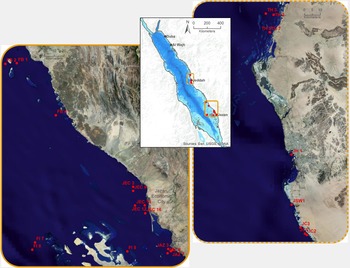
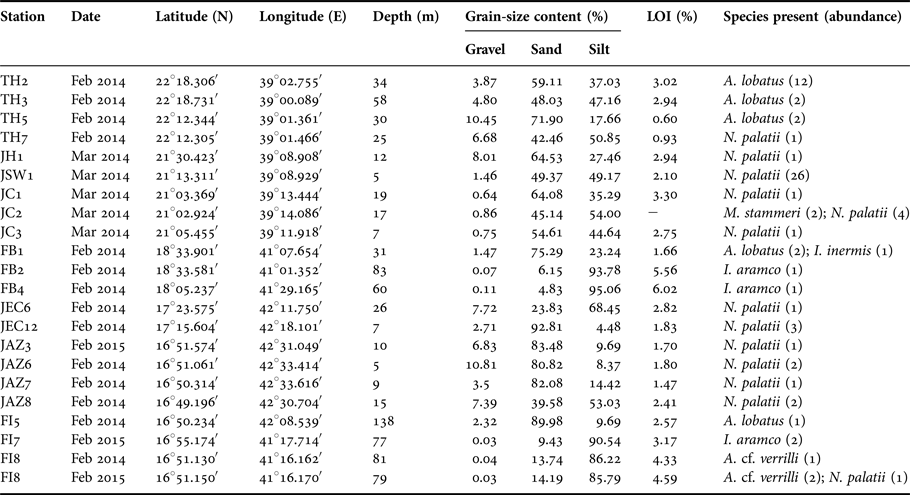
Samples were collected with a Van Veen grab (0.1 m2; two replicates per site) in the central (Thuwal and Jeddah) and southern Red Sea (Farasan Banks to Farasan Islands) (Figure 1). Biological samples were sieved through a 1 mm mesh screen and preserved in 96% ethanol. In addition, sediment sub-samples were taken for grain-size analysis and organic matter content. Grain particle-size analysis and organic matter content, determined by ‘loss on ignition’, were performed following Carvalho et al. (Reference Carvalho, Moura, Gaspar, Pereira, Falcão, Cancela da Fonseca, Drago, Leitão and Regala2005). Data on grain size and organic matter content for each sample, along with coordinates and depth, are given in Table 1.
Map with the location of the sampling sites.

List of samples (from north to south) along the Saudi Arabian coast of the Red Sea with specimens of Nephtyidae, and its characterization in terms of sediment grain-size and organic matter content.

LOI, organic matter lost on ignition; – missing values.
The descriptions included herein are based on the studied specimens unless otherwise stated. The chaetae were examined under a stereo compound light microscope and descriptions follow the terminology included in Dnestrovskaya & Jirkov (Reference Dnestrovskaya and Jirkov2011). Drawings were prepared from preserved specimens with a camera lucida. Measurements of body width were taken from the widest part of the body, without/with parapodia, excluding chaetae. Body length excludes prostomial appendages and anal cirrus. Type material is deposited at the Natural History Museum, London (NHM), some paratypes and remaining (non-type) material are deposited at the Biological Research Collection, Departamento de Biologia, Universidade de Aveiro (DBUA) and at the Saudi Aramco-KAUST Center for Marine Environmental Observations (SAKMEO) collection.
RESULTS AND DISCUSSION
In the present study, two nephtyid species previously reported for the Red Sea (Wehe & Fiege, Reference Wehe and Fiege2002) were identified – Inermonephtys aff. inermis and Nephtys palatii. Three species are new records for the region – Aglaophamus lobatus, Aglaophamus cf. verrilli and Micronephthys stammeri, and one species of Inermonephtys is new to science. Nephtys palatii was the most abundant species, represented by a total of 45 specimens. This species was found in the majority of the sampled sites, mainly in sand in shallow water, and with particular high abundance at the site JSW1 (South Jeddah) (Figure 1). Nephtys palatii has been considered to be an endemic species to the Arabian Sea. Its bathymetric distribution is given here for the first time (4–90 m) and the species is transferred to the genus Micronephthys. Aglaophamus lobatus, a species previously known only from Japan, is also well represented in the studied samples (with 19 specimens), occurring in five sites located at shelf depths (30–138 m) in sand with up to 37% of silt content (Table 1). It was particularly abundant at the site TH2 (Thuwal, North Jeddah) (Figure 1). The remaining species (A. verrilli, I. inermis and M. stammeri) are represented by a few specimens only (3, 1 and 2, respectively) and require taxonomic confirmation in future studies, when more material is available. Aglaophamus verrilli had never been reported in the Red Sea. This species was originally described from New Zealand and apparently has a very wide geographic distribution that should, however, be considered with caution and requires further investigation. Some morphological variation has been reported, depending on the author and locality, indicating a possible complex of species (see systematic section). Inermonephtys inermis was originally described from Florida and has been widely reported ever since. Recently, a new species, Inermonephtys foretmontardoi Ravara, Cunha & Pleijel (Reference Ravara, Cunha and Pleijel2010a), was erected for specimens from North Europe. We believe other species may be hidden within the geographic range of I. inermis hence supporting the need for further studies. Micronephthys stammeri is another widespread species not previously reported in the Red Sea. It is known to occur in the Mediterranean and in the Indian and the Pacific Oceans, although these records require further attention. The present study also extends its bathymetric range. One other species belonging to the genus Inermonephtys was found in the southern part of the Red Sea on muddy sand at shelf depths (60–83 m) and is here described as new to science.
From the eight species previously reported to occur in the Red Sea (Wehe & Fiege, Reference Wehe and Fiege2002), six were not found in this study (A. dibranchis, A. malmgreni, N. hystricis, N. incisa, N. longosetosa and N. paradoxa). Aglaophamus dibranchis is known to occur in the Indian and west Pacific oceans. This species is morphologically very similar to A. verrilli and some confusion between the two species has occurred in the past (Knox, Reference Knox1960; Paxton, Reference Paxton1974; Rainer & Hutchings, Reference Rainer and Hutchings1977). The two species differ mainly in the chaetiger where branchiae start (4 in A. dibranchis, 5–8 in A. verrilli) and pharynx morphology (smooth, with 14 rows of 4–5 papillae in A. dibranchis, with warts and 22 rows of 3–9 papillae in A. verrilli). The occurrence of the same species or similar in both west Indian and Indo-Pacific regions has been frequently reported for polychaete species (e.g. Mackie & Hartley, Reference Mackie, Hartley and Morton1986; Mackie, Reference Mackie1991; Darbyshire & Mackie, Reference Darbyshire and Mackie2003), denoting the existence of some affinity between the two geographic areas. Aglaophamus malmgreni, N. hystricis, N. incisa, N. longosetosa and N. paradoxa are considered to be circumpolar or boreal species, mainly distributed in Arctic and North-east Atlantic waters (Ravara et al., Reference Ravara, Cunha and Pleijel2010a). The presence of these species in the Red Sea should be considered with caution and further investigated.
SYSTEMATICS
Order phyllodocida Dales, Reference Dales1962
Family nephtyidae Grube, Reference Grube1850
Genus Aglaophamus Kinberg, Reference Kinberg1865
Aglaophamus lobatus Imajima & Takeda, Reference Imajima and Takeda1985
TYPE LOCALITY
Sagami Bay, Japan, W Pacific Ocean.
MATERIAL EXAMINED
February 2014: 2 incomplete spms, Station FB1, 18°33.901′N 41°07.654′E, 31 m depth (DBUA0001878.01); 1 inc. spm, Station FI5, 16°50.234′N 42°08.539′E, 138 m depth (DBUA0001878.02); 12 inc. spms, the larger one with 48 chaetigers, 14.56 mm long, 1.75/2.25 mm wide, Station TH2, 22°18.306′N 39°02.755′E, 34 m depth (SAKMEO); 2 inc. spms, the larger one with 25 chaetigers, 5 mm long, 1.00/1.45 mm wide, Station TH3, 22°18.731′N 39°00.089′E, 58 m depth (DBUA0001878.03); 2 inc. spms, the larger one with 20 chaetigers, 5.1 mm long, 1.10/1.68 mm wide, Station TH5, 22°12.344′N 39°01.361′E, 30 m depth (DBUA0001878.04).
DESCRIPTION
Body of small size (in comparison to other nephtyid species), slightly wider at pharynx region, tapering anteriorly to prostomium and posteriorly towards the pygidium. Colour in ethanol whitish with light brown pigmentation spot on anterior region of prostomium. Prostomium sub-rectangular, much longer than wide. Antennae and palps subequal in length, long and with cirriform tip. Palps inserted ventrally in anterior region of prostomium, close to antennae. Pharynx distal region with nine pairs of terminal bifid papillae with inner rami much shorter than outer, separated by a gap ventrally and a simple conical papilla dorsally; long middorsal papilla present; subdistal region with 14 longitudinal rows of 4 or 5 short subterminal papillae, extending over 1/3 the length of pharynx; proximal region covered with minute warts (visible with methyl blue). One pair of subdermal eyes faintly visible at basal part of second chaetiger. Parapodia of first chaetiger directed forward, parallel to prostomium; acicular lobes conical; notopodial lamellae well-developed but not extending behind acicular lobes; neuropodial lamellae forming a cylinder around acicular lobe; dorsal cirri very small, cirriform; ventral cirri subequal in length and shape to antennae and palps. Following parapodia increase in size towards mid-body where it attains its maximal development; acicular lobes conical in anterior parapodia, becoming acutely pointed from middle chaetigers. Prechaetal lamellae of median parapodia conical, slightly displaced towards interramal space, similar in length to acicular lobes; notopodial postchaetal lamellae longer than acicular lobes, broadly rounded; neuropodial postchaetal lamellae much longer than acicular lobes, rounded. Dorsal cirri of second chaetiger already well-developed, with broad base and cirriform tip (similar in shape to ventral cirri of first chaetiger), becoming dorso-ventrally flattened with cirriform tip towards median parapodia where it attains half the length of the branchiae. Ventral cirri long and slender along body. Branchiae present from chaetiger 3 to posterior end of fragment, long and loosely involute when fully developed, with a bump-like accessory cirrus. Neuropodial superior lobes absent. Chaetae of four kinds: barred in preacicular position, lightly serrated and lyrate in postacicular position and capillary in neuropodia of first chaetiger. Preacicular chaetae about 2/3 length of postacicular ones.
REMARKS
This species was originally described from Japan and has never been reported from outside that area. This study extends its geographic distribution to the Red Sea. We found no differences between the specimens examined and the original description of the species (Imajima & Takeda, Reference Imajima and Takeda1985, p. 75, fig. 9a–m).
DISTRIBUTION
Pacific Ocean (Japan); Indian Ocean (Red Sea) (Imajima & Takeda, Reference Imajima and Takeda1985; present study).
HABITAT
11–270 m depth (Imajima & Takeda, Reference Imajima and Takeda1985).
Aglaophamus cf. verrilli (McIntosh, Reference McIntosh1885)
Nephthys verrilli: McIntosh, Reference McIntosh1885; Knox, Reference Knox1960.
Aglaophamus verrilli: Paxton, Reference Paxton1974; Rainer & Hutchings, Reference Rainer and Hutchings1977; Imajima & Takeda, Reference Imajima and Takeda1985; Hilbig, Reference Hilbig, Blake, Hilbig and Scott1997.
Aglaophamus dicirris: Hartman, Reference Hartman1950; Kudenov, Reference Kudenov1975.
TYPE LOCALITY
Queen Charlotte Sound, New Zealand, W Pacific Ocean.
MATERIAL EXAMINED
February 2014: 1 incomplete spm, Station FI8, 16°51.130′N 41°16.162′E, 81 m depth (SAKMEO); February 2015: 2 inc. spms, the larger one with 50 chaetigers, 19 mm long, Station FI8, 16°51.150′N 41°16.170′E, 79 m depth (DBUA0001879).
COMPARATIVE MATERIAL EXAMINED
Pacific Ocean, Queen Charlotte Sound, New Zealand, Cook Strait: Challenger Expedition, near Long Island, 18.3 m, 27 June 1874, 1 incomplete spm, syntype (NHM 1885.12.1.12).
DESCRIPTION
Body of similar width throughout, whitish in ethanol, without pigmentation marks. Prostomium sub-rectangular, much longer than wide. Antennae and palps subequal in length, short. Palps inserted ventrally in anterior region of prostomium, close to antennae. Pharynx distal region with 10 pairs of terminal bifid papillae with inner rami much shorter than outer, separated by simple conical papillae dorsally and ventrally; long mid-dorsal and mid-ventral papillae absent; sub-distal region covered with minute warts, with 22 longitudinal rows of up to nine subterminal papillae extending over 1/2 length of pharynx. One pair of eyespots present at posterior corners of prostomium. Parapodia of first chaetiger directed forward, parallel to prostomium; notopodial lamellae poorly developed; neuropodial lamellae forming a cylinder around acicular lobe; dorsal and ventral cirri long, digitiform. Following parapodia directed laterally; acicular lobes acutely pointed; prechaetal lamellae rudimentary; notopodial postchaetal lamellae well-developed from third chaetiger becoming longer than acicular lobes at median chaetigers, broadly rounded; neuropodial postchaetal lamellae well-developed from third chaetiger, similar in length or slightly smaller than acicular lobes, triangular with rounded edge; dorsal cirri with broad base and cirriform tip, very short compared with branchiae length; ventral cirri digitiform, similar in length or longer than acicular lobes. Branchiae present from chaetiger 7/8 to posterior end of fragment, long and thin, involute, with bump-like accessory cirrus. Neuropodial superior lobes present from chaetiger 12, cirriform, much longer than acicular lobes in median parapodia. Chaetae of four kinds: barred in preacicular position, lightly serrated with scattered spines and lyrate in postacicular position, and capillary in neuropodia of first chaetiger. Postacicular chaetae very thin and four times longer than preacicular ones. Lyrate postacicular chaetae of same length as preacicular ones. Aciculae with curved tips.
REMARKS
Aglaophamus verrilli was originally described from New Zealand. Posteriorly, Hartman (Reference Hartman1950) described a very similar species, Aglaophamus dicirris, from Panama. Knox (Reference Knox1960) synonymized the two species without comment, and Rainer & Hutchings (Reference Rainer and Hutchings1977) confirmed this synonymy examining the lectotype of A. verrilli and the holotype of A. dicirris. Aglaophamus verrilli has thus been frequently recorded from very distant geographic areas such as the eastern and western North America, and the western Pacific Ocean (from Japan to New Zealand).
Specimens of A. dicirris were not examined in the present study. However, according to the literature, the two species (A. dicirris and A. verrilli) have very similar morphological characteristics differing only in the chaetiger where the neuropodial superior lobes start to appear. In the specimens of A. verrilli from the Indo-Pacific region, the neuropodial superior lobes start at chaetiger 7 or 8, along with the branchiae (Rainer & Hutchings, Reference Rainer and Hutchings1977; Imajima & Takeda, Reference Imajima and Takeda1985; specimen from New Zealand examined herein), while in the specimens from North America (either referred to as A. dicirris or A. verrilli) the neuropodial superior lobes start at chaetiger 14 or after (Hartman, Reference Hartman1950; Kudenov, Reference Kudenov1975; Hilbig, Reference Hilbig, Blake, Hilbig and Scott1997).
The majority of the authors refer to the branchiae as starting at chaetigers 5–8 in the specimens from North America. However, in the original description of A. dicirris, Hartman (Reference Hartman1950) pointed out the existence of two groups of individuals, one with branchiae starting at chaetiger 5 (rarely 6) (including the holotype), and another with branchiae starting at chaetiger 7 or 8. The chaetiger where the neuropodial superior lobe starts to occur in those two groups of individuals is not clear in the original description and should be further investigated. Aglaophamus verrilli may thus include at present two different species and further revision is needed. In the specimens from the Red Sea examined herein the branchiae starts at chaetiger 7 or 8 and the neuropodial superior lobe starts at chaetiger 12. All other characteristics are in accordance to the species diagnosis.
DISTRIBUTION
Atlantic Ocean (from Maryland to Gulf of Mexico); Indian Ocean (India); Pacific Ocean (from S California to Panama; Japan, Australia, New Zealand) (Hilbig, Reference Hilbig, Blake, Hilbig and Scott1997).
HABITAT
Silty sand and mud, 0–200 m depth (Hilbig, Reference Hilbig, Blake, Hilbig and Scott1997).
Genus Inermonephtys Fauchald, Reference Fauchald1968
Inermonephtys aff. inermis (Ehlers, Reference Ehlers1887)
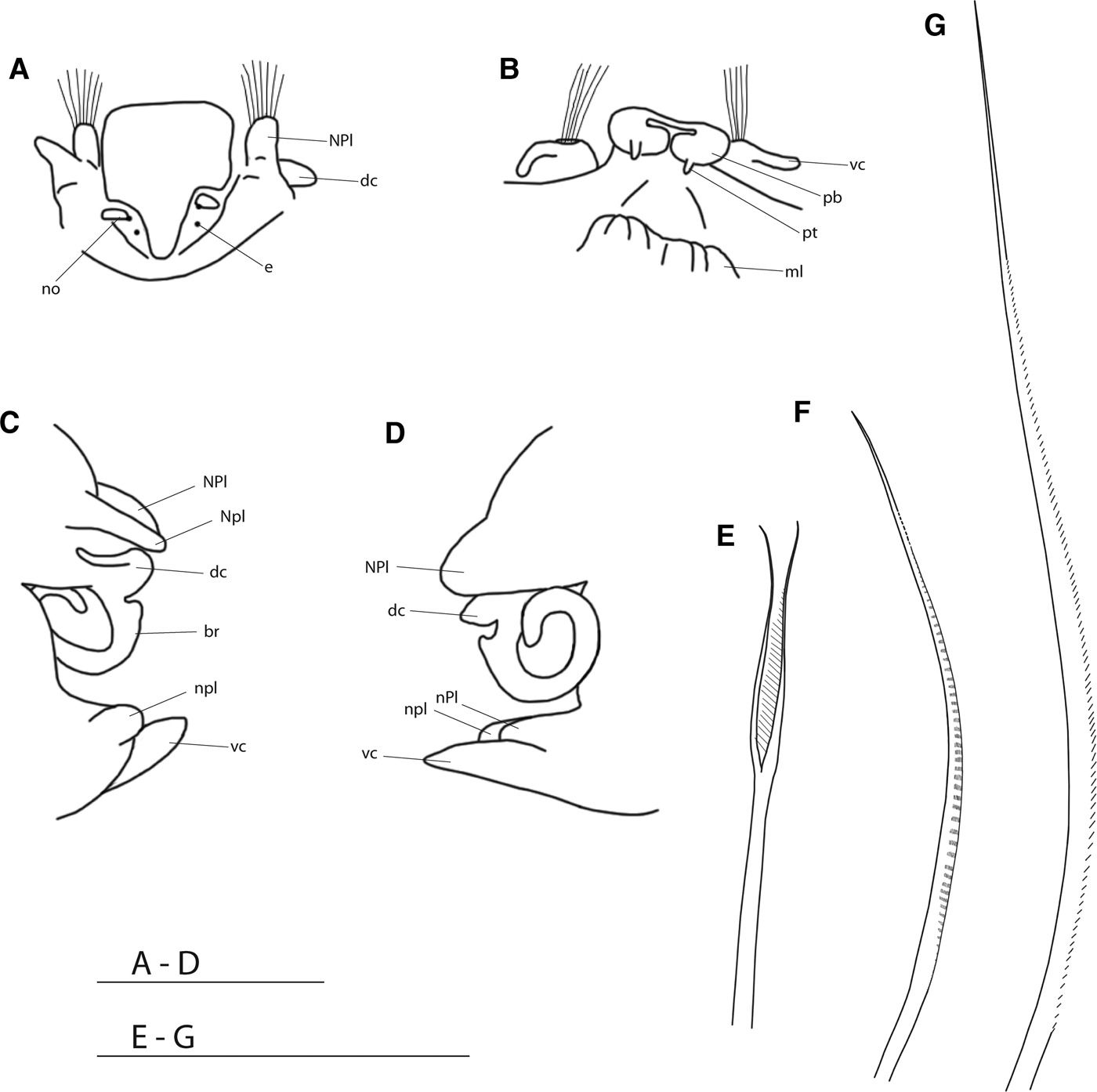
(Figure 2A–G)
Nephtys (Aglaophamus) inermis: Ehlers, Reference Ehlers1887.
Nephtys inermis: Hartman, Reference Hartman1940.
Aglaophamus inermis: Hartman, Reference Hartman1950.
Inermonephtys inermis: Fauchald, Reference Fauchald1968; Taylor, Reference Taylor, Uebelacker and Johnson1984.
? Inermonephtys inermis: Imajima, Reference Imajima1970; Uschakov & Wu, Reference Uschakov and Wu1979; Lee & Jae, Reference Lee and Jae1983; Kirkegaard, Reference Kirkegaard1995.
Inermonephtys aff. inermis (A) prostomium; (B) palps, ventral view; (C) parapodium 30, anterior view; (D) parapodium 30, posterior view; (E) lyrate chaeta; (F) preacicular chaeta; (G) postacicular chaeta. Abbrev.: br, branchia; dc, dorsal cirrus; e, eye; ml, mouth lips; no, nuchal organ; Npl, notopodial prechaetal lamella; NPl, notopodial postchaetal lamella; npl, neuropodial prechaetal lamella; nPl, neuropodial postchaetal lamella; pb, palp base; pt, palp tip; vc, ventral cirrus. Scale bars: A–D – 0.5 mm; E–G – 0.1 mm.

TYPE LOCALITY
Off Aligator reef, Florida, USA, W Atlantic Ocean.
MATERIAL EXAMINED
February 2014: 1 incomplete spm, 52 chaetigers, 21 mm long, 1.62/2.28 mm wide, Station FB1, 18°33.901′N 41°07.654′E, 31 m depth (DBUA0001880).
DESCRIPTION
Colour in ethanol light tan, without pigmentation patterns. Prostomium pentagonal, proportionally small relative to body (Figure 2A). Antennae absent. One pair of palps ventrally bent with cushion-like base and small cirriform process (Figure 2B). Pharynx and jaws not examined. Two pairs of eyes near posterior corners of prostomium (Figure 2A). A pair of nuchal organs with single digitiform eversible processes located near anterior pair of eyes (Figure 2A). Parapodia of first chaetiger directed anteriorly, parallel to prostomium; acicular lobes conical; notopodial prechaetal lamellae rudimentary, postchaetal lamellae longer than acicular lobes, rounded; neuropodial lamellae forming a cylinder around acicular lobe; dorsal cirri well-developed, conical (Figure 2A); ventral cirri similar in length to dorsal cirri, cirriform (Figure 2B). Following parapodia similar in length throughout body attaining full development at median region. Fully developed parapodia with conical acicular lobes; notopodial prechaetal lamellae elongated, slightly longer than acicular lobes, postchaetal lamellae rounded, similar in length to prechaetal lamellae; neuropodial prechaetal lamellae conical, similar in length to acicular lobe, postchaetal lamellae rounded, slightly shorter than acicular lobe, often hidden by the ventral cirri; dorsal cirri digitiform, one-third length of branchiae; ventral cirri elongated, surpassing neuropodia and frequently directed dorsally (Figure 2C, D). Branchiae present from chaetiger 4, involute, long and thin, with small accessory cirrus. Chaetae of four kinds: spinose in preacicular position (Figure 2F), serrated (Figure 2G) and lyrate with sub-equal rami (Figure 2E) in postacicular position, and capillary in neuropodia of first chaetiger. Preacicular chaetae two-thirds length of postacicular ones. Anterior parapodia with 2 aciculae in noto- and neuropodia. Posterior region missing.
REMARKS
Inermonephtys inermis was originally described as Nephtys (Aglaophamus) inermis by Ehlers (Reference Ehlers1887) from specimens from Florida. For a long time, it was considered to have a cosmopolitan distribution in temperate, tropical and sub-tropical seas (including Atlantic, Pacific and Indian Oceans) (e.g. Hartman, Reference Hartman1940, Reference Hartman1950; Fauchald, Reference Fauchald1968; Taylor, Reference Taylor, Uebelacker and Johnson1984; Kirkegaard, Reference Kirkegaard1995). Recently, Ravara et al. (Reference Ravara, Cunha and Pleijel2010a) reviewed the South European nephtyids and proposed the erection of a new species, Inermonephtys foretmontardoi, to accommodate the European specimens previously identified as I. inermis. These two species differ on the morphology of the palps (cirriform in I. foretmontardoi and cushion-like with small digitiform process in I. inermis), the parapodia (in I. foretmontardoi the neuropodial postchaetal lamellae extends well beyond the acicular lobes and the prechaetal lamellae of both rami are well-developed, while in I. inermis all these lamellae are rudimentary or poorly developed), and the preacicular chaetae (spinulated in I. foretmontardoi and barred in I. inermis). Furthermore, two pairs of eyes are described for I. inermis but not visible in I. foretmontardoi specimens. The single specimen reported herein for the Red Sea presents mixed characteristics from these two species. The palps are cushion-like with cirriform processes and two pairs of eyes are present as in I. inermis, but the parapodial preacicular chaetae are spinulated as in I. foretmontardoi. In general, the parapodia morphology is closer to I. inermis except for the neuropodial postchaetal lamellae that are well-developed instead of rudimentary, as in I. foretmontardoi, although not extending beyond the acicular lobes. Apart from this, the notopodial postchaetal lamellae are rounded while in the other two species they are elongated. Although we believe this specimen may represent a different species, more specimens are needed in order to properly describe it. Therefore, the specimen is here reported as similar to I. inermis, a species previously reported for the Red Sea.
There are further reports of this species from Morocco to Angola (W Africa, E Atlantic Ocean) (Kirkegaard, Reference Kirkegaard1995) that require confirmation. Also the reports from West Pacific Ocean (Imajima, Reference Imajima1970; Uschakov & Wu, Reference Uschakov and Wu1979; Lee & Jae, Reference Lee and Jae1983) probably refer to other species and should be further studied.
DISTRIBUTION
Atlantic Ocean (North Carolina, Florida, Bahia Honda, cf. West Africa); Indian Ocean (Maldives); Pacific Ocean (California, Panama; Viet Nam; cf. Yellow Sea; cf. Tsushima Islands) (Hartman, Reference Hartman1940; Taylor, Reference Taylor, Uebelacker and Johnson1984; Kirkegaard, Reference Kirkegaard1995).
HABITAT
Sandy bottoms, 0–131 m depth (Hartman, Reference Hartman1950; Taylor, Reference Taylor, Uebelacker and Johnson1984), cf. 450 m depth (Kirkegaard, Reference Kirkegaard1995).
Inermonephtys aramco sp. nov.
(Figure 3A–L)
Inermonephtys aramco sp. nov. (A) prostomium; (B) palps, ventral view; (C) jaws, dorsal view; (D) cross-section view of left jaw (widest part); (E) parapodium 11, anterior view; (F) parapodium 11, posterior view; (G) parapodium 21, anterior view; (H) parapodium 21, posterior view; (I) preacicular chaeta of the inner part of the fan; (J) preacicular chaeta of the outer part of the fan; (K) postacicular chaeta; lyrate chaeta. Abbrev.: ac, aciculae; act, acicula tip; br, branchia; dc, dorsal cirrus; dv, dorsal view; e, eye; ml, mouth lips; n, neuropodium; no, nuchal organ; npl, neuropodial prechaetal lamella; nPl, neuropodial postchaetal lamella; pb, palp base; pt, palp tip; vc, ventral cirrus; vv, ventral view. Scale bars: A–B, E–H – 0.5 mm; C–D – 1 mm; I–L – 0.05 mm.

TYPE MATERIAL
Holotype: incomplete, 38 chaetigers, 20 mm long, 1.94/2.53 mm wide, Station FB2, 18°33.581′N 41°01.352′E, 83 m depth, February 2014 (NHMUK 2017.100).
Paratypes: February 2014: 1 incomplete spm, 82 chaetigers, 63 mm long, 3.32/4.94 mm wide, Station FB4, 18°05.237′N 41°29.165′E, 60 m depth (SAKMEO); February 2015: 2 incomplete spms, larger one with 62 chaetigers, 35 mm long, 2.40/3.25 mm wide, pharynx dissected, smaller one with 30 chaetigers, 5,09 mm long, 0.68/0.96 mm wide, Station FI7, 16°55.174′N 41°17.714′E, 77 m depth (DBUA0001881).
DESCRIPTION
Colour in ethanol light tan, larger specimen with brown pigmentation on mid-dorsum of anterior region, parapodial lamellae and distal part of pharynx; chaetae amber; aciculae with red tips. Ventral surface with small rounded lateral expansions between parapodia. Prostomium sub-pentagonal, proportionally small relative to body (Figure 3A). Antennae absent. One pair of palps ventrally bent with cushion-like base and small digitiform process (Figure 3B). Pharynx smooth. One pair of jaws spindle-shaped with straight free edge, connected ventrally by a straight ligament (Figure 3C, D). Two pairs of eyes near posterior corners of prostomium (Figure 3A). Pair of nuchal organs with single digitiform eversible processes located between eyes (Figure 3A). Parapodia of first chaetiger directed anteriorly, parallel to prostomium; notopodial acicular lobes broadly conical; prechaetal lamellae well developed, rounded, not extending beyond acicular lobes; postchaetal lamellae rudimentary; neuropodial pre- and postchaetal lamellae forming a cylinder enclosing acicular lobe. Dorsal cirri well-developed, conical (~0.08 mm for the holotype) (Figure 3A). Ventral cirri cirriform (~0.10 mm for the holotype) (Figure 3B). Chaetae of first parapodia surpassing prostomium. Parapodia similar throughout body, fully developed at median region (Figure 3E–H). Acicular lobes obliquely truncated. Notopodial prechaetal lamellae broadly conical, shorter than acicular lobes; postchaetal lamellae rounded, extending beyond acicular lobe, larger on anterior parapodia. Neuropodia with anterior face slightly twisted inwards and anteriorly displaced relative to notopodia; prechaetal lamellae conical, directed dorsally, shorter than acicular lobe; postchaetal lamellae rudimentary (anterior parapodia) or poorly developed (median parapodia). Dorsal cirri long, digitiform. Ventral cirri long, surpassing neuropodia and frequently directed dorsally (Figure 3E, F), conical from second chaetiger. Branchiae well developed from chaetiger 15 or 16 but may be present as rudimentary papillae in previous chaetigers (difficult to detect) (Figure 3E, F); involute, long and thin, with bump-like accessory cirrus when fully developed (Figure 3G, H). Chaetae of four kinds: smooth or faintly barred on preacicular position (inner part of the chaetae fan) (Figure 3I), very finely serrated (resulting in a crenulated appearance under low magnification) in preacicular (outer parts of the chaetae fan) and postacicular positions (Figure 3J, K), lyrate chaetae with sub-equal rami in postacicular position (Figure 3L), and capillary in the neuropodia of the first chaetiger. Anterior parapodia with 3 aciculae in noto- and neuropodia. Posterior region missing.
REMARKS
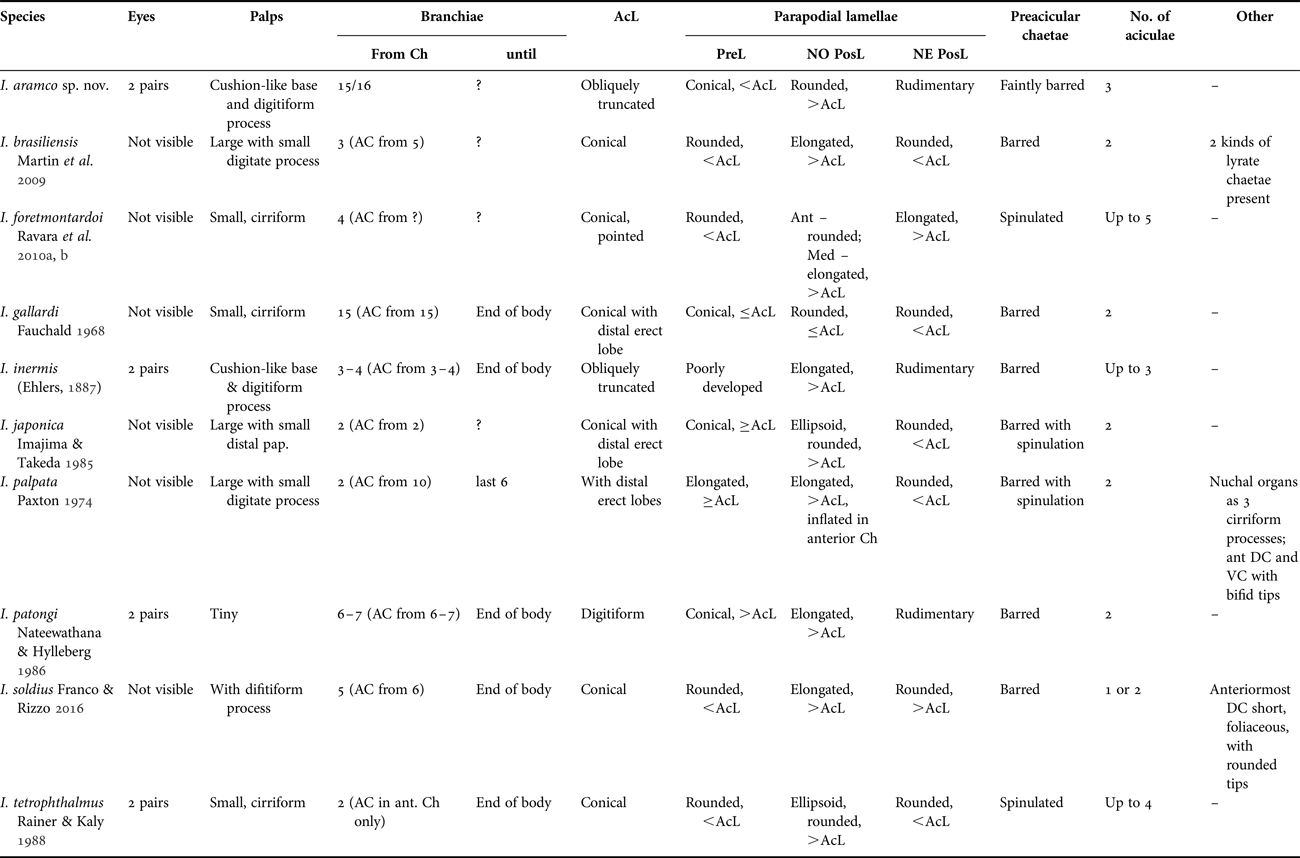
Currently, the genus Inermonephtys includes nine described species, the majority of which are from the Pacific Ocean (Inermonephtys gallardi, Inermonephtys japonica, Inermonephtys palpata, Inermonephtys patongi and Inermonephtys tetrophthalmus), three from the West Atlantic (Inermonephtys brasiliensis, Inermonephtys inermis and Inermonephtys solidus) and one from Europe (Inermonephtys foretmontardoi). Inermonephtys aramco sp. nov. is distinguished from all these species by the chaetiger where branchiae start (15 or 16) and the parapodia morphology. It is morphologically close to I. gallardi, from Vietnam, but differs from it by the parapodia morphology and prechaetal arrangement. In I. gallardi acicular lobes are conical with erect digitiform lobes extending beyond the acicula and neuropodial postchaetal lamellae are present as short and thickset superior lobes, while in I. aramco sp. nov., the acicular lobes are obliquely truncated and the neuropodial postacicular chaetae are rudimentary. Preacicular chaetae in I. gallardi are separated in two fascicles while in I. aramco sp. nov. it forms a continuous fan. Also, eyes are not referred to or represented in the original description and figures of I. gallardi. Table 2 includes diagnostic characteristics for all known species of Inermonephtys.
Morphological comparison of species of Inermonephtys. Observations on parapodial lamellae refer to fully developed parapodia on median chaetigers.

AcL – acicular lobe(s); AC – branchiae accessory cirrus; Ant – anterior(ly); Ch – chaetiger(s); DC – dorsal cirri; Med – median region; NO – notopodia(l); NE – neuropodia(l); PreL – prechaetal lamellae; PosL – postchaetal lamellae; VC – ventral cirri.
ETYMOLOGY
The name of the species refers to the company Saudi Aramco that has been providing the financial support for an extensive baseline characterization of the physico-chemical and biological patterns of the Red Sea, where this species has been found.
DISTRIBUTION
Indian Ocean (S Red Sea).
HABITAT
Muddy sand, 60–82 m depth.
Genus Micronephthys Friedrich, Reference Friedrich1939
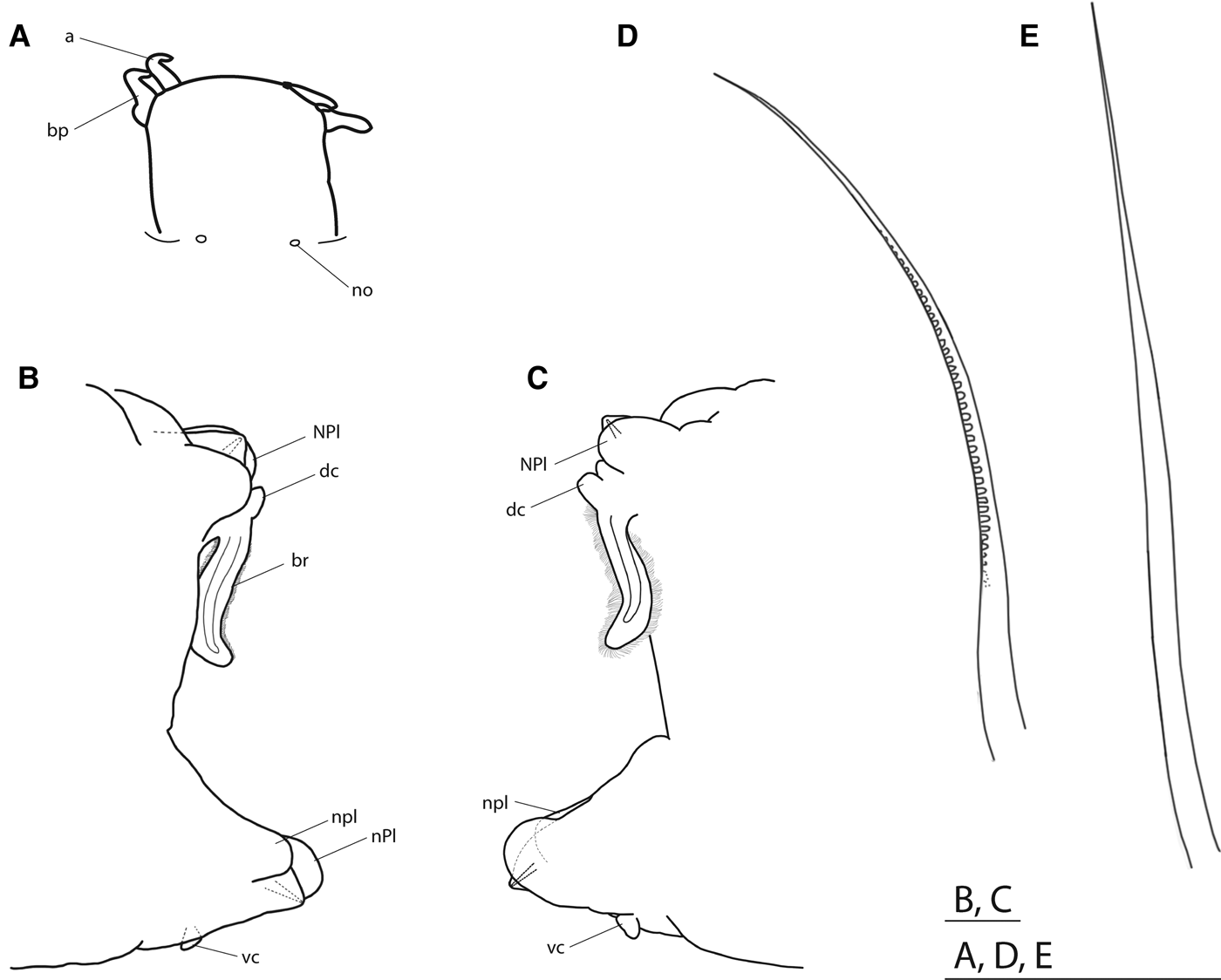
Micronephthys palatii (Gravier, Reference Gravier1904) new combination
(Figure 4A–E)
Nephthys palatii: Gravier, Reference Gravier1904; Gravier, Reference Gravier1906; Fauvel, Reference Fauvel1919b.
Nephtys palatii (A) prostomium; (B) parapodium 15, anterior view; (C) parapodium 15, posterior view; (D) preacicular chaeta; (E) postacicular chaeta. Abbrev.: a, antenna; bp, bifid palp; br, branchia; dc, dorsal cirrus; no, nuchal organ; NPl, notopodial postchaetal lamella; npl, neuropodial prechaetal lamella; nPl, neuropodial postchaetal lamella; vc, ventral cirrus. Scale bars: A – 0.5 mm; B–C – 0.1 mm; D–E – 0.05 mm.

TYPE LOCALITY
Djibouti, Gulf of Aden, N Indian Ocean.
MATERIAL EXAMINED
February 2014: 2 incomplete spms, the larger one with 25 chaetigers, 6.4 mm long, Station JAZ6, 16°51.061′N 42°33.414′E, 5 m depth (DBUA0001883.02); 1 inc. spm with 32 chaetigers, 9.76 mm long, 1,09/1.36 mm wide, Station JAZ7, 16°50.314′N 42°33.616′E, 9 m depth (DBUA0001883.03); 2 inc. spms, Station JAZ8, 16°49.196′N 42°30.704′E, 15 m depth (DBUA0001883.04); 1 inc. spm, Station FI8, 16°51.130′N 41°16.162′E, 81 m depth (SAKMEO); 1 inc. spm, Station JEC6, 17°23.575′N 42°11.750′E, 26 m depth (DBUA0001883.06); 1 inc. spm, Station TH7, 22°12.305′N 39°01.466′E, 25 m depth (DBUA0001883.09); March 2014: 1 inc. spm, Station JH1, 21°30.423′N 39°08.908′E, 12 m depth (DBUA0001883.08); 26 inc. spms, Station JSW1, 21°13.311′N 39°08.929′E, 5 m depth (SAKMEO); 1 inc. spm, Station JC1, 21°03.369′N 39°13.444′E, 19 m depth (DBUA0001883.10); 4 inc. spms, the larger with 22 chaetigers, 7.68 mm long, 0.85/1.24 mm wide, Station JC2, 21°02.924′N 39°14.086′E, 17 m depth (DBUA0001883.11-12); 1 inc. spm, Station JC3, 21°05.455′N 39°11.918′E, 7 m depth (DBUA0001883.13); February 2015: 1 inc. spm, Station JAZ3, 16°51.574′N 42°31.049′E, 10 m depth (DBUA0001883.01); 1 inc. spm, Station FI8, 16°51.150′N 41°16.170′E, 79 m depth (DBUA0001883.05); 3 inc. spms, the larger one with 34 chaetigers, 8 mm long, 0.82/1.17 mm wide, Station JEC12, 17°15.604′N 42°18.101′E, 7 m depth (DBUA0001883.07).
DESCRIPTION
Body of small size (when compared with other nephtyid species), tapering anteriorly to prostomium and posteriorly towards pygidium. Colour in ethanol light tan, without pigmentation patterns. Prostomium sub-quadrangular with convex sides (Figure 4A). Antennae conical, on anterior corners of prostomium. Palps bifid, inserted just behind and subequal in length to antennae (Figure 4A). Bifid palps, when present, are usually clearly developed only in larger specimens (Dnestrovskaya & Jirkov, Reference Dnestrovskaya and Jirkov2010). In our specimens lower branch present as a bump-like projection at base of palp (Figure 4A) (difficult to observe on smaller specimens). Nuchal organs rounded, located near posterior corners of prostomium, difficult to detect (Figure 4A). Pharynx distal region with 10 pairs of terminal bifid papillae with inner rami much shorter than outer, separated by simple conical papillae dorsally and ventrally; long mid-dorsal and mid-ventral papillae present; subdistal region with 22 longitudinal rows of 5 or 6 subterminal papillae; proximal region smooth (pharynx description based on original description of species). One pair of subdermal eyes visible at basal part of second chaetiger. Parapodia of first chaetiger directed forward, parallel to prostomium; acicular lobes acutely conical, prominent in notopodia; notopodial lamellae poorly developed, rounded; neuropodial lamellae forming a cylinder around acicular lobe; dorsal cirri small, conical; ventral cirri smaller than antennae and palps, cirriform. Remaining parapodia of similar size along body, with well separated rami; acicular lobes conical, prominent in anterior parapodia; prechaetal lamellae poorly developed, rounded; postchaetal lamellae similar in length or shorter than acicular lobes, rounded; dorsal and ventral cirri similar in shape and length, conical, very short (Figure 4B, C). Branchiae present from chaetiger 5 (rudimentary) or 6 (well-developed), thick, heavily ciliated, straight or slightly recurved, occupying half the interramal space when fully developed (Figure 4C). Posteriormost parapodia without branchiae. Neuropodial superior lobes absent. Chaetae of three kinds: barred in preacicular position of anterior parapodia, smooth or very lightly spinulated in postacicular position and preacicular position of median and posterior parapodia, and capillary in neuropodia of first chaetiger. Preacicular chaeta about 2/3 length of postacicular ones.
REMARKS
This species, originally described as belonging to the genus Nephtys, is here transferred to the genus Micronephthys based on the small body size of the specimens, the poorly developed parapodial lamellae, the bifid palps and the presence of smooth or slightly spinulated chaetae (instead of barred) in the preacicular position of the median and posterior parapodia (see Ravara et al., Reference Ravara, Wiklund, Cunha and Pleijel2010b, table 5, as Bipalponephtys; Murray et al., Reference Murray, Wong and Hutchings2015, 419). Ravara et al. (Reference Ravara, Wiklund, Cunha and Pleijel2010b) proposed a new genus, Bipalponephtys, for the small body species with bifid palps and capillary-like preacicular chaetae on posterior chaetigers. However, the validity of this genus has been contested based on the presence of those diagnostic characteristics on the holotype of Micronephthys minuta (Théel, Reference Théel1879), the type species of the genus Micronephthys (Dnestrovskaya & Jirkov, Reference Dnestrovskaya and Jirkov2010). Gravier (Reference Gravier1906) recognized all these characteristics (except for the bifid condition of the palps) when describing Nephtys palatii, but at that time the genus Micronephthys had not yet been described.
DISTRIBUTION
Red Sea; Gulf of Aden (bay of Djibouti) (Gravier, Reference Gravier1904; Fauvel, Reference Fauvel1919b; Wehe & Fiege, Reference Wehe and Fiege2002; this study).
HABITAT
Muddy sand, 4–90 m depth (Fauvel Reference Fauvel1919b, this study).
Micronephthys stammeri (Augener, Reference Augener1932)
Nephthys stammeri: Augener, Reference Augener1932.
Nephthys inermis: Augener, Reference Augener1932.
Micronephthys stammeri: Hartman, Reference Hartman1950; Banse, Reference Banse1959; Ravara et al., Reference Ravara, Cunha and Pleijel2010a.
Micronephthys maryae: San Martín, Reference San Martín1982; Rainer & Kaly, Reference Rainer and Kaly1988; Laborda, Reference Laborda, Viéitez, Alós, Parapar, Besteiro, Moreira, Nuñez, Laborda and San Martin2004.
TYPE LOCALITY
Adriatic Sea (Timavo-Geviet region).
MATERIAL EXAMINED
March 2014: 2 incomplete spms, Station JC2, 21°02.924′N 39°14.086′E, 17 m depth (SAKMEO; DBUA0001882).
REMARKS
A recent description of this species can be found in Ravara et al. (Reference Ravara, Cunha and Pleijel2010a). The specimens examined herein add nothing to the previous descriptions. This species was originally described from the Adriatic Sea but is also reported from SE Indian and W Pacific areas. The single specimen identified in this study further extends the geographic distribution of the species along with its bathymetric range (from 7 to 17 m depth).
DISTRIBUTION
Adriatic Sea; Mediterranean Sea (Balearic Islands); Indian Ocean (Red Sea, W Australia); Pacific Ocean (Japan, Marshall Islands) (San Martin, Reference San Martín1982; Rainer & Kaly, Reference Rainer and Kaly1988; Laborda, Reference Laborda, Viéitez, Alós, Parapar, Besteiro, Moreira, Nuñez, Laborda and San Martin2004; this study).
HABITAT
Sandy mud to median sand with gravel and sediment associated with seagrass and algae, 4–17 m depth (Banse, Reference Banse1959; Laborda, Reference Laborda, Viéitez, Alós, Parapar, Besteiro, Moreira, Nuñez, Laborda and San Martin2004; this study).
KEY FOR THE SPECIES OF NEPHTYIDAE FROM THE ARABIAN PENINSULA (ADAPTED FROM RAVARA ET AL., 2010A)
-
1. Prostomium without antennae; nuchal organs digitiform; pharynx without papillae; jaws spindle-shaped………Inermonephtys…2
-
– Prostomium with antennae; nuchal organs rounded; pharynx papillae present; jaws conical, hook-like………3
-
-
2. Branchiae start at chaetiger 4; prechaetal lamellae poorly developed; notopodial postchaetal lamellae elongated………I. inermis
-
– Branchiae start at chaetiger 15/16; pre-chaetal lamellae well-developed; notopodial postchaetal lamellae broadly rounded………I. aramco sp. nov.
-
-
3. Branchiae absent or, if present, small and nearly straight; pre- and postchaetal lamellae rudimentary; body small………Micronephthys…4
-
– Branchiae present, well developed, involute or recurved; at least postchaetal lamellae well developed………6
-
-
4. Branchiae present from chaetiger 5/6, absent from posterior chaetigers; palps bifid; preacicular chaetae of median and posterior parapodia smooth or very lightly spinulated (instead of barred); lyrate chaetae absent………M. palatii
-
– Branchiae absent; palps simple; all preacicular chaetae barred; lyrate chaetae present on median and posterior parapodia………5
-
-
5. Modified chaetae present on notopodia of first chaetiger; two pairs of coalescent eyes present at the level of chaetiger 3………M. stammeri
-
– Modified chaetae absent; one pair of small subdermal eyes may be visible at the level of chaetiger 2–3………M. sphaerocirrata
-
-
6. Acicular lobes acutely pointed; branchiae involute; neuropodial superior lobes may be present; pharynx middorsal papilla absent, proximal papillae sometimes arranged in small groupsAglaophamus………7
-
– Acicular lobes conical, rounded or bilobed; branchiae recurved; neuropodial superior lobes absent; pharynx middorsal papillae present in some species………Nephtys…12
-
-
7. Prostomium eyes absent; branchiae starting at chaetiger 11–13, absent from posterior chaetigers; neuropodial superior lobe absent; postchaetal lamellae shorter than acicular lobes, bilobed in notopodia; lyrate chaetae absent; pharynx with 22 rows of 2–17 short subterminal papillae, proximal papillae arranged in small groups, otherwise smooth………A. malmgreni
-
– Prostomium eyes present or absent; branchiae starting at chaetiger 3–8; neuropodial superior lobe present or absent; postchaetal lamellae similar in length or longer than acicular lobes, always rounded; lyrate chaetae present; pharynx with 14 or 22 rows of up to 9 subterminal papillae, smooth or covered with warts………8
-
-
8. Branchiae starting at chaetiger 5–8, to near posterior end of body; neuropodial superior lobe present at chaetigers 7 to 8/14; prechaetal lamellae bilobed; pharynx with 22 rows of 3–9 subterminal papillae, covered with warts………A. verrilli
-
– Branchiae starting at chaetiger 3–5; neuropodial superior lobe present or absent; prechaetal lamellae rounded; pharynx with 14 rows of up to 6 subterminal papillae, smooth………9
-
-
9. Branchiae starting at chaetiger 4–5; neuropodial superior lobe present………10
-
– Branchiae starting at chaetiger 3; neuropodial superior lobe absent………11
-
-
10. Prostomium eyes absent; branchiae starting at chaetiger 4–5; postchaetal lamellae similar in length to acicular lobes; pharynx with 14 rows of 4–6 subterminal papillae………A. lyrochaetus
-
– Prostomium eyes present; branchiae starting at chaetiger 4; postchaetal lamellae longer than acicular lobes; pharynx with 14 rows of 4–5 subterminal papillae, proximal papillae arranged in small groups………A. dibranchis
-
-
11. Prostomium eyes present; neuropodia elongated surpassing notopodia, with poorly developed postchaetal lamellae; pharynx with 14 rows of 4–6 subterminal papillae, smooth………A. longicephalus
-
– Prostomium eyes absent; neuropodia and notopodia similar in length and shape, pharynx with 14 rows of 4–5 subterminal papillae, covered with warts………A. lobatus
-
-
12. Acicular lobes conical; prechaetal lamellae well developed, rounded or bilobed; postacicular chaetae finely spinulated; branchiae start at chaetigers 4–10; pharynx proximal region smooth or covered with warts………13
-
– Acicular lobes rounded to bilobed; prechaetal lamellae rudimentary or poorly developed; postacicular chaetae coarsely spinulated; branchiae start at chaetigers 3–14; pharynx proximal region smooth………15
-
-
13. Postchaetal lamellae of neuropodia extending well beyond acicular lobes; branchiae with dorsal membranous expansion, start at chaetiger 4, to near posterior end; pharynx covered with minute warts, middorsal papilla long………N. tulearensis
-
– Postchaetal lamellae poorly developed or no longer than twice the length of acicular lobes; branchiae start at chaetigers 5–10, absent from posterior chaetigers; pharynx smooth, middorsal papillae long………14
-
-
14. Postchaetal lamellae up to twice the length of acicular lobes; branchiae start at chaetigers 5–7, usually at chaetiger 6………N. hystricis
-
– Postchaetal lamellae shorter than or as long as acicular lobes; branchiae start at chaetigers 9–10………N. incisa
-
-
15. Acicular lobes truncated to slightly bilobed; postchaetal lamellae more than twice as long as acicular lobes, much longer in neuropodia; branchiae start at chaetiger 3, to near posterior end of body………N. longosetosa
-
– Acicular lobes rounded with conical tip; postchaetal lamellae equal in size or slightly shorter than acicular lobes; branchiae foliaceous, start at chaetigers 9–14, reduced in posterior chaetigers………N. paradoxa
-
ACKNOWLEDGEMENTS
The authors would like to thank the crew of the RV ‘Thuwal’ and the staff of the Coastal and Marine Resources Core Lab, namely Abdulaziz Al-Suwailem, David Pallett, Francis Mallon, Haitham Aljahdali, Ioannis Georgakakis, Ramzi S. Aljahdali and Zenon Batang for their support before, during and after the scientific cruises. We are also grateful to our colleagues Holger Anlauf, Zahra AlSaffar, Saskia Kürten, Richard Payumo and Amr Gusti for their help during field and laboratory work. Ute Langner prepared the maps presented in the paper. In one of the expeditions to the southern Red Sea, the help of 10 students from the Reed Ecology class (2014) was invaluable to accomplish our goals. We also thank the very useful suggestions of the two anonymous reviewers that greatly improved the manuscript.
FINANCIAL SUPPORT
This study has resulted from collaboration between KAUST and Saudi Aramco within the framework of the Saudi Aramco-KAUST Center for Marine Environmental Observations. The first author was supported by FCT co-financed by ESF and MEC (SFRH/BPD/112408/2015) and by CESAM with funds from FCT/MEC co-financed by the FEDER within the PT2020 Partnership Agreement and Compete 2020 (UID/AMB/50017).