A co-operative beginning
The AKMB (Arbeitsgemeinschaft der Kunst- und Museumsbibliotheken – Working Group of Art and Museums Libraries) was founded in February 1995 and held the first member's meeting on occasion of the annual Librarian's Conference at Göttingen in June.Footnote 1 The first issue of AKMB-news, a simple word processed document, was published in August. This look into the history shows the close relationship between the working group and its main publishing format. The profile, formulated in the first editorial, corresponds to the mission statement, defined for the working group: to publicize the activities of the new founded working group, to improve the communication and exchange of information between art and museum libraries of different sizes, as well as between related institutions, tips and tricks for the daily work. The affiliated museums and libraries of the members of the first editorial board belong to the founding members of the AKMB, coming from all over Germany (Hanover, Bonn, Cologne, Karlsruhe). The editorial board was supported by two board members from Düsseldorf and Berlin.Footnote 2 At a later date other ways of communicating and publishing followed, because of the immense technological changes since the 1990s. AKMB-news still plays an important role, all members receive the journal by subscription and the revenues finance the work of the AKMB.
Art and museum libraries do not really match to the classical schema of the library structures within the German speaking region in the 1990s. Although art and museum libraries can be in different types of institutions (public, academic, or research), vary in size and staffing numbers, accessibility, and funding provider, they share common subject areas - arts and humanities - as well as their passion for the work. The AKMB was founded, because there was no adequate possible partner within the library field, and also a new journal.
Layout and editorial work – step-by-step to a professional workflow
The members of the first editorial board did not have much experience in making a journal, but having an art and media background, the development of a professional layout and design had high priority. Supported through personal contacts and networks, the second issue obtained a new look, including a first logo, and a ISSN. Three issues per year (30–40 pages) had to be filled in form and content. The whole production process was organized by the editorial team itself.
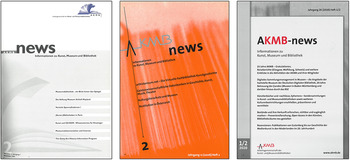
Again personal contacts and networks were activated and a publisher contacted. VDG (Verlag und Datenbank für Geisteswissenschaften – Publishing Company and Database for Art & Humanities), located in Weimar and founded in 1992, took over the production process until 2004.Footnote 3 The publishers were responsible for the layout and design of the issues and organised the printing. The editorial board was able to focus on the content and editorial work. One member of the editorial board had the main responsibility for each issue and coordinated the workflow, also with the publisher. The first design was used until 1999. After five volumes with covers in combinations of grey, blue and white, more colours were introduced. Each volume had its own color – red, green, orange, light blue, grey/silver – and the logo of the AKMB changed. The layout inside of the issues, grey background for the text, remained unchanged until 2002, afterwards the background became white and some other details were updated.
In 2005 – with volume 11 – the frequency was reduced from three to two issues (with 70–80 pages). The editorial states, that the profile of the content will not change, but the board had to react to increasing production costs, the growing workload of the editorial staff, still working on a voluntary basis, and that new ways of communication were also available for AKMB members and more and more used - website and mailing list are at the disposal to distribute current and short-lived information, for example about professional training programs, study tours, surveys, or colleagues' queries.Footnote 4 The cooperation with VDG Weimar was terminated and the editorial board was able – thanks to support and contacts of the network again – to find another partner for the production process, i.e. the layout of the issues, printing, and distribution. The spectrum of coloured covers did not change until 2016, while an increasing number of black and white pictures illustrated the articles. The editorial board benefits here also from the changing technologies and the easier ways to generate illustrations for the articles, specially with regard to the topic and the importance of visual aspects. On the other hand, at least one member of the editorial board had to become an expert in handling the images, in communicating between the authors and the publisher, with regard to formats, quality and size.
Covers of the AKMB-news 1995, 2006, 2020

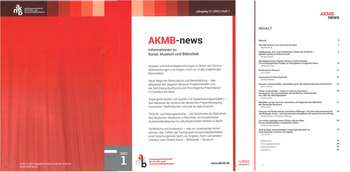
In 2017 the cover of the AKMB-news became grey once again, with some color elements, the layout inside was revised with some colour elements, too, primarily with coloured images. The chromaticity of media and objects, handled within art and museum libraries, was transferred to the journal and may, from time to time, brighten the ‘grey’ day-to-day work.Footnote 5 The latest changes took place in volume 27 in 2021, because the AKMB as an organization has renewed its branding. On the occasion of the 25th anniversary in 2020, the board of the AKMB assigned a design practice to develop a new logo and some promotional material in order to modernize the image of the working group. The anniversary issue was published as double issue in the previous style, distributed together with some giveaways as a birthday present in the new style in October 2020. The layout of the next volume has been once more adapted and redesigned – the logo, the font, and decorative elements will be implemented and fit to the new and modernized appearance of the AKMB.
Layout of the AKMB-news, adapted to the new CI

And what about the content?
After more than 25 years about 70 issues have been published. If one has a look to the website, containing the archive of the news (https://www.arthistoricum.net/netzwerke/akmb/akmb-news), it is possible to get an overview by category.Footnote 6 The highest figure of hits can be found under contributions („Beiträge“) with 392, reviews („Rezensionen“, „Neuerscheinungen“, „Publikationen“) with 125, reviews of fiction („ohne Zugangsnummer“) with 101 and reports („Berichte“, „Mitteilungen“, „Fortbildungen“) with 87 records. All kinds of digitized contributions, independent of the category, are recorded and accessible through the GVK (Gemeinsamer Verbundkatalog – Common Union Catalogue). The names of the categories changed in some cases and some ideas just were experiments or could not be realised for the long term.
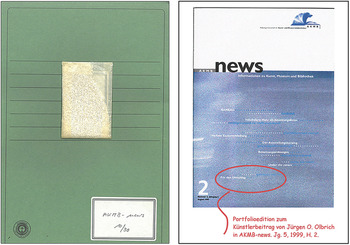
An ambitious approach were the contributions of artists („Künstlerbeiträge“) between 1997 and 1999. The idea was to present adjacent to information and discussions about libraries and museums art works with relation to or inspired by museums and libraries. The first came from Jan Svenungsson (Swedish artist, born in 1961), the second from Thomas Huber (Swiss artist, born in 1955), the following from Jenny Holzer (US-american artist, born in 1950), two contributions in one issue by Jürgen O. Olbrich (German artist, born in 1995) and by Lawrence Weiner (US-american artist, born in 1942), the last one by Katrin von Maltzahn (German artist, born 1964). In 2000 followed a second article with regard to the contribution of Jenny Holzer and how the idea was put into practice in some art and museums libraries.Footnote 7 Contributions of artists can only be acquired, if one has contacts to artists, working on this topic, and the artist is interested in working together with such a quite small and unknown journal. In some cases the artistic work was part of the printing and production process and complicated the cooperation with the publisher. The idea to continue this kind of contributions comes up regulary, but without artist contacts, this initiative cannot proceed.
A very successful category „ohne Zugangsnummer“ (without accession number), contains reviews of (light) fiction. From the perspective of art and museums libraries this kind of literature may not be relevant to the collection profile, but is an entertaining way to learn something about the arts, art history, libraries, the image of libraries and librarians … Meanwhile the editors restrict the number of reviews within this category, because it is (only) an add-on at the end of each issue.
Contribution of artists by Jürgen O. Olbrich, limited edition with 30 copies

Contributions and reports reflect the whole range of aspects within the work of art and museum libraries:
• Technical issues - computer-based work and digitization, new services and strategies
• Collection and library management
• Rules and standards with regard to cataloguing and indexing, data exchange, metadata
• Concepts and roles of libraries - history, self-conception, image and visibility, marketing and public relations
• Provenance of art objects and other cultural resources
• The legal framework – copyright, open access, data security
• Quality management
• Intersectional cooperation between archives, libraries, galleries, and museums
• Sustainable preservation and long-term archival strategies
• Networking on the local, regional, national, and international level
• Examples of best practice, portraits of art and museum libraries
How does the editorial team acquire the contributions? The members of the team have varied throughout the 25 years. The idea was to find members from all over Germany and from different types of art and museum libraries. In the meantime a stable workflow and schedule has been developed and implemented. Normally the editors meet twice a year on-site - once in January or February to discuss the first issue (to be distributed in June) and in July to manage the second issue (to be distributed in November). The current team consists of five colleagues, located in Paris, Frankfurt, Bonn, Düsseldorf, and Wolfsburg. Some other colleagues support the editorial team by proofreading.
During the first years the content focussed more on the activities and interests of the AKMB itself. The journal was the only or main resource to inform and improve the communication among the members. Furthermore the editors use their contacts and networks, press releases and other information. The participation in congresses and workshops helps to find interesting topics and authors. In the context of events organized by the AKMB itself, the editors ask the speakers to publish their papers, as well they ask colleagues taking part in study tours and excursions to report on the events. Sometimes the editorial team receives proposals for articles or reviews.
Future prospects
Already in the first issue (1995) an article discussed the question of digital ways of communication. Shortly afterwards the question arose of the digital publication instead of, or parallel to, the printed version.Footnote 8 In 2010 the editorial team initiated a survey, asking for the degree of satisfaction and profile of the readers. The survey was developed in collaboration with the AKMB as a bachelor's dissertation at the University of Applied Science in Information Management at Hanover.Footnote 9 One question examined the opinion concerning the preferred version. The readers preferred the printed version, even though they accepted a digital version as well. But an important aspect was not included in the survey – the question of funding, the willingness to pay for the digital version as well as for the printed one. Since that time new payment models have been developed and habits of usage may have changed. Open access is a topic in this context. But on the other hand, the arts live through the feel of surface, materiality and many more analogue aspects. Examples are artists‘ books or study collections of materials. And last but not least, which revenues will the AKMB have at its disposal, when the membership is not anymore related to the subscripton of the printed journal? The discussion of the channels of distribution and how to generate funding will continue in future with regard to changing possibilities and practices of its members.