




No CrossRef data available.
Article contents
Changes in causes of sudden deaths by decade in patients with coronary arterial lesions due to Kawasaki disease
Published online by Cambridge University Press: 16 September 2005
Abstract
Over a 25-year period, we encountered 12 patients who died suddenly with coronary arterial lesions due to Kawasaki disease. We report their clinical course, and analyze the happenings of their deaths. Of the 12 patients, 10 were dead on arrival at hospital. Their age at death ranged from 13 months to 27 years, with a median of 16 years, and the interval from the onset of Kawasaki disease to death ranged from 2 months to 24 years. In 4 patients, death was found to be due to myocardial infarction, while in the remaining 8, it could not be determined. In 7 patients, coronary angiograms obtained less than 4 months after the acute onset of Kawasaki disease showed lesions bilaterally, most being giant aneurysms. Myocardial infarction had occurred in 6 patients prior to their death. In 1 patient of the late 1970s, who collapsed after running, cardiac sequels had not been suspected prior to autopsy. During the 1980s, 3 infants with bilateral giant aneurysms died within a year of the initial onset of Kawasaki disease, with acute myocardial infarction being the cause in 2 of them. In the late 1990s, and the 2000s, 5 patients died suddenly with left ventricular dysfunction, their ejection fractions being less than 40 percent more than 20 years after the initial onset of Kawasaki disease. Prior to their sudden deaths, they had had no cardiac events for many years, but had suffered previous myocardial infarctions. Multifocal premature ventricular contractions, and non-sustained ventricular tachycardia, are probable risk factors in such patients. Careful follow-up, checking for ventricular arrhythmia, is needed to prevent sudden death in patients suffering left ventricular dysfunction in the setting of Kawasaki disease.
Keywords
Information
- Type
- Original Article
- Information
- Copyright
- © 2005 Cambridge University Press
Although it is now almost 40 years since Kawasaki first described the disease that now carries his name, its long-term prognosis remains unclear.1, 2 In recent years, encouragingly, the rate of death due to the disease and its cardiac sequels has decreased to less than 0.1 percent.3 It remains important, nonetheless, to prevent late deaths in those patients with coronary arterial lesions resulting from the disease. In this light, because we have now encountered 12 patients with the disease who died suddenly, we have analyzed their clinical course, and what is known of the causes of their deaths, seeking to determine if the cause of death has changed over the last three decades with improvements in medical and surgical treatment.
Patients
From 1977, from 580 patients with coronary arterial lesions due to Kawasaki disease being followed up in our hospital, 19 have died, 15 of male gender and 4 female. Amongst these 19, 12 patients died suddenly (63 percent), with 10 of these being male and 2 female (Table 1). For the purposes of this study, we have defined sudden death as occurring within 24 hours of the precipitating event. The age at sudden death ranged from 13 months to 27 years, with a median of 16 years. The age at the onset of Kawasaki disease varied from 2 months to 12 years, with a median of 1 year, and the interval from the onset of the disease to death varied from 2 months to 24 years.
Table 1. Details of the patients dying suddenly.

According to the decade of onset of Kawasaki disease, six of the patients had suffered the acute onset during the 1970s, five in the 1980s, and one over the 1990s. The course of Kawasaki disease had been typical in 11, but atypical in one. The fever suffered in the acute stage had lasted from 10 to 30 days. Cardiac failure with disseminated intravascular coagulation had occurred in one patient, and another had developed a pericardial effusion.
Treatment during the acute phase had consisted of aspirin in 5 patients, and aspirin together with steroids in 1. Intravenous immunoglobulin had been given to two patients, late after the onset in one, and in a small dose in the other. Treatment during the acute stage could not be determined in four patients. During follow-up, antiplatelet agents were given to nine patients, and warfarin to two. Other medications included inhibitors of angiotensin converting enzyme given to 2 patients, beta-blockade to 1, a calcium antagonist to 2, and nitrates in 2 (Table 1).
Among the patients not dying suddenly, 5 had died due to cardiac disease, and 2 from non-cardiac causes. All patients dying with cardiac problems had triple-vessel coronary arterial disease. Of these, 4 had suffered heart failure due to previous myocardial infarction. In 1983, 2 patients admitted because of heart failure died of recurrent myocardial infarction, both aged 20 months. Of these, 1 boy sustained 2 myocardial infarctions within 6 months of the onset of the Kawasaki disease, and died 16 months after the onset. The other patient, a girl, had cardiomegaly and developed decreased motion of the posterior wall of the left ventricle 12 months after the acute illness. She died 15 months after the onset. In 1999, 2 patients died subsequent to transplantation because of heart failure secondary to myocardial infarction. Another patient died in 1989 during attempted percutaneous balloon angioplasty.
Methods
In the patients dying suddenly, we analyzed the clinical course after the acute episode, and sought to establish the cause of the sudden death. Autopsies had been performed in only 3 of the 12 patients. Cardiac catheterization and selective coronary angiography had been performed in 11, while an initial coronary angiogram had been performed within 4 months of the acute onset of disease in 7 of these. The last angiogram prior to the sudden death had occurred from 5 days to 9 years previously, with a median of 1 year. From the angiograms, we calculated left ventricular end-diastolic volumes, and left ventricular ejection fractions, using Simpson's method. Other investigations had included radionuclide myocardial perfusion imaging in 11 patients; dipyridamole loaded body surface electrocardiographic mapping in 8, treadmill testing in 7, and Holter monitoring in 9. For the purposes of our analyses, we defined non-sustained ventricular tachycardia as 3 or more successive ventricular beats at a rate greater than 120 beats per minute and lasting less than 30 seconds, with no associated symptoms other than nonspecific palpitations.
Results
Sudden deaths
The time of sudden death is shown in Table 1. Of the 12 patients, 10 were dead on arrival at hospital, with 9 of these deaths occurring at other hospitals. The cause of sudden death was established as acute myocardial infarction in 4 patients, but could not be determined with certainty in the remaining 8.
Sudden collapse while at school had occurred in 2 cases. Our first patient, an 8-year-old boy, fell down after running in 1979, and autopsy revealed previously undiagnosed coronary arterial lesions, with evidence of both acute and old myocardial infarction, aneurysms and severe localized stenosis of the left anterior interventricular artery. Our fifth patient, a 15-year-old boy, collapsed in 1990 while playing soccer. In his case, coronary arterial lesions due to Kawasaki disease had been revealed by electrocardiographic tracings taken at school when he was 13. A 12-lead tracing showed negative T waves in lead III. His coronary angiogram revealed segmental stenosis of the right coronary artery, and localized stenosis of the anterior interventricular artery. Depression of the ST-T segments in leads II, III, aVF and V4-6 were found in the dipyridamole loaded electrocardiogram. Anteroseptal ischemia, however, had not been detected by either myocardial perfusion imaging or by treadmill exercise testing. Although advised not to exercise by his doctor, the patient did not follow the advice.
A 13-month-old boy, our second patient, had died 5 days after cardiac catheterization in our hospital in 1983. Early in the morning, his condition suddenly deteriorated, and an electrocardiogram showed elevation of the ST-T segments in leads II, III, and aVF. Ventricular fibrillation ensued, and despite attempted resuscitation, he died. Autopsy confirmed acute inferior myocardial infarction, with occlusion of the right coronary artery.
Our third patient, a 1-year-old boy who had undergone coronary arterial bypass grafting of his left anterior interventricular artery 2 months previously, died one morning immediately after crying. Autopsy showed patency of the grafts, but occlusion of the distal left anterior interventricular artery. He was known to have a distal aneurysm of this artery. Our fourth patient, another 1-year-old boy, died in 1988 after taking a bath.
Our sixth patient, an 18-year-old boy, developed back pain after dinner in 1996, and attended the local clinic. An electrocardiogram on arrival showed elevation of the ST-T segments in leads II, III, and aVF. Complete atrioventricular block and bradycardia occurred immediately after taking the tracings, followed by cardiac arrest. He could not be resuscitated.
Our seventh and eighth patients died during their sleep in 1999. The seventh patient, a 16-year-old boy known to have a giant aneurysm of the left coronary artery, and occlusion of the right coronary artery, was found dead in the morning by his mother. He had had no symptoms since a previous inferior myocardial infarction. The eighth patient was a 22-year-old male who had suffered a myocardial infarct in the inferior and anteroseptal areas. His left ventricular ejection fraction was 39 percent, and he was known to have significant localized stenosis in the left circumflex. He had had his first inferior infarction at the age of 8 months, and suffered a second anterior infarction at the age of 15 years. Coronary arterial bypass grafting was advised, but because he was asymptomatic, he and his family decided to postpone surgery until after examinations for employment. He died on the morning of the examination.
Our tenth patient was a 19-year-old female who had suffered with ischaemic cerebral damage after a myocardial infarction at the age of 11 months. She fainted, and was found dead by her parents in 2000. She was known to suffer from non-sustained ventricular tachycardia, and had a low left ventricular ejection fraction.
The ninth patient, a 22-year-old male, and the eleventh patient, a 27-year-old female, both collapsed immediately after complaining of chest pain or discomfort occurring at midnight, in 1999 and 2002, respectively. The young man had contracted Kawasaki disease in 1977, when he was 6-month-old. The diagnosis was made later, when he was referred to our hospital at the age of 6 years. Investigation at that time revealed segmental stenosis of the left anterior interventricular, circumflex, and right coronary arteries (Fig. 1). The native arteries were too small to permit coronary arterial bypass grafting. He remained asymptomatic until his sudden death, although a treadmill test showed ischaemic changes. He had a low left ventricular ejection fraction, increased left ventricular end-diastolic volume, with multifocal premature ventricular contractions and non-sustained ventricular tachycardia. He had not experienced any cardiac event, nor suffered symptoms, until his fatal episode. The young lady was referred to our hospital when 15 years old, with heart failure due to myocardial infarction and mitral regurgitation. She underwent coronary arterial bypass grafting to the left anterior interventricular artery using the internal thoracic artery, and mitral annuloplasty. A postoperative angiogram showed a string sign of the left internal thoracic artery. The mitral regurgitation was reduced, and the left ventricular volume index decreased from 315 to 197 millilitres postoperatively. Left ventricular ejection fraction was decreased by the use of verapamil to prevent short runs of premature ventricular contractions. She improved functionally from the third to the first class of the system devised by the New York Heart Association when treated with beta-blockade and inhibitors of angiotensin converting enzyme. She had suffered, however, frequent episodes of asymptomatic non-sustained ventricular tachycardia a few years before her sudden death.

Figure 1. The selective coronary angiograms taken in our ninth patient at the age of 17 years. The left hand panel shows the right, and the right hand panel the left coronary angiogram.
The twelfth patient, a 26-year-old male, collapsed in the parking lot, where he was found dead in 2003. He had had a dilated left ventricle, suffering left ventricular dysfunction after myocardial infarction when 2 years old. He had had segmental stenosis of the right coronary artery, but no stenosis of the left anterior interventricular artery (Fig. 2). He had remained asymptomatic until his sudden death, although he had increased left ventricular end-diastolic volumes, a low left ventricular ejection fraction, multifocal premature ventricular contractions, and non-sustained ventricular tachycardia.

Figure 2. These selective coronary angiograms were taken at the age of 21 years in our twelfth patient. The left hand panel shows the right, and the right hand panel the left coronary angiograms.
Coronary arterial lesions and a history of acute myocardial infarction
Initial selective coronary angiograms performed in 7 patients showed bilateral lesions in all, mostly giant aneurysms (Table 2). The coronary arterial lesions identified in the last coronary angiogram are shown in Table 2. The remaining patient was diagnosed at autopsy. In 2 of the patients, none of the branches showed stenotic lesions, but amongst the others, 1 artery was involved in 6 patients, 2 arteries in 2 patients, and all 3 in the final patient. Significant localized stenoses, suitable for coronary arterial bypass grafting, were identified in 2 patients.
Table 2. The table shows the maximal measured diameters of the coronary arteries as observed in the initial coronary angiograms, and the details of the obstructive lesions found in the latest studies.

Of the 12 patients, 6 had suffered a myocardial infarct prior to their death (Table 1), with 3 of the 6 having more than two separate episodes of infarction. In 5 patients, the first episode occurred less than 1 year after the initial attack by Kawasaki disease. In 3 patients, the infarction was asymptomatic, and occlusion or segmental stenosis was first recognized at selective angiography. In 2 patients, there was no history of myocardial infarction.
Left ventricular ejection fraction and arrhythmia
Left ventricular ejection fractions measured at the last cardiac catheterization is shown in Table 3. In 6 of 11 patients, ejection fractions were decreased to less than 50 percent. Left ventricular end-diastolic volume was increased in all these patients. Levels of brain natriuretic peptide had been measured in 5 patients, being normal in 4, but raised at 91 picograms per millilitre in the eleventh patient. All patients, except the one with ischaemic brain damage, were in the first class of the functional classification devised by the New York Heart Association.
Table 3. Details of left ventricular ejection fractions and ventricular arrhythmias.

Multifocal premature ventricular contractions were detected in 4 of the 6 patients with non-sustained ventricular tachycardia (Table 3). These four had asymptomatic non-sustained ventricular tachycardia, and had a left ventricular ejection fraction less than 40 percent. The age at detection of non-sustained ventricular tachycardia ranged from 8 to 17 years.
Myocardial imaging, treadmill testing and dipyridamole loaded testing
In perfusion images at rest, perfusion defects were present in 9 of 11 patients, treadmill testing showed ST-T abnormalities in 1 of 7 tested (Table 3); and dipyridamole loaded mapping showed ischaemia in 3 of the 8 patients tested.
Discussion
In 11 of our 12 patients, coronary angiograms had revealed multi-vessel disease of the coronary arteries prior to the sudden death. In 9 of the 11, the studies had shown occlusions of one or more coronary arteries, with 6 known to have suffered previous myocardial infarctions, and 3 patients having had asymptomatic myocardial infarctions. Both multi-vessel disease and previous infarction are known to be risk factors for sudden death.4
All the patients, however, had also been born in the 1970s and 1980s, when appropriate treatment for acute phase of Kawasaki disease had not yet been established.5, 6 During that period, many other patients almost certainly died, but precise means of diagnosis of the cardiac sequels were not used. For example, many sudden deaths related to exercise occurring in the 1970s and 1980s in patients who had not, at the time, been diagnosed as suffering from the coronary arterial lesions that are now known to be the sequel of acute Kawasaki disease.7–10 Although sudden deaths related to exercise have decreased recently, autopsies still show that some of those dying suddenly in this fashion have coronary arterial lesions suggestive of previous Kawasaki disease.11–13 And we still encounter patients with coronary arterial lesions suggestive of previous acute Kawasaki disease, but in whom the disease had not previously been diagnosed.14, 15 These patients are also, unfortunately, often recognized only because of an acute myocardial infarction, or even sudden death.16
In addition to the fact that the correct diagnosis was often not made, the mode of use of anticoagulants for the coronary arterial lesions caused by Kawasaki disease in the 1970s and early 1980s, as compared to current practice, was insufficient to prevent myocardial infarction. Thus, one of the causes of sudden death up to the early 1980s was acute myocardial infarction within several years of the onset of Kawasaki disease.4 More effective anticoagulation, including the use of warfarin, has now certainly decreased the prevalence of acute myocardial infarction. We now know that, because giant aneurysms often cause acute myocardial infarction during the first year after the onset of Kawasaki disease, anticoagulation is essential when these lesions are recognized.
Coronary arterial bypass grafting using the internal thoracic arteries was also introduced as treatment for afflicted patients in the middle of the 1980s,17 and is now recognized as an effective means of myocardial revascularization, improving the prognosis for patients with severe stenotic lesions.18 This advance using appropriate surgical techniques has also now decreased the prevalence of sudden deaths, as well as improving the quality of life for patients with severe coronary arterial stenosis. Although our third and eleventh patients who died suddenly had undergone coronary arterial bypass grafting, it is clear that the grafts placed were insufficient. Surgical revascularization had also been proposed for our fifth and eighth patients, but unfortunately they died before surgery could be undertaken. This highlights the fact that symptoms caused by Kawasaki disease are rare, and evidence of ischemia is often not present until infarction occurs. Furthermore, acute myocardial infarction as a sequel of Kawasaki disease is often caused by giant aneurysms in the absence of significant stenosis, and coronary arterial bypass grafting is not indicated in this setting. For all these reasons, it remains difficult to determine the optimal time for surgery.
The 18-year-old who died because of inferior wall infarction and complete heart block was taken to a small countryside clinic, where the staff was not totally aware of the implications of the diagnosis. This highlights the fact that patients at high risk of cardiac complications, and their families, should be educated about emergency treatment. More public education on the emergency management for patients suffering potential sudden death is also desirable.
In 3 of the patients, the eighth, tenth and twelfth in our series, no significant localized stenosis or large aneurysms had been seen on their most recent coronary angiograms, but all 3 were known to have decreased left ventricular ejection fractions, as well as suffering multifocal premature ventricular contractions and non-sustained ventricular tachycardia. In these patients, their sudden deaths were completely unexpected, and the causes of the deaths were unknown. As one of the known causes of sudden deaths, arrhythmia may be the most likely explanation. In the late 1990s and early 2000s, several sudden deaths were reported in patients with left ventricular dysfunction suffering non-sustained ventricular tachycardia.19 These patients were born in the 1970s and 1980s, had suffered myocardial infarction early after the onset of Kawasaki disease, but had had no cardiac events and no symptoms for many years prior to their sudden deaths. On the basis of previous mid-term follow-up, the possibility of sudden death in this population was considered to be low,20 but our experience now suggests this to be incorrect. There are probably some more patients, now in their twenties, who are at risk. The cause of sudden death in this group, and its prevention, is an important issue. Electrophysiologic studies may be needed to detect potentially fatal arrhythmias in such patients.
Ventricular premature complexes are suggested to increase the risk of sudden death after myocardial infarction due to atherosclerosis in adults,21 albeit that this interpretation has been controversial.22 In the previous decade, we considered that 3–4 beats of premature ventricular contraction did not necessarily indicate a poor prognosis in children. More recently, in adults, it has been suggested that those with ischaemic cardiomyopathy, severely depressed left ventricular function, and asymptomatic non-sustained ventricular tachycardia may be at significant risk for future arrhythmic events even when electrophysiologic studies have proved negative.23 It may be the same for patients with left ventricular dysfunction and non-sustained ventricular tachycardia due to coronary arterial lesions after Kawasaki disease. Sudden deaths in patients with left ventricular dysfunction due to Kawasaki disease, however, have occurred more than 20 years after a previous myocardial infarction. We suspect that fatal arrhythmias in such patients are a late complication of myocardial infarction. Their timing may differ from that of sudden deaths with left ventricular dysfunction in adults due to atherosclerosis. This means that we need to recognize the potential for possible cardiac events occurring late after previous myocardial infarctions.
It is already known that bilateral giant aneurysms due to Kawasaki disease leading to myocardial infarction, decreased left ventricular ejection fraction, multifocal premature ventricular contractions and asymptomatic non-sustained ventricular tachycardia are major risk factors for sudden death. In these patients, the prevention of myocardial infarction and left ventricular dysfunction depends on careful follow-up, anticoagulation, and coronary revascularization. In the presence of left ventricular dysfunction, it will be necessary to use inhibitors of angiotensin converting enzyme and beta-blockade if we are to improve the prognosis. Electrophysiologic studies and antiarrhythmic treatment may be required in certain cases. If critical ventricular tachycardia is detected, catheter ablation or implantation of a cardioverter-defibrillator should be considered.24, 25 Recently, we encountered such patients with low ejection fractions.26 In these patients, careful follow-up is mandatory even if critical ventricular tachycardia is not detected. Prevention of sudden death is an urgent challenge in patients with Kawasaki disease suffering chronic left ventricular dysfunction due to a previous myocardial infarction.
Our experience shows, therefore, that sudden death may occur more than 20 years after the initial onset of Kawasaki disease, particularly in patients with left ventricular dysfunction when the left ventricular ejection fraction is less than 40 percent. We suggest that multifocal premature ventricular contractions, and non-sustained ventricular tachycardia, are probable risk factors in such patients.
Acknowledgements
We thank all those paediatric cardiologists working at the National Cardiovascular Center in Osaka since 1977 for their support and cooperation. We thank Professor Peter Olley and Dr Setsuko Olley for their kind help with the use of the English language.
References
Kawasaki T, Kosaka F, Ozawa S, Shigematsu I, Yanagawa H. A new infantile acute febrile mucocutaneous lymph node syndrome (MLNS) prevailing in Japan. Pediatrics 1974; 54: 271–276.Google Scholar
Kato H, Sugimura T, Akagi T, et al. Long-term consequences of Kawasaki disease. A 10 to 21 year follow-up study of 594 patients. Circulation 1996; 94: 1379–1385.Google Scholar
Nakamura Y, Yanagawa H, Harada K, Kato H, Kawasaki T. Mortality among patients with a history of Kawasaki disease: the third look. Acta Paediatr Jpn 2002; 156: 162–165.Google Scholar
Kato H, Ichinose E, Kawasaki T. Myocardial infarction in Kawasaki disease: Clinical analyses in 195 cases. J Pediatr 1986; 108: 923–927.Google Scholar
Furusho K, Kamiya T, Nakano H, et al. High-dose intravenous gammaglobulin for Kawasaki disease. Lancet 1984; 2: 1055–1058.Google Scholar
Newburger JW, Takahashi M, Burns JC, et al. The treatment of Kawasaki syndrome with intravenous gamma globulin. N Engl J Med 1986; 315: 341–347.Google Scholar
Quam JP, Edwards WD, Bambara JF, Luzier TL. Sudden death in an adolescent four years after recovery from mucocutaneous lymph node syndrome (Kawasaki Disease). JFSCA 1986; 31: 1135–1141.Google Scholar
Wreford FS, Conradi SE, Cohle SD, Lie JT, Dana SE, Puri S. Sudden death caused by coronary artery aneurysms: A late complication of Kawasaki disease. JFSCA 1991; 36: 51–59.Google Scholar
Smith BA, Grider DJ. Sudden death in a young adult: sequelae of childhood Kawasaki disease. Am J Emerg Med 1993; 11: 381–383.Google Scholar
Fineschi V, Reattelli LP, Baroldi G. Coronary artery aneurysms in a young adult: a case of sudden death. A late sequelae of Kawasaki disease? Int J Legal Med 1999; 112: 120–123.Google Scholar
Madrid AH, Marin-Huerta E, Serrano MC, Barcia F, Villagra F, Rayo I. Aborted sudden death in the chronic phase of Kawasaki disease. Am Heart J 1991; 121: 1547–1549.Google Scholar
Lier DV, Jores PG, Cools F, Bossaert LL, Vrints CJ. Successful recovery after ventricular fibrillation in a patient with Kawasaki disease. Resuscitation 2000; 44: 215–218.Google Scholar
Burke AP, Frab A, Virmani R, Goodid J, Smialek JE. Sports-related and non-sports-related sudden cardiac death in young adults. Am Heart J 1991; 121: 568–575.Google Scholar
Kristensen IB, Kristensen BO. Sudden death caused by thrombosed coronary aneurysm. Two unusual cases of Kawasaki disease. Int J Leg Med 1994; 106: 277–280.Google Scholar
Rozin L, Koehler SA, Shakir A, Ladham S, Wecht CH. Kawasaki disease. A review of pathologic features of Stage IV disease and two cases of sudden death among asymptomatic young adults. Am J Forensic Med Pathol 2003; 24: 45–50.Google Scholar
Burns JC, Shike H, Gordon JB, Malhotra A, Schoenwetter M, Kawasaki T. Sequelae of Kawasaki disease in adolescents and young adults. JACC 1996; 28: 253–257.Google Scholar
Kitamura S. The role of coronary bypass operation on children with Kawasaki disease. Coron Artery Dis 2003; 13: 437–447.Google Scholar
Tsuda E, Kitamura S, and the Cooperative Study of Japan. National survey of coronary artery bypass grafting for coronary stenosis caused by Kawasaki disease in Japan. Circulation 2004; 110 (Suppl II); II61–II66.Google Scholar
Kazuma N, Tatara K, Murata M. Can heart rate variability predict sudden death? A case of sudden death in a child with severe coronary sequelae of Kawasaki disease. Pediatr Cardiol 2000; 21: 403–406.Google Scholar
Celermajer DS, Sholler GF, Howman-Giles R, Celermajer JM. Myocardial infarction in childhood: clinical analysis of 17 cases and medium term follow up of survivors. Br Heart J 1991; 65: 332–336.Google Scholar
Roberman W, Weinblatt E, Goldberg JD, Frank CW, Chaudhary BS, Shapiroo S. Ventricular premature complexes and sudden death after myocardial infarction. Circulation 1981; 64: 297–305.Google Scholar
Hammill SC, Trusty JM, Wood DJ, et al. Influence of ventricular function and presence or absence of coronary artery disease on results of electrophysiologic testing for asymptomatic nonsustained ventricular tachycardia. Am J Cardiol 1990; 65: 722–728.Google Scholar
Kim MH, Bruckman D, Krish MM, Kou WH. Outcome of men with ischemic cardiomyopathy, asymptomatic nonsustained ventricular tachycardia, and negative electrophysiologic studies. Am J Cardiol 2000; 85: 119–121.Google Scholar
Moss AJ, Hall WJ, Cannom DS, et al. Improved survival with an implanted defibrillator in patients with coronary disease at high risk for ventricular arrhythmia. Multicenter Automatic Defibrillator Implantation Trial Investigators. N Engl J Med 1996; 335: 1933–1940.Google Scholar
Della Bella P, Riva S, Fassini G, et al. Incidence and significance of pleomorphism in patients with postmyocardial infarction ventricular tachycardia. Acute and long-term outcome of radiofrequency catheter ablation. Eur Heart J 2004; 25: 1127–1138.Google Scholar
Yagi S, Tsuda E, Shimizu W, et al. Two adults requiring implantable defibrillators because of ventricular tachycardia and left ventricular dysfunction caused by presumed Kawasaki disease. Circ J 2005; 69: 870–874.Google Scholar

Table 1.

The selective coronary angiograms taken in our ninth patient at the age of 17 years. The left hand panel shows the right, and the right hand panel the left coronary angiogram.

These selective coronary angiograms were taken at the age of 21 years in our twelfth patient. The left hand panel shows the right, and the right hand panel the left coronary angiograms.
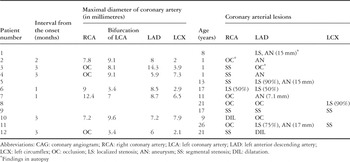
Table 2.
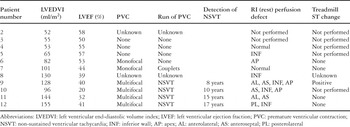
Table 3.
 You have
Access
- 51
- Cited by