Exponential decay models are common in the natural sciences. For systems that operate in a discrete manner,
 $$ y(t)\hskip0.70em =\hskip0.35em K\cdot y\left(t-1\right) $$
(1)
where y(t) is the dependent variable at step t, y(t-1) is its value at the preceding step, and K is a variable of proportionality.
The odds of sequential coin tosses also are described by exponential decay (K = 0.5). If the first toss is heads, the odds of the following heads are 0.500; the odds of two heads are 0.250; and of three heads, 0.125. The propensity of sequential heads with weighted coins follows the same exponential logic: If K = 0.6, then 0.600, 0.360, 0.216, and so on.
If t is continuous,
 $$ y(t)\hskip0.35em =\hskip0.35em y(o)\cdot {\mathrm{e}}^{- kt} $$
(2)
where y(o) is its value at t=0 and k is an exponent.
 $$ k\hskip0.35em =\hskip0.35em -\ln (K) $$
The t at which y(t )= 0.5 t(o) is the half-life,
 $$ t(0.5)\hskip0.35em =\hskip0.35em -\mathit{\ln}(0.5)/k $$
Carbon-14’s t(0.5) is 5,730 years; that of uranium 238 is 4.5 billion years. Another example is infiltration into soil. Different soils infiltrate rainfall at different rates of diminishment. However, for a given medium, the mathematical description tends to be exponential: for example, the K of clay is greater than that of loam, which in turn exceeds that of sand.
The bases for exponential behaviors are not necessarily the same. Radionuclide half-lives can be explained by random emissions; soil physics makes deterministic use of saturation, fluid properties, and interstitial geometrics. Why this is so requires an understanding of the particular system.
POLITICAL APPLICATIONS
Exponential models have been used to describe the survival of political systems or entities. Relevant to this article is a model that examines the life spans of empires (Arbesman Reference Arbesman2011); another is the dissolution of cabinets in Italy (Cioffi-Revilla Reference Cioffi-Revilla1984). These studies empirically estimate the functional distribution of the duration of the system under examination.
We similarly construct an exponential decay model to inquire into the rate of reelection of the incumbent political parties, those of the governor or the premier, in state or provincial governments in Australia, Canada, and the United States. These data are suited for our purposes for several reasons. Electorally, these units of government behave in ways similar to their counterparts at the national level (Cuzán Reference Cuzán2022, 37, 52 59), with the advantage of including a much larger number of observations. All three countries share a common British heritage; arguably, this limits the range of exogenous cultural influences on the comparisons of their political systems relative to studies with multiple countries but few observations per country.
We seek to answer a simple question: “The incumbent party, having won n elections, what is its propensity to win the next?” A literature search revealed no previous inquiry into the topic.
We seek to answer a simple question: “The incumbent party, having won n elections, what is its propensity to win the next?” A literature search revealed no previous inquiry into the topic.
DATA AND METHOD
The data consist in almost 1,200 state or provincial elections in the United States, Canada, and Australia (see table 1).Footnote 1 As explained in this article, the series for each state or province begins with an “old” incumbent loss and, correlatively, the vote of the winning opposition party—that is, the party that now becomes the new incumbent. All party spells or reigns subsequent to that first election made it into our dataset. (Heggen and Cuzán Reference Heggen and Cuzán2022). We entered the name of the state or province; the year of the election; the new incumbent party vote from the first election when, in opposition, it defeated the old incumbent to gain control of the executive office; the opposition party vote; and whether the incumbent was reelected or defeated.Footnote 2
Descriptive Statistics: State, Provincial, or Territorial Elections in Three Countries

Notes: *Australia is divided into six states and three territories and Canada is divided into 10 provinces and three territories. This article treats Australia’s Capital Territory and Northern Territory and Canada’s Yukon Territory as the equivalent of a state or province because, unlike the other territories in each country, they are governed by an assembly composed of political-party members.
Generally, in all three countries, elections are held at the end of a constitutionally or legally specified term: two to four years in the United StatesFootnote 3 and three to four years in Canada and Australia. In the latter two countries, a premature election may be called when the previous one yielded a minority government, the government fell because of a no-confidence vote, or the incumbents think it advantageous to do so.
In the US states, the governorship—a single-occupancy office analogous to the presidency at the national level—is filled by the winner of a statewide plurality vote. In Canada and Australia, the choice of head of government is made by Parliament, the members of which are elected from single-member, “first-past-the-post” districts. Australia uses a preferential ballot; however, in the interest of comparability with Canada, we entered the “primary” vote. This did not affect the rate of reelection—which is our outcome of interest—only the proportion of party vote entered.
Again, in this study, it is the party of the governor or premier, not the individual officeholder, that constitutes the incumbent. In Australia or Canada, that is true whether it forms a government alone or in coalition with other parties. Electoral choice in the United States generally is constrained to one of two parties: Democrats or Republicans. In the rare case when a third party wins the office, it is rarer still for it to secure more than one term. This is less rare in Canada and Australia: several of their states or provinces exhibit something closer to a three-party system. US state governors, although not their party, are subject to term limits. These restrictions on reelection do not apply to parliamentary premiers.
We partitioned the election history of every state or province into “strings.” Every string consists in a series of consecutive elections that the incumbent party—the one whose spell in office the string describes—contested. The string begins with Election 0, which the party won thereby gaining control of the executive office, and ends with Election n, which the party lost. Thus, every election results in either the renewal of the incumbent party’s lease on the executive office or its defeat and the beginning of a new string. We used only “closed strings”—those that begin and end within our dataset. “Open strings,” in which the incumbent party remains undefeated as of 2020, thus are not included. No string originated earlier than the 1930s, a time when many incumbents—buffeted by the Great Depression—went down to defeat. Other strings, particularly in the US South, started as late as the 1960s or 1970s, when Democrats lost their first election since Reconstruction.
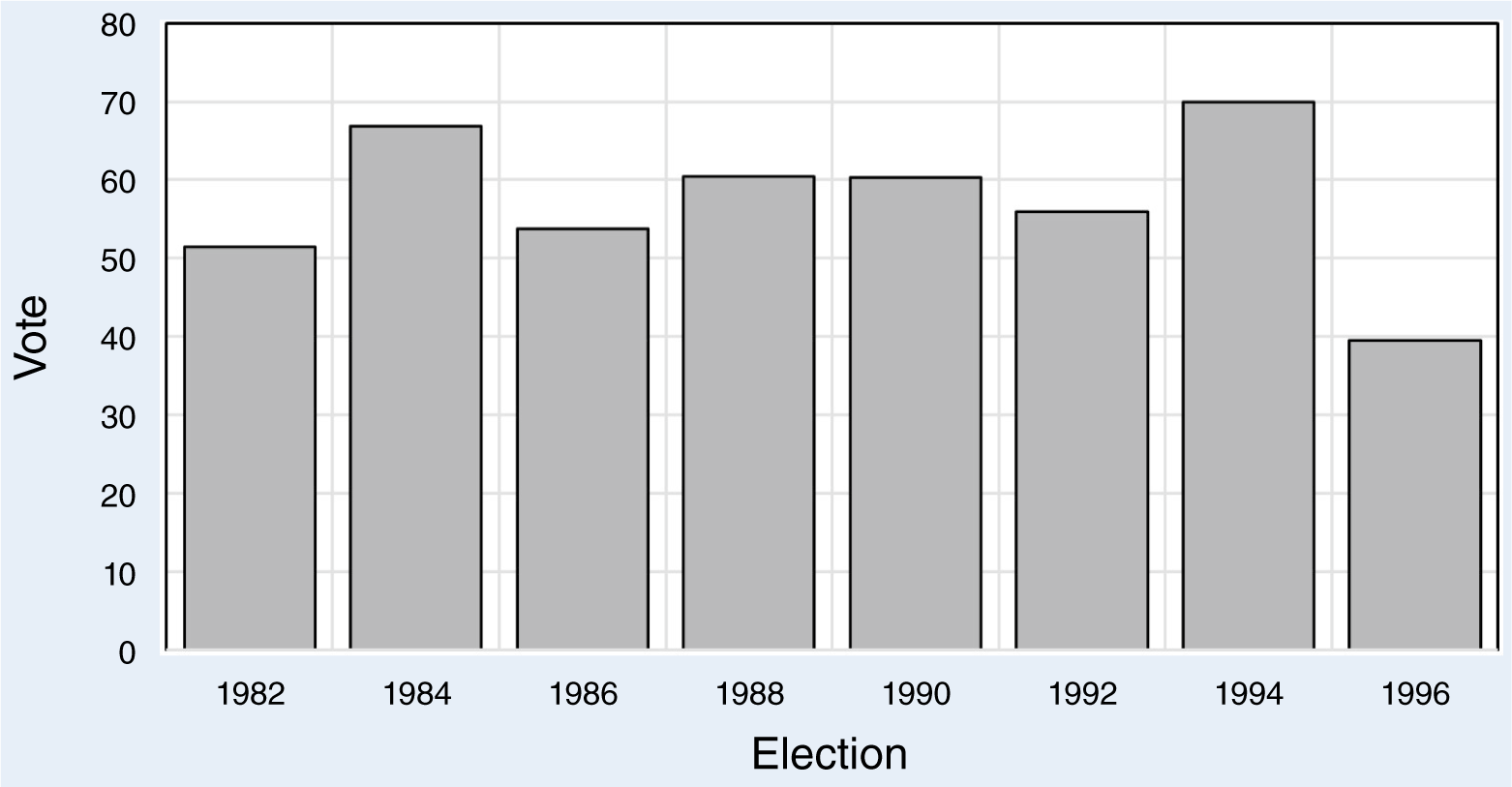
The string of a party serving n consecutive terms brackets n+1 elections: the initial election, n-1 reelections, and the last election, a loss. For example, figure 1 displays a string from New Hampshire in which Republicans assumed the governorship in 1982, defeating the incumbent Democrats with 51.5% of the vote. Subsequently, they were reelected six times until their defeat in 1996, with less than 40% of the vote. The Republican Party thus enjoyed seven terms in office, with the loss marking the conclusion of an eight-election string.
New Hampshire’s Seven-Term Republican String, 1982–1996

FINDINGS
Table 1 lists the descriptive statistics of our data. Most of the observations are from the United States. The ratio of elections to strings and the incumbent win rate is highest in Australia and lowest in the United States. Note that the two variables are related: the higher the win rate, the longer and, therefore, the fewer the number of strings and, therefore, the lower the ratio of elections to strings. Note also that the incumbent party is reelected approximately 60% to 75% of the time.
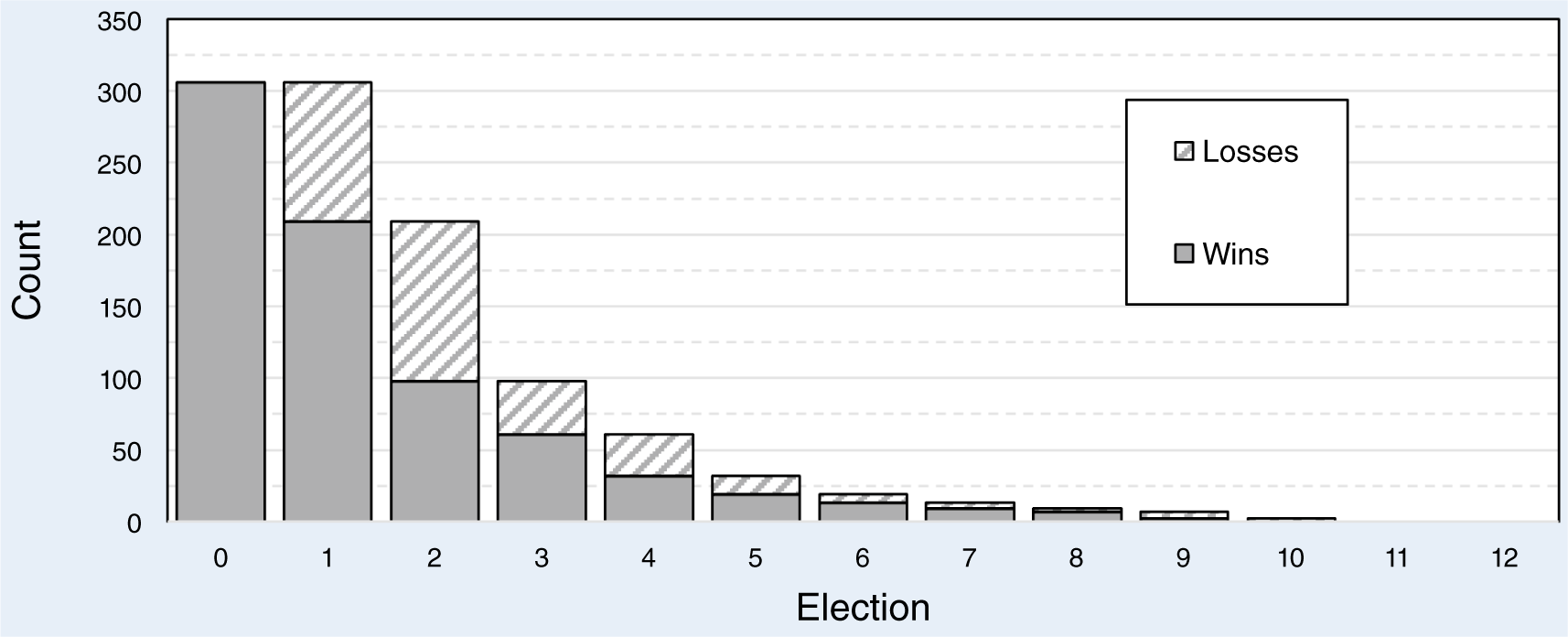
Figure 2 displays the number of incumbent survivors by election within all of the United States strings. The bar at the far left represents Election 0, the one that catapulted a new party into the governorship and initiated a new string. All 306 members of this cohort began with victory at Election 0. In their first bid for reelection, 209 incumbents were successful. At Election 2, 98 incumbents remained to appeal to voters for a third term, and so on until the two remaining incumbents who did not win past Election 10.
Frequency of Incumbent Wins and Losses, US States

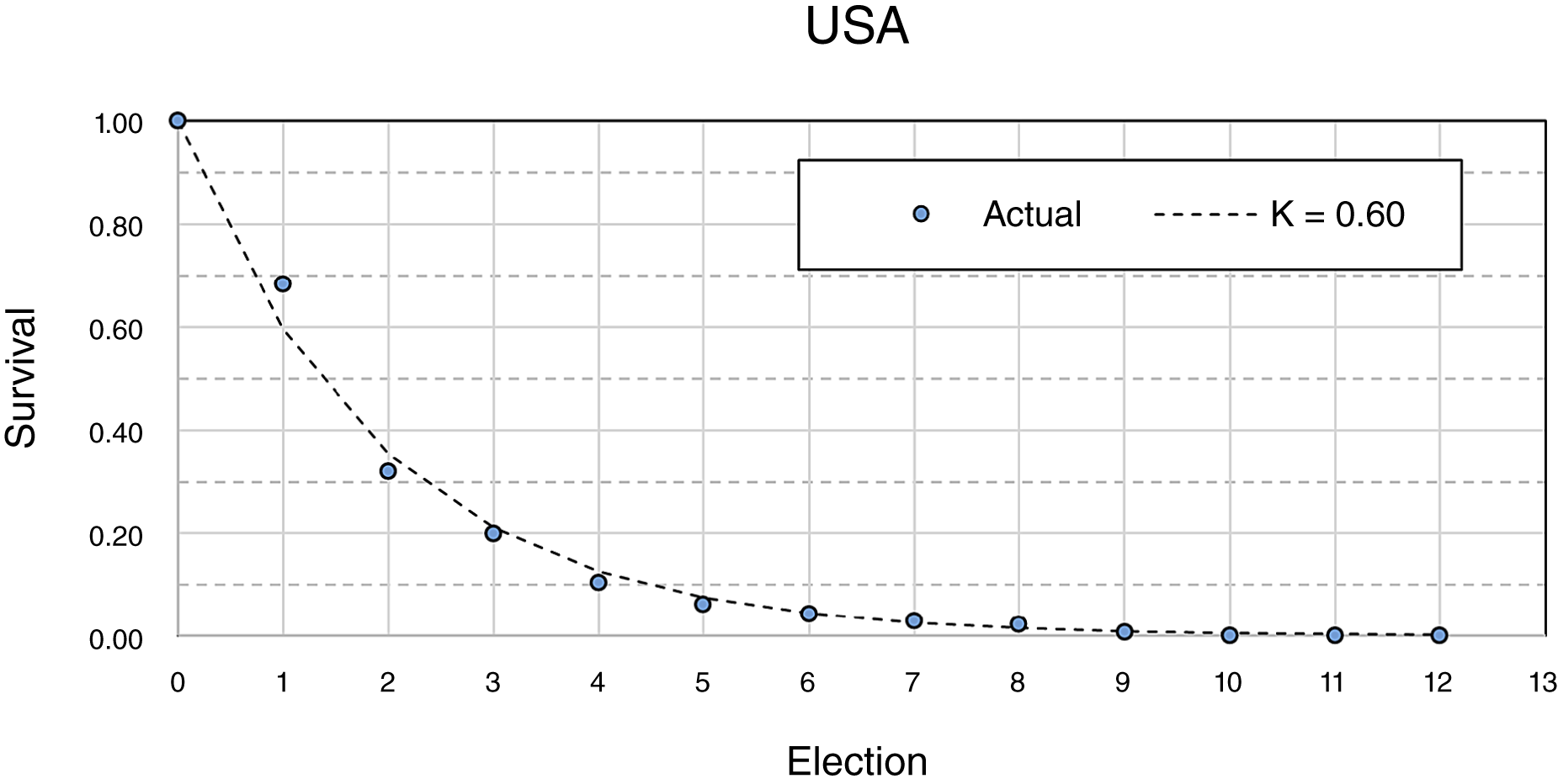
Figure 2, a discrete counting, converts into figure 3, which is a continuous curve matching the bar heights at each integer term. The transformation is appropriate when the sample size is large and the behavior of concern (i.e., the sustainability of an incumbent, in this case) is not at the tail. Our samples are large and our interest focuses on the more commonly experienced lefthand side and mid-domain of the distribution—less so, for example, than on the particular odds of eight-termers making it to nine. A K of 0.60 (see Equation 1) is estimated by curve fitting.
Incumbent Survival Curve, US States

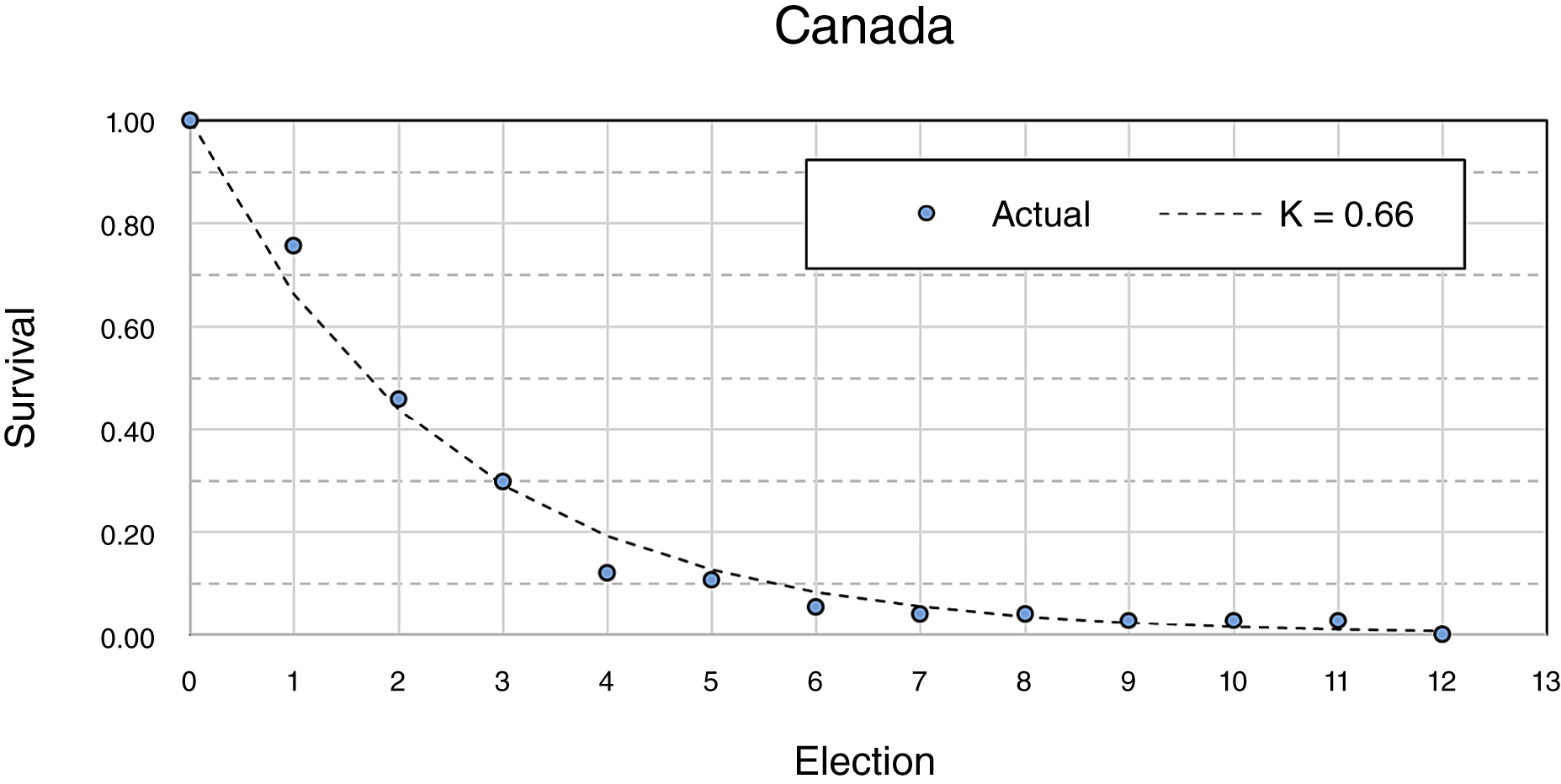
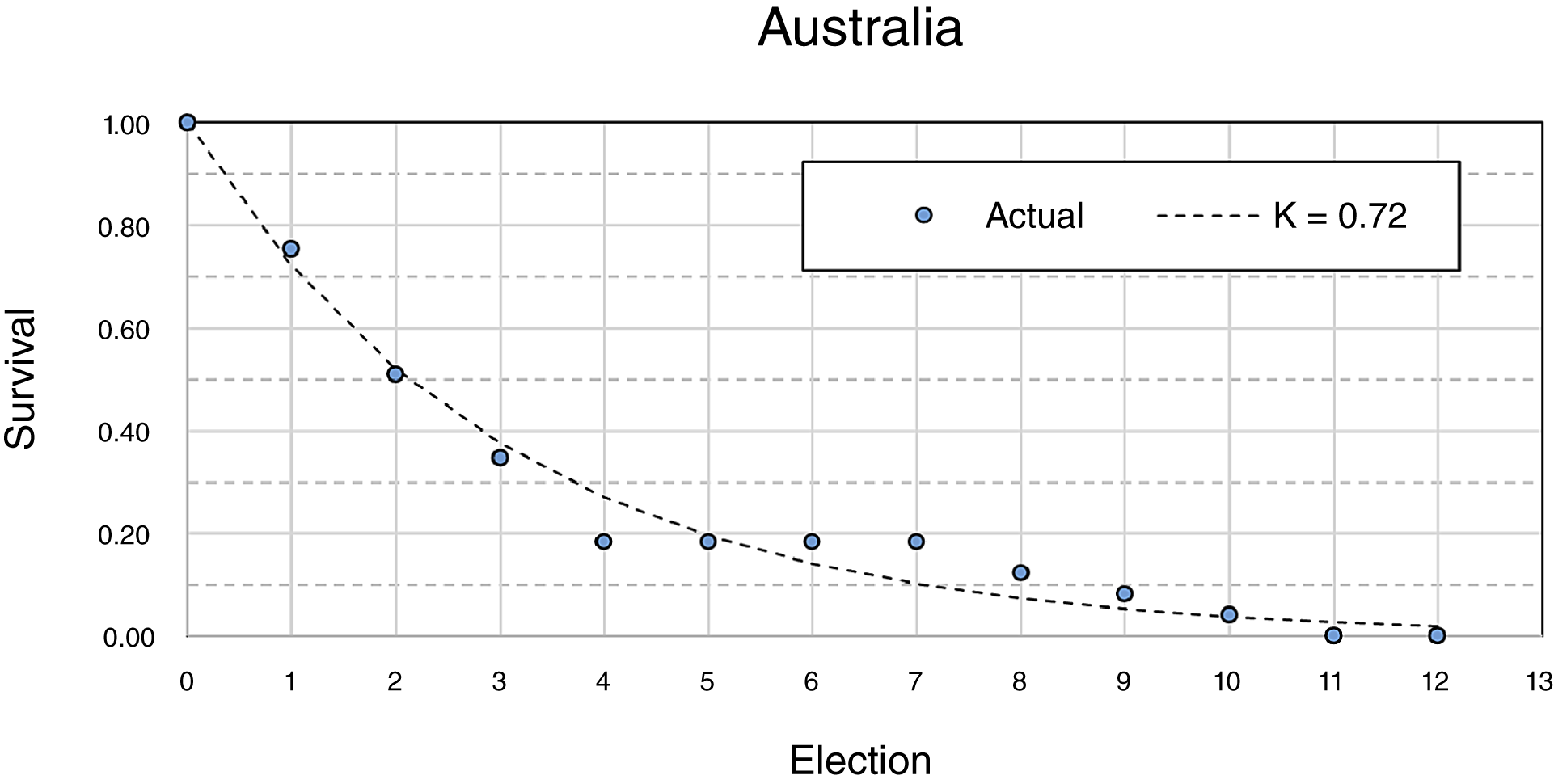
Figures 4 and 5 exhibit the results for Canada and Australia, respectively, which were obtained using the same method.
Incumbent Survival Curve, Canadian Provinces

Incumbent Survival Curve, Australian States

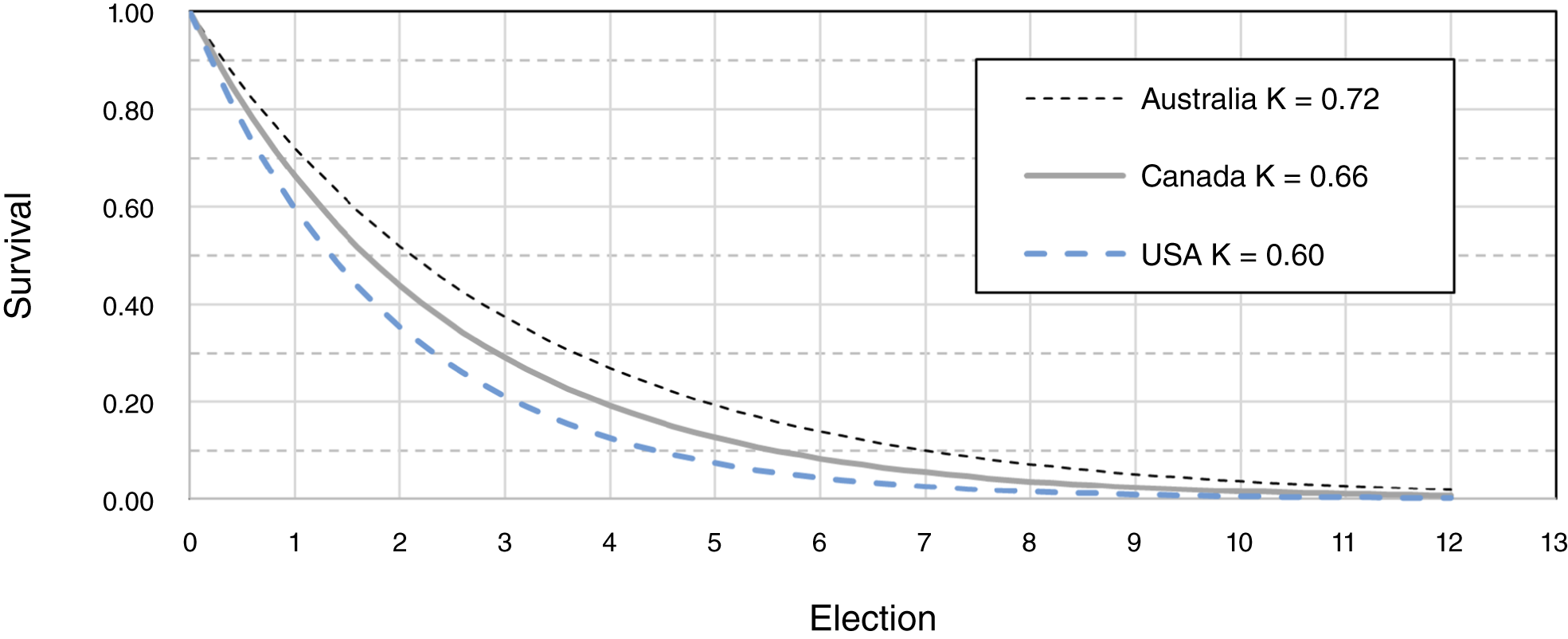
Figure 6 compares all three survival curves in the same graph. In all three countries, the half-life (i.e., 0.50 on the vertical axis) occurs between Elections 1 and 2—that is, between the first and second reelection: 1.3 terms for the United States, 1.7 terms for Canada, and 2.1 terms for Australia.
Exponential Survival Curves: Australia, Canada, and the United States

In an electoral democracy, survival depends on winning more popular votes or capturing more seats in Parliament, singly or in combination with partners or allies. In the following example, we examine only the United States.
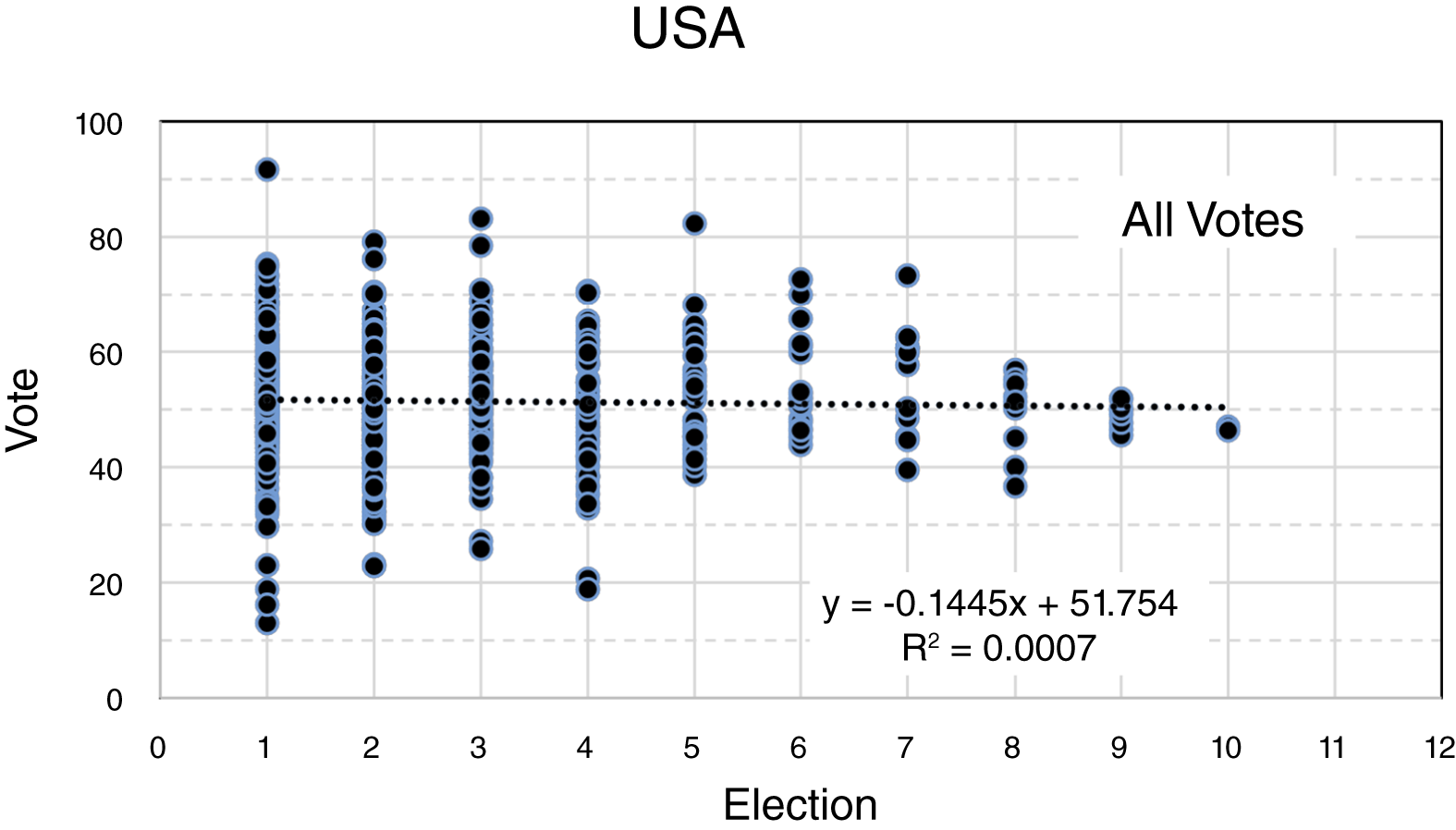
Figure 7 shows the scatter of the incumbent vote per election, beginning with Election 1, at the end of their first term in office when all 306 incumbents made a bid for reelection. Each observation consists of two or more incumbent votes from a single string. For example, the New Hampshire string shown in figure 1 contributes one point to each of Elections 0 through 7 (remember that the string did not make it past Election 7).
Incumbent Vote, US States

The overall slope of the scatter is statistically indistinguishable from 0 (p<0.01). That is, election after election, the incumbent vote share does not trend. As those defeated drop out, the winners maintain more or less their share until the electoral equivalent of energy is depleted. All incumbencies eventually end—an outcome that is guaranteed by the exponentially declining odds of remaining in office.
DISCUSSION
We answered our original question asking about the likelihood that an incumbent will win the next election and remain in control of the executive office. Because our results statistically support the validity of an exponential model for strings, the answer is simple: K, a constant. If it were not, an exponential fit would not describe the record. An exponential equation, however, likely would not describe string lengths in a state or country where the same party routinely prevails and its spells in office are interrupted only occasionally by an interloper.
The K need not be the same for all countries, of course; however, we observe that for the three evaluated, the value falls between 0.60 and 0.72. We surmise that such consistency derives from the observation that when the incumbent vote is statistically non-trending over a string, the stochasticity of that vote sooner or later leads to defeat. Like the randomness of a coin toss (in our case, a coin with odds other than 50–50), an exponential model indicates that a string of heads eventually will experience a tails.
As to why K is higher in the parliamentary governments of Canada and Australia, the answer may lie in the fact that in those systems, the premier requires a lower percentage of votes to capture control of the executive office than what is required in the US states (see table 1). Institutional differences between parliamentary and gubernatorial regimes and two- versus three-way party systems may provide an explanation.
CONCLUSION
This article addresses the question regarding the likelihood that an incumbent will win the next election and remain in control of the executive office in subnational governments in the United States, Canada, and Australia.
We show that exponential models similar to those used to account for the survival of cabinets and empires fit the staying power of incumbents at state and provincial levels. To our knowledge, no previous study has demonstrated this result.
We show that exponential models similar to those used to account for the survival of cabinets and empires fit the staying power of incumbents at state and provincial levels. To our knowledge, no previous study has demonstrated this result.
The exponential K is different for each system, just as Cioffi-Revilla (Reference Cioffi-Revilla1984) expected for cabinet survival in different countries. Nevertheless, we observe that for these three countries, K falls between 0.6 and 0.72. Whether other electoral systems fit into this range merits further analysis.
We acknowledge that our model is only part of the narrative. It does account for the distribution of survivors over the entire series of elections. It indicates that when incumbents return to voters for an extension of their lease in office, on average, approximately 66% of the time they will succeed. However, the model predicts neither the identity of the survivors nor their vote. It indicates nothing about their particular characteristics, or the environment in which they operate, or the challenges that confront them at election time.
As with stochastic and events models used to account for the duration of parliamentary cabinets, our model must be set against “deterministic” or “attributes” models in the expectation that a synthesis will emerge (Browne, Frendreis, and Gleiber Reference Browne, Frendreis and Gleiber1986; King et al. Reference King, Alt, Burns and Laver1990; Laver Reference Laver2003; Somer-Topcu and Williams Reference Somer-Topcu and Williams2008). We hope that this study will encourage related research and engender greater mining of state and provincial electoral data.
As with stochastic and events models used to account for the duration of parliamentary cabinets, our model must be balanced against “deterministic” or “attributes” models in the expectation that a synthesis will emerge.
ACKNOWLEDGMENTS
We thank Ian Budge, Josep Colomer, Carl Klarner, and Rein Taagepera for their helpful suggestions and encouragement.
DATA AVAILABILITY STATEMENT
Research documentation and data that support the findings of this study are openly available at the PS: Political Science & Politics Harvard Dataverse at https://doi.org/10.7910/DVN/LQUXL1.