Introduction
The infraorder Siricomorpha (Hymenoptera: Symphyta) was proposed in the framework of a classical taxonomic approach as an explicitly paraphyletic assemblage to collectively treat the Pamphilioidea, Siricoidea, and Cephoidea, taxa that share a closed head capsule between the oral and occipital orifices and larval phytophagy (Rasnitsyn Reference Rasnitsyn1980). In recent analyses (Sharkey Reference Sharkey2007; Heraty et al. Reference Heraty, Ronquist, Carpenter, Hawks, Schulmeister and Dowling2011; Peters et al. Reference Peters, Meyer, Krogmann, Borner, Meusemann and Schütte2011; Ronquist et al. Reference Ronquist, Klopfstein, Vilhelmsen, Schulmeister, Murray and Rasnitsyn2012; Klopfstein et al. Reference Klopfstein, Vilhelmsen, Heraty, Sharkey and Ronquist2013), it has been regularly recovered as a grade sister to the Tenthredinoidea and ancestral to the Vespina (that is, Orussoidea+Apocrita, see Rasnitsyn and Zhang Reference Rasnitsyn and Zhang2010). Here, we describe new species of Pamphiliidae, Siricidae, and Cephidae, the only currently established Ypresian (early Eocene) Siricomorpha.
Pamphiliidae
The Pamphiliidae today has over 300 species that mostly range through temperate and boreal regions of the Holarctic, but are also known into Mexico and in the Oriental Region to Myanmar and India (Taeger et al. Reference Taeger, Blank and Liston2010). It is divided into three subfamilies: the extant Pamphiliinae and Cephalciinae, and the extinct Juralydinae. Their larvae spin silk, forming webs in which they live either singly or in sometimes large groups; those of Cephalciinae feed on conifer foliage of the Pinaceae, and of Pamphiliine on angiosperm leaves, which they roll (Benson Reference Benson1945; Middlekauff Reference Middlekauff1964; Smith Reference Smith1988; Goulet Reference Goulet1993).
All known species of the family before the Oligocene are currently assigned to the Juralydinae: Juralyda udensis Rasnitsyn (Uda Formation, Transbaikalia, Russia, Late Jurassic); Scabolyda orientalis Wang et al. (Jiulongshan Formation, China, late Middle Jurassic); S. incompleta Wang et al. (Yixian Formation, Liaoning, China, Early Cretaceous) (Wang et al. Reference Wang, Rasnitsyn, Shih and Ren2014a); and Atocus defessus Scudder (Florissant, Colorado, United States of America, latest Eocene), its youngest known occurrence.
The Cephalciinae appeared in the Oligocene with Tapholyda caplani Cockerell (Cockerell Reference Cockerell1933, Reference Cockerell1940; in Tapholyda Rasnitsyn: Rasnitsyn Reference Rasnitsyn1983) (Creede Formation, Colorado, United States of America); and then in the Miocene with the extant genus Acantholyda Costa: the formerly recognised French species A. grangeoni Riou (Riou Reference Riou1999), which was synonymised with the extant A. erythrocephala (Linnaeus) by Nel (Reference Nel2004) and possibly A. ribesalbesensis Penãlver and Arillo in Spain (Penãlver and Arillo Reference Penãlver and Arillo2002; Nel Reference Nel2004). The Pamphiliinae has no known fossil record.
Siricidae
Extant horntail wood-wasps (Siricidae) consist of about 122 species in 10 genera (Schiff et al. Reference Schiff, Goulet, Smith, Boudreault, Wilson and Scheffler2012) assigned to the subfamilies Siricinae and Tremicinae. They are serious forest pests, attacking stressed trees (conifers and angiosperms), drilling into wood to insert eggs, mucus, and fungal spores or bits of hyphae (review of siricid natural history: Schiff et al. Reference Schiff, Goulet, Smith, Boudreault, Wilson and Scheffler2012). The tree dies as the larvae bore through the wood and feed on the phytotoxic fungus that flourishes as their mucus compounds weaken the tree’s immune system.
The native ranges of the majority of modern siricids are restricted to the Holarctic, from northern boreal forests through those of mid latitudes, but a few are found south into Mexico, Cuba, The Dominican Republic, rarely and at times questionably in Central America, and in Papua New Guinea, the Malay Peninsula, and lower latitudes of sub-Saharan Africa (Smith Reference Smith1988; Schiff et al. Reference Schiff, Goulet, Smith, Boudreault, Wilson and Scheffler2012). They have been introduced in a number of southern hemisphere countries (Schiff et al. Reference Schiff, Goulet, Smith, Boudreault, Wilson and Scheffler2012; Malagon-Aldana et al. Reference Malagon-Aldana, Serna and Smith2014).
The modest fossil record of the family (sensu stricto) was recently summarised by Wedmann et al. (Reference Wedmann, Pouillon and Nel2014, table 1, “crown-group Siricidae”). We emend their list by considering the specimen from the Crato Formation of Brazil (Osten Reference Osten2007) to belong to the Pseudosiricidae; adding two unnamed specimens from the Early Cretaceous (Albian) of the Emanra Formation in the Russian Federation (Gromov et al. Reference Gromov, Dmitriev, Zherikhin, Lebedev, Ponomarenko and Rasnitsyn1993, fig. 14); and we agree with various authors (e.g., Lutz Reference Lutz1986; Jarzembowski Reference Jarzembowski1996; Bolton Reference Bolton2014) that the enigmatic Megapterites mirabilis Cockerell from the Ypresian Bournemouth Group, United Kingdom, is an ant. We propose that the Brazilian Crato Formation specimen belongs to the Pseudosiricidae by similarity of its wing venation, best exemplified by the Early Cretaceous Myrmicium heeri Westwood (see Rasnitsyn et al. Reference Rasnitsyn, Jarzembowski and Ross1998), with which it shares a long, proclival 1-Rs, unlike Siricidae, wherein 1-RS is vertical or reclivous.
Cephidae
The Cephidae are distinctively slender sawflies whose larvae are known for feeding on tissues in the stems of grasses and woody plants. They can be major pests of grains. Today, they have about 170 species in 24 genera of three subfamilies – all but four species placed in the Cephinae (Taeger et al. Reference Taeger, Blank and Liston2010). Like the Pamphiliidae and Siricidae, they predominantly range in the temperate/boreal Holarctic, with few species found outside of this: in the western hemisphere, one south of the United States of America in Mexico; and in the eastern hemisphere two in Madagascar, and one each in Vietnam, Kalimantan, Sulawesi, and Australia (Goulet Reference Goulet1993; Smith Reference Smith1997, Reference Smith1999; Smith and Shinohara Reference Smith and Shinohara2002; Smith and Schmidt Reference Smith and Schmidt2009; Taeger et al. Reference Taeger, Blank and Liston2010).
They have a scant fossil record, with a single species each in the earlier (Barremian?) and later (Aptian) Early Cretaceous of Baissa (Mesocephus sibiricus Rasnitsyn), eastern Siberia, and Bon-Tsagan, Mongolia (M. ghilarovi Rasnitsyn), respectively; and the Late Eocene (Priabonian) Florissant (Janus disperditus Cockerell) and Baltic amber (Electrocephalus stalendorffi Konow) (summarised by Taeger et al. Reference Taeger, Blank and Liston2010), all assigned to the Cephinae. Heer (Reference Heer1847) described two species from the Miocene (Sarmatian) of Oeningin, Germany, Cephites oeningensis Heer and C. fragilis Heer, which he considered to be cephids, but judging from his illustrations (Heer Reference Heer1847, plate XIII, fig. 17, and plate XIV, fig. 1) are unquestionably ants (possibly Myrmicinae).
Here, we describe new siricomorph genera and species from the Ypresian Okanagan Highlands localities in far-western North America: the pamphiliid Ulteramus republicensis new genus, new species from Republic, Washington, United States of America, either a member of the Pamphiliinae or Cephalciinae; the siricid Ypresiosirex orthosemos new genus, new species from McAbee, British Columbia, Canada, which we place in the Siricinae (see subfamily concept, below); and the cephid Cuspilongus cachecreekensis, new genus, new species from McAbee and the un-named Cephinae species A from Horsefly River, also in British Columbia, both of which we assign to the Cephinae.
Materials and methods
The fossils described here are preserved in lacustrine shales from Republic, Washington, United States of America, and McAbee and Horsefly River, British Columbia, Canada. These are localities of the Okanagan Highlands series of Ypresian basins that occur scattered across about a 1000 km transect from north-central Washington, United States of America, to west-central British Columbia, Canada (map and overview: Archibald et al. Reference Archibald, Greenwood, Smith, Mathewes and Basinger2011). Although their climates and floras vary in detail, these localities broadly represent a mixed mesophytic montane forest in many ways similar to that of the modern North American eastern deciduous zone, but including plant genera that are now extinct or found in low latitudes (Greenwood et al. Reference Greenwood, Archibald, Mathewes and Moss2005; Moss et al. Reference Moss, Greenwood and Archibald2005).
The Republic site is an exposure of the Tom Thumb Tuff Member of the Klondike Mountain Formation within the town itself. Radiometric dating gives a latest Ypresian age of 49.4±0.5 million years old (Wolf et al. Reference Wolfe, Gregory-Wodzicki, Molnar and Mustoe2003). The McAbee locality consists of exposures of an unnamed formation in south-central British Columbia near the town of Cache Creek. 40Ar/39Ar analysis gives a radiometric age of 52.90±0.83 million years old (Archibald et al. Reference Archibald, Bossert, Greenwood and Farrell2010). The Horsefly River localities in the central Cariboo region of southern British Columbia are exposures of laminated shales of an unnamed formation that have received extensive attention in particular from M.V.H. Wilson (e.g., Wilson and Barton Reference Wilson and Barton1996; Barton and Wilson Reference Barton and Wilson2005). Horsefly River does not have a radiometric age estimate, but the great similarity of its fauna and flora (including palynomorphs, see Moss et al. Reference Moss, Greenwood and Archibald2005) firmly associates it temporally with the other lacustrine basins of the Okanagan Highlands, all of which are dated within the latter half of the Ypresian (Archibald et al. Reference Archibald, Greenwood, Smith, Mathewes and Basinger2011).
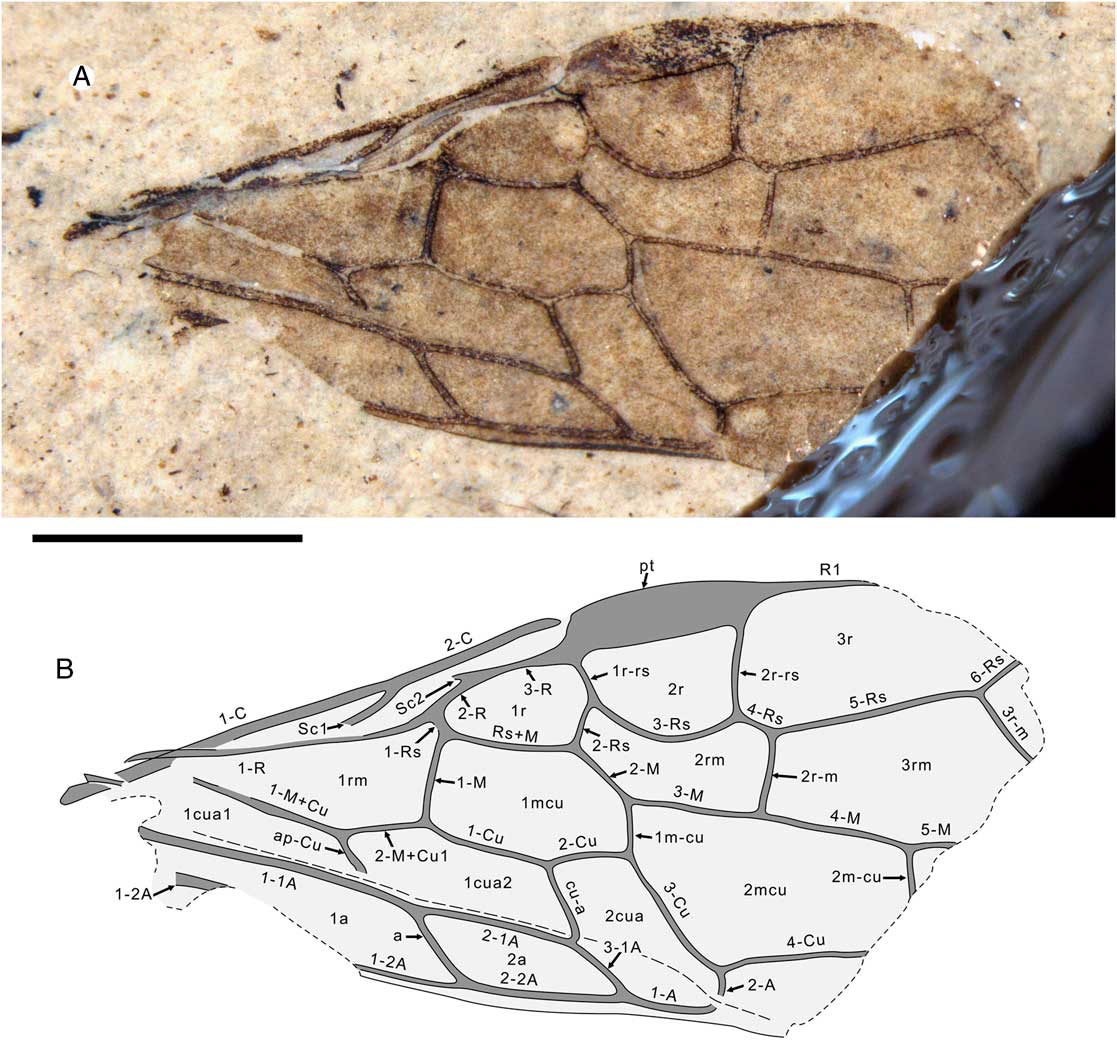
We follow the wing vein and cell terminology of Rasnitsyn (Reference Rasnitsyn1969, fig. 1). The vein seen in some hymenopteran forewings (e.g., the new pamphiliid: Fig. 1) between M+Cu and 1A (but truncate, not joining 1A) is not present and named in that figure. We treat this as “ap-Cu” (appendix of Cu). The identity of this vein as a branch of Cu or a crossvein is currently not clear, and so we use this provisional, neutral term that does not express an opinion. The cells resulting from its division of 1cua when it is present we call 1cua1 and 1cua2. Terminology of other morphology follows Huber and Sharkey (Reference Huber and Sharkey1993).
Ulteramus republicensis new genus and species, holotype forewing UWBM 77532: A, photograph; B, drawing; both to scale, 2 mm.

Institutional abbreviations: The Burke Museum of Natural History and Culture (Seattle, Washington, United States of America), BM; Brandon University (Brandon, Manitoba, Canada), BU; Thompson Rivers University (Kamloops, British Columbia, Canada), TRU; and the Royal British Columbia Museum (Victoria, British Columbia, Canada), RBCM.
Order Hymenoptera Linnaeus, 1758
Infraorder Siricomorpha Rasnitsyn, Reference Rasnitsyn 1980
Superfamily Pamphilioidea Cameron, 1890
Family Pamphiliidae Cameron, 1890
Subfamily incertae sedis
Genus Ulteramus Archibald and Rasnitsyn, new genus
Type species. Ulteramus republicensis Archibald and Rasnitsyn, new species. Here designated.
Diagnosis. As for its only species: forewing easily separated from those of all other pamphiliid genera by Sc2 joining R distad 1-Rs.
Description. As for the only species (see below).
Etymology. The genus name is formed from the Latin ulter, meaning on the farther side, and ramus, meaning branch, referring to the distal position of the joining of Sc1 and R, distinctive within the Pamphiliidae. Gender masculine.
Ulteramus republicensis Archibald and Rasnitsyn, new species
(Fig. 1)
Material. BM accession number UWBM 77532 (part only); A mostly complete and well-preserved forewing, only missing portions of the apical-most and basal-most portions and the region between C and R mostly folded and damaged; housed in the BM collection; collected by Wesley Wehr in 1993. Labelled: HOLOTYPE, Ulteramus republicensis Archibald and Rasnitsyn, 2015.
Diagnosis. Forewing easily separated from those of all other pamphiliids by Sc2 joining R distad 1-Rs.
Description. Forewing. Length as preserved (with basal-most, apical-most portions missing) about 7.3 mm, width about 3 mm; present portions of membrane evenly infuscate, apparently smooth without coreaceous or corrugated region; pterostigma sclerotised, large, about half width of cell 2r; basal portion of Sc mostly missing by damage, folding; Sc1 joins C basad level of 1-Rs, apical stub of Sc2 joins R distad 1-Rs; 1-Rs present, short, about quarter length of 1-M (but see Discussion); 3-Rs deeply curved (cell 2r wide); 4-Rs long; 2r-m inclined basad; Rs+M about 1.4 length of 1-M; 1r-rs normal (not shortened or weakened); angle of 1-M to 1-Cu just over 90°; ap-Cu stub present, sinuate, not joining A; 2-M about 0.58 Rs+M length; cell 2a length about 1.8 times width.
Etymology. The specific epithet republicensis refers to the known locality of this species.
Age and locality. Ypresian; Klondike Mountain Formation exposure A0307B (BM locality code), Republic, Washington, United States of America.
Discussion. The new species is excluded from the Juralydinae, as it clearly lacks its diagnostic forewing characters (e.g., in Juralydinae, 1-Rs is longer and the ap-Cu stub is missing: see Wang et al. Reference Wang, Rasnitsyn, Shih and Ren2014a). It is possible that it is a member of either the Pamphiliinae or Cephalciinae, but determining which is problematic. The only reported forewing character that separates them is membrane texture in the apical region: in the Cephalciinae it is irregularly coriaceous and in the Pamphiliinae it is longitudinally corrugated, i.e., with distinct folds (Benson Reference Benson1945). Unfortunately, most of this region is not preserved in the single specimen of the new species, although the apical-most portion that is present appears smooth as preserved.
The new genus and species are clearly separated from all other described pamphiliids by its distal joining of Sc2 and R, a condition seen in Xyelidae (Rasnitsyn Reference Rasnitsyn1969, figs 69, 77), but not previously known within the Pamphiliidae. Sc2 appears here to be a stub, but much of the vein may be damaged or obscured by folding in this area. A better fossil is needed to resolve this. Some other venational character states are of interest.
Vein segment 4-Rs is comparatively long; often in pamphiliids, this is short, such that 2r-rs and 2r-m join Rs closely. 1-Rs is confidently present and short, unlike in the cephalciine Caenolyda Konow or the pamphiliine genera Pseudocephaleia Zirngiebl and Kelidoptera Konow. Details of its morphology might be importantly distinctive, but, unfortunately, are not preserved clearly at this level in this specimen. It may be thicker, much thicker, or about the same width as M as they join; M may or may not bend sharply immediately before their joining. A specimen with this region better preserved is needed to clarify these issues.
If the new species belongs to the Pamphiliinae, Neurotoma Konow is further excluded, as Sc1 is absent in that genus; and from Pseudocephaleia and Kelidoptera, where vein 1r-rs is extremely short and distinctively very narrow. Apart from the form of Sc2, U. republicensis in many ways resembles species of the pamphiliine genera Onycholyda Takeuchi and Pamphilius Latreille. If it is a member of the Cephalciinae, Caenolyda is further excluded, as Sc1 does not extend to the pterostigma as in that genus. Acantholyda and Cephalcia Panzer also differ in the form of the stub ap-Cu, which is either absent, or short, or subvertical in these genera (Beneš Reference Beneš1968), in contrast to the long, oblique stub almost reaching A in the new genus. Chinolyda Beneš also bears such a long, oblique ap-Cu. While Beneš placed Chinolyda in the cephalciine tribe Cephalciini, he noted that it bears a variety of character states that appear ambiguous at the subfamily level. Given available evidence, it cannot be ruled out that Chinolyda is the surviving remnant of a lineage embracing Ulteramus as well.
A more complete fossil is needed to determine if U. republicensis extends the age of an extant subfamily back to the Ypresian, or if the history of the family becomes more complex with the establishment of a new, extinct subfamily.
Superfamily Siricoidea Billberg, 1820 (1802)
Family Siricidae Billberg, 1820 (1802)
Ypresiosirex Archibald and Rasnitsyn, new genus
Type species. Ypresiosirex orthosemos Archibald and Rasnitsyn, new species. Here designated.
Diagnosis. Separated from other genera of Siricidae as provided in the diagnosis of its only species, below.
Description. Female as in description of its only species, below.
Etymology. The generic name is formed from Ypresian, referring to its age, and Sirex Linnaeus (horntail wood-wasp). Gender masculine.
Ypresiosirex orthosemos Archibald and Rasnitsyn, new species
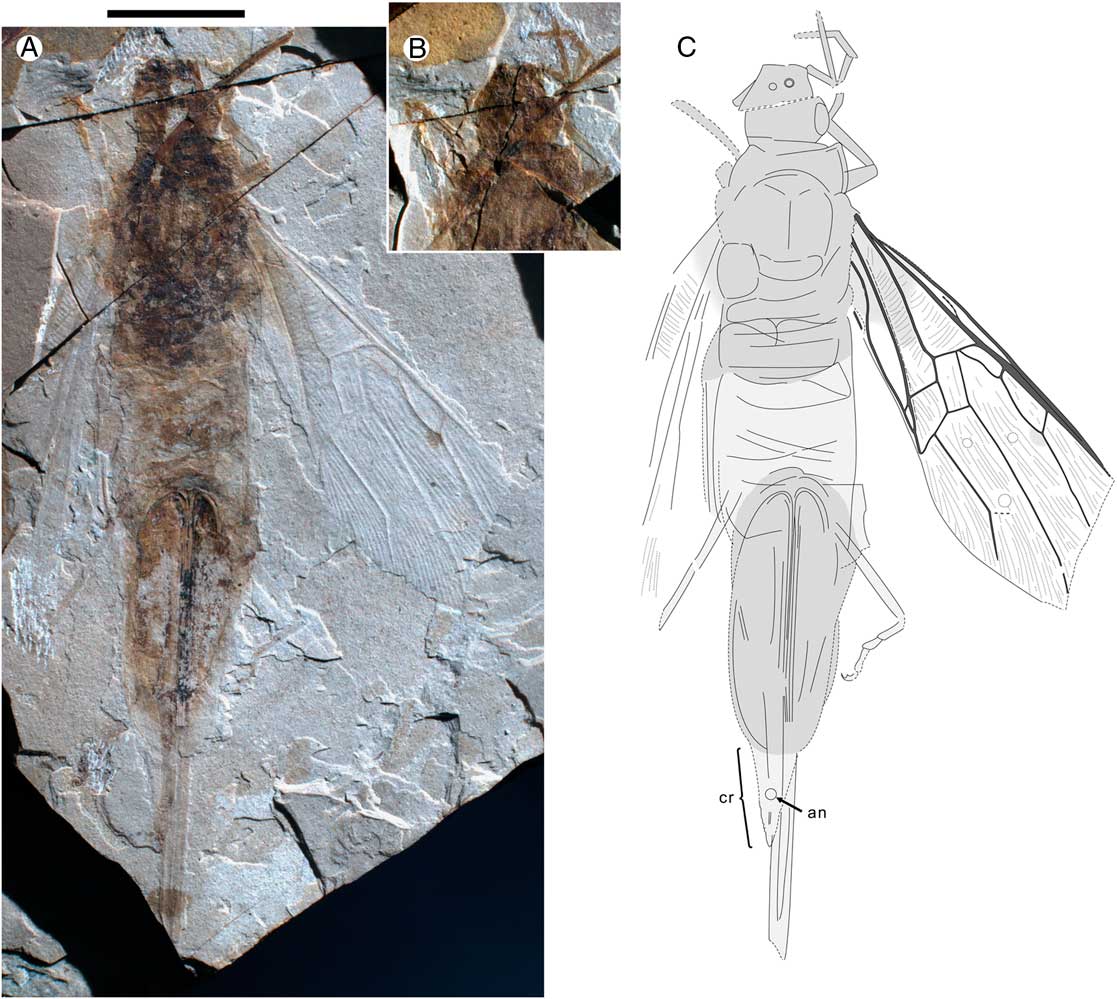
Ypresiosirex orthosemos new genus and species, holotype (RBCM.EH2015.004.0001.001 A&B). A, photograph, part; B, head, thorax of counterpart; C, drawing. Abbreviations: cr is cornus, an is anus; all to scale, 10 mm.

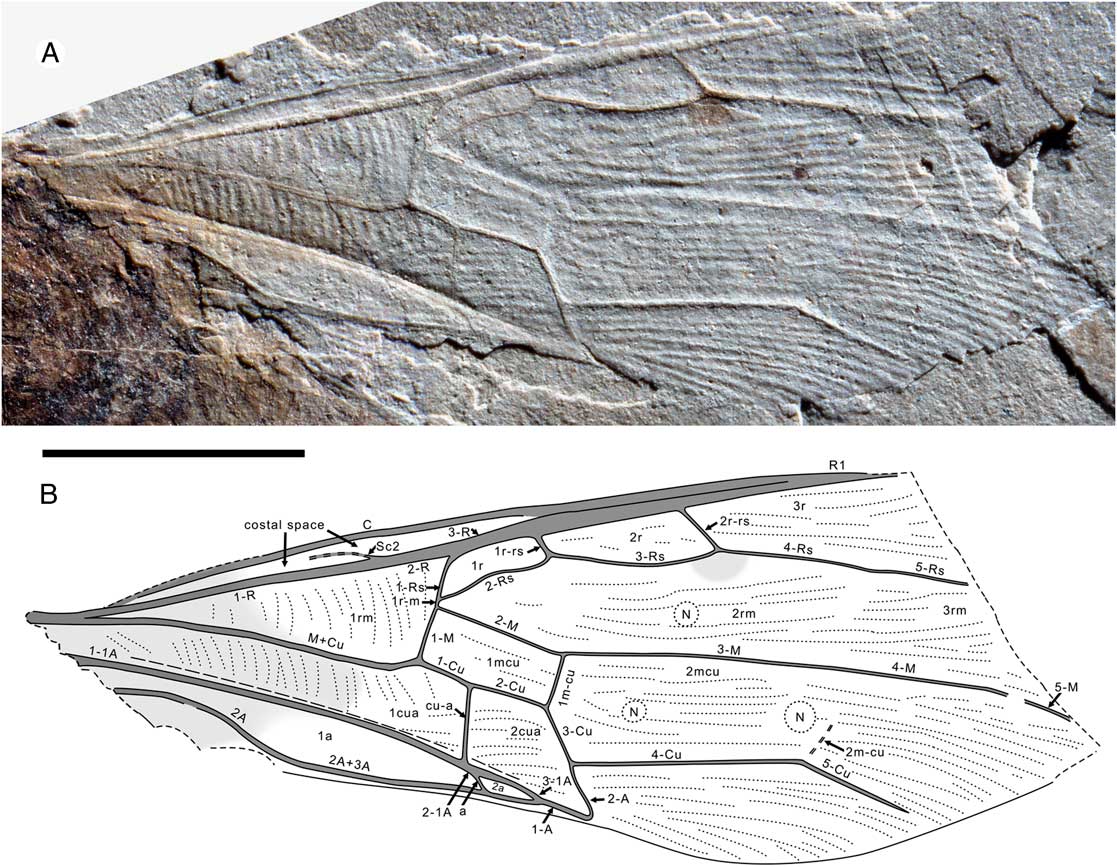
Forewing of Ypresiosirex orthosemos: A, photograph of the part (A side); B, drawing. Dotted ovals with “N” are nygmata: see Figures 4B–4C, 5. Some morphology in drawing not present in the photograph of the part in A is preserved on the B side, e.g., more of the posterior margin of the wing, see Figure 4A. Both to scale, 10 mm.

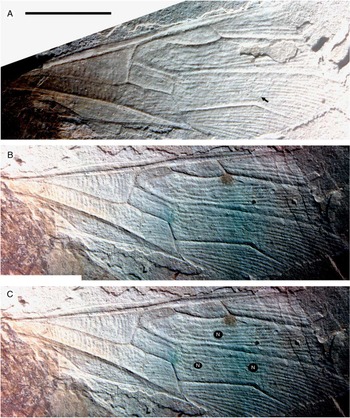
Further features of the forewing of Y. orthosemos photographed under oblique lighting: A, counterpart (RBCM.EH2015.004.0001.001B) showing weak 2m-cu crossvein indicated by arrow (note some morphology preserved on B side not on A side e.g., more complete posterior margin); B, part (RBCM.EH2015.004.0001.001A) showing nygmata; C, same as A with nygmata indicated “N”. All to scale, 10 mm.

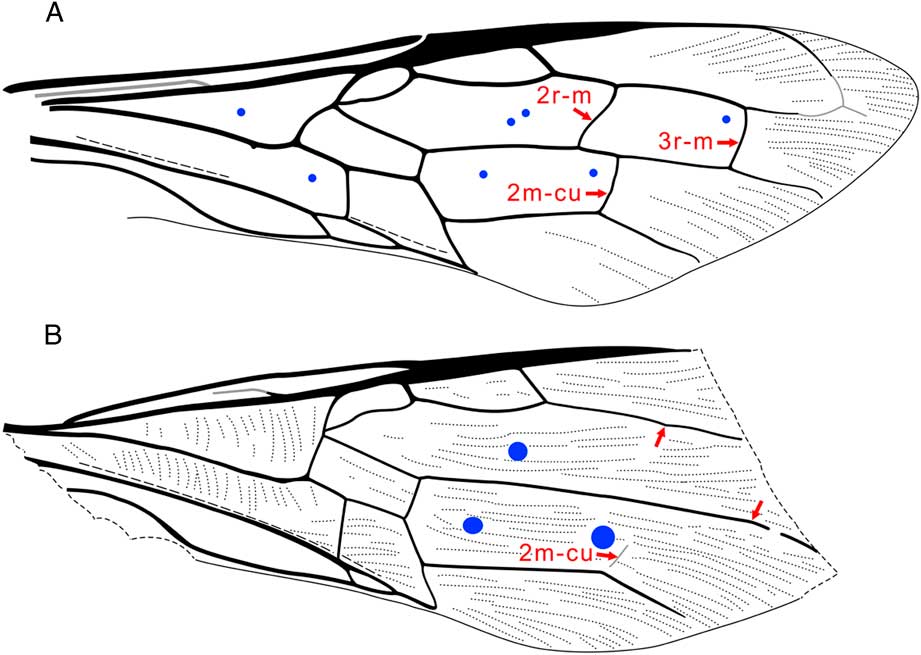
Comparison of forewings of A, Ypresiosirex orthosemos and B, Urocerus gigas with crossveins and nygmata (blue dots) indicated.

Type material. Holotype: RBCM.EH2015.004.0001.001A&B (part; counterpart), Figures 2–5, a mostly complete and generally well-preserved female; housed in the RBCM collection. Labelled: HOLOTYPE, Ypresiosirex orthosemos Archibald and Rasnitsyn 2015. Collected by SBA at McAbee, British Columbia, in the mid-1990s.
Diagnosis. May be easily separated from all Siricoidea by transverse corrugation in forewing basal cells (1rm, 1cua, 1a in part), also from all Siricoidea but Siricidae sensu stricto (comprised of former Siricinae+Tremecinae, i.e., Siricinae sensu Rasnitsyn Reference Rasnitsyn1969) by presence of female metasomal horn; or by forewing anal cell with loop (bend of 2A, creating membrane space in extant species known to enclose a rough membrane patch bearing cenchri, forming a wing locking device) in basal rather than subbasal position. May be separated from all genera of Siricidae sensu stricto by loss or extreme weakening of crossveins 2r-m, 3r-m, 2 m-cu (either absent or weak: not as tubular or nebulose veins, i.e., not darkened, so invisible in fossils); or by interanal crossvein “a” placed well distad cu-a (proximad cu-a or at most subaligned with it in other genera). Additionally it differs from Tremex Jurine, Eriotremex Benson, Afrotremex Pasteels, Teredon Norton species by the female cornus distinctly longer than wide; from Eriotremex, Afrotremex, Xeris Costa, Siricosoma Forsius, Teredon species by the absence of Rs+M; from Tremex, Eriotremex, Afrotremex, Xeris, Siricosoma species by cu-a positioned distad basal third of cell 1mcu.
Description (female). Overall length 59.3 mm anterior of head to tip of cornus, 67.9 mm including ovipositor (incompletely preserved, tip missing). Body dorsum apparently darkly coloured except for mid-abdominal section (but preserved caudal abdomen colouration may be of ventral surface). Head, thorax integument where visible densely but not deeply pitted, pits particularly large on lateral pronotal dorsum; otherwise morphology difficult to interpret except that head appears long (at least about as long as wide); pronotal sides somewhat converged forwards; hind margin deeply excised; mesonotum longer than usual, with long medial suture, notauli widely diverging. Legs: Imperfectly preserved, ordinary as visible. Forewing: length 34.5 mm preserved, estimated complete length (based on dimensions of Urocerus Geoffroy wing, see Fig. 5) 37 mm; maximum width 12.4 mm; hyaline except basal quarter infuscate; Sc2 joining R basad Rs for distance equal to that between 1-Rs, 1r-rs; cells 1r, 1mcu not touching; ap-Cu, crossveins 2r-m, 3r-m absent or extremely weak (not tubular nor nebulose; no trace detected as preserved), portion of 2 m-cu detected but very weak (Fig. 4A), characteristic bends in M+Cu, Rs, M, Cu indicate lost positions; membrane strongly transversely corrugated in basal cells (1rm, 1cua, at least partly 1a), strongly longitudinal corrugated in cells 2r, 3r, 2rm, 3rm, 1mcu, 2mcu, 2cua, and all outer wing membrane preserved; crossvein a distad cu-a, forming small cell 2a below cell 2cua; vein 2A+3A adjacent to posterior margin in about distal half of cell 1a; tracing its direction proximal (Fig. 3) indicating basal loop reaching wing base or near so; free vein 3A absent. Three nygmata detected: two in cell 2mcu and one in cell 2rm (Fig. 4B, 4C). Hindwing: fragmentarily, indistinctly preserved if at all. Abdomen: only mid portion well visible (otherwise obscured by heavier sclerotised coxae, basal ovipositor structures), lacking rough sculpture; valvifers 2+3 almost half as long (16.2 mm) as estimated length of forewing; cornus wedge-shaped, twice as long as wide, half as long as valvifers 2+3, with circular anus midlength.
Etymology. The specific epithet orthosemos means “with vertical stripes” in Greek, referring to the distinctive transverse corrugation in the forewing basal cells.
Age and locality. Ypresian; McAbee, British Columbia, Canada.
Discussion. The taxonomic position of Y. orthosemos as a member of the superfamily Siricoidea is beyond doubt by its characteristic general appearance, with a long, straight, and strong ovipositor coupled with other distinctive traits of living horntails, that is, a strongly corrugated wing membrane, moderately narrow ribbon-like costal space, reclival Rs base, basal position of the anal loop, and the presence of the metasomal cornus in the female. However, the higher-level systematics within the superfamily is not as clear today as it appeared to be a few decades ago (Rasnitsyn Reference Rasnitsyn1969, Reference Rasnitsyn1988) due to the accumulation of new described (Wedmann Reference Wedmann1998; Rasnitsyn and Zhang Reference Rasnitsyn and Zhang2004a, Reference Rasnitsyn and Zhang2004b; Wedmann et al. Reference Wedmann, Pouillon and Nel2014), re-interpreted (Nel Reference Nel1988, Reference Nel1991; Rasnitsyn et al. Reference Rasnitsyn, Jarzembowski and Ross1998), and undescribed fossils that complicate matters, a development that deserves at least a short discussion.
The siricoid families Anaxyelidae, Xiphydriidae, and the enigmatic Daohugoidae are confidently defined and require no further special consideration here. The remaining siricoids consist of the living and fossil Siricidae sensu stricto (i.e., Siricinae+Tremecinae=Siricinae sensu Rasnitsyn Reference Rasnitsyn1968), and an array of fossil taxa that include recent discoveries of debatable position. These Mesozoic species are usually grouped now as the Auliscinae, Gigasiricinae, and Sinosiricinae, subfamilies of Siricidae (Rasnitsyn Reference Rasnitsyn1969, Reference Rasnitsyn1980, Reference Rasnitsyn1988; Carpenter Reference Carpenter1992; Taeger et al. Reference Taeger, Blank and Liston2010; the latter two papers add also Praesiricidae, which rather belong to Pamphilioidea: Wang et al. Reference Wang, Rasnitsyn, Shih and Ren2014a and references therein), and the Protosiricidae and Pseudosiricidae (=Myrmiciidae).
All of these five are insufficiently known and not firmly defined as separated from each other, nor in cases from the Siricidae sensu stricto. For instance, Siricidae sensu stricto and Pseudosiricidae are putatively synapomorphic in the strong corrugation of their wing membrane; Siricidae is further apomorphic in having 1-Rs reclival (proclival in Pseudosiricidae), the anal loop basal (probably subbasal in Pseudosiricidae: see Rasnitsyn Reference Rasnitsyn1969, fig. 17 versus 18) and the metasomal cornus present in the female (never reported in Pseudosiricidae). Sinosiricinae are similar to Siricidae sensu stricto in many wing characters (except for clearly subbasal anal loop and the absence of corrugation – at least not as preserved), but differ in lacking the modification of the transmesonotal suture characteristic of Siricidae sensu stricto and unknown otherwise except in the Auliscinae. Auliscinae is supposedly synapomorphic with Siricidae sensu stricto in the above modification of the transmesoscutal suture (laterally curved forward) and has 1-Rs vertical and not proclival, similar to another siricid apomorphy. In turn, Gigasiricinae species generally differ from those of Auliscinae in having 1-Rs proclival and by the presence of a longitudinal Sc (not found in Auliscinae). However, in Liasirex Rasnitsyn 1-Rs is practically vertical, and the structure of Sc is only known in a few Auliscinae (Rasnitsyn Reference Rasnitsyn1968). In turn, Protosiricidae definitely differ from Gigasiricinae only by a longer and proclival 1-Rs, which is a comparatively modest distinction: when creating this family, they were differentiated from Siricidae sensu lato in lacking the transmesoscutal suture (Rasnitsyn and Zhang Reference Rasnitsyn and Zhang2004a). However, evidence of this structure in Gigasiricinae has not been found (A.P.R., personal observation). As a result of these issues, the five Mesozoic families that are now known to form the bulk of Siricoidea constitute an assemblage that is difficult to confidently subdivide, and so have obscure internal relations.
Ypresiosirex is firmly established as a member of Siricidae sensu stricto by the presence of an apical cornus on the female abdomen, and by its forewing with a strongly corrugated membrane, reclival 1-Rs, and strictly basal anal loop. Siricidae sensu stricto is sufficiently distinguished from this otherwise confusing group of siricoid taxa, and so here, we limit ourselves to consider the new Okanagan Highlands horntail in the context of that taxon and set aside the problem of the structure of Siricoidea as a whole.
Within the Siricidae sensu stricto, the issue of subfamily composition bears some examination. Wedmann et al. (Reference Wedmann, Pouillon and Nel2014) recently revisited the significant problem of differentiating the Siricinae and the Tremicinae, its generally accepted subfamily level groups. They demonstrated convincingly the absence of serious reasons to maintain these as distinct taxa, an opinion with which we concur. Further to the morphological and molecular evidence that they discuss, host plant association has often been cited as consistent between these putative taxa, with siricine larvae characterised as feeding within conifer wood and tremicines within angiosperms. However, while those genera assigned to the Siricinae where host plants are known (Sirex, Urocerus) do feed within conifers, the host plants of the others (Sirotremex Smith, Xoanon Semenov) are not known; of those assigned to the Tremicinae, Tremex feeds in angiosperms, Xeris (+Neoxeris, within Tremicinae: Schiff et al. Reference Schiff, Goulet, Smith, Boudreault, Wilson and Scheffler2012) feeds in conifers, Eriotremex in both conifers and angiosperms, Afrotremex has a very restricted record of an angiosperm host, and the host plants of Siricosoma (in Tremicinae: Schiff et al. Reference Schiff, Goulet, Smith, Boudreault, Wilson and Scheffler2012) and Teredon are not known (Smith Reference Smith2008; Schiff et al. Reference Schiff, Goulet, Smith, Boudreault, Wilson and Scheffler2012; Goulet Reference Goulet2014). Therefore, this is also too weak a character to separate the Tremicinae. By these reasons, we treat the Siricidae sensu stricto as composed of a single subfamily, the Siricinae (we consider it highly likely that at least some of the Mesozoic taxa referred to above will be considered as further subfamily-level groupings within a confidently defined Siricidae following revision).
Ypresiosirex is unique within the family and within Hymenoptera as a whole by the distinctive, apomorphic transverse corrugation of its basal forewing membrane, by the loss of crossveins 2r-m and 3r-m (and 2 m-cu portion present but very weak, barely detectable: see Fig. 4A), and by the distal position of the interanal crossvein. The remaining venational characters and long and narrow cornus of the new genus are, however, comparable to those of Urocerus (Fig. 5), providing support for that genus to be considered as a possible analogue in the modern fauna.
The forewing of Y. orthosemos shows three nygmata, organs of unknown function found on the wings of insects such as Hymenoptera, Mecoptera, and Neuroptera (Wang et al. Reference Wang, Rasnitsyn, Shih and Ren2014b). They are rarely detected in fossil Hymenoptera (Wang et al. Reference Wang, Rasnitsyn, Shih and Ren2014b), and have never before been reported in fossil Siricidae. Nygmata have been described numerous times in the wings of Okanagan Highlands fossil Neuroptera (Makarkin and Archibald Reference Makarkin and Archibald2003; Archibald and Makarkin Reference Archibald and Makarkin2006).
Superfamily Cephoidea Neuman, 1834
Family Cephidae Neuman, 1834
Subfamily Cephinae Kirby, 1882
Cuspilongus Archibald and Rasnitsyn, new genus
Type species. Cuspilongus cachecreekensis, Archibald and Rasnitsyn new species. Here designated.
Diagnosis. Separated from other genera of Cephidae as in the diagnosis of its only species, below.
Description. As in description of female of its only species, below.
Etymology. The generic name Cuspilongus is formed from the Latin cuspis, meaning a lance, and longus, meaning long, referring to its extremely extended ovipositor. Gender masculine.
Cuspilongus cachecreekensis Archibald and Rasnitsyn, new species
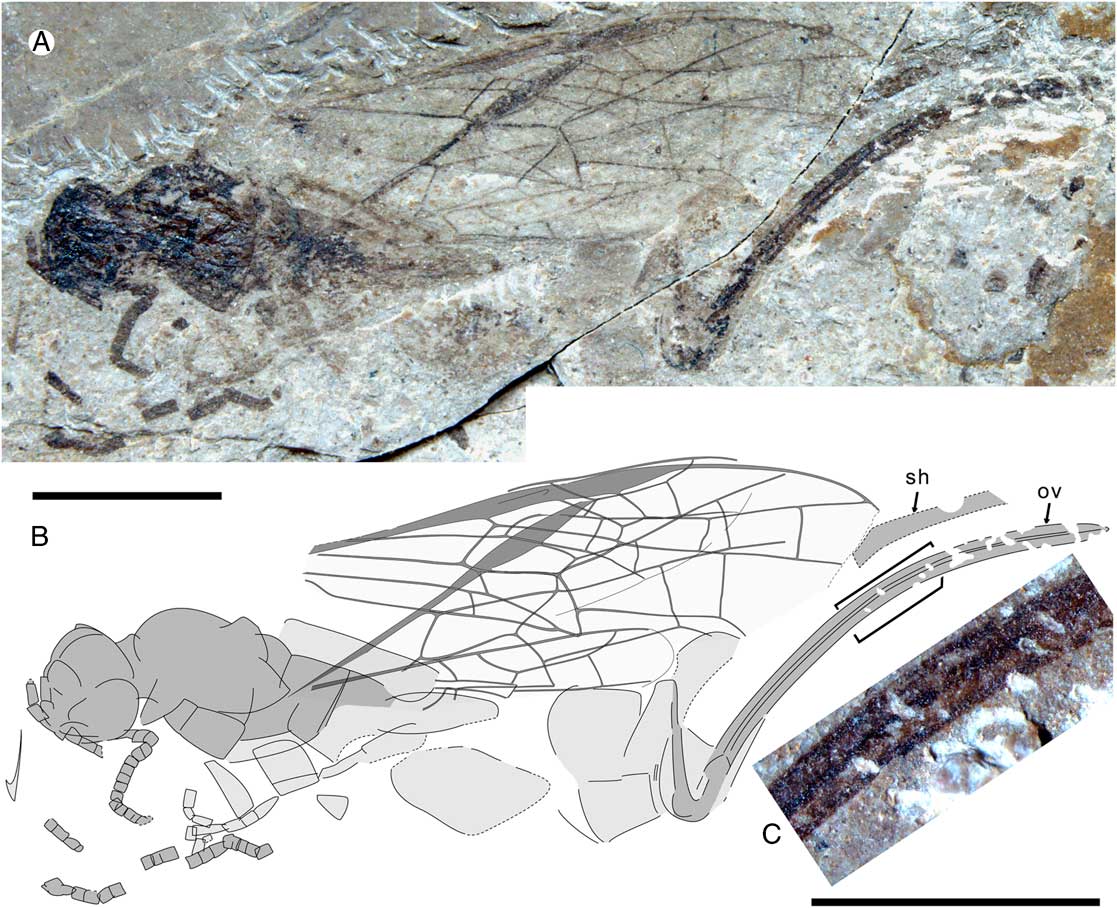
Cuspilongus cachecreekensis new genus and species, Cephidae from McAbee (F-1545/1546): A, photograph of the part (F-1545); B, drawing, showing combined morphology preserved on both part and counterpart: C, close-up photograph of portion of ovipositor indicated in B. Abbreviations: sheath, sh; ovipositor, ov. A, B to scale, 4 mm; C scale, 2 mm.

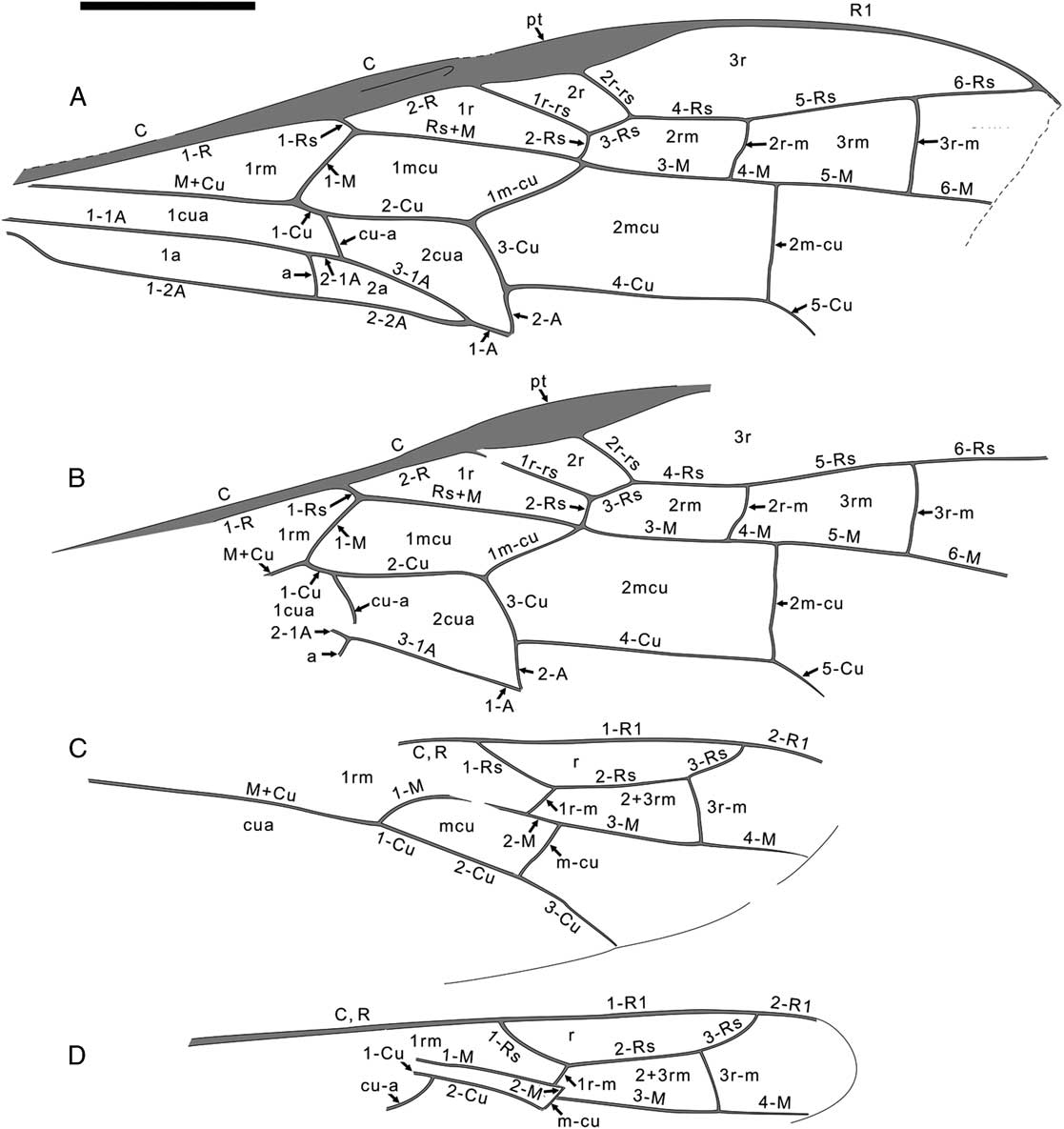
Cephidae from McAbee (F-1545/1546), wings: A, B, forewings; C, D, hind wings; only cells mentioned in the text are labelled; all to scale, 2 mm.

Type material. Holotype: F-1545 (part), F-1546, (counterpart): a very complete female specimen but lacking legs, abdomen somewhat obscurely preserved, housed in the TRU collection, collected by John Leahy ay McAbee, British Columbia. Labelled: HOLOTYPE, Cuspilongus cachecreekensis, Archibald and Rasnitsyn 2015.
Diagnosis. Females most easily separated from all other extant Cephidae by ovipositor almost as long as forewing: extant cephids have ovipositor at most half as long as forewing. Separated from fossil Cephidae (which mostly lack preserved ovipositor) by: Mesocephus sibiricus Rasnitsyn (Early Cretaceous, Baissa) differs by 3r cell short, wide, by 1-M distinctly bent before junction with Rs; M. ghilarovi Rasnitsyn (Early Cretaceous, Bon-Tsagan) differs by 1-Rs longer, by 3r cell wider (1:3.8 versus 1:5); Janus disperditus Cockerell (Priabonian, Florissant), assigned to an extant genus, differs by 2-M very long, by 3-Cu short; Electrocephus stralendorffi Konow (Priabonian Baltic amber) differs by short ovipositor, smaller (length 6 mm) more robust body, 3-Cu short.
Description (female). Overall length about 14 mm anterior of head to tip of abdomen (but somewhat damaged, distorted) excluding ovipositor. Head, thorax integument where visible dark, abdomen light coloured; no portions identifiable as belonging to any leg preserved. Antennae: elements apparently of similar width (but, preserved in disarticulated sections), apparently mostly dark, lighter apically. Forewing: length about 12 mm (practically complete); width unknown by preservation; membrane hyaline or very lightly infuscate, except intercostal space dark; veins dark. 1-Rs more than half as long as 2-Rs, 1r-rs complete, joins R at pterostigma base; cell 3r five times as long as wide; 2r-rs joins pterostigma near mid-point; 2r-m gently bent; 3r-m, 2 m-cu rather straight; 2-M (between Rs+M, 1 m-cu) almost non-existent, cell 1rm shorter than 2rm, 4-M longer than half 2r-m, 1-Cu about 2/3 length of cu-a; distinct bend in 2A near base, directed posteriad, apicad this subparallel 1A. Hindwing: membrane hyaline or very lightly infuscated; 3r-m, m-cu, cu-a present. Abdomen: mostly damaged, indistinctly preserved other than ovipositor, which is long, about 11 mm, curved downward; small portion of sheath preserved (Fig. 6).
Etymology. The specific epithet is formed from the name of the nearby town of Cache Creek, some 8 km to the west of the McAbee site.
Age and locality. Mid-Ypresian; McAbee, British Columbia, Canada.
Discussion. The new species is confidently assigned to Cephinae by the darkened intercostal region and the ovipositor sheath curved downward (Benson Reference Benson1946; Smith and Schmidt Reference Smith and Schmidt2009). It is further separated from the Athetocephinae by 2r-rs joining the lower margin of the pterostigma near the mid-point, and from the Australcephinae by the forewing with 3r-m present, 1r-rs meeting pterostigma at the base, not in the middle region near 2r-rs, the pterostigma longer and narrower, and cell 2r not unusually small as in that subfamily.
Most of the described fossil cephids are in need of revision – there are new, undescribed Cretaceous specimens and more material of the currently little-known M. ghilarovi (A.P.R., personal observation), and the descriptions of the Eocene species are over a century old, outdated, and inadequate by modern standards (E. stralendorffi: Konow Reference Konow1897; J. disperditus: Cockerell Reference Cockerell1913). We translate Konow’s (Reference Konow1897) Latin “feminae vagina exerta” to mean the ovipositor, or perhaps the sheath, just protruding behind the abdominal apex and not unusually long as in Cuspilongus.
Cephinae species A
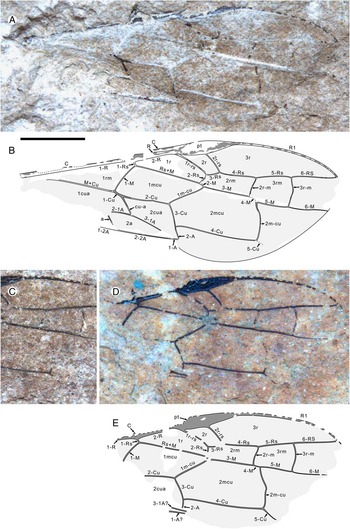
Cephidae from Horsefly River: A, photograph of RBCM.EH2015.005.0001.002; B, drawing of RBCM.EH2015.005.0001.002; C, partial photograph of RBCM.EH2015.005.0001.001, dry (shows membrane infuscation better); D, photograph of RBCM.EH2015.005.0001.001 wetted with ethanol (shows venation better); E, drawing of RBCM.EH2015.005.0001.001; all to scale, 2 mm.

Material. Two isolated forewings, mostly complete but missing basal portions, RBCM.EH2015.005.0001.001 and RBCM.EH2015.005.0001.002, collected by S.B.A. 2.x.2001 at Horsefly River (Black Creek Road), housed in the RBCM collections.
Description (forewing). Forewing length 10 mm, width 3.8 mm (RBCM.EH2015.005.0001.002 as preserved, fairly complete); membrane distinctly infuscate. 1-Rs less than half 2-Rs length, cell 3r four times as long as wide, 2-M scarcely longer than 1-Rs, cell 2rm longer than 3rm, 4-M at most half as long as 2r-m, 2 m-cu distinctively bent.
Age and locality. Ypresian; Horsefly River, British Columbia, Canada.
Discussion. We assign it to the Cephinae by characters of the forewing discussed for C. cachecreekensis above. Distinct from C. cachecreekensis by 1-Rs, 4-M and cells 3r, 3rm shorter; 2-M longer; 2 m-cu bent. We consider these Horsefly River forewings to be confidently conspecific by the close agreement of their morphologies.
Siricomorpha in the Ypresian
The new species described here are the only Siricomorpha currently established in the Ypresian. By this time, forest communities had recovered from low floral diversity following the K-Pg extinction event (particularly in North America) to reach high levels of community richness into mid-latitude localities such as those of the Okanagan Highlands (Archibald et al. Reference Archibald, Bossert, Greenwood and Farrell2010; Smith et al. Reference Smith, Basinger and Greenwood2012). This included the radiation and appearances of many modern genera belonging to groups characteristic of or most diverse in modern northern temperate regions (e.g., Rosaceae: DeVore and Pigg Reference DeVore and Pigg2007; Betulaceae: Pigg et al. Reference Pigg, Manchester and Wehr2003; Fagaceae: Bouchal et al. Reference Bouchal, Zetter, Grímsson and Denk2014). Ichnofossil evidence of plant-insect interactions shows highly disturbed food webs followed by a rebound through this interval, apparently differing in intensity across the globe, e.g., perhaps affecting North America more severely than Europe and South America (Labandeira et al. Reference Labandeira, Johnson and Wilf2002; Wilf et al. Reference Wilf, Labandeira, Johnson, Cúneo and Dilcher2005, Reference Wilf, Labandeira, Johnson and Ellis2006; Currano et al. Reference Currano, Wilf, Wing, Labandeira, Lovelock and Royer2008; Wappler et al. Reference Wappler, Labandeira, Rust, Frankenhäuser and Wilde2012; Donovan et al. Reference Donovan, Iglesias, Wilf, Cúneo and Labandeira2014; and see brief review in Archibald et al. Reference Archibald, Kehlmaier and Mathewes2014a).
Okanagan Highlands localities contain the oldest confident fossil record or oldest macrofossil record of a number of important modern genera of angiosperms, e.g., Rubus Linnaeus, Sorbus Linnaeus, Prunus Linnaeus, Crataegus Linnaeus (Rosaceae); and Betula Linnaeus, Corylus Linnaeus, and Carpinus Linnaeus (Betulaceae) and the conifers Abies Linnaeus, Picea Dietrich (Pinaceae) and Thuja Linnaeus (Cupressaceae) (Crane and Stockey Reference Crane and Stockey1987; Wehr and Schorn Reference Wehr and Schorn1992; Schorn and Wehr Reference Schorn and Wehr1996; Pigg et al. Reference Pigg, Manchester and Wehr2003; DeVore and Pigg Reference DeVore and Pigg2007, Reference DeVore and Pigg2010).
The Republic forest contained many host plants that pamphiliid larvae feed on today, such as Rubus, Prunus, Sorbus, Crataegus and Spiraea Linnaeus (Rosaceae); Betula, Corylus, Carpinus, and Alnus Miller (Betulaceae); Populus Linnaeus (SaIicaceae); Quercus Linnaeus (Fagaceae); Cornus Linnaeus (Cornaceae); Acer Linnaeus (Sapindaceae); and such conifers as Pinus Linnaeus, Abies, Picea, and Tsuga (Endlicher) Carrière (Pinaceae) (larval hosts: Benson Reference Benson1945; van Achterberg and van Aartsen Reference van Achterberg and van Aartsen1986; Smith Reference Smith1988; Republic flora: Greenwood et al. Reference Greenwood, Archibald, Mathewes and Moss2005; Moss et al. Reference Moss, Greenwood and Archibald2005; DeVore and Pigg Reference DeVore and Pigg2010). Schorn and Wehr (Reference Schorn and Wehr1996) estimated that the Republic flora contains the richest conifer record in the Paleogene. The McAbee forest included many plants associated with extant siricids: the conifers Abies, Pinus, and Picea (Pinaceae), Juniperus Linnaeus, Thuja, Chamaecyparis Spach, and Sequoia Endlicher (Cupressaceae); and the angiosperms Acer (Sapindaceae), Fagus Linnaeus and Quercus (Fagaceae), Carya Nuttall (Juglandaceae), Fraxinus Linnaeus (Oleaceae), Populus (Salicaceae), and Ulmus Linnaeus (Ulmaceae) (larval hosts: Schiff et al. Reference Schiff, Goulet, Smith, Boudreault, Wilson and Scheffler2012; McAbee flora: Greenwood et al. Reference Greenwood, Archibald, Mathewes and Moss2005; Moss et al. Reference Moss, Greenwood and Archibald2005 and references therein). (The references cited above refer to Quercus, Juniperus and Fraxinus at these Okanagan Highlands sites, but we treat the Quercus and Juniperus classifications as tentative, as they have not been confirmed there by fossil reproductive structures; we report here confirmation of Fraxinus at McAbee by two samaras, see Fig. 9)
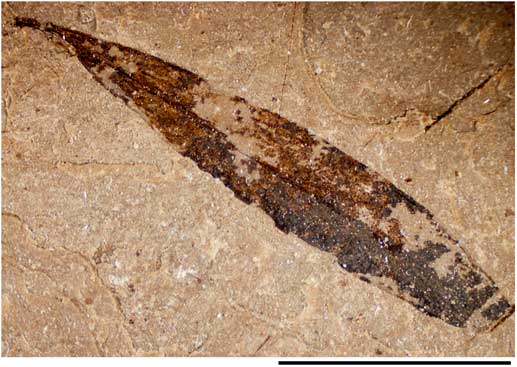
Fraxinus samara from McAbee confirming its presence there; specimen SBA 335, in the BU McAbee collection, collected by S.B.A. at McAbee, British Columbia, 22.vi.2000 (a second specimen: SBA 235, collection information the same, also in the BU collection). Identification by M. DeVore. Scalebar is 10 mm.

Today, the major centres of cephid diversity are in grasslands of the Mediterranean and Eurasian steppes, particularly where they merge with temperate forests (Benson Reference Benson1946). They are well known for feeding on grasses (Poaceae), however, they also feed on some dicots, mostly of the Rosaceae (Rosa Linnaeus, Rubus, Agrimonia Linnaeus, Filipendula Miller, Sanguisorba Linnaeus, Pyrus Linnaeus, Malus Miller), but also of the Salicaceae (Populus, Salix Linnaeus), Papaveraceae (Papaver Linnaeus), Fagaceae (Quercus), Grossulariaceae (Ribes), and Adoxaceae (Viburnum Linnaeus) (Benson Reference Benson1945; Scheibelreiter Reference Scheibelreiter1978; Smith Reference Smith1988; Wei and Smith Reference Wei and Smith2010; Budak et al. Reference Budak, Korkmaz and Basibuyuk2011). The molecular phylogeny of Budak et al. (Reference Budak, Korkmaz and Basibuyuk2011) suggests a host shift (or shifts) from grasses in more basal cephines to these other groups, although they recognised the limitations of conclusions that can be drawn from their phylogeny based on a single gene fragment.
Pollen, phytolith, and proxy mammal tooth evidence show grasses as old as the Late Cretaceous (Maastrichtian), but as minor, cryptic community elements. The oldest known grass macrofossil is from the Paleocene-Eocene boundary, and their abundant fossil record does not appear until the Miocene (Strömberg Reference Strömberg2005, Reference Strömberg2011 and references therein). Grass fossils of any kind have not been reported in the Okanagan Highlands, but dicots that are modern hosts of Cephinae are known from McAbee (Populus, Salix, Quercus, and Ribes) and Horsefly River (Salix, Quercus, and Ribes) (Greenwood et al. Reference Greenwood, Archibald, Mathewes and Moss2005; Moss et al. Reference Moss, Greenwood and Archibald2005).
The fossil record of Cephinae, however, extends to the Early Cretaceous (see Introduction), before grasses or any of the other modern host-plant groups are known or are thought to have originated. This, combined with the richness of Eocene non-grass cephine host plants and the rarity of grass fossils until the Miocene suggests a more complex history of host plant interactions than could be indicated by a molecular phylogeny of extant representatives.
Modern siricomporphs overwhelmingly prefer temperate to cool Holarctic climates. The latter half of the Ypresian, however, was the globally warmest sustained interval of the Cenozoic, known as the Early Eocene Climatic Optimum (Zachos et al. Reference Zachos, Dickens and Zeebe2008). Eocene climates with mean annual temperatures comparable to those of the temperate/boreal Holarctic ranges of most modern siricomorphs are only known in polar regions (e.g., the Canadian High Arctic: Basinger et al. Reference Basinger, Greenwood and Sweda1994) and high elevations, such as the Okanagan Highlands (Rouse et al. Reference Rouse, Hopkins and Piel1971; Wolfe et al. Reference Wolfe, Forest and Molnar1998; Greenwood et al. Reference Greenwood, Archibald, Mathewes and Moss2005; Smith et al. Reference Smith, Basinger and Greenwood2009). The three Okanagan Highlands sites considered here had mesic climates with upper microthermal mean annual temperature of about 10–13 °C, like that of Portland, Oregon or Vancouver, British Columbia today, but distinctly differing by their mild, frost-free winters (Greenwood et al. Reference Greenwood, Archibald, Mathewes and Moss2005; Moss et al. Reference Moss, Greenwood and Archibald2005; Archibald et al. Reference Archibald, Greenwood, Smith, Mathewes and Basinger2011, Reference Archibald, Morse, Greenwood and Mathewes2014b).
The Okanagan Highlands localities represent a unique set of factors known nowhere else at this time combined with an extensive, well-preserved fossil insect assemblage during an early stage of formation of modern temperate terrestrial ecosystems. Here, we see the first evidence of siricomporphs taking on their modern ecological character with the appearance of many of the host plants associated with them today set in an environment with their preferred modern climate, conditions apparently restricted to this series of sites and present here for the first time.
Acknowledgements
The authors thank Caroline Strömberg, Curator of Paleobotany and Regan Dunn, collections manager at the Burke Museum (Seattle, Washington) for loan of the pamphiliid specimen; Richard Hebda, curator, and Marji Johns, collections manager at the Royal BC Museum (Victoria, British Columbia) who accessioned and then loaned us the siricid and Horsefly River cephid specimens; and the late John Leahy, who provided the McAbee cephid specimen to us, donating it to TRU, and Nancy Van Wagoner of TRU, who accessioned it and loaned it to us; Robert Campbell and the late David Langevin for access at McAbee; Marlow Pellatt (Parks Canada) for use of microphotography equipment in his laboratory, James Haggart and Hillary Taylor of the Geological Survey of Canada (Vancouver), and Karen Needham, Don Griffiths, and Hamzeh Karim-Ramezani of the Beaty Biodiversity Museum (Vancouver) for further assistance with fossil insect photography and David Greenwood (Brandon University) for Fraxinus photography (Canada Foundation for Innovation funded Olympus MVX10 microscope at BU). The authors thank David Smith (Smithsonian Institution) for discussion of cephid ovipositors, Enrique Penãlver (Instituto Geológico y Minero de España) for information about A.(?) ribesalbesensis; and Kathleen Pigg (Arizona State University), David Greenwood, and Melanie DeVore (Georgia College and State University) for discussion of Okanagan Highlands paleobotany (M. DeVore for Fraxinus identification). S.B.A. thanks Rolf Mathewes (Simon Fraser University) and David Greenwood for financial (Natural Sciences and Engineering Research Council of Canada Discovery grants #311934 to D.G and #3835 to R.M.), and infrastructure support; and work by A.P.R. was additionally supported by the Presidium RAS Program “Origin and evolution of the geo-biological system”.