The Bohemian composer Václav Jan Křtitel Tomášek (1774–1850) is generally known for his short piano pieces – eclogues, dithyrambs and rhapsodies – which are described along with John Field’s nocturnes as initiating the Romantic genre of the intimate character piece. Neither Richard Taruskin (in the Oxford History of Western Music) nor Leon Plantinga (in Romantic Music) mentions the fact that he also wrote a significant number of songs, including settings of Klopstock, Hölty, Schiller and especially Goethe.Footnote 1 This delightful new recording by Renata Pokupić and Roger Vignoles will no doubt put Tomášek’s German settings on the map for listeners, scholars and performers.Footnote 2 The recording includes 15 Goethe settings from Tomášek’s opp. 53–59; the Six Bohemian Songs op. 71; four songs chosen from opp. 37, 69, 96 and 107; and the Three Songs op. 92 (including two settings of Robert Burns in translation).Footnote 3 Susan Youens provides liner notes with rich historical context and informative descriptions of the songs. English translations by Richard Stokes and Richard Wigmore read well with flexibility for idiom and linguistic flow.
This is Pokupić’s first lieder release; her singing is full of verve with rich tone, precise declamation and enticing coloratura power. Subtle varieties of vocal tone and dynamics help to articulate the text at certain moments. In ‘Die Nacht’ op. 55, no. 5 (track 4), for instance, Pokupić sings ‘zwar’ (‘indeed’) emphatically at the end of the first strophe, she backs away playfully from ‘Scherz’ (‘play’ or ‘jest’) at the end of the second strophe and delivers ‘Lust’ (‘joy’) with warm breathy tone at the end of the third strophe. One might only wish for more of these expressive shadings; they can be relished in the intimate genre of the lied. Roger Vignoles is a master piano collaborator with a large song discography on Hyperion. His performance here is beautifully calibrated, with playfulness and Mozartian grace – which is appropriate since Mozart’s music was Tomášek’s ideal.Footnote 4
Tomášek’s Goethe settings deserve special attention. Goethe’s poetry may be considered the ‘source and catalyst’ for the genre of the lied, not only in Schubert’s famous settings of 1814–15 and not only in the earlier settings by Reichardt and Zelter, but also in 41 settings by Tomášek begun in 1815.Footnote 5 The 15 Goethe songs chosen by Pokupić and Vignoles for this recording include settings of ‘Schäfers Klagelied’, ‘Wandrers Nachtlied’ (beginning ‘Der du von dem Himmel bist’), ‘Erlkönig’ and ‘Heidenröslein’ – all Schubertian favourites. ‘Mailied’, the first song on the CD, sets a poem that Beethoven had set as his op. 52, no. 4. How do Tomášek’s settings measure up? One may naturally ask this question – and yes, Tomášek’s songs tend to be simpler and shorter than Schubert’s or Beethoven’s. But they are also beautifully crafted and thoroughly enjoyable, exhibiting the composer’s close attention to the poetic texts and his ability to capture a variety of moods and effects. Goethe himself responded very favourably to Tomášek’s settings; he accepted Tomášek’s offer of a dedication in 1818, and in 1820 he reported enjoying ‘many pleasant hours’ with the songs and requested a meeting with the composer.Footnote 6 It is easy to understand and identify with Goethe’s pleasure in the Tomášek settings, even if we remain surprised by Goethe’s apparent lack of appreciation for Schubert’s songs.
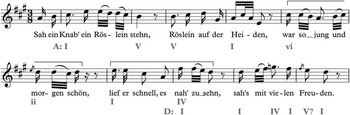
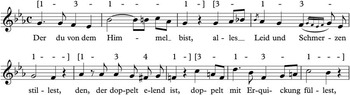
In ‘Heidenröslein’, it is ironically Tomášek (op. 53, no. 1; track 9) who introduces new music to dramatize the plucking of the rose in the third stanza, while Schubert adopts strict strophic repetitions. Tomášek also responds beautifully to a poetic irregularity in the first two strophes. The initial couplet of Goethe’s poem (‘Sah ein Knab’ ein Röslein stehn,/Röslein auf der Heiden’ [‘A boy saw a rose standing/a rose on the heath’]) leads to a tercet with an extra line (‘War so jung und morgenschön,/Lief er schnell, es nah zu sehn,/Sah’s mit vielen Freuden’ [‘It was so young and lovely as the morning,/he ran quickly to see it up close,/he gazed at it with great pleasure’]). Tomášek sets the tercet with a rising thirds sequence, breaking out of the melody’s expected range just as the boy breaks into action in the first stanza.Footnote 7 Pokupić’s voice rings out beautifully at the climax of ‘sah’s mit vielen Freuden’. (Example 1 and Audio Example 1 provide excerpts from the score and recording.) ‘Wandrers Nachtlied’ op. 58, no. 4 (track 7) features a flexible line with lovely elongation of ‘Himmel’, a slight quickening for ‘den der doppelt elend ist’ and matching appoggiaturas for the rhyming ‘stillest’ and ‘füllest’.Footnote 8 Annotations in Example 2 show the varied placement of accented syllables and poetic lines in the notated meter.Footnote 9 (Audio Example 2 excerpts Pokupić’s and Vignoles’s performance of this passage.) An analogous flexibility in ‘Am Flusse’ op. 55, no. 3 (track 14) suggests the dissolution of songs that flow into the sea of oblivion, and in ‘Auf dem See’ op. 57, no. 3 (track 5) it correlates with an anxious search for the beloved. All of this is presented in a simple and direct style, but it is remarkably effective – it’s wonderful.
Tomášek, ‘Heidenröslein’ op. 53, no. 1, bars 5–14

Tomášek, ‘Wandrers Nachtlied’ op. 58, no. 4, bars 4–12

One might assume that strophic forms would be the norm in a song style favoured by Goethe, but this is not the case here. Only three of the 28 songs on the recording are in simple strophic forms, six are in varied strophic forms, eight are in ternary forms and 11 – the largest number – are through-composed settings.Footnote 10 ‘Des Greises Trauerlied’ op. 69 no. 1 (track 22) is the most ambitious song on this CD; it begins with an improvisational fantasy for piano, almost two minutes long in Vignoles’s compelling rendition, and the three varied strophes then feature increasingly turbulent and virtuosic piano accompaniments. Five of the Six Bohemian Songs op. 71 are in ternary forms, but the details of the form are different in each case. The heartfelt ‘Wehmut’ op. 71, no. 3 (track 18), for instance, can be described as ternary in the sense that it has the same music for the outer stanzas, but the full form is ABCA′. The C section is a storm scene, like the one in Schubert’s ‘Der Lindenbaum’, and the varied return features a Neapolitan harmony for the bitter final couplet, ‘Sagt ihr, dass ich starb,/Ach, im Liebesgrame!’ (‘Tell her that I died here,/Ah, consumed with Love’s torment!’).Footnote 11
Tomášek’s songs would be a valuable addition to studio and classroom repertoires. They are musically rewarding, often without excessive demands on the singer or pianist. They offer a full range of diatonic and chromatic harmonies, modulations, phrase types and song forms for music theory classes. They provide a window into the breadth of the genre for music history and music appreciation classes. This lovely recording by Pokupić and Vignoles gives us all the more reason to enjoy the songs with open ears and hearts.
Supplementary Material
To view supplementary material for this article, please visit https://doi.org/10.1017/S1479409816000409