

Introduction
Can a real estate market operate without legal title? If so, by what means does it operate? The answer to the first question has conventionally been no. It is widely believed that a functioning property law regime is a precondition for developing a market economy.Footnote 3 Scholars assume that the market for real estate, the primary form of property and oftentimes the most valuable asset to individuals, cannot operate without legal title.Footnote 4 As a result, development scholars have seldom studied the exchanges of untitled real properties.Footnote 5 A negative answer to the first question has precluded any serious inquiry into the second question.
“Where do we record the relevant economic features of assets, if not in the records and titles that formal property systems provide? Where are the codes of conduct that govern the use and transfer of assets, if not in the framework of formal property systems?”Footnote 6 Hernando de Soto, by posing these rhetorical questions, implies that life in informal settlements, where formal property rights are absent, is nasty, brutish, and poor.Footnote 7 For example, according to a study on informal settlements in Lima, Peru, one adult must occupy the house twenty-four hours a day in order to prevent others’ from taking possession of it.Footnote 8
But in Shenzhen, the iconic city of China’s market economy, an opposite phenomenon exists: half of the buildings within the city, which covers 1,993 square kilometers of land and has over 10 million people, have no legal titles. In China, urban land is state owned, while rural land is collectively owned by farmers in the respective villages. Only urban land can be developed, and only urban houses can be freely transacted. Farmers are only allowed to use rural land for agriculture. Only the government can sell and develop rural land, after converting it to urban land through expropriation; private rural land development and transactions are prohibited. However, over 300,000 indigenous villagers in Shenzhen have abandoned agriculture (planting crops) and built over 350,000 buildings on their land despite the legal prohibition. These buildings have been built by either villagers themselves or land developers, or through the cooperation of both, and they have been rented or sold to millions of people, including millions of migrant workers, middle-income, white-collar workers, start-up entrepreneurs, and even real estate speculators.Footnote 9
According to an official at the Shenzhen Real Estate Ownership Registration Center, “Nobody cares whether they have legal titles or not. You say they are illegal: dare you void the contracts? You say they are legal: are you to grant them legal titles? The contracts are there—could you void that? There is a huge amount of transactions—you say farmers cannot sell, it is illegal, but they do it privately with little ado. Are you to tell them whether it is legal or illegal?”Footnote 10 These illegal buildings exist not only in Shenzhen but nationally. According to official estimates, 10% of houses in China are developed and sold by Chinese farmers in violation of the legal prohibition on private rural land development. People in China call these illegal buildings small-property houses (xiaochanquan in Chinese), because their property rights are “smaller” (weaker) than those on the urban/formal housing market, which have “big” property rights that are protected by the government. Shenzhen is the city with the highest ratio of small-property houses; small-property houses contribute 49.27% of the total built-up area in Shenzhen, compared to 30% in Xi’An and 20% in Beijing.Footnote 11
I spent one year in Shenzhen investigating how the market of small properties has evolved, carrying out ninety-four interviews in total. The forms of these interviews vary. The majority are in-depth interviews, typically a one- to two-hour conversation. Some consist of half- or whole-day road trips made to small-property neighborhoods in the different districts of Shenzhen, during which I usually had conversations with real estate brokers, residents, and potential buyers and sellers of small-property houses. Another important part of my fieldwork was working with a twenty-member team on a research project commissioned by the Shenzhen municipal government to address the problem of widespread small properties. We had meetings and discussions with numerous Shenzhen government officials, including the mayor and the municipal commissioner of urban planning, land, and resources. All the interviews were taped and recorded. I also collected various materials including government investigation reports, court files, village maps and records, transaction documents, and news reports.
Based on my fieldwork in Shenzhen, this paper is a first step toward explaining the small-property market and its implications for law and development. It serves as a factual basis for theoretical discussions on the evolution of property rights and the emergence of markets in follow-up papers.Footnote 12 Its sole purpose is to prove empirically that a real estate market can operate without legal titles. It focuses on the small-property market itself and presents its factual situation and mechanisms. The main participants in the market are legitimate and include village co-ops, real estate brokers, lawyers, a local bank, and even the local government branches and agencies, which from time to time chose to acquiesce to the development of the small-property market. But although they are legitimate actors, they are not constrained by legal boundaries. They have developed a network to support the operation of the small-property market. The formal property law has been ambiguous and subject to change and inconsistent enforcement, and thus has had limited prohibitive force. It should be noted that this paper omits several relevant aspects of the small-property market, in particular, the efforts of the Shenzhen government to legalize the small-property market, which is addressed in a separate paper.Footnote 13
This paper proceeds as follows: Part I introduces the historical background of the small-property market and discusses rural land development amid the legal ambiguity of China’s market transition. Part II discusses the number of small properties and the scale of small-property transactions, which are mostly impersonal exchanges; explores the network of institutional innovators that supports this market, including village co-ops, real estate brokers, a local bank, and lawyers, all of which are legitimate organizations or professionals; and examines how this network reduces the contract risks of small-property transactions. Part III investigates the confrontation between the small-property market and the government and explores why the legal enforcement campaigns of the Shenzhen government have not eliminated the small-property market. This part also expands the network of institutional innovators by incorporating the different levels and agencies of the local government. Part IV concludes the discussion.
I. Development amid Legal Ambiguity
Shenzhen is located in Southern China’s Guangdong province, on the northern border of Hong Kong. It was the first Special Economic Zone to experiment with a market economy in China after 1978, and it has grown from an agricultural county of about 300,000 people in 1979 to the fourth biggest city in China. From 1979 to 2010, the annual growth rate of its gross domestic product (GDP) was 25.3%.Footnote 14
Originally, it consisted of hundreds of villages and an urbanized town of about three square kilometers. In a rapid urbanization process, many villages disappeared or lost much of their land due to land expropriation by the local government; the remaining 320 villages are now surrounded by the urbanized areas of the city and thus called intracity villages (chengzhongcun in Chinese). Most of the illegal buildings are located within the intracity villages.
The economic development of Shenzhen is a miracle of land capitalism. When the Shenzhen Special Economic Zone was founded, the need for financing posed the biggest barrier to modern development. Infrastructure construction required a huge amount of money, and the central government could provide only limited support. An answer to this quandary was suggested by a Hong Kong lawyer, who remarked: “Isn’t the land money? Even your ancestor Marx admitted that land was wealth.”Footnote 15 A hurdle was the 1982 Chinese Constitution, which prohibited any commercial alienation (i.e., renting and sales of land), including both urban land (owned by the state) and rural land (owned collectively by farmers).
Breaking the law was the only way that Shenzhen could awaken the dormant capital of land. Early in 1979, Shenzhen charged a land-use fee to Hong Kong investors. On December 1, 1987, the Shenzhen government held the first public auction of land-use rights in the post-Mao era of China, which eventually triggered the 1988 amendment of the Chinese Constitution that allowed the alienation of land-use rights. Fully aware that the auction would publicly conflict with the Chinese Constitution, the Shenzhen government invited a member of the Political Bureau of the Central Committee of the Chinese Communist Party (PBCCCCP), a deputy head of the State Bureau of Land Administration (SBLA), seventeen mayors from the country, twenty-eight Hong Kong entrepreneurs and economists, and more than sixty journalists to observe the auction. It was a public attack on the old norm, one through which the Shenzhen government successfully challenged the old Marxist opposition to the commoditization of land and showed that land is a highly valued commodity.Footnote 16 In its wake, in 1988, the Chinese central government amended the two most important laws regarding land administration, the Chinese Constitution and the Land Administration Law (hereinafter “LAL”), thereby allowing for the legal alienation of land-use rights.Footnote 17
The 1988 constitutional amendment and the 1988 revision of the LAL both state that “use rights of state-owned land and collectively-owned land can be alienated according to law.” In 1990, the State Council of the central government promulgated regulations governing the alienation of urban land-use rights but did not provide the corresponding legal authorization for rural land development and transactions. With this absence, the central government’s position on rural land development and transaction remained ambiguous from the late 1980s into the 1990s.
But the need for economic development in Shenzhen could not wait for definitive legal authorization of rural land development and transactions from the Chinese central government. For Shenzhen, the first Special Economic Zone to pilot the reform, obtaining foreign investment (and, later, investment from other parts of China) was the top priority, and the Shenzhen government encouraged every unit under its jurisdiction, including villages, to pursue foreign investment. Each village in Shenzhen had one or more so-called industrial zones, in which factories were built and investments were received from Hong Kong and other parts of China. Most of the factories in these industrial zones were called joint ventures, meaning that villages contributed factories and investors contributed money, technology, and management. This was the early history of capitalization of rural land in Shenzhen. The Shenzhen government encouraged investment in villages and issued rules, such as guidelines for land leasing rates, on the capitalization of rural land.Footnote 18
With the arrival of investment, factories were built and villages became industrial centers. Millions of migrant workers arrived, primarily to work in factories. In the 1980s, the supply of housing was the responsibility of the local government, which was unable to keep up with the population increase. The Shenzhen government could not even satisfy the housing needs of its own employees, and until the mid-1980s, many government agencies were located in iron-sheet houses.Footnote 19 Meanwhile, migrant workers, the main force behind Shenzhen’s economic development, were wholly excluded from the Shenzhen government’s housing supply, because they were not residents of the city.Footnote 20 The huge demand for housing made rural land development and transaction very profitable. Without legal authorization, rural land development and transactions were still, officially speaking, illegal. However, in such an era of reform, this illegality was not taken seriously, as rural land development and transactions were important conditions for economic development and urbanization.
Farmers therefore developed their land in order to house the millions of migrant workers and the middle- to low-income populations flooding into Shenzhen. “Planting houses” replaced “planting crops” as the main livelihood of the indigenous villagers. In the 1980s and 1990s, rural houses grew taller and taller: from two floors in the early 1980s, intended mainly for self-use, to four or five floors in the early 1990s and eight to ten floors by the end of 1990s.Footnote 21
II. The Growth of the Market and Supporting Institutions
A. The Market
In tandem with China’s peaking economic development and urbanization in the first decade of the twenty-first century, more buildings were illegally built on rural land in response to the demand for housing. These building were intended for a variety of residential and industrial uses, as well for use as shopping malls, offices, and public facilities such as primary schools, hospitals and even government buildings. In fact, in the peri-urban area, the problem became not finding an illegal building, but finding a legal building. In a report on small properties in Shenzhen, a journalist found that even an official building of a subdistrict government had no legal titles.Footnote 22 About 12% of the illegal buildings are over fifteen floors and 2,000 square meters, and most of them are well-built apartments intended for sale.Footnote 23 According to officials from the Bureau of Construction of the Shenzhen government: “[T]he illegal buildings built after 2000 were designed by professional designers, the projects of which were supervised by professionals; they also used high-quality steels; the qualities of these buildings are above the median level.”Footnote 24 This differs from the conventional view of informal settlements presented by de Soto and many others. De Soto emphasizes, with no empirical backup, that both the selling and the renting of the illegal buildings are limited because of the lack of legal titles.Footnote 25 Below, I present some statistics from the Shenzhen government in order to discuss the scale of the market, which is not limited to exchanges between villagers and their acquaintances.
A comprehensive investigation by the Shenzhen government conducted in 2010 found that the city had 356,852 small-property buildings, the built-up area of which totaled 390 million square meters and composed 47.57% of the total built-up area of Shenzhen, as shown in Table I.Footnote 26
Illegal Buildings in Shenzhen

Source: Shenzhen Municipal Government Report 11.
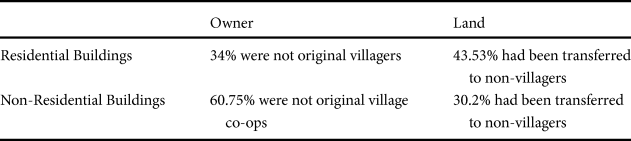
As it is shown in Table II, for residential buildings, about 34% of the current owners were not original villagers, the only category of legal owners. For non-residential buildings, 60.75% of the current owners were not village co-ops, the only category of legal owners.Footnote 27 Regarding the land used in building these small properties, for residential buildings, over 43% of the land had been transferred to non-villagers. For non-residential buildings, over 30% of the land had been transferred to non-villagers, as shown in Table II.Footnote 28
Illegal Transactions of Land and Buildings

Source: Shenzhen Municipal Government Report 49, 65
The Shenzhen government also investigated small-property high-rises, buildings of fifteen floors or more that were mostly built after 2000 in response to the high demand for residential housing in Shenzhen. The total floor area of these buildings totaled 21,598,800 square meters,Footnote 29 about one-third of the total area of legally developed residential houses for sale built in Shenzhen from 2000 to 2009.Footnote 30 There is no data available for the number of transactions involving small properties. But according to a calculation of a government official in Bao’An, a district of Shenzhen, there were 1,400,000 legal sales of apartments in 2011 in that district; the number of illegal sales of small properties was about half that number.Footnote 31 Such transactions are not limited to villagers and people who know them; rather, they happen daily between strangers. A network of institutional innovators, including village co-ops, real estate brokers, and land developers, has formed to support this small-property market.
B. A Network of Institutional Innovators
1. Village Co-ops
In Shenzhen, each village has a shareholding co-op, which is the core of a village community. On the one hand, it is a social and economic organization and is responsible for the wealth-maximization of its shareholders, who are members of the same village community. Village co-ops divide the village land into two categories: collective development land and residential land. Residential land is divided into equal-area plots (usually 100–120 square meters) and distributed to villagers for free or bought by village members at nominal prices. In general, one plot is provided to each household. Village co-ops are responsible for the daily management of the collective development land and allocate dividends to villagers at the end of each year. Income from the collective development land is also used for road construction, the drinking water and sewer systems, the electricity system, and for maintaining sanitation and other public services within the village.
On the other hand, village co-ops function like government by providing public services and maintaining social order within their villages; these are services that the Shenzhen government needs, acknowledges, and respects. Members of village co-ops are insiders in village communities, which are characterized by intracommunity familiarity. This gives the co-ops complete access to local property arrangements, access that is not available to even the external government branches at the same level. Moreover, co-ops are much less constrained than government branches and agencies are by the formal law. This is exactly why co-ops can function as catalysts and coordinators of a network of institutional innovators.
Motivated by economic incentives, village co-ops are willing to provide information and support for the small-property transactions. Further, their reputation as de facto village governments makes them credible intermediaries and sellers to outside buyers.
Village co-ops often keep records on the construction and transaction history of buildings within a village. The records may be maps of named plots, minutes of meetings of the village co-op boards, or receipts signed by the director of the board of the village co-ops. Both villagers and outsiders acknowledge the authority of the village co-ops regarding the property rights of the illegal buildings. Sales contracts of small properties are usually carefully designed as a form of cooperative house building. Using the term “cooperative house building” does not legalize the illegal sales, but it does present the relationship between village co-ops and outside buyers as a kind of cooperative joint enterprise rather than a simple transaction. Moreover, the official seals of village co-ops are often on the sales contract and serve as an endorsement of the transaction. A village co-op seals all the contracts for houses sold by it. Some village co-ops even issue certificates of honorable villager-ship to buyers.Footnote 32 This is a way to strengthen the confidence of buyers—only village members can legally acquire a plot of land from the village, but an honorable villager-ship means that the village treats your rights to the bought house the same as they treat villagers’ rights to their houses. In other situations, such as the development of houses by individual villagers or outside investors, village co-ops charge fees for their sealing of sales contracts. In 2011, a seal from a village co-op usually cost a buyer about 6,000 RMB (1 RMB = 0.16 USD). With the endorsement of village co-ops, some real estate developers even issue certificates to buyers. The certificates look very similar to the official ones and assign a number to each property.
2. Land Developers
The expertise of land developers is in high demand in this process. Villagers and village co-ops have land in hand, but they may not know how to build modern business units or residential condominiums. Small land developers, who are often capable builders but cannot afford to bid on government land in the public auction market, are happy to participate in the rural land market. They can either form joint ventures with village co-ops or buy land directly from village co-ops. Their familiarity with officials of government agencies overseeing construction-related administration further benefits any necessary collaboration.
3. Shenzhen Rural Commercial Bank (SRCB)
The Shenzhen Rural Commercial Bank (SRCB) is a government-owned but profit-driven local bank. It developed from the Shenzhen Rural Credit Co-op and has one branch in each village. Indigenous villagers are its main clients and call the SRCB their own bank. The managers and employees of the SRCB are mostly local villagers, recruited from the villages where its branches are located. Though open to all people in Shenzhen, the SRCB often reserves a VIP room for local villagers. The mutual familiarity and trust between SRCB employees and local villagers greatly reduces the need for formality. One villager told me that if she were to lose her account book, she could get a new one without presenting any official documents to the bank. As this villager said, “They know who I am. I deposit and withdraw cash from them several times a week. I lost my account book and then they should give me a new one. What documents do they need?”Footnote 33 The SRCB has played a crucial role in financing village economic development by providing loans to villagers to build industrial parks and other economic facilities. When rural real estate development became the main business for Shenzhen villagers, the SRCB gradually got involved in it just as it would in any other businesses of villagers. With a pledge from village co-ops, the SRCB provides mortgages to ordinary buyers. A buyer usually has to pay half of the price as the down payment and can pay the remaining amount of money as installments over half a year, five years, or even ten years.Footnote 34
4. Real Estate Brokers
A real estate broker’s office is a common sight in a neighborhood of small-property houses. As in the formal market, in the small-property market, a real estate broker will provide all the information regarding apartments and negotiate a deal. After signing a contract, the buyer will pay the agreed price, which is about one-third to one-half of the price of similar apartments in the formal market. After making the payment, the buyer will get the keys and the contract. If he wants to rent the apartment out or resell it, the same land broker can help him for a fee. Buyers are mostly middle- to low-income people in the city who often cannot afford an apartment on the formal market. Real estate brokers may be invited by village co-ops to set up offices in the villages; or, village co-ops may actually set up their own real estate brokerage and management companies and employ qualified real estate brokers.
Real estate brokers promote the sales of small properties in many ways. Throughout the intracity villages, advertisements for the renting and selling of small-property houses are everywhere—on front doors, walls, and electricity poles, and along roads all around the city. Posters for small properties are quite standard, usually indicating the number of floors and buildings, the developer (usually emphasizing that the property was developed by a village co-op), the location, the provision of public utilities, the price, the area, the forms of contracts and certificates, the payment methods (installments and related terms), and the relevant contact information (cellphone, QQFootnote 35 group number, website, etc.). The most effective way to advertise is to build a website, start a blog, or set up a QQ group, through which potential buyers can view all the small-property apartments available, ask questions, and communicate with other potential buyers. I have joined five such QQ groups and still have conversations with real estate brokers, potential buyers, and owners of small properties from time to time.
5. Lawyers
Lawyer notarization (lv shi jian zheng), the process by which a lawyer certifies that a transaction has been made according to both parties’ real will and is consistent with the principle of freedom of contracts, is part of almost all transactions. The lawyer keeps copies of all the transaction documents on file, which are then available for review. If a buyer wants to sell a bought house, he has to surrender all the related documents to the lawyer, who creates another file of documents for the new buyer. In one law firm, the earliest records could be traced back to 2003.Footnote 36 The lawyer is generally silent regarding the illegality of the transaction, and because of lawyers’ special identity, the parties involved may have the impression that the transaction is legal. As a result, the Lawyers’ Association of Guangdong, the province to which Shenzhen belongs, has forbidden its members to notarize transactions of small-property houses. However, this prohibition is only effective for big law firms. Many small law firms still provide this service. Notarization of small-property transactions is a lucrative business for them: a seller of apartments, either village co-ops or land developers, will invite a lawyer to make all notarizations for a residential complex, which often includes several hundred apartments.
Thus, government-certified professionals, including lawyers, land developers, and real estate brokers, and government-recognized institutions, including village co-ops and the SRCB, have developed a network to support and facilitate the transaction of small properties. This network is centered on the most credible participant, the village co-ops. As one government official remarked, “Village co-ops function like land developers, Bureau of Urban Planning, Bureau of Land, Bureau of Construction in building small-property houses and can do whatever the above players can do. They also work with banks to issue mortgages to buyers, and as the Registration Center for Real Estate Transfer to record and endorse the transactions.”Footnote 37
The following is a picture of this network:
This network of institutional innovators provides a mechanism for potential buyers to collect and verify the information necessary for a real estate transaction. Modern technologies of transportation and communication have greatly reduced the cost of collecting and verifying such information.
An ordinary buyer or seller has only to reach out to any participant in this network in order to obtain access to the protection provided by the network. One needs to know only the village affiliation and personal identity of his trade partner, which can be certified by a seal from the corresponding village co-op, a real estate broker located in the village, and a notarization from a lawyer invited by the corresponding village co-op. He does not have to know his partner personally. In the absence of a legal recording system, information on small properties is kept by village co-ops and other participants in the network. However, this network is motivated by profit making, and it is not closed but open to all. The legitimacy of the network’s participants, in particular that of the village co-ops, and the mechanisms they have developed to provide and verify information, makes the network credible to outsiders. Each small network is a part of the bigger and actually boundless network of which millions of potential buyers of small properties are members. Transactions abound within this network.
C. The Risk of Contract Breach
Any transaction carries the risk of contract breach. It is important to make sure that sanctions are imposed on the party that violates the contract. In the modern state, the government is said to monopolize the force of violent sanction. But in reality, private sanction, including violent sanction, is everywhere. The advantage of public sanction lies in the state’s ability to locate the party against which the sanction will be taken and to ensure the effectiveness of the sanction. Risks can be too high to control in contracts that rely on private sanction. It is important to minimize the risks in order to make transactions feasible. To make private sanction an effective deterrence, a party has to ensure that it can locate the person to be sanctioned and that it has the resources to implement the sanction. In a society of high mobility and rapid change, these conditions are not easy to satisfy. However, the network of institutional innovators has greatly facilitated the provision and verification of the information necessary for the deterrence of contract breach in small-property transactions.
In transaction contracts, sellers’ addresses are written clearly and easy to verify. It might be difficult for an outsider to know the transaction history of the small property he plans to buy. But this does not matter if the village co-op is willing to endorse the contract, as this serves as an implicit promise that the village co-op will be responsible in the case of any conflicts regarding the rights to the real estate. Lawyers are outsiders but also professionals, and they are paid for notarizing a contract. Lawyers’ services are often localized, and their professional reputations are at stake in these transactions. Lawyers are thus incentivized to provide accurate information and prevent fraud. Therefore, while a village co-op’s seal, a lawyer’s notarization, and other privately made documents do not constitute a way to legalize illegal sales, they do offer a way to guarantee the information regarding transactions.
Moreover, village co-ops, as the economic and social engines of this network, have the credibility and resources to reassure outside buyers that participants in the network will keep their promises. Village co-ops are not impartial governments and are responsible only for the interests of their members. However, as Avner Greif has written on the community responsibility system in the context of premodern Europe, partial courts of a community are economically motivated to provide impartial justice.Footnote 38 Village co-ops persist longer than any of its individual members, and they have an interest in long-term economic performance. In the context of legal uncertainty, they endeavor to strengthen outsiders’ confidence in transactions in order to make money from the business of small properties. Rumors may be spread very quickly among groups of potential buyers through online chat rooms, blogs, and even local newspapers, and co-ops do not want to incur any extra trouble by cheating on outside buyers. As for other participants in this network, they not only have their professional qualifications and reputations at stake; they also are constrained by their continuing business relationships with the village co-ops. They are therefore invested in the ongoing prosperity of the small-property market.
III. Development against Law
As discussed previously, after the 1988 amendments to the Chinese Constitution and LAL, legal reform for rural land development and transactions stalled. In 1998, reform moved in the opposite direction when the Chinese government made a comprehensive revision to LAL that left little room for the alienation of rural land-use rights. Article 2 of LAL was revised from “use rights to the state-owned land and collectively-owned land can be transferred according to law” to “land-use rights can be transferred according to law.” The deletion of “collectively-owned land” signaled an important change: while the former phrasing acknowledged the transfer of rural land-use rights as a subject for further law reform, the latter eliminated that option. Moreover, section 1, Article 43 of the 1998 LAL excluded the possibility for rural land development and transaction, despite the still-effective 1988 constitutional amendment on land-use rights. In 1999, a notice of the State Council of the Chinese central government stipulated unambiguously for the first time since 1978 that urban citizens could buy neither rural houses nor rural land on which to build houses.Footnote 39
In 1999, one year after the 1998 LAL revision, the Shenzhen government initiated its campaign against rural land development and transaction, calling the rural buildings “historical illegal buildings” (lishi yiliu weifa jianzhu). In 2004, the Shenzhen municipal government even established a small leading team headed by the mayor to deal with illegal rural land development. In 2009, the Shenzhen government created a new Department of Land Use Monitoring (DLUM) and established branches in all fifty-seven subdistricts of Shenzhen.Footnote 40
However, the market of small properties and the network supporting it had become so enmeshed with the economic development and social stability of Shenzhen that any serious legal enforcement of the revised measures was impossible. As a senior official of land administration of Shenzhen acknowledged, “[I]t is a war against the people that cannot be won.”Footnote 41 From 1999 to 2010, the number of illegal buildings grew from 221,600 to 356,852.Footnote 42
A. Too “Big” to Fail
Small-property buildings are spread across the most prosperous as well as the remotest areas of Shenzhen. The more prosperous the location, the more concentrated and the taller the illegal buildings are. These illegal buildings have increased both in number and in size with the economic development and urbanization of Shenzhen, and they are too interconnected with the normal functioning of the city to fail.
First, the buildings provide shelter to the more than eight million migrant workers in Shenzhen. Shenzhen depends heavily on cheap labor from inland provinces, yet over the past three decades of development, the Shenzhen government has provided no public housing for migrant workers. Without the illegal buildings, these laborers would have few places live.
Second, these illegal buildings are concentrated in 320 intracity villages of Shenzhen, over which the municipal administration has never exercised effective management. In most villages, roads and basic public services such as electricity and water are maintained and provided by the villages themselves. The intracity villages maintain their own order and operation, which substantially reduces the great pressure on the municipal administration from rapid urbanization. The intracity villages of the illegal buildings are too important to the city to be demolished.
Third, these illegal buildings are the main livelihood of Shenzhen’s indigenous people. Over 300,000 indigenous people, as the contributors and beneficiaries of Shenzhen’s transformation from a small agricultural county to the most urbanized city in China, have accumulated vast economic and political resources in the past three decades. Several villages claim to be the first village under heaven or the first village of South China, and other villages are among the wealthiest in China. All the reform era’s supreme leaders—Deng Xiaoping, Jiang Zemin, and Hu Jintao—have visited Shenzhen’s villages. Several village heads are members of the National People’s Congress or the Provincial People’s Congress; many village heads are members of the Municipal or the District People’s Congress. The strong interests of such a powerful constituency cannot be easily disregarded.
B. Competing Government Interests
1. Competition between Different Levels of the Local Government
The scale and functions of illegal buildings have different implications for different levels and different departments of the local government. The local government of Shenzhen is divided into three levels: the municipal, the district, and the subdistrict (street) level. The municipal and district governments of Shenzhen are responsible for economic development in Shenzhen and have stronger motivation than the subdistrict governments to eliminate small properties.
First, the municipal and district governments prefer big investors over small ones, not to mention over street vendors or restaurants that serve middle- to low-income populations. The Shenzhen municipal government’s primary worry is that no land will be available to big investors if land is used for illegal rural land development. Cheap and sometimes free land is the key incentive that the municipal government has at its disposal. For example, in an effort to prevent Huawei, one of the biggest suppliers of telecommunication facilities in the world, from moving to another city, the Shenzhen municipal government developed a town of 21.9 square kilometers and gave it to Huawei for free as its new headquarters in 2010.Footnote 43 Big companies like Huawei are viewed as the engines of economic development in Shenzhen. The subdistrict governments, on the other hand, face millions of ordinary people in the city and are directly involved in the daily management of the city. Their daily work is centered on the housing and monitoring of millions of migrant workers, and on overseeing the livelihoods of over 300,000 indigenous villagers. They understand how crucial the small properties are to the normal operation of the city.
Second, there are more local employees at the subdistrict level than at the municipal and district levels, where highly educated graduates of elite colleges, and well-connected politicians from other cities or higher-level governments, dominate. Thus, subdistrict governments are generally reluctant to punish and deter small-property transactions. Actually, some subdistrict governments neighbor small properties or are even located in small-property buildings.
How do the differences between the various levels of local government influence legal enforcement? There is only one municipal government, and there are only eight district governments, but there are fifty-seven subdistrict governments. These subdistrict governments have the closest connection with the 320 villages and the best information about people and buildings within them; they also have the most sympathy for and interest in the small properties. They are on the side of the villages rather than of the upper-level governments. They are inclined to help villages avoid monitoring and punishment by the upper-level governments. It is no wonder, then, that in 2004, the Shenzhen municipal government set up a discipline team to supervise government officials and ensure that they fulfill their responsibilities in dealing with illegal rural land development. However, as it turns out, discipline campaigns cannot overcome vested interests.
2. Competition between Different Agencies of the Local Government
Competition of interests exists not only between different levels of the local government, but also between different agencies of the local government. There are both government agencies responsible for the enforcement of land law, mainly the Committee of Urban Planning, Land and Resources and the Bureau of Land Use Monitoring, and government agencies responsible for the economic development and social stability of the city. The latter accept the status quo and exercise their powers based on the reality of widespread small properties. For example, the Bureau of Business Administration grants business licenses to enterprises (restaurants, factories, shops, etc.) located in small properties, on the condition that village co-ops certify that the buildings are rented or owned by the enterprises; meanwhile, the Municipal Office of Housing Renting (MOHR), which was set up by the Party Committee on Political and Legal Affairs, an organ in charge of public security and social stability, registers and numbers all small properties in its system. This system serves as a basis for taxation and for the management of population migration, and it has been created with the help and support of village co-ops. As a MOHR official said: “[W]e knew these buildings were illegal; our registration has nothing to do with illegality; we just want to maintain social stability by closely monitoring the migrant population, most of which live in these buildings.”Footnote 44
Of course, government agencies responsible for the enforcement of land laws have the final say on the legality of the small properties. They do, from time to time, take action against the small properties. Participants in the small-property market have two ways of dealing with this situation: one is to invite government agencies to participate in the market, and the other is to pay for government officers’ collusion. Often, villagers intentionally involve government employees in the business. A CCTVFootnote 45 undercover report revealed that about forty employees of a district government agency of land administration in Shenzhen had bought illegal apartments.Footnote 46 In reflecting on its failure to stop rural real estate development, the Shenzhen municipal government has acknowledged corruption as an important factor. Villagers told me that payments made to government officers are part of their investment, and that payments are estimated by floor. For example, in one village that I investigated, the price officials charge to turn a blind eye is 6,000 RMB per floor. According to China Securities Daily, about one-third of the profits of the informal housing market fall into the hands of government officers in charge of enforcing land and housing laws.Footnote 47
C. An Expanded Network
Thus, different levels and different departments of the government are involved in the network of small-property institutions. Some disregard the illegality of small properties and incorporate them into their official systems in order to effectively address issues such as the monitoring of population migration and the physical site requirements for business operation. Some try to enforce the land law and fight against small properties. But without the support of other levels and agencies of the local government, the effect of legal enforcement is limited. Further, bribery becomes a weapon for market participants, who use it to reduce the risk of legal action being taken against them.
Again, village co-ops play a crucial role. They cooperate with the government and grant access to it to promote the integration of small properties into the official systems. They sidestep the government and resist legal enforcement with bribery when necessary.
Taking the government into consideration, the network of small-property institutions should be expanded as follows:
This expanded network further reduces the risk of government demolition of small properties and increases the credibility of small-property transactions by including local government agencies and branches. It provides a stronger core for the bigger, boundless network through which millions of people engage in impersonal transactions involving small properties.
IV. Conclusion
A famous saying suggests how people in Shenzhen treat law: Go around the red light; hurry up at the yellow light; speed past the green light (jian le hong deng rao zhe zou, jian le huang deng qiang zhe zou, jian le lv deng kuai kuai zou). The legal definition and protection of property rights are the green traffic lights that facilitate market transactions. However, green lights are not always available, and a well-functioning property law regime, though beneficial to the development of a market economy, may be far on the horizon for transitional countries such as China. In all the theories discussing the evolution of property rights since Demsetz, government is either absent or taken for granted as a maker and enforcer of law. Thus, in theory, all that developing countries need to do is to pass the proper laws.Footnote 48 Yet this view of the government ignores the struggle between the old (traditional or socialist) system and the reform effort. The government of a transitional country may, itself, be an uncertain factor in the development of a market economy. It is unclear whether such a government can make laws that challenge the past, and whether laws can be enforced in the event that they are made. Top-down legal reform tends to be ineffective and is frequently hindered by bureaucracy and interest groups.
Given the constraints above, hurrying up at the yellow light and going around the red light may be more feasible options. The traffic lights of China’s post-Communist transition have sometimes shifted in reverse order, as red lights on rural land development and transaction have shifted to yellow. Often, it has been unclear whether rural land reform should be on the agenda. During this period, people in Shenzhen have not waited for a green light; instead they have hurried up at the yellow light—millions of transactions have occurred amid legal ambiguity and relaxed enforcement of the legal prohibition on rural land development and transaction.
The key issue, of course, is the process by which this has happened. De Soto holds that transactions in the absence of legal titles are limited to people of the same group, because the only insurance available to extralegal businesses is that provided by their neighbors and the local mafias. As a result, property arrangements are intracommunity in character, highly reliant on local information and networks, and dispersed among hundreds of communities. To the outsider, the chain of title is blurry at best.Footnote 49 On the one hand, the small-property market testifies to de Soto’s argument that local communities and various intermediaries play a crucial role in the extralegal property system; on the other hand, however, it challenges de Soto and the conventional view that transactions are limited to people within the same community. It proves that community organizations and market intermediaries can develop a network that supports large-scale, impersonal market transactions.
The Chinese government has been characterized as an authority that is fragmented at both the horizontal level (i.e., between different government agencies) and the vertical level (between different levels of the government).Footnote 50 However, this theory does not take into account other institutional players: legally certified associations such as village co-cops, and professionals such as lawyers and real estate brokers, all of which have some authority. How do these fragmented authorities work in China? How do they build the institutional foundations for a modern market economy in China? The answer is that these fragmented authorities are networked together to provide institutional support for market transactions. The theory of fragmented authority emphasizes competition and conflict between different authorities, but in the case of small properties, fragmented authorities have worked together. Rather than being managed by a centralized authority that protects property rights and enforces contracts, the small-property market involves a network of credible institutional innovators, with village co-ops serving as the central coordinators. This network supports the growth of the small-property market and reduces the risks of contract breach and legal enforcement.
Can a market operate without legal titles? Yes—the small-property market in Shenzhen proves that it can. While I have not measured the efficiency of this market statistically, the gradual commodification of rural land is undoubtedly an improvement over the de-commodification of land under the Communist regime. Scholars often devalue informal property rights and view them as a barrier to market transition. For example, de Soto does “not believe the appearance of small enclaves of prosperous economic sectors in the midst of large undeveloped or informal sectors marks the dawn of an uneven but nevertheless inevitable transition to capitalist systems.”Footnote 51 This case study demonstrates that, contrary to de Soto’s claim, a robust and impersonal market can develop in the absence of legally enforceable rights. Set against the backdrop and in the context of China’s transition, this paper presents a feasible plan for building a market economy in transitional countries, where property laws are often less than ideal. The emergence of the small-property market—like the emergence in China of Household Responsibility System and private enterprises in the 1980s, both of which were initially illegal and therefore informal—is a further step in China toward building a modern market economy.
Appendix: Map of Residential Land in Intracity Villages of Shenzhen