The study of grammaticalization can be understood as an attempt to disprove the assumption that changes resulting in grammatical forms are completely random and unpredictable. (Hopper & Traugott Reference Hopper and Traugott1993: 232)
1 The future
A quintessential example of grammaticalization is the so-called go future, which not only reveals over-arching cross-linguistic pathways (Givón Reference Givón1979; Bybee, Perkins & Pagliuca Reference Bybee, Perkins and Pagliuca1994; Heine & Kuteva Reference Heine and Kuteva2002) but also well-defined developmental constraints. In English the go future is the construction be going to which has been involved in a longitudinal layered relationship with will, as in (1), for the past 600 years, perhaps longer.
- (1)
(a) Oh no, I ain't gonna do that, he won't talk if ee do that. (TIV/a)Footnote 2
(b) I think that's where it’s gonna be most expensive so that’ll be savings plus wages to pay for that, but it’ll be fine when we get it all done. (LER/6)
The development of the go futures is one of the most widely studied grammaticalization pathways. Research on the go future spans different languages (French, Spanish, English, pidgins and creoles, etc.), research paradigms (descriptive, theoretical, empirical) and methodological approaches.Footnote 3
In contemporary English the go future is still evolving, so the question is: what is its current position on the diachronic trajectory of change? In the late twentieth and early twenty-first century, the future temporal reference system remains extensively layered, split between will (including the contracted form ’ll and the negative form won't) and be going to (and its phonological variants) along with use of the present and present progressive. However, in the vast majority of cases, future meaning is expressed by variants of will and be going to. According to many commentators, these two forms, despite their divergent origins, exhibit ‘no demonstrable difference’ between them (e.g. Hall & Hall Reference Hall and Beatrice1970; Palmer Reference Palmer1974: 163; Quirk, Greenbaum, Leech & Svartvik Reference Quirk, Greenbaum, Leech and Svartvik1985: 218; Danchev & Kytö Reference Danchev, Kytö and Kastovsky1994: 384). Indeed, in the data we will be investigating in this study from a number of dialects across the British Isles (see section 3), alternation of forms is rampant, often occurring in the same sentence in the same stretch of discourse, as in (1) above and (2).
- 2
(a) I says, ‘It’ll only be six month.’ Didn't know it were gan be six year. (MPT/r)
(b) ‘How you gonna do that?’ ‘Oh,’ said I, ‘I’ll soon do it.’ (CMK/m)
(c) You’ll have to marry Wendy, because otherwise she's not gonna be able to . . . afford to live. (HEN/e)
Considerable study has been devoted to the typical evolutionary path of go futures and there is general consensus of a common path of development across languages. We will make use of these pervasive pathways of change to inform our hypotheses and interpret our analyses of be going to in our data. First, we turn to a discussion of the chronological evolution of the grammaticalized form be going to in English.
2 Evolution of the future
The use of be going to as a future marker originated as the progressive aspect of the lexical verb go, meaning movement towards a goal, which collocated with a preposition followed by a complement.Footnote 4 A cursory perspective on what the language was like at earlier points in time can be gleaned from the Helsinki Corpus (Reference Quirk, Greenbaum, Leech and Svartvik1991), a multi-genre diachronic corpus which spans Old, Middle and Early Modern English. A gross extraction of all forms of be going to/goyng to returns just 48 tokens, almost none of which can be construed as having future temporal reference. This is consistent with Mair (Reference Mair, Lindqvist and Mair2004), who suggests that the grammaticalized version was rare until the nineteenth century. In contrast, there are 1,838 tokens of will and 95 of ’ll. One of the prerequisites for early grammaticalization is the occurrence of ambiguous bridging contexts, in which ‘both the old and the new meaning can occur’ (Brinton & Traugott Reference Brinton and Traugott2005:109); in the Helsinki Corpus, the only reasonable example meeting this criterion is the one in (3a), which provides the important context of intention in the development of be going to (e.g Poplack & Tagliamonte Reference Poplack and Tagliamonte1999; see also Disney Reference Disney2009). In most cases, substitution with will is not possible, as in (3b). At this point in time the construction be going to is also used to mean ‘intend’. Concomitantly, the verb intend is used in contexts that are future-like in meaning, as in (3c).
- 3
(a) I will tell it M = r = Isaac. S = r = John Walter is going to be marryed to my Lady Stoel w = ch = will be very happy for him. (Helsinki Corpus, 1695, The Countess of Nottingham)
(b) The council sat upon it, and were going to order a search of all the houses about the town. (Helsinki Corpus, The Popish terror and the impeachment of Danby)
(c) My Cozin Val Pettit is paid his debt. Mr. Trusser's bond and Mr. Dickenson's bond I intend, God willing, to pay tomorrow being Mooneday; if I see Mr. Twiman I intend to pay him what is due to Him; and if Mr. Crux his bond be sent up, I intend to pay that, so that I shall not be troubled with their summons any further. (Helsinki Corpus, 1662, Henry Oxinden)
These facts make it understandable why the earliest date of attestation of an unambiguous use of be going to to express future temporal reference has been somewhat contentious; however, we can reasonably assume that be going to started being used with future temporal reference sometime during the mid 1400s, based on the examples in (4) and (5) reported in Danchev & Kytö (Reference Danchev, Kytö and Kastovsky1994, Reference Danchev and Kytö2002).
(4) Therefore while this onhappy sowle by the vyctoryse pojmpys of her enmyes was going to be broughte into helle for thesynne and onleful lustys of her body (‘Therefore, while this unhappy soul by the formidable victories of her enemies was going to be sent to hell for the sin and wicked lusts of her body’) (Helsinki Corpus, 1482, The Revelation to the Monk of Evesham) (Danchev & Kytö Reference Danchev, Kytö and Kastovsky1994:69)
(5) And thane come Englissh folk to the seid Merchauntz of the Maryknyght and bad theym beware whome they had lefte yn their Ship sayng that yt was likely be taken And there vppon the seid persones of the ship of Hull goyng to do the said wrong/yaf to oon henry wales Gentilman. . . (Helsinki Corpus 1438, Chancery English) (Danchev & Kytö Reference Danchev and Kytö2002)
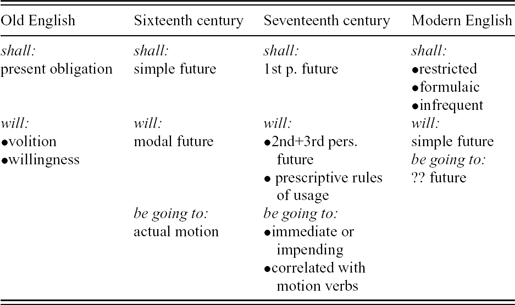
It has been suggested that the early meaning of physical movement towards a goal (e.g. be going to be married) gradually receded in favour of a more general sense of prediction (Royster & Steadman Reference Royster and Steadman1923/1968: 402) and connotations of intention, purpose and determination came to the fore. Table 1 summarizes these developments in relation to other forms expressing future meaning (will, shall), highlighting the interaction of forms across time.
Historical perspective on developments of future temporal reference forms

By the seventeenth century be going to became more frequent and is reported with a wide array of lexical verbs while still retaining strong associations with its literal meaning of ‘intention’ and ‘movement’ (Danchev & Kytö Reference Danchev, Kytö and Kastovsky1994). Eventually be going to started occurring with inanimate subjects and stative verbs. The prevailing story in the literature suggests that be going to has been gaining ground ever since (e.g. Mair Reference Mair, Hickey and Puppel1997; Poplack & Tagliamonte Reference Poplack and Tagliamonte1999; Tagliamonte Reference Tagliamonte, Chambers, Trudgill and Schilling-Estes2002). Recent books reporting frequency data on shall/will in present-day English converge in reporting: (i) an increase in be going to over time; (ii) a heightened rate in North American English; and (iii) differential usage by register with press reporting and spoken data in the lead (Leech et al. 2004: 108, 271, 294 etc.; Mair Reference Mair2006: 95–100). This is supported by a Google n-grams search for am be going to/is be going to/are be going to in British and American fiction where there is an upward swing across both varieties over the period 1840–2000.Footnote 5
Contemporary reports suggest that shall, as in (6a), has mostly receded to formulaic and legal uses (Williams Reference Williams, Aarts, Close, Leech and Wallis2013). Present-tense and present-progressive constructions are infrequent and highly circumscribed, as in (b-c) (e.g. Poplack & Tagliamonte Reference Poplack and Tagliamonte1999; Torres-Cacoullos & Walker Reference Torres-Cacoullos and Walker2009). The rise of be going to appears to be assured.
- 6
(a) I shall have to put the kettle on in a minute. (TIV/a)
(b) Aye she's at Workington but she goes to Carlisle in September (MPT/a)
(c) They’re spending Christmas and New-Year with her (CMK/F)
It is still not entirely clear how or when be going to evolved to express pure prediction. This is undoubtedly due to the fact that the meanings of intention and motion are so difficult to distinguish (Harada Reference Harada and Kazuo1958; Pérez Reference Pérez1990). Indeed, the early examples in (4) and (5) above have elements of movement, intention and proximity in the future. Thus while meaning change in grammaticalization often proceeds along clines (Heine & Kuteva, Reference Heine and Kuteva2002), this suggests that some of the most grammaticalized meanings for be going to were in place from the very beginning of its future uses long before the form became frequent in the mid-seventeenth century (Royster & Steadman Reference Royster and Steadman1923/1968; Fries Reference Fries1940; Pérez Reference Pérez1990; Hopper & Traugott Reference Hopper and Traugott1993; Danchev & Kytö Reference Danchev, Kytö and Kastovsky1994).Footnote 6 Indeed, recent research on Quebec City and Montreal English in Canada in the early 2000s (Torres-Cacoullos & Walker Reference Torres-Cacoullos and Walker2009) suggests that many of the earliest meanings remain entrenched. This brings into question the relative timing of different stages of grammaticalization and the role that frequency of use plays in the process.
3 Data and methods
The goal of this article is to add to the available information on grammatical development by measuring the pathway of change of be going to in a compendium of vernacular speech data from research projects in the United Kingdom at the turn of the twenty-first century.Footnote 7 To study grammatical change in synchronic data we first need the perspective of time. In this case we will use two different proxies for time depth. On the assumption that language change progresses across space (e.g. Trudgill's (Reference Trudgill1974) Gravity Model), we will make use of a range of dialects across the UK. On the assumption that language change is represented among people of different ages, we will use the generations of the communities in which the dialects are spoken. Second, we need an analytic method designed to examine complex patterns of language use in conversational data. In this case, we will exploit both the frequency of forms as well as the underlying constraints on their competition. This will expose not only the progress of grammaticalization, but also the mechanisms of change, as represented in the shifting weights and strength of different influences in the process. Layering – the co-existence of multiple forms ‘within a broad functional domain’ (Hopper Reference Hopper, Traugott and Heine1991: 22) – between the main expressions of future temporal reference (be going to and will/’ll) will be the foundation of our analysis. We will begin with a systematic exploratory study of the data, using comparison of marginals and cross-tabulation to arrive at a detailed understanding of the patterns inherent in the data set and conditional inference trees to uncover how the most important predictors work together (e.g. Tagliamonte & Baayen Reference Tagliamonte and Baayen2012: 163–4) and finally a series of mixed-effects generalized linear models to evaluate the statistical significance, patterns and interactions across competing contextual constraints influencing the use of one variant or the other (e.g. Baayen Reference Baayen2008). Interpretation of the results of the statistical models compared across communities and across generations (see e.g. Tagliamonte Reference Tagliamonte, Chambers, Trudgill and Schilling-Estes2002) will be used to help us situate be going to as it grammaticalizes.
A further consideration will be the extent to which grammaticalization pathways are parallel from one major variety of English to another. On the one hand, grammaticalization is thought to be a phenomenon that has broad typological tendencies. On the other hand, local idiosyncracies may lead to divergent tendencies. It would not be surprising, of course, for varieties to ‘go their own way’ since grammaticalization is well known to be influenced by social factors (Hopper & Traugott Reference Hopper and Traugott1993). Indeed, a single constraint may have varying tendencies from one dialect to another. Thus, in a cross-variety study of the preterit of be, Tagliamonte (Reference Tagliamonte and Siemund2011: 149–51) discovered that the effect of negation differed across communities. Some varieties favoured was for negatives, some varieties favoured was for affirmatives. In other cases there was no difference between the two. Such possibilities will inform our interpretation of trends in one locality compared to another.
Crucially for our purposes, be going to is said to be more frequent in North America than the United Kingdom (Wekker Reference Wekker1976; Berglund Reference Berglund1997; Tagliamonte Reference Tagliamonte, Chambers, Trudgill and Schilling-Estes2002; Szmrecsanyi Reference Szmrecsanyi2003). This décollage between two major varieties of English offers the analyst a unique opportunity to examine how grammaticalization proceeds since it may be that these two major varieties are at two different points in the trajectory of change.
3.1 Communities
Our analysis draws on data from ten communities across the United Kingdom – from the Shetland Islands in the north to Devon in the south, as in the map in figure 1.Footnote 8
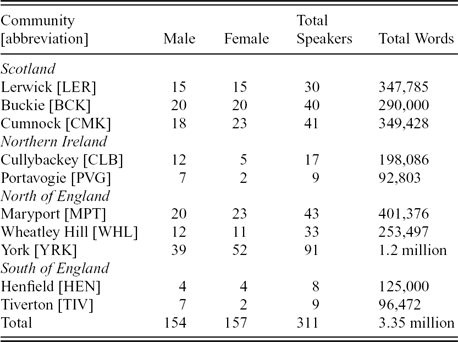
Communities studied
Map data © 2013 Geobasis-DE/BKG (© 2009), Google
These data were collected for a number of different projects between 1997 and 2009 (Tagliamonte 1996–8, 1999–2001, 2000–1, 2001–3; Smith, 2007–9), as detailed in table 3. The communities range from small villages to cities, from the Shetland Islands off the north coast of Scotland to the southern counties of England, from mainstream to isolated. All the data come from sociolinguistic interviews, which are essentially conversations focused on oral history and personal narrative (see Labov Reference Labov1972). In four of the communities (York, Wheatley Hill, Buckie and Lerwick) we collected interviews from speakers ranging from young adults to the oldest residents, which will allow us to also study change in apparent time. For the others (Cumnock, Portavogie, Cullybackey, Maryport, Tiverton, Henfield) only the oldest generation was surveyedFootnote 9 (see Tagliamonte, Smith & Lawrence Reference Tagliamonte, Smith, Lawrence, Filppula, Klemola, Palander and Penttilä2005: 87–117; Tagliamonte Reference Tagliamonte2013b: 27–45 for a fuller description of these communities).
3.2 Circumscribing the variable context
The future temporal reference system is often highly layered and there is considerable variation in terms of where (and how often) different future variants can occur and which of these are included across studies. In this study we followed the data coding practices of earlier work (Poplack & Tagliamonte Reference Poplack and Tagliamonte1999; Tagliamonte Reference Tagliamonte, Chambers, Trudgill and Schilling-Estes2002; Torres-Cacoullos & Walker Reference Torres-Cacoullos and Walker2009) and included for analysis only those expressions that were clearly temporal and made reference to future time. While various tense/aspect constructions can encode future temporal reference in English, the simple present and the present progressive tend to be highly circumscribed. The present tense, for example, is mostly restricted to temporal clauses where there is an accompanying time adverb (Mossé Reference Mossé1952; Biber, Johansson, Leech, Conrad & Finegan Reference Biber, Johansson, Leech, Conrad and Finegan1999: 454–5), or with near future associations (Torres-Cacoullos & Walker Reference Torres-Cacoullos and Walker2009: 330), as in (7). Moreover, contemporary quantitative investigations have found that these mark future temporal reference relatively infrequently (Poplack & Tagliamonte Reference Poplack and Tagliamonte1999: 326, 5–16 per cent, table 2) (Torres-Caccoulos & Walker Reference Torres-Cacoullos and Walker2009: 328, 3 per cent, table 1).
(7) She goes to Carlisle in September (MPT/a)
Sample design
Another anomaly in the contemporary system, as mentioned earlier, is shall, which is often reported to be restricted to formal registers and formulaic utterances in modern English (Williams Reference Williams, Aarts, Close, Leech and Wallis2013). Furthermore, it is rare to non-existent in Ireland and Scotland, (Robertson & Graham Reference Robertson and Graham1952/1991; Crystal Reference Crystal1986). Indeed, we found only 43 tokens of shall and of these 51% (N = 22) come from York, the only urban centre; they are used mostly by women and in formulaic questions, as in (8).
- 8
(a) What shall I do? (YRK/Z)
(b) Shall I put this back on? (YRK/R)
The periphrastic expression about to, as in (9), was very rare (N = 4):
- 9
(a) I was just about to say he must've been clean-living – but no – he smoked. (MPT/8)
(b) They were about to settle in Australia but the ship had got – it was shipwrecked. (MPT/10)
All these forms were excluded from the variable context in order to focus on the robust variability between variants of will and be going to.
Further constructions were found to be invariant and these were also excluded. For example, tag questions always agree with the verb in the main clause (10).
(10) Oh, you'll spoil my chances, will you? (BCK/024)
Future-in-the-past contexts, as in (11), represented 5 per cent of the total number of tokens (N = 278). Of these, 98 per cent are be going to, making them near-categorical in our data.
- 11
(a) It was like a bitty more than we thought it was gan to be. (BCK/j)
(b) I was terrified he was gonna tell the whole class that I'd cried. (MPT/%)
These contexts are substantially different from standard future temporal reference in terms of frequency of forms (predominance of be going to) and patterns of use (antithetic constraints) (Poplack & Tagliamonte Reference Poplack and Tagliamonte1999: 334; Torres-Cacoullos & Walker Reference Torres-Cacoullos and Walker2009: 327) and therefore we have excluded them here as well.
The resultant data comprise 4,764 tokens of will and be going to from 183 individuals born between 1906 and 1989 across 10 communities.Footnote 10
4 Results
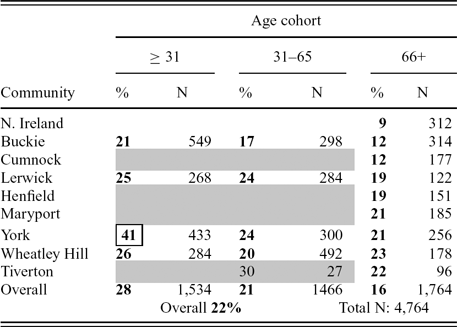
As a first step in the long process of understanding the trends and patterns in the data, we begin with a comparison of marginals of the linguistic and social predictors and their interactions. The proportion of be going to out of the total N of will and be going to combined, according to community and three broad age groupings (≥ 31, 36–65, and 66+), is displayed in table 3.
Rates of be going to by community/age cohort
The gaps in our coverage of the population in these communities (the shaded areas in table 3) are immediately apparent. In Northern Ireland, Cumnock, Henfield, Maryport and Tiverton, only the oldest generation was sampled. As noted earlier, this is due to the distinct research questions of the four independent research projects from which these materials have been drawn. These gaps notwithstanding, table 3 provides a striking perspective on how different the proportion of be going to can be depending on the age of the individual and community (compare York residents ≥31 at 41 per cent, indicated by the boxed number, to the oldest people in York, 21 per cent, and Northern Ireland, 9 per cent).Footnote 11 These facts are crucial and demonstrate that no study of be going to should be undertaken without contextualizing the materials in terms of the region from which they come, the age of the speakers in the sample and the date of collection. A compounded, albeit separate issue, is the problem of low numbers. The nature of the sample design will impact on how far the data can be partitioned before the diminishing token counts forestall further breakdown of the data. For example, the Northern Ireland data (N = 312) already represent a combined sample from Portavogie and Cullybackey since the number of future temporal reference contexts in Portavogie was so limited (N = 26). All these issues directly affect our approach to these materials.
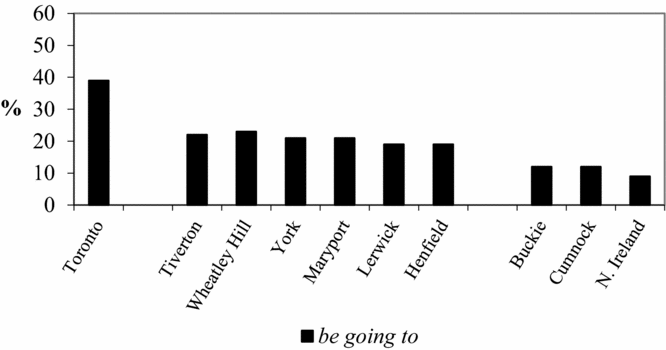
It is, of course, critical to analyse be going to in data sets that are in fact comparable. Figure 2 shows the proportion of use of be going to among the age group for which we have cross-dialectal representation — speakers aged 66 or older. The total N for this analysis comprises 1,764 tokens. Figure 2 also includes the proportion of be going to in Toronto (c. 2003–4) (Tagliamonte & D'Arcy Reference Tagliamonte and D'Arcy2009; Tagliamonte Reference Tagliamonte2012) for comparison.Footnote 12
Overall proportion of be going to by community, speakers over 66
The data in figure 2 reveal that the frequency of be going to amongst the oldest generation in the United Kingdom communities is indeed comparatively moderate (each community 23 per cent or under) in comparison to North American varieties (over 35 per cent). Further, in the United Kingdom, the communities can be distinguished according to the frequency of be going to. It is lowest of all, 9 per cent, in the villages of Northern Ireland (Portavogie and Cullybackey), and small towns of Scotland (Buckie and Cumnock). In contrast, it is 20 per cent or more in Tiverton, Wheatley Hill, York, Maryport, Lerwick and Henfield. Thus, it seems plausible to assume we have caught the encroachment of be going to at an incipient stage of its development in these communities.Footnote 13 At the same time the divergent frequencies correlated with speaker age and community add a high degree of complexity to this data structure. How can we approach the analysis so as to discover the process underlying the variation?
The overall frequency of the incoming form (be going to) is in line with previous analyses of other features in these varieties. Buckie, Portavogie and Cullybackey are consistently found to be the most conservative across a number of linguistic forms (Tagliamonte & Smith Reference Tagliamonte, Smith, Lawrence, Filppula, Klemola, Palander and Penttilä2005, Reference Tagliamonte and Smith2006; Tagliamonte et al. Reference Tagliamonte, Smith, Lawrence, Filppula, Klemola, Palander and Penttilä2005).Footnote 14 The literature informs us that grammaticalization is typically identified by an increase in frequency of the grammaticalizing form (e.g. Bybee Reference Bybee, Joseph and Janda2003). Indeed Brinton & Traugott (Reference Brinton and Traugott2005: 209) suggest that ‘token frequency can be used to hypothesize the historical time-depth of a particular grammatical morpheme – the more frequent an item the more grammaticalized it is’. Thus, based on our previous results for these varieties, coupled with the frequencies of use in figure 2, one way to approach an analysis of these communities is to arrange them in terms of the relative frequency of be going to.Footnote 15 We can also make profitable use of Nevalainen & Raumolin-Brunberg's assessment of how language change proceeds (Nevalainen & Raumolin-Brunberg Reference Nevalainen and Raumolin-Brunberg1996: 213–55). For them, an incoming form is ‘incipient’ when it is used at a rate of 15 per cent or below, while it is ‘new and vigorous’ when the incoming form is between 15 and 36 per cent. Using Nevalainen & Raumolin-Brunberg's division suggests a means to partition the communities based on these frequency distinctions as a proxy for viewing the stages of grammaticalization of be going to. In some communities, it has just begun to enter the future temporal reference system, while in others it has moved further along the path of grammaticalization. By comparing the communities in this way, we may be able catch be going to as it transits from one level of frequency to another, and potentially from one stage of development to another. In Canadian varieties considered previously ‘early stage’ communities (Poplack & Tagliamonte Reference Poplack and Tagliamonte1999) had rates of be going to well within the ‘vigorous’ levels defined by Nevalainen & Raumolin-Brunberg (Reference Nevalainen and Raumolin-Brunberg1996), which further supports our contention that we have caught the grammaticalization of be going to on the upswing of the S curve in these conservative dialect materials.
4.1 Constraints in apparent time
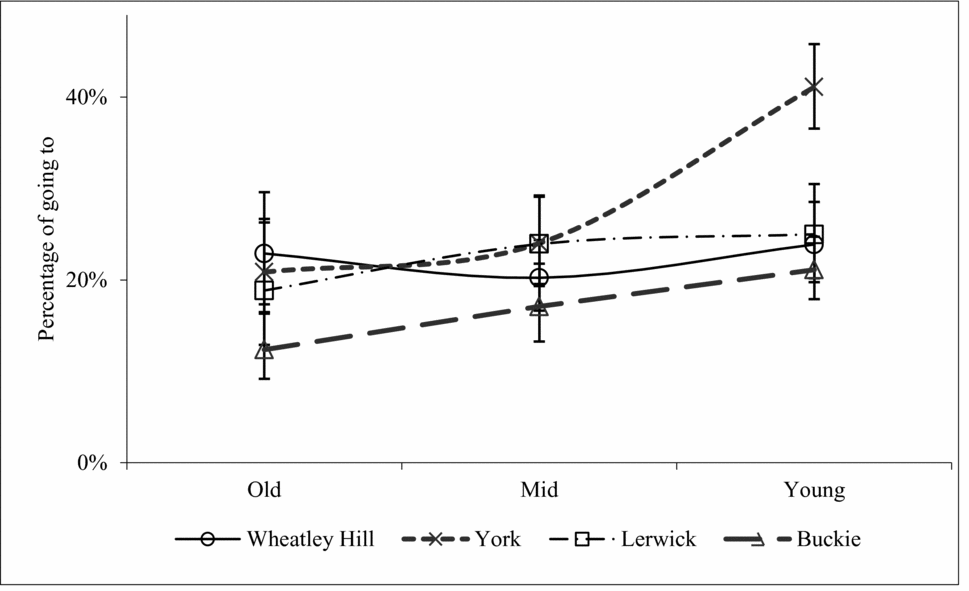
Further support for this approach to the data can be gleaned from investigating the apparent time dimension of the data. Figure 3 shows use of be going to across the four communities where we have generational data (Wheatley Hill, York, Lerwick and Buckie). This view of the data provides a visualization of the frequencies of be going to by the generational cohort and community (see table 3 for the numbers and percentages).
Apparent time perspective on the use of be going to in four communities
The future temporal reference system in Lerwick and Wheatley Hill is either stable or changing very slowly.Footnote 16 There is a modest increase in the use of be going to in Buckie but a distinct upswing in the youngest speakers in York (Tagliamonte Reference Tagliamonte, Chambers, Trudgill and Schilling-Estes2002). The difference between the age groups is statistically significant in both communities, but obviously stronger in York. Note too that the error bars confirm that the York younger speakers are evolving well beyond the rest of the population, suggesting that they are the vanguard of the change.
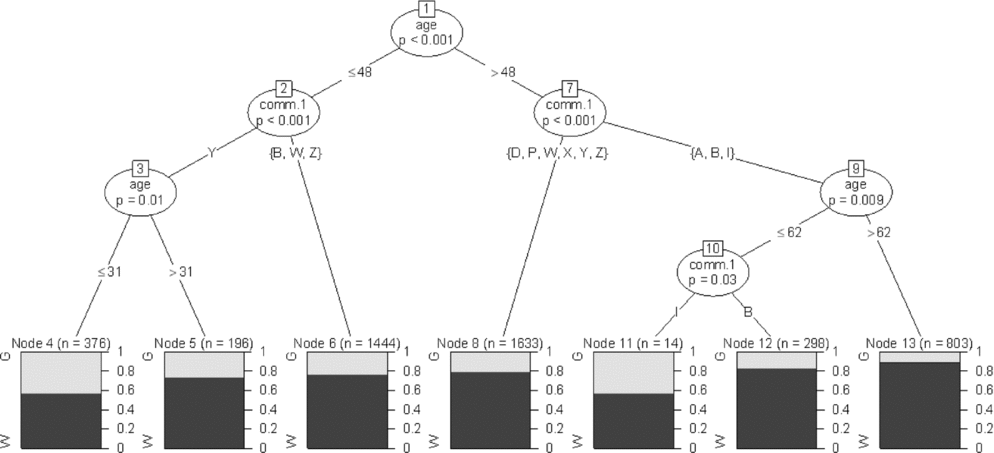
Complex interactions and vastly different cell sizes such as in the data structure under investigation are known to be difficult to capture adequately even with a mixed-effects logistic linear model. In order to determine which communities and age cohorts to distinguish so as to model appropriate stages of development we sought statistical corroboration by subjecting the data to a conditional inference tree (Strobl, Malley & Tutz Reference Strobl, Malley and Tutz2009), as in figure 4.Footnote 17 The value of this method is that it can identify the complex interactions characterizing a data set (for a practical example see Tagliamonte & Baayen Reference Tagliamonte and Baayen2012).
Conditional inference tree – community and speaker age
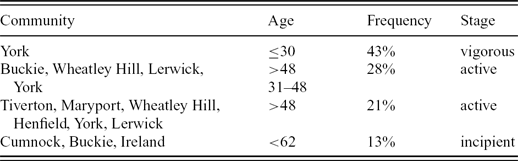
In this case, the conditional inference tree uncovers the relevant important divisions in the data.Footnote 18 It shows that are five major groupings according to community and age cohort, which corresponds to varying frequencies of be going to, as illustrated in table 4.Footnote 19
Community/age partitions for statistical modelling
In the analyses that follow, we will partition the data for statistical modelling as follows: (i) communities and age cohort where be going to is incipient (<15 per cent); (ii) communities and age cohorts where it is active (21–28 per cent);Footnote 20 and (iii) the one community (York) where the youngest age cohort stands apart from the rest in vigorous use of be going to (43 per cent).Footnote 21 We interpret the first as providing insight into varying stages of the entry of be going to as a future marker into the grammar and the latter as providing insight into how it has spread. Just as the development of be going to did not start at the same time in all communities, neither can we assume that it will develop at the same speed in all communities or even advance in a regular and consistent way. Wagner & Sankoff (Reference Wagner and Sankoff2011), for example, show that the development of the periphrastic future in French was arrested along its trajectory of change and Tagliamonte & Smith (Reference Tagliamonte and Smith2006) have documented a reversal in the development of modal have got to. Thus in addition to probing the rates of change by locality and generation, we will pay particular attention to how the well-known constraints on the grammaticalization of be going to as a future marker in English are reflected in these generational cohorts in the dialects.
4.2 Testing for grammaticalization
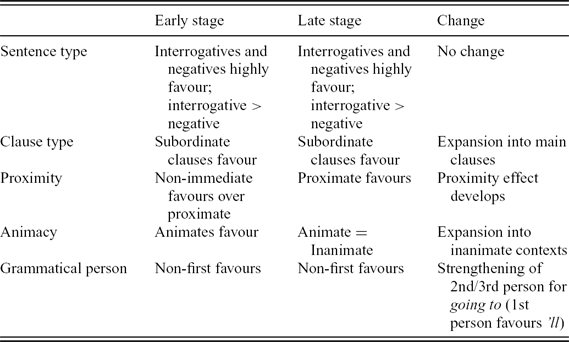
In what follows we will review the main predictors reported for the development of be going to (Bybee et al. Reference Bybee, Perkins and Pagliuca1994) using the research results from earlier quantitative analyses as a baseline (Poplack & Tagliamonte Reference Poplack and Tagliamonte1999; Torres-Cacoullos & Walker Reference Torres-Cacoullos and Walker2009), as summarized in table 5. The table displays a composite view of overall developments attested for each predictor: sentence type, clause type, proximity, animacy and grammatical person.Footnote 22 Poplack & Tagliamonte's (Reference Poplack and Tagliamonte1999) analysis was based on a range of communities arrayed from conservative to mainstream. Canadian enclaves in Nova Scotia were argued to be at an early stage of development, with data from the Canadian capital city of Ottawa showing a later stage.Footnote 23 Torres-Cacoullos & Walker's (Reference Torres-Cacoullos and Walker2009) study was based on data from Quebec City and Montreal, which they argued represented a late stage in the grammaticalization of be going to. These studies, their results and their varying time and place enable us to contextualize and interpret what situation we find in the United Kingdom communities where be going to is either incipient or vigorous.
Predictions for stages of grammaticalization of be going to
4.3 Sentence type
One of the clearest findings in contemporary studies is the contrast between negative and affirmative, with be going to favoured in negatives, as in (12) (Berglund Reference Berglund1997; Szmrecsanyi Reference Szmrecsanyi2003; Torres-Cacoullos & Walker Reference Torres-Cacoullos and Walker2009).Footnote 24 Interrogatives also favour be going to where these have been studied independently (Torres-Cacoullos & Walker Reference Torres-Cacoullos and Walker2009).
- 12
(a) They’re not be going to do that. (LER/h)
(b) I’m no gonna get that phone number again. (CMK/o)
(c) He wasnae going to give me it. (CLB/f)
(d) He’ll not better. No, he’ll not. (CLB/e)
According to Szmrecsanyi (Reference Szmrecsanyi2003), however, this difference is geographically circumscribed. American English prefers be going to in negatives, as in (12a–c), but British English prefers will/’ll, as in (12d). Why would this be the case? It may be that as grammaticalization proceeds there is a trend towards more use of be going to with negatives or it could be that these two major varieties of English are simply divergent in their grammaticalization pathway with respect to this predictor. Table 4 shows that it may be more complicated than this. While later stage communities in North America disfavour be going to with negatives less than early stages, be going to is still not a favoured form. Interrogative constructions, as in (13), tend to be very infrequent compared to other sentence types; however, in studies of linguistic change they are often in the lead. There was a strong effect of interrogatives in Quebec City where be going to was found at a rate of (yes/no questions 71 per cent), (WH-questions 92 per cent) (Torres-Cacoullos & Walker Reference Torres-Cacoullos and Walker2009: 338).Footnote 25 Reanalysis of the data presented in Poplack & Tagliamonte (Reference Poplack and Tagliamonte1999) yielded a corroborating result: interrogatives consistently and strongly favour be going to across all the varieties studied.
- 13
(a) What are we gonna do when we get there anyway? (YRK/_)
(b) Is she gan to send it up to you? (BCK/g)
Given these results, Szmrecsanyi's claims and the hypothesized development of be going to towards increasing use in negatives and interrogatives, we might expect them to disfavour be going to across all the United Kingdom communities. We might also expect a strengthening of this effect across the generations, as presumably is the case in the North American situation.
4.4 Clause type
A consistent finding for all studies of be going to is that it is favoured in subordinate clauses, as in (14), while main clauses disfavour it (Royster & Steadman Reference Royster and Steadman1923/1968; Poplack & Tagliamonte Reference Poplack and Tagliamonte1999; Tagliamonte Reference Tagliamonte, Chambers, Trudgill and Schilling-Estes2002; Torres-Cacoullos & Walker Reference Torres-Cacoullos and Walker2009).
- 14
(a) He's hoping Brian's gonna sign. (MPT/%)
(b) If I’m gonna write, it's gonna be a story, (MPT/%)
This may be tied to the fact that subordinate clauses are thought to be the original syntactic location of future readings of be going to. Indeed, the two early examples (4) and (5) above, cited by Danchev & Kytö, are both in subordinate clauses.
The conservative communities studied by Poplack & Tagliamonte (Reference Poplack and Turpin1999) mirror the effect displayed in table 4, i.e. the more conservative communities have a much lower frequency of be going to and younger people have a higher frequency. In mainstream communities the difference between main and subordinate clauses had become attenuated, presumably as be going to spread to a wider range of clause types. Therefore we predict that we will also find this effect across our United Kingdom communities.Footnote 26
4.5 Proximity
Near future has often been claimed to favour be going to, as in (15), while the far future favours will, as in (15).
- 15
(a) We're gonna sing a hymn this morning. (PVG/%)
(b) You’re gonna get wet tonight, aren't you! (YRK/™)
(c) I’m going to make a cup of tea. (CMK/v)
- 16
(a) I’ll do that when I retire (LER/a)
(b) In old age we’ll sell it (YRK/a)
(c) In ten or fifteen years there’ll be nae dialect. (PVG/d)
This effect has been reported for certain contemporary (not relic) North American dialects (Poplack & Tagliamonte Reference Poplack and Tagliamonte1999; Torres-Cacoullos & Walker Reference Torres-Cacoullos and Walker2009) with the suggestion that it develops as be going to grammaticalizes. Yet other varieties that have been studied show an early correlation of go futures with proximity, e.g. eighteenth-century English (Roy Reference Roy2007) and nineteenth-century Brazilian Portuguese (Poplack & Malvar Reference Poplack and Malvar2007). Indeed, considering the effect of proximity for North American early vs late stage situations (i.e. conservative vs mainstream communities), it becomes evident that the effect of proximity varies. This may be tied to methodological issues where studies have categorized the contexts differently. In order to distinguish these contexts without temporal grounding, we created a three-way division for proximity: near future,Footnote 27 far future and no reference. It will be particularly informative to see how this effect operates in communities where be going to has only just begun to infiltrate the grammar.Footnote 28
4.6 Animacy
When be going to started down the path of grammaticalization it is said to have been correlated with human subjects capable of movement, linked to its original meaning of movement towards a physical goal, as in (17a–b). Thereafter it extended to non-human and inanimate subjects, as in (17c–d). The underlying mechanism is the metaphorical spread from movement, (17a), to intention, (17b), to prediction (17c–d).
- 17
(a) Angusis going to to bigg a shed. (LER/c)
(b) I’m gan to go on a diet, ken. (BCK/w)
(c) Your two bonesare gan to go thegither and grind. (BCK/5)
(d) I'm hoping that this weather's gonna ease up a bit. (LER/6)
This was substantiated in the North American varieties. As indicated in table 5, animates and inanimates are parallel in early stage situations, but in the later stage situations be going to expands to inanimates and extends to the point of these favouring be going to over animates. For the United Kingdom data, which we have caught at an even earlier stage of development (i.e. incipient, active and vigorous), there is a substantially lower frequency of be going to than in North America (see figure 2). We might therefore expect animate subjects to actually favour be going to. Alternatively, because the United Kingdom communities are distinguished by frequency, it could be the case that the two situations will reveal an early developmental shift from animates favouring be going to to extension of use with inanimates.
4.7 Grammatical person
Many studies report that be going to is favoured for second- and third-person subjects. (Wekker Reference Wekker1976; Poplack & Tagliamonte Reference Poplack and Tagliamonte1999; Tagliamonte Reference Tagliamonte, Chambers, Trudgill and Schilling-Estes2002; Torres-Cacoullos & Walker Reference Torres-Cacoullos and Walker2009), as in (18). Researchers have argued that this is due, at least in part, to the fact that first-person subjects are more likely to show volition than other grammatical persons and this is ‘a reading said to be associated with will’ (Tagliamonte Reference Tagliamonte, Chambers, Trudgill and Schilling-Estes2002: 750).
- 18
(a) He's going to be a doctor. (YRK/D)
(b) They’re gan to bide on for another week. (BCK/t)
(c) You‘re gointa get all sorts. (YRK/t)
This effect is reported in North American varieties at both early and later stages, but the effect of grammatical person strengthens from conservative to mainstream varieties. We predict that we may find a similar contrast in our United Kingdom data.
In contrast to earlier studies, in the analyses that follow grammatical person and animacy have been combined into a single predictor categorized as follows: first-person subjects, second- and third-person animates and second- and third-person inanimates. This is to avoid interaction between grammatical person and animacy since first-person subjects are always animate.
Given these predictions for the grammaticalization of be going to and the findings that arise from studies that have tested them in spoken language data across varying types of communities and speaker generations representing incipient, active and vigorous stages of development, we are now in a position to turn to the analyses of the United Kingdom dialects.
5 Statistical modelling
We will test the predictors of grammaticalization of be going to by using generalized mixed-effect models, (lme4) in R (Team 2007). First, we will fit one regression model over all the communities/age cohorts to establish the main trends and interactions of the internal predictors. Second, we will probe a particularly intriguing interaction in the data – the intersection of sentence type and animacy/grammatical person. Third, we will fit comparative mixed-effects models for each community/age cohort in order to compare and contrast the main predictors at each ‘stage of development’ of be going to. This type of analysis will enable us to assess the statistical influence of the predictors over and above the effect of the individuals in the sample as well as the interactions of the predictors with each other. In interpreting the results we will make use of several types of evidence from the ensuing tables. The intercept indicates the overall tendency of the dependent variable (in this case be going to) to surface out of all the other potential forms (i.e. will, ’ll, won't). As well as considering the dependent variable, the intercept is calculated incorporating a reference level for each predictor. We have set the reference level for each predictor as follows: PROXIMITY, far; ANIMACY/GRAMMATICAL PERSON, first; SENTENCE TYPE, declarative; CLAUSE TYPE, main. In the overall model, we set the reference value for COMMUNITY as York, given that this is the context in which the frequency of be going to is greatest and distinguished from all other community/age cohorts. Each of the predictors that have been considered in the analysis is listed with the results for each level shown in estimated coefficients in log odds using the reference level as the base. A positive value is a favouring effect of be going to to occur in that context. The model also evaluates the relative influence of predictors, as indicated by the stars. Three stars correspond to a p value of 0.001, two stars 0.01, one star 0.05 and a small dot is 0.1. The standard metric for complex data structures with social and linguistic predictors is 0.05. Constraint ranking of factors is inferred from the difference between the reference level at 0 and the values of the estimated coefficients.
5.1 Overall mixed-effects model — all communities/age cohorts
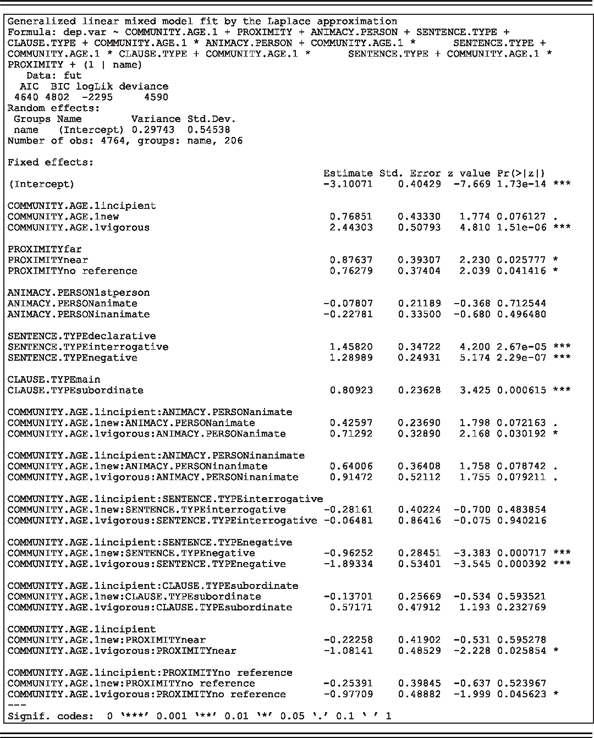
Table 6 presents a complex generalized mixed-effects model of be going to in the data structure as a whole (N = 4764) with the communities/age as an independent predictor (new, active and vigorous) and a random effect for the 206 individuals in the sample. The inclusion of the random effect for individual enables us to provide statistical validation of the significance of the social and linguistic factors in the model over and above the varying behaviours of these individuals (Tagliamonte & Baayen Reference Tagliamonte and Baayen2012: 146). This model shows the relative influence of the linguistic factors together with the influence of community/age cohort. We include as predictors each of the internal factors as well as their interactions with community/age. If the interaction of community/age cohort and any of the internal predictors is significant, then we will take this as evidence that the predictor is changing over time.
Generalized linear mixed model – all communities/age cohorts
Following Baayen (Reference Baayen2008), we will use the index of concordance C to measure how well the model discriminates between the be going to and will variants. The index of concordance value of this model is .74. When C = .5 classification performance is at chance while values higher than .8 are considered very good. The p values are progressive for the community/age predictor in the order: incipient (p > .01), active (new) (p > 0.001), vigorous (p > 0.001), revealing that this partitioning of the data is highly significant and each one distinct from the other. Looking at the fixed predictors first, three of the four known influences on the use of be going to are statistically significant overall. The most important of these is the type of sentence, followed by type of clause and proximity. Animacy/person is not significant. However, the tests for interaction of these predictors by community/age all reach significance, exposing a significant reorganization of linguistic factors across communities, which we will interpret as an indication of change. Indeed, the extent of interaction here may explain the modest C value for this model. Among the interactions, the most dramatic is that between COMMUNITY/AGE and SENTENCE TYPE. What mechanism underlies this?
5.2 Animacy/grammatical person and sentence type
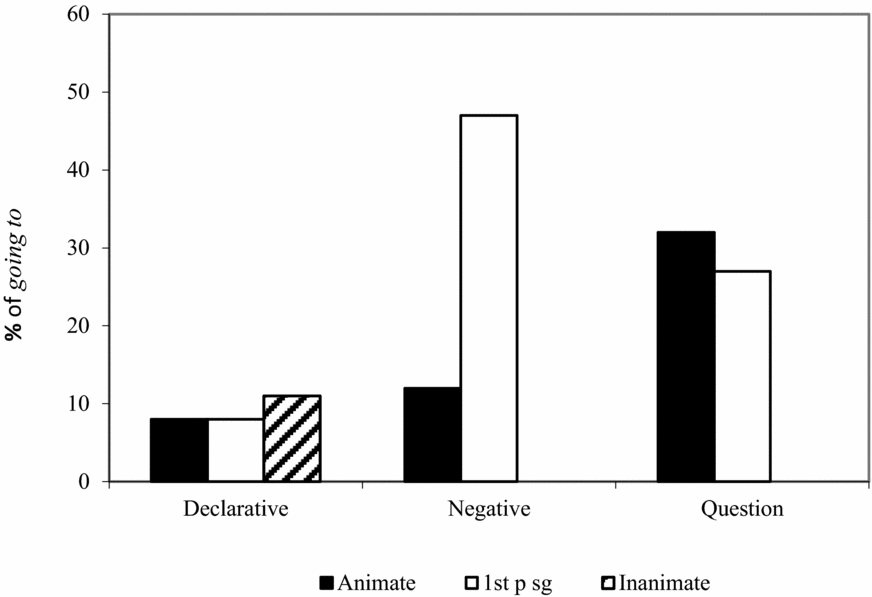
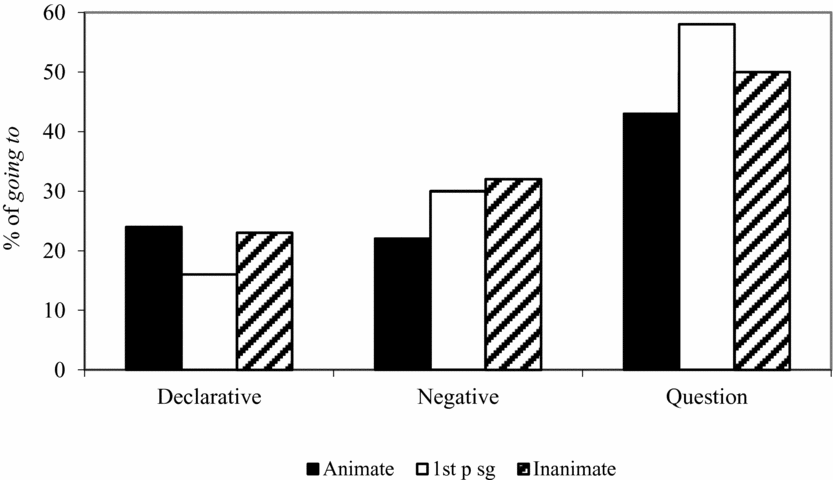
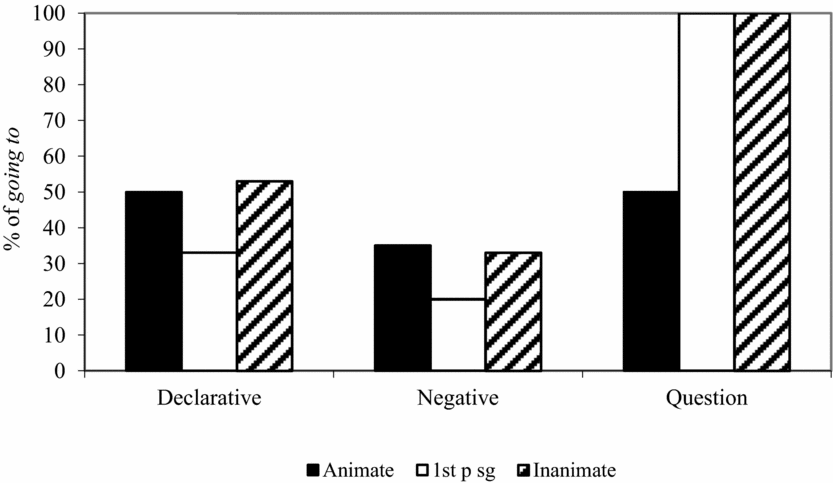
Figures 5, 6 and 7 cross-tabulate the marginal data for animacy/grammatical person and sentence type in order to clearly display the patterns in incipient, active and vigorous be going to situations (see appendix A for the marginal data for the total data set).
Incipient be going to
Active be going to
Vigorous be going to
In incipient be going to situations (figure 5), first-person negatives and questions have the highest frequency of be going to (47 per cent), as in (19), (27 per cent), as in (20).
(19) I’m nae gan to argue about that! (BCK/7)
(20) What am I gonna do? (WHT/m)
Contrast this with the active be going to situation in figure 6, where first-person negatives do not stand apart questions are highly disposed to the incoming form. In figure 7, the vigorous situation, be going to is as likely in declaratives as negatives and questions. Note that although first person singular and inanimates appear to have accelerated rates, these bars represent only 1 token each and so cannot be definitive. The main point here is that declaratives — the most ubiquitous context — is now hospitable to the incoming form. These divergent patterns from one community type to another explain the strong interactions in the amalgamated model.
5.3 Incipient vs active vs vigorous
With the shifting patterns of be going to in mind, we will now focus on the system in each community/age cohort where it is apparent that systemic reorganization of the internal predictors is in progress. To obviate problems arising from small cell sizes we restrict the models to the fixed predictors, the critical interaction between sentence type and animacy/grammatical person and a random effect of individual. Tables 7, 8 and 9 present the results.
Incipient be going to
Active be going to
Vigorous be going to
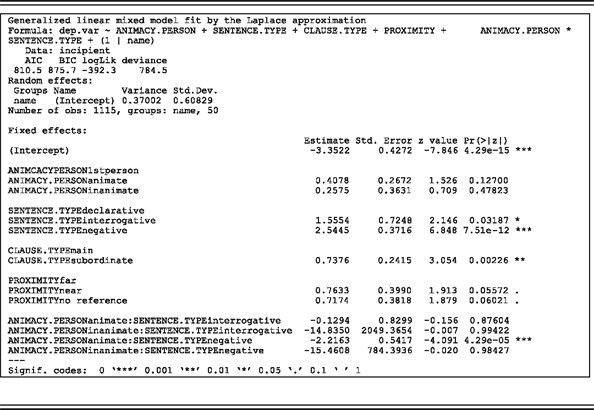
Table 7 shows the incipient be going to situations. The index of concordance value of this model is .75. The strongest predictor is sentence type. Both interrogatives and negatives favour be going to, particularly negatives (p > .001) while declaratives are conservative, favouring will. Clause type is also significant with subordinate clauses favouring be going to (p > .01), whereas main clauses favour will. Near future contexts and those with no temporal reference exhibit a near equal and modest favouring effect for be going to (p > .1) while those that are far future disfavour be going to. Animacy/grammatical person is not significant as a fixed effect in the model; however notice that the interaction between animacy/grammatical person and sentence type is dramatic: animate negatives that are first person strongly favour be going to (see also figure 5).
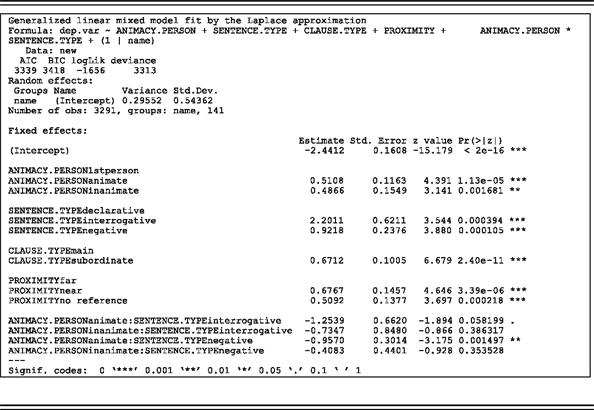
Table 8 shows the active be going to situations. The index of concordance value of this model is .71. The strongest predictor in this situation is type of sentence. The reference level is dramatically set apart from interrogatives as well as negatives, although notice the weakening of this effect compared to the vigorous situation in table 7. Proximity is another very strong predictor. In this case, the reference level ‘far’ is significantly different from both near and no reference contexts. Similarly, animacy/grammatical person is significant, with first person subjects significantly differentiated from all other subject types. Moreover, the interaction factor group shows that declaratives remain distinct from interrogatives and negatives.
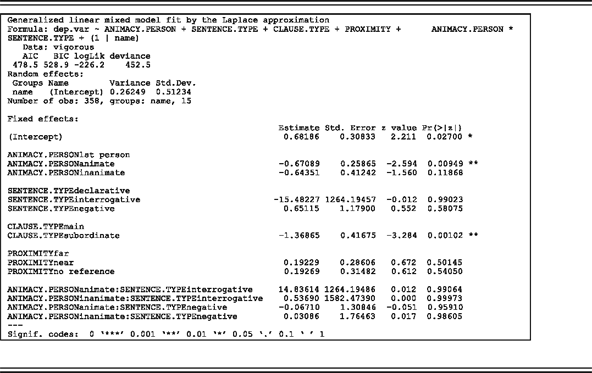
Table 9 shows the vigorous be going to situation. The index of concordance value of this model is .71. There is a shift in the predictors that are significant and to what degree. First, sentence type is no longer significant. Second, clause type has decreased in strength. Third, the effect of proximity levels is different. While this was one of the strongest effects in the incipient situation, yet here there is no longer a statistically significant effect. These results jibe with the idea that as be going to grammaticalizes it becomes more ‘colorless’ (Joos Reference Joos1964: 23) or neutral (Brisard Reference Brisard2001). Finally, animacy/grammatical person shows a clear contrast between first-person and animate subjects types, as in the active be going to situations; however, now it has expanded into inanimate contexts since there is no statistically significant contrast between first person and inanimates.
In sum, we can infer three distinct changes in the use of be going to across incipient, active and vigorous stages from these data. First, when be going to starts to be used for future temporal reference, it does so with first-person questions and negatives. Negatives are most hospitable, followed by interrogatives. Declarative sentences are only gradually infiltrated by be going to. As it increases in frequency, this strong tendency changes. The conservative nature of first person, however, endures across all community/age groups. Second, the effect of proximity changes dramatically: the association of be going to with no reference and near reference futures levels out as be going to expands into far future contexts. Further, it appears that in incipient contexts the proximity effect is not necessarily ‘near’ as previous research has suggested, but simply ‘not far’. Both ‘near’ and ‘no reference’ contexts favour incoming be going to. Far future contexts stand apart; in these contexts be going to is rare. Finally, the effect of clause type is stable across all contexts. Thus, in contrast to previous studies, in our data there is no development towards increasing use of be going to in main clauses.
We now review each of the predictors in turn according to statistical significance, constraint ranking and relative weights of the factors. The complexity of this data structure and the cross-variety nuances of the sample make it particularly important to base our interpretations on a convergence of all the evidence available in the analyses (see Tagliamonte Reference Tagliamonte, Bayley and Ceil2007: 204).
The effect of sentence type shows the most dramatic change across the community/age cohorts. First, the constraint reorganizes: among the older speakers both negatives and interrogatives favour be going to but the favouring effect of negatives declines from highly favouring to irrelevant among the York younger speakers. Second, the strength of the constraint decreases from oldest to youngest speakers, which adds to the earlier comparison (tables 3–4) in elucidating the change in this constraint. Taken together with Szmrecsanyi's (Reference Szmrecsanyi2003) observationFootnote 29 that British varieties favour I won't (or I'll not) over I'm not going to, this leads us to surmise that his data represent a more conservative variety and/or stage in the development of be going to.
The effect of clause type is significant in the amalgamated data with no interaction by community/age cohort and is significant in each of the individual community/age cohort models. The fact that be going to is said to have arisen first in subordinate clauses suggests that this is a longtime retention of earlier patterns.
The effect of proximity is confirmed but it involves an effect of far future rather than near future as has often been suggested in the literature. The data make it evident that far future contexts have a tendency to resist be going to. Among the Buckie older speakers, for example, they are never marked by be going to; however, far futures takes on more be going to from incipient to active situations. In the vigorous situation there is no difference across temporal reference contexts and the constraint is not significant.
The effect of animacy/grammatical person incrementally changes across cohorts (as also visible in figures 3–7). In figure 3, the frequency of be going to rises across generations in apparent time. In figure 4 the conditional inference tree splits the populations by age in virtually every splitting of the data. In figures 5–7, which probe the animacy/grammatical person predictors more deeply, we see changes from incipient to active to vigorous. In the youngest group in York first person singular still stands apart; however, only animates remain statistically different, which establishes the developmental extension of be going to into inanimates. The original association of be going to with animate subjects, particularly first person, has shifted to a strong effect for the use of ’ll for first person.Footnote 30
Taken together, we suggest that the results for the oldest generation across communities and the generational trends within and across communities offer new insight into the early grammatical development of be going to. We propose the following pathway of grammaticalization. First-person singular negatives and questions play a key role in the early stage. In contrast to earlier accounts which put special emphasis on first-person animates capable of movement, we suggest that personal intention, which is particularly strong in negatives and questions, played the more important role. This is supported by: (i) examples of be going to in the Helsinki Corpus which have intention as a highly foregrounded meaning; and (ii) early examples of the verb intend from the same time period which collocate with first person singular (see example (3c)). These few examples from the historical record show that the intention reading was present from the earliest uses. The literature identifies subordinate clauses as the early entry point for be going to. However, our findings suggest that contexts of first-person intention and interrogatives may have been early favouring contexts for be going to as well, perhaps more so. It is not solely the results in table 7 that suggest this but also the fact that these varieties represent localities where be going to is apparently just beginning to encroach on the future temporal reference system. Studies with higher rates of be going to (such as in North America) embody the system at a point in its trajectory of development where this early penetration into the system is long past. The resistance of be going to to first-person singular subjects more generally, as visible in the contrast between first-person and animates in the vigorous context (p < .01), must be a later development linked to prescriptive norms or to the increased strength of the collocation I'll. This is consistent with the characteristics of older grammatical morphemes, which tend to be fused and short (Bybee et al. Reference Bybee, Perkins and Pagliuca1994: 47). Finally, extension of be going to to inanimates and far future readings is a noticeably progressive development, visible in the shifting values of coefficients and relative strength of this factor in the predictor (animacy/grammatical person). From the active to the vigorous situation, inanimate contexts have more be going to, to the point where they are not distinguished from first-person contexts. Similarly, far future readings go from being distinguished from the other future readings to the York young data, where there is no statistically significant difference among types.
If we step back and take an over-arching look at the results, we see that there are relatively dramatic differences between the old Buckie speakers and the young York speakers – in terms of frequency as well as predictors’ significance, constraint ranking and strength of effect. Following this through, we can now make the observation that where we observe dramatic changes in frequency (13% vs 22% vs 41%) reorganization of constraints is paramount. Thus, grammaticalization certainly involves increasing frequency as well as shifting weights of constraints. However, when frequency differences are greatest, they correlate with a brisk reorganization in certain areas of the grammar. In this way, the system advances with incremental, often minute changes (as visible in the shifting strength of factors), and appears to transition from one (stable) pattern to another in the context of substantial acceleration of the incoming form. These developments are not necessarily expected. Many changes advance by moving forward at the same rate in all contexts, i.e. the Constant Rate Effect (Kroch Reference Kroch1989, Reference Kroch, Baltin and Collins2003), for example, the rise of do support (Ellegård Reference Ellegård1953). In grammaticalization, however, constraints (patterns) necessarily reorganize via analogical extension, levelling, pragmatic strengthening and the like. We suggest that the two patterns should, in theory, be visible in empirical data, permitting analysts to infer what type of change is taking place (see Tagliamonte Reference Tagliamonte2012: 83–91). In the case at hand, the interpretation points to grammatical change.
In sum, by examining varieties at varying stages in the process of change we have been able to uncover what we believe are important insights into the evolutionary pathway of be going to as it rises in frequency and develops new patterns. The two-tiered approach of examining different communities and different generations has allowed us to establish subtle shifts that would not have been apparent otherwise and the elusive sparks of acceleration that push the system forward.
6 Conclusions
Regional dialects (space) and speakers of varying ages (apparent time) have offered a vernacular, community-based perspective on the history of the grammaticalization of be going to in English across the entire first half of the S curve.
Our findings suggest that some of the well-known and often-attested constraints on be going to must have been present at the earliest stages of grammaticalization since we have found them to be significant in situations where be going to has just begun to make headway in the grammar. These constraints include: (i) the strong effect of be going to with questions; (i) the preponderance of be going to in subordinate clauses; and (i) the inhospitality of be going to to far future meaning. This provides yet another demonstration that grammaticalization does not require a certain threshold in frequency for the operation of relevant constraints. Moreover, it confirms the idea that ‘tenacious patterns of distribution’ can last across centuries and shape grammatical variation over the long term (Torres-Cacoullos & Walker Reference Torres-Cacoullos and Walker2009: 323). The composite of meanings noted in the literature on the go future involving movement and/or intention with animate subjects in embedded clauses is a case in point. This is a virtually unextricable set of meanings that can be found in the earliest uses of be going to, whether they are clearly future or not, right up to the present day. Moreover, we have documented the well-known patterns of the grammaticalization of be going to across dialects that have never been studied for this feature before. In this way our findings bolster the idea of universal pathways of grammaticalization where meanings are shaped and smoothed and sculpted out of lexical and discourse patterns (Sankoff & Brown Reference Sankoff and Brown1976; Poplack & Tagliamonte Reference Poplack and Tagliamonte1999; Bybee Reference Bybee2006). Some of the associations we have uncovered precisely embody these kinds of systemic processes. Developments such as extension and levelling take place over the long term and in incremental steps along the way. For example, the use of be going to starts out in interrogative and negative sentences, but then extends to declaratives. Similarly, the use of be going to for near and no reference is extending to far future contexts. In both these cases, be going to spreads out from an association with a particular context to a more general set. The same trends are apparent in the development of other tense/aspect systems such as the extension of hodiernal past into the general past temporal reference system (Dahl Reference Dahl, Butterworth, Comrie and Dahl1984) or an anterior perfect generalizing to a perfective (Schwenter Reference Schwenter1994). The development of the contracted form of will as ’ll which is fused with first person singular is another over-arching trend. As far as our data are concerned, this is a relatively recent development and, at least in part, must be a more general process in the aging of grammatical morphemes. Taken together, all these widely diverging patterns of change – some reactionary, some revolutionary – reveal the complex nature of grammaticalization generally. These complementary impacts on the system may be part of the explanation for the longitudinal layering of be going to and will in contemporary English.