


Women high judges
In March of 2024, the European Parliament called for the adoption of the Charter of Women’s Rights. This charter addresses the need and sets standards to increase gender equality throughout the EU in places like labor, education, training, and protections against discrimination. This charter emphasizes the strong call from the public to increase gender equality. While political institutions represent a gender diverse population that often demand gender diversity and gender equality, elite positions held within those institutions historically have not replicated the gender distribution nor the equality demands of the population. In 2019, women occupied just 24% of legislative seats worldwide (Sanbonmatsu Reference Sanbonmatsu2020). When examining progress in a variety of sectors such as socioeconomic status, health, and household, the political sphere has seen the least progress toward gender equality (Dilli, Carmichael, and Rijpma Reference Dilli, Carmichael and Rijpma2019).
The judiciary provides no exception to this general trend in politics. For a large portion of history, country level judicial positions have been held predominately by males (Hurwitz and Lanier Reference Hurwitz and Lanier2003). Grossman (Reference Grossman2011) discusses the reality that international courts remain largely dominated by male jurists as well. Aside from being underrepresented as judges, women have been underrepresented at almost every position in the legal profession, particularly in representation at large law firms (Ash, Chen, and Ornaghi Reference Ash, Chen and Ornaghi2021).
While there is a general historical trend of a lack of gender diversity, recent years have experienced changes toward gender parity. A recent report found that women now make up 41% of state supreme court seats in the US, a stark contrast from previous years (Powers and Bannon Reference Powers and Bannon2022). As aforementioned, women now make up 61% of the judiciary in European countries (Organisation for Economic Co-operation and Development 2019). These developments in diversity are certainly of note and have important consequences. Scholars have found that in order for citizens to feel represented, diverse officeholders are needed (Escobar-Lemmon and Taylor-Robinson Reference Escobar-Lemmon and Taylor-Robinson2014; Barnes and Holman Reference Barnes and Holman2020). Gender diversity also matters in terms of future officeholders. Kedia and Pareek (Reference Kedia and Pareek2023) find that women officeholders in the US Congress serve to increase the number of participating women in lower level politics. Furthermore, women officeholders often draw attention to different issues than their male counterparts. For example, Ennser-Jedenastik (Reference Ennser-Jedenastik2017) finds that women politicians in Austria spend a significant amount of time discussing social issues, while male officeholders do not devote the same time or attention to these issues. Thus, for a host of reasons, gender diversity is of clear importance.
In this paper, we take advantage of the growing number of women serving on high courts to examine how an increase in diversity influences perceptions of the judiciary as a whole. As previously detailed, the increase in female representation on courts is a relatively new phenomenon and one that many citizens are pushing for as a way to increase the accountability of the institution. However, strides toward judicial accountability can lead to decreases or perceived decreases in judicial independence. Thus, this increase in gender diversity in the judiciary deserves to be investigated, particularly as it relates to public perceptions of judicial independence. In particular, in this paper, we examine the effects of this new trend of increased female representation on the perceived judicial independence of high courts, or a courts ability to make decisions without interference from outside political forces. To do this, we utilize survey data to examine citizen attitudes from twenty-seven different European countries. Our findings reveal that increasing the percentage of women judges on high courts serves to slightly increase citizens’ confidence in judicial independence. From a normative perspective, our findings are notable for showcasing the importance of descriptive representation and its ability to shape citizen views.
Literature review
Women leaders in political institutions
As previously noted, there has been an increase in the number of women serving in political institutions across the globe. Even before this increase, scholars sought to understand the impact women leaders have on the institutions in which they serve. This question has been examined at length in the legislative realm. In general, researchers have discovered three ways that women leaders can impact political institutions. First, women serving in political institutions often impact policy outcomes and attention to certain policy issues. For example, one study finds that women representatives are able, dependent on committee assignment, to block pro-life legislation at the US state legislature level (Berkman and O’Connor Reference Berkman and O’Connor1993). This propensity to shape legislation is not subject to only one issue area. Courtemanche and Green (Reference Courtemanche and Green2017) find that women legislators are also more likely to spend large amounts of the state budget on health care for the poor, while Shea and Christian (Reference Shea and Christian2017) find that women legislators can impact a state’s willingness to engage in humanitarian military intervention. Having more women in office shapes policy outcomes differently than having more men in office.
While there is ample research detailing the differential focus on policy issues and outcomes in legislatures, judicial scholars have also looked at the direct policy impact of women judges. Judicial scholars have found that male and female judges also can behave differently dependent on the issue area of their cases. For example, Songer and Crews-Meyer (Reference Songer and Crews-Meyer2000) showcase that female judges on US state supreme courts vote more liberally on the issues of the death penalty and obscenity. It is evident that male and female leaders often bring varied levels of attention to diverse sets of issues.
Second, the impact of female leaders goes beyond policy outcomes and extends to the communication and benefits these officeholders are able to offer constituents. Thomsen and Sanders (Reference Thomsen and Sanders2020) find that female officeholders are more responsive to constituent requests than their male counterparts. Similarly, Bauer and Cargile (Reference Bauer and Cargile2023) find that women legislators are more responsive and display more compassion toward their constituents. The notion of differences between the communication styles and relationships of men and women extends beyond the legislature to the judiciary. In the judiciary, female judges can be more lenient toward certain offenders (Boyd and Nelson Reference Boyd and Nelson2017). From this literature, it can be concluded that there are gendered differences in male and female leaders in terms of benefits and communication.
A third thread of scholarship has focused on the impact of women when it comes to voter evaluations and assessment. It is important to note that demographic characteristics such as gender can and do shape the way citizens assess politicians (Pancer, Brown, and Barr Reference Pancer, Brown and Barr1999). These evaluations vary greatly based on the specific characteristic being assessed. O’Brien (Reference O’Brien2019) showcases that political parties with women leaders are perceived as more moderate by voters. This finding compliments a study by Park and Baek (Reference Park and Baek2019) that depicts voters as feeling ambivalent toward women politicians and needing more information to view women as polarizing.
While these findings may show women as successful at garnering broad support, women leaders do not always summon positive evaluations from the citizenry. For example, Lawless (Reference Lawless2004) finds that voters view males as more competent in issue areas of war and international affairs and are thus more likely to punish women candidates when elections take place during heightened security concerns.
For the judiciary, there is evidence demonstrating that citizens view female and minority judges negatively due to perceived judicial bias when deciding gender or minority related issues (Ono and Zilis Reference Ono and Zilis2022). When we define judicial independence as the ability of a judge to make decisions without influences – whether that be in the traditional sense of independence from other branches of government, from the public (Clark Reference Clark2010), of from private groups – the idea of bias can be detrimental to a positive evaluation.
The reality that voters can and do perceive female and male leaders differently is certainly of note. Given the rise in women’s representation in political institutions, it is perhaps more important than during previous time periods to thoroughly consider voter perceptions of women leaders, what exactly these perceptions are, and how they could shape political institutions.
Citizen perceptions of female leaders’ corruption and independence
While some voters may have negative feelings toward women leaders regarding their ability to govern over certain issues, or stemming from bias against traditionally underrepresented or minority groups (Lawless Reference Lawless2004; Valdini Reference Valdini2013; Setzler Reference Setzler2019; Endo and Ono Reference Endo and Ono2023), many citizens hold increasingly positive attitudes toward female leaders and decreasing political corruption. We define political corruption as the abuse of power to benefit an individual in the form of political capital or favors. Across the literature, scholars have found that citizens possess different perceptions regarding the likelihood of officeholders to be corrupt. An important finding from legislative politics shows that voters perceive females as less likely than males to engage in corrupt practices (Barnes and Beaulieu Reference Barnes and Beaulieu2019). Barnes and Beaulieu (Reference Barnes and Beaulieu2019) conclude that this is the case because voters perceive females to be more risk averse than their male counterparts. Other studies reach similar conclusions. Benstead and Lust (Reference Benstead, Lust, Stensöta and Wängnerud2018) find that, when surveyed, voters see females as less corrupt (although this stated belief does not regularly map onto their ultimate vote). For the judiciary, there is evidence that left-leaning political elites are aware of these beliefs and will appoint female judges to high courts when there are major judicial reshuffles as a way to preemptively avoid political backlash from voters (Arana Araya, Hughes, and Pérez-Liñán Reference Arana Araya, Hughes and Pérez-Liñán2021).
Importantly, voters’ beliefs often fit with actual practices. Women political leaders have been referred to as “corruption cleaners” due to their decreased propensity to practice corruption (Goetz Reference Goetz2007; Guerra and Zhuravleva Reference Guerra and Zhuravleva2022). Bauhr and Charron (Reference Bauhr and Charron2021) showcase that newly elected women are instrumental in reducing levels of corruption. While the exact mechanism for this lower level of corruption is multi-faceted and not entirely agreed upon by scholars, the important takeaway is that the presence of women coincides with both actual and perceived lower levels of corruption, particularly in democracies where corruption is more likely to be viewed as unacceptable (Swamy et al. Reference Swamy, Knack, Lee and Azfar2001; Sung Reference Sung2003; Sundström and Wängnerud Reference Sundström and Wängnerud2016). Thus, female leaders are lending credence to voters’ perceptions that they are less corrupt.
Perceptions of courts and corruption
The above discussion primarily focuses on perceptions of female and male leaders broadly. But, more specifically, how are female and male judges perceived? Ono and Zilis (Reference Ono and Zilis2022) provide insight into this question by depicting that voters use characteristics like gender to ascertain a judge’s potential for bias as well as their ideological leaning. Similarly, Ono and Zilis (Reference Ono and Zilis2023) showcase that voters perceive female judges to be biased decision, makers while Fix and Johnson (Reference Fix and Johnson2017) use evidence from a survey experiment to depict that voters in the US form perceptions of state court judges based on gender.
Clearly, in some aspects, women judges are often punished by voters for perceptions of bias, such as when it comes from a specific societal expectation or regarding a specific issue area. Nonetheless, there is evidence indicating a perceived relationship between corruption in the courts and a judge’s gender. While the judiciary is often depicted as a powerful force to fight corruption from other institutions, courts themselves can be large arbiters of corruption (Houqe et al. Reference Houqe, Zahir-ul-Hassan, Idrus and van Zijl2020). For example, focusing on the US, Pahis (Reference Pahis2008) documents that judicial corruption is particularly difficult to uncover, but is somewhat commonplace through the form of bribery in traffic courts. Bribery is the act of monetary or similar types of payment for a favorable outcome. Gong (Reference Gong2004) showcases that the institutional structure of China has created an environment ripe for judicial corruption. Della Porta (Reference Della Porta2001) documents that despite appearances otherwise, judges in Italy can be involved in political corruption taking place in other political institutions. Thus, across countries and contexts, judicial corruption does occur.
Can female judges make any sort of difference in these practices? In the legislative realm, as detailed above, this question has been examined more thoroughly. In the judicial space, the answer to the question is more ambiguous and unanswered. Some research suggests the presence of women is distinct and matters. For example, in a report from the United Nations Office on Drugs and Crime focused on Nigeria, researchers found that female judges were six times less likely to take a bribe than their male colleagues (Gibbons Reference Gibbons2021). They find this is due to women judges’ negative views on bribery, women judges’ need to prove themselves worthy of the job, and a lower likelihood of a woman judge being offered a bribe. Peresie (Reference Peresie2004) showcases that female presence matters across a host of different outcome variables. An important finding with regards to corruption and independence comes from Choi et al. (Reference Choi, Gulati, Holman and Posner2011). These authors find that across various independence measures, female judges are more independent than their male counterparts or more likely to make decisions without influence from other sources. The literature remains mixed on whether an increase in women judges has a positive or negative impact on perceptions of the court.
Theoretical expectations
We seek to fill the gap in knowledge concerning the relationship between gender and judicial independence by answering the following question: Does the presence of women on high courts impact citizen perceptions of judicial independence? There are three outcomes that could occur based on the literature we have examined so far. First, the presence of female judges on high courts could decrease perceptions of judicial independence among constituents. Alternatively, the presence of female judges on high courts could increase perceptions of independence. Finally, the presence of female judges on high courts could not influence perceptions of independence at all. We focus our attention on whether female judges might increase perceptions of independence. While we are not able to explore specific mechanisms that cause an increased number of women judges to increase perceptions of judicial independence, we spend the following section discussing whether we would expect women to increase rather than decrease, or have a null effect on public perceptions of judicial independence.
Female politicians and judges can impact the perceptions of citizens in a host of areas. For instance, Huddy and Terkildsen (Reference Huddy and Terkildsen1993) show that respondents form different opinions of female candidates than their male counterparts. From a similar perspective, O’Brien (Reference O’Brien2019) finds that voters perceive parties with female leaders as more moderate (despite whether or not this is actually the case). Importantly, research on the impact of gender diversity and perceptions extends to perceptions of independence and corruption. As we detailed earlier, scholars find that female politicians can decrease perceptions of corruption or the influence of outside forces (Barnes and Beaulieu Reference Barnes and Beaulieu2019).
Increased gender diversity can impact perceptions because of the diversity of perspectives that comes with enhanced gender diversity. As the number of female judges on a court increases, along with that comes an increase in diverse perspectives. The notion that gender diversity can have this sort of an impact is seen in a variety of literature. For instance, this is demonstrated in a number of studies, including that of Minta and Brown (Reference Minta and Brown2014). These authors demonstrate that gender diversity in Congress leads to diverse perspective among leaders, which leads to disparate attention provided to certain issues over others. Essentially, this work and others in similar areas argue that when gender diversity increases, so does the diversity of perspectives. Importantly, citizens are able to observe these changes and make inferences based on the diversity of perspectives and the citizenry, particularly minority individuals like women, overwhelmingly view diversity in perspectives as a positive change. More importantly, while increased descriptive representation might increase judicial accountability and could thus lead to a decrease in judicial independence, we argue that particularly for women, we expect the opposite. We expect descriptive representation for female citizens will actually increase perceptions of judicial independence more so than for male respondents.
Women serving in the judiciary will increase public perceptions of independence because the public tends to hold greater trust in women leaders. Across various political offices and positions, citizens report high feelings of trust toward female leaders. For example, one study from the field of psychology found that the presence of a woman in organizational leadership resulted in greater trust for the organization at large (Joshi and Diekman Reference Joshi and Diekman2022). Another example of trust in women leaders comes from the COVID-19 pandemic. Willis, Smith, and Devine (Reference Willis, Smith and Devine2021) demonstrate that citizens reported higher trust of women health leaders during the pandemic. They argue this is the case because of citizens’ likelihood to view women as more caring than men.
This greater trust citizens possess toward female leaders extends to attributing other favorable qualities toward females as well. For example, Thomas and Petrow (Reference Thomas and Petrow2020) showcase that when surveyed, voters indicate they believe women leaders possess greater integrity than their male counterparts. Courtemanche and Green (Reference Courtemanche and Green2017) documents that voters are more likely to view male politicians as susceptible to wrongdoing than female politicians. Perhaps most important for our purposes, is that voters trust women more than men, and this trust changes or extends to their feelings about the rest of government (Atkeson and Carrillo Reference Atkeson and Carrillo2007). This all points to an increase in women being able to influence public perceptions of judicial independence.
It is also essential to note that trust in politicians can decrease voters’ perceptions of corruption and increase their perceptions of independence. Barnes, Beaulieu, and Saxton (Reference Barnes, Beaulieu and Saxton2018) describe this connection focusing on police forces. These scholars find that an increase in women police officers reduces suspicions of corruption in policing practices. Wroe, Allen, and Birch (Reference Wroe, Allen and Birch2013) also conclude that trust and perceptions of corruption are correlated. This relationship between trust and corruption is consistent across context and countries. Morris and Klesner (Reference Morris and Klesner2010) document that citizens in Mexico evaluate corruption based on trust, and Lavallée, Razafindrakoto, and Roubaud (Reference Lavallée, Razafindrakoto and Roubaud2008) uncover similar findings in African countries. There is a clear relationship between trust and perceptions of corruption, and the presence of women.
Both trust and perceptions of corruption are important in understanding perceptions of judicial independence. When judicial independence is defined as a court being seen as above or insulated from improper influences, citizens need to trust there are no untoward actions like corruption happening. Thus, women, who in general tend to garner higher levels of trust and are seen as corruption cleaners, would lead us to expect that higher numbers of those types of individuals will increase perceived levels of judicial independence.
Therefore, we hypothesize the following:
H1: A greater percentage of women serving on courts increases citizens’ perceptions of judicial independence.
In addition to this hypothesis, we posit that certain citizens will be more impacted by a greater percentage of female judges than others. Specifically, we anticipate that female citizens will be more impacted by an increasing percentage of women on high courts than male citizens. We anticipate this relationship to be stronger for women because of the ties between descriptive representation and legitimacy. Research suggests that diverse decision-making bodies, including those with gender diversity, are often perceived as more fair and legitimate. This research is embedded within theories concerning descriptive representation and its impact. In essence, scholars argue that political institutions can garner legitimacy by reflecting all of a society that they serve, including minority or previously excluded groups (Mansbridge Reference Mansbridge1999; Scholte Reference Scholte2011). Because political institutions are historically lacking in female representation, scholars reason that when institutions do mirror the gender makeup of the populace, these institutions will be more likely to achieve higher levels of legitimacy (Clayton, O’Brien, and Piscopo Reference Clayton, O’Brien and Piscopo2019). Arnesen and Peters (Reference Arnesen and Peters2018) showcase this in their study. Specifically, they find that Norwegian citizens are more accepting of a body’s decision when the decision comes from a diverse group. Also, Clayton, O’Brien, and Piscopo (Reference Clayton, O’Brien and Piscopo2019) note that citizens place high value on descriptive representation. Not only does it impact their feelings of legitimacy and trust, the value of increased symbolic representation is found even apart from substantive representation (Hayes and Hibbing Reference Hayes and Hibbing2017).
Applying this concept to the judiciary, a similar relationship between descriptive representation and legitimacy exists. Scherer and Curry (Reference Scherer and Curry2010) and Scherer (Reference Scherer2023) find that for certain groups, increasing representation among judges in US courts increases perceptions of legitimacy, particularly for the groups being newly represented. From a comparative politics perspective, Valdini and Shortell (Reference Valdini and Shortell2022) showcase that in democracies across the globe, descriptive representation positively impacts citizen’s beliefs in a court’s legitimacy. Descriptive representation is of enough importance to voters that they even reward executives for prioritizing judicial diversity (Badas and Stauffer Reference Badas and Stauffer2023).
Scholarship provides a clear linkage between descriptive representation and citizen support. For instance, a judicial nominee’s shared identity with an individual increases that individual’s support for the nominee (Badas and Stauffer Reference Badas and Stauffer2018). Descriptive representation can also lend itself to an individual feeling better represented (Montoya et al. Reference Montoya, Bejarano, Brown and Gershon2022). When women are represented descriptively, they report higher feelings of representation (Montoya et al. Reference Montoya, Bejarano, Brown and Gershon2022). Descriptive representation also increases female participation in government. This is demonstrated through a study by Barnes and Burchard (Reference Barnes and Burchard2013), finding that an increase in descriptive representation caused female citizens to become more politically engaged. This literature demonstrates that descriptive representation shapes the behavior of female constituents.
Acknowledging this research, we combine it with a large section of scholarship that documents the differential effects of descriptive representation on male and female voters. A brief summation of this literature finds that while descriptive representation impacts all citizens, female citizens are affected differently. For instance, Atkeson and Carrillo (Reference Atkeson and Carrillo2007) conduct a study on the impact of descriptive representation on political efficacy. They find that higher levels of female representation lead to higher belief in efficacy by female citizens. Focusing on the 2008 presidential election in the US, Stout and Tate (Reference Stout and Tate2013) find that the presence of female candidates created greater feelings of efficacy among female voters. Others reach similar conclusions. Schwindt-Bayer and Mishler (Reference Schwindt-Bayer and Mishler2005) offer a model of descriptive representation that finds increased female politician presence translates to increased legitimacy among female constituents. Given this research, we propose that female citizens should be even more likely to view courts with increasing gender diversity as independent.
Therefore, we form the following hypothesis:
H2: In the aftermath of increased gender representation on high courts, female citizens will hold higher perceptions of independence than male citizens.
Data and methods
To answer the question of how women judges influence citizens’ perception of judicial independence, we need to examine an institution where the number of women in the high court vary over time; furthermore, it would be ideal to examine different institutions where the number of women vary over time. For this reason, we examine high courts in all countries included in the European Union from 2016–2022. The data was collected from government websites following the data collection strategies of Escobar-Lemmon et al. (Reference Escobar-Lemmon, Hoekstra, Kang and Kittilson2021).
These courts provide an ideal scenario because we are able to explore what conditions influence public opinion of judicial independence, whether that be a change in the percentage of women judges on the high court, or a combination of institutional or social factors that could influence perceptions of women or the perceptions of the courts in general.
From 2016–2022, there is a surprising amount of variation in the percentage of women on high courts in each European country. The change in percentage of women on high courts from 2016–2022 for individual countries ranges from decreasing 12% to increasing 56% during the time period in our data set. So while there is an overall trend of appointing women to high courts (Organisation for Economic Co-operation and Development 2019), there are instances where the percentage of women judges is decreasing.
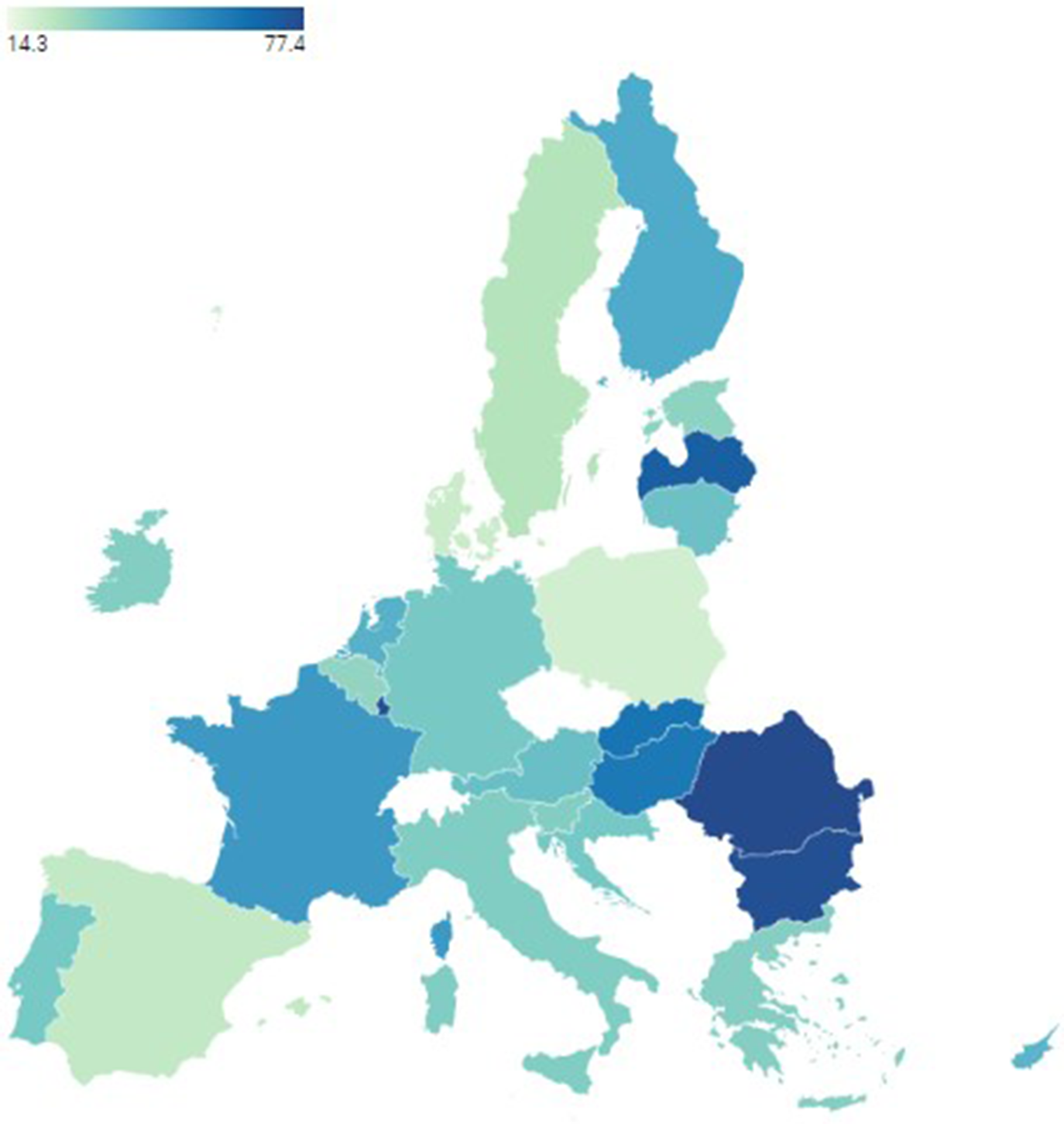
The variation between countries is also surprising. Figure 1 displays the variation in the percentage of women in high courts across the EU, from the lowest percentage in the United Kingdom at 10%, to almost 78% in the highest court in Romania.
Percent of Women Judges by Country in the EU in 2022.
To gather information about citizen perceptions of judicial independence, we rely on special editions of the Eurobarometer survey. This survey is fielded yearly near the start of the year in the twenty-seven countries that form the EU. At least one thousand survey respondents are randomly selected from each country every year. The topics of the special Eurobarometer change depending on the needs of the European Commission (European Commission, 2020). From 2016 to 2022, the Special Eurobarometer has included a question asking citizens, “From what you know, how would you rate the justice system in (COUNTRY) in terms of the independence of courts and judges? Would you say it is very good, fairly good, fairly bad or very bad?” (European Commission, 2020). We utilize this survey instrument as our dependent variable. It is important to note that this survey question does not define judicial independence for the respondents and simply relies on their preconceived notions of the definition of the terms. The variable is coded from 1 to 4 with 1 indicating very bad judicial independence and 4 indicating very good judicial independence. The dependent variable as well as the included independent variables are detailed in Table 1.
Variable Ranges and Averages
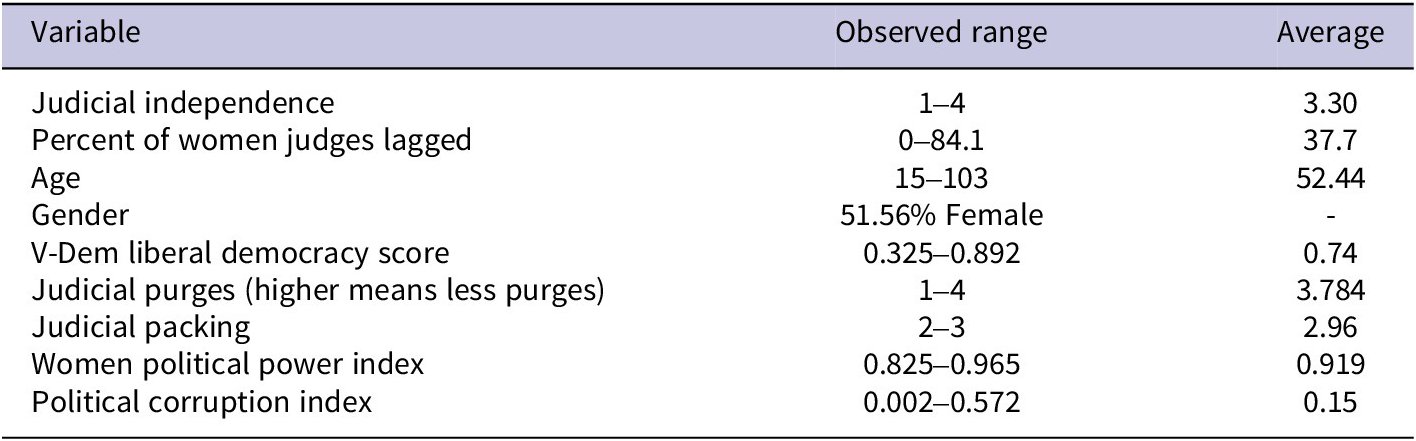
Our main independent variable for the model is a 1-year lag of the percentage of women in the high court of the country. We chose to use a percentage in place of a count of the number of women due to the variation in sizes of the high courts across the EU. A percentage standardizes the measure to allow for comparability across institutions. Theoretically this could range from 0 to 100%. However, the highest percentage of women we see at any court in any given year is 84.1%, with the lowest at 0%. We lag the percentage by one year to address any concern with causality direction. The surveys of citizen attitudes are fielded generally around the beginning of each calendar year. The counts of women judges on high courts comes from the number of women at the end of a calendar year. Thus, to avoid any reverse causality it is important to use the number of women in the high courts from the previous year (December prior year) to help predict influence on citizen attitudes (in February or March current year)Footnote 1.
To examine how this increase influences citizens differently, we include an interaction with the lagged percentage of female judges with the binary gender of the survey respondent.
We also include a variety of individual level and country level controls in our model. For individual controls we account for age and education. Education is based on if the respondent completed high school or received more than a high school education. We also include post estimation frequency weights that account for any adjustments needed for the sample to be proportional to each country’s share in the total population of the EU provided by the Eurobarometer.
We also include a battery of control variables at the country level. These include a measure of liberal democracy, judicial purges, court packing, a gender empowerment index, women’s political empowerment index, and a political corruption index all coming from V-Dem (Coppedge et al. Reference Coppedge, Gerring, Knutsen, Lindberg, Teorell, Altman and Bernhard2023).
These V-Dem variables are derived from surveys sent to political experts on each country. For example, the judicial purges variable comes from experts responding to the following question, “Judges are sometimes removed from their posts for cause, as when there is strong evidence of corruption; however, some judges are removed arbitrarily, typically for political reasons. With this distinction in mind, please describe the removal of judges that occurred this calendar year” (Coppedge et al. Reference Coppedge, Gerring, Knutsen, Lindberg, Teorell, Altman and Bernhard2023). The variable is coded from 0 to 4 with higher values indicating less purging in judicial offices, particularly for arbitrary reasons. This variable is included in the model due to prior literature indicating its importance in both perceptions of judicial independence, as well as its influence on the number of women appointed to high courts (Arana Araya, Hughes, and Pérez-Liñán 2021). We include court packing measures for the same reason. For this variable, experts were asked if there had been any kind of increase in positions to the court during the year. This variable theoretically can range from 0 to 3 with higher values indicating fewer, less politically motivated judicial increases. We only observe ranges from 2–3 in the dataset.
The gender empowerment index is included to account for institutional and societal norms relating to the perception of women in each country. This index runs from 0 to 1. It is an equally weighted combination of civil liberties for women, women’s discussion of political issues, and the descriptive representation of women in formal political institutions, including the executive and legislative branches. Higher levels of this number indicates increasing political capacity for women. The final country level control variable is a measure of expert perception of political corruption. This variable runs from 0 to 1 with higher values indicating more perceived corruption. The index is an equally weighted combination of perceived public sector, executive, legislative, and judicial corruption.
We also include a control for year to account for any other time-based observable characteristics that may be influencing both the perceived independence as well as the lagged percentage of women in high courts.
Results
To examine how the percentage of women in high courts influences citizens’ perceptions of judicial independence, we take advantage of a multilevel modeling strategy due to the clustered nature of our data, individuals i within countries j. For this research question, we utilize survey questions from the Eurobarometer from 2016–2022. This survey was fielded across twenty-seven countries, with a similar distribution of respondents from each of those countries. The multilevel model is appropriate for cross-sectional, time-series data. By using this model, we are able to account for the residual variation within a specific country over the time period included in our data set (i.e., accounting for any observable changes between 2017 to 2022 in country j) while also accounting for cross-country comparisons (i.e., what is unique about country j compared to country j1 that is observable). These comparisons lead to more accurate estimates of standard errors by accounting for grouping, allowing each individual country to have its own intercept. Table 2 details the model output.
Perceptions of Judicial Independence
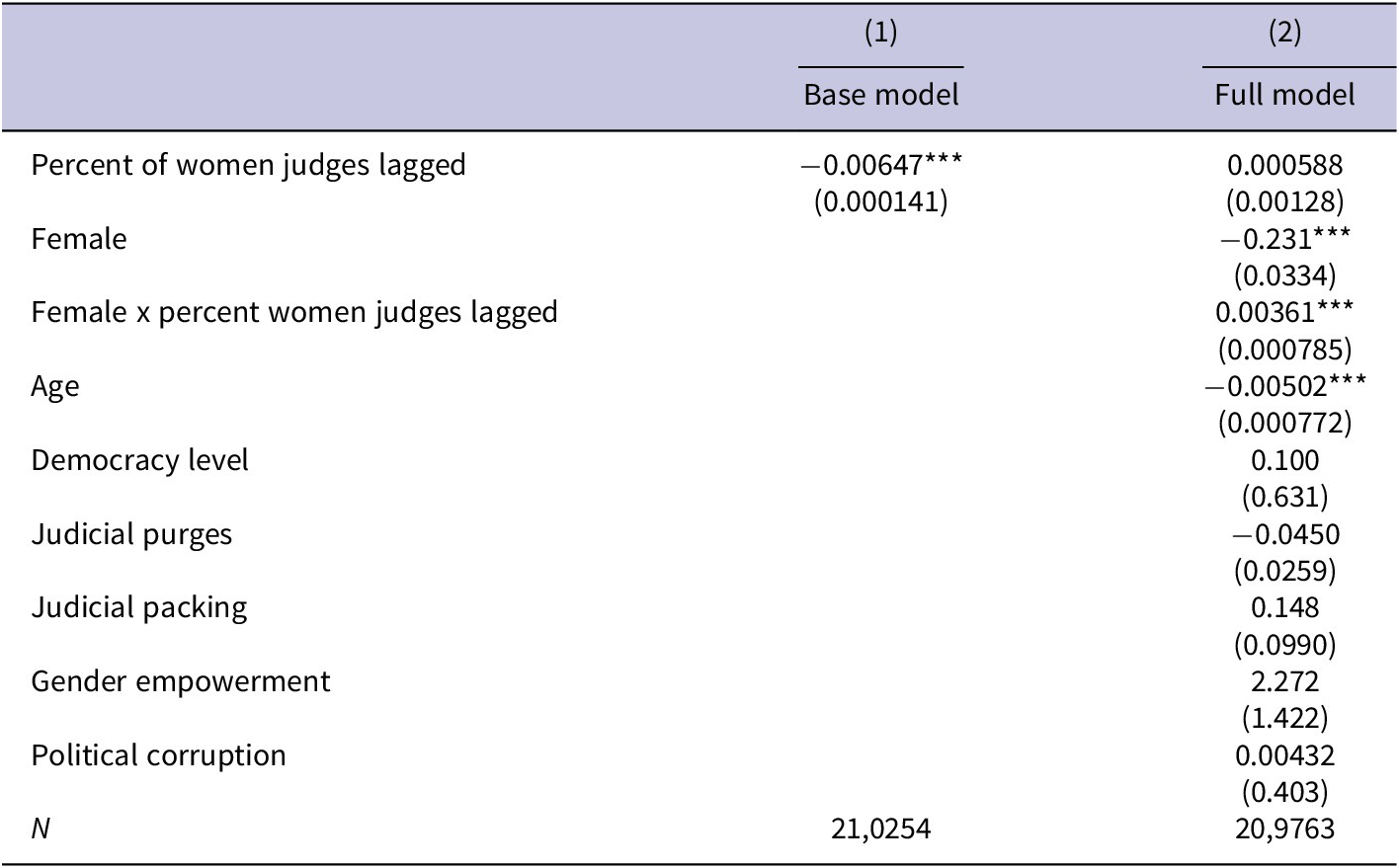
Notes: Model 1 and 2 are multilevel mixed effects models clustered by country with population weights, with the dependent variable being the perceptions of judicial independence. Fixed effects for survey year included in both models. Model 1 is a base model with only the main independent variable of the lagged percentage of women judges. Model 2 includes the interaction with survey respondent gender as well as controls. Robust standard errors in parentheses.
* p < .05, ** p < .01, *** p < .001.
First, looking to model 1 in Table 2 and our main independent variable of interest, we do not find support for H1. As the number of women judges on a high court increases, citizens are more likely to state that the court’s independence is not good. While this variable is statistically significant, the coefficient is substantively small. Moving from 0% women on the high court to the highest percentage of women available in the data at 84%, perceived judicial independence only decreases from 3.5 to 3. This shift does not quite move a response from good levels of judicial independence to bad levels of judicial independence. While these coefficients are small, they are statistically significant. The results are further explained in Model 2 where we find support for H2 that includes the interaction between the lagged percentage of women judges and the gender of the respondent.
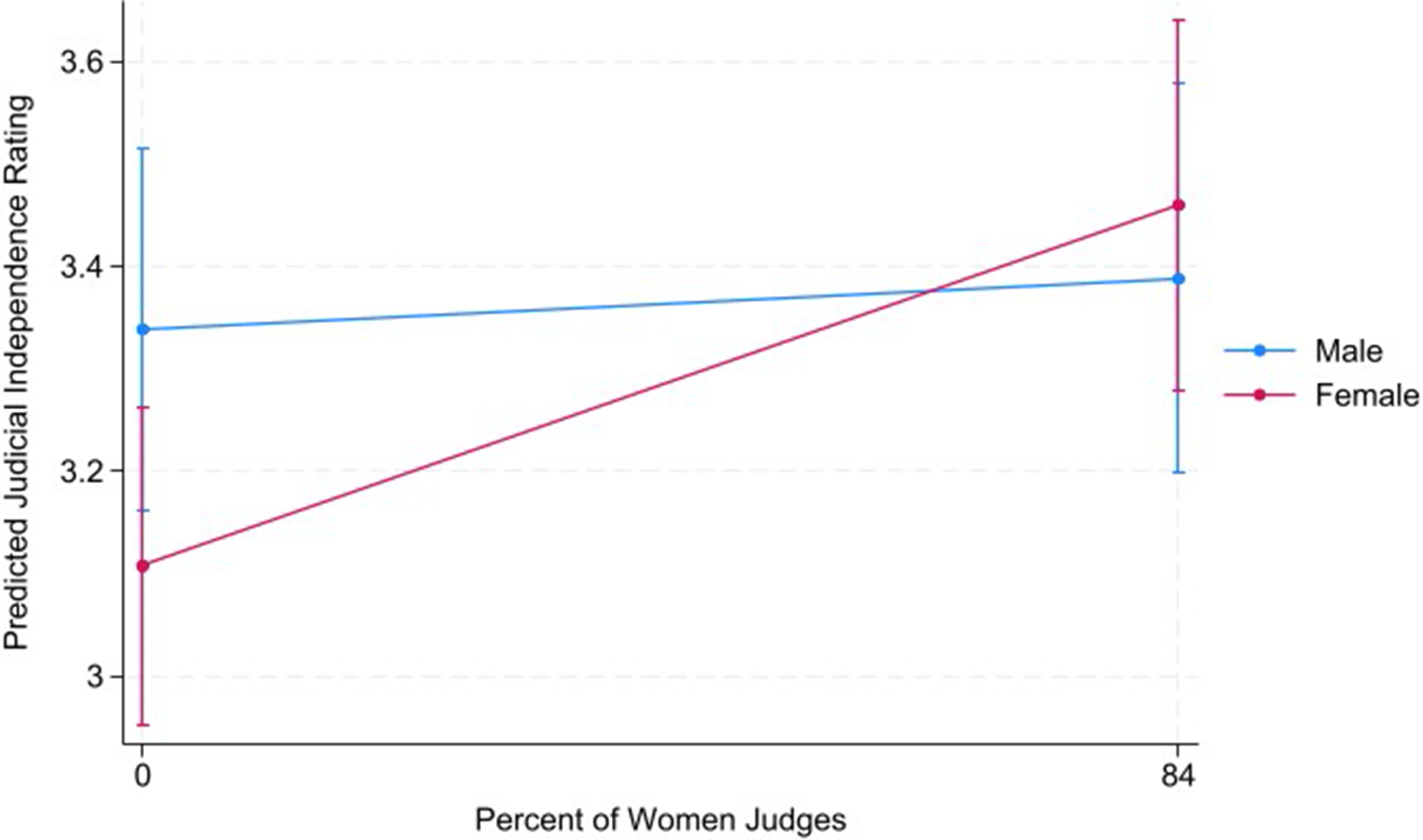
From model 2, we see that the interaction between survey respondent gender and the lagged percentage of women judges is significant with female respondents more likely to rate the courts higher on judicial independence when there are more women on the court. In figure 2, we see that male perceptions of judicial independence increase slightly as the number of women judges increase, but the female respondents have a larger upward shift in perceptions. The difference between men and women is statistically significant at .001.
Predicted Levels of Perceived Judicial Independence. Notes: Figure shows the predicted levels of perceived judicial independence with an increase of women on the Court from 0% to 84% given a respondent’s gender. 95% confidence intervals are included. The difference between men and women is statistically significant at p < .001.
Looking to the respondent controls, older individuals are less likely to think the court has good independence with the size of the coefficient similar in size to the main independent variable.
Country level variables seem to have greater influence on citizen perceptions of judicial independence. Higher levels of democracy, as well as higher levels of women’s political empowerment, lead to higher levels of perceived judicial independence. Less court packing due to political reasons leads to an increase in perceptions of judicial independence. However, none of these are statistically significant.
Interestingly, when there is less judicial purging for arbitrary reasons, individuals are less likely to think of the court as independent, though it does not reach statistical significance. This could be a lack of citizen knowledge about judicial purging that is more likely to occur behind the scenes with forced retirements, threats etc., unlike court packing, which results in a public appointment to the court.
Additionally, higher levels of perceived government corruption by experts is a positive predictor of greater perceived judicial independence. While it may be unexpected that the outcome of experts varies from the outcome of citizens, it is important to remember that the perceived corruption variable accounts for perceived corruption in all three branches of government. Usually, it is the judicial branch that prosecutes accounts of political corruption from the other two branches. Because of this, it makes sense that when there is higher perceived government corruption, there is also a higher perceived level of judicial independence by citizens.
Discussion
Having showcased these results, we now turn to a brief discussion as to potential explanations for our findings. Put another way, why do female judges increase perceptions of judicial independence? In general, they do not. However, for female citizens, descriptive representation seems to influence perceived judicial independence.
While we ultimately leave the question of the specific mechanism as an avenue for future inquiry, we do propose three forces that could be shaping citizen perceptions of female judges. First, we hold that our results could be explained by a recognition that the public holds greater trust in women leaders. This greater trust, we argue, could translate to a greater trust in women leaders to act independently of other influences and institutions. Some evidence of this might be seen through the country level effects. Perhaps there are different opinions and perceptions of women in society in each country that influence the levels of trust people have in women, thus influencing how women judges impact perceptions of judicial independence.
Another potential explanation is that voters could use women judges as informational cues. For example, McDermott (Reference McDermott1997, Reference McDermott1998) showcases that race and gender serve as informational cues to provide voters with potential information regarding a candidate’s platforms, ideology, and more. Importantly, research has demonstrated that citizens use cues not just with regards to legislators or executives, but judges as well. Ono and Zilis (Reference Ono and Zilis2022) show in their work that citizens also use demographic cues to evaluate assess a judge’s position. These researchers showcase that gender is one factor that matters for citizens and serves as an informational cue or shortcut for other knowledge. Braman and Easter (Reference Braman and Easter2014) uncover a similar pattern in how citizens interpret court decisions using cues.
These cues that citizens use do not just relate to their evaluations of a single candidate, lawmaker, or judge, but can also be used to evaluate an entire political institution or body. Brader, Tucker, and Duell (Reference Brader, Tucker and Duell2013), using data from Hungary, Poland, and Great Britain, find that cues can shape support for an entire party. Cues can even inform citizens’ beliefs about policies and initiatives (Boudreau and MacKenzie Reference Boudreau and MacKenzie2014). Voters may even rely on ideological cues to form opinions about judicial elections (Lim and Snyder Reference Lim and Snyder2015). Cues concerning judges themselves can also shape feelings toward an entire court. Apart from the cues previously summarized that impact perceptions toward an individual judge, these same types of cues can shape feelings toward a whole court. Focusing on the US Supreme Court, Zilis (Reference Zilis2021) finds that rulings, actions, and the makeup of a court can all be utilized as cues. Similarly, Clark and Kastellec (Reference Clark and Kastellec2015) note that cues, when provided to survey respondents, can shape an individual’s likelihood to support court curbing. Furthermore, Nicholson and Hansford (Reference Nicholson and Hansford2014) also argue that partisan cues can shape a citizen’s attitudes and perceptions of a court.
Given that citizens tend to rely on demographic cues, and these cues shape beliefs and perceptions about entire political entities, this could perhaps be a mechanism that shapes perceptions of judicial independence in Europe. As more women are appointed to high courts, these cues would be more obvious. Specifically, seeing a female judge serving on a court could cause a voter to imply other things about the court based on that female judge. More research would be needed to examine what information citizens are given when female judges are appointed. Are women appointees being lauded by those appointing in the media, in press releases, or in campaigning efforts?
Finally, it could be that descriptive representation is impacting perceptions by voters. Research suggests that diverse decision-making bodies, including those with gender diversity, are often perceived as more fair and legitimate. Perhaps male citizens who are not being descriptively represented by women judges are more likely to view the court as being publicly or politically accountable, and thus less independent.
Conclusion
In this paper, we examine how the presence of women on high courts shapes perceptions of judicial independence among European citizens. We argued that a there would be an increase in perceptions of judicial independence when there is a greater percentage of women on the court. Using survey data from citizens across European countries, we find that an increase in the number of female judges leads to an increase in perceptions of judicial independence primarily for female citizens and not for the whole citizenry in general.
This research is a start to unravelling the extent of the influence of women in high political positions. Overall, our findings are important for a variety of reasons. First, most literature regarding the impact of female leaders within political science focuses on legislators and executives. We extend knowledge regarding perceptions of women leaders by contemplating how citizens perceive female judges. Importantly, we document an area in which female judges are actually viewed positively by the citizenry. Second, and closely related, our results lend credence to the notion of women as corruption cleaners. By finding that women judges translate to perceptions of independence, we showcase that the perception of women as corruption cleaners pertains to the judiciary as well. Third, from a normative perspective, we showcase the importance of descriptive representation. By demonstrating that female judges can impact female perceptions of judicial independence, we show that gender diversity on courts is valuable for yet another reason. To that end, our results are meaningful as politicians and others consider various appointment mechanisms to courts and ways to increase diversity in political institutions.
Supplementary material
The supplementary material for this article can be found at http://doi.org/10.1017/jlc.2024.23.
Data availability statement
All replication materials are available on the Journal of Law and Courts Dataverse archive.
Acknowledgments
Special thanks to the Law and Courts group at the Southern Political Science Association for their feedback, especially Amanda Driscoll and Mike Nelson for organizing the Comparative Conference within a Conference panels. Also, thanks to Justin Wedeking for his advice about the article.
Competing interest
None



