CHD is the most common form of congenital anomaly and as a group is a significant cause of perinatal morbidity and mortality.Reference Rosano, Botto, Botting and Mastroiacovo 1 The incidence of CHD varies across different studies from 6 to 11 per 1000 live births.Reference Hoffman and Kaplan 2 , Reference van der Linde, Konings and Slager 3 However, the incidence of complex CHD is relatively similar across different populations and registries. The reported incidence of complex CHD is three per 1000 live births.Reference Khoshnood, De Vigan and Vodovar 4
Fetal echocardiography was introduced for focussed diagnosis of fetal CHD in the 1980s.Reference Friedman, Kleinman and Copel 5 Since then it has become an integral part in the early diagnosis and management of CHD. Owing to lack of accurate screening tests for complex CHD in the first few hours to days of life, prenatal diagnosis plays a major role in the management of these patients.Reference Gorla, Hsu and Kulkarni 6 Prenatal diagnosis helps us to better coordinate the care of the pregnant mother and the fetus and the newborn baby after birth.Reference Landis, Levey and Levasseur 7 , Reference Brown, Ridout, Hoskote, Verhulst, Ricci and Bull 8 Advanced planning in care of these patients should improve pre-operative morbidity in complex CHD. However, there is conflicting data regarding the benefit of prenatal diagnosis on early and late post-operative mortality. The mortality benefit of prenatal diagnosis demonstrated in a few series of patients with hypoplastic left heart syndromeReference Sivarajan, Penny, Filan, Brizard and Shekerdemian 9 and transposition of great arteriesReference Bonnet, Coltri and Butera 10 have not been replicated consistently in larger series.Reference Kumar, Newburger, Gauvreau, Kamenir and Hornberger 11 , Reference Khoshnood, Lelong and Houyel 12
Despite the widespread use of screening ultrasound and fetal echocardiography, the overall prenatal diagnosis rate of complex CHD remains low.Reference Friedberg, Silverman and Moon-Grady 13 , Reference Pinto, Keenan, Minich, Puchalski, Heywood and Botto 14 In addition, there is significant variability in the diagnosis rates across the United States and between centres in the same geographic area.Reference Garne, Stoll, Clementi and Euroscan 15 , Reference Marek, Tomek, Skovranek, Povysilova and Samanek 16 Despite this variability, the temporal trends show a gradual improvement in the rate of prenatal diagnosis over the past two decades.Reference Khoshnood, De Vigan and Vodovar 4 Given this background, we evaluated the rates and trends of prenatal diagnosis of complex CHD in a tertiary care cardiac centre in South Florida. We also assessed its effect on early and late post-operative mortality.
Materials and methods
Study population
This was a retrospective chart review of patients with complex CHD, who were born in the Jackson Health System, affiliated to the University of Miami, Miller School of Medicine in Miami, FL, United States of America between January 2000 and December 2016. This review was approved by the Institutional Review Board of Human Subjects Research at the University of Miami and Holtz Children’s Hospital.
Definition of complex CHD
Complex CHD was defined as cardiac anomalies with either complex intracardiac anatomy, and/or those that required catheter and/or surgical interventions in the first month of life. This included both cyanotic and acyanotic CHD.
Exclusion criteria
Patients who were transferred to our centre from other institutions for neonatal surgery and who were not followed subsequently at our centre were excluded. We also excluded the patients with complex CHD whose prenatal diagnosis status could not be ascertained from the chart review.
Data collection
Maternal health records of all patients who were included in this study were reviewed for the fetal echocardiogram reports. If there was a fetal echocardiogram done, the indication, gestational age at which it was first performed, and the results were documented. All fetal echocardiograms were interpreted by paediatric cardiologists experienced in this modality of imaging. Information regarding adequacy of maternal prenatal care and the type of delivery were obtained. We reviewed the patient’s charts for gestational age at delivery, post-natal diagnosis, mode of delivery, and 30-day and 1-year mortality. For the deceased patients the age at death was documented. We also obtained the total number of live births each year in the Jackson Health System for the study period.
Statistical analysis
The mean and SD of continuous variables were calculated. The association between prenatal diagnosis and the mortality at 1 month and 1 year of age were analysed using Pearson’s χ2-test. The survival advantage of prenatal diagnosis of complex CHD was analysed using Kaplan–Meier analysis. SPSS v24.0 (IBM Corp., Armonk, NY, United States of America) was used for statistical analysis.
Results
Demographic and obstetric data
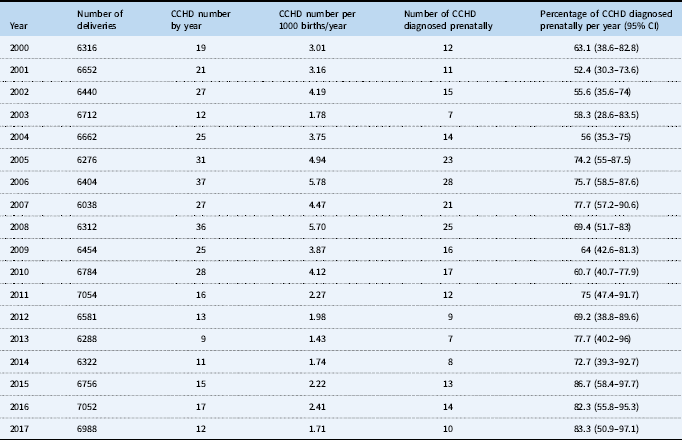
There were a total of 118,091 live births in our health system between January 2000 and December 2017, with an average of 6160 births per year. Among them, 399 patients had complex CHD with an incidence of 3.4 per 1000 live births. Of these, 381 neonates met the criteria and were included in the study. Table 1 shows the yearly data of livebirths and complex CHD. The mean age of the mothers of the cohort at delivery was 27.1±5.8 years. Of the 381 mothers, 42% were of Hispanic origin, 15% African-Americans, 13% Caucasians, and 30% were unclassified or other races. The mean gestational age at the time of the initial diagnosis of complex CHD in the group with prenatal detection was 27.4±3.8 weeks. Of the pregnancies 90% had been documented as having adequate prenatal care. Among the patients who had a prenatal diagnosis, 95% had documented adequate prenatal care, whereas this rate was 79% among those without a prenatal diagnosis of the CHD (p<0.0001). Among the entire study cohort, 65.3% were delivered by caesarean section. The rate of C-section was 68.3% among the prenatal diagnosis group versus 58.8% in the group without prenatal diagnosis (p⩾0.05). There were 90 pre-term births (<37 weeks) accounting for 24.1% of the complex CHD patients. The incidence of premature birth was 25.2% in the prenatal diagnosis group versus 21.8% in the group without prenatal diagnosis (p<0.48).
Percentage of complex CHD diagnosed prenatally.

CCHD=complex CHD
Prenatal diagnosis trends
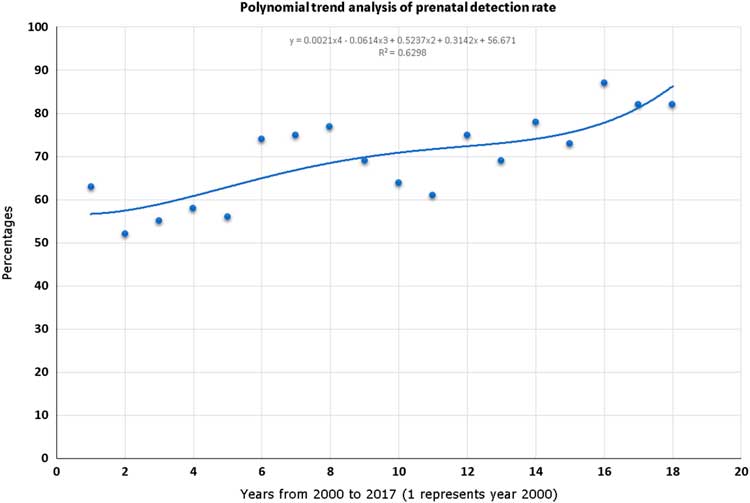
Prenatal diagnosis by fetal echocardiography was made in 262 (68.8%) of the 381 patients in the cohort. The diagnosis rate ranged from 52.4 to 83.3%. The frequency of diagnosis increased from 63.1% in the first year of the study, to 83.3% towards the end of the study. The yearly rates and trends are shown in Table 1 and Figure 1. The average diagnosis rate in the first 4 years of the study period was 59.5%, whereas it was 81.8% in the last 4 years (p=0.001). During the study period, the lowest diagnosis rate was seen in the year 2001 at 52.4% and the highest in 2017 at 83.3%.
Polynomial trend analysis of prenatal detection rate of complex CHD.

Indications for fetal echocardiography
Abnormal level 2 obstetric screening ultrasound was the most common indication for fetal echocardiogram in our study. It accounted for 211 (80.5%) of 262 patients with prenatal diagnosis. Maternal diabetes mellitus was the second most common indication (n=32, 12.2%). Other less common indications included prenatal diagnosis of aneuploidy (n=8, 3.1%), other major congenital anomalies (n=6, 2.3%), family history of CHD (n=3, 1.1%), and fetal arrhythmia (n=2, 0.7%)
Prenatal detection rates for various complex CHD
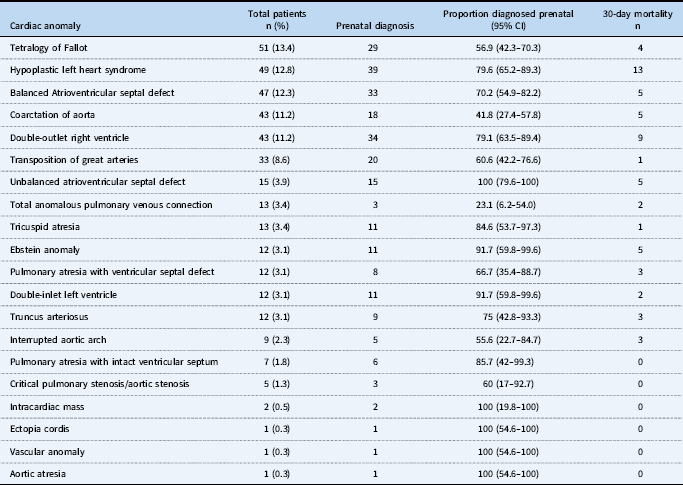
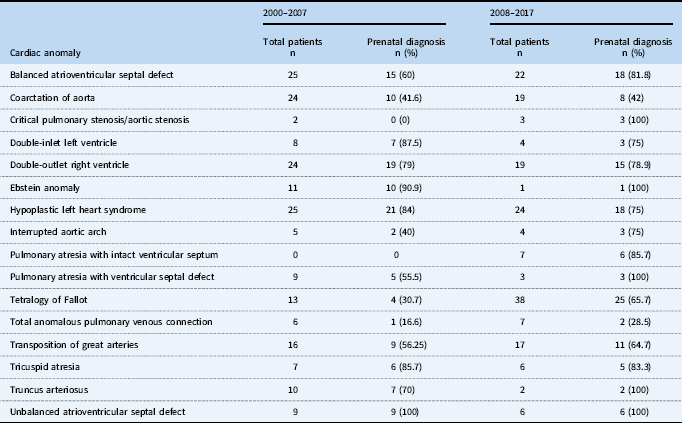
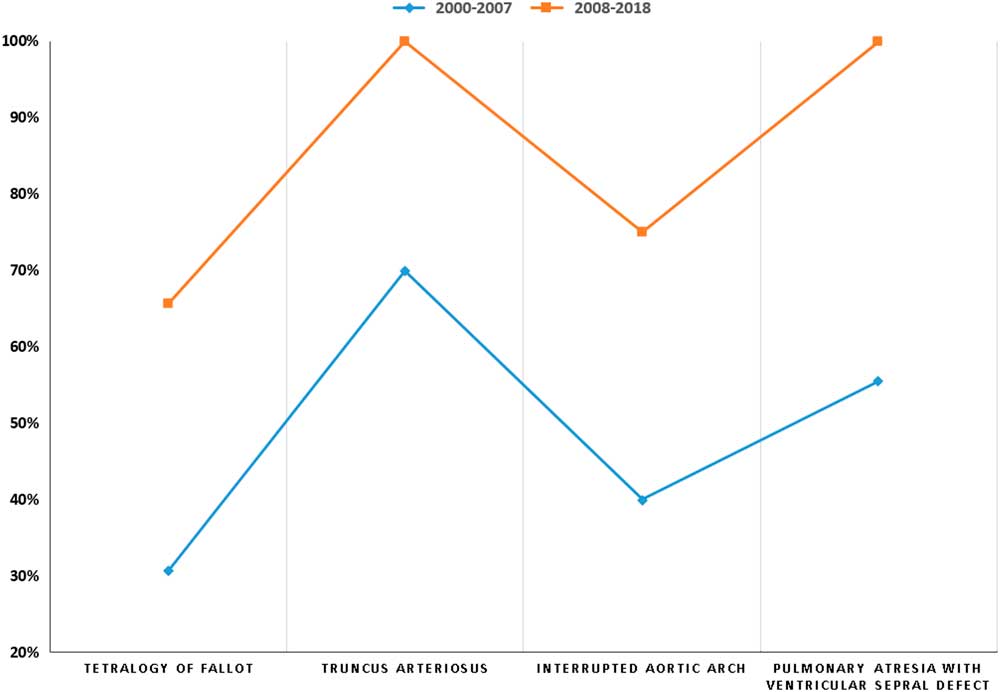
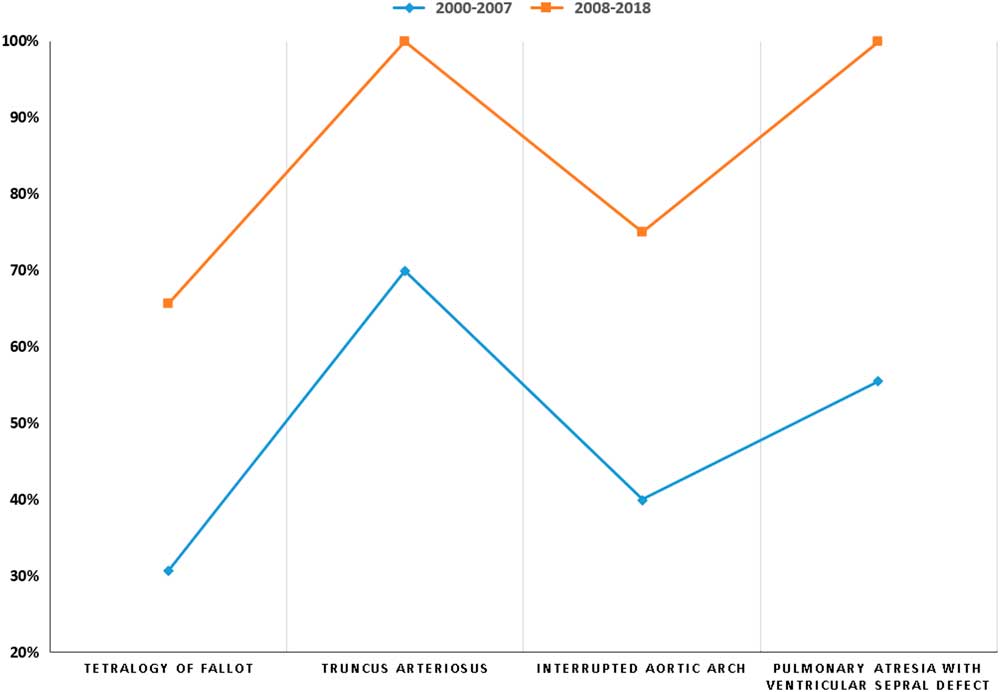
The various cardiac anomalies identified in this study along with their prenatal detection rates are shown in Table 2. The most common diagnosis in this study was tetralogy of Fallot (13.4%), followed by hypoplastic left heart syndrome (12.9%). The highest detection rate was noted for unbalanced atrioventricular septal defects (100%), followed by double-inlet left ventricle (91.7%) and Ebstein anomaly of the tricuspid valve (91.7%). Total anomalous pulmonary venous return had the lowest detection rate of 23.1%, followed by coarctation of aorta (41.8%) and interrupted arch (55.6%). Table 3 shows the comparative analysis of the data on prenatal diagnosis between first and second halves of the study period. As shown in Table 3 and Figure 2, there is a significant increase in the detection rate for cardiac anomalies which require evaluation of the ventricular outflow tracts in the level 2 second trimester ultrasound. These include CHD such as tetralogy of Fallot, truncus arteriosus, pulmonary atresia with ventricular septal defect, and aortic or pulmonary valve stenosis.
Prenatal detection rate for each of the complex CHD.

Comparison of prenatal detection rate for various CHDs between the first and second periods of the study.

Comparative rates of prenatal diagnosis for outflow tract anomalies in the first and second periods of the study.
Analysis of survival benefit with prenatal diagnosis
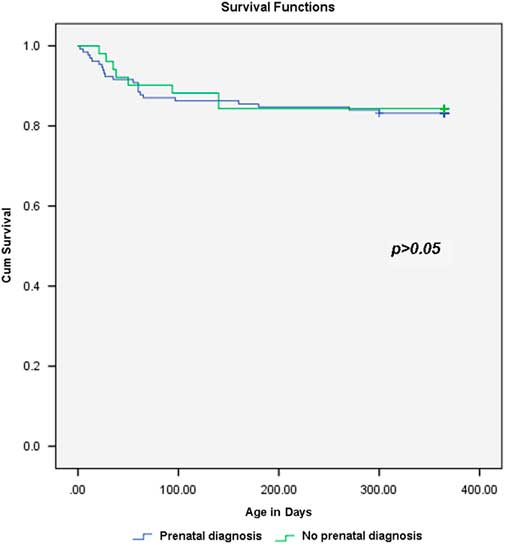
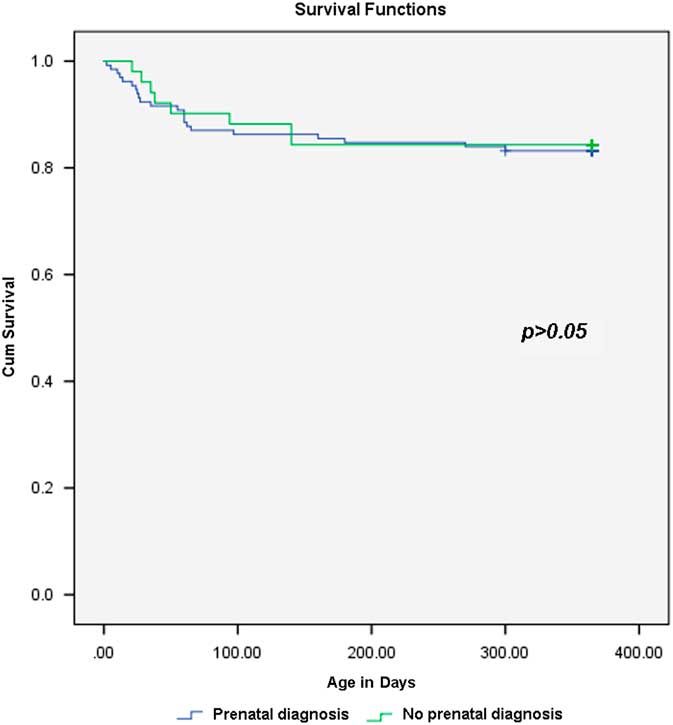
There were 61 deaths at 1 month of age in the study cohort, which amounts to 16% of the total patients. Among the 262 newborns who had a prenatal diagnosis, there were 47 deaths in the first month (17.9%). There were 14 deaths among 119 patients without a prenatal diagnosis (11.8%) (Table 4). This difference was not statistically significant (p=0.246). Moreover, 1-year follow-up data was available in 182 patients only (Table 4). Among these patients, 131 patients belonged to the prenatally diagnosed group. A total of 31 deaths were noted at 1-year follow-up, 22 (16.8%) in the prenatally diagnosed group, and nine (17.6%) in the group without prenatal diagnosis. There was no statistically significant difference in the 1-year mortality between the two groups (p=0.89). Kaplan–Meier analysis did not show any survival benefit with prenatal diagnosis, at 1 year of age (Fig 3). Table 2 demonstrates the 30-day mortality rates for the individual cardiac anomalies. Patients with Ebstein anomaly of the tricuspid valve had the highest 1-month mortality rate at 41.7% (n=5).
30-day and 1-year outcomes.

Kaplan–Meier survival curves for patients with and without prenatal diagnosis of complex CHD
Discussion
The overall rate of prenatal diagnosis of complex CHD at our institution over the entire study period was 68.8%. However, the detection rates progressively increased over the study period. The average prenatal detection rate over the last 4 years of our study was 81.8%, one of the highest reported so far. This improving trend is in conformation with other contemporary studies.Reference Liberman, Getz and Lin 17 , Reference Quartermain, Pasquali and Hill 18 Improvement in the prenatal detection rates of CHD over the past two decades is probably multifactorial. The advances in the imaging technology resulting in higher resolution images of the heart, coupled with experience and better skills of sonographers in imaging are the most important factors. Another contributing factor is the recent modifications in the level 2 screening obstetric ultrasound in order to include ventricular outflow tracts.Reference Carvalho 19 The inclusion of outflow tract views translates to enhanced detection of outflow tract abnormalities such as tetralogy of Fallot, as seen in our study. Recent studies have also demonstrated that by training the obstetric sonographers in obtaining ventricular outflow views leads to increased prenatal diagnosis of CHD.Reference Levy, Pretorius and Rothman 20 , Reference Carvalho, Mavrides, Shinebourne, Campbell and Thilaganathan 21 Increase in the indications for the performance of fetal echocardiogram over time in combination with improved prenatal care might also play a significant role in this positive trend. The positive impact of adequate prenatal care on the detection rates for CHD was also noted in our study.
Our study showed a very high prenatal detection rate for complex CHD, when compared to recent studies in the literature.Reference Chu, Yan, Ren, Li and Gui 22 , Reference Sekar, Heydarian, Cnota, Hornberger and Michelfelder 23 In a recent large multi-centre study involving 31,000 patients with CHD across 47 states in the United States, the average prenatal detection rate was reported to be 43%.Reference Quartermain, Pasquali and Hill 18 However, the detection rates varied by region. In that study, the overall detection rate in Florida, the same state where the current study was performed, was reported at 39%, lower than the national average. This higher rate of detection at our centre could be due to the factors such as ours being a big tertiary care teaching institution with vast experience in diagnosis and management of patients with complex CHD; many of the obstetric sonographers being trained in performing cardiac imaging by experienced fetal cardiologists with continued feedback on the imaging; regular attendance of obstetric sonographers at the weekly cardiovascular case management conferences and maternal fetal medicine meetings; quality improvement initiatives in our department comparing the prenatal and post-natal diagnoses to enhance our skills as a team; ease of scheduling fetal echocardiogram, among others.
As reported by others, we also found a considerable variability in the prenatal detection rate among various types of CHD. The detection rates of the various cardiac anomalies in our study are comparable to other studies in the literature.Reference Friedberg, Silverman and Moon-Grady 13 , Reference Pinto, Keenan, Minich, Puchalski, Heywood and Botto 14 , Reference Quartermain, Pasquali and Hill 18 , Reference Sklansky, Berman, Pruetz and Chang 24 , Reference Acherman, Evans and Luna 25 In our study, the detection rates varied from a low of 23% for total anomalous pulmonary venous connection to a high of 100% for unbalanced atrioventricular septal defects. It is evident from this and previous studies that cardiac lesions which can be identified from four-chamber views of the heart have a considerably higher detection rate than those which also require outflow tract views. Therefore, changes were made in the recommendations for level 2 screening second trimester ultrasound, by groups such as American Institute of Ultrasound in Medicine and International Society of Ultrasound in Obstetrics and Gynaecology. These changes have definitely contributed to the increase in detection rates. Supporting this viewpoint, we found an increase in the rate of prenatal detection of outflow tract or conotruncal anomalies such as tetralogy of Fallot and pulmonary atresia in the second periods of our study.
The data on the benefit of prenatal diagnosis of complex CHD on early and late mortality are conflicting. Some of the studies among patients with specific complex CHD requiring surgical repair soon after birth showed survival benefits with prenatal diagnosis.Reference Sivarajan, Penny, Filan, Brizard and Shekerdemian 9 , Reference Bonnet, Coltri and Butera 10 However, other studies did not find such a survival benefit.Reference Landis, Levey and Levasseur 7 , Reference Brown, Ridout, Hoskote, Verhulst, Ricci and Bull 8 , Reference Khoshnood, Lelong and Houyel 12 , Reference Swanson, Selamet Tierney, Tworetzky, Pigula and McElhinney 26 , Reference Levey, Glickstein and Kleinman 27 In fact, some studies have demonstrated a worse outcome in patients diagnosed prenatally.Reference Mazwi, Brown and Marshall 28 , Reference Wright, Ehrlich, Stauffer, Samai, Kogon and Oster 29 The authors attributed this perplexing finding to the fact that more critical varieties of heart defects were more easily diagnosed during prenatal period. In our study, we did not find a statistically significant benefit on early and late infant mortality with prenatal diagnosis. No survival benefit was noted with prenatal diagnosis, even among the patients with the same cardiac anomaly. This may be because this study was conducted in a tertiary care centre equipped with 24-hour paediatric cardiology and cardiothoracic surgical services. There might be survival benefits if the data are from a community hospital not equipped with the above-mentioned round-the-clock services.
Limitations of the study
There were several limitations to our study. This was a retrospective study with data from a single institution. In addition, 1-year outcomes were not available for several patients who were not followed subsequently at our institution. Larger regional and population-based studies are needed to further assess the benefits of prenatal diagnosis of complex CHD on morbidity and mortality in this population.
Acknowledgements
The authors thank the fetal sonographers who performed the fetal echocardiograms in this study.
Financial Support
This research received no specific grant from any funding agency, or from commercial or not-for-profit sectors.
Conflicts of Interest
The authors declare no conflict of interest.