Introduction
Contentious narratives around land can shape the dynamics of political violence, both in how elites organize violence and why ordinary people participate. Footnote 1 These narratives played an important role in the electoral violence of the 1990s and the 2007–2008 postelection violence in Kenya. Footnote 2 Political elites have used land narratives to convince supporters that their access and rights to land hinged on electoral outcomes. In such scenarios, civilians may have a motive to engage in violence, either to preempt their eviction by rivals or to ensure the victory of a leader who will protect their land security. Contentious land narratives develop from group members’ fears of losing land, desires to strengthen land rights, and beliefs about the legitimacy of the land distribution process. Footnote 3
While the salience of contentious land narratives between groups can help explain the escalation of electoral violence, there are also contexts in which strong contentious land narratives between groups do not map onto the sites of electoral violence. This article asks why land narratives foment violent escalation in one region of a country but not another. I focus my analysis on two counties in Kenya’s Coast region where contentious land narratives between “insiders” and “outsiders” are a feature of political life yet electoral violence is rare. I contrast these cases with counties in the Rift Valley region, where seemingly similar land narratives provide a mechanism for organizing violence.
Many recent studies of electoral violence ask why elites have the incentive or capacity to incorporate violence into their political strategy (Hafner-Burton et al. Reference Hafner-Burton, Hyde and Jablonski2013; Wilkinson Reference Wilkinson2004; Collier & Vicente Reference Collier and Vicente2012). While studies of elite logics are central to advancing understandings of political violence, I shift the analysis in two ways. First, I suggest that electoral violence is not only a function of elite calculations, but also emerges from the interaction of elite incentives and the interests of ordinary citizens. Second, while most studies focus on the causes of violence, I focus on the factors that restrain or moderate the escalation of violence (Straus Reference Straus2012).
Broadly, I argue that land narratives in the Coast region do not create the same motives for violence that I observe in the Rift Valley. This is partly because many citizens along the coast do not view elections as an imminent threat to their land security or an opportunity to expand rights. As a result, land narratives are less effective in organizing violence. I analyze two factors that can help explain regional variation in the role of land narratives: (1) the capacity of political leaders to act as effective land patrons, and (2) the proportion of “outsiders” to “insiders.”
I draw on two main sources of data. The first is in-depth interviews and focus groups based on paired case studies that I conducted in the Rift Valley and Coast regions in 2012. In this article I draw primarily on interviews and focus groups from Kwale and Kilifi counties. Footnote 4 The second data source is a household-level survey that I administered to 750 Kenyans in the Rift Valley (Uasin Gishu and Nakuru) and the Coast (Kwale and Kilifi) in February 2013. The map in figure 1 highlights each of these counties.
The Boundaries of Kenya’s Forty-Seven Counties
Note: The counties highlighted in dark gray—Uasin Gishu, Nakuru, Kilifi, and Kwale—indicate the four counties where the author conducted research.

Setting the Stage: Comparing the Coast with the Rift Valley Region
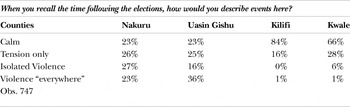
Kenya’s 2007–2008 postelection violence left approximately fifteen hundred people dead and six hundred thousand people displaced (Mwiandi Reference Mwiandi2008). The majority of these deaths occurred in only seven of the country’s forty-seven counties, with the highest incidence of violence occurring in Nakuru and Uasin Gishu counties. Footnote 5 By contrast, in the Coastal counties of Kwale and Kilifi there was tension, isolated cases of looting, and destruction of property, but violence never escalated. Footnote 6 Table 1 shows results from a survey question in which respondents described the level of violence they experienced during the postelection period. The differences between the two regions are stark. In Nakuru and Uasin Gishu, 51 percent of respondents recall violence. In Kwale and Kilifi, less than 1 percent of respondents experienced violence of any kind. Footnote 7
Cross-County Variation in the Level of Postelection Violence

These results contrast with the common generalization that the Coast is a region “engulfed by violence” or prone to violence due to landlessness (Human Rights Watch 2002). Overall, the Coast region has been relatively stable over each electoral period since the reintroduction of multiparty elections in 1992. The notable exceptions of electoral violence have occurred in certain neighborhoods of Mombasa District, where both population density and ethnic composition alter the incentives of leaders and followers to use violence. Footnote 8
While violence has escalated in other areas of the Coast during non-electoral periods, I limit the scope of my analysis to election-related violence in the primarily rural and suburban zones of the Rift Valley and the Coast region. I define electoral violence as a form of political violence in which the dynamics of electoral competition shape the motives of perpetrators (Staniland Reference Staniland2014), the identification of targets, and the forms and timing of physical violence. Footnote 9
The Puzzle: Land Inequality, Land Narratives, and Mobilization
Why should we expect violence to escalate during electoral periods along the coast? I suggest that the agrarian zones of Kwale and Kilifi counties are possible sites for violence because they share important characteristics with the Rift Valley, where incidents of electoral violence have been far greater in frequency and broader in scope and intensity than much of the Coast region. These parallels include a high degree of inequality in land tenure security between “insiders” and “outsiders,” salient contentious land narratives along this cleavage, and the use of insider–outsider land narratives as campaign appeals. Importantly, the Coast and Rift Valley are also different along a number of important dimensions. Footnote 10 I highlight the relevant similarities, however, to demonstrate that while the Coast region has not experienced significant electoral violence, is it nonetheless a setting in which violence could be reasonably expected to occur because it shares important features with the Rift Valley (Mahoney & Goertz Reference Mahoney and Goertz2004; Straus Reference Straus2012). I explain each of these points briefly.
First, the Coast region is characterized by high rates of land tenure insecurity and significant inequality in land ownership. The majority of Coastal residents, most of whom identify as Mijikenda, have no formal land tenure rights. Instead, they reside as “squatters” or de facto tenants on the land of absentee landlords. Title deeds for the region’s prime agricultural and commercial land belong to the region’s elite: prominent Arab families, Indians, Swahili, and residents from “upcountry” Kenya. Land insecurity along the coast is more profound than in the Rift Valley and emerges from a unique regional history. Among survey respondents from the Coast region, only 34 percent hold a title deed to their land, compared to 56 percent of sampled respondents from the Rift Valley. Yet in both regions many residents believe that migrants have gained stronger land rights than the regions’ natives.
The absence of violent mobilization in the Coast contradicts expectations of early grievance theories (Gurr Reference Gurr1970). Huntington sums up these arguments (1968:375): “No group is more conservative than a landowning peasantry and none is more revolutionary than a peasantry that owns too little land or pays too high a rental.” Yet the deeper land insecurity experienced by many Coast residents compared to Rift Valley residents suggests that relative land deprivation—or grievances over rights and access to land—has not provided a sufficient factor to provoke violent collective action.
A second parallel between the two regions is the salience of contentious land narratives between “insiders” and “outsiders.” Along the coast, the struggle for Mijikenda residents to acquire secure land-tenure rights has generated strong anti-outsider land narratives. These narratives, while in some ways unique to the Coast, echo the nativist claims of Kalenjin farmers in the Rift Valley. A common theme of these narratives describes a process in which outsiders—Arabs, Europeans, and Kenyans from upcountry—have “grabbed” or stolen ancestral land. A second theme emphasizes extreme land insecurity. Yet in contrast to many Rift Valley residents, Mijikenda residents fear their imminent eviction by a powerful individual, corporate entity, or the State rather than a particular ethnic community.
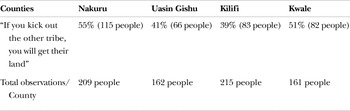
In addition to the presence of salient contentious land narratives, politicians from both the Rift Valley and Coast regions incorporate divisive land appeals as part of their campaign strategy. Table 2 shows results from a survey that I conducted in the lead-up to the March 2013 general elections. The results suggest that candidates in both regions rely on polarizing land appeals that signal opportunities for followers to strengthen land rights or make implicit and explicit appeals that encourage the use of violence against rivals.
Frequency of Land-Related Political Appeals Across Counties

In sum, both regions suffer from high rates of land insecurity and inequality, though these rates are more profound along the coast. Contentious narratives have formed along lines of land inequality and between “natives” and “migrants.” Further, as I show in table 2, politicians in both regions rely on these divisive land appeals at similar rates. I aim to explain why similar patterns in land inequality, contentious narratives, and political appeals around land have shaped electoral violence in the Rift Valley, yet have not in the Coast. Further, I aim to gain analytic leverage over the concept of land narratives by analyzing two contexts where the dynamics around land are similar, yet the use or escalation of violence is distinct. This enables me to theorize other factors that may help explain the regional variation linking land with the onset of electoral violence.
Argument: Land Narratives and Violence
Leaders can exploit existing land narratives to mobilize electoral violence by convincing supporters that their land rights hinge on electoral outcomes. The land narrative can establishe two broad logics of violence. The first is based on the logic of preemption and defense—“evict them before they can evict us”—and emphasizes threat to land from political or ethnic rivals. This threat gains credibility when it is based on memories of past evictions and rumors that circulate during elections. The second is based on the logic of opportunity: the belief that elections present a narrow window to strengthen the land rights of group members. Violence becomes a strategy for physically seizing land during the electoral process or ensuring the victory of one’s leader at all costs (Höglund Reference Höglund2009). In each scenario, land narratives provide a way of coordinating followers’ beliefs about how electoral outcomes will alter land rights.
Yet even when land narratives are salient and divisive, they do not always provide the sufficient conditions for electoral violence. While land narratives in Kwale and Kilifi are often contentious, most politicians have not effectively used these narratives to signal the risks or opportunities linked to electoral outcomes. Two factors help explain the weaker link between land and elections along the coast. The first is the strength of the local political patron (e.g., the Member of Parliament). Elections are more likely to present opportunities to strengthen land rights when political patrons have the capacity to allocate land or protect the land security of supporters. The second factor is the political influence of “outsiders” relative to the “host” community. While this delineation is rarely drawn in such stark terms, elections are more likely to signal threat to the land security of both groups when outsiders can compete politically with insiders.
Figure 2 illustrates how the interaction between threat and perception of opportunity shapes the possibilities for violent collective action. Ordinary actors have a motive for violence when they believe that elections present a threat to their land security and an opportunity to secure land.
Perceptions of Threat and Opportunity and the Possibilities for Violent Collective Action.

This scenario captures much of the Rift Valley in 2007. Footnote 11 By contrast, the lower right quadrant captures the dynamics of the Coast region in 2007: citizens do not associate elections with threats to their land or with opportunities to expand rights. Hence there are few motives for participating in violence and leaders face high barriers in mobilizing violence. Yet when citizens view elections as opportunities to gain rather than moments of threat, the motivation to engage in violence is weak (lower left). The opportunity to gain, absent any perception of threat, is rarely a strong enough incentive for individuals to run the high risk of participating in violence. Violence is possible, but the barriers to collective action are much higher.
Strength of the Political Patron
A growing literature examines the way that patronage politics shapes the possibilities for electoral violence, particularly in countries with majoritarian electoral institutions (Fjelde & Höglund Reference Fjelde and Höglund2016). One argument is that in contexts of competitive elections where patronage politics is more entrenched, the likelihood of electoral violence is greater (Staniland Reference Staniland2014). Patronage politics refers to relationships of exchange where the patron is able to use state or private resources to provide protection, services, jobs, or other goods to reward political clients (Van de Walle Reference Van de Walle, Kitchelt and Wilkinson2007). These “clientelistic networks” allow patrons to build a network of loyal political followers. Patronage politics can become a powerful and disruptive form of politics because patron–client linkages rely on “complex webs of exchange, obligation, and reciprocity . . . sustained over a long period of time” (Kitschelt & Wilkinson Reference Kitschelt and Wilkinson2007:19).
In countries such as Kenya, where the state controls the allocation of land, the distribution of land rights has provided a key source of patronage, particularly in the face of declining state revenues (Boone Reference Boone2014; Klopp Reference Klopp2002; Kanyinga Reference Kanyinga2000). Leaders reward loyal followers with land, and revoke and reallocate land rights to coerce or punish political opponents (Boone Reference Boone2011). When patronage politics is the defining feature of distributive politics, each side has a much greater incentive to win because group members perceive the stakes of an electoral loss to be more costly. Political clients believe that they are far more likely to gain access to land rights, jobs, security, or services if their ethnic or political patron is in power. One implication is that electoral violence is more likely where political patrons are strong because followers believe that their candidate has the capacity to protect or alter the status quo in their favor.
Patronage provides a mechanism of authority and control. Hence, where patronage networks are strong, leaders are better able to organize and recruit potential fighters. The ability to control clients can work through expectations of trust and reciprocity (Kitschelt & Wilkinson Reference Kitschelt and Wilkinson2007) or through coercion and punishment (Reno 2007). The capacity for political leaders to mobilize followers during elections lies in their ability to leverage patronage networks. The more resources at their disposal—and the more entrenched these networks—the more power leaders have to organize followers.
Citizens are more likely to participate in violence when they believe that the victory of their candidate will strengthen their land security or land holdings. Yet for individuals to risk the high costs of participation, they must also believe that their leader has the capacity and political will to follow through on land-related promises.
Leaders can signal their commitment to implement land promises through tradition and precedent. In the Rift Valley the political patron is well institutionalized: a figure who has the political and financial power to “feed” and protect his community. This leadership image perpetuates the expectation that incoming politicians will continue to fulfill patron–client obligations. While leaders may fall short of their promises, the tradition of patronage bolsters the credibility of campaign appeals. Patronage in this sense is not about votes in exchange for money or gifts. Instead, a strong patron projects the ability to distribute land rights to loyal followers and protect her community from threats such as eviction and attacks on land or livestock (see Boone Reference Boone2011).
Majimbo rallies in the 1990s provide one example of the way that Rift Valley patrons used land to encourage violence. Majimboism, or ethnic federalism, was a political movement born at independence that reemerged in 1991. Politicians used it to call for the expulsion of “non-natives” from the Rift Valley while promising the return of ancestral land to “rightful owners.” This discourse invoked beliefs about indigenous rights to land and specified expulsion as the method of violence while offering incentives for supporters to participate.
Yet across much of the Coast, patron–client relationships are very weak. Coast leaders do not have the same power to use land as a source of political patronage because they lack the personal land wealth of many Rift Valley politicians. Equally, they tend to lack the political party connections that facilitate land accumulation. Without political status or wealth in land, Coastal politicians have become brokers to national politicians from upcountry and regional business elites. Local residents have come to view their leaders as brokers to “outsiders” rather than their own patrons. A resident of Kilifi provided an example of how this broker-style leadership limits possibilities for reform:
When we elect our leaders, rich people target them. They don’t want leaders who represent the issues of the common man. If a politician or MP is deemed to do so, then the rich people call him and tell him to stop discussing the issues of the poor because the poor will realize they are being denied their rights and start asking questions. They bribe these politicians too. (Interview, Kilifi 1 [Kijipwa], Nov. 20, 2014)
One implication is that residents do not trust that their leaders have the capacity or autonomy to follow through on their campaign commitments to protect their land rights.
Several factors explain these weak patron–client ties. First, while Mijikenda comprise the majority in the Coast region, they constitute only 5 percent of the national population (2009 Kenya Census). Footnote 12 Hence, Mijikenda have not played a strategic or consistent role in any national-level party alliances. National politicians have therefore had few incentives to empower Mijikenda politicians. Specifically, they have had few incentives to distribute state or privately owned lands located in the Coast region to develop a grassroots patronage base. Instead, these politicians have used Coastal lands to enrich themselves and to reward close allies without building the political coalitions that they have developed in more politically strategic regions including Rift Valley and Central (Kanyinga Reference Kanyinga2000). Further, many Mijikenda leaders do not own Coastal land on the same scale as elites from upcountry, Europeans, or wealthy Arab families. They thus lack the power to act as land patrons who can protect, allocate, and remove land rights. Coast politicians must play by a set of rules that facilitate the acquisition of private property for the wealthy while protecting the land and capital investments from the demands of the landless majority. In sum, Coastal politicians have become brokers to a small and powerful class of business elites and upcountry politicians, diminishing their capacity to act as reliable patrons to their land-poor electorate.
Coast residents, meanwhile, have few expectations that their leaders have the will or power to use land as a patronage good. A member of a youth focus group in Kwale remarked, “The government has always marginalized the Coast people. What the government does upcountry is not what it does here. Our counterparts living upcountry all have title deeds, even the poorest” (Focus Group, Youth-Kwale [Msambweni], Nov. 18, 2012). The comment captures the belief that Rift Valley politicians provide land rights while Coastal leaders have failed to protect their constituents.
I highlight several features of this broker-style leadership in the Coast region and their implications for political mobilization. First, there is a widely shared belief among Coastal residents that their MPs are constrained and hence lack the power to follow through on pledges to strengthen land rights. One respondent stated, “MPs have no power to solve this [land] issue, otherwise they would have done so” (Interview, Kilifi 6 [Kijipwa], Nov. 21, 2012). An elder resident of Kilifi remarked, “Even if I elect a good MP they will be influenced at the highest level with money, so they won’t take care of my interests” (Focus Group, Elders-Kilifi [Kijipwa], Nov. 28, 2012). Citizens emphasize that their leaders have far less autonomy or power than their upcountry counterparts. Politicians prove unable or unwilling to alter the status quo distribution of land rights. In an interview with a farmer in Kilifi, he explained why Coastal leaders, much like the people, find themselves marginalized in national-level politics:
If we look at these people who have been grabbing this land, they don’t come from the Coast. . . . Even our people down here, the Giriama, have no say. Once they leave they go to the Government. They have got no say! They can do nothing. The party leaders are all from that place [upcountry Kenya]. So they [Coast MPs] just sneak into these parties. So if you just sneak in, or they let you in, you have no say. You can’t do anything. (Interview, Kilifi 5 [Kijipwa], Nov. 21, 2012)
The respondents’ comments illustrate the belief that local politicians lack the power to protect or strengthen the rights of local people because they have no real power themselves. Participants in a youth focus group framed the constraints on their leaders in even starker terms: “As per history, all the good leaders who fought for the local people have been killed. If you don’t toe to the status quo, they kill you. So some of these leaders don’t act on some issues because they are scared” (Focus Group, Youth-Kilifi [Kijipwa], Nov. 23, 2012). Footnote 13
In many interviews, respondents described their leaders as easily co-opted by higher-ranking politicians. While local MPs may lack the political power to advocate on behalf of locals, most believe that these same politicians knowingly and willingly cooperate with higher-ranking politicians or investors to undermine the land rights of Coastal residents. The particular accusation is that MPs and local councillors become complicit or active players in land grabs that have denied Mijikenda their ancestral land. A resident in Kwale described the complicity of local politicians:
The politicians are the corrupt ones. They sold the land off. For example, the Chale Islands were sold off to foreigners and the locals were not given anything. People like Mwamzandi, Boy Juma Boy, and Shariff Nassir helped people grab our land. (Interview, Kwale [Kinondo-A-3], Nov. 14, 2012) Footnote 14
A youth group member from Kwale provided a similar view of their MPs:
The fat cats have the financial muscle to do anything. If it’s title deeds, they have the money to fly to Nairobi and back so that their titles are processed faster. A good example is our own MP who helped rich people acquire our Chale Forest and built a five star resort without the knowledge of the community. So for whom are these political leaders fighting? (Focus Group, Youth-Kwale [Msambweni], Nov. 18, 2012)
Community elders in Kwale claim that political leaders “have failed us” because they “have forced these foreigners on us. The Kikuyu and Kamba own the biggest land around here” (Focus Group, Elders-Kwale [Msambweni], Nov. 18, 2012). A fisherman in Chale (Kwale) claimed, “Political leaders don’t help at all. They even bring people from upcountry to buy land at horrible prices” (interview, Kwale [Chale-2 Part 2], Nov. 17, 2012). From this perspective, politicians are mere brokers or middlemen who cater to Nairobi’s elite and facilitate the gains of “outsiders.”
The inability or unwillingness of Coastal leaders to advocate for followers has affirmed the view among many local residents that electoral outcomes have little bearing on their land security or everyday livelihood. The electoral process has become a mechanism for aspirants to attain political office. And in Kwale and Kilifi, where the voter base is relatively homogeneous and where party leadership changes frequently, the stakes of each election are low. In sum, despite being able to elect co-ethnic representatives, citizens feel insulated from any changes that elections might otherwise bring. Mijikenda politicians are largely constrained actors who act as brokers to national elites and the business class, and are not strong patrons who can distribute or protect the land of supporters. The result is that most politicians do not have the political legitimacy or authority to organize violence.
Weak political patrons also affect the power and viability of group land claims. The power of the land claim is twofold: residents must believe that they have the moral or legitimate right to occupy or reclaim a piece of land or territory from competing claimants. But they must also believe that they have the resources and power to defeat competing claimants through legal, political, or violent means. Yet many citizens along the coast doubt the willingness or capacity of their leaders to advocate for their claims.
As one way of observing the effects of patronage strength, I looked at how residents in each region make claims to land. The theory here is that where political patrons are stronger and better connected to the central state apparatus, citizens are more likely to rely on formal land claims. Yet where leaders are weak, citizens will rely on ancestral claims. A survey question asked respondents to imagine a situation where two groups argue over the same piece of land. The first group claims that they are the true owners because they have the ancestral rights to the land. The second claims they are the legitimate owners because they have purchased the land and hold a title deed. Respondents were asked to select the stronger claim. As table 3 indicates, 87 percent of residents from the Rift Valley believe that having a title deed is the strongest method of claim making, in contrast to 29 percent of respondents from the Coast.
Preferences in Claim-Making Across Counties

What accounts for this difference? In the absence of strong leaders to formulate a coherent Mijikenda land claim, civilians have relied on the ancestral land claim as a mode of protesting the power of the title-based land claim. Many Kwale and Kilifi residents view the title deed as a tool used by outsiders or the government to evict them. Despite the power of a title deed to secure land rights, the process of acquiring a title feels beyond the reach of many people. This feeling is largely a function of the ambiguity and dysfunction of formal land institutions that favor wealthy and well-connected individuals who can navigate the complex bureaucracy or have the power to subvert the formal process. A resident of Kilifi remarked, “Our community does not really care about the title deed. They fear the process, the time, and the finances involved. . . . We know the importance of the title but it’s complicated to follow it up” (interview, Kilifi 7 [Kijipwa], Nov. 21, 2012).
Ancestral land claims are compelling because they have greater legitimacy and moral resonance among group members. One interviewee explained, “selling land is like selling your own mother” (interview, Kwale [Makongeni 2 & 3], Nov. 13, 2012). Another respondent provided a similar view: “The title deed in the African context is not valid. We used to plant trees to mark which land belongs to us. These title deeds were brought in to take away land from the local people” (interview, Kilifi 8 [Kijipwa], Nov. 22, 2012). These comments imply that formal land sales fall beyond the established norms of Mijikenda culture. The tension between title and ancestral-based claim-making has weakened an effective narrative for asserting Mijikenda rights to land. Residents understand the pragmatic potential of the title deed but they articulate ancestral claims as a way of protesting the power of title-based claims. Knowing the power of title deeds, yet viewing them as illegitimate or inaccessible, has created what Sharon Hutchinson describes as a “simultaneous dependence on and estrangement from the powers of the government” (quoted in Willis & Gona Reference Willis and Gona2012:51). The comments of one interviewee hint at this dilemma, whereby local residents understand the power of the titleholder, “according to the law”:
We cannot confirm who has the right, the locals or people from upcountry. A title deed confirms you as the real owner by law. That’s the most important. The people who have the right to ownership are the titleholders, according to the law. Yet the local people who have stayed here for a long time deserve land too. (Interview, Kilifi 6 [Kijipwa], Nov. 21, 2012)
In this context, residents have struggled to develop a single and coherent discourse for asserting rights to land. On the one hand, residents assert their rights through a language of ancestral belonging and a rejection of land commodification. At the same time, they seek the private benefits and security of participating in the formal land economy by acquiring an individual title deed. An interviewee from Kilifi reflected on the challenges of adjudicating between competing claims: “A title deed is very important because when these rich people come asking for title deeds [we don’t have one]. Therefore it means the title deed shows that you are the true owner of this land. The people who have stayed there for the longest need to be allocated land first, forget about those people who come with title deeds” (interview, Kilifi 16 [Kijipwa], Nov. 23, 2012). As these comments suggest, ancestral claim making is not only a form of protest, but also a livelihood strategy that endures from a longer tradition of demarcating and asserting a household’s plot and acknowledging the lineage rights of the family.
Yet in the Rift Valley, ancestral claim-making has become a political rather than livelihood tool. A Kalenjin youth in Nakuru explained, “If you advocate for your ancestral land claims by saying that the land belonged to your forefathers, nothing will happen. You will be ignored. It’s not as strong as having a title deed” (Focus Group, Youth-Njoro-Nakuru County, [Mauche], July 5, 2012). The ancestral claim is instead a political strategy and mobilization tool that declares the right of one group to reclaim land from another, “invading” group. This narrative acquires political power because it is linked to a group’s belief in its right to occupy or reclaim territorial space from another.
In sum, Mijikenda claimants doubt the capacity of their leaders to advocate on their behalf. Yet in counties of the Rift Valley, residents are more likely to make title-based claims because they expect their political patron to distribute or protect existing titles. Along the coast, however, there are few examples of leaders who distribute land to the landless majority. Hence, most Mijikenda do not see elections as viable moments of opportunity to reclaim or improve individual or group-level land rights.
Group Size
Several scholars suggest that electoral violence is more likely when the anticipated margin of victory between leading candidates is narrow (Wilkinson Reference Wilkinson2004) and when voting occurs primarily along ethnic lines (Collier & Vicente Reference Collier and Vicente2012). These arguments are based on the assumption that social identity provides a mechanism of electoral mobilization and shapes voters’ expectations of resource allocation, thereby strengthening the salience of identity-based cleavages during elections (Eifert et al. Reference Eifert, Miguel and Posner2010). Building on these observations, I suggest that when outsiders and insiders have approximately equal numbers at the subnational level (i.e., constituency or region) they serve as viable bases for political mobilization and competition (Posner Reference Posner2005). Yet when either the migrant or host group comprises a very small proportion of the population within the subnational arena of electoral competition, the insider–outsider cleavage will not provide a viable basis to mobilize support (Klaus & Mitchell Reference Klaus and Mitchell2015). This means that where political competition closely aligns with a salient insider–outsider cleavage, elections become a zero-sum game where outsiders compete with insiders over political office and resources. In this scenario, each side has the incentive and power to use coercive strategies (e.g., forced evictions) to alter electoral outcomes in the pre- and postelectoral periods. Civilians on each side are thus likely to associate threat of eviction or attack with the election period. Footnote 15
This dynamic has played out in some constituencies of the Rift Valley where “natives” are a smaller but still competitive minority group relative to “migrants.” Rift Valley natives have used violence to “remove” outsiders as a way to alter the balance of political power while seeking opportunities to acquire the land of those killed or displaced. The driving logic behind pre-poll violence, particularly in the 1990s, was for the incumbent regime to ensure that the opposition parties would not defeat KANU candidates. Footnote 16 The ethnically competitive nature of elections in the Rift since 1992 has shaped a narrative among residents that elections are opportunities to acquire land and power and, equally, to disrupt the status quo distribution of land and power.
In Kwale and Kilifi, two factors have constrained this logic of election-time violence. First, Mijikenda constitute the large majority across most constituencies in Kwale and Kilifi and hence the ethnic balance of power favors Mijikenda locally. Footnote 17 While non-Mijikenda aspirants are on the ballot, electoral competition is not ethnically competitive; they are not races where party affiliation divides the population ethnically. This is not to say that candidates have not used ethnic identity to build political support. In the 1990s, KANU politicians used outsiders as a scapegoat for rising landlessness and insecurity (and continue to do so). The majority of Mijikenda supported KANU candidates because—among other reasons—these candidates presented themselves as “anti-outsiders” who could defend locals from the land acquisitions of Kikuyus and other groups from “upcountry” (Kanyinga Reference Kanyinga2000). While local politicians have exploited Mijikenda anxieties around the in-migration of Kikuyus, this has primarily been a tool of co-ethnic outbidding. Mijikenda politicians use the issue to outbid one another to prove who has the political muscle to defend locals from outsiders. In most cases, however, rival candidates are Mijikenda or Swahili. Candidates gravitate toward parties based on calculations about the resources that would be made available through party networks and the possibilities for political and social advancement, regardless of the electoral outcome.
With the exception of a few urban constituencies or those dominated by upcountry settlers, Mijikenda residents are able to elect their co-ethnics into office. Many Mijikenda are thus confident that they have the demographic advantage to keep outsiders from gaining local political power. As a result, residents have few incentives to use violence a way of chasing away or removing outsiders as a method of ensuring political power.
It is important to note, however, that many local residents of the Coast are preoccupied by fears of their eviction. Yet unlike residents from the Rift Valley, they do not believe that this threat is heightened more in election periods than in non-election periods. Land insecurity and the risk of eviction are facts of daily life rather than unique features of the campaign period. A respondent in Kilifi emphasized this sense of daily land insecurity: “I have never been allocated land and I don’t know if I will ever get land. I don’t have any paperwork to show that I own this land. I know I can be evicted any time” (interview, Kilifi [Kijipwa], Nov. 22, 2012). These comments illustrate how many Coast residents understand the source of threat: not as a neighboring ethnic community or a rival political party that might evict residents during elections. Instead, residents fear the eviction orders sent from companies and powerful individuals who seek to clear the land for private or commercial purposes. Footnote 18 Another Kilifi respondent explained, “I cannot say that the land issue is caused by a particular tribe. It is the rich people who are taking advantage of us. The government was involved in my eviction” (interview, Kilifi 2 [Kijipwa], Nov. 20, 2012).
Beyond Ethnic Demography: Ambiguous Constructions of Rivalry and Threat
As interview excerpts from Coast residents suggest, ethnic demography only partially explains how and why contentious land narratives vary so markedly in their power to mobilize violence. Many ethnic theories of conflict tend to overlook how the boundaries, meanings, and political salience of group identity change over time (e.g., Horowitz Reference Horowitz1985; Cederman et al. Reference Cederman, Gleditsch and Hug2013). In much of the Rift Valley, land narratives have worked to sustain and deepen the meanings and salience attached to certain ethnic identities (Lynch Reference Lynch2011). Yet along much of the coast, land narratives are constantly reshaping the meaning and significance of group identity.
The history of land access and ownership on the coast has created a set of narratives in which there is very little consensus about who constitutes an outsider, how these outsiders bear responsibility for Mijikenda landlessness, or how this group threatens Mijikenda political power. This ambiguity diminishes the sense of threat tied to elections. As I have argued, threats to land security are part of daily life—they come from state officials, wealthy individuals with the power to contract out “thugs,” and private companies with demolition equipment. A key factor, however, is that the insider–outsider distinction does not provoke the same political narrative it provokes across much of the Rift Valley.
At first glance, the increasingly nativist tone of the Mijikenda land narrative parallels the Kalenjin narratives in the Rift Valley. I recorded many stories about how outsiders have migrated from upcountry regions to take over the lands of local people. Yet the category of the outsider is neither as well defined nor as visible as, for example, the narrative about Kikuyu outsiders in the Rift Valley. The term “outsider” can refer to private developers, government bureaucrats in the land ministries or provincial administration, European investors, upcountry Kenyans, Arab families who have lived on the coast since the nineteenth century, or even Mijikenda who must rent land or property from other locals. The ubiquity of the term “outsider” along the coast makes it difficult for politicians to appropriate. It is too broad to effectively divide followers and opponents.
In many interviews with Coast residents, respondents expressed a willingness or desire to fight for land rights or to seek revenge for land that they had lost. But unlike in the Rift Valley, residents do not specify the ethnic identity of their target. When I asked the interviewees to specify whom they would fight, respondents often conflated an ethnic outsider with a bureaucratic official and the state. The perception of crime and injustice, absent an identifiable target group, limits the possibilities for violence. The following excerpt from an interview with a Kilifi respondent demonstrates how residents understand culpability and envision the target. The respondent stated,
We are getting ready.
Q: What do you mean?
Whether they like it or not, I will fight first before they get my piece of land. I won’t let [the land] go like that. No, because I don’t come from America or India. I was born here. I am a Kenyan. And I’m above fifty, how come I can’t have a piece of land? Why? What happened? Why does someone have to come and say that this is his piece of land?
Q: You say that you would fight for your land. So whom would you fight?
[I would fight] the people coming from Nairobi with their title deeds, those who claim that these pieces of land are theirs. (Interview, Kilifi 5 [Kijipwa], Nov. 21, 2012)
The respondent makes an implicit claim to the land based on his citizenship, on “being born here”—on not being a foreigner. Yet when he envisions the perpetrator of this land injustice, it is not the American or the Indian or even the Kikuyu. Instead, he remarks that the target of his violent acts would be “the people coming from Nairobi.” His comments hint at how residents understand culpability: not along lines of ethnic identity or belonging, but by the method through which a person claims land.
Interviews demonstrate that land narratives have become stories of ascribing blame, yet the subjects of this blame are vague at best. For one elderly interviewee, land insecurity is the fault of Arab families, who “really sold us out.” Many other respondents blame state officials or political elites. One interviewee claimed, “Our land was taken away by the big fish in government. Most of it was allocated to government officials” (interview, Kilifi 4 [Kijipwa], Nov. 21, 2012).
For many respondents, the term “outsider” describes a lack of authenticity or legitimacy in how one acquires land. Narratives frame outsiders as wealthy, greedy, and powerful individuals who leverage their connections (to the state apparatus) to disinherit local communities. According to another Kilifi respondent: “An outsider is somebody who has land in their motherland but comes down here to grab land. People from other countries buy land or arrange partnerships, but upcountry people use corrupt deals to access land” (interview, Kilifi 8 [Kijipwa], Nov. 22, 2012). An elder Digo man provided a similar view: “There are two groups of people living here [in Likoni]: Those who were born here, and those who bought land from the local people.” (Focus Group, Elders [Likoni], Dec. 2, 2012).
Other residents use the term “outsider” to describe their own feelings of insecurity and rootlessness: someone who does not have the social or political power to attain the status of belonging. A respondent from Kwale explained, “An outsider is someone who doesn’t own land. Maybe they stay in rental houses. . . . When I get land and a title deed I will feel less of an outsider” (interview, Kwale [Kinondo A-2], Nov. 14, 2012). In Kilifi, a respondent described a similar feeling: “My land rights are not protected because I don’t have a title. I am like a stranger here, as much as I am a local person” (interview, Kilifi 10 [Kijipwa], Nov. 22, 2012). Interview responses demonstrate that the term “outsider”—while ubiquitous in everyday discourse—does not have a single and commonly agreed-upon meaning, nor does it describe a particular group identity.
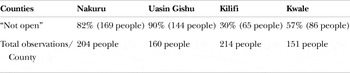
Despite the fears and anxieties around “outsiders,” land narratives along the coast reflect a greater level of tolerance toward outsiders compared to narratives that I documented in parts of the Rift Valley. As a way of comparing these different views, I draw on responses from a survey question where respondents indicated whether they are comfortable with “any Kenyan coming to live in [their] community, even if the [newcomer] has a title deed and [they] do not have their own.” (See table 4.) The variation in “openness to outsiders” between counties in the Rift Valley and the Coast is striking. In Uasin Gishu, where the majority of respondents are Kalenjin, 90 percent say that they do not feel comfortable with “any Kenyan” coming to live in their community. By contrast, only 30 percent of respondents in Kilifi are opposed to “any Kenyan” moving into their community.
Proportion of Respondents “Not Open” to Outsiders Living in Their Community

Different histories of political patronage and migration can help account for regional variation in attitudes—or narratives—toward outsiders. In the more arable regions of the Rift Valley, elites have created patronage networks along ethnic lines. Early on, residents learned to fear a political leader from another ethnic community because it signaled their exclusion from the “national cake.” Yet in the sparsely populated Coastal region, KANU elites felt no great rush to build networks of political supporters. Footnote 19 Without strong co-ethnic patrons who could offer land or employment, Coastal residents have had to negotiate access to land or employment through relationships with strangers—including Europeans, Arabs, Indians, or upcountry Kenyans—rather than relying on party or ethnic networks (Cooper Reference Cooper1980; Kanyinga Reference Kanyinga2000). The outsider in this sense has become an imperative for survival more than a political and economic threat.
In sum, Mijikenda land narratives have not provided elites with the same mechanism for organizing violence as they have in parts of the Rift Valley because there is not a well-defined outsider or target group that elites and followers can link to electoral outcomes. Beyond towns and cities, many upcountry residents are a small and largely invisible minority who occupy a well-protected stratum of society.
Conclusion
Within certain contexts, contentious land narratives can provide political elites with an effective tool to mobilize election violence. I have developed a theory of land and election violence based on observations from the Rift Valley region. Yet the Coast region provides an important site to explain why and how the relationship between land narratives and violence breaks down. By selecting two regions where land is of central importance to residents, I aimed to explain why land narratives have provided elites with an effective tool to organize violence in parts of the Rift Valley but not the Coast.
This question frames the mobilization of violence along two axes. The first is patronage capacity: does the candidate have the power to exploit both resources and a political narrative? The second concerns the narrative itself: how do ideas about the rights and distribution of land shape beliefs about threats of land appropriation or opportunities to expand land rights during an election period?
I have specified several factors that make electoral violence more likely based on the dynamics that I document in the Rift Valley. These include strong patron–client relations, the credibility of one group’s land claims over another’s, the proportion of outsiders relative to insiders, and the political salience of the “outsider” as a category. When citizens believe that elections create either a threat of land appropriation or an opportunity to strengthen land rights, there may be stronger motives to engage in violence. Footnote 20 Yet when citizens do not view elections as a significant threat to their land security, or a window of opportunity to strengthen their land rights, there are far fewer incentives to fight. The strength of the political patron and the number of outsiders relative to insiders help explain whether citizens will associate threat and opportunity with the electoral process.
While the analysis I have presented focuses on regions within Kenya, the theory should generalize to other countries in Africa where property rights are weak and vulnerable to expropriation by elites, and where land provides a source of livelihood and identification for a majority of the population. For example, in regions within Burundi, the Democratic Republic of the Congo, and Côte d’Ivoire, struggles over land often manifest as competing claims between “autochthons” and “outsiders.” Violent conflict has escalated in spaces where politicians can exploit competing land claims during electoral periods by encouraging the eviction of one community or promising land reforms or resettlement that appear to favor one group over another. However, because this theory is about where elites can convince ordinary citizens to participate in electoral violence, it does not generalize to contexts where civilians have little agency in relation to their participation (e.g., child soldiers in Uganda) or where formal state security forces perpetrate violence exclusively against civilians, in contexts such as Ethiopia and Zimbabwe.
The story of Coastal politics is one in which citizens do not feel part of the formal political system (see Willis & Chome Reference Willis and Chome2014). There are few incentives for participation in the political process because many citizens feel relatively insulated from both the positive and negative effects of political participation. Yet this feeling of marginalization does not preclude all forms of political violence. On the contrary, while election violence is not common, there is a growing window for new forms of violence, particularly as citizens express the view that their politicians and the government do not represent them, or that leaders facilitate land accumulation for outsiders at the expense of the poor majority. These sentiments have helped to generate a movement for secession from Kenya under the slogan of Pwani si Kenya—the Coast is not Kenya (see Willis & Gona 2012; Botha 2014).
There is also a rise in new forms of violence along the coast: attacks on churches, grenade attacks on buses and hotels, targeted attacks on religious leaders, and attacks on sites that symbolize the success of migrants at the expense of locals. This escalation of violence points to new and growing forms of authority in the region with links to religious organizations, secessionist groups, and Al-Shabaab. Future research might consider how the devolution of power away from the central state reshapes patronage networks and by extension, how citizens choose to engage or subvert the formal political process.
Acknowledgments
Thanks to Goodluck Mbaga, Rebecca Munga, and the wonderful research teams in Kwale and Kilfi. Thanks also to Scott Straus, Michael Schatzberg, Jeffrey Paller, and the anonymous reviewers at ASR for suggestions on earlier versions of this article.