Introduction
Notwithstanding differences in healthcare systems across developed countries, there is probably no government that has been able to escape cost-containment in healthcare over the last decades (Blank and Burau, Reference Blank and Burau2010). The need to implement often unpopular reforms to control increasing public healthcare expenditure has become even more urgent during the recent economic crisis that, although unequally, hit the majority of European societies. At the same time, in a climate of austerity, job and income insecurity negatively affect health resulting in greater need for care (Thomson et al., Reference Thomson, Figueras, Evetovits, Jowett, Mladovsky, Maresso, Kluge, Thomson, Figueras, Evetovits, Jowett, Mladovsky, Maresso, Cylus, Karanikolos and Kluge2015). Yet, this same financial insecurity as well as cuts in services and growing out-of-pocket (OOP) payments might prevent citizens from seeking healthcare (Karanikolos et al., Reference Karanikolos, Mladovsky, Cylus, Thomson, Basu, Stuckler, Mackenbach and McKee2013). Hence, studying healthcare reforms and their effect on access to care takes on added importance.
Copious literature has focused on the impact of austerity on the reform of healthcare systems. Much less, though, has dealt with the implications for access. Attention to outcome, and not only output, is however very relevant to learn how the crisis has affected citizens. Among the most outstanding broad comparative analyses dealing with changes in access in EU member states are those of Cylus and Papanicolas (Reference Cylus and Papanicolas2015), Eurofound (2014), Wenzl et al. (Reference Wenzl, Naci and Mossialos2017), and Baeten et al. (Reference Baeten, Spasova, Vanhercke and Coster2018). In-depth case studies covering the full span of the crisis are even more scant.
The aim of this article, therefore, is to examine healthcare reforms under austerity across two different settings with a special focus on whether these reforms have targeted cost-containment while compromising the social objective, i.e. that of providing access and treatment for those in need and according to their needs. Using an interpretative comparison in search for cross-case similarities and differences, we examine the evolution of equity of access to healthcare during the crisis in two potentially vulnerable Eastern and Southern European countries – Lithuania and Spain. Both nation states were deeply affected by the Great Recession and rocketing unemployment and required tough austerity adjustment measures in public policies.
The two healthcare systems under scrutiny differ broadly in size and maturity. Further, institutional designs are very dissimilar as to eligibility principles, financing sources, managerial and provision arrangements, to the extent that they represent the two prevalent healthcare models in the EU, namely Social Health Insurance systems (SHI) and National Health Services (NHS). Considering that an NHS tends to support equity of access better than other types of healthcare systems due to its universality of access, a high share of public funding and a generally identical benefits package to the entire population (OECD, 1987; Freeman, Reference Freeman2000: 5–7, 32–65; Hassenteufel and Palier, Reference Hassenteufel and Palier2007; Wendt, Reference Wendt2009; Blank and Burau, Reference Blank and Burau2010: 245–48), it could be the case that equity of access to care during the crisis was affected more in Lithuania, a relatively immature SHI, than in Spain, a consolidated NHS. Still, the way in which the crisis was managed in the two healthcare systems under scrutiny, together with its duration and intensity, may have had different effects in terms of equity of access.
In the following three sections, we first analyse the institutional design of the two healthcare systems and the reforms introduced during the crisis. Second, we examine self-perceived barriers to access to healthcare and their evolution over time in both countries. Third, we compare objective indicators of barriers to access and their change over time. Conclusions interpret the evidence found and consider directions for future research.
Institutional design and healthcare reforms under austerity
We analyse here four main institutional dimensions – rules of access, benefits package, financing of the system, and management arrangements (Hassenteufel and Palier, Reference Hassenteufel and Palier2007; Palier, Reference Palier and Palier2010) – and indicators of access regulation (Wendt, Reference Wendt2009; Reibling, Reference Reibling2010), as well as restrictive changes applied to them during the crisis.
As to mode and rules for access, the Spanish General Health Care Act in 1986 developed a national health service in Spain (Guillén, Reference Guillén2002; Guillén and Cabiedes, Reference Guillén and Cabiedes1997) that led to universal access to care. Nonetheless, despite being nearly fully funded through general taxation and organised on a gate-keeping basis, the Spanish NHS did not fully abandon the social insurance principle until 2011, so that population coverage was gradually universalised to all legal residents by including various social groups into the social insurance regime or through other entitlement paths (illegal immigrants also gained full access to care through Law 4/2000). In the meantime, after regained independence Lithuania moved from the Semashko model to a social health insurance system granting access to healthcare upon the payment of compulsory health insurance contributions unless one falls into one of the exemption categories whose health insurance premiums are paid from state’s budget.
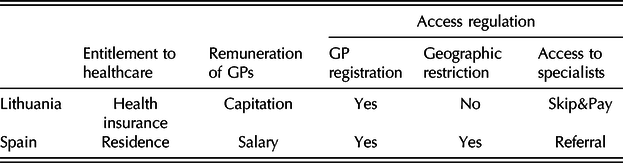
Besides the mode of entitlement, access regulation, which captures the level of patient choice or freedom (Wendt, Reference Wendt2009), should be considered (see Table 1). Although patients have to register for the list of a certain general practitioner (GP) in both countries, the freedom of choice between GPs is restricted to the GPs available within the territorial unit in Spain (García-Armesto et al., Reference García-Armesto, Abadía-Taira, Durán, Hernández-Quevedo and Bernal-Delgado2010) while de jure there are no geographic restrictions in Lithuania (de facto the choice may be quite limited in the rural areas) (National Audit Office of Lithuania, 2013). Further, as a NHS-type country, Spain has a strong gatekeeping system with access to specialists upon referral only. There has been no direct access to the majority of specialists without a referral from GPs in Lithuania since 2002 either (Kasiulevičius and Lember, Reference Kasiulevičius, Lember, Kringos, Boerma, Hutchinson and Saltman2015) but patients may skip this step by agreeing to additional payments, which give patients more freedom to choose but may reduce equity of access.
Institutional indicators of access to care (based on Wendt, Reference Wendt2009 and Reibling, Reference Reibling2010)

Sources: MISSOC, 2018; Murauskiene et al., Reference Murauskiene, Janoniene, Veniute, van Ginneken and Karanikolos2013; García-Armesto et al., Reference García-Armesto, Abadía-Taira, Durán, Hernández-Quevedo and Bernal-Delgado2010.
In Spain, the publicly financed package of services, established in 1995, is ample, explicitly defined and free at the point of use, although cost-sharing applies to over-the-counter pharmaceuticals (with exemptions) and benefits exclude optical products and adult dental care (with partial exception for pregnant women), both of which are fully covered by OOP payments (García-Armesto et al., Reference García-Armesto, Abadía-Taira, Durán, Hernández-Quevedo and Bernal-Delgado2010; Petmesidou et al., Reference Petmesidou, Pavolini and Guillén2014). Autonomous regions/communities (ACs) may improve the package unilaterally. In Lithuania, the state guarantees free access to basic primary and specialised healthcare although there is no explicit positive list of services (Law on Health Insurance, 1996). Medical rehabilitation and dental care are also partially financed by the National Health Insurance Funds (NHIF). Prescribed pharmaceutical and medical aids, however, are fully or partially reimbursed for few population groups and for patients suffering from certain diseases only. Optical products are also excluded.
The Spanish NHS is funded through general taxation while Lithuania established financing through the compulsory health insurance managed by the NHIF (National Audit Office of Lithuania, 2011; Lazutka et al., Reference Lazutka, Skučienė, Černiauskas, Bartkus, Navickė and Junevičienė2013) although due to universalisation of access in SHI systems payments for inactive population from state’s budget, i.e. other than payroll taxes, are significant too. OOP spending as a share of total health expenditure (THE) is significant and higher than EU average in both countries (see Figure 5) – mainly due to dental care in Spain and pharmaceuticals in Lithuania (OECD/EU, 2016). As a result, the share of public funding is lower than EU average too.
The supply of healthcare in the Spanish NHS is public, whose organisation is fully devolved to the regional governments (Petmesidou et al., Reference Petmesidou, Pavolini and Guillén2014). As typically found in NHS-type systems, ambulatory care is organised in health centres with teams of general practitioners (including as well gynaecologists, paediatricians, social workers and psychologists), paid on a basis of monthly salary. In the meantime, ambulatory care in Lithuania includes both general practitioners, paid on a capitation basis, and specialists, paid per consultation (Murauskiene et al., Reference Murauskiene, Janoniene, Veniute, van Ginneken and Karanikolos2013; Kasiulevičius and Lember, Reference Kasiulevičius, Lember, Kringos, Boerma, Hutchinson and Saltman2015). Although public service provision dominates, the supply of healthcare in Lithuania can be both public and private, with the NHIF and its branches being responsible for contracts with healthcare providers. Nonetheless, the sickness funds are subordinate to the Ministry of Health (Murauskiene et al., Reference Murauskiene, Janoniene, Veniute, van Ginneken and Karanikolos2013) and, therefore, the state’s control remains strong in Lithuania.
In brief, due to a highly centralised decision-making process, strong state role and mainly public service provision (Lazutka et al., Reference Lazutka, Skučienė, Černiauskas, Bartkus, Navickė and Junevičienė2013), the Lithuanian healthcare system is not an ideal type of a social health insurance system. However, as we have shown, it is financed mainly by health insurance contributions, managed by the national sickness funds; and patient choice is still higher than in a national health service. In the meantime, the Spanish system is a (fully decentralised) national health service despite the social insurance principle as an entitlement path to healthcare, since de facto all residents – and undocumented immigrants – can access care.
Analysing how the financial crisis affected the countries and their healthcare systems and comparing their responses to the crisis, we note changes to the rules of access, benefits structure and financing and management arrangements.
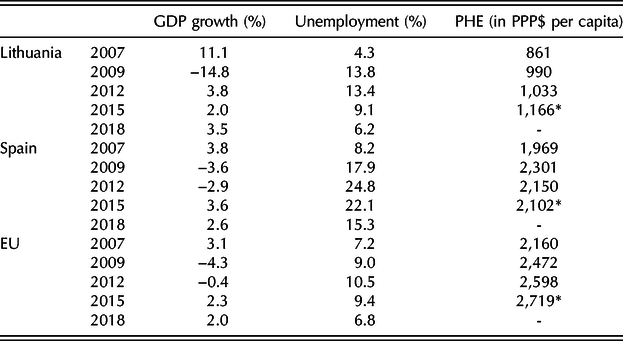
Although still experiencing difficulties in modernising the healthcare system, as Table 2 shows, Lithuania was catching up with the EU and having high GDP growth rates in the 2000s. Yet, the financial crisis pushed the country into a deep recession – the GDP contracted by almost 15 per cent in 2009 and unemployment rose from less than 5 per cent in 2007 to almost 18 per cent in 2010. However, the unemployment rate started falling and GDP returned to grow since 2010. Spain as well experienced rapid economic growth since EU accession in 1986, which was drastically stopped by the crisis. GDP growth rates were negative from 2009 to 2013 and, although the numbers did not reach such skyrocketing figures as in Lithuania, the recession has been longer and led to dramatic increases of unemployment rates – from 8 per cent in 2007 to 26 per cent in 2013 (falling to 15.8 per cent in 2018). The EU-SILC survey revealed that the poorest suffered significant reductions in their income during the crisis and the share of people in the second-poorest quartile at risk of poverty increased sharply in both Lithuania and Spain (Cylus and Pearson, Reference Cylus, Pearson, Thomson, Figueras, Evetovits, Jowett, Mladovsky, Maresso, Cylus, Karanikolos and Kluge2015).

Economic contraction affected the Spanish NHS – due to cost-containment reforms, public health expenditure (PHE) in PPP per capita, which was growing until 2009, decreased from 2,301 in 2009 to 2,102 in 2014 (see Table 2). The Lithuanian NHIF, however, had reserves which helped to soften short-term budget pressures in 2009 and the adopted counter-cyclical mechanisms maintained health sector funding later on – while the compulsory health insurance contributions were decreasing due to growing unemployment and salary reductions, the government increased its transfers for inactive population linking them to average gross salary lagged two years (Kacevicius and Karanikolos, Reference Kacevicius and Karanikolos2014; Jowett et al., Reference Jowett, Thomson, Evetovits, Thomson, Figueras, Evetovits, Jowett, Mladovsky, Maresso, Cylus, Karanikolos and Kluge2015). As a result, PHE per capita has been slowly growing (see Table 2). Therefore, the countries opted for different ways to confront the crisis – Spain implemented measures to reduce public health expenditure while Lithuania aimed to mobilise public revenue and maintain health budgets (Jowett et al., Reference Jowett, Thomson, Evetovits, Thomson, Figueras, Evetovits, Jowett, Mladovsky, Maresso, Cylus, Karanikolos and Kluge2015), which was a positive solution for a country with traditionally relatively low health expenditure and poor population health. On top of the danger to worsen population health further, the Lithuanian government of conservatives leading the country between 2008 and 2012 feared the close scrutiny by voters it is usually subjected to – as opposed to what happens when social-democrats are in office.
Budgetary restrictions in Spain included measures from reducing the salaries of health professionals, freezing new contracts and introducing private management of health institutions in some autonomous regions to closing operating rooms and beds in others (Ventura and González, Reference Ventura, González, Pavolini and Guillén2013; Petmesidou et al., Reference Petmesidou, Pavolini and Guillén2014). Lithuania did not manage to avoid some ad-hoc budget cuts either, such as reduced salaries of health professionals in 2010 or lower sick leave benefits (Kacevicius and Karanikolos, Reference Kacevicius and Karanikolos2014) but counter-cyclical mechanisms allowed protection of prioritised sectors of primary, outpatient and day care and continue pre-crisis policies of restructuring healthcare institutions (Stamati and Baeten, Reference Stamati and Baeten2014).
Furthermore, the Tax reform of 2008 in Lithuania extended health coverage for the self-employed and some other population groups (e.g. artists, sportsmen or business owners) (Kacevicius and Karanikolos, Reference Kacevicius and Karanikolos2014). Besides this, there were no fundamental changes to coverage and benefits package in Lithuania. In the meantime, Royal Decree 16/2012 in Spain modified 2011 legislation by re-establishing the condition of access to healthcare through social insurance and by restricting access for illegal adult immigrants, i.e. a relatively vulnerable population group. Such reform was frontally opposed by most ACs so that its implementation was testimonial until July 2018 (Royal Decree 7/2018), when universal access was reinstated.
In addition, multiple measures adopted in Spain since 2006 to improve rational use of medicines (including Royal Decrees 4/2010 and 16/2012) achieved reductions of pharmaceutical expenditure up until 2014 when it slowly returned to increase (Spanish Economic and Social Council, 2016). Royal Decree 16/2012 also modified co-insurance rates and reimbursement mechanisms for outpatient prescription drugs, i.e. not only did it change the benefit level but also affected the benefit structure and mode of access to reimbursement. Cost-sharing for prescribed pharmaceuticals was extended for pensioners previously exempted from user charges albeit with monthly caps (Petmesidou et al., Reference Petmesidou, Pavolini and Guillén2014).
The crisis provided an opportunity to rationalise pharmaceutical expenditure in Lithuania as well (van Ginneken et al., Reference van Ginneken, Habicht, Murauskiene, Behmane and Mladovsky2012). The ‘Drug plan’ or Plan for the Improvement of Pharmaceutical Accessibility and Price Reductions approved in 2009 was a direct response to the crisis and ‘reregulated every aspect of drug sales and consumption from production and authorizations to dispensation and reimbursement’ for the first time (Stamati and Baeten, Reference Stamati and Baeten2014: 57). Garuoliene et al. (Reference Garuoliene, Alonderis and Marcinkevicius2011) argue that the reform was successful in reducing the reference prices of many drugs as well as public and private pharmaceutical expenditure. Total pharmaceutical expenditure as a share of total health expenditure indeed decreased in 2011 but returned to increase after that, reaching nearly 28 per cent in 2014 which is above Spain and EU averages (around 17 per cent) (WHO Regional Office for Europe, 2019). However, public pharmaceutical expenditure as a share of total pharmaceutical expenditure has been decreasing since the reform – from 39 per cent in 2009 to 33 per cent in 2014, as compared to 61 per cent and 64 per cent in Spain and the EU-27 respectively in 2014 (OECD/EU, 2016); which results in increasing privatisation of risk and may lead to significant financial barriers to access for lower income individuals.
On the whole, during the crisis, a wave of reforms aimed at containing costs and increasing efficiency took place in both countries. Apart from the ‘Drug plan’ and partially the Tax reform of 2008, Lithuania continued pre-crisis policies as well as developing a couple of ad-hoc budgetary cuts. Lithuania was in the process of implementation of absolutely necessary reforms of restructuring healthcare institutions when the crisis hit. In this sense, the crisis was not strong enough to break this path. Conversely, Spain implemented drastic budgetary cuts and reforms of policy instruments. We turn now to the analysis of how the impact of these reforms on access to care was subjectively appraised by populations.
Access to care under austerity: subjective data
Most European countries – Spain and Lithuania, among them – have achieved universal coverage. It is a necessary but not sufficient condition of equity of access, however. The range of services covered and the degree of cost-sharing might hinder access to care by affecting affordability, particularly among the lower income populations (OECD/EU, 2016). Geographical access and not excessively long waiting times to receive health services are also important indicators of access to care. Hence, in this section we analyse the subjective indicators of financial and non-financial accessibility. Nevertheless, it is worth noting that beyond these health-system related factors, there are other less tangible but equally important barriers to care – stigma associated with some conditions (e.g. mental disorders) or lack of awareness or social support (Economic Policy Committee, Ageing Working Group and Commission Services, 2016), all of which are beyond the scope of this study.
An indicator of self-reported unmet needs for medical or dental care is often used to reveal perceived barriers to healthcare and to compare their magnitude across population groups. The EU-SILC (EU-Statistics on Income and Living Conditions) survey captures information on individuals that were unable to receive healthcare that they felt they needed over the previous twelve months and their perceived reasons of these unmet needs (Hernández-Quevedo and Papanicolas, Reference Hernández-Quevedo, Papanicolas, Papanicolas and Smith2013). The reasons can be divided into two groups – health-system related (financial barriers, geographical barriers and waiting times) and other reasons (no time, fear of doctors or treatments, waiting to see if symptoms got better on their own, etc). For the purpose of this study, we focus on the health-system related reasons.
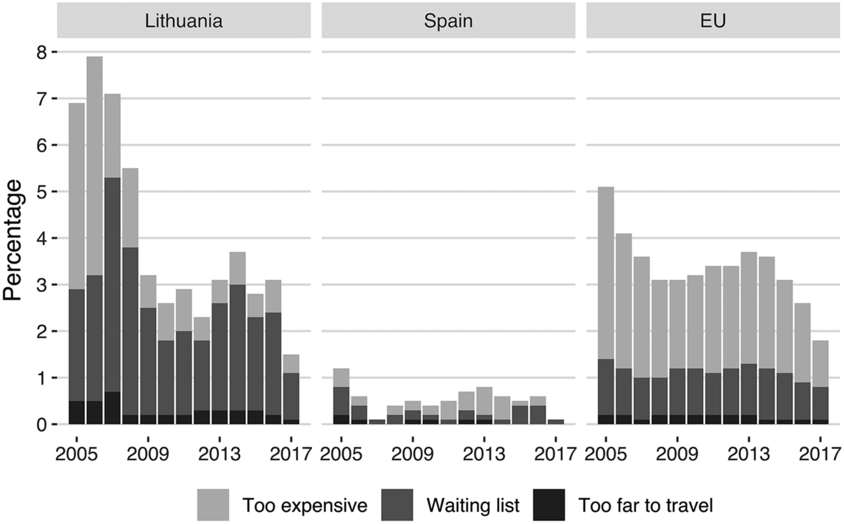
Although the majority of the population in both Lithuania and Spain do not perceive unmet needs in themselves for medical examination, the reasons and trends over time of those who do perceive them differ (see Figure 1). A significantly higher share of the Lithuanian population perceived unmet medical needs between 2005 and 2008, which decreased to approx. 3 per cent or less since then notwithstanding the crisis. However, it should be underscored that, in Lithuania, the share has not only reduced over the austerity years but also it is similar to the EU average, all in all showing an outstanding performance of the Lithuanian healthcare system.
Self-reported unmet needs for medical examination due to health-system related reasons in 2005–2017.

In Spain, the situation has been relatively stable, except for decreases in 2007 and 2017. Less than 1 per cent of the population in Spain report unmet needs for medical examination due to health-system related reasons. The share of geographical barriers is negligible but the proportion of financial barriers grew slightly after the onset of the crisis, a trend reverting in 2015 with a decrease of financial barriers and an increase of waiting times as a barrier. The importance of health-system reasons is higher in Lithuania. Although financial barriers decreased significantly during pre-crisis prosperity and have been less than 1 per cent since 2009, waiting lists are perceived as a major barrier to access to care and are above the EU-27 average. Perceiving waiting times as a barrier could be indicating ‘insufficient availability of healthcare infrastructure and health workforce, as well as inadequate spatial distribution or poor management of resources’ (Economic Policy Committee, Ageing Working Group and Commission Services, 2016: 80).
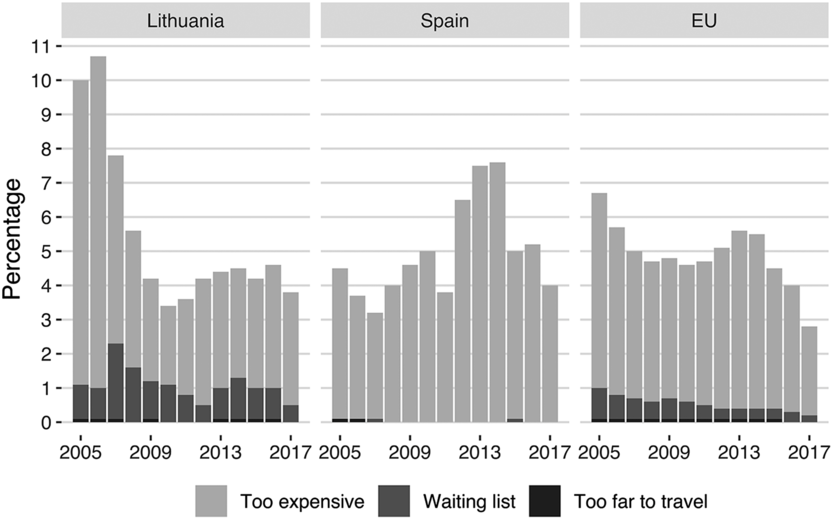
However, unmet needs for dental examination reverse the situation (see Figure 2). Since the onset of the crisis, unmet needs have been generally higher in Spain (although decreasing in 2017), where it is nearly entirely delivered by private provision, than in Lithuania, where dental care can be received in the public sector although often paying user charges. Financial barriers are of major importance in both countries and have been increasing in Spain since the onset of the crisis, which may particularly affect the most vulnerable populations. Nonetheless, any comparisons of rates between the countries should be cautious since differences in reporting may be a result of socio-cultural factors such as social norms and expectations (OECD/EU, 2016) and, therefore, should be interpreted and compared with more objective indicators such as OOP expenditure. However, while socio-cultural factors may partially explain differences between the countries, they will have less explanatory power when explaining any differences among social groups within the countries.
Self-reported unmet needs for dental examination due to health-system related reasons in 2005–2017.

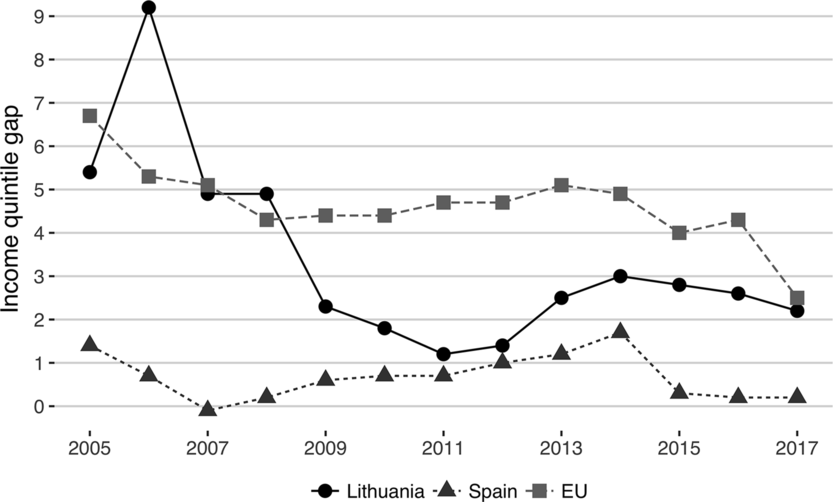
Indeed, unmet needs for medical examination due to health-system related reasons differ across the groups within the countries and prove to be related to income. The poorest (the first income quintile) report unmet medical needs twice as often as the richest do (the fifth quintile) in Lithuania and the ratio remained stable during the crisis although the absolute difference (income quintile gap) had been decreasing since 2005 but went up again in 2013 (see Figure 3). This ratio has been increasing from 1.7 in 2008 to 17 in 2014 in Spain (i.e. the poorest reported unmet medical needs 17 times more often than the richest), although the proportion of the poorest reporting unmet medical needs due to health-system reasons remains low (less than 2 per cent). The absolute difference has been slowly increasing since the crisis but decreased sharply in 2015.
Income gap of unmet needs (absolute difference of needs between the poorest and richest quintiles) for medical examination due to health-system related reasons, 2005–2017.

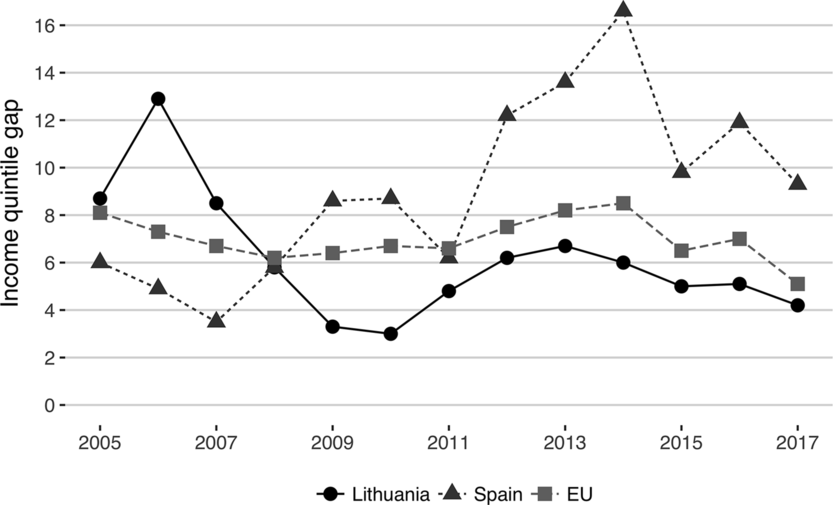
On the other hand, the income gap of unmet needs for dental care due to financial barriers has been approaching the EU-27 average or even exceeding it in both countries and has been particularly pronounced over the last years in Spain (see Figure 4). One in every six individuals (16.7 per cent) in the lowest income quintile reported unmet needs for dental care in Spain in 2014 because it was too expensive; while less than one in one hundred (0.7 per cent) did it in the highest income quintile, meaning a relative difference of almost twenty-four times. The share of unmet needs for dental care due to financial barriers in the highest income quintile is rather similar both in Lithuania and Spain (less than 2 per cent in both countries since 2007) and does not seem to have been affected by the crisis while the lowest income quintile has been reporting unmet needs for dental care due to financial barriers more often in both countries (Eurostat Statistics, 2019), which results in a growing income gap (see Figure 4).
Income gap of unmet needs (absolute difference of needs between the poorest and richest quintiles) for dental examination due to financial barriers, 2005–2017.

Notwithstanding relatively low levels of unmet needs for medical examination in both Lithuania and Spain over the last years, the fact that they are related to income in the European health systems that strike for universalism and equity leads one to believe that ‘there is worse access to healthcare for relatively poor people, whether that is due to inability to pay co-payments, travel, or other issues’ (Economic Policy Committee, Ageing Working Group and Commission Services, 2016: 80). Furthermore, it is particularly concerning that the income gap for dental care due to financial barriers has been increasing after the onset of the crisis. Nonetheless, as earlier mentioned, perceptions of barriers to care should be analysed in the context of more objective indicators of access. Hence, in the next section, we consider available data on out-of-pocket expenditure, the incidence of informal payments, waiting times and geographical access.
Access to care under austerity: objective data
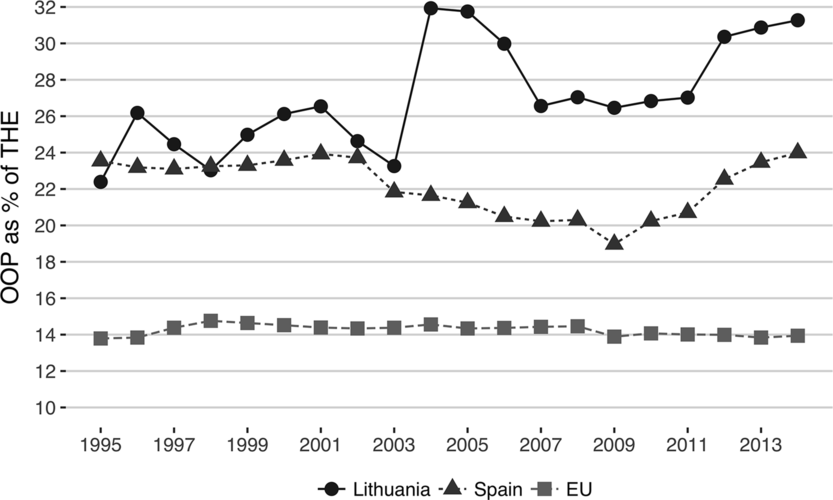
The magnitude of cost-sharing in healthcare reflects in OOP spending as a share of THE and functions as a tool of rationing in healthcare that aims to improve efficiency and reduce inappropriate use of healthcare (Gemmill et al., Reference Gemmill, Thomson and Mossialos2008; Drummond and Towse, Reference Drummond and Towse2012; Economic Policy Committee, Ageing Working Group and Commission Services, 2016). However, it may lead to poor access to care if badly designed and add a regressive component to the healthcare system since poorer and/or higher-need groups spend more on healthcare as a proportion of their income (Gemmill et al., Reference Gemmill, Thomson and Mossialos2008; Murauskiene et al., Reference Murauskiene, Janoniene, Veniute, van Ginneken and Karanikolos2013). OOP payments usually include user charges for prescribed and over-the-counter medicines, curative care, dental care and therapeutic appliances (eye-glasses, etc.) (OECD/EU, 2016). Figure 5 illustrates changes in OOP expenditure in Lithuania and Spain since 1995. The EU average has remained stable over the last twenty years, which is significantly lower than the share in Lithuania and Spain.
Out-of-pocket expenditure on health as a share (%) of total health expenditure, 1995–2014.

The share in Spain, which had been steadily decreasing before the crisis, reached 24 per cent in 2014, which was the highest proportion since 1995. Furthermore, private spending on health as a proportion of total household consumption increased from 2.9 per cent in 2006 to 3.6 per cent in 2015 with the population aged sixty-five plus spending significantly more (4.7 per cent in 2015) (National Statistics Institute of Spain, 2018). This could be partially explained by introduced user charges for prescribed pharmaceuticals in 2012 for pensioners – who are usually intense users of healthcare. Nonetheless, pharmaceutical spending amounted only to 30 per cent of OOP in 2014 (OECD/EU, 2016) as compared to 29 per cent in 2012 (OECD, 2014) while the share of OOP payments for dental care increased from 30 per cent to 36 per cent over the same period. Therefore, both self-perceived unmet needs and the share of OOP payments for dental care suggest that there are significant financial barriers to access to dental care in Spain.
On the other hand, there has been no stability in OOP expenditure in Lithuania (see Figure 5). Even though the ‘Drug plan’ partially resulted out of concern about rising OOP spending for pharmaceuticals and aimed to regulate prices of non-reimbursable medicines (Garuoliene et al., Reference Garuoliene, Alonderis and Marcinkevicius2011), its success seems to be minimal. OOP spending in PPP per capita on average grew by 6.7 per cent annually from 2009 to 2014 (inclusive), which was well above GDP growth rates and was the second highest rate in the EU (calculations based on data from WHO, 2018), and, as a result, reached more than 31 per cent of THE in 2014. As in other post-socialist societies, pharmaceutical spending represented the major part of OOP payments in Lithuania – almost 60 per cent, while dental care accounted for 17 per cent in 2014 (OECD/EU, 2016). Patients have to cover the full price for prescribed pharmaceuticals unless they fall into one of total or partial reimbursement categories (see the first section) and expenditure on over-the-counter medicines for self-medication is historically high in Lithuania (OECD/EU, 2016): nearly 57 per cent of population reported using non-prescribed medicines in 2014 compared to 22 per cent in Spain and 35 per cent as the EU average (Eurostat Statistics, 2019).
Furthermore, although there were no fundamental formal changes in the benefits package during the crisis, it was reported that some healthcare institutions were charging patients for diagnostic tests and certain treatments as a means of balancing out their budgets which are not clearly regulated and exist as quasi-formal direct payments (Kacevicius and Karanikolos, Reference Kacevicius and Karanikolos2014). The study commissioned by the National Audit Office of Lithuania (2011) confirmed the existence of these payments for publicly financed services in both inpatient and outpatient healthcare institutions, which increases financial barriers to access for vulnerable population groups. High OOP expenditure on pharmaceuticals and services may particularly burden frequent healthcare users such as pensioners. Even though private spending on health was around 5–6 per cent of total household consumption in 2008 and 2012, the share reached 11 per cent among population over sixty (Official Statistics Portal of Lithuania, 2018). Such financial barriers may delay help-seeking, harm adherence to treatments and increase use of free but resource-intensive emergency care (Gemmill et al., Reference Gemmill, Thomson and Mossialos2008; Drummond and Towse, Reference Drummond and Towse2012). Finally, private health insurance can be used to cover any cost-sharing and its importance has been growing in Spain reaching around 15 per cent of population while the share in Lithuania is extremely low (1 per cent in 2014) (OECD/EU, 2016). Nonetheless, vulnerable populations in need are not likely to be able to afford it.
In addition to official user charges, informal payments by patients in cash or in kind (‘under-the-table’/‘envelope’ payments or ‘gratuities’) to healthcare providers for publicly funded services in inpatient or outpatient care, although inexistent in Spain, are still frequent in post-socialist societies and function as a tool of queue-jumping and securing access to quality and more attentive care. Kornai and Eggleston (Reference Kornai and Eggleston2001: 170) state that informal payments ‘are probably specifically socialist and post-socialist’. They emerged under the Soviet regime and its command economy as a result of shortage and very low salaries of healthcare providers and survived the regime’s collapse partly due to weak enforcement of regulations (Sitek, Reference Sitek2010). Informal payments lead to inefficient use of health services and inequity of access since no exemptions to vulnerable populations are made which disproportionally burdens lower-income groups and frequent healthcare users.
A survey, conducted in the three Baltic countries in 2002, showed the highest incidence of informal payments in Lithuania – 8 per cent of patients gave these payments and 14 per cent gave gifts in their last contact with the health system (Cockcroft et al., Reference Cockcroft, Andersson, Paredes-Solís, Caldwell, Mitchell, Milne, Merhi, Roche, Konceviciute and Ledogar2008). In another survey in 2013, 21 per cent of patients in Lithuania reported giving an extra payment or gift to healthcare providers in the previous 12 months, which was the second highest rate after Romania, compared to only 1 per cent in Spain (Eurobarometer, 2014). The proportion, however, dropped to 12 per cent in 2017, which is still three times higher than the EU average (Eurobarometer, 2017). These figures, therefore, highlight the widespread practice of informal payments in Lithuania, although it seems to decrease over time.
Changes in waiting times for non-urgent surgery or specialist care can be an indicator of success or failure of cost-containment reforms under austerity. Although being a non-price measure per se, long waiting times can become a financial barrier to access since lower-income groups are least likely to be able to bypass long waiting times by purchasing care from private providers or accepting an additional fee for access to specialist care without GPs referrals, as is the case in Lithuania (Murauskiene et al., Reference Murauskiene, Janoniene, Veniute, van Ginneken and Karanikolos2013). According to opinion surveys in Spain, the proportion of population stating that waiting lists worsened during the previous year has been growing from 6 per cent in 2000 to 30 per cent in 2012 (Spanish Economic and Social Council, 2014). Furthermore, while waiting times have remained around two months for specialist care, they have grown from two months in 2009 to three months in 2015 for non-urgent surgery and a share of population waiting more than six months has doubled over the same period reaching nearly 11 per cent (Spanish Economic and Social Council, 2014, 2016).
In Lithuania, however, the official data on waiting times is not available. Notwithstanding, there are indications of longer waiting times due to growing patients’ dissatisfaction and perception of waiting times as the major barrier to access in the recent years’ surveys (Murauskiene et al., Reference Murauskiene, Janoniene, Veniute, van Ginneken and Karanikolos2013; see also Figure 1). Despite the efforts of strengthening the gatekeeping role of GPs in Lithuania, it remains underdeveloped as many patients visit GPs to get a referral only, which leads to inefficient use of resources and creates longer waiting times to specialist care. Van Ginneken et al. (Reference van Ginneken, Habicht, Murauskiene, Behmane and Mladovsky2012) argue that the major barriers to strengthening their role are gaps in GPs’ training and negative attitudes of the population. In the study conducted by the National Audit Office of Lithuania (2013), 80 per cent of surveyed GPs referred their patients to specialists without using all their competences in terms of diagnosis and treatment and more than 50 per cent of them admitted doing so because patients requested. Moreover, the average waiting times for non-urgent cataract surgery or hip replacement in other post-socialist societies such as Estonia or Poland were around 400 days in 2014–15 (OECD/EU, 2016) suggesting similar numbers in Lithuania.
As to geographical access, long travelling distances to receive healthcare are also a sign of lack of capacity in the health system and inefficient spatial distribution of health services and providers (Economic Policy Committee, Ageing Working Group and Commission Services, 2016). Geographical barriers can turn into financial barriers, especially for lower income groups who are particularly sensitive to any additional costs in order to receive health services. Although the number of physicians per capita is above the EU average in both Lithuania and Spain (OECD/EU, 2016), evidence suggests variability of physician density across regions and municipalities (García-Armesto et al., Reference García-Armesto, Abadía-Taira, Durán, Hernández-Quevedo and Bernal-Delgado2010; Murauskiene et al., Reference Murauskiene, Janoniene, Veniute, van Ginneken and Karanikolos2013; OECD, 2014). Unequal distribution of healthcare providers is stressed as a serious problem in Lithuania (Murauskiene et al., Reference Murauskiene, Janoniene, Veniute, van Ginneken and Karanikolos2013) with the lowest density in rural areas and even shortage of GPs in some regions, which creates long waiting times to access primary care (National Audit Office of Lithuania, 2013). Due to absence of a centralised model for medical personnel planning or lack of attractiveness of towns and rural areas, the number of GPs can differ three times between some municipalities in Lithuania.
Differences across ACs or rural and urban areas are often perceived as major barriers to equitable access to healthcare rather than socioeconomic status, gender or age in Spain (Spanish Economic and Social Council, 2011). Furthermore, the implementation of the reforms under austerity (particularly Royal Decree 16/2012) has not been identical across the ACs. Several ACs returned to extend coverage to illegal immigrants registered in their municipalities or other vulnerable population groups that were not affiliated with the social insurance system (Spanish Economic and Social Council, 2017). Some ACs also approved additional resources to cover user charges of certain services and pharmaceuticals for groups without financial resources. All of these enhance solidarity across population within ACs but may increase geographical inequity between regions.
To sum up, the analysis of the evolution of objective indicators during the crisis, such as OOP spending, waiting times and territorial inequalities in access, shows that, although departing from higher levels of equity in access, the Spanish healthcare system suffered more intensely than the Lithuanian one.
Conclusions
Even though both Lithuania and Spain resisted extreme retrenchment in health services, at the same time they neglected to cover newly emerged risks or those that increased in salience after the onset of the crisis. That is to say, despite the fact that some institutions needed to be recalibrated in response to socioeconomic changes, they failed to do so, which led to gradual transformations away from social needs. Namely, the ‘Drug plan’ in Lithuania did not refocus reimbursement policy in order to extend it to vulnerable groups such as the working poor. Therefore, the absence of effective safety nets has not protected a number of vulnerable groups from growing privatisation of risk, i.e. increasing OOP expenditure. By the same token, equity of access has been compromised through quasi-formal charges for diagnostic tests in some healthcare institutions, informal payments and inefficient work of GPs. This is likely to increase waiting times for specialist care which the better off can bypass by accepting additional fees or in the private sector. Thus, solidarity, which has long been a core value in European health policies, has been put at risk in Lithuania.
Unlike Lithuania, Spain introduced a sophisticated pharmaceutical reimbursement structure relating it to individual’s income level and maintained the benefits package without introduction of any cost-sharing, which should have protected vulnerable populations and, as a result, reflects in relatively low unmet medical needs for health-system related reasons. Like Lithuania, however, the government also failed to renegotiate some institutions despite the changing socioeconomic environment. Budgetary cuts eroded the capacity of the Spanish NHS to provide for all. Unmet needs for dental care due to financial barriers have risen significantly since 2012 and doubled among the poorest population and the unemployed since it simply became unaffordable due to income reductions. However, there were more debates around pharmaceutical reimbursement policy, which seems to be equitable per se, than about dental care, where unmet needs are clearly related to income. Finally, unequal implementation of cost-containment reforms across ACs and growing perceived geographical inequity question territorial solidarity between ACs although some of them did increase equity of access within their own populations.
Therefore, taking into account high OOP payments or greater importance of unmet medical needs due to health-system related reasons in Lithuania, institutional design indeed is significantly less capable to support equity of access in Lithuania than in Spain (except for dental care). Nonetheless, described trends suggest that compromised equity in Lithuania is an outcome of longer-term social policies and neglect of social and health inequalities in Lithuanian society rather than a consequence of the crisis itself. In fact, the crisis years demonstrate high resilience on the part of the Lithuanian healthcare system, that was not only capable of lowering unmet need but also to match the EU-28 average.
Further, intensity and duration of the crisis and types of reforms adopted (or the opposite) have had stronger impact on equity of access in Spain than in Lithuania notwithstanding their institutional designs. In fact, in Spain, significant budget restrictions led to increased waiting times, which higher-income groups can bypass in the private sector; unequal implementation of healthcare reforms across ACs increased geographical inequity; and intensity of the crisis and a lack of reforms taken to facilitate access to dental care considerably increased unmet needs, particularly among the poor and unemployed making dental care nearly a symbol of status. All of this suggests that the crisis particularly affected the weakest features of the healthcare system and also the worst-off.
Institutional design and healthcare reforms under austerity as well as their impact on access to care have been analysed in both Lithuania and Spain, showing that Lithuania was able to weather the storm better than Spain did. This suggests that the way a crisis is managed and where priorities are placed could be more salient than the institutional design of a healthcare system, while length and intensity of crises may also account for the degree of resilience. The strength of such explanatory variables and their effects in terms of access to care, together with external pressure/conditionality, cultural systems or socioeconomic changes could be further tested in comparative analyses. Furthermore, equity of access is just one of the healthcare objectives. Other objectives, particularly quality of care, have not been assessed in this study although it might have been compromised at cost of the economic or social objectives. Finally, we are still to evaluate the health impact of inequity of access to care under austerity on the most vulnerable populations, who have suffered the biggest fall in their income during the crisis and who at the same time have faced growing barriers to effective healthcare.
Acknowledgements
The work of the first author was financially supported by the Research Group PROMEBI (Promoviendo el Empleo y el Bienestar en Europa/Promoting Employment and Welfare in Europe) at University of Oviedo (ref. no. FC-15-GRUPIN14-086). An earlier draft of this article was also presented at the annual conference of Research Committee 19 (RC19) of the International Sociological Association, thanks to a Jean Monnet Conference Fellowship granted to the first author by the Centre for European Studies, University of North Carolina at Chapel Hill, and at the annual ESPAnet Conference in Lisbon, Portugal. We would also like to express our gratitude to Bruno Palier for his valuable comments at the annual conference of RC19.