Between 1860 and 1901, suburbanization in the metropolis was moving apace, the population of outer London increasing from 414,226 to 2,044,861 people.Footnote 1 But this growth appeared to be unequally shared. Contemporary commentators argued it was the middle class and the skilled elite of the working class that were taking up the suburban lifestyle. In contrast, members of the working class in irregular employment, unable to afford train fares or the inconvenience of commuting, were forced to reside near to their workplaces in the centre. Furthermore, as the wives and children of irregular workers might also be in casual or irregular employment, there was a further reason to remain in the centre where such employment was considered relatively plentiful. Consequently, the introduction of workmen's trains in 1864, which offered cheap fares to ‘artisans and labourers’ and aimed to promote suburbanization, was usually argued as being of little benefit to the majority of the working class. In 1861, Lord Shaftesbury informed the House of Lords that
The labouring man must live near the scene of his work. When I consulted the working men themselves on the subject I found them much more ready to go to a distance from London than their wives, the managers of their households. I have not heard one woman speak in favour of the suggestion. They one and all said that such a removal from London would break up their connections and deprive them of the 3s or 4s a week they are now enabled to earn.Footnote 2
Similarly, the housing reformer Octavia Hill argued in 1882 that
Where you have a mechanic who is the sole bread winner, he can get out of town pretty well, if he can get good workmen's trains, and his family all profit by it; but where, as in the lower classes of labour. . .several members of the family are more or less employed, then the workmen's trains do not fit at all; both boys and girls are at work, and do not live at home, their hours do not often correspond; the train fare mounts up, and the breaking up of the family for meals is very much more serious.Footnote 3
Historians have often repeated these criticisms. When examining south London between 1860 and 1914, H.J. Dyos, citing both Shaftesbury and Hill, concluded that casual labourers needed to live near their work, typically in central London, as a matter of ‘imperative necessity’.Footnote 4 Furthermore, casual workers were unable to afford daily commuting fares at a penny per mile rate (the cheapest third-class railway fare) and a lack of cheap markets, such as at Billingsgate, made suburban life too costly.Footnote 5 While noting the relative success of workmen's trains charging a 2d daily return fare in north-eastern and eastern suburbs, Dyos gave little detail about their operation or impact. Similarly, Polasky has contended that unskilled workers were unable to suburbanize as they depended upon the earnings of wives and children usually in low-paid employment, such as charring or washing, most easily obtained in central London. Skilled workers, less dependent on family labour, could more readily move outwards. Consequently, Polasky argued that housing was segregated by income level along railway lines, with elite workers living furthest out while casual workers remained centralized.Footnote 6
While historians have noted that this pattern changed after the late 1880s, comparatively little analysis has been produced. Stedman Jones in Outcast London focused upon the inconveniences suffered by workmen living in the suburbs in the 1870s and 1880s, concluding that workmen's trains were too inconvenient and expensive, especially for casual labour.Footnote 7 While noting ‘much evidence of decentralization of both population and employment in London’ from the late 1880s onwards, the only evidence presented is the increasing number of workmen's trains.Footnote 8 Rodger gives a similar account, arguing that although workmen's trains were initially inconvenient, they bolstered artisanal suburbs between 1883 and 1914, ‘leaving an undifferentiated corps of low-paid slum dwellers in the centre trapped by irregular earnings, high rents, and immobility’.Footnote 9
What is argued here is that a much broader cross-section of the working classes benefited from workmen's trains from the 1880s onwards. While the most casual workers were excluded, these must be distinguished from those in irregular employment (covering short periods of time and in varying locations – such as building projects), like general labourers, who benefited. Furthermore, it will be demonstrated that wives and children in subsidiary employment were also commuting, contesting the notion that these households were unable to leave the centre of London. These families then benefited from a healthier environment and cheaper suburban rents which helped offset the costs of commuting. This article focuses principally on the outer suburbs of London, an area beyond the easy reach of the other transport innovation of the period, the tram. While trams played a major role in the inner suburbs (workmen's tickets issued on trams in the County of London rose from 9,898,289 in 1904–05 to 71,718,033 in 1912–13),Footnote 10 in the outer suburbs tram services were often considered unreliable by regular commuters, only competing effectively against the railways within a six mile radius of the centre.Footnote 11 The aim is to demonstrate that even on the suburban fringes of London irregular workers and their families could be commuters, a lifestyle prefaced on the availability of workmen's trains.
Workmen's trains
The 1860 Act authorizing the construction of the metropolitan extension to the London, Chatham & Dover Railway was the first to include a clause requiring a railway company to run a workmen's train. This was intended to compensate for the destruction of working-class housing within central London by providing those displaced with a means of moving into the suburbs and commuting to work. In 1864, Lord Derby suggested that all railway bills requiring parliamentary approval for construction work within the metropolis should contain similar clauses.Footnote 12 These typically required a workmen's train to be run at a specific time from the suburb to the city terminal in the morning, usually before 6am, and back again in the evening, at a 2d fare for the daily return journey. The minimum third-class fare at this time was usually a penny-per-mile, so these trains often represented significant savings.
The first workmen's train service was introduced by the Metropolitan Railway in 1864, offering a daily return between Paddington and Farringdon for 3d, half the third-class fare, leaving at 5.30 and 5.40am. There was no statutory requirement for these trains to be run; they were voluntarily introduced by the company. This was because certain companies saw workmen's tickets as a means of increasing passenger numbers in the early hours of the morning when the railway would otherwise go unused. By 1883, while 11 workmen's trains run by 6 companies were statutorily required in London, 10 companies were running 110 trains, rising to 307 in 1890 and 476 in 1894.Footnote 13 The majority of these ran from outer districts into the centre in the morning, though there were exceptions, and by the 1890s workmen were usually allowed to return in the afternoon and evening by most third-class trains after a certain time (often 12 noon). While the trains created by statutory requirement had their fares set by law, this was not the case with the others, and companies set their own fares. Usually, earlier trains were the cheapest and later trains increasingly more expensive. Collectively, these trains were regarded as ‘cheap trains’, a mix of statutory workmen's trains, voluntary workmen's trains (trains run with no statutory obligation) and more expensive ‘half-fare’ trains (priced between the workmen's fare and the third-class fare), which ran later in the morning. The intention was to divide passengers by class and income, with poorer artisans and labourers travelling earliest, clerical workers following and higher management travelling as late as 9am, an endeavour bolstered by the different starting times of work between these groups. This was acknowledged by the Great Eastern Railway (GER) in 1899, which operated differential fares because they felt ‘the proper working of the railway does require that there should be this separation between the different classes’.Footnote 14
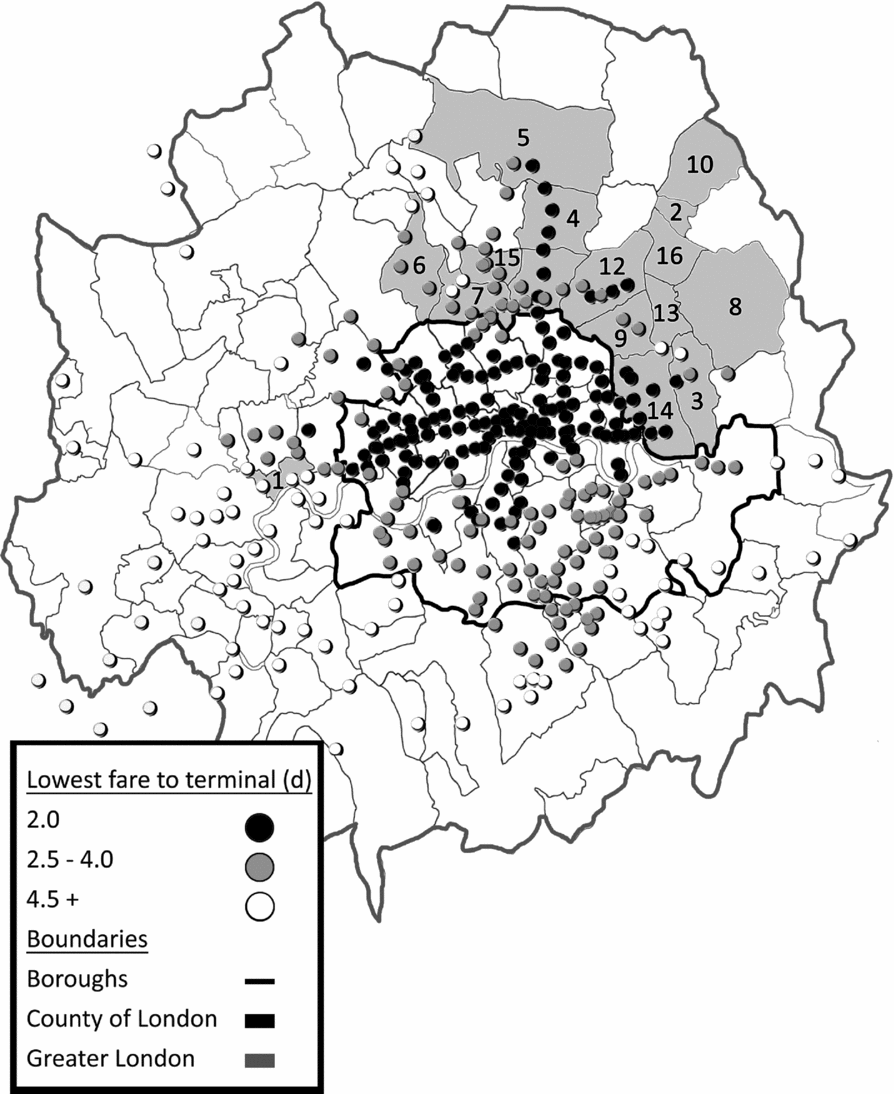
In 1883, this framework was complicated by the passage of the Cheap Trains Act.Footnote 15 The Act abolished taxes charged on railway fares of a penny-per-mile or under while requiring railway companies to provide ‘sufficient’ trains for ‘workmen’ (terms left undefined) which should reach their final destination before 8am. No standardized fares were established, allowing companies to set their own rates. If a company was considered to be providing insufficient or excessively expensive workmen's trains, a petition could be made to the Board of Trade. The Board could pass such petitions on to the Court of the Railway and Canal Commission, which could call witnesses from railway companies, petitioners and interested bodies (such as the London County Council) and had legally binding powers to adjust services. The result of this legislative complexity was wildly varying fares on different railways for similar distances. While a journey of 11 miles between Enfield and Liverpool Street was 2d daily return, a similar distance between Brentford and Waterloo was 7d.Footnote 16 These disparities can be seen in Figure 1.
Map (not to scale) showing the lowest workmen's fare issued by stations in Greater London (boundary defined by the Metropolitan Police District) to the relevant central terminal in 1903. The 2d flat rate fares are evident in the north-east and east, operating well beyond the County of London boundary. In contrast, fares in south-west outer London could be as high as 10d. Stations issuing 2d tickets within the County are mainly those of the underground railways. Districts shaded and numbered are referred to in the main text; Brentford (1), Buckhurst Hill (2), East Ham (3), Edmonton (4), Enfield (5), Finchley (6), Hornsey (7), Ilford (8), Leyton (9), Loughton (10), Walthamstow (12), Wanstead (13), West Ham (14), Wood Green (15) and Woodford (16). Based on map from London County Council, London Statistics, vol. XVI (London, 1906), iv (from author's collection).

The railway companies then reinforced these disparities as they began to view workmen's trains as problematic. The GER felt their 2d workmen's trains (created by statutory Act) had introduced a flood of working-class movement into certain districts, primarily Edmonton, which issued 3,055 such tickets in one week in March 1882.Footnote 17 In 1884, the general manager of the company argued that Edmonton, Stratford and Walthamstow were ‘spoilt for ordinary residential purposes’ as a result and advocated measures to limit working-class suburbanization into other districts.Footnote 18 However, the Cheap Trains Act prevented cutting back services on lines already offering workmen's trains. Instead, companies effectively refused to offer very cheap fares on other lines to prevent repeating the perceived de-gentrification of districts such as Edmonton. The GER refused to offer workmen's tickets to suburbs such as Loughton and Ilford, claiming they had the right to keep those railway lines for ‘the better class of people’.Footnote 19 While it was largely proven that workmen's trains did make a profit (doubly so through the tax breaks provided by the Cheap Trains Act by running them), the fear of de-gentrification (often reinforced by local councils fearful of rate rises) buttressed the fare disparities which in turn meant that working-class suburbanization was funnelled into certain districts along particular lines, principally the GER lines to Edmonton and Walthamstow to the north-east, and the London, Tilbury & Southend Railway through East and West Ham to the east. This is in part evidenced by the fact rates in these suburban districts were some of the highest in London. In 1905–10, the districts with the highest average rates in Greater London were Poplar (139d), Edmonton (121d), West Ham (117d), East Ham (117d), Walthamstow (115d) and Tottenham (113d), compared to an approximate overall average of 89d.Footnote 20
Despite its flaws, the Cheap Trains Act had an impressive impact on London. The number of workmen's tickets rose from 7,152,923 in 1882,Footnote 21 to 23,480,000 in 1893 and 67,250,000 in 1902.Footnote 22 By 1912, around 25 per cent of suburban passengers took a workmen's ticket and within the radius of six to eight miles from the centre of London 40 per cent of passengers travelled on workmen's tickets.Footnote 23 However, the impact was skewed to the east and north-east suburbs. In 1902, the railway terminals serving those districts received 19,929 workmen passengers on 2d trains every weekday morning, while terminals serving the rest of London received only 5,640 passengers.Footnote 24 Workmen's and half-fare passengers made up 46.8 per cent of passengers arriving at terminals serving north-eastern and eastern suburbs between 5am and 10.30am, in contrast to 34.2 from south-western suburbs, 30.0 from western suburbs, 22.5 from northern suburbs and 21.4 from south-eastern suburbs. The influence of workmen's trains was therefore primarily directed to the north-east and east, where the concentration of working-class households led the London County Council (LCC) in 1898 to consider it ‘productive of social danger’.Footnote 25
Workman passengers
This section examines the experience of adult male passengers on workmen's trains. In 1882, an irregularly employed house painter told a Select Committee that he ‘might as well go to America as go to the suburbs’.Footnote 26 However, this hyperbolic claim became increasingly invalid. George Norden, a casual labourer who had been living in the suburb of Leyton since around 1885, made this apparent in 1911.
Mr Balfour Browne [Counsel] – What is your work?
George Norden [Witness] – A builders labourer – general labourers we call ourselves.
Browne – Naturally you have to go where the job is?
Norden – Where the job is. No matter whether it is in Hammersmith or in any part of London. I go where the work is. I go to work where I can find it.
. . .
Browne – In the twenty-six years you have always been working in London?
Norden – With the exception of about two months at Woodford and a month at Leyton.Footnote 27
While irregular workers found their work shifted location they still took workmen's trains into the centre, with some taking another workmen's train to their final destination (most probably walked or took trams).Footnote 28 Many noted that, despite the building up of the suburbs, their work was predominantly in the centre and not their locality, though some alternated depending on the labour market.Footnote 29 While districts like Leyton may have been removed from the centre, they were hardly America.
As noted above, a case could be made before the Court of the Railway and Canal Commission if it was felt that a railway company was not providing sufficient workmen's trains. The records of these petitions provide a unique insight into the lives of those using those trains. Some 26 applications had been referred to the Court by 1903, and at least one thereafter, although many cases were dropped when the railway company agreed concessions or the petitioner failed to pursue the matter. Four transcripts of cases that did proceed are known to survive, three of which, two from 1899 and one from 1911, involve the interviewing of passengers travelling by workmen's or half-fare trains. How witnesses were enlisted is often unclear. In one case, the local Cheap Trains Committee put out a newspaper advert requesting workmen and women using early morning cheap trains to come forward. Volunteers were apparently paid for their time, but how universal this practice was is uncertain.Footnote 30 How representative witnesses were of their areas and of workmen's train passengers in general is also an issue. Notably, no Counsel employed by the railway companies in these cases appears to have argued that witnesses were unrepresentative. Surveys conducted by the LCC and other bodies (which are outlined below), investigating larger numbers of passengers, suggest witnesses were representative as far as a small body of individuals could be. The witnesses gave varying degrees of information about their employment, rent and family circumstances. Certain witnesses also gave information on behalf of relatives. An examination of this information suggests that large numbers of low-paid adult men in irregular employment lived in the suburbs.
In 1899, 14 men from Walthamstow, Enfield and Stratford (in West Ham) were examined in a case regarding the GER. Eight used 2d workmen's trains and the rest 4d trains. Eight men gave their wages, ranging between 18 and 32s with an average of 26s. They were typically skilled manual workers, including a carpenter, wheelwright, boot maker and chair maker. However, a survey of workmen passengers, presented alongside their evidence, showed that not only skilled artisans used the trains. Of 1,410 passengers surveyed, 800 earned undefined ‘very low wages’, including 135 labourers, 50 dressmakers and machinists (presumably female), 83 warehousemen, 46 porters, 33 packers, 54 printer's labourers and 46 dock workers.Footnote 31 This suggests that a substantial number of male passengers on workmen's trains were in unskilled or semi-skilled irregular work.
In 1911, another case concerning the GER examined individuals from Buckhurst Hill, Ilford, Leyton, Loughton, Wanstead and Woodford. This case gives information for 71 male witnesses, 63 of whom gave information about their wages. While the average wage recorded was higher, 31s 5d, a broader range of wages of 18 to 65s was recorded.Footnote 32 The latter were the earnings of Thomas Burt, a compositor employed by the Daily Mail and commuting on a 3d workmen's train between Barking and Fleet Street. Burt embodies the idealized working-class suburbanite; a well-paid artisan in regular employment with only two children. But the social distance between Burt and other witnesses was vast. One, Arthur Curtis, was using a 4d train to commute from Leyton, but his work as a builder's labourer was irregular, he earned around 18s, and had nine children. Despite this, he had lived in Leyton for around nine years. Of the 1911 witnesses, 35 definitively stated they were in irregular occupations and 13 others were probably also.
The third case, held in 1899, concentrated on the Great Northern Railway (GNR) running through the northern suburbs of Hornsey, Finchley and Wood Green. The GNR operated a more expensive and less frequent workmen's train service than the GER, running only 13 workmen's trains daily compared to the GER's 215 in 1902.Footnote 33 In 1912, the average workmen's fare was 0.25d per mile on the GNR (to Moorgate) but 0.15d per mile on the GER (to Liverpool Street).Footnote 34 Many of the witnesses were not using workmen's trains but more expensive half-fare trains (the daily return fare on a half-fare train from Bowes Park in Wood Green was 5½d, for example). Consequently, they spent more on fares, six adult male witnesses spending 3.9d daily compared to 2.9d on the GER in 1899. Witnesses were also better off than their GER counterparts. Nine witnesses stated their wages, averaging 40s 2d weekly, almost double that given in the 1899 GER case, and the lowest wage was 29s, substantially above the 18s low given in both GER cases. However, some commuters still found the fares too high. George Holloway, a builder's labourer earning a maximum of 29s 2d weekly (his wage was usually lower, he claimed, given that several days each week might be lost to bad weather), explained to the court that he only travelled by the GNR when work around King's Cross obliged him to because ‘the fare is out of my reach. I cannot afford to pay 3½d when I can get a train by the Great Eastern at 2d, but I am sorry to say I have three-quarters of an hours walk through wet and bad weather to get to Bruce Grove station in order to save the extra expense.’Footnote 35 Similar issues arose for those living near GER stations where 2d fares were not available, such as Leyton, where some men walked significant distances to alternative stations.
This demonstrates that it was the fares that were often crucial to determining the kinds of households that moved into the suburbs, with higher fares requiring higher family income. While this seems obvious, fares have often been conflated with distance. Polasky's argument that housing was segregated by income, the elite on the periphery and casual workers in the centre, assumes fares increased with distance. But certain workmen's trains charged 2d flat-rate fares which did not increase with distance (apparent on Figure 1). Consequently, while the witnesses examined in the GER cases were poorer than their GNR counterparts, they were just as much on the periphery of London. The suburban fringe, therefore, was not only the preserve of elite workers like Thomas Burt, but also of irregularly employed workers such as Arthur Curtis. The fare differentials, however, restricted men like Curtis to certain districts.
By commuting from outlying suburbs, these men benefited from cheaper suburban rents. In 1902, the LCC estimated that the average cost of renting a room in a ‘labouring-class’ house north of the Thames in central London was around 4s compared to 2s in the outer eastern suburbs. Fares could therefore be offset by savings in rent. The better quality of life in the suburbs was also often important. Several witnesses in 1911 noted they had moved outwards in order to benefit their households from a healthier environment.Footnote 36 These two factors help explain why these men put themselves through the inconvenience of commuting.
Workwomen and children
The above section has dealt with adult men, but a significant number of women and children also travelled on workmen's trains. Children were often vital in supporting working-class families by contributing to a ‘family wage economy’. Associated with ‘poor’ families, children paid into a common fund to support the household.Footnote 37 For some witnesses, the desire to have their children earn was apparent. Harry Chamberlain, an irregularly employed builder's labourer living in Stratford on around 20s weekly, demonstrated this in 1911.
Sir James Woodhouse [Commissioner] – Do the children use the workmen's trains at all?
Harry Chamberlain [witness] – No, I wish they did.
Woodhouse – They are not old enough?
Chamberlain – No.Footnote 38
In the 1899 GER case, 8 boys or young men and 18 girls or young women were called as witnesses. Often their ages are not given, but their youth can be inferred from their testimonies, which included references to parents and none appear to have been married. The ages that were given range between 13 and 17, fitting well with the minimum employment age set in 1899 of 12, which appears to have been predominantly complied with as London had an estimated school attendance rate of 88.2 per cent in 1906,Footnote 39 and the peak of women's employment between 14 and 25, typically before marriage.Footnote 40 The earnings of these workers were very low. The boys earned on average 10s 8d a week, although the lowest was 5s 2d, typically through factory work or as messengers. Six of these boys used 2d workmen's trains, one a 4d train, and one gave no information. Among the girls, the average wage earned was 9s 6d, the lowest being 5s, in employment largely confined to factory work such as machining and tea labelling. All but three of the girls used 2d workmen's trains.
The executives of the GER also believed that wives commuted to work on their trains. In 1899, the company reserved 200 tickets for women on the last 2d workmen's train from Edmonton (the 6.21am), all of which were taken, ‘allowing the workwomen to travel with their husbands or their sons if they liked to do so’.Footnote 41 However, scholarship on working-class wives suggests they would only work if the wages of the rest of the family were insufficient to support the household, their time being more important in running the household itself.Footnote 42 Despite this, in London in 1911, an estimated 42.3 per cent of married women worked (compared with 77.3 per cent of unmarried women).Footnote 43 The Railway and Canal Commission records provide meagre evidence on the subject; only two adult women were examined in the 1899 GER case. Their testimonies, however, suggest both worked out of necessity.
The first was Frances Huxley, a married machinist living in Walthamstow earning 10s weekly. She had six children and travelled with her daughter, who worked at the same firm in Aldersgate Street. Huxley appears to have been the primary earner; noting she had ‘to help to support [her family], because my husband is delicate; he is not strong, and can only work now and again’.Footnote 44 The other witness was Martha Pearson, a widowed machinist living in Walthamstow and commuting to Aldersgate Street. It appears she was supporting her three children solely on her wage of 16s a week, earnings almost as high as some of the male labourers, but no information is given as to her home circumstances or whether her children were employed. Like Huxley, the lack of a male breadwinner seems to have been the primary motivation for her employment. Consequently, it seems likely that the majority of female passengers using workmen's trains were single women or girls living with their parents and paying into a family wage economy.
Female commuters using workmen's trains suffered greater inconveniences than their male counterparts. Workmen's trains had been created with male artisans and labourers in mind and arrived in central London early in the morning. In 1882, Alfred Evans explained that ‘people in the building trade have to get to work at six o’clock’, although this probably referred only to the summer months.Footnote 45 Despite claims that working hours were decreasing in the nineteenth century, many manual workers still began work around this time.Footnote 46 In 1900, LCC enquiries at Poplar and Chalk Farm found that 626 of 659 workmen surveyed started work between 4am and 6am.Footnote 47 In 1911, 13 witnesses examined, all working in the building trade, started work by 6.30am outside of winter. But employment for women and children usually began around 8 or 9am, leaving them a choice between later, more expensive, trains, or loitering in the centre until their work began.
In the 1899 GER case, 6 of the 8 boys, 15 of the 18 girls, and both adult women examined travelled on 2d trains. This meant travelling before 6.30am, despite their employment not commencing until between 8 and 9am. For those whose families could afford to or who saw the necessity, taking a later train was an option. Helen Taylor commuted to work on the 7.19am train from Silver Street in Edmonton at a cost of 5d daily. She had previously taken an earlier, cheaper, train, but had caught a cold loitering at Liverpool Street.Footnote 48 Her parents evidently decided to place her on a later train rather than risk her losing work through illness. The four girls interviewed in the GNR case also took later trains. They earned on average 13s 2d (compared with 9s 6d earned by the GER witnesses) and travelled on more expensive trains, departing after 6.45am with fares of at least 5½d daily. One witness, Alice Edwards, was even taking a second-class season ticket at a cost of £2 0s 9d quarterly (7½d daily), a relative extravagance. Edwards was only earning 15s weekly, so it is highly unlikely that she could have afforded the up-front expense of such a ticket on her own (the same reason so few adult male workmen took season tickets). It seems likely that her parents, with whom she was living, purchased it, which in turn suggests a relatively high household income.
For the majority of working-class female passengers, however, the additional expense of later trains was prohibitive. In 1899, it was reported in Edmonton that
on Saturday morning three workgirls lost the 6.15 train, for which their tickets were marked, and were refused admission to the next train unless they procured other tickets. This was impossible, as all of those for the later train had been sold on the previous Saturday. Even if this had not been the case, the girls had not the wherewithal to pay the fare, and with admirable pluck they started off on a seven mile walk to their work in London.Footnote 49
Furthermore, as in the case of some of the men noted above, women and children occasionally walked to stations where cheaper, 2d trains were in operation. A member of Wood Green Urban District Council noted in 1899 that a large number of people, including women and girls, left Wood Green around 4am and walked some two miles across unmade roads to use the GER's 2d train service in order to save 1½d daily.Footnote 50 With the 2d trains arriving in the centre before 7am, loitering around the stations in the city centre was often an unfortunate consequence of using cheap transport.
However, female and child commuters adopted a range of methods to deal with this problem. While Octavia Hill contended that the breaking up of the family for meals was ‘serious’, commuters seem to have made alternative arrangements. In 1893, William Birt explained why the waiting rooms at Liverpool Street were locked to prevent their use by workmen passengers. He explained:
Many years ago we did allow our waiting rooms to be opened upon the arrival of the early workmen's trains, but we found that the workpeople coming up by those trains used to bring red herrings, and fish of all sorts, and cook them in these waiting rooms, and quietly sit down there and enjoy their breakfasts, leaving these waiting rooms in such a condition that the ordinary passengers did not care to use them afterwards.Footnote 51
Herring was a foodstuff being actively promoted at the time by the Charity Organization Society as cheap and nutritious.Footnote 52 However, it was inconvenient to cook in a cramped kitchen space due to its smell. It seems passengers overcame both issues by moving breakfast from home into the station.
Despite the waiting rooms reopening after 1893, there appears to have been no repeat of passengers breakfasting in this fashion. Instead, female passengers and children often ate in coffee shops near the station despite the additional expense, although measures were taken to minimize costs. Florence Curry explained in 1899 that she had to wait for an hour and 20 minutes at Liverpool Street, dividing her time between loitering in the station and sitting in Lockhart's Cocoa Rooms, where patrons who ordered a cup of cocoa were allowed to bring and eat their own food.Footnote 53 Annie Derby breakfasted with a friend living near Liverpool Street, noting that those without friends in the locality breakfasted in coffee houses.Footnote 54 These included Emma Hayward, a 13-year-old notefolder earning 6s weekly, who, despite already spending 1s weekly on fares, breakfasted in a coffee house.Footnote 55 In total, eight children mentioned spending at least part of their morning inside a coffee house. Adult male workers in the building trades sometimes did likewise during winter, when their work could start as late as 8am. William Coe, a joiner, noted that he was compelled to take the 6.02am train in the mornings during the 12 weeks of the year when winter hours were in operation and then wait around ‘either in the street or in a coffee-house at expense to myself’.Footnote 56 Other arrangements for female passengers involved waiting in the nearby All Hallows on the Wall church, which was opened by arrangements made between clergy in Edmonton and the East London Church Fund. In 1899, 115 girls and women took advantage of the accommodation daily, arriving before 7am with many waiting there until 8.45am.Footnote 57 In 1895, the Board of Trade issued a circular to railway companies on ‘an alleged necessity for the provision of later cheap trains for workwomen’.Footnote 58 The circular suggested that workmen's fares for women should be valid later in the morning to overcome the problems of loitering. The response from the railway companies was unsurprisingly non-committal; the general manager of the Metropolitan Railway, for example, merely graciously asserted ‘I have the pleasure in stating that the working class travelling arrangements in force on this railway embrace both sexes.’Footnote 59
But while inconveniences existed, they were apparently acceptable. Additional costs for breakfasting in the centre did not prevent children on very low wages from using coffee shops. Loitering, while problematic, was not so inconvenient that women and children gave up commuting. As such, the argument that wives and children in subsidiary employment needed to live in the centre of London was not as pertinent in the 1890s as it had been beforehand. These individuals were demonstrably commuting to work, allowing a suburban lifestyle whilst retaining employment in the centre.
Who was travelling and when?
The previous sections have demonstrated that men in irregular employment and women and children in subsidiary employment did use workmen's trains, but questions have been raised as to how many of the passengers using these trains were actually working class. This stems from the failure of the 1883 Cheap Trains Act to define the term ‘workman’. One former railway managing director claimed in 1904 that he never discovered what the term actually meant.Footnote 60 While Polasky argues that most railway companies actively enforced restrictions on those who could take workmen's tickets to ‘mechanics, labourers, and persons working for wages whose income did not exceed thirty shillings a week’, this is contentious.Footnote 61 It appears that the majority of companies enforced few restrictions, especially as time progressed. William Birt explained in 1884 that workmen's credentials were not checked because ‘before you could get through your work, instead of one week having expired, half a dozen weeks would have expired.’Footnote 62 One witness examined in the 1899 GER case was employed as a court attendant at the court the case was proceeding in, earning a rebuke from the judge presiding who contended ‘He hardly comes within the designation of “workman”, does he?’Footnote 63 Consequently, allegations of abuse of the trains by passengers other than bona fide workmen were frequent, though little evidence was produced in confirmation. Historians have also argued that many passengers on cheap trains were not working class. Kellett suggested that a proportion of passengers were probably local tradesmen, market people and those taking day trips or going shopping, though how many was ‘pure guesswork’.Footnote 64
To determine how many passengers were bona fide workmen, we can consult information collected by the LCC on passengers travelling by workmen's and half-fare trains between 1899 and 1901 to be used in cases before the Railway and Canal Commission.Footnote 65 The information is slightly problematized because it covers only a fraction of the trains in operation at the time and passengers are usually generically categorized as workmen, boys, (male) clerks and women. Inspectors probably determined what group passengers should be placed into by their clothing or if they were carrying tools (which workmen typically carried with them). However, it gives unrivalled information for approximately 30,762 passengers using workmen's trains and 15,790 passengers on half-fare trains. It suggests that on the workmen's trains 86.9 per cent of passengers were workmen, 4.3 per cent women, 2.7 per cent boys and 4.2 per cent clerks (who might be considered as abusing the trains). The remaining 1.9 per cent of passengers were classified as shopmen, tradesmen, marketmen, warehousemen and ordinary passengers (those who should have been taking third-class tickets instead). This suggests no significant abuse; on average almost 9 out of 10 workmen passengers were workmen. On the half-fare trains, 54.0 per cent of passengers were workmen, 11.5 per cent women, 6.6 per cent boys, 27.5 per cent clerks and the remainder fell into the other categories given above. Unlike workmen's trains, these were not nominally restricted to workmen, and so the charge of abuse of tickets by clerks and others cannot be applied to them.
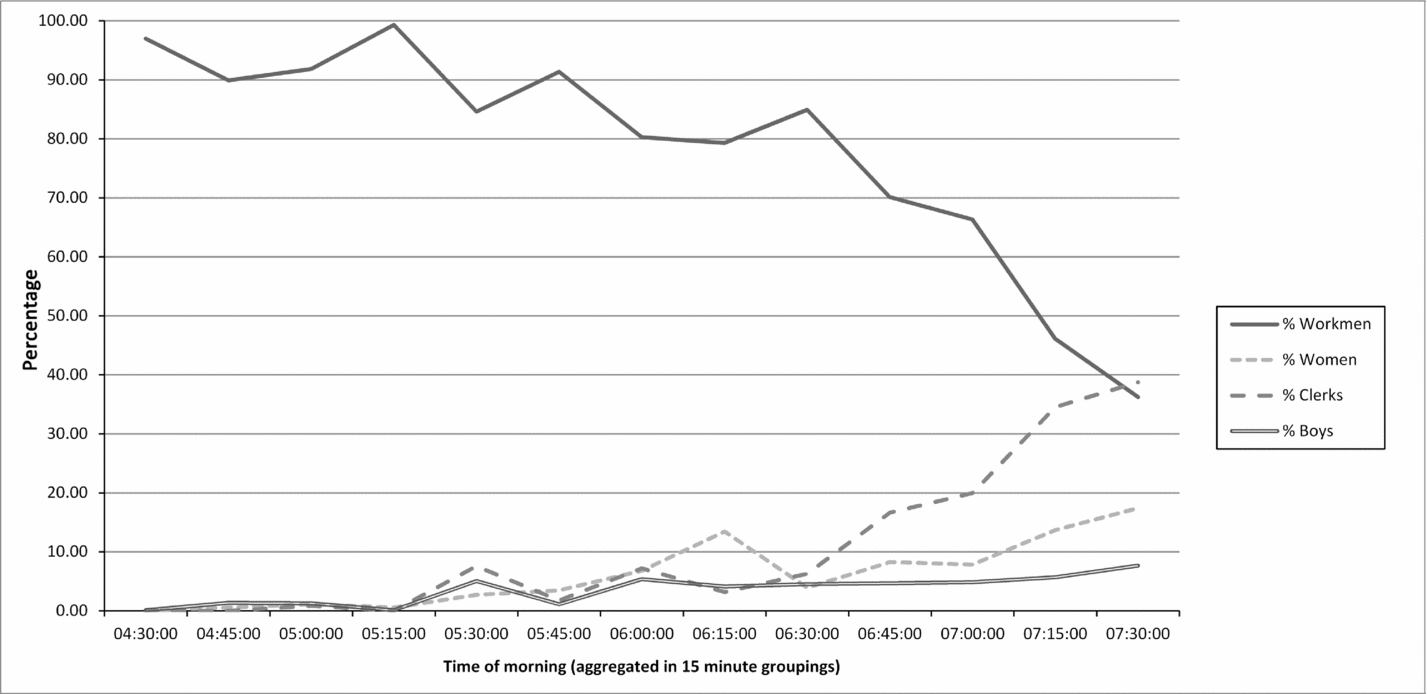
However, important detail is lost by averaging the data. Figure 2 shows the proportions of the four main groups of passengers and aggregates the starting times of the trains they were travelling on into 15 minute intervals. This shows how the relative proportions of passengers changed over the morning. The proportion of workmen, effectively the only passengers before 5am, drops rapidly after 6.30am (in absolute terms approximately one third of passengers surveyed began their journeys between 6.00 and 6.30am). In contrast, the number of clerks begins to rise, peaking around 7.30am when approximately 1,480 clerks began their journeys. This demonstrates that railways were reasonably successful in separating their passengers by social class. The number of female passengers peaks in absolute terms around 6.00am (557 passengers) and proportionally around 6.15am (301 passengers). This was around the time the last 2d trains were leaving, suggesting a rush by workwomen passengers to travel on the latest 2d trains possible. On the last 2d workmen's train from Edmonton (the 6.21am), just under a quarter of passengers were female. The proportion of women then slowly starts to rise again after 6.30 am. These individuals are probably a mix of workwomen deferring their travel at greater expense to avoid loitering and female clerks travelling alongside their male counterparts (in 1911 around 22 per cent of clerks nationally were female).Footnote 66 Unfortunately, the generic way female passengers were recorded makes it impossible to provide a more detailed analysis.
Proportions of passengers travelling on workmen's and half-fare trains between 4.30am and 7am from LCC surveys conducted 1899–1901. 141 trains run by the Great Eastern, Great Northern, London, Brighton & South Coast, London & North Western, London & South Western, North London, and South Eastern railway companies were examined. The absolute number of passengers peaks around 6.00am with 8,206 passengers travelling, with smaller peaks at 5am (5,396) and 7am (5,384).
Conclusion
Workmen's trains were therefore accessible to a much broader spectrum of the working class before 1914 than has previously been supposed. Far from being restricted to the artisan elite, workmen's trains were used by men in irregular and unskilled work, including general labourers, builder's labourers, porters, packers and even apparently dock workers. By at least the 1890s, households which required children or wives to earn subsidiary wages, those asserted to be most dependent on living in the centre of London, were also using workmen's trains. The arguments made by Hill and Shaftesbury, and then repeated by Dyos and Polasky, are therefore less accurate for the 1890s onwards. Stedman Jones’ assertion that in the 1870s a married man with a family would need to earn over 30s weekly to afford moving out was no longer true in the decades that followed.Footnote 67 However, this phenomenon was not universal around London, being largely restricted to the north-eastern and eastern suburbs where fares and rents were cheapest. Expense and inconvenience remained problematic and conditions on the trains could be appalling. Frank Broad, the Labour member of parliament for Edmonton during much of the interwar period and a former workman passenger, recalled in 1922 that
During a hot summer we had girls who had been working in underground warehouses, men who had come from the fish market with their clothes reeking from that market, men from the meat market, and men from all sorts of industries – men whose work had made them perspire until their clothes were reeking with perspiration. There were 22 in a carriage [compartment], night after night packed into the compartment, with no means of getting air, until I myself have had to get out mid-way and vomit at the station because of the condition of the carriages. Hon. Members who represent the railway companies may laugh at such disgusting tales, but I have seen girls faint, and men faint, this, of course, following their day's work.Footnote 68
For some, however, the benefits of a healthier environment and cheaper rents outweighed these problems. This explains why men on irregular weekly wages as low as 18s moved into the suburbs and remained there for many years. It also explains why family members on low subsidiary earnings, as low as 5s, were willing to spend hours commuting and loitering. These commuters probably never formed a majority of residents in these boroughs. Kellett estimated that in the outer eastern and north-eastern districts served by the GER perhaps one in two of the working population were commuters while around one in four workers used public transport in London as a whole in 1906, though these estimates should be treated with caution.Footnote 69 But they were a significant minority, often fundamental to the development of the district. Edmonton, for example, gained its working-class character largely as a consequence of workmen's trains. Furthermore, a large proportion of the working class had the ability to commute from the outer suburbs if they chose to. This would include Booth's class C workers, on irregular earnings of 18–21s, and class D, on small regular earnings, both considered in poverty, though classes A and B, the casual workers and very poor remained excluded. As classes A–D consisted of an estimated 30 per cent of the working class, the cheapest workmen's trains offered suburban living to the majority, though a multitude of other reasons might prevent working-class households from relocating into the suburbs.Footnote 70 While workmen's fares outside the east and north-east districts were often too expensive and inhibited working-class suburbanization, as the railway companies usually intended, the 2d trains especially were important for establishing some of London's earliest outlying working-class districts. As one workman claimed in 1911, and for many working-class suburbanites like him, these trains were fundamental in escaping central London's ‘wilderness of houses’.Footnote 71