Background
The pathophysiology of bipolar disorder (BD) is complex, involving genetic, epigenetic, and environmental factors.Reference Mühleisen, Leber and Schulze 1 , Reference Lichtenstein, Yip and Björk 2 Current theoretical frameworks postulate that these factors underlie neuronal changes (eg, hyperexcitability), further leading toward: (a) circuitry and brain matter changes (eg, respectively, default mode network alterations and gray matter loss); (b) systemic consequences (eg, increased inflammation and oxidative stress); and (c) behavioral correlates (eg, changes in energy and activity levels).Reference Vieta, Berk and Schulze 3 Together these pathways determine functional outcome in BD, commonly marked by cognitive deficits and poor psychosocial adjustment.Reference Vieta, Berk and Schulze 3 – Reference Chen, Fitzgerald, Madera and Tohen 5
Over the years, BD has been linked to peripheral and central nervous system immune and/or inflammatory mechanisms.Reference Fries, Walss-Bass, Bauer and Teixeira 6 – Reference Giridharan, Sayana and Pinjari 8 Cytokines—molecules responsible for immune cells interactions—have been reported to be increased in patients with BD, especially during mood episodes,Reference Muneer 9 – Reference Barbosa, Vaz and Rocha 12 including interleukin (IL)-1β, IL-4, IL-6, IL-10, tumor necrosis factor (TNF)-α, and interferon (IFN)-γ.Reference Giridharan, Sayana and Pinjari 8 , Reference Barbosa, de Almeida Ferreira and Rocha 13 – Reference Kunz, Ceresér and Goi 15
Regarding structural neuroimaging findings, reductions in brain gray matter (GM) volumes and thickness in several regions have been consistently reported in BD.Reference Du, Wu and Yue 16 – Reference Hibar, Westlye and Doan 18 Specific cortical areas found with low GM were frontal regions, including orbitofrontal cortex, inferior frontal cortex, pars orbitalis, middle frontal cortex, right ventral prefrontal cortex, and right fronto-insular cortexReference Chen, Chang and Hsu 19 – Reference Wise, Radua and Via 22 ; occipitotemporal regions, including lingual gyrus, planum polare, temporal pole, and temporal gyrusReference Chen, Chang and Hsu 19 , Reference Selvaraj, Arnone and Job 20 , Reference Wise, Radua and Via 22 , Reference Sarıçiçek, Yalın and Hıdıroğlu 23 ; other cortical regions, like parahippocampal gyrus and cingulate cortexReference Wise, Radua and Via 22 , Reference Mathew, Gardin and Tandon 24 , Reference Shi, Guo and Fan 25 ; and subcortical regions, namely insula, claustrum, hippocampus, and thalamus.Reference Selvaraj, Arnone and Job 20 , Reference Hibar, Westlye and van Erp 26
Despite the evidence pointing out the involvement of both peripheral inflammation and structural brain changes in BD, only a few studies have evaluated the potential link or association between these two different features of BD pathophysiology. Apart from few studies showing a link between volumetric alterations and IL-6,Reference Chen, Chang and Hsu 19 , Reference Warren, Beason-Held and Carlson 27 there is a dearth of research investigating potential associations between inflammatory biomarkers and volumetric changes in BD.Reference Benedetti, Aggio, Pratesi, Greco and Furlan 28 Our study aimed at exploring potential correlations between peripheral inflammatory biomarkers and frontolimbic volumes in patients with BD.
Methods
Study sample
This study was performed at the UT Center of Excellence on Mood Disorders, Houston, TX. Twenty-one patients with BD type I were recruited from the associated outpatient clinic. Healthy controls (n = 22) were recruited through flyers placed in the community.
The inclusion criteria for cases and control were (a) Age 18 to 65 years old; (b) any race/ethnicity; (c) fluency in English; and (d) have the capacity to give informed consent. Additional specific inclusion criteria for the patient group were (a) bipolar I disorder and (b) euthymic mood state, identified as lack of any active symptoms of severe depression or mania or psychosis (based on the clinical scales mentioned below). The inclusion criteria for controls incorporated (a) no lifetime diagnosis of major psychiatric and neurologic disorders and (b) no family history of any axis-I psychiatric disorder and/or hereditary neurologic disorders in first-degree relatives. For both cases and controls, the exclusion criteria were (a) any current major medical problems that could potentially affect brain anatomy or function; (b) history of any central nervous system diseases; (c) family history of hereditary neurological disorders; (d) pregnancy; (e) substance abuse or dependence; and (f) any contraindications to magnetic resonance imaging (eg, floating metallic objects in the body). The Structured Clinical Interview for DSM-IV (SCID)Reference First 29 was administered to confirm the diagnosis of BD among patients and the absence of a psychiatric diagnosis in controls. Written informed consent was obtained from patients and healthy controls. The UT Health Institutional Review Board approved the study protocol.
Demographic data, including age, sex, weight, height, and education were obtained. Any potential confounding effects of cognitive deficits were ruled out through our exclusionary criteria and cognitive assessment with the montreal cognitive assessment.Reference Carson, Leach and Murphy 30 Only patients performing above the cutoff points in the general cognitive assessment scale were recruited for the study.
Clinical scales
To assess clinical variables, the following scales were used—(a) The Clinical Global Impressions (CGI) Scale with subscales of CGI-1 = severity of mania, CGI-2 = severity of depression, and CGI-3 = severity of overall illness; (b) Montgomery–Åsberg Depression Rating Scale (MADRS) for depressive symptoms; (c) Young Mania Rating Scale (YMRS) for manic symptoms; (d) Behavioral Inhibition System (BIS) scale for aversive motives; and (e) Functioning Assessment Short Test (FAST) for functional impairment.
Blood work
Blood samples were collected in vacuum tubes, centrifuged twice at 1800 g, and samples were stored in −80°C freezer for further processing. Plasma levels of interleukins (IL-1β, 2, 4, 6, 8, 10), TNF-α, IFN-γ were assessed through cytometric bead array. The concentrations were measured in pg/ml. All imaging and plasma analyses were performed blindly to the clinical status of the participants.
Neuroimaging
Based on current literature, frontolimbic regions were assessed to compare between BD patients and controls. All structural neuroimaging scans were acquired using a 3.0 T magnetic resonance imaging (MRI) Philips scanner (Philips Medical System, Andove, MA) using a sagittal three-dimensional T1-weighted fast field echo sequence with the following parameters: Repetition time (TR) = 8.0 ms, echo time (TE) = 3.68 ms, flip angle = 6°, field of view = 288 mm, slice thickness = 0.88 mm, matrix size = 288 × 288 and 180 slices. Cortical thickness and GM volumes measures were acquired using FreeSurfer suite version 6.0.Reference Dale, Fischl and Sereno 31 – Reference Jovicich, Czanner and Greve 33 FreeSurfer is a fully automated software that performs motion correction, intensity normalization, automated topology correction, and atlas-based cortical segmentation and labeling of MRI images.Reference Fischl, Van Der Kouwe and Destrieux 34
Analyses
The statistical packages STATAReference StataCorp 35 and SPSSReference Spss 36 were used for the statistical analyses. Student t-test and chi-square test were used for the statistical inference regarding the comparison of both groups on the variables of interest. Linear regression was used for the correlation analysis between volumetric data and cytokines, with age as a covariate, and further to assess the correlation between clinical data with significant volumetric and cytokine levels.
Results
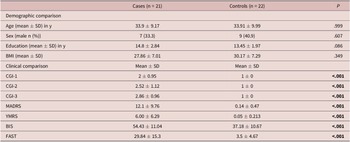
Both groups had similar demographic profiles and, as expected, all psychopathological scores were significantly higher in BD patients compared to controls (Table 1). At the time of the study, 23% of the BD group were using lithium, 27% were taking anticonvulsants, 50% were on antidepressants, 5% were on atypical, and 14% were on typical antipsychotics.
Demographic and Clinical Comparison between Patients with BD and Controls

The Student t-test and the chi-square test were used for the statistical inference; a significance level of 0.05 was adopted.
Bold P values represent those that met the significance threshold (<.05).
Abbreviations: BD, bipolar disorder; BIS, Behavioral Inhibition System scale; CGI, Clinical Global Impressions; CGI-1, severity of mania; CGI-2, severity of depression; CGI-3, severity of overall illness; FAST, Functioning Assessment Short Test; MADRS, Montgomery–Åsberg Depression Rating Scale; YMRS, Young Mania Rating Scale.
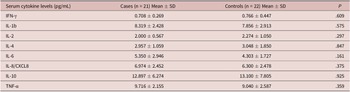
No significant differences were found between BD patients and controls with regard to any of the assessed cytokine levels (Table 2).
Serum Cytokine Level Differences between Patients with BD and Healthy Controls

Abbreviations: BD, bipolar disorder; CXCL8, C-X-C Motif Chemokine Ligand 8; IFN-γ, interferon-gamma; IL, interleukin; TNF-α, tumor necrosis factor-alpha.
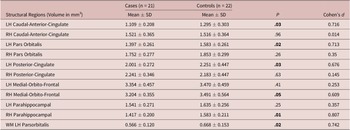
With respect to the volumes of the brain structures analyzed, BD patients had significantly lower GM volumes in (a) left Caudal-Anterior-Cingulate; (b) left Pars orbitalis; (c) left Posterior-Cingulate; (d) right Medial-Orbito-Frontal; (e) right Parahippocampal; and had lower white matter (WM) left Pars orbitalis volume (Table 3). Effect size for all the significantly lower volumes were at least medium (P < .05, d > 0.5). No other volumetric differences were found in frontal, hippocampus, or amygdala regions between BD patients and healthy controls.
Frontolimbic Differences between Patients with BD and Healthy Controls

The Student t-test was used for the statistical inference; a significance level of 0.05 was adopted.
Abbreviations: BD, bipolar disorder; LH, left hemisphere; RH, right hemisphere; WM, white matter.
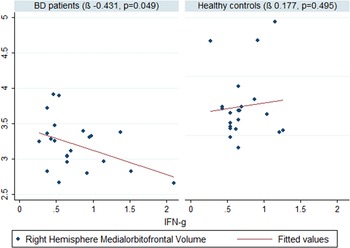
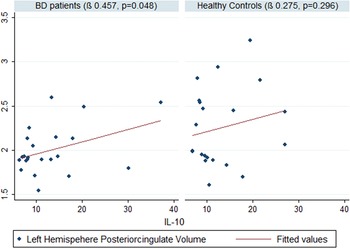
With a regression model adjusted for age as a covariate in regions significantly different between cases and controls, a significant negative correlation was found between the RH Medial-Orbito-Frontal volume and IFN-γ (β = −0.431, P = .049), as well as a significant positive correlation between IL-10 and LH Posterior-Cingulate volume (β = 0.457, P = .048) in BD patients (Figures 1 and 2). No significant correlations were reported between any other cytokine and other brain structures in BD patients or healthy controls.
Correlation between interferon-gamma (IFN-γ) and medial orbitofrontal gray matter volume between patients with bipolar disorder (BD) and controls. Volumes in mm3. Linear regression was used for the statistical inference with age as a covariate. A significance level of 0.05 was adopted.

Correlation between interleukin (IL)-10 and medial posterior cingulate gray matter volume between patients with bipolar disorder (BD) and controls. Volumes in mm3. Linear regression was used for the statistical inference with age as a covariate. A significance level of 0.05 was adopted.

Discussion
In our exploratory study, we found that peripheral immune mediators correlate with frontolimbic changes implicated in the pathophysiology of BD. Specifically, we identified negative correlation between medial-orbito-frontal volumes and levels of IFN-γ, a pro-inflammatory cytokine, while posterior cingulate volumes were positively correlated with the levels of the anti-inflammatory cytokine IL-10.
The relationship between immune-inflammatory pathways and mood disorders has been extensively investigated.Reference Goldsmith, Rapaport and Miller 37 – Reference Miller and Raison 39 While previous studies have shown increased levels of pro-inflammatory cytokines in BD, this evidence has been more consistent in patients with active bipolar depression, mania/hypomania, or mixed mood states.Reference Muneer 9 – Reference Barbosa, Vaz and Rocha 12 For example, high levels of IL-6 have been reported during mania/hypomania, with IL-6 returning to baseline levels after treatment with mood stabilizers.Reference Brietzke, Stertz and Fernandes 40 – Reference Hayes, Khandaker and Anderson 42 We did not find significant differences between patients and controls in the levels of cytokines. Actually, this lack of difference might reflect the fact that our sample comprised only clinically stable euthymic outpatients.
As expected, there were significant differences between patients and controls in volumes of frontolimbic regions implicated in emotion processing and BD pathophysiology.Reference Sanches, Soares, Young and Soares 43 , Reference Teixeira, Colpo, Fries, Bauer and Selvaraj 44 Even with small sample size in this study, the effect size showed significant difference in BD patients. Chen et al.Reference Chen, Chang and Hsu 19 reported volumetric differences in regions like orbitofrontal cortex, lingual gyrus, inferior frontal cortex, middle frontal cortex, and planum polare, which seem to be significantly smaller in patients with BD compared to controls. In the same study, the volume of certain structures (ie, orbitofrontal cortex, middle frontal cortex, inferior frontal cortex, cingulate cortex, lingual gyrus, superior temporal cortex, and Heschl’s gyrus) were negatively correlated with IL-6 receptor levels, suggesting that high levels of pro-inflammatory mediators might affect brain structure.Reference Chen, Chang and Hsu 19 Bai et al.Reference Bai, Chen and Hsu 45 also reported that levels of pro-inflammatory mediators (IL-6 and sTNF-R1) are associated with greater reductions of 12 GM volumes (R. cerebellar lobule, R. putamen, L. putamen, R. superior frontal gyrus, L. lingual gyrus, L. precentral gyrus, R. fusiform gyrus, L. calcarine, R. precuneus, L. inferior temporal gyrus, L. hippocampus, and L. superior frontal gyrus) in BD patients. Our finding of a negative correlation between right medial-orbito-frontal volumes and the levels of IFN-γ is in line with these previous reports.
Our results also show positive correlation between left posterior cingulate cortex volumes and IL-10 levels in BD patients. IL-10 is an anti-inflammatory cytokine and has been found to be increased in the early stages of BD.Reference Kunz, Ceresér and Goi 15 , Reference Kauer-Sant’Anna, Kapczinski and Andreazza 46 Actually, the increase of IL-10 follows a heightend inflammatory response as a compensatory mechanism.Reference Brunoni, Supasitthumrong and Teixeira 47 While the involvement of cingulate cortex in emotional processing and pathophysiology of mood disorders has been well-described, there is no clear consensus about the function of posterior cingulate cortex (PCC) within system-level models of brain function.Reference Leech, Braga and Sharp 48 One hypothesis is that PCC plays a central role in supporting internally directed cognition as it shows increased activity when individuals retrieve autobiographical memories or plan for the future.Reference Buckner, Andrews-Hanna and Schacter 49 PCC also plays a direct role in regulating the focus of attention and the balance between internally and externally focused thoughts.Reference Leech and Sharp 50
Altogether all results suggest that inflammation, as evidenced by pro- and anti-inflammatory cytokines, might be involved in progressive structural changes in brain areas implicated in emotion processing and pathophysiology of BD. Interestingly, an “allostatic load” theory has been proposed to explain the progressive changes in BD, also called “neuroprogression,” based on the physiological “wear and tear” in response to multiple stressors, and associated with increased peripheral inflammation among other biological processes.Reference Castaño-Ramírez, Sepúlveda-Arias, Duica, Zuluaga, Vargas and López-Jaramillo 51
Our study had several limitations. First, all patients were medicated at the time of their participation in the study. The lack of significant differences in cytokine levels between patients and controls can also be attributed to different effects of medication on cytokines.Reference Altinay, Karne and Anand 52 – Reference Köhler, Freitas and Md 54
Literature from studies in rodents and human cell lines have showed effect of psychotropic medications on brain volume changes in BD. While lithium and valproate have shown neurotrophic effects in vitro, antipsychotics; especially first-generation ones have been associated with brain volume loss.Reference McDonald 55 Specifically, the anterior cingulate cortex (ACC) region has been found with significantly lower volume in earlier phases of BD.Reference Fountoulakis, Giannakopoulos, Kövari and Bouras 56 Given our sample size and euthymic status of our patients, it was not possible to assess impact of psychotropic medications in our patients.
Second, the small sample size is another limitation of our study, preventing us from carrying out stratified analyses. Third, the cross-sectional nature of study limited our ability to infer causal relationships between inflammatory biomarkers and GM volumes. Taking into consideration that the inflammatory cytokines per se could be influenced by many factors including body weight and other medical comorbidities, it will be important to follow the trajectory of both inflammatory biomarkers and GM volumes in drug-naïve and drug-free patients.
In summary, our findings corroborate the importance of the complex interactions between inflammation and structural brain changes in the pathophysiology of BD. Future studies including patients in different mood states and adopting longitudinal designs are of pivotal importance to further elucidate this complex relationship and its possible implications for a better understanding of BD, its pathophysiology, and ultimately its management.
Financial Support
Partly supported by NIMH grant 1R01MH085667-01.
Disclosures
The authors have no conflicts of interest to disclose.