Introduction
Corynosoma strumosum (Rudolphi, 1802) Lühe, 1904 matures in seals and other marine mammals in the Holarctic Region. Larvae develop in amphipods (Van Cleave Reference Van Cleave1953; Hoklova Reference Hoklova1986), and many species of fish serve as paratenic hosts. Juveniles are commonly found in accidental hosts such as mammals (including man), birds, and other fish-eating animals (Schmidt Reference Schmidt1971). Partial lists of paratenic, accidental, and definitive host species and worldwide geographical distribution can be found in Meyer (Reference Meyer and Bronn1933), Van Cleave (Reference Van Cleave1953), Petrochecko (Reference Petrochenko1958), Yamaguti (Reference Yamaguti1963), Margolis & Dailey (Reference Margolis and Dailey1972), Schmidt (Reference Schmidt, Crompton and Nickol1985), Hoklova (Reference Hoklova1986), and Valtonen & Helle (Reference Valtonen and Helle1982).
The first detailed information on Caspian seal parasites was reported by Shchupakov (Reference Shchupakov1936) and Dogiel (Reference Dogiel1947, Reference Dogiel, Polyansky and Kheisinym1962), who declared the Caspian seal a relic species for having lost cestode and arthropod parasites. Kurochkin (Reference Kurochkin1975) included C. strumosum in one of three groups of widely distributed Caspian seal parasites that also infect other species of seals and terrestrial mammals and birds elsewhere. In the Caspian Sea, many species of paratenic fish hosts have been reported. These include, but are not limited to, sturgeons (Sattari & Mokhayer Reference Sattari and Mokhayer2005). Palo (Reference Palo2003) proposed that the Caspian seal (and its parasites) descended from the ringed seal Pusa hispida (Schreber) and reached the Caspian during the Quaternary period from the north when continental ice sheets melted. Popov and Fortunato (Reference Popov and Fortunato1987) previously documented substantial morphological variations in various geographical populations of C. strumosum from the ringed seal, extending from Barents, East Siberian, Bering, and Oshotsk seas, especially at the Chaun Bay in the East Siberian Sea, which were attributable to prolonged isolation. In the present investigation, we (Amin et al. Reference Amin, Heckmann, Halajian and El-Naggar2011) revisit our original description and provide the first molecular analysis of this unique population of C. strumosum as a new species.
In the present investigation, over 700 specimens were collected from one seal. Representative samples were studied with light microscopical studies, scanning electron microscopy (SEM), and histopathology. SEM, transmission electron microscopy (TEM), and histopathological findings are reported for the first time. We conducted phylogenetic analyses based on the nuclear markers, the internal transcribed spacer (ITS1-5.8S-ITS2) region, and mitochondrial cox1 gene to describe the new species and determine its relationships with congeners.
Materials and Methods
Worms were collected from the intestine of one young male Caspian seal off Ramsar City, Mazandaran Province, Iran (36°55’N, 50°40’E) on 29 April 2009. Specimens were processed routinely for microscopical examination, and histological, SEM, and TEM studies were conducted as described in Amin et al. (Reference Amin, Heckmann, Halajian and El-Naggar2011).
DNA extraction and PCR amplification
For molecular analysis, genomic DNA was extracted from ethanol-preserved worms using Qiagen DNeasy tissue kit (Qiagen Inc., Valencia, CA, USA) according to the manufacturer’s instructions. Finally, purified DNA was kept at -20°C until use. The polymerase chain reaction (PCR) mixture was performed in a final volume of 30 μL containing 15 μL of 2X PCR premix with 1.5 mM MgCl2 (Ampliqon, Odense, Denmark), 20 ρM of each primer, and 2 μL of the extracted DNA. PCR amplification of the ITS1-5.8S-ITS2 ribosomal RNA fragment was performed using the primers BD1 (5′ GTCGTAACAAGGTTTCCGTA-3′) and BD2 (5-TATGCTTAAATTCAGCGGGT-3′) (Luton et al. Reference Luton, Walker and Blair1992). Also, primers used for the amplification of the partial mitochondrial cytochrome oxidase subunit1 gene were COI-F (5′-AGTTCTAATCATAARGATATYGG-3′) and COI-R (5′ TAAACTTCAGGGTGACCAAAAAATCA-3′) (Folmer et al. Reference Folmer, Black, Hoeh, Lutz and Vrijenhoek1994). The PCR conditions of ITS-rDNA region amplification consisted of initial denaturation at 95°C for 5 min, 35 cycles of 95°C for 30 s, 55°C for 30 s, and 72°C for 90 s, followed by a final extension at 72°C for 10 min. The thermal PCR profiles for cox1 gene consisted of initial denaturation at 95°C for 6 min followed by 35 cycles of 95°C for 30 s (denaturation), 55°C for 30 s (annealing), and at 72°C for 60 s (extension), with a final extension of 72°C for 6 min. The PCR products were separated by electrophoresis on a 1.5% agarose gel and visualized with UV transluminator (Vilber Lourmat, Collégien, France). Finally, PCR products were sequenced by an ABI 3730 DNA Analyzer (Applied Biosystems, Foster City, CA, USA).
Phylogenetic analysis
Sequences of the ITS cluster and the cox1 gene were aligned with other respective sequences available on the Genbank database for species of Corynosoma using ClustalW (Higgins et al. Reference Higgins, Thompson, Gibson, Thompson, Higgins and Gibson1994) with default parameters, implemented using Molecular Evolutionary Genetic Analysis (MEGA11; Tamura et al. Reference Tamura, Stecher and Kumar2021) (Table 1). In the phylogenetic analyses, sequences belonging to the species Polymorphus were used as outgroups (Table 1). For the phylogenetic analysis, the jModelTest 0.1.1 programme (Darriba et al. Reference Darriba, Taboada, Doallo and Posada2012) was used to select the best-fit nucleotide substitution model, and the Akaike Information Criterion (AIC) was chosen. This was the model GTR + G + I (general time-reversible model, including estimations of invariant sites and gamma distributed among-site variation) that was calculated as the best-fitting model for both genes. Phylogenetic trees were reconstructed by maximum likelihood (ML) and Bayesian inference (BI) analyses. For ML analyses, the program MEGA11 was used, and a GTRGAMMAI substitution model was used for the ML analyses. To assess nodal support for the present ML analysis, 10,000 bootstrap replicates were run. The BI tree was constructed using Topali 2.5 (Milne et al. Reference Milne, Lindner, Bayer, Husmeier and McGuire2009) with a Metropolis-coupled Markov Chain Monte Carlo (MCMCMC) search on two simultaneous runs of four chains over 1000,000 generations with every 100th tree saved. The ’burn-in’ was set to 25. The genetic distances (uncorrected p-distance) were calculated with MEGA11. The new sequences obtained for Corynosoma neostrumosum n. sp. in the present study were deposited in GenBank for accession numbers.
Corynosoma species included in the phylogenetic analysis with information on the host, locality, and GenBank accession number

Species in bold sequenced during the present study.
* Sequences unpublished available on Genbank database.
Results
Amin et al. (Reference Amin, Heckmann, Halajian and El-Naggar2011) established the morphological uniqueness of the isolated population of Corynosoma sp., recognized then as C. strumosum, from the Caspian seal specimens in the land-locked Caspian Sea. Amin et al. (Reference Amin, Heckmann, Halajian and El-Naggar2011) provided more descriptive details, measurements, 20 SEM and TEM, and eight histopathological images that apply equally well to the newly designated species Corynosoma neostrumosum by virtue of molecular analysis that was not previously available. Appropriately, however, major highlights adapted from the Amin et al. (Reference Amin, Heckmann, Halajian and El-Naggar2011) descriptive morphological account are presented below.
Description of Corynosoma neostrumosum n. sp.
General. Trunk less than 5.00 mm long, bulboid anteriorly and cylindrical with parallel sides posteriorly. Sexual dimorphism slight in trunk size but marked in size of proboscis and proboscis hooks. Anterior trunk sharply tapers into a conical neck. Integument with many micropores and posteriorly pointed ovate spines. Anterior spines larger, confined to bulboid swelling, and dispersed in longitudinal and in circular rows. Posterior spines in up to seven circular rings incomplete anteriorly. Proboscis bent ventrally, with 16–18 (usually 16) longitudinal rows of 9–10 (rarely 11) hooks each. Outer layer of hooks hard, thin, and porous, enveloping inner medullary core. Dorsal hooks relatively smaller than ventral hooks. Apical end of proboscis bare. Anterior hooks small slender progressively becoming more robust posteriorly up to hook 5. Hook 6 invariably longest and most robust. Posterior four hooks smallest, becoming progressively smaller more posteriorly. Hooks 5–7 more widely spaced. Roots of anterior six hooks simple, slightly longer than blades. Roots of posterior hooks small, stubby. Lemnisci equal, slightly shorter than double walled proboscis receptacle; receptacle longer than proboscis. Gonopore terminal in both sexes.
Males (based on five mature adults). With ovoid oblique testes, tandem at posterior end of anterior trunk bulb or anterior end of posterior trunk. Anterior testis larger than posterior testis. Clavate cement glands six, in three pairs, larger posteriorly.
Females (based on 10 gravid adults). reproductive system at most posterior portion of posterior trunk. Fully ripe eggs corrugated longitudinally with polar prolongation of fertilization membrane. Terminal gonopore with prominent lips. Copulation plug may retain open channel with gonopore and may indicate multiple copulations.
Taxonomic summary
Type host: Caspian seal, Pusa caspica (Gmelin).
Type locality: The Caspian Sea by Ramsar City, Mazandaran Province off the southern coast of Iran (36°55’N, 50°40’E).
Site of infection: Intestine.
Deposits: Holotype male, allotype female, and many paratypes on two slides were deposited in the University of Nebraska’s State Museum’s Harold W. Manter Laboratory (HWML) (Coll. no. 49703 and Accession nos. P-2011-014), Lincoln, NE.
Representative DNA sequences: ITS (ITS1-5.8S-ITS2), OQ750114 (738 bp); Cox1 gene, OQ745812 (521 bp).
Etymology: The new name designates the elevated new Caspian Sea form derived from the old Corynosoma that is often reported from open waters.
Remarks
The distribution of trunk spines is but one feature distinguishing our population of Caspian Sea specimens from others reported elsewhere. Other marked distinguishing features include the consistently smaller size of trunk and testes, larger eggs, and fewer proboscis hooks. Specimens of C. neostrumosum from P. capsica in the southern Caspian Sea could be confused with those of the superficially similar Corynosoma capsicum Golvan and Mokhayer, Reference Golvan and Mokhayer1973 known from three other species of sturgeon, Acipenser stellatus Pallas, A. guldenstaedtii Brandt, and Huso huso Linn., in the same Caspian Sea. Based on Glovan and Mokhayer (Reference Golvan and Mokhayer1973), C. caspicum can be distinguished from C. neostrumosum based on Amin et al. (Reference Amin, Heckmann, Halajian and El-Naggar2011) by the following morphological differences, in addition to the following molecular evidence. In C. neostrumosum, the length of males and females averaged 3.65 mm and 3.86 mm vs. 3.92 mm and 4.67 mm, respectively in C. capsicum. Male proboscis: 0.582–0.645 (609) X 0.250–0.281 (0.260) mm vs. 0.575 X 0.260 mm. Female proboscis 0.686–759 (0.725) mm X 0.270–0.322 (0.301) mm vs. 0.725 X 0.270–0.320 mm. Proboscis hooks in 16–18 rows each with 9–10 (rarely 11) hooks vs. 16 rows of 10 hooks each. In C. neostrumosum, hooks 5–7 are more widely spaced and the sixth hook is suddenly much bigger vs. hooks equally spaced and the fifth hook largest in C. capsicum. Length of largest hooks in C. neostrumosum is 65–70 μm dorsally and 72–77 μm ventrally in males and 80–92 μm dorsally and 87–100 μm ventrally in females vs. the distinctly smaller corresponding hooks of 43 μm in males and 60 μm in females of C. capsicum. Hook 7 measured 40–42 μm long in males and 45–52 μm in females of C. neostumosum vs. 30 μm and 48 μm in C. capsicum. The roots of the smaller posterior hooks (posterior to hooks 6 & 7) are shaped like a three-pointed star in C. capsicum, but not so in C. neostrumosum. The testes are smaller in C. capsicum, 0.30 X 0.25 mm, than in C. neostrumosum, at 0.228–0.447 mm (368) (anterior) and 0.187–0.447 mm (0.312) (posterior) X 104–270 (210) mm (anterior) and 135–270 (197) (posterior). The number of cement glands is especially important, reported as four in C. capsicum but six in C. neostrumosum.
Most importantly Golvan & Mokhayer (Reference Golvan and Mokhayer1973) clearly stated that C. capsicum is distinctly a different species than C. strumosum. We shall coin their rationale (p. 602), with which we totally agree, as follows: “l’espèce que nous avons trouvée chez les esturgeons est nettement différente de C. strumosum. Ce dernier est en effet nettement plus grand (jusqu’à 9 mm de long), il possède de 22 à 24 files de crochets dont 8 à 10 crochets vrais suivis de 5 à 6 épines basales. Le dimorphisme sexuel est peu apparent alors qu’il est très net chez notre espèce. De plus la spinulation du tronc est, chez C. strumosum, en continuité avec la spinulation génitale alors que chez nos exemplaires des deux sexes, le champ antérieur est nettement séparé du champ génital par une longue zone inerme occupant presque toute la face ventrale de la portion cylindrique du tronc. Il faut enfin signaler la morphologie très particulière des racines des crochets des couronnes VI et VIL.”
Palo’s (Reference Palo2003) proposal that the Caspian seal descent from the ringed seal and its subsequent isolation (along with its parasites) in the Caspian Sea during the Quaternary period from the north when continental ice sheets melted suggest that the uniqueness and evolution of our Caspian Sea population may be related to its geographical isolation since glacial times. Not having had the molecular findings that we now do, we initially proposed that “we do not regard the differences between our Caspian Sea population of C. strumosum and those reported elsewhere to be of sufficient magnitude that warrants its designation as a new species” (Amin et al. Reference Amin, Heckmann, Halajian and El-Naggar2011). Our molecular findings now provide support for the elevation of the status of that “unique” Caspian Sea “population” to a higher status as an independent species.
Phylogenetic analyses
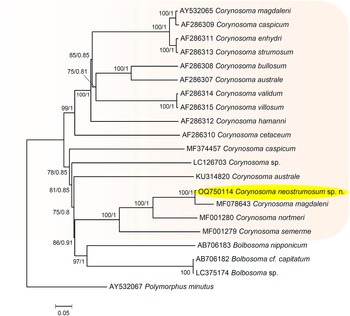
ITS region: The ITS sequence of Corynosoma neostrumosum n. sp. amplified herein is 737 bp in length. For the genus Corynosoma, the ITS sequence data are available in GenBank for the species shown in Figure 1 and Table 1. Pairwise comparison of the ITS sequences of C. neostrumosum n. sp. obtained herein with congeners displayed 0.25–0.76% nucleotide divergence.
Phylogenetic analysis of C. neostrumosum n. sp. ITS region of rDNA gene sequences using the maximum likelihood algorithm. The numbers on each node correspond to the bootstrap analysis of 10,000 replicates (only the percentage greater than 70% are represented). Numbers above branches indicate nodal support as maximum likelihood (ML) and posterior probabilities from BI. The sequences amplified in the present study are highlighted in a yellow box. The GenBank accession numbers of the species used in the phylogenetic analysis are also shown. The scale bar indicates distance.

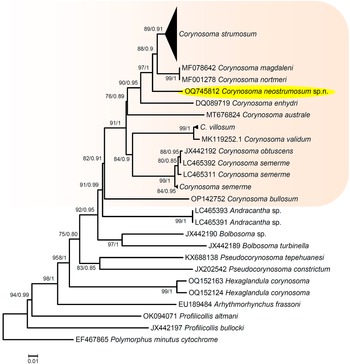
Cox1 region: One cox1 sequence of Corynosoma neostrumosum n. sp. obtained herein is 521 bp in length. In the genus Corynosoma, the cox1 sequence data are available in GenBank for the species shown in Figure 2 and Table 1. Pairwise comparison of cox1 sequences of Corynosoma neostrumosum n. sp. with isolates of C. strumosum showed 0.10–0.17% nucleotide divergence, and with the other two closely related species, C. magdaleni (MF078642) and C. nortmeri (MF001278), there was 0.16–0.17% nucleotide divergence.
Phylogenetic tree based on the mitochondrial cytochrome c oxidase subunit 1 (cox1) gene dataset for Corynosoma spp. Bootstrap support values and posterior probabilities and are shown as nodal support; only values > 0.80 (BI) and 75% (maximum likelihood). The scale-bar indicates the expected number of substitutions per site.

Phylogenetic results based on the ITS and cox1 sequence data using ML and BI methods show similar phylogenies (Figures 1 & 2). In the ITS tree (Figure 1), C. neostrumosum n. sp. clustered together with the representatives of Corynosoma with strong support; it also formed a sister relationship with Corynosoma magdaleni with good support (Figure 1). The resulting ITS region phylogeny is clearly distinct between C. neostrumosum n. sp. and the species C. strumosum whose one sequence is available in GenBank (AF286313). The mitochondrial cox1 showed a more resolved phylogenetic relationship, especially between the representatives of Corynosoma with C. neostrumosum n. sp. (Figure 1). In the tree, C. neostrumosum n. sp. clustered distinctly, in a highly supported clade (ML = 97%; BI = 1.00) (Figure 1). The representatives of C. strumosum formed a sister relationship with C. neostrumosum n. sp. that constituted a separated branch, confirmed it is a different species, as also predicted by Amin et al. (Reference Amin, Heckmann, Halajian and El-Naggar2011). According to Amin et al. (Reference Amin, Heckmann, Halajian and El-Naggar2011), they looked at the differences between their Caspian Sea population of C. strumosum and others reported previously and found adequate differences that could designate it as a new species.
Discussion
The family Polymorphidae comprises a large group of acanthocephalans that are mainly parasites of marine mammals including fish-eating marine birds and waterfowl, with more than 120 species described (Schmidt Reference Schmidt1975; Dimitrova & Georgiev Reference Dimitrova and Georgiev1994; Aznar et al. Reference Aznar, Pérez-Ponce de León and Raga2006; García-Varela et al. Reference García-Varela, Pérez-Ponce de León, Aznar and Nadler2011, 2013; Amin Reference Amin2013; Aznar et al. Reference Aznar, Crespo, Raga and Hernandez-Orts2016, Reference Aznar, Hernandez-Ortes and Raga2018; Ru et al. Reference Ru, Yang, Chen, Kuzmina, Spraker and Li2022). In this family Amin (Reference Amin2013) included 12 genera viz. Andracantha, Ardeirhynchus, Arhythmorhynchus, Bolbosoma, Corynosoma, Diplo-spinifer, Filicollis, Ibirhynchus, Polymorphus, Profilicollis, Pseudocorynosoma, and Southwellina.
We have demonstrated the morphological uniqueness of an isolated population of Corynosoma recently described as C. strumosum obtained from the Caspian seal in the Caspian Sea, as well as its molecular identity as C. neostumosum n. sp., and associated its peculiarities to its long isolation from its source populations. Since the study of Amin et al. (Reference Amin, Heckmann, Halajian and El-Naggar2011), very few studies have addressed the morphology of C. strumosum; these include studies by Niksirat et al. (Reference Niksirat, Hatef, Hajimoradloo, Ghorbani and Nikoo2006), Aznar et al. (Reference Aznar, Crespo, Raga and Hernandez-Orts2016, Reference Aznar, Hernandez-Ortes and Raga2018), Leidenberger et al. (Reference Leidenberger, Boström and Wayland2019), Salnikova et al. (Reference Salnikova, Golubev, Mlutina and YaI2017), and Lisitsyna et al. (Reference Lisitsyna, Kudlai, Spraker and Kuzmina2018). None of these works, however, addressed the impact of long isolation on morphometric variability. Issues related to the molecular identity of C. neostrumosum n. sp. are addressed below.
In light of the presented finding and the new designation of C. neostrumosum n. sp. from the Caspian seal, P. capsica, in the Caspian Sea, we would like to draw attention to the many publications reporting C. strumosum from other host systems, namely fish, in the Caspian Sea, to emphasize the need for verification of the identity of reported specimens that can be easily confused with C. neostrumosum n. sp. We have identified 21 such reports from the southeast and southwest of the Caspian Sea in Iran alone, where our specimens were collected, of which 12 sites were listed by Tavakol et al. (Reference Tavakol, Amin, Luus-Powell and Halajian2015), excluding associated rivers and lagoons. Reports from other countries bordering the Caspian Sea in more northern latitudes, e.g. Azerbaijan, Kazakhstan, Turkmenistan, and Russia, remain to be accounted for.
The present species, C. neostrumosum n. sp., was morphologically studied by Amin et al. (Reference Amin, Heckmann, Halajian and El-Naggar2011), who predicted it to be a different population of C. strumosum. We reported the ITS and cox1 sequence data of the same population, which enabled us to more accurately identify our present material. Pairwise comparison of both the ITS and cox1 sequences in the dataset and the phylogenetic relationship of our material with C. strumosum showed each of them to be a different species. The present molecular analysis revealed that the genetic variation in the ITS and cox1 regions shows useful genetic markers for identifying and discriminating acanthocephalan parasites (Rosas-Valdez et al. Reference Rosas-Valdez, Morrone, Pinacho-Pinacho, Domínguez-Domínguez and García-Varela2020; Chaudhary et al. Reference Chaudhary, Amin, Heckmann and Singh2020; Ru et al. Reference Ru, Yang, Chen, Kuzmina, Spraker and Li2022), especially for the analysis of closely related species. Our phylogenetic results from the ITS region showed that our Caspian Sea population of C. neostrumosum is clearly differentiated from the closely related species, C. strumosum and C. magdaleni, with strong support that aligns with Amin et al. (Reference Amin, Heckmann, Halajian and El-Naggar2011). Moreover, the cox1 phylogenetic analysis produced a more resolved clade between species of Corynosoma. The phylogenetic analysis herein inferred using the cox1 gene of C. neostrumosum n. sp. has formed a distinct and well-supported phylogenetic lineage (Figure 2). These findings are consistent with a previous study of morphological description provided by Amin et al. (Reference Amin, Heckmann, Halajian and El-Naggar2011). C. strumosum and C. neostrumosum n. sp. Share close morphological features that can be easily understood, considering that they have the same hosts. The present phylogenetic analysis supported the validity of the population of C. strumosum of Amin et al. (Reference Amin, Heckmann, Halajian and El-Naggar2011) as C. neostrumosum n. sp., which is sister to C. strumosum, C. magdaleni, and C. nortmeri, with strong support in both analyses of the phylogenetic tree. However, for the species C. capsicum from the Caspian sea and from the same host (AF286309 and MF374457) as our species neostrumosum, no Cox1 sequence was available, but the 18S analyses were consistent with both the isolates of C. capsicum and our species, forming clades far apart from each other.
Therefore, the present new species within the genus Corynosoma with distinctive morphological characteristics shows that the diversity of acanthocephalan parasites in fish across the Middle East is still poorly known and fragmentary, and it is probable that some other species will be described in the near future. Furthermore, the morphological description of acanthocephalan parasites necessitates the use of molecular data to achieve a more stable validation of the species, as in the case of the present study, and to understand the phylogenetic relationships among species and genera.
Acknowledgements
We are grateful to Dr. Ali Halajian, Sefako Makgatho Health Sciences University (SMU), Pretoria, South Africa who originally provided the research material from the Caspian seal and to Dr. Atif M. El-Naggar and Dr. Richard A. Heckmann (deceased) at Brigham Young University, Provo, Utah for producing the SEM and TEM images. We would also like to acknowledge the laboratory facilities provided by the Department of Zoology, Chaudhary Charan Singh University, Meerut, India.
Financial support
None.
Competing interest
None.
Ethical standard
The authors declare that they have observed all applicable ethical standards.