Educators often regard chamber music education to be effective in teaching students’ collaboration, cultivating students’ comprehensive music knowledge and improving students’ performance confidence (Breth, Reference BRETH2010; Dunhill, Reference DUNHILL2013; Emeneth, Reference EMENETH2013; Stubbs, Reference STUBBS1983; Tall, Reference TALL2014). Educators are concerned about teaching ideas and practical methods to better express the concept of a chamber music education. There is a growing body of international evidence indicating that chamber music education positively impacts students. Much of the existing research adopts the methods of observing, interviewing, autobiography and experimentation to understand the influence of chamber music education. For instance, some studies included educators’ personal chamber music playing, teaching experiences and thoughts to help improve students’ ability to perform chamber music (Aho, Reference AHO2009; Loft, Reference LOFT2003; Rutkowski, Reference RUTKOWSKI2000; Tovey, Reference TOVEY2015); some experimented with chamber music in schools using direct coaching and course observation and discovered certain influence points with regard to students (Berg, Reference Berg2008; Carmody, Reference CARMODY1988; Larson, Reference LARSON2010) and other studies examined the standing of chamber music education by interviewing educators, concluding that chamber music education has played a supportive role in music education regardless of students’ study level (Blum, Reference BLUM1987; Hanzlik, Reference HANZLIK2010; Sacks, Reference SACKS2016; Tsai, Reference TSAI2001).
Chamber music education is a relatively new teaching course in China. Due to the country’s historical development, chamber music is not a local genre in China, and China initially followed the European example. The development of chamber music in China began in the late 20th century, which was comparatively late compared with other countries because of previous social, economic and politic instability in China (China in this article refers to mainland China). Since that time, chamber music has gradually been introduced to education, especially higher education. The initial setting occurred at two top Chinese music conservatories (Central Conservatory of Music and Shanghai Conservatory of Music) (Chen, Reference CHEN2014; Rees, Reference REES2009; Zhang, Reference ZHANG2008).
In addition, increasing numbers of experienced musicians and educators returned from the West, where they participated in many chamber music performances and appreciated concert experiences. Their encouragement of the importance of including chamber music in education has only existed in recent years. Increasingly, Chinese college music educators have paid attention to chamber music education, which was progressively extended to more universities (Liu, Reference LIU2010; Wu, Reference WU2002).
After chamber music education was introduced in universities, research in China into an effective and appropriate approach to chamber music education became an urgent issue to be examined. Several observational studies by educators and researchers have contributed to describing and understanding the general development status and systemic problems of Chinese college chamber music education as well as the possible problems of students (Liu & Yu, Reference LIU and YU2015; Hu, Reference HU2014; Qin, Reference QIN2003; Song, Reference SONG2014; Sun, Reference SUN2009; Wang & Wang, Reference WANG and WANG1992; Zhang, Reference ZHANG2015). Other studies explored certain aspects of chamber music education and provided suggestions from educators’ perspectives. For instance, Liu (Reference LIU2009) developed methods to improve intonation during performing from his experience; Piao (Reference PIAO2011) suggested that every player must pay attention to instrumental characteristics and voice balance by illustrating his knowledge of various woodwind instruments and Chen (Reference CHEN2014) examined the construction of the chamber music curriculum by observing and experimenting in certain school and provided suggestions to educators and school managers. Similar outcomes and viewpoints were provided by Long (Reference LONG2010), Wang (Reference WANG2017), and Zhu (Reference ZHU2013).
These studies, primarily written from educators’ and spectators’ perspectives, provided effective information leading to an understanding of the problem of the existing Chinese college chamber music teaching environment. They also contributed to understanding chamber music education in Chinese universities and provided direction for educators and researchers regarding the future of chamber music education in China. Furthermore, these studies provided some indirect information, including explanations of traditional Chinese culture and thought, and demonstrated the relation between knowledge concepts and the music educational environment.
Even though numerous studies contributed to investigating Chinese college chamber music education, very little literature examined chamber music education from the students’ perspectives. Perhaps one of the most significant reasons is that traditional Chinese education considers educators to be the leaders of education (Li, Reference LI2015). Reconsidering basic college education, however, suggests that educators and students are two fundamental subjects and component elements (Feldman, Reference FELDMAN1988; Liu, Reference LIU2012; Jasper, Reference JASPER1959; Zheng, Reference ZHENG2010). Both educators’ and students’ considerations of education and the interaction and communication between them are key points that can aid the development of education (Jorgensen, Reference JORGENSEN2014; McCarger, Reference MCCARGER1993). Without understanding the students’ ideas, educators may only provide what they think is right or effective in teaching, which can cause bias and limit education (Zhao & Zhang, Reference ZHAO and ZHANG2012). Chamber music education is no exception. To better develop Chinese college chamber music education, research involving students is necessary.
Therefore, the author deemed it important to acquire knowledge about the progress of chamber music education in Chinese colleges by examining the perceptions and expectations of the students who have taken chamber music courses in universities. Several aspects have easily been ignored: students’ feeling towards the chamber music courses, students’ role in the chamber music courses and students’ expectations in learning chamber music. Unlike previous studies that investigated chamber music education from the educators’ point of view, the author enlisted students to be direct participants in this research. The main question in this research was the following: What do students consider that chamber music education in Chinese colleges provides?
Based on that question, the author arranged general conceptual illustrations from interviews with certain educators, personal reflections from a survey of selected students, which was based on the focused content of this research, and utility-based discussion from data analysis during the research. The purpose of this study was to acquire a better understanding of students’ perceptions and the expectations of college chamber music education in China. This perspective differs from other current research. Furthermore, the author sought to indicate how students’ considerations could be extended to illustrate the characteristics and manifestations of current chamber music education in China. In addition to ‘chamber music education background’ and ‘practical knowledge analysis’, ‘students’ perceptions’ contribute to promoting the development of the educational environment of chamber music education in China.
Research methods
This research focused on students’ perspectives of chamber music education. However, to broaden the understanding of chamber music education in Chinese colleges, educators’ descriptions from the interview conducted by the author will be first presented. These educators were the chamber music course instructors of the surveyed students. Then, the students’ views, represented by their responses to several survey questions, which contained both multiple choice and free response questions, will be fully analysed to obtain direct and concrete analytical data. Demographic data were collected, including students’ experiences with chamber music activities, cooperation among group members and expectations and difficulties in learning chamber music. A variety of data were examined to support the analysis, including the current literature, the chamber music course information in universities and online resources. A mixed-method approach was chosen for this research.
The selected educators and students were from one Chinese university to better examine their thoughts and cognitions simultaneously. This university, which is intended to represent the general situation of chamber music education in Chinese colleges, satisfied the following conditions: (1) was among average-ranked universities in China; (2) established chamber music courses; (3) enrolled students from several cities of China and (4) was conveniently located, enabling easier communication with other Chinese universities in various provinces and cities.
This study emphasised students’ perspectives. To address students’ perceptions and expectations in detail and conduct a scientific analysis to further understand the present situation of chamber music education for Chinese university students, survey questions regarding chamber music learning were provided. These questions were designed by the author based on the concept of data collection and the survey investigation of Gall et al. (Reference GALL, GALL and BORG2013). The student questionnaire was modified to suit current Chinese music education in universities. All participants (N = 23) in this research were undergraduate music performance majors who had experience learning chamber music while attending the selected university.
Inspired by the content of the survey questions of Lindsey and Somchai (Reference LINDSEY and SOMCHAI2016) and Purves et al. (Reference PURVES, MARSHALL, HARGREAVES and WELCH2004), questions included the background of the students’ chamber music learning, students’ attitude towards the chamber music course, difficulties in learning chamber music and the employment of practical activities. Participation in the study was voluntary, and the survey questions were distributed by the chamber music educators in the university and then returned to the author for demographic data analysis. Considering the limitations of the multiple-choice questions, two free response questions were provided to obtain students’ direct statements in detail. For analysis, the survey questions were transcribed in the participants’ original language. All responses were in Chinese, and they were immediately translated into English by the author (see Appendix for the complete survey questions in English).
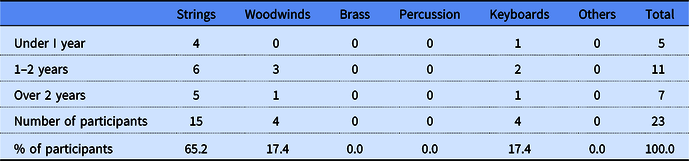
The survey questions were divided into several sections: the first section collected demographic data regarding the participants’ background, such as their major instruments, their birthplace and the duration of their chamber music learning, to create brief descriptions of the participants. The result indicated that participants were from seven different Chinese cities: Jiangxi (n = 2; 8.7%), Hunan (n = 8; 34.8%), Shandong (n = 1; 4.3%), Shanxi (n = 4; 17.4%), Anhui (n = 5; 21.7%), Jiangsu (n = 1; 4.3%) and Hebei (n = 2; 8.7%). As shown in Table 1, the majority of the participants were string majors (n = 15; 65.2%), followed by woodwind majors and keyboard majors (n = 4; 17.4%). The majority of the students had taken chamber music courses for 1–2 years. Other results of the survey questions were analysed and conclusions were drawn.
Participants’ Major Instrument and Chamber Music Learning Duration

Current situation of Chinese college chamber music education from educators’ perspectives
The interviews with educators in the selected university provided a complete and initial understanding of Chinese college chamber music education and the operating content of chamber music teaching before exploring the details with students. Thus, the interview content was focused on Chinese college chamber music education and the arrangement of chamber music courses, supported by educators’ personal experiences. The interviewees had certain chamber music experiences and had taught chamber music for more than 3 years. As several studies mentioned previously (Burt-Perkins & Mills, Reference BURT-PERKINS and MILLS2008; Hanzlik, Reference HANZLIK2010; Sacks, Reference SACKS2016; Tall, Reference TALL2014), the educators considered chamber music education to be a significant practical course to guide students. Even though college chamber music education developed gradually in China, some limitations remain in many universities and were mentioned by the educators. Limitations included a lack of students who majored in certain instruments, well-trained teachers in many universities and unified course outline requirements across universities. Some universities could only modify the course organisation to promote chamber music education.
One educator specified that to better develop chamber music education in his/her university under limited conditions, chamber music courses could not be established for all students who major in music performance. Instead, the educators selected students who had better performance ability or met the requirement of ‘major in certain instruments’. Since not all students take this course, the students’ grades in the chamber music course were included in other professional music courses, such as a comprehensive art course, an instrumental course or an ensemble course because of the curriculum regulations. At present, except for music conservatories and some universities, many Chinese universities continue to have the problem of ‘needed adjustment,’ which renders it difficult for educators to push the development of chamber music education in China.
In the process of chamber music teaching, the educator generally plays the role of a class leader. The educator determines the direction of the chamber music course. One educator mentioned that because students generally have no sense of chamber music, s/he had to arrange the entire teaching process, such as assigning a repertoire and designing the process of the classes. S/he provided guidelines on what students can do, what students should learn and how students cooperate with each other. S/he even stated that there were limited communication and interaction between educators and students: the students followed the educator’s plan to learn chamber music.
However, ‘understanding each other’ is important in promoting teaching quality and the teaching process (Boekaerts, Reference BOEKAERTS2007; Suraya et al., Reference SURAYA, WAYCOTT, SHERAH and CHANG2015; Ushinsky and Piskunov, Reference USHINSKY and PISKUNOV1978). In this situation, some issues arose regarding the students’ thoughts and views: How familiar were students with chamber music? What was most needed to help students strengthen in their chamber music playing? How can students understand the differences between chamber music and other music genres? What are the details of playing chamber music that students have to be aware of? This research sought to provide a direction for answering these questions by investigating the students.
Results
The purpose of this investigation was to identify the perceptions and expectations of chamber music education in Chinese colleges by students majoring in music performance. The results of the questions regarding students’ previous chamber music experiences revealed that most students lacked opportunities to become familiar with chamber music. They had little experience participating in chamber music activities before entering the university.
The results showed that 78.3% of the participants had no chamber music experience before taking a chamber music course at the university, only 13.0% of the participants went to chamber music concerts and 8.6% of the participants actually ‘participated in’ playing chamber music (Table 2).
Participants’ Chamber Music Experience before Taking a Chamber Music Course

* Percentages are slightly below 100% due to rounding procedures.
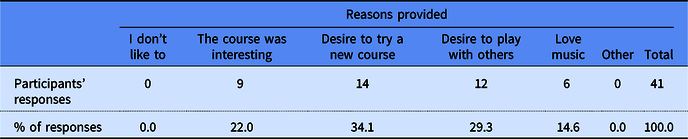
The following question sought to identify the how of students’ perceptions of chamber music courses (Table 3). The survey question regarding the students’ attitude was designed in a multiple-choice format, and the participants selected as many choices as applied. The results of the query investigation of the participants’ preferences towards chamber music courses showed that all of the participants liked the chamber music courses (100%), and they had a positive attitude. In total, 22% provided the reason for their enthusiasm towards the chamber music courses, 34.1% were willing to challenge themselves, 29.3% of the participants discovered the meaning and interesting aspects of working with others, while 14.6% of the participants expressed their love for the characteristics of chamber music.
Response to the Survey Question: Do You Like to Take Chamber Music Courses? Why?

The next set of questions investigated what students considered to be the most efficient and the most difficult aspects of chamber music education. To thoroughly understand students’ thoughts regarding what chamber music courses offered, the survey question was designed to allow the participants to indicate their ‘top 3’ choices in order. To clearly distinguish the students’ thoughts, the analysis was based on the ‘score-adjusted procedure,’ which means the scores were adjusted to provide for differences within those ranked first, second and third.
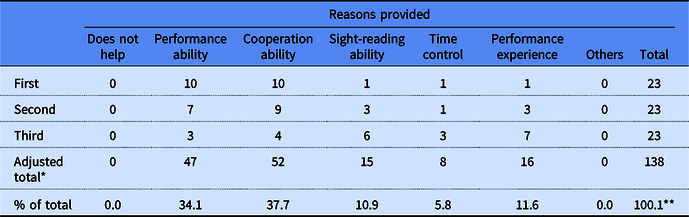
The first question was based on Burt-Perkins and Mills (Reference BURT-PERKINS and MILLS2008), and seven specific options were provided. Those options included performance ability, sight-reading ability and performance experience from the performance aspect; cooperation ability and time control from the social competence aspect and an unspecified aspect (written out by the participant). The survey result shown in Table 4 presents the levels of assistance: the two most highly ranked responses were ‘Performance ability’ and ‘Cooperation ability,’ which represented 71.8% (34.1% and 37.7%, respectively) of the total number, followed by ‘Performance experience’ (11.6%), ‘Sight-reading ability’ (10.9%) and ‘Time control’ (5.8%).
Response to the Survey Question, What Help Does the Chamber Music Course Offer to You?

* The ‘score-adjusted procedure’ was based on Rank 1 = 3 points; Rank 2 = 2 points and Rank 3 = 1 point.
** Percentages are slightly above 100% due to rounding procedures.
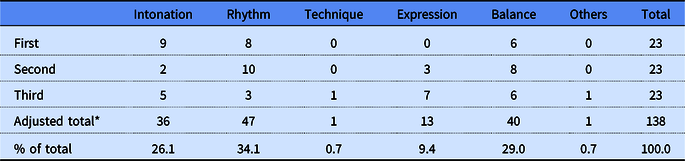
The second of these questions inquired about students’ problems learning chamber music. The choices provided, including intonation, rhythm, technique, expression and balance, were based on Estrella’s basic and common elements of music performing (Reference ESTRELLA2018), Sacks’ opinion of the importance of chamber music playing (Reference SACKS2016), as well as South’s (Reference SOUTH2006) and Powell’s (Reference POWELL2010) group focus when performing music (see Table 5).
Response to the Survey Question, What Is/Are the Difficulty/Difficulties in Playing Chamber Music?

* The ‘score-adjusted procedure’ was based on: Rank 1 = 3 points, Rank 2 = 2 points and Rank 3 = 1 point.
As with the previous question, the participants selected the ‘top 3’ choices that they considered to be the most difficult aspects of learning chamber music, and the analysis was based on the ‘score-adjusted procedure’. According to the investigation of the survey, even though the order of the choices may have differed among majors, the top three difficulties were similar. Intonation, rhythm and balance were the three main issues in chamber music learning and represented 89.2% of the total (rhythm issues had the highest rate at 34.1%; see Table 5). An interesting finding was that technique was not the main problem for students; only one participant selected technique as his/her third choice.
The final survey question examined the relationship between practice and learning in chamber music. According to the results of the student surveys (Table 6), all of the participants have the practical experience. Several participants even performed in more than two practical activities. All of the participants had participated in studio classes, followed by chamber music recitals (20 of 23), lectures (9 of 23) and competitions (7 of 23).
Participants’ Experiences in Performing in Practical Activities during the Chamber Music Course Sessions

* Percentages are slightly above 100% due to rounding procedures.
Free response
To determine how chamber music education works, which is related to the survey question regarding the function of chamber music education and the connection between practice and learning in playing chamber music, two free-response questions inspired by the survey ideas of Mills (Reference MILLS2004) were asked (Do you think establishing chamber music courses in university is necessary or unnecessary? Do you like to participate in practical chamber music activities?). The methodology utilised for analysis was to classify the response data into themes.
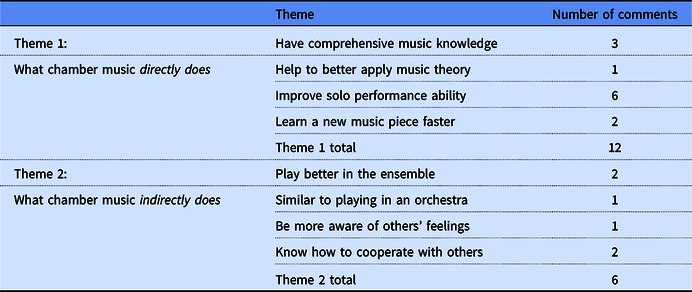
For the first free response, all students agreed on the necessity of having chamber music courses, and a majority of respondents (N = 18) provided concrete and valuable responses to this question for a total of 23 comments (78.2%). As shown in Table 7, the reasons fell into two themes: the ability to perform music (what chamber music directly does) and the ability of social coordination (what chamber music indirectly does).
Participants’ Awareness of the Necessity for Chamber Music Courses (Free Response) (N = 18)

The ability to perform music (what chamber music education directly does) represented more than half of the total comments (n = 12). Common statements included ‘By playing chamber music, I feel that I’m getting better at having comprehensive music knowledge’ and ‘My solo performance ability improved by learning chamber music’. The second theme, the ability of social coordination (what chamber music indirectly does), represented fewer overall comments than the first direction (n = 6). The statements included discussion of the relationship between the chamber music courses and other practical courses (e.g., ‘Learning chamber music helps students play better in the ensemble’ and ‘The concept of playing in the chamber group is somehow similar to the concept of playing in an orchestra’) and the meaning of team work (e.g., ‘I am more aware of others’ feelings after taking the chamber music course’ and ‘It helps me to know more about how to stimulate partners’ enthusiasm’).
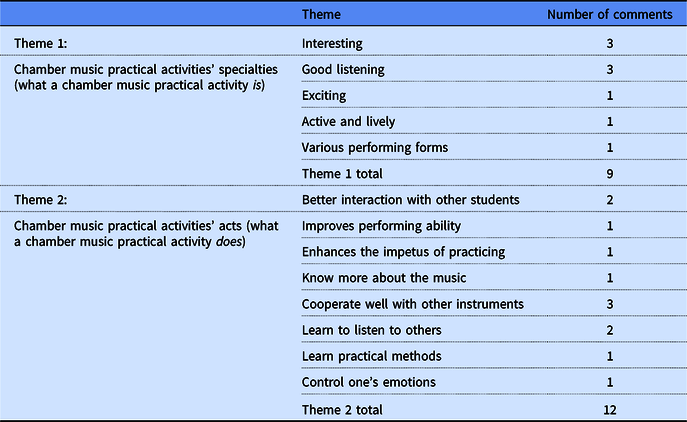
The second free response question showed that all participants expressed their favourite things about chamber music practical activities, and nearly every participant provided concrete responses (91.3%, 21 of 23). As shown in Table 8, the reasons why the participants liked the practical chamber music activities can be divided into two themes: chamber music practical activities’ specialties (what a chamber music practical activity is) and chamber music practical activities’ acts (what a chamber music practical activity does). The first theme, chamber music practical activities’ specialties (what a chamber music practical activity is), is related to the direct perceptual feeling of the participants (n = 9). ‘Interesting’ and ‘good listening’ were the two statements mentioned most often.
Participants’ Feeling Towards Chamber Music Practical Activities (Free Response) (N = 21)

Chamber music practical activities (what a chamber music practical activity does) drew the majority of the total comments (n = 12). This theme illustrated the further functional change in participants. Common statements referenced ‘cooperation,’ demonstrating that practical chamber music activities provide an environment for students to work with others (e.g., ‘It is wonderful to play with other instruments,’ ‘It provides a chance to share our opinions and suggestions with others regarding chamber music’ and ‘I identified my own deficiencies and studied the strengths of others by practical activities’).
Discussion
The initial insights into students’ perceptions and expectations regarding chamber music education were examined using data analysis. The findings revealed a relatively clear concept of these students. Overall, the research revealed that chamber music is still not very popular in China, and students have little chance to experience chamber music before entering universities. However, the students showed high receptivity to new things and understood what to do and how to do it.
The majority of the music performance students who have not yet entered the universities and their educators learn and teach their instruments to allow students access to a good university (Guan, Reference GUAN2013; Zhang, Reference ZHANG2008). Students pay little attention to group practical activities such as chamber music before entering universities; several students did not even know about chamber music until they took a chamber music course at the university. This investigation explained why several Chinese educators continuously advocated the promotion of chamber music education in universities, and some of them even mention the advantage of providing a chamber music education to students before they select music as their major (Liu, Reference LIU2010; Tsai, Reference TSAI2001; Song, Reference SONG2014).
Not being exposed in the chamber music education or activities before entering the university did not dim students’ passion towards chamber music. Chamber music education is attractive to students, not merely because students noticed the function of what chamber music education can bring to them, as some studies stated (Loft, Reference LOFT2003; Tall, Reference TALL2014; Tovey, Reference TOVEY2015), but also because of the musical characteristics of chamber music. Several students expressed their love for the chamber music itself, which is a great perception and attitude in learning (Wager, Reference WAGER1979). Furthermore, the students showed their adaptability by accommodating to the chamber music course quickly after beginning the course. This finding indicated that students possess good abilities to receive new things, which is helpful in learning chamber music for both students and educators.
The learning content is an important component of this research, and the results were particularly interesting to the author. Simultaneously, the findings inspired educators to consider what to do in future courses. The survey items included advantages and difficulties, which indicates what a chamber music education can bring and what it in fact does for students. After analysing and comparing these two issues, the findings somehow showed the concept of the motto, ‘no pain, no gain’.
The results regarding ‘the advantages of learning chamber music’ aligned with similar points in previous studies, such as Song (Reference SONG2014), Sun (Reference SUN2009), Wang and Wang (Reference WANG and WANG1992), and Wu (Reference WU2002), which addressed the assistance of a chamber music education from educators’ perspectives. However, the details of this view are slightly different here. Those studies focused more on the function of a chamber music education’s collective advantages, which are categorised in this research as ‘social competence improvement’. However, based on students’ feedback, this advantage occurs more in ‘performance improvement’ than in ‘social competence improvement’. The results suggested the possibility that students might be able to feel the improvement in direct individual performance growth.
The areas in which the music performance major students identified difficulties, intonation, rhythm and cooperation indicated that students lacked the ability to ‘listen’ when playing chamber music. Students were more accustomed to personal expression and personal characteristics. This result supported several educators’ statements regarding the problem of Chinese education in music performance: the deficiency in music fundamentals and the emphasis on the individual (Liu, Reference LIU2010; Yu, Reference YU2015; Wang, Reference WANG2007; Wang & Wang, Reference WANG and WANG1992). This result also provided further concrete examples of the problems from students’ own perspectives, which can help the educators consider how to help them solve these problems.
Much of the current Chinese literature emphasises that participating in practical activities such as recitals, studio classes, master classes, lectures and competitions is an efficient ways for students to resolve their learning problems (Liu, Reference LIU2010; Liu & Yu, Reference LIU and YU2015; Yu, Reference YU2015; Wen, Reference WEN2014). The last survey items asked what practical activities students participated in after taking the chamber music courses and what they gained from the practical activities. Based on the results of the participants’ experience with the chamber music practical activities and their feedback on these activities, the author discovered that practical chamber music activities are attractive to students and effective. More than half of the students’ responses (57.1%) supported the researchers’ statement of practicability (Stubbs, Reference STUBBS1983; Tall, Reference TALL2014; Zhang, Reference ZHANG2015), while others (42.9%) provided different thoughts from their perceptions. No matter what students considered the perceptual influence or functional influence that these practical activities bring, participants were all positive regarding the practical activities.
It should be noted that there are two limitations to the present study. First, the selected Chinese university was purposefully sampled in accord with the school level, curriculum setting, location and students’ origin. The results cannot be generalised beyond the entire population of the music performance major students who took chamber music courses in this university, which accounted for the low number of participants in this research. Second, the constitution of the sample might be biased. The numbers of students majoring in different instruments were unequal. The author tried to provide results analysis as accurately as possible to represent the majority of the participants’ responses within the constraints of the survey choices. Notwithstanding its limitation, this research does suggest a fairly clear picture of Chinese college chamber music education representing the general learning situation and environment of Chinese universities. Despite its preliminary character, this study clearly represented students’ concrete ideas about chamber music.
Educational researchers need to continue conducting research to ascertain the factors that influence students’ chamber music learning and how to balance the relationship between the educators’ teaching methods and the students’ learning achievement in China. First, the researchers can adopt different research methods to provide a more solid sample. Second, the researchers can compare influential factors from different perspectives. Finally, experimental research can be conducted to determine effective employment in chamber music education.
Conclusion
The purpose of this research was to investigate several issues regarding chamber music education from students’ perspectives in one selected Chinese university, including the orientation of chamber music education in the university, the advantages that chamber music education brings, the difficulties in playing chamber music and the relationship between practice and learning. This study showed that students do have clear perceptions and expectations of a chamber music education.
This research highlighted current chamber music education in Chinese colleges, which indicated that the majority of the students had no experience with chamber music before taking chamber music courses at university. However, this research has also shown the importance of learning attitudes in supporting chamber music learning, which can affect students’ learning outcomes and future development. While the performance basics and the cooperative ability in chamber music education were highly valued by the participants, educators must consider how to truly help students mature. There is also a suggestion that the educators could play an even stronger role in understanding students and supporting students to establish their conceptions.
To researchers and educators, this research is not merely the presentation of questionnaire statistics regarding students but includes some valuable topics for Chinese music education: the relationship between educators and students and the balance between students’ cognition and educators’ philosophy. Of course, there are several ways to resolve these topics, and the manner adopted in this study is one of the traditional modes; however, it is the most significant and direct way to obtain results. It should be noted that the sample was too small to make an assumption to apply to a large population. Nevertheless, these data are a valuable initial step in obtaining a more complete and concrete understanding of Chinese chamber music education.
The research on students’ involvement in Chinese chamber music education has been comparatively neglected. Although student involvement is not the only way to measure Chinese chamber music education, it represents an important step in promoting the development of chamber music education. Students’ perspectives towards chamber music education somehow reflect the current changes, challenges and developments in today’s Chinese music education environment. Even though a complete chamber music education system may take decades to realise, it is building on the work of past generations of music educators.
Funding
This work was supported by the MOE (Ministry of Education in China) Liberal Arts and Social Sciences Foundation [grant number 17YJC760011].
Appendix
Chamber music learning survey
1. Please indicate your major instrument. Choose the one that applies by placing an X by the appropriate number.
(1) Strings
(2) Woodwinds
(3) Brass
(4) Percussion
(5) Keyboards
(6) Other (Specify): ___________________
2. Where are you from?
I am from: ___________________
3. How long have you participated in chamber music course(s)?
(1) Under 1 year
(2) 1 year–2 years
(3) Over 2 years
4. What chamber music experiences did you have or events that you were involved in before taking the chamber music course? Choose as many as apply by placing an X by the appropriate numbers.
(1) None
(2) Chamber music recitals
(3) Chamber music competition
(4) Chamber music rehearsal
(5) Other (Specify): ___________________
5. Do you like to take chamber music course(s)? Why? Choose as many as apply by placing an X by the appropriate numbers.
(1) No, I don’t like them.
(2) I feel the course is interesting.
(3) Desire to try new things
(4) Desire to play with others
(5) Love music
(6) Other (Specify): ___________________
6. Do you think setting up the chamber music courses in university is necessary or unnecessary?
(1) Necessary, because (specify): ___________________
(2) Unnecessary, because (specify): ___________________
(3) I do not know.
7. What help does the chamber music course offer to you? Choose as many as apply by placing an X by the appropriate numbers. Then, for your top three choices, place a one next to the most helpful, a two next to the second most helpful and a three next to the third most helpful.
(1) No help
(2) Performance ability
(3) Cooperation ability
(4) Sight reading ability
(5) Time control
(6) Performing experience
(7) Other (Specify):___________________
8. What is/are the difficulty/difficulties in playing chamber music? Choose as many as apply by placing an X by the appropriate numbers. Then, for your top three choices, place a one next to the most difficult, a two next to the second most difficult and a 3 next to the third most difficult.
(1) Intonation
(2) Rhythm
(3) Technique
(4) Expression
(5) Balance
(6) Other (Specify): ___________________
9. Have you ever performed in any practical activities (such as recitals, masterclasses, lectures or competitions) during a chamber music course session?Choose as many as apply by placing an X by the appropriate numbers.
(1) No, I have not
(2) Recitals
(3) Studio classes
(4) Master classes
(5) Competition
(6) Lectures
(7) Other (Specify): ___________________
10. Do you like to participate in chamber music practical activities?
(1) Yes, because (specify): ___________________
(2) No, because (specify): ___________________
(3) I do not know.