Introduction
The transition into nursing homes for people with dementia is complex, with timing of placement being unpredictable. There are over 320,000 Australians living with dementia, including 53% of all nursing home residents (Australian Institute of Health and Welfare, 2012).
In Australia, the usage rate for permanent nursing home care is considerably lower among non-English-speaking overseas-born people (17.8 per 1,000 people aged 50 years and over) than Australian-born people (26.2 per 1,000 people aged 50 years and over) (Australian Institute of Health and Welfare, 2011). About 14% of Australians with dementia speak a language other than English at home (Access Economics, 2009).
The decision to place a person with dementia into a nursing home is difficult for caregivers (Chene, Reference Chene2006). Various theoretical models have been proposed which describe the decision as a process involving several stages. Ducharme and colleagues (Reference Ducharme, Couture and Lamontagne2012) proposed that the process begins when a caregiver or healthcare professional introduces the idea of placement, then the caregiver evaluates the situation weighing the pros and cons of placement, which finally leads to either a cessation of the decision-making process (which may later be reactivated) or a decision for placement. Chang and Schneider's (Reference Chang and Schneider2010) study of Taiwanese caregivers described the process as a painful experience for caregivers who often vacillated between whether or not to place their relative in a nursing home, proposing a theory bearing similarity to a study in the United States describing four stages from moving toward the decision to remaining involved post-placement (Butcher et al., Reference Butcher, Holkup, Park and Maas2001).
Factors that relate to both patients and caregivers can delay or predict institutionalization of people with dementia (Yaffe et al., Reference Yaffe, Fox, Newcomer, Sands, Lindquist, Dane and Covinsky2002; Schoenmekers et al., Reference Schoenmekers, Buntinx, Devroey, van Casteren and DeLepeleire2009). One such factor is ethnicity. A meta-analysis of quantitative studies demonstrated that people from minority ethnic groups with dementia in the United States were 40% less likely to be institutionalized, but a UK study, the only non-American study included in the meta-analysis, showed no difference between cultural groups (Cooper et al., Reference Cooper, Tandy, Balamurali and Livingston2010). Another meta-analysis looking at differences in American ethnic minority family caregivers found that these caregivers provided more care and had stronger beliefs of filial obligation than Anglo-American caregivers. Asian-American caregivers used less formal support, and were more depressed (Pinquart and Sörensen, Reference Pinquart and Sörensen2005).
A Taiwanese study of the decision-making process identified particular issues of family conflict and filial piety for Chinese families (Chang and Schneider, Reference Chang and Schneider2010). Chinese caregivers are often reluctant to place relatives in a nursing home. In Taiwan there is a distrust of nursing home care quality and disappointment post-placement (Chang et al., Reference Chang, Schneider and Sessanna2011). Most family caregivers of people with dementia in Singapore and Taiwan prefer to continue caregiving at home, but dementia-related mental and behavioral problems, lack of family or a domestic maid available to provide care at home, and fewer perceived benefits to the caregiver were associated with preferring nursing home placement (Chiu et al., Reference Chiu, Shyu, Liu, Wang and Chang2001; Tew et al., Reference Tew, Tan, Luo, Ng and Yap2010).
Chinese background caregivers living in another culture describe a similar attitude about nursing home placement for dementia to those living in Asia. Chinese Australian caregivers preferred community-based services to nursing homes (Low et al., Reference Low, Anstey, Lackersteen and Camit2011). Chinese Canadian caregivers who had made applications to nursing homes accepted caregiving as a cultural obligation and only half were ready to institutionalize when the place became available (Ho et al., Reference Ho, Friedland, Rappolt and Noh2003).
Few studies have looked at the experiences of caregivers of people with dementia on the waiting list for nursing homes, reasons why caregivers apply for a waiting list, or why places are accepted or declined. Although some quantitative comparisons of ethnic minority and majority caregivers exist, no qualitative studies exist that directly compare the subjective experience of ethnic minority and majority caregivers in this decision-making process, which would provide a deeper understanding of this complex issue.
This study is the first qualitative study to directly compare the subjective experience of ethnic minority and majority caregivers in the decision-making process for nursing home placement of people with dementia. We chose to focus on people from a Chinese background, as China is the largest non-English-speaking overseas country of birth for Australians (1.7% of the Australian population) (Australian Bureau of Statistics, 2011). We aimed to investigate (1) the decision-making process for placing a person with dementia on a waiting list for a nursing home; (2) why offers of a place in a nursing home are accepted or declined; (3) the influence of cultural factors in this decision, in people living in Australia from a Chinese background compared with those from an English-speaking background (ESB).
Methods
A qualitative approach was used to provide a rich description of the decision-making process, and data were obtained from semi-structured interviews with 27 caregivers of family members with dementia.
Sample
Chinese background participants were recruited through three Chinese ethno-specific nursing homes, and ESB participants were recruited through four mainstream facilities in corresponding geographic areas of Sydney, Australia. We asked nursing homes to post information about the study and a consent form to all eligible caregivers and to phone or personally approach caregivers where possible. The response rate was 50% (20/40) for Chinese caregivers, and 10% (7/70) for ESB caregivers. Inclusion criteria were based on caregiver characteristics as the study focuses on the decision-making process of the caregiver, with main language spoken used as a proxy for culture. Criteria were that the caregiver had to be from a Chinese- or English-speaking background and caring for a person with dementia who was either living in a nursing home or on a nursing home waiting or enquiries list. Chinese background caregivers included people from China, Hong Kong, Malaysia, and Singapore. Caregivers from non-English speaking backgrounds other than Chinese were excluded.
Data collection
Interviews with caregivers were conducted face to face by the researcher (Lauren Caldwell), with three participants interviewed with the assistance of a Chinese interpreter. Ethics approval was obtained from UNSW Human Research Ethics Committee (HREC Ref: #HC12029). All participants gave written informed consent prior to commencing each interview. Interviews lasted for approximately one hour, and were based on a series of open-ended questions focusing on the circumstances leading to the decision for nursing home placement, how facilities were chosen, whether an available place would be accepted (for those pre-placement), and expectations of the nursing home (for those post-placement; see Appendix). The semi-structured design allowed the researcher to add follow-up questions and further explore the participants’ responses.
Interviews were audio-recorded and transcribed; transcripts were reviewed with the audio recording to verify accuracy. Demographic data were collected, including caregiver's age, relationship to the person with dementia, employment status, gender, country of birth, and year of migration.
Analysis
Interviews were analyzed qualitatively using thematic analysis (Braun and Clarke, Reference Braun and Clarke2006), following which comparison of themes was made between the two groups. NVivo 9.0 software (QSR International, 2010) was used to code and organize themes. As initial codes were identified, they were sorted into a coding frame based on the study aims. As new data were collected and analyzed, more codes were identified, which were then reorganized into themes as similarities were drawn between the accounts of different participants. New participants were recruited and interviewed while analysis continued until data saturation was reached. After discussion with two other researchers, themes were reviewed and defined, and material was recoded into the final set of six main themes and associated sub-themes. Chinese and ESB groups were then compared by examining whether each theme was strong, mentioned or absent in each cultural group.
Data describing demographic characteristics of participants in each cultural group were analyzed using IBM SPSS Statistics software (IBM Corp., 2010). Continuous variables were compared with an independent sample Student's t-test (equal variances not assumed), and categorical variables were compared with Fisher's exact test (two-sided).
Results
Participant characteristics
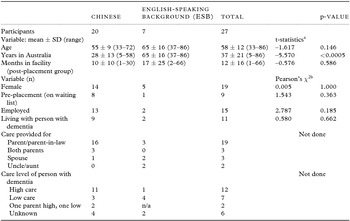
Table 1 shows the demographic characteristics of the sample. The Chinese and ESB groups were similar, but more of the people with dementia in the ESB group were in low-level care.
Description of caregivers by ethnicity (n = 27)

Notes: aIndependent samples t-test, equal variances not assumed.
bPearson's χ 2 statistics, Fisher's exact test (two-sided).
The countries of birth for Chinese background caregivers were China/Hong Kong (n = 12), Malaysia (n = 3), Australia (n = 2), Singapore (n = 1), Vietnam (n = 1), and Fiji (n = 1); and for the ESB caregivers, the countries of birth were Australia (n = 5), Malta (n = 1; English is an official language of Malta and this caregiver moved to Australia when she was four years old), and China (n = 1; although this caregiver was born in China, she was considered to be from an English-speaking background because her parents are Caucasian and she moved to Australia before she was two years old). The countries of birth for Chinese background people with dementia were China/Hong Kong (n = 17), Malaysia (n = 2), and Singapore (n = 1); and for ESB people with dementia, the countries of birth were Australia (n = 4), Malta (n = 1; has been living in Australia for 61 years), Germany (n = 1; living in Australia for 63 years), and Uruguay (n = 1; living in Australia for 40 years). All people considered to be from an English-speaking background were Caucasian in heritage.
Thematic analysis results
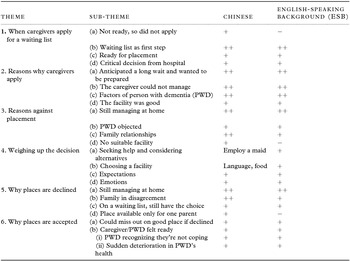
The themes and sub-themes describing the decision-making process for nursing home placement are summarized in Table 2. In the following description of these themes, quotes from caregivers are labeled with C or E (Chinese background or English-speaking background), W or R (on a Waiting or enquiries list, or Residing in a nursing home), and an identification number.
Summary of themes, by ethnicity

Note: Theme strongly described (++); theme mentioned (+); theme absent (−).
1. Stages of decision-making when caregivers apply for a waiting list
Caregivers were at different stages of decision-making when they applied for a waiting list for a nursing home. For some, the decision to put the dementia patient's name on the waiting list was part of a gradual realization that they were not coping. For others, the step was triggered by a specific incident (such as a fall, accident, or decline in person with dementia or caregiver's health) whereupon they suddenly realized the need for nursing home care, as one caregiver said the following:
My dad had a fall at home last December so I said even at home they are not really safe. So I check with my sister and we better start to enroll them in nursing home. (CW1)
(a) Some caregivers who were on enquiry lists were not ready, so did not apply for any waiting lists, as they did not want to think about nursing homes.
In the future . . . maybe my parents have to go to some nursing home . . .. But like, until now, everything is still good, so I stop thinking about something in the future. You know that make me worry, I stop thinking about those. (CW20)
(b) Many caregivers perceived applying for waiting lists as the first step toward nursing home placement. They were not necessarily ready for a nursing home at this stage, but applied knowing the person with dementia could deteriorate. One caregiver on a waiting list said the following:
I didn't have a hard feeling making this decision because I think it's like step by step . . . if I don't put my mum in a queue at an earlier stage . . . when she's not in a good condition and then still has to wait, that's no good. (CW2)
Caregivers in both groups hoped to trial nursing homes using a respite service before committing, or used respite as a step for the person with dementia to adjust:
It was just a week so we thought it was necessary for her to try out. So it was to help us to make a further decision whether she is suitable or not. (CR4)
(c) Some caregivers applied when they were ready to place the person with dementia in a nursing home, and viewed the decision to apply for a waiting list as committing to place the person with dementia in care:
I knew I have to wait . . . I applied for that because I want to put him in the nursing home. (CR12)
(d) Caregivers were on waiting lists for between one month and two years, although for some, nursing home placement was a critical decision after an acute admission to hospital:
We had a social worker from (X) hospital called me and say, “This nursing home has a place available. You have 24 hours to go and look at it. It's probably one of the better ones, so don't be too fussy. (ER5)
After the person with dementia was transferred to respite from hospital, some Chinese caregivers then applied for a waiting list for a better nursing home:
We had to look for an alternate place, which is respite then because there was no nursing home where permanently straight you can take her in, because she wants a Chinese-speaking nursing home. (CR19)
2. Reasons why caregivers apply
(a) Caregivers in both groups commonly described applying for a waiting list because they anticipated a long wait and wanted to be prepared for when they really could not care for the person with dementia at home. Caregivers said they were warned about long waiting times by doctors, social workers, aged care assessment teams (these provide approval for government-subsidized nursing home placement), nursing home staff, and friends. Caregivers felt Chinese facilities in particular would have a long waiting time:
Those good Asian ones, they always have a long queue . . . late last year I decided to put my mum in the queue. But I actually don't want her to go even if a position is available. . .. But end up you know we say “Ok we put her on the queue.” Just in case. . .. Because we understand she's already 86, things may drop at any time. (CW2)
(b) Almost all of the caregivers described applying because they could not manage to continue with adequate caring for the person with dementia. Caregivers felt stressed by burden of caring, particularly when they had no time for themselves between working and caring for their own family, or when they were arguing with the person with dementia:
Finally we believe we have no alternative because we are so tired to taking of her for almost three years, and me and my wife . . . we are start to suffer from a bit of hell because of the stress of taking care of her. (CR8)
Some children lacked the time, money, or energy to care for elderly parents at home, particularly when the person with dementia had other comorbidities, including Parkinson's disease, stroke, or cancer, like one son who said:
I think the decision we make here is more like . . . if she is in care, would it be better off and I said I just couldn't provide the care at home. There's no way we could have done it. (CW10)
Caregivers’ poor health was another reason to apply, particularly for elderly spouses. Caregivers described applying after an angina attack, fracturing an arm after a fall, needing surgery, or just realizing they were getting older and physically less capable, as one husband said the following:
It sort of becomes impossible, you know. I've got older and less mobile and she's got a little bit harder to look after and you just can't do it. (ER2)
(c) Factors related to symptoms of the person with dementia were also described by many as a reason for applying to a nursing home. Many caregivers were concerned about dementia patient's unsafe behavior at home because the person with dementia was forgetting medication, not eating properly, wandering, or having accidents at home such as starting fires or having falls:
I just saw it as really necessary for her safety. You know, because I would have hated for anything to have happened to her and nobody being around. (ER3)
Some caregivers in each group described reaching their limits of caring when incontinence, particularly fecal incontinence, was difficult to manage:
It was mainly after she lost control of her feces and things that it just became pretty much impossible for me. (ER2)
Caregivers also applied when there was deterioration in the health of the person with dementia after hospitalization, meaning they could no longer return home, or would require home modifications.
(d) Some caregivers applied for a waiting list because they felt the facility was good, particularly Chinese caregivers applying for ethno-specific facilities. Some applied when they heard a new facility was opening, because they liked the facility or so that both parents could go in together. When one caregiver was asked what prompted her to think about nursing home placement, she responded:
It was a new nursing home that opened up, it was Cantonese . . . they said he could have his own room, and it was so close to home as well. (CR9)
3. Reasons against placement
(a) The biggest reason against nursing home placement described in both groups was that the caregiver and person with dementia were still managing at home. For some, nursing homes were seen as a last resort and many were happy to continue caring at home as long as they were able to manage:
The last resort is nursing home . . . nobody likes to be admitted to nursing home. We hang on until we have no choice. (CR19)
Some felt staying home was better because the person with dementia would enjoy life more as they would have more freedom in choice of food and outings:
I think if you can keep them in their own home for as long as you can they'll appreciate it a lot more. (ER4)
Some caregivers felt they did a better job of caring than a nursing home would, and thought the dementia patient's condition would be better if they were at home. One caregiver who chose not to apply for a waiting list said:
It's just too early stage to take her to the nursing home. Reason being that one, going to nursing home is just like going to jail. . .. So food, she can enjoy good food, she can have the general basic living, what other people do, she does some little shopping for herself, and doing all this exercise, right, it helps her brain. (CW14)
(b) Caregivers were reluctant to apply for nursing home placement if the person with dementia objected to going, as one daughter said the following:
She put the fear of God in the three of us . . . that she is not going into any home, this is her home, she's staying here and she doesn't care. So I thought, yeah well I don't want to upset you anymore. (ER4)
One reason that people with dementia objected was because they feared poor quality care in nursing homes. For some in the Chinese group this was based on experiences of nursing homes in Asia, as one caregiver described as follows:
In Hong Kong and China . . . the general standard of nursing home in those places are not well. So the elder generation would believe that the service level would be similar. So they are afraid of been put in those places. (CR8)
Fear also came from negative experiences of other family members in nursing homes. Some in the ESB group were fearful because of past perceptions of nursing homes, as one described:
In my mother's era, nursing homes were like institutions. And if you were to put your loved one there, it was like they were going mad. And they weren't very, very nice, and they smelled. And people knew it. And there's that fear. (EW1)
Objections also arose from bad experiences with respite. This was described more strongly in Chinese people who had been to respite in a mainstream facility, such as one caregiver who said the following:
The plan actually was to trial her and then if she gets used to all that . . . we know that next time the respite care can be extended. But that experience is a no go zone. (CW15)
Some people with dementia objected because they felt attached to their home. One caregiver described why her mother wanted to stay home:
She liked her little room and she'd like her house and it was all her things around and they're things that her and my dad strove for and built . . . she just likes her home and yeah that was where she wanted to be. (ER4)
(c) Another reason against nursing home placement was because of family relationships. Some Chinese caregivers described conflict between siblings or parents about whether a nursing home was the right decision. One caregiver, when asked about when she first considered nursing home placement, said:
I had thought of it ages ago. It's just that my brother was a lot more resistant to the idea. And I guess my mum wasn't unwell enough . . . she was resistant to the idea as well. (CR16)
Many Chinese felt there was a cultural responsibility for children to look after parents at home, and said sending a parent away would be dishonoring the parent and failing in their duty. However, a few Chinese caregivers felt this was a value held by the older generation, which was changing for them. Some Chinese caregivers said as follows:
As a Chinese, when you send your mum to a nursing home you don't honor your mother. (CR11)
If I put my mum in the nursing home, I'm the bad guy . . . I fail my duty. (CW5)
There was also a fear – most strongly described by Chinese caregivers – that if they send a parent to a nursing home or even discuss nursing home placement, their parents would think they were being abandoned. One caregiver who chose not to apply to a nursing home said:
My mum and dad will think, if the children . . . do not want to take good care of them, they find an excuse that is to send them to nursing home. . .. So like they're abandoned by their children. (CW20)
Some caregivers were reluctant because they enjoy having the person with dementia at home. Another caregiver chose not to apply because
I get benefits from it too. Because I think she's a very good company. . . Because the doctor's telling me one day, your mum will not remember me. That's the sad part of it. And that has driven me – I don't want mum to forget me. (CW14)
Spouses were reluctant about nursing homes because of their relationship with the patient having dementia, and children were reluctant to separate parents, particularly if the spouse objected. One wife said:
In Chinese culture, relatives have to take care of each other. Husband and wife have to take care of each other too. You can't put your husband or wife into a nursing home. (CR12)
(d) Another reason against nursing homes described by a few Chinese caregivers was that there was no suitable facility available, particularly for low-care dementia. Caregivers said:
For people not speaking English . . .b a nursing home that can handle only Chinese, is not that many in Sydney. There are few but the queue is long. (CR8)
It's a long waiting process as well. Especially for the low care period, I think that was very hard . . . it's almost like oh, you know, let's let them deteriorate until they're high care and then let them in. (CR16)
4. Weighing up the decision
(a) In weighing up the decision for nursing home placement, caregivers sought help and considered alternative ways to care for the person with dementia. Help and advice was sought from friends and family, caregiver support groups, general practitioners, social workers, and aged care assessment teams. Alternatives to nursing homes were considered, such as receiving more help at home from community services or a neighbor; however, most felt that the situation would eventually reach the stage where that was not enough. Although moving in with one of the children (which for Chinese sometimes meant moving overseas) was considered as an alternative, for many this was not possible. Often this was because of other commitments, as one caregiver said:
If I didn't work I could possibly do it but . . . I'd have to do it 24/7, it was a really big decision. (ER4)
But for other ESB caregivers they felt they just could not live with the person with dementia, as one daughter said:
I wasn't willing to go and live with her. . .I think I'd lose it. (ER3)
Many Chinese caregivers discussed employing a full-time maid, which is an option in Asia generally considered too expensive in Australia:
We came up with other things like to bring in a carer for her, but she wouldn't like that . . .. Another one was for her to stay with one of the children but she objected to that. . .. And then . . . it would be a full-time care if she had come in and stayed with one of the children. (CR13)
(b) When choosing a facility, caregivers read information, spoke to other caregivers, and visited facilities, and applied for one to five waiting lists. There were a number of considerations in their choice of facility. Most caregivers were looking for a clean, spacious environment that did not smell:
Some of them are dirty, and the conditions no good, and so they won't choose that kind of residential care. And the one they finally got her . . . is neat and tidy, brand new, good looking. (CR6)
For the Chinese group, most caregivers said the main consideration was finding a culturally appropriate facility, mainly because of language and food. For some, this meant more than just finding a Chinese-speaking facility, but having staff or residents that spoke their particular dialect. One caregiver said:
I want that nursing home – Chinese food, Chinese TV, because my mum can't speak English, you know, only very basic, and the nurses speak Cantonese. (CR11)
Caregivers in both groups wanted a facility that was close by so that they could visit, and had good quality care where they trusted the management. A few mentioned wanting to find a facility where the dementia patient's GP could continue to visit.
(c) Caregivers had a range of expectations about how the person with dementia would cope with living in a nursing home. Some feared the person with dementia would be unhappy and so deteriorate:
What I worry is if she feel depressed or she doesn't like, you know, one of the staff there or one of the residents there, what's going on affect her health. From emotional, from psychological to physical. (CW1)
Some were worried it would be traumatic when they were first admitted:
The idea was to keep them at home as long as possible because it's going to be traumatic when she goes in for sure. (EW1)
Caregivers also described expectations from the facility. A few did not really know what to expect, but most just expected that the person with dementia would be cared for better than at home. Some expected only basic care and others expected it would be very good for the person with dementia:
I never had any concrete thoughts on it. All I wanted to know was that she was going to be looked after as good as I was going to look after her, or I was looking after her. I didn't want her to get any less than that but I think she needed more concentrated care that I obviously couldn't give her. (ER7)
Some had heard negative stories about nursing homes:
It was hard to decide where to put her actually because we sort of don't know the different nursing home and don't know what they're like and . . . unfortunately you know, only bad news make it to the media right, so. . .you only hear bad things about nursing homes. (CR16)
(d) Caregivers experienced various emotions, and most caregivers found the decision difficult, as one said: “It's a really tough, hard decision” (ER4). Some caregivers felt guilty or sad that their loved one could not stay home, and a few cried when speaking about this decision. As some caregivers said:
We feel bad putting her in nursing home. We miss her. (CR19)
I feel guilty because she'd been a wonderful wife to me . . . I feel as though I'm letting her down but she doesn't realize that we're doing it or what's going on or anything. (ER2)
While being difficult, some also saw the decision as quite a matter of fact necessity:
It wasn't a decision any more, it was a necessity. . . I felt it's probably unavoidable . . .. I would prefer not to make that decision. But I guess you know that will be – it's probably – is going to happen. (CR4)
When a place came up, some felt rushed to make a decision:
We had already prepared to put him in the nursing home, but once it happened . . . we still feel surprised. It happened too quickly. (CR12)
Others felt lucky and relieved that a vacancy opened:
It just worked out so well that I tell everyone, I don't have to win lotto now, I've won it. . .We applied at the right time and everything just fell into place. Just like a poker machine. It was the jackpot at the end of it. (ER7)
5. Why places are declined
Even after applying, some caregivers on the waiting list said they would decline a place if one became available. A few caregivers already had been offered places, which they declined. There were various reasons behind this.
(a) The main reason to decline a place described in both groups was that the caregiver felt the person with dementia was still managing at home and it was better to wait until the situation became more critical:
Mother will go when we, for one reason or another, can't manage her, and then we have to relinquish. As long as we can manage, we will continue our community home care. (CW15)
However, a few ESB caregivers felt it was not good to wait until you were desperate:
My sister thinks she should go in you see. So that we're not waiting till the absolute last second to put her in. (EW1)
(b) Places were also declined because there was family disagreement about whether the person with dementia should be sent to a nursing home. This was more strongly described in the Chinese group:
If I can make up my own decision, I don't have to wait for the sibling – I would put them earlier. (CW15)
(c) Some caregivers in both groups felt that after applying to be on a waiting list, they still had the choice, whether or not to choose nursing home placement. Some felt there was a chance, as the place would never come up anyway. One caregiver said:
We make application beforehand for the nursing home. But this is just kind of, for the sake of just have her put into the waiting list . . . it's just an open choice that we can have more options for later. But we not very keen to send her to nursing home (CR3)
(d) A few Chinese caregivers said, they would decline a place unless both their parents could be in the same facility: “We would decline . . . because there's no way that they go into different spot.” (CW1).
6. Why places are accepted
Reasons for accepting a place when a vacancy became available were similar for both cultural groups.
(a) Caregivers were concerned, they might miss out on a place in a good facility if they declined, and accepted available places for this reason even if they did not feel entirely ready:
When we had first enquired . . . they said there was a two-year waiting list or something, and out of the blue they had a vacancy which they said “You have to either accept or reject within a couple of days.” So anyway, realizing that if we waited till it became necessary to put her in, we may have had to choose a lesser standard of nursing home, we decided to put her in this one. (ER2)
(b) Caregiver/person with dementia felt ready:
(i) Places were accepted because the caregiver and person with dementia had got to the stage where they felt “ready” to accept a place. This sometimes happened when the person with dementia recognized they are not coping:
When my mother was assessed for low-level care . . . she probably reject it at that time I think. . . But this time she probably, may be thinking that no, she doesn't have a choice. . . Incontinence is one thing. And she also realize that she lost memory. . . She probably recognized a bit that she not coping. (CR8)
At the time we put in the application, they are not in a stage that they desperately need it as yet. But after the ACATFootnote * had pointed out the risks, they might, you know, there might be risks for them to stay at home, then I realized that yes maybe, you know, if there's a placement come up I would accept it. (CR18)
(Footnote *ACAT = Aged Care Assessment Team. They assess and approve older people for government-subsidized aged care services, including nursing home placement.)
(ii) Some caregivers or patient having dementia were ready to accept a place if there was a sudden deterioration in dementia patient's health:
We would decline . . . except you know, my dad's health-wise deteriorate all of a sudden. . . It will change my decision. . .because I usually understand the high care queue is very long as well, rather than the low care. (CW1)
Summary of cultural differences
The decision-making process was generally similar for both cultural groups, although there were some differences. For Chinese caregivers, reluctance for nursing home placement was associated with feelings of children failing in their duty, concerns that parents would think they were being abandoned, family disagreement, or not finding a suitable Chinese facility, whereas for ESB caregivers, the attachment of the person with dementia to the family home was a stronger reason. In weighing up the decision, differing past experiences in each group led to fearful expectations of nursing homes, and consideration of alternatives such as employing a full time maid by the Chinese group. Chinese caregivers had additional considerations in their choice of facility (mainly language and food), but having a facility close by to family was a stronger consideration for ESB caregivers.
Discussion
Our study provides a qualitative description of the decision-making process for nursing home placement, directly comparing the experiences of ethnic minority and majority caregivers. Although the process was similar for both groups, there were notable differences. Our results are consistent with the finding that caregivers apply for nursing homes when they cannot manage the person with dementia and need more skilled care (Buhr et al., Reference Buhr, Kuchibhatla and Clipp2006). Patient and caregiver factors reported in the literature to predict actual institutionalization, including dementia patient's unsafe behavior, incontinence, caregiver's burden, and caregiver's poor subjective health (Yaffe et al., Reference Yaffe, Fox, Newcomer, Sands, Lindquist, Dane and Covinsky2002; Gaugler et al., Reference Gaugler, Kane, Kane, Clay and Newcomer2003), were also reasons for applying for waiting lists in this study. Caregivers spoke about the person with dementia being a danger to themselves or others as a reason for placement, but other behavioral and psychological symptoms of dementia, including psychotic symptoms and aggressive behaviors, did not seem to be key factors in comparison with other studies which found this to be a strong predictor of institutionalization (Yaffe et al., Reference Yaffe, Fox, Newcomer, Sands, Lindquist, Dane and Covinsky2002). Additional reasons identified include anticipating a long waiting time and the desire to get into a good facility. The reasons against placement found in this study were similar to those in the literature, such as objections of the person with dementia and lack of a suitable facility (Schoenmekers et al., Reference Schoenmekers, Buntinx, Devroey, van Casteren and DeLepeleire2009), family relationships, and negative attitude toward nursing homes (Hagen, Reference Hagen2001). The most commonly described reason was that caregivers felt they were still managing at home. An important reason for delaying the decision for placement is financial, especially in countries where users have to pay for nursing homes (Gaugler et al., Reference Gaugler, Kane, Kane, Clay and Newcomer2003). We did not find this to be a major issue, as nursing home care is heavily subsidized by the government in Australia.
Consistent with theoretical models of the decision-making process described in studies of caregivers living in Canada, United States, and Taiwan (Butcher et al., Reference Butcher, Holkup, Park and Maas2001; Chang and Schneider, Reference Chang and Schneider2010; Ducharme et al., Reference Ducharme, Couture and Lamontagne2012), caregivers in our study described the decision as a difficult process in which they weighed up reasons for and against placement. Our findings add to these previous descriptions by elucidating the role of waiting lists in the decision-making process, and discussing the decision to accept or decline a place after applying. Whereas many previous studies were retrospective, a strength of our study was that it was contemporaneous, involving caregivers at different stages of deciding about nursing home placement. Similar themes were raised by caregivers on waiting lists and those whose dependents had been admitted to a nursing home.
This study has some limitations. The small number of ESB caregivers also limited the comparison. There may also be sampling bias in this group as only 10% of ESB caregivers invited agreed to participate. The reason for the higher recruitment rate in the Chinese group was likely to be because of better follow-up by facility staff. Sampling bias may have meant that caregivers of people with behavioral problems were less willing to participate. Also, caregivers’ satisfaction with the transition may have influenced their decision to participate. Recall bias may have affected some of the interviews, as the mean time since nursing home placement in the post-placement group was 12 months, with the earliest placement being five years prior to the interview. Despite these limitations, this study confirms and extends reports that caregivers experience grief, anxiety, guilt, and a high level of depressive symptoms when the decision for nursing home placement is made and while waiting for a place (Meiland et al., Reference Meiland, Danse, Wendte, Gunning-Schepers and Klazinga2001; Chene, Reference Chene2006). Because the Chinese caregivers were all recruited through Chinese-specific facilities, we could not know if these reports generalize to caregivers of Chinese people living in mainstream nursing homes or to caregivers from other cultures. Information was only obtained from family caregivers (although two interviews involved two relatives of the person with dementia), and not from nursing home staff or those with dementia themselves. Future research could include the experience of ethnic minority caregivers from mainstream facilities, other ethnic groups, and other people involved in the decision-making process.
It may be helpful for healthcare workers to be aware of these cultural differences when supporting caregivers from different cultural backgrounds through the decision-making process and communicating with families. Doctors, social workers, and those providing information to caregivers can be more informed about how waiting lists operate and how caregivers make decisions, so they can advise families appropriately. Being able to talk about reasons for and against applying, and issues specific to people of different cultural backgrounds may assist in helping caregivers through this difficult process, particularly when there is family conflict over the decision.
Nursing homes could more clearly communicate with caregivers when they first enquire or apply for a waiting list, so caregivers understand that the waiting time is variable but they will have to decide quickly when a place becomes available, and also understand what happens if a place is declined. Nursing homes may also consider having food alternatives for ethnic minority groups, and employing bilingual staff, which for people from Chinese backgrounds usually include Cantonese- and Mandarin-speaking staff.
Concerns about nursing homes should be addressed by healthcare workers and service providers to ease some of the unfounded fears affecting the decision. Highlighting positive aspects of living in a nursing home, such as the professional care provided and the increased opportunities for social interactions, may be reassuring for caregivers. Also, information targeting people from a Chinese background could emphasize that nursing home placement is not about abandoning the person, and that the caregiver will continue to be involved in the person's care.
The findings also support the recommendations of the Australian Productivity Commission Inquiry Report (Productivity Commission, 2011) that there is a need for more support at home for caregivers who work, more low-care dementia respite for people to trial nursing homes, and more residential facilities and staff to decrease waiting times and ensure good care. We conclude that for all caregivers the transition of placing a family member in a nursing home can be stressful. For those from non-English-speaking backgrounds, there are added difficulties that service providers and health professionals should consider.
Conflict of interest
None.
Description of authors’ roles
L. Caldwell, L.F. Low, and H. Brodaty contributed to formulating the research question and study design and in finalizing the paper. L. Caldwell conducted the interviews, performed data analysis, and drafted the paper. L.F. Low designed the interview questions and contributed to data analysis.
Acknowledgments
We would like to thank each of the participants and nursing homes for their time and assistance. Thanks to P. Caldwell for her advice in writing the paper.
Appendix
Interview questions
Demographic data:
-
1. Caregiver's age, gender, employment status, country of birth, relationship with person having dementia, whether living with person having dementia.
-
2. Please tell me about the circumstances leading up to the decision to place Mr/Mrs X on the waiting list for residential careFootnote *?
-
3. Tell me about how the decision to place Mr/Mrs X on the waiting list for residential careFootnote * was made.
Other prompts:
-
• How did you feel when making the decision, on the waiting list, and during the actual relocation?
-
• What has been particularly helpful in making the decision?
-
• What has made the decision more difficult?
-
• Who else was involved in this decision? What was their role?
-
• In what ways do you think being Chinese has influenced your experience as a caregiver? Were there any cultural factors that influenced your decisions?
-
4. How did you go about choosing the facilities for which you placed Mr/Mrs X on the waiting list?
-
5. What is your opinion about the care in nursing homes in general?
-
6. For caregivers of people with dementia on waiting list:
-
• If a place became available tomorrow for Mr/Mrs X, would you take it? Why?
-
• What are your expectations of how Mr/Mrs X will be cared for in the specific residential facilities on which he/she is on the waiting list?
-
-
7. For caregivers with people with dementia already living in residential careFootnote *:
-
• Thinking back to before Mr/Mrs X entered residential careFootnote *, what were your expectations of the care he/she would receive from (name of facility)?
-
• Is there anything else you would like to add about the process about deciding to place a person into residential aged careFootnote *? Or anything you feel would help others making this decision?
-