INTRODUCTION
Spionids belong to one of the largest families of polychaetes in the world and are very common in both intertidal and subtidal marine habitats (Blake & Kudenov, Reference Blake and Kudenov1978). The coastal waters around the UK are likely to contain around 80 species of spionid from 20 genera (Radashevsky, Reference Radashevsky2012). The family can loosely be distinguished by the presence of a pair of grooved feeding palps arising dorsally from near the head. However, this feature is shared by other polychaete families, and therefore a combination of characters such as body shape, parapodia structure and chaetae must be used for positive identification (Radashevsky, Reference Radashevsky2012). Spionids are found in a range of substrata and may form temporary or permanent tubes and burrows or live freely within the sediment. Some also have the ability to bore into calcareous material (Hartman, Reference Hartman1940; Blake, Reference Blake1981; Sato-Okoshi & Okoshi, Reference Sato-Okoshi and Okoshi1997; Simon et al., Reference Simon, Thornhill, Oyarzun and Halanych2009). Spionids are interface feeders (Dauer et al., Reference Dauer, Maybury and Ewing1981; Radashevsky, Reference Radashevsky2012) that typically use their prehensile palps to collect food from the surface of the seabed and/or from the waters immediately above.
Spionids of the genus Boccardia Carazzi, 1893 belong to a group commonly known as ‘Polydorins’, and are often associated with shellfish. These spionids are distinguished by their modified chaetae on chaetiger five, which are usually robust and distinctly shaped. Many of these spionids are able to bore directly into calcareous material and can be damaging to molluscs farmed commercially (Haigler, Reference Haigler1969; Skeel, Reference Skeel1979; Nel et al., Reference Nel, Coetzee and Van Niekerk1996). Others, such as Boccardia proboscidea Hartman, Reference Hartman1940 can form burrows on the shell surface or within crevices and ‘blisters’ formed by other shell-burrowing species (Simon et al., Reference Simon, Thornhill, Oyarzun and Halanych2009).
Boccardia proboscidea is a species found throughout the world in a number of different habitats. The species was originally described from intertidal California (Hartman, Reference Hartman1940) and has since been found in sewage outfalls in Australia (Blake & Kudenov, Reference Blake and Kudenov1978) and Argentina (Jaubet et al., Reference Jaubet, Sanchez, Rivero, Garaffo, Vallarino and Elias2011), Hawai‘i (Bailey-Brock, Reference Bailey-Brock2000), Japan (Imajima & Hartman, Reference Imajima and Hartman1964), Canada (Sato-Okoshi & Okoshi, Reference Sato-Okoshi and Okoshi1997), Spain (Martínez et al., Reference Martínez, Adarraga and López2006) and as a pest on commercial abalones in South Africa (Simon et al., Reference Simon, Worsfold, Lange and Sterley2010). The occurrence of B. proboscidea in UK waters has been recognized previously but never formally documented.
MATERIALS AND METHODS
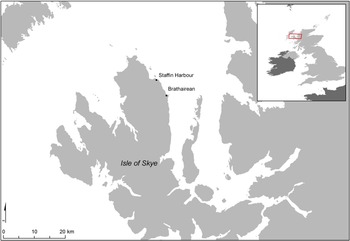
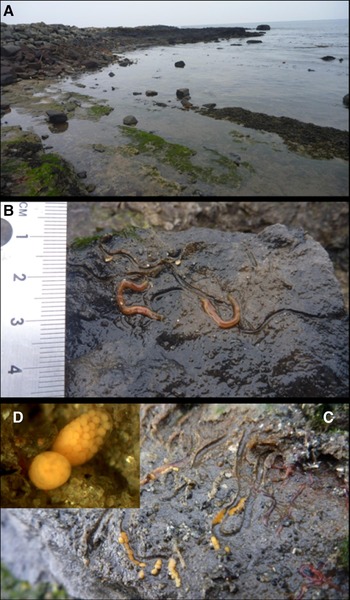
The specimens were first collected in September 2011 from Staffin Harbour on the Isle of Skye (Figure 1) 57°37.9698′N 6°11.865′W. A second visit to Staffin Harbour in March 2013 yielded more specimens that were found burrowing inside mud layers underneath sandstone ledges on the lower shore. They were extracted by lifting up small sections of sandstone that form stepped ledges down the shore (Figure 2A) to reveal the horizontally oriented burrows. The burrow walls were built up with a soft layer of sediment that often remained when the sandstone was removed suggesting that the sediment was held together by a secretion from the worm (Figure 2B, C). Egg capsules could often be observed lining the burrows (Figure 2C, D). Specimens were also collected further south near Brathairean, within mud underneath sandstone ledges, 57°35.1858′N 6°8.8332′W.
Locations of Boccardia proboscidea.

(A) Intertidal sandstone at Staffin Harbour and location of Boccardia proboscidea; (B) live B. proboscidea and their burrows; (C) burrows with live worms and egg capsules; (D) egg capsules at higher magnification.

The worms were preserved in absolute ethanol and transferred to the laboratory for identification. The specimens were initially examined under a Zeiss Stemi 2000 stereo-microscope which enabled identification to genus level. They were then mounted on a slide and examined under a Zeiss Axiostar Plus microscope to allow the specialized chaetae on chaetiger five to be observed, therefore enabling the species to be identified. Photographs were taken using a PAXcam USB Digital Microscope Camera.
RESULTS
SYSTEMATICS
Order SPIONIDA Rouse & Fauchald, 1977
Suborder SPIONIFORMIA Fauchald, 1977
Family SPIONIDAE Grube, 1850
Genus Boccardia Carazzi, 1893
Boccardia proboscidea Hartman, Reference Hartman1940
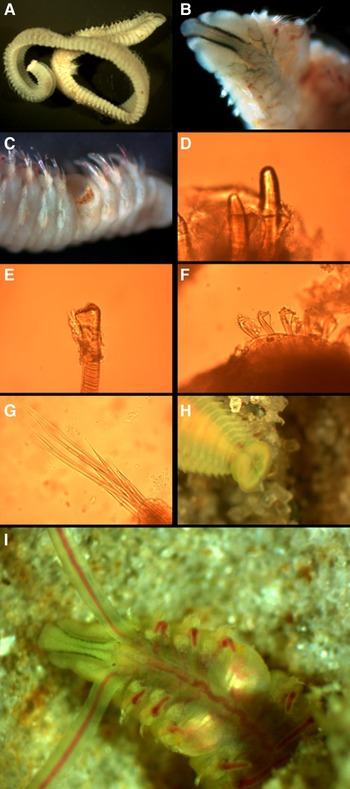
The preserved specimens range from 21 to 29 mm long (excluding palps) and are all approximately 1.0–1.5 mm wide. Chaetiger number varies from 85 to 105. When alive the body is light green in colour with dark green pigment along the margin of the prostomium (Figure 3I). A light yellow/cream coloration is often observed in median segments caused by eggs visible under the skin of gravid females. The prostomium is anteriorly rounded in preserved specimens (Figure 3B) but due to its flexibility can often appear to have a straight or truncated margin in live animals (Figure 3I). After preservation in alcohol the bodies' green coloration disappears, however the margin of the prostomium remains dark green in colour and some green pigment can also be seen on the first few segments radiating from the caruncle (Figure 3B). There are 2–3 pairs of small poorly defined eyes. The sensory caruncle extends to the end of chaetiger 3. Branchiae start on chaetiger 2 and are present on chaetigers 3 and 4 then absent on chaetiger 5. The branchiae recommence on chaetiger 6 and continue for most of the body length but are absent from the last 6–15 chaetigers. The branchiae are cirriform in shape and are thicker and more robust in the anterior of the body with blood vessels easily visible in live animals (Figure 3I). In the posterior region the branchiae become smaller and thinner than in the anterior of the body. Chaetigers 1–4 possess both noto- and neuro- broad capillary chaetae. Notochaetae of chaetiger 1 are shorter than those found on subsequent chaetigers. Chaetiger 5 possesses thickened modified notochaetae of two types; smooth spines with a subterminal bend (Figure 3D) and shorter, blunt, bristle-topped spines (Figure 3D, E). The neurochaetae of segment 5 are short broad capillaries. Bidentate hooded hooks (Figure 3E) appear on neuropodia of segment 7, accompanied by 1–5 short ventrally located broad capillaries on segments 7–9. The number of hooks varies from 6–9 in anterior and median segments then decreases to 2–3 in the most posterior segments. From segment 10 to the posterior region the neuropodia have hooks only. In the posterior segments a single fine capillary sits dorsally to the hooded hooks in the neuropodia. The notochaetae of anterior segments are long broad capillaries and shorter needle-like capillaries (Figure 3G). The notochaetae of posterior segments become thinner in shape and less numerous than those of the anterior segments. The pygidium is disc-shaped with slight indentations dorsally and ventrally (Figure 3H). The anus is centrally located on the pygidium.
Boccardia proboscidea: (A) whole preserved animal; (B) anterior region, dorsal view (without palps); (C) anterior region showing modified chaetae on segment 5, lateral view; (D) modified chaetae on segment 5; (E) blunt bristle-topped spine from segment 5; (F) bidentate hooded hooks; (G) capillary notochaete; (H) pygidium of live animal, ventral view; (I) anterior of live animal, dorsal view.

REMARKS
The collected specimens were initially identified to genus using the key by Radashevsky (Reference Radashevsky2012) of spionids of the British Isles. Radashevsky suggests that three species of Boccardia are or could possibly be found in UK waters: Boccardia aff. polybranchia Haswell, 1885, Boccardia proboscidea and Boccardia semibranchiata Guérin, 1990. All three of these species have been recorded in the Atlantic Ocean and are included in a key developed by Martínez et al. (Reference Martínez, Adarraga and López2006) of which also contains Boccardia chilensis Blake & Woodwick, 1971 and Boccardia natrix Söderström, 1920.
DISCUSSION
The specimens collected from the Scottish coast are morphologically consistent with the original description by Hartman (Reference Hartman1940). There are two possibilities for the emergence of Boccardia proboscidea in the UK; misidentification of other Boccardia species or introduction via human activities. The other species of Boccardia that have been recorded or may occur in the UK are Boccardia polybranchiata and Boccardia semibranchiata (Radashevsky, Reference Radashevsky2012). Boccardia proboscidea can be distinguished from B. polybranchiata due to the presence of notochaetae on chaetiger 1, and from B. semibranchiata due to the bristle-topped spines of segment 5.
Boccardia proboscidea is considered to be native to the west coast of North America and Japan (Hartman, Reference Hartman1940; Petch, Reference Petch1995; Sato-Okoshi & Okoshi, Reference Sato-Okoshi and Okoshi1997; Simon et al., Reference Simon, Thornhill, Oyarzun and Halanych2009). It is thought to be an introduced species in South Africa (Simon et al., Reference Simon, Thornhill, Oyarzun and Halanych2009), Argentina (Jaubert et al., 2010), Hawai‘i (Bailey-Brock, Reference Bailey-Brock2000) and Australia (Blake & Kudenov, Reference Blake and Kudenov1978). It is a very common species in its native Pacific and can be found in a wide variety of habitats worldwide (Petch, Reference Petch1995). It is thought to have a wide tolerance of varying salinities and temperatures (Hartman, Reference Hartman1940). This would suggest an advantage when being transported between different oceans. Boccardia proboscidea has poecilogonous development that includes the production of planktotrophic and adelphophagic young (Gibson & Smith, Reference Gibson and Smith2004) which would also be an advantage when colonizing a new area.
Polydorin spionids are often associated with shellfish due to their ability to bore into calcareous materials. The genus Polydora Bosc, 1802 includes many species that have been observed to directly bore into the shells of molluscs (Sato-Okoshi & Okoshi, Reference Sato-Okoshi and Okoshi1997). Polydora websteri Hartman, 1943 bores into the shells of oysters and creates a burrow lined with mud that causes the oyster to cover the burrow with a layer of shell. This has a deleterious effect on the oyster that ultimately decreases its ability to accumulate nutritional reserves (Wargo & Ford, Reference Wargo and Ford1993). This becomes a particular problem in commercial shellfish farms where these pest species can occur in large densities. Boccardia species are also associated with molluscs (Sato-Okoshi & Okoshi, Reference Sato-Okoshi and Okoshi1997; Bailey-Brock, Reference Bailey-Brock2000; Simon et al., Reference Simon, Thornhill, Oyarzun and Halanych2009). Boccardia proboscidea has been recorded as a non-native introduction within abalone farms in South Africa (Simon et al., Reference Simon, Thornhill, Oyarzun and Halanych2009). In this situation this species was observed as a ‘secondary borer’, meaning that rather than boring directly into shellfish they instead inhabit the burrows of initial boring species such as Polydora hoplura Claparède, 1869 (Simon et al., Reference Simon, Thornhill, Oyarzun and Halanych2009).
Boccardia proboscidea has been introduced into Hawai‘i via a shipment of the oyster Ostrea edulis Linnaeus, 1758 destined for aquaculture from Maine (Bailey-Brock, Reference Bailey-Brock2000). A similar vector has been suggested to be responsible for the introduction of B. proboscidea into South Africa where the abalone Haliotis midae Linnaeus, 1758 was imported from overseas (Simon et al., Reference Simon, Thornhill, Oyarzun and Halanych2009). The UK imports live shellfish species for aquaculture and it may be that B. proboscidea was introduced from overseas. However, this species is known to have a wide range of habitats and it could possibly have been introduced by other human activities such as the uptake and discard of ballast water.
ACKNOWLEDGEMENTS
We thank Bianka Rasch for making the original identification and Tim Worsfold and Vasily Radashevsky for the subsequent confirmation. We are also grateful to Emma Delduca and Muffy Seiderer for reading and commenting on earlier drafts of this paper.