

Many societies worry about how each generation of adolescents seems to display a distinct set of behaviours, attitudes and aspirations different from the previous generations and from current mores of society. This is certainly true in the Philippines where such worries are often framed in terms of concerns about the ‘erosion of values’ the adolescents have; and in this regard, there has been some effort to measure and understand the values of Filipino adolescents (McCann Erickson Philippines, Reference McCann Erikcson2001; Ogena, Reference Ogena1999). One way of comprehensively describing what adolescents are like entails assessing the content, structure and hierarchy of their values, defined here as beliefs about desirable end states or behaviours that transcend specific situations and serve as guiding principles in people's lives (Schwartz & Bilsky, Reference Schwartz and Bilsky1987). As Schwartz (Reference Schwartz2006) puts it, studying values directly is an efficient way to capture and characterise groups or cultures. Values emphasised in one community or culture may constrain the behavioural choices that are available to individuals in the group, particularly in cultures that have a very stronger articulation of and conformity to value norms (Hong & Phua, Reference Hong and Phua2013). As values direct behaviour towards certain goals instead of others, explicating the values of adolescents may shed light on the motivations propelling certain behaviours and experiences that are often associated with this developmental stage. For instance, internalisation of prosocial values (e.g., kindness) has been linked to behaving prosocially (e.g., doing things that benefit others without expecting anything in return) (Hardy & Carlo, Reference Hardy and Carlo2005), and endorsement of moral values (e.g., truth, affiliation) was inversely related to self-reported delinquency (Tarry & Emler, Reference Tarry and Emler2007). In Asian contexts, conservation values are associated with adolescent students’ social-oriented achievement motives, whereas self-enhancement values are associated with individual-oriented achievement motives (Liem, Martin, Porter, & Colmar, Reference Liem, Martin, Porter and Colmar2012; Liem & Nie, Reference Liem and Nie2008). In the domain of work, emphasis on intrinsic work values may influence career choice (Duffy & Sedlacek, Reference Duffy and Sedlacek2007), whereas Confucian-related work values including self-discipline and interpersonal ethics impact on individual and team performance in Chinese organizations (Huang, Liang, & Hsin, Reference Huang, Liang and Hsin2012).
Filipino Values
The present investigation aims to describe the value structure and hierarchy of Filipino adolescents. A quick survey of the literature on value studies in the Philippine context reveals a focus on identifying values that are purportedly salient to most Filipinos. Much of the work on this subject has mostly been descriptive, with scholars nominating their own set of values, which they deemed would best describe the Filipino. For example, Ramirez (1997) culled local leadership values based on her observations of the events that transpired during the 1986 EDSA People Power Revolution. She identified being maka-Diyos (belief in a transcendent force that is present within; a truth that guides in life), maka-tao (being humane) and maka-bayan (being nationalistic) as values of authentic leadership. Talisayon (Reference Talisayon, Obusan and Enriquez1994) synthesised nearly 100 studies on Filipino values and identified five value clusters that comprise the Filipino value system: namely, relationship (e.g., respect for authority), inwardness (e.g., spirituality), social (e.g., nationalism), livelihood (e.g., hard work) and optimism (e.g., joy and humour). Other oft-mentioned value themes in previous studies include close family ties, self- and emotional control, courteous and friendly interactions, concern and sharing with others, hospitality, courage and endurance, and desire for economic progress (Church & Katigbak, Reference Church and Katigbak2000). In an attempt to re-conceptualise Filipino behaviour patterns and value structure (Pe-Pua & Protacio-Marcelino, Reference Pe-Pua and Protacio-Marcelino2000), Enriquez (Reference Enriquez2008) proposed a shared identity model (SIM) of Filipino values. The most important assertion in the SIM is that the core value of the Filipino is a sense of oneness or unity that emanates from the recognition of a shared identity or a notion of a shared inner self. Thus, the self and the other are one and the same. Consequently, other values in this model (e.g., hiya/propriety, lakas ng loob/courage, pakikiramdam/interpersonal sensitivity, pakikibaka/resistance against injustice, etc.) are related values that are expressions of this core value.
As the SIM aimed to characterise Filipinos in general, recent studies have employed this model to specifically elucidate the value priorities of Filipino adolescents. For instance, Clemente et al. (Reference Clemente, Belleza, Yu, Catibog, Solis and Laguerta2008) showed that apart from the values listed in the SIM, adolescents also deemed piety and respect as important guiding principles in their lives. Notably, kindheartedness (kagandahang-loob) ‒ defined as shared nobility manifested by acts of generosity that spring spontaneously from the goodness of the heart (Enriquez, Reference Enriquez2008) ‒ emerged as the highest rated value in the adolescents’ lists of values. In a review (Gastardo-Conaco, Jimenez, & Billedo, 2003), the following values were identified as being particularly important to Filipino adolescents: nationalism and pride regarding identity, parental and family concerns, conformity, leadership and benevolence. Sex differences regarding values were also noted. Young Filipino males valued family, religion, nation, social awareness and recognition more than their female counterparts. On the other hand, young Filipino females seem to value family attachment, social mobility, friendships, autonomy, moral orientation, social consciousness and benevolence more than the males. Note that some of the ‘values’ listed are not strictly speaking values (i.e, they are not beliefs about desirable end states that serve as guiding principles); instead, some may be considered as concepts deemed important or valuable to the adolescents. The review ends with the observation of a trend that seems to suggest the deterioration of the youth's moral values as social acceptance rather than principle becomes the norm of behaviour. Similar observations regarding the shifting values of Filipino adolescents have been noted in previous surveys (Ogena, Reference Ogena1999).
These aforementioned investigations on Filipino values often used indigenous approaches, which were assumed to provide a less distorted image constructed from the perspective of Filipinos (Pe-Pua & Protacio-Marcelino, Reference Pe-Pua and Protacio-Marcelino2000). By articulating value structures using local concepts culled from the language and emphasising an ‘insider's point of view’ in the interpretation of the results, such studies have provided nuanced, contextualised and culturally-appropriate descriptions of Filipinos, in general, and adolescents, in particular. While we affirm the importance of such indigenous or emic approaches, we would also like to argue that it would be beneficial to describe adolescents using an etic perspective that refers to a more comprehensive value structure that is recognised across cultures, like Schwartz’ theory of basic human values (Schwartz, Reference Schwartz and Zanna1992). Exemplars of this cross-cultural approach go beyond interpreting value structures and hierarchies in isolation and afford a meaningful interpretation of the cultural-distinctiveness or cultural-similarity of such value priorities. As demonstrated by Liem, Martin, Nair, Bernardo and Prasetya (Reference Liem, Martin, Porter and Colmar2011), for instance, adolescents from four countries with diverse backgrounds share a strikingly similar pattern of value configuration. Aside from the establishment of similar value configurations across cultures, the etic perspective also allows for cross-cultural comparison of value priorities and also comparisons with pan-cultural norms (Schwartz & Bardi, Reference Schwartz and Bardi2001). Schwartz's values theory and the use of norm-referenced comparisons in values research are briefly discussed in the next section.
Schwartz's Value Types
Two main features of Schwartz's values theory are relevant in the current investigation. First, values are cognitive representations of desirable, trans-situational goals which aim to meet three universal requirements of human existence ‒ biological needs, requisites of coordinated social interaction and demands of group survival or functioning (Schwartz, Reference Schwartz and Zanna1992). Because these needs are universal, it is assumed that people across cultures recognise and endorse more or less similar values.
Schwartz (Reference Schwartz2006) defined ten value types that comprehensively capture nearly all the possible value categories. Each value type is motivationally distinct; that is, each value type represents, manifests and expresses a central and general motivational life goal. For instance, giving importance to the value type of self-direction implies striving for independent-thought and action across various domains in one's life. To make each value type more concrete, the theory also proposes that the content of each type is represented by a set of specific values. Conceptually, this implies that the attainment of the specific values promotes the central goal of each value type. Operationally, these sets of value items are used to measure each value type, as in the case of the Schwartz Value Survey (SVS), which assesses the importance of each distinct value as a guiding principle in one's life. For example, the life goal of pursuing independent thought and action (i.e., self-direction) means giving importance to specific values such as creativity, freedom and choosing own goals.
As described by Schwartz (Reference Schwartz2006), aside from self-direction, other value types include: stimulation (the pursuit of excitement and novelty, represented by values such as a varied life and daring); hedonism (the quest for sensuous gratification for oneself, exemplified by pleasure and enjoying life); achievement (the life goal of attaining personal success by demonstrating competence in accordance with society's standards, represented by values such as ambitious and capable); power (aiming for prestige, social status and control over people and resources, characterized by valuing wealth and preserving public image); security (attainment of safety, harmony and stability of self, relationships and society, represented by social order and reciprocation of favours); conformity (the goal of restraining action likely to upset or harm others and violate social norms, embodied by giving importance to politeness and honoring parents and elders); tradition (motivated by respect, commitment and acceptance of customs, represented by humble, devout and accepting my portion in life); benevolence (the pursuit of enhancing and preserving the welfare of one's ‘in-group,’ exemplified by honest, loyal and forgiving); and, universalism (the life goal of understanding, appreciating and protecting the welfare of all people and nature, represented by social justice, a world at peace and unity with nature).
The second feature of Schwartz's values theory is that values are ordered by relative importance to one another. Individuals and groups may vary in the importance they attribute to the aforementioned value types. Although much of the cross-cultural studies on values have focused on how nations differ, research shows that there is a high degree of consensus regarding the value priorities of individuals across nations. Certain values are consistently ranked as especially important (e.g., benevolence) while others are consistently regarded as less important (e.g., power) (Schwartz & Bardi, Reference Schwartz and Bardi2001). Using data sets of representative or near-representative samples across 13 nations, teacher samples from 56 nations and student samples from 54 nations, they derived pan-cultural norms or averages of value hierarchies which were used to analyse the value priorities of any nation, sample of teachers and sample of students respectively. This average value hierarchy is the basis for the establishment of pan-cultural norms against which specific groups (e.g., adolescents) and societies can be compared.
Using pan-cultural norms, the interpretation of value endorsement scores and ranks in a particular country of interest (e.g., Philippines) becomes more meaningful because ratings are not considered in isolation. The comparative approach can shed light on which values are more emphasised (or less emphasised) in a particular group when compared to the normative baseline. To illustrate, Schwartz and Bardi (Reference Schwartz and Bardi2001) compared value hierarchies of Singaporean teachers against the pan-cultural ranking. Their analysis suggests that in Singapore, there is much more emphasis on stability of relationships and an aversion for violating societal norms; security and conformity were ranked highly compared to the pan-cultural average. Consistent with this description of the Singaporean sample, self-direction was also found to be emphasised less, suggesting a relatively less importance given to supporting independent thought and action. Using pan-cultural norms can also reveal whether value hierarchies are either culturally distinct or highly congruent with the average of the comparative group. As a case in point, the value hierarchies of Black African samples seem to deviate from the pan-cultural average, with correlations relatively lower when compared to the degree of consensus of the majority of the nations or regions with the normative baseline (Schwartz & Bardi, Reference Schwartz and Bardi2001). In relation to this, the comparative approach can provide insight as to which factors possibly influence any significant deviations from these norms. Schwartz and Bardi posit that nations have more or less congruent value hierarchies because this reflects similar priorities that nations have in accordance with their goals of preserving relationships among group members and supporting individual members’ self-interests. Any deviations from the pan-cultural pattern may reflect cultural particularities that help shape an individual's value hierarchy.
As the present study focuses on describing the value profile of Filipino adolescents using Schwartz's values theory, it is important to note that the theory has been validated in diverse samples of adolescents from countries such as Germany (e.g., Bubeck & Bilsky, Reference Bubeck and Bilsky2004), Chile and Portugal (e.g., Bilsky, Niemann, Schmitz & Rose, Reference Bilsky, Niemann, Schmitz, Rose, Bilsky and Elizur2005), South Africa (e.g., Schwartz et al., Reference Schwartz, Melech, Lehman, Burgess, Harris and Owens2001; Study 2), Uganda (e.g., Schwartz et al., Reference Schwartz, Melech, Lehman, Burgess, Harris and Owens2001; Study 3), China and Indonesia (Liem et al., Reference Liem, Martin, Porter and Colmar2012; Liem & Nie, Reference Liem and Nie2008), Singapore, Australia and the Philippines (e.g., Liem et al., Reference Liem, Martin, Nair, Bernardo and Prasetya2011). Most of these studies have focused on confirming the theory's value structure (i.e., whether the ten value types were positioned in the same space within the circular model, similar to the proposition of the original theory). At the same time, these studies tested the stability of the value structure among children and adolescent samples, since the proposed circular model and most subsequent studies validating it were often derived from adult samples. In this study, however, we intended to compare and interpret the value hierarchy of Filipino adolescents using the pan-cultural norms uncovered by Schwartz and Bardi (Reference Schwartz and Bardi2001), an approach which is not usually employed in studies profiling Filipino adolescents’ values.
Method
Participants
Participants were recruited from two secondary schools and one university in Metro Manila. A total of 752 students participated in the study. However, data of seven participants were excluded because they failed to answer a substantial number of items. Thus, data from 745 participants were included in the final analyses. The participants’ mean age was 16.7 years (SD = 1.84). Majority of the participants were males (N = 477).
Materials
The 40-item Portrait Values Questionnaire (PVQ) was used in this study. The PVQ includes short verbal portraits which describe a person's goal, aspirations or wishes that point implicitly to the importance of a value (Schwartz, Reference Schwartz2006). For instance: ‘It's very important to him/her to help the people around him/her. S(he) wants to care for their well-being’ describes a person for whom benevolence values are important. For each verbal portrait, participants were asked to think about how much the person being described is like him/her. In this study, the PVQ was administered to different batches of students on separate occasions. Participants responded with options ranging from 6 (very much like me) to 1 (not like me at all).
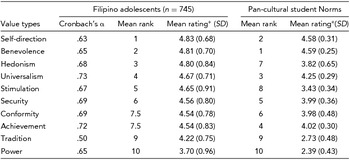
To test the structural validity of the scale, a confirmatory factor analysis was conducted to verify whether the data fitted the proposed ten-factor model. Instead of using all of the scale items as indicators for each of the ten factors, we used two parcels for each factor (Little, Cunningham, Shahar, & Widaman, Reference Little, Cunningham, Shahar and Widaman2002). Parcels were used because it is likely that having numerous indicators in a large sample would lead to unsatisfactory fit in the measurement model (Bagozzi & Heatherton, Reference Bagozzi and Heatherton1994); the use of parcels also reduces the likelihood that parameters will be affected by item-specific variance (Lance, Woehr, & Fisicaro, Reference Lance, Woehr and Fisicaro1991). The use of parcels in confirmatory factor analysis of the PVQ has been done in previous studies (Leung, Au, Huang, Kurman, Niit, & Niit, Reference Leung, Au, Huang, Kurman, Niit and Niit2007). The results of the confirmatory factor analysis indicated adequate fit between the data and the ten-factor model: χ2(125) = 473.203, p <0.001; χ2/df = 3.786; CFI = 0.924, GFI = 0.940, AGFI = 0.900; TLI = 0.884; RMR = 0.045, and RMSEA = 0.061. The regression weights for all ten factors were significant, with standardised regression weights ranging from 0.53 to 0.95. Similar to Liem et al. (Reference Liem, Martin, Nair, Bernardo and Prasetya2011; see also Schwartz, Reference Schwartz, Tamayo and Porto2005), the ten subscales that measured each of the ten value types had acceptable reliability coefficients except for the four-item Tradition subscale (see Table 1).
Summary of means and ranks of value types for Filipino adolescents and pan-cultural student norms

*The mean ratings for the Filipino adolescent sample were derived from scores using a 6-point scale, whereas the mean ratings for the pan-cultural student norms were derived from scores using an 7-point scale; thus, the two sets of means may not be directly compared to each other.
Results
Table 1 presents the mean ratings and rankings of the ten value types for both the Filipino adolescents and the pan-cultural student norms. An Analysis of Variance for repeated measures was conducted to test whether there were differences among the ten value types. However, the Mauchly's test indicated that sphericity cannot be assumed (Mauchly's W = 0.165; χ2(44) = 1332.601, p < 0.0001), so we used the Wilks’ Lamba multivariate test. The results showed a significant difference across value types, Wilks’ Lambda = 0.317, F(9,736) = 176.394, partial η2 = .683, p < 0.0001. The means were then compared using a pairwise comparison with Bonferroni adjustment, and the results indicate a clustering of means across the ranks. In particular, the means for the top three ranked value types (self-direction, benevolence and hedonism) were not significantly different from each other, but were all significantly higher than all other value types, thus forming the highest cluster of value types. The mean for universalism and stimulation were also not significantly different from each other, but universalism was significantly higher than all other value types, whereas stimulation was not different from security, conformity and achievement. We consider these five value types as forming the middle cluster of value types in the ranking. The two lowest ranked value types (tradition and power) were significantly lower compared to all other value types, and were also significantly different from each other; thus, forming the lowest cluster of value types in the ranking.
How do the value hierarchies of the Filipino sample compare to the pan-cultural hierarchy? The correlation between the ranks was computed, and indicated a moderate correlation between the two (rs[8] = 0.74, p = 0.015). The correlation suggests a substantial degree of agreement regarding the relative importance of the value types. However, the relationship is not as strong when compared to correlation coefficients that Schwartz and Bardi (Reference Schwartz and Bardi2001) found in other countries (i.e., median rs = 0.82). Inspection of the ranks would indicate some notable differences: hedonism and stimulation ranked higher (3rd and 5th, respectively) in the Filipino adolescent sample compared to the pan-cultural norms, and achievement ranked relatively lower (7.5th) in the Philippine sample when compared to the norms. So although there are clear similarities in the way the value hierarchies are ordered, there also seem to be important differences.
Discussion
The primary goal of the present study was to describe the values of Filipino adolescents by measuring how they prioritise ten value types. As a complement to the more emic descriptions in the extant literature on adolescence and value systems in the Philippines, we took an etic approach by using Schwartz's theory of basic human values to illustrate what Filipino adolescents value and compared their value priorities with pan-cultural norms. The results of comparing the Filipino adolescents’ value types and hierarchies to the pan-cultural norms suggest that Filipino adolescents (a) prioritise stimulation (pursuit of an exciting and novel life) and hedonism (quest for sensuous gratification for oneself) more than the average adolescent does, and (b) place less importance on achievement (i.e., attaining success with reference to society's standards).
But before we discuss these comparative results, we should note that the general ranking of the values of the Filipino adolescent sample was not very different from the ranking of the pan-cultural norms for the student sample, with the same pair of values (self-direction and benevolence) ranked highest and another pair of values (tradition and power) ranked the lowest in both samples. That Filipino adolescents share such a pattern with other adolescents across cultures could be reflective of the common experiences that all adolescents undergo in this developmental stage. Adolescence is referred to as a state of tension between connection and individualism (Brown & Larson, Reference Brown, Larson, Brown, Larson and Saraswathi2002) where adolescents begin to negotiate between dependence on their close groups and independence to do tasks on their own. In their negotiation of such tensions, they may be guided by openness to change values (e.g., self-direction) and less by conservative values (i.e., tradition), while still recognising the importance of taking care of their in-group (in this case, their family, aligned with prioritising benevolence). Noting these similarities to the pan-cultural norms leads to different characterisations of the values of Filipino adolescents compared to if the values are described in isolation. For example, if we just consider the Filipino adolescent means in isolation, it would seem that the young Filipinos prioritise the values of self-direction and benevolence, but do not give importance to tradition and power given their low ranks in the value hierarchy. But a comparison with the pan-cultural norm indicates that that pattern is not unique to Filipino adolescents and may actually be common to most adolescents.
On the other hand, the comparison with pan-cultural norms also suggests that Filipino adolescents might actually give more importance to stimulation and hedonism relative to other young people. The pan-cultural comparisons show that the Filipino adolescents ranked these two value types as more important relative to their counterparts in other parts of the world. Recall that stimulation refers to the pursuit of excitement and novelty and hedonism is the quest for sensuous gratification for oneself, and the asserted shift in the values of Filipino adolescents might be more in these particular areas of their development. These results regarding hedonism and stimulation seem consistent with previous observations regarding the shifting values of Filipino adolescents (Gastardo-Conaco et al., 2003; Ogena, Reference Ogena1999), but can also be seen from the lens of certain aspects of the Filipino culture. Both these value types emphasise the freedom to pursue pleasure and an exciting life. The higher ranking of these values might be linked to the importance that Filipinos ascribe to their relationships (Enriquez, Reference Enriquez2008). The pursuit of pleasurable activities might be within the context of the adolescents’ ever-expanding social networks. In addition to the shared activities with family members, Filipino adolescents are also engaging in more (leisure) activities outside the home, with their peers and romantic partners (Santa Maria, Reference Santa Maria, Brown, Larson and Saraswathi2002). Because shared pleasurable activities are a means to establish and maintain relationships, it might be that Filipino adolescents find such pursuits to be extremely important.
The comparison with pan-cultural norms also suggests that Filipino adolescents may value achievement less than other youths. Recall that achievement refers to the goal of demonstrating competence with reference to standards set by society. We can try to make sense of this result by considering Filipino adolescents’ values and aspirations in their educational life, particularly as school is one of the main preoccupations of the Filipino adolescents in the sample. Indeed, although the goal of demonstrating normative competence based on external standards (or performance-approach goals) seems to be important to Filipino adolescent students (Dela Rosa & Bernardo, Reference Dela Rosa and Bernardo2013; Ganotice, Bernardo & King, Reference Ganotice, Bernardo and King2012), some comparisons suggest that they give such goals less importance than other Asian students and that they actually perceive students who aspire to display such normative competence less favourably (c.f., Bernardo & Ismail, Reference Bernardo and Ismail2010). Other research indicate that Filipino adolescents perceive achieving in school as not being important to succeeding in Philippine society (Bernardo, Reference Bernardo2003), and reject parental norms regarding the level of achievement they should aspire for in school (Bernardo, Reference Bernardo2010, Reference Bernardo2012). In other words, if we consider adolescents’ aspirations related to schooling, there seems to be convergent data showing that Filipino adolescent students ascribe less importance to achievement in the academic domain.
In this study we wanted to emphasise that values of adolescents are best interpreted when compared to the pan-cultural norms. Indeed we noted the degree of similarity between the value hierarchies of the Filipino adolescents and the pan-cultural sample, but there were also some value types that were either more emphasised or less emphasised in the Filipino adolescent sample. We proposed some speculative interpretations of the trends we observed, but what we wish to underscore is how simple and straightforward descriptions of the Filipino adolescents’ values may not be warranted. We acknowledge that our results may also not be generalisable given the nature of our sample, which was drawn from an urban and educated sample, and may also be drawn from a relatively higher socioeconomic group. It would be important that future studies employ the same etic approach we employed in this study using a more representative sample; and indeed, the benefit of the etic approach is that the data-gathering procedures are such that it is actually easier to obtain the desired data from a more representative sample. The current study also does not inquire into the factors that shape these value hierarchies, and future studies may now look into other contextual factors that shape endorsement of values. For example, what socialisation agents and social developmental experiences encourage the pursuit of stimulation while potentially stifling achievement? Future research could also inquire into specific subtypes of the ten value types that were recently defined in a refined version of Schwartz’ values theory (Schwartz et al., Reference Schwartz, Cieciuch, Vecchione, Davidov, Fischer, Beierlein and Konty2012).
We wanted to underscore the importance of using etic approaches in assessing values of adolescents not as the only approach to measuring values, but as a complementary approach to emic approaches to describing values of a population. We note that there is some convergence between the values found in emic studies and the results of our current study. In particular, we see that benevolence, which was ranked high in our results, was also mentioned in the survey of Gastardo-Conaco and colleagues (2003), and is consistent with kagandahang-loob or kindheartedness and respect for others observed by Clemente and colleagues (Reference Clemente, Belleza, Yu, Catibog, Solis and Laguerta2008) in their study of Filipino adolescents’ values. The high ranking of benevolence can also be seen as somewhat consistent with Enriquez's (2008) shared identity model where in a sense of kapwa (shared identity of self and others) is assumed to be the core value of the Filipinos. Our data show that Filipino adolescents also give relatively high priority to benevolence and universalism, which are the two value types most closely related to a sense of shared identity. But the results show that these two value types are not the most important for the Filipino adolescents, which might lead us to question whether these are actually ‘core’ values for the Filipino adolescents.
There are more obvious discrepancies between the results of emic studies and of the current study. For example, the emic studies on Filipino values also identify some values such as piety (Clemente et al., Reference Clemente, Belleza, Yu, Catibog, Solis and Laguerta2008), nationalism and pride regarding one's identity (Gastardo-Conaco et al., 2003) that do not seem to be captured in our data. Likewise, the higher priority for the value types of hedonism and stimulation found in our sample is not a value that has been noted in emic studies of Filipino values. We believe that these discrepancies underscore the importance of doing both emic and epic studies on Filipino adolescents’ values. The emic approaches can identify culture-specific or group-specific values that may not be included in etic-based taxonomies of value types. On the other hand, comparisons involving pan-cultural data and norms could also pick up value priorities that are not readily drawn from emic approaches. As we have demonstrated, etic approaches seem to capture both similarities and differences that emic approaches may not readily surface. Indeed, it is hard to imagine how an emic study might reveal that Filipino adolescents do not give too much importance to the achievement value type. Thus, future studies must indeed take both the emic and etic approaches into account. Looking at values from these two perspectives should increase our appreciation of these important principles that guide adolescents and all people in their everyday lives.