Globally, yoghurt is the most popular fermented milk product and is widely consumed for its nutritious characteristics and sensory properties (Walstra et al. Reference Walstra, Wouters and Geurts2006; Cheng, Reference Cheng2010). There have been studies investigating the influence of manufacturing process on yoghurt composition (Tamime & Robinson, Reference Tamime and Robinson2007). However, the influence of feeding systems, particularly pasture-based systems, on compounds involved in yoghurt quality (flavour compounds and organic acids) and nutritional value (fatty acids; FA) has not been extensively studied.
Pasture is the main source of nutrients for dairy cows in many parts of the world, including Australia, New Zealand and Ireland. It is also well known that milk from grazing dairy cows contains a number of compounds with benefits for human health (Dewhurst et al. Reference Dewhurst, Shingfield, Lee and Scollan2006). Dairy cows grazing pasture are often offered supplementary grain or forage to meet their nutritional requirements. Some traditional pasture-based feeding systems are not efficient in rumen fermentation when a high amount of grain supplements are fed to dairy cows at milking times and cause fluctuations in rumen pH, and reduced milk yield responses (Wales & Doyle, Reference Wales and Doyle2003; Doyle et al. Reference Doyle, Francis and Stockdale2005).
Partial mixed rations (PMR), defined as total mixed rations (TMR) incorporated into the diets of grazing dairy cows and supplements provided after milking (Bargo et al. Reference Bargo, Delahoy, Schroeder, Baumgard and Muller2006; Auldist et al. Reference Auldist, Marett, Greenwood, Hannah, Jacobs and Wales2013), has been suggested as an efficient system to provide supplements to grazing dairy cows. These systems have been reported to lead to more stable rumen fermentation as they provide longer period of time for the consumption of the supplement and increase the milk production response of grazing cows compared to traditional systems (Bargo et al. Reference Bargo, Muller, Varga, Delahoy and Cassidy2002; Garcia & Fulkerson, Reference Garcia and Fulkerson2005; Doyle, Reference Doyle, Fuquay, Fox and McSweeney2011; Auldist et al. Reference Auldist, Marett, Greenwood, Hannah, Jacobs and Wales2013).
There are previous studies reporting the influence of PMR systems on milk composition (Bargo et al. Reference Bargo, Delahoy, Schroeder, Baumgard and Muller2006; Morales-Almaráz et al. Reference Morales-Almaráz, Soldado, González, Martınez-Fernández, Domınguez-Vara, de la Roza-Delgado and Vicente2010; Trenerry et al. Reference Trenerry, Akbaridoust, Plozza, Rochfort, Wales, Auldist and Ajlouni2013, Akbaridoust et al. Reference Akbaridoust, Plozza, Trenerry, Wales, Auldist, Dunshea and Ajlouni2014). For example, Bargo et al. (Reference Bargo, Delahoy, Schroeder, Baumgard and Muller2006) and Morales-Almaráz et al. (Reference Morales-Almaráz, Soldado, González, Martınez-Fernández, Domınguez-Vara, de la Roza-Delgado and Vicente2010) reported that compared to TMR, PMR diets increased the concentration of beneficial FA such as poly unsaturated fatty acids (PUFA) and conjugated linoleic acid (CLA). However, there are no reports on the influence of PMR systems on yoghurt composition and the influence of such systems on milk organic acids and flavour compounds.
A research programme was implemented at the Department of Environment and Primary Industries in Victoria, Australia, to evaluate the influence of differently formulated PMR on milk production, as well as the composition of milk and dairy products, compared to traditional pasture based feeding systems (Auldist et al. Reference Auldist, Marett, Greenwood, Hannah, Jacobs and Wales2013; Akbaridoust et al. Reference Akbaridoust, Plozza, Trenerry, Wales, Auldist, Dunshea and Ajlouni2014).The aims of the current experiment was to determine whether different systems of feeding supplement to grazing dairy cows alongside with yoghurt manufacturing process would affect the amount of fatty acids, organic acids and volatile organic flavour compounds in yoghurt prepared from milk produced using these systems.
Materials and methods
Experimental design
The experiment was conducted at the Department of Environment and Primary Industries (DEPI) Ellinbank, Victoria, Australia (38°14′S, 145°56′E) in autumn (April and May), for a 25-d period. The experiment was undertaken in accordance with the Australian Code of Practice for the Care and Use of Animals for Scientific Purposes and under institutional animal ethics committee approval. This experiment included a 14-d adaptation period and an 11-d measurement period and the same pasture allowance (14 kg DM/cow per d) was offered to all the cows.
The details of the experimental designs, feeding strategies and sample collection were reported previously by Auldist et al. (Reference Auldist, Marett, Greenwood, Hannah, Jacobs and Wales2013) and Akbaridoust et al. (Reference Akbaridoust, Plozza, Trenerry, Wales, Auldist, Dunshea and Ajlouni2014). Briefly, 216 cows were divided into 24 groups of 9 cows and each were fed supplementary grain and forage according to one of 3 different strategies (8 groups per strategy). The 3 strategies were: (1) Control: Cows fed Control diet grazed perennial ryegrass pasture supplemented with milled barley grain fed twice daily in the dairy and pasture silage provided in the paddock. This feeding strategy was designed to mimic a pasture-based diet traditionally used in Victoria, Australia; (2) PMR1: Cows offered the same pasture at the same allowance and the same amounts of milled barley grain and pasture silage as Control diet, but these supplements were mixed and presented as a ration on a concrete feedpad immediately after each milking; (3) PMR2: Cows grazed the same pasture at the same allowance offered to the Control and PMR1 cows, but a mixed ration comprising barley grain (25% of total supplement dry matter, DM), crushed corn grain (30% of DM), corn silage (20% of DM) and alfalfa hay (25% of DM), fed after each milking on a feedpad was also offered to these cows. Two groups of 9 cows within each feeding systems (Control, PMR1 and PMR2) were randomly assigned to receive either 6, 8, 10 or 12 kg DM supplement/cow per d. Thus there were two replicated groups per supplement amount per feeding systems.
Milk samples were collected at consecutive milking (p.m. + a.m.) using in-line milk meters (DeLaval International, Tumba, Sweden). Cows with clinical mastitis were excluded. Each milk sample was a mixture of the milk from one group of 9 cows fed the same dietary treatment with the same amount of supplement. The milk from replicate groups was not mixed. In total, 48 samples were collected and samples were stored at −20 °C for yoghurt preparation and further analyses.
Milk composition
Milk fat, protein and lactose concentrations were measured in fresh milk at a commercial laboratory using near infrared spectrophotometry (Foss 605B Milko-Scan, Foss Electric, Hillerød, Denmark).
Yoghurt preparation
Yoghurt was produced from each thawed milk sample using Thermophilic Yoghurt Culture Yo-Flex® (YC-380) Freeze-Dried Lactic Culture for Direct Vat Set (DVS) (CHR. Hansen, Melbourne, Australia). The starter culture consisted of Streptococcus thermophilus and Lactobacillus delbrueckii subsp. bulgaricus. The procedures of starter culture preparation and yoghurt production were carried out following the manufacturer's guidelines. Milk samples, 100 ml each, were pasteurised (85 °C-30 min), cooled to 43 °C and inoculated with 200 µl yoghurt starter culture at 43 °C. The inoculated milk samples were incubated at 43 °C until the pH reached 4·5 (4·5 h) and cooled to 4 °C.
Fatty acid analysis
Yoghurt fat was extracted according to ISO14156-IDF172. Extracted fat was methylated according to ISO15884-IDF182 (ISO-IDF, 2001, 2002) using a methanolic solution of potassium hydroxide (2 m). Fatty acid methyl esters were analysed using a Varian 3800 gas chromatograph (GC) (Varian, Mulgrave, Australia) fitted with a 100 m × 0·25 mm, 0·2 µm Varian CP-Sil 88 column and equipped with a Varian CP-8400 autosampler and flame ionisation detector. The GC oven temperature programme started at 45 °C (held for 4 min), then heated at 13 °C/min to 175 °C (held for 27 min) and 4 °C/min to 215 °C (held for 10 min). The injector and detector temperature were 250 and 275 °C. Fatty acid methyl esters were identified and quantified using a standard mixture of 37 fatty acids C4-C24 (Supelco, Bellefonte, PA, USA). Linoleic acid, conjugated methyl ester (Sigma, Sydney, Australia) and trans-11-vaccenic acid (Supelco, Bellefonte, PA, USA) were used for the identification of 9c,11t-18:2 and 11t-18:1, respectively.
Organic acid analysis
Standard solutions of acetic (4·29 mg/ml), citric (3·33 mg/ml), formic (4·05 mg/ml), lactic (3·21 mg/ml), orotic (0·43 mg/ml), oxalic (3·06 mg/ml), propionic (3·74 mg/ml), pyruvic (3·26 mg/ml), succinic (3·31 mg/ml) and uric (0·17 mg/ml) acids in Milli-Q water were used for identification of organic acids. All the standards were purchased from Sigma (Sydney, Australia) except citric acid from Merck (Melbourne, Australia). Working standards were prepared by combining aliquots of each stock solution to produce dilutions of 8 : 100, 4 : 100, 2 : 100 and 1 : 100 for HPLC calibration curves.
Organic acids were analysed in both milk and yoghurt samples according to the method described by Tormo & Izco (Reference Tormo and Izco2004) using a Waters 2695 HPLC equipped with a cooled autosampler at 4 °C and heated column compartment at 30 °C (Waters, Milford, MA, USA) coupled to a Waters 996 photo diode array (PDA) detector. The components were separated on a SphereClone C18 (250 × 4·60 mm, 5 µm) stainless steel HPLC column (Phenomenex, Sydney, Australia), fitted with a C18 guard column. The mobile phase consisted of 20 mm KH2PO4 adjusted to pH 2·1 with 85% phosphoric acid and the analysis conducted under isocratic conditions. Acquisition for quantitative measurement was made at 210 nm for all the organic acids, except for orotic and uric acids which were monitored at both 210 and 280 nm. The organic acid peaks in the sample chromatograms were identified comparing the retention times and UV spectra of those compounds in the standard mixture. Organic acids were quantified using Empower 2 software (Waters, Milford, MA, USA).
Volatile organic flavour compound analysis
Purge and trap gas chromatography- mass spectrometry (P&T GC-MS)
An aliquot (10 g) of each yoghurt sample was mixed with 5 ml saturated sodium chloride solution. Volatile organic compounds were analysed using a Hewlett Packard 5890 Series II (Agilent Technologies, Melbourne, Australia) coupled to a Hewlett Packard quadruple MSD 5971 (Agilent Technologies, Melbourne, Australia). Volatile flavour compounds were separated on a DB-264 column (20 m × 0·18 mm, 1 µm FT). Samples were purged for 15 min using helium at a flow rate of 37·5 ml/min into a 28·6 cm Vocarb 3000 trap kept at room temperature. The trap was heated for 5 min at 220 °C for compound desorption. Capillary transfer line and valves were heated at 200 °C in order to avoid volatile compound condensation. Oven temperature for GC analysis was programmed at 38 °C (held for 4 min), 2 °C/min to 45 °C then 50 °C /min to 200 °C (held for 5 min). Ultra high purity helium at 10 kPa was employed as carrier gas. The MS source temperature was 230 °C and the scanned mass range was 35–300 amu.
Peak Identification and qualitative analysis
Peaks were identified using the NIST Mass Spectral library (NIST08). For each sample, 9·8 µg/l of pentafluoro benzene, 1,4-difluorobenzene, chlorobenzene d5 and 1,4-dichlorobenzene and the same amount of dibromofluoromethane, toluene d8 and 4-bromofluorobenzene were included as internal standards and surrogates. The peak area of each compound was normalised against the internal standard pentafluoro benzene in all the chromatograms. The normalised peak areas were used to compare their relative abundance in different samples.
Statistical analysis
The effect of the treatments (feeding strategies, amounts of supplement and their interaction) on yoghurt fatty acids, organic acids and volatile organic flavour compounds were analysed as a randomised complete block design using SAS (2009) and according to the model
 $${Y_{ijkl}}\, = \,{\rm \mu} \, + \,{R_i}\, + \,{T_j}\, + \,{S_k}\, + \,{(TS)_{\,jk}}\, + \,{{\rm\varepsilon} _{ijkl}}$$
where Y ijkl = observed value of response variable from replicate i, feeding strategies j, amounts of supplement k, μ = population mean, T j = effect of feeding strategies, S k = effect of supplement amount, (TS)jk = interaction effect of feeding strategies by amounts of supplement and εijk = experimental error.
Prior to ANOVA, residuals were tested for the assumptions of normality and homogeneity; where required, data were log-transformed. Treatments means were compared using protected LSD at 95% confidence level.
Results
Feed composition
Feed composition and its fatty acid profile were previously reported by Auldist et al. (Reference Auldist, Marett, Greenwood, Hannah, Jacobs and Wales2013) and Akbaridoust et al. (Reference Akbaridoust, Plozza, Trenerry, Wales, Auldist, Dunshea and Ajlouni2014).
Milk composition
Fat concentration in PMR2 milk was greater (P < 0·01) than PMR1 and Control milk (4·8, 4·5 and 4·4% for PMR2, PMR1 and Control, respectively). The increase in the amount of supplement from 6 to 12 kg of DM/cow per d caused 29, 16 and 6% decrease in fat percentage of milk produced respectively from Control, PMR1 and PMR2 systems. The percentages of protein (P = 0·80) and lactose (P = 0·38) were not influenced by dietary treatments.
Fatty acids
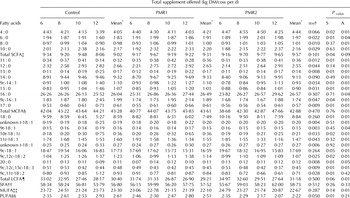
Both feeding strategies and amount of supplement affected (P < 0·05) most of the FA measured in yoghurt samples (Table 1), but the interactions between these two factors were not significant (P > 0·05; results are not shown). Fatty acid profiles of Control and PMR1 yoghurts were largely similar, but different from PMR2 yoghurt.
Fatty acids proportions in yoghurt produced from milk from cows offered different amounts (6, 8, 10 and 12 kg DM/cow per d) of supplement according to 3 different feeding strategies (Control, PMR1 and PMR2).

Data represent mg FA/100 mg Fat
Mean* indicates the average proportion of fatty acids within each strategy (Control, PMR1 and PMR2), regardless the amount of supplement
P value (s) indicates the differences between feeding strategies (Control, PMR1 and PMR2)
P value (A) indicates the differences between the amounts of supplement
† Standard error of the mean
‡ Short chain fatty acids
§ Medium chain fatty acids
¶ Long chain fatty acids
†† Saturated fatty acids
‡‡ Monounsaturated fatty acids
§§ Polyunsaturated fatty acids
The largest proportions of total short chain fatty acids (SCFA) and smallest proportions of PUFA were observed in PMR2 yoghurt compared to Control and PMR1 yoghurts. Similar to other PUFA, 9c,11t-18:2 proportions in the Control and PMR1 yoghurt were large and reached 0·93 and 0·85 mg/100 mg fat, respectively compared to 0·70 mg 9c,11t-18:2/100 mg fat in PMR2 yoghurt. There was a general increase (15%) in the amount of medium chain fatty acids (MCFA) when the amount of supplement increased from 6 to 12 kg DM/cow per d (regardless the type of feeding systems; data in Table 1 is based on different feeding systems). In contrast, the amount of long chain fatty acids (LCFA) decreased generally by 17% when the amount of supplement increased from 6 to 12 kg DM/cow per d (regardless the type of feeding systems).
Organic acids
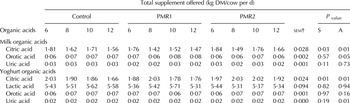
To investigate the influence of fermentation on organic acids, these compounds were measured both in milk and yoghurt samples. Lactic, citric, orotic and uric acids were identified in yoghurt samples, and lactic acid was the major organic acid. In comparison, milk samples contained only citric, orotic and uric acids. Citric acid was the only organic acid in both milk and yoghurt samples that was affected (P < 0·05) by the feeding systems. Citric acid content was greatest in PMR2 milk and yoghurt, and decreased as the amount of supplement increased (Table 2).
Organic acid proportions in milk and yoghurt from cows offered different amounts (6, 8, 10 and 12 kg DM/cow per d) of supplement according to 3 different feeding strategies (Control, PMR1 and PMR2). Data represent mg organic acid/ml milk and mg organic acid/g yoghurt

P value (s) indicates the differences between feeding strategies (Control, PMR1 and PMR2)
P value (A) indicates the differences between the amounts of supplement
† Standard error of the mean
Volatile organic flavour compounds
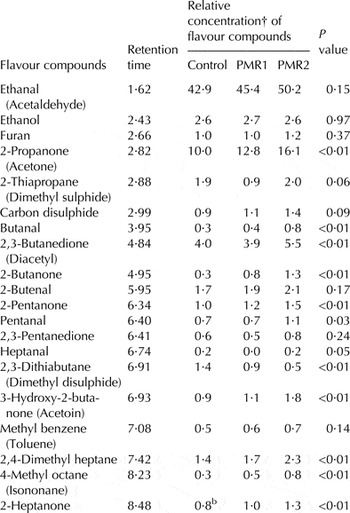
A wide range of volatile compounds was identified in yoghurt using P&T GC-MS. However, comparing these results with data reported in the literature (Imhof et al. Reference Imhof, Glättli and Bosset1995; Beshkova et al. Reference Beshkova, Simova, Frengova and Simov1998; Ott et al. Reference Ott, Germond, Baumgartner and Chaintreau1999; Cheng, Reference Cheng2010) and the NIST MS library match, only 20 components were attributed to volatile organic flavour compounds in yoghurt samples (Table 3). Control and PMR1 contained similar relative abundances of volatile compounds and were different (P < 0·05) from PMR2 yoghurt (Table 3).
Relative concentrations of volatile organic flavour compounds of yoghurt produced from milk from cows offered 3 different feeding systems (Control, PMR1 and PMR2, regardless the amount of supplement)

† Area of the peak corresponds to the flavour compound divided by the area of internal standard pentafluoro benzene
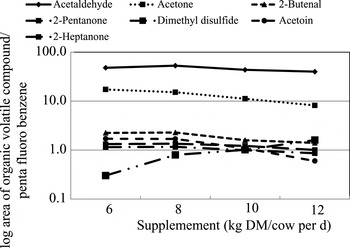
The relative abundance of acetone, 2-pentanone, dimethyl disulphide, acetoin and 2-heptanone were influenced (P < 0·05) by both dietary treatments and amount of supplement (Table 3 and Fig. 1).
Increasing amounts of supplement (from 6 to 12 kg DM/cow per d; regardless the type of feeding systems) decreased (P < 0·05) the relative concentrations of yoghurt volatile organic flavour compounds.

Most of these compounds were greater in PMR2 yoghurt compared to Control and PMR1 yoghurt, and their relative abundance decreased as the amount of supplement increased. The only exception was dimethyl disulphide which was larger in Control and PMR1 yoghurt and increased as the amount of supplement increased. The relative abundance of butanal, diacetyl, 2-butanone, pentanal, 2,4-dimethyl heptane, 4-methyl octane, total amount of ketones and total amount of hydrocarbons were influenced (P < 0·05) by dietary treatment, but not the amount of supplement, and were greater in PMR2 yoghurt. The relative abundance of acetaldehyde and 2-butenal decreased (P < 0·05) as the amount of supplement increased from 8 to 12 kg DM/cow per d (Fig. 1), but were not influenced by the dietary treatments.
Discussion
Control (the traditional feeding system) and PMR1 feeding systems used the same amounts and types of supplements, but were different in terms of the form in which they were offered. Supplements were offered to cows in the milking parlour and paddock for Control cows vs. on a feedpad after milking for PMR1. The purpose of providing cows with Control and PMR1 diets was to investigate the influence of different ways (traditional pasture based diet i.e. Control vs. PMR) of offering the same supplements to dairy cows on milk and yoghurt composition. PMR2 was also offered to cows on a feedpad after milking, but it contained different dietary components to the Control and PMR1 systems.
Fatty acids
The influence of feeding systems on yoghurt FA was similar to those effects observed in corresponding milk samples (Akbaridoust et al. Reference Akbaridoust, Plozza, Trenerry, Wales, Auldist, Dunshea and Ajlouni2014). Previously, Boylston & Beitz (Reference Boylston and Beitz2002) and Dave et al. (Reference Dave, Ramaswamy and Baer2002) studied yoghurt FA profile from cows fed different diets and studied the influence of yoghurt manufacturing process on FA profile. They reported no difference between milk and yoghurt FA composition. Similarly, the results of current study suggest that the same pattern of changes in milk FA will be reflected in yoghurt FA.
As in milk samples (Akbaridoust et al. Reference Akbaridoust, Plozza, Trenerry, Wales, Auldist, Dunshea and Ajlouni2014), Control and PMR1 yoghurts contained similar proportion of FA profile which was different from FA profile of PMR2 yoghurt. The mechanisms by which these feeding systems influenced milk FA composition was discussed in details by Akbaridoust et al. (Reference Akbaridoust, Plozza, Trenerry, Wales, Auldist, Dunshea and Ajlouni2014). Briefly, the similar FA composition of Control and PMR1 yoghurt could be explained by similar ruminal metabolism (Auldist et al. Reference Auldist, Marett, Greenwood, Hannah, Jacobs and Wales2013) of diets in cows fed a similar supplement (Control and PMR1) which is mainly attributed to the similar carbohydrate source. Consequently, the differences between carbohydrate sources of the diets could affect ruminal biohydrogenation, de novo synthesis and uptake of FA from blood stream (Auldist et al. Reference Auldist, Marett, Greenwood, Hannah, Jacobs and Wales2013; Akbaridous et al. Reference Akbaridoust, Plozza, Trenerry, Wales, Auldist, Dunshea and Ajlouni2014). Control and PMR1 cows were offered a readily digestible carbohydrate source (barley), while PMR 2 cows were fed a slowly digestible carbohydrate source (maize). Thus, similar to milk, the observed differences between FA proportions of Control and PMR1 yoghurt as compared to PMR2 yoghurt was speculated to be a result of different carbohydrate source. However, the way that similar supplements were offered (traditional vs. PMR) to the grazing dairy cows did not influence the FA concentrations in yoghurt.
Organic acids
Citric acid concentration in yoghurt was influenced by feeding systems, but not by yoghurt preparation process. This is consistent with the fact that yoghurt starter cultures are not able to metabolise citric acid (Walstra et al. Reference Walstra, Wouters and Geurts2006). Citrate (ionised form of citric acid depending on the pH) is produced in the mammary glands from precursors such as acetate and amino acids (Faulkner & Peaker, Reference Faulkner and Peaker1982). Ruminal acetate content decreased as amount of supplement increased (Auldist et al. Reference Auldist, Marett, Greenwood, Hannah, Jacobs and Wales2013), which might cause the decrease in citric acid proportion in milk and consequently yoghurt. Furthermore, PMR2 diet contained maize (as a protein source) which might provide more amino acids for citric acid biosynthesis. However, it has been suggested that due to the two-way permeability of the mammary epithelium to citrate, milk citrate concentration usually reflects mammary activity rather than metabolism (Garnsworthy et al. Reference Garnsworthy, Masson, Lock and Mottram2006).
Lactic, orotic and uric acids were not affected by feeding strategies; however, the concentration of orotic acid reduced in yogurt compared to milk. The reduction in orotic acid content during yoghurt processing was in agreement with Fernandez-Garcia & McGregor, (Reference Fernandez-Garcia and McGregor1994) who reported that yoghurt starter culture could consume orotic acid as a growth factor.
Yoghurt volatile organic flavour compounds
Different feeding system did not lead to the formation of different flavour compounds in yoghurt. However, the relative abundance of the identified compounds was altered dependant on the feeding system.
Yoghurt flavour compounds might originate from transformation of milk components by yoghurt starter culture, formed via degradation of milk constituents during heat treatment (i.e. 80–90 °C for 15–30 min), or transferred directly from original milk to yoghurt (Beshkova et al. Reference Beshkova, Simova, Frengova and Simov1998; Tamime & Robinson, Reference Tamime and Robinson2007). It appeared that the influence of feeding systems on yoghurt flavour compounds (except dimethyl disulphide and acetaldehyde) was mainly induced by auto-oxidation of unsaturated FA and β-oxidation of saturated FA. Similar to milk fat concentration, the relative abundance of these compounds were greater in PMR2 yoghurt compared to Control and PMR1 yoghurt. Auldist et al. (Reference Auldist, Marett, Greenwood, Hannah, Jacobs and Wales2013) and Akbaridous et al. (Reference Akbaridoust, Plozza, Trenerry, Wales, Auldist, Dunshea and Ajlouni2014) previously reported from the same experiment that Control and PMR1 diets (especially at higher amounts of supplement) induced milk fat depression in dairy cows, which was coincident with the increase of PUFA (main precursors of auto-oxidation) in Control and PMR1milk and yoghurt. In contrast, milk fat depression did not occur in PMR 2 cows.
Milk methyl ketones, except acetone, are produced mainly during heat treatments via β-oxidation of SFA followed by decarboxylation or by decarboxylation of β-ketoacids naturally present in milk (Valero et al. Reference Valero, Villamiel, Miralles, Sanz and Martínez-Castro2001; Vazquez-Landaverde et al. Reference Vazquez-Landaverde, Velazquez, Torres and Qian2005). A correlation between the severity of heat treatment, milk fat content and milk methyl ketones, such as diacetyl, has also been reported previously (Valero et al. Reference Valero, Villamiel, Miralles, Sanz and Martínez-Castro2001; Contarini & Povolo, Reference Contarini and Povolo2002; Vazquez-Landaverde et al. Reference Vazquez-Landaverde, Velazquez, Torres and Qian2005; Pereda et al. Reference Pereda, Jaramillo, Quevedo, Ferragut, Guamis and Trujillo2008). Higher relative abundance of diacetyl led to the higher relative abundance of acetoin in PMR2, as acetoin is produced from aspartic acid or via the reduction of diacetyl and 2,3-pentadione (Ott et al. Reference Ott, Germond and Chaintreau2000; Martin et al. Reference Martin, Cachon, Pernin, De Coninck, Gervais, Guichard and Cayot2011).
Except for acetaldehyde, other aldehydes (butanal, pentanal and heptanal) are the products of oxidation of PUFA and 9c-18:1 and are not produced by the yoghurt starter culture (Imhof et al. Reference Imhof, Glättli and Bosset1995; Valero et al. Reference Valero, Villamiel, Miralles, Sanz and Martínez-Castro2001; Vazquez-Landaverde et al. Reference Vazquez-Landaverde, Velazquez, Torres and Qian2005). Their content in milk could also increase by increasing the severity of heat treatments (Pereda et al. Reference Pereda, Jaramillo, Quevedo, Ferragut, Guamis and Trujillo2008). Furthermore, relative concentrations of 2-pentanone, 2-heptanone and 2-butenal (product of autoxidative and thermal processes; Kielhorn et al. Reference Kielhorn, Mangelsdorf and Ziegler-Skylakakis2008) decreased in yoghurt samples as amount of supplement increased, which was coincident with the decrease in milk fat concentration.
The effect of fat concentration and lipid oxidation on yoghurt flavour compounds is supported by the greater amounts of hydrocarbons (2,4-dimethyl heptane and 4-methyl octane) in PMR2 yoghurt compared to Control and PMR1 yoghurt. Hydrocarbons are the secondary products of lipid oxidation (Kourkoutas et al. Reference Kourkoutas, Bosnea, Taboukos, Baras, Lambrou and Kanellaki2006).
Dimethyl disulphide was the only compound that was more abundant in Control yoghurt compared to PMR2 yoghurt. Dimethyl disulphide and other sulphur compounds are produced from sulphur containing amino acids (particularly methionine) during heat treatment (Vazquez-Landaverde et al. Reference Vazquez-Landaverde, Torres and Qian2006). Acetaldehyde, the main yoghurt flavour compound, is the only aldehyde formed during fermentation and originates from different metabolic pathways, particularly protein degradation (Walstra et al. Reference Walstra, Wouters and Geurts2006). Amino acids were not measured in this experiment, thus the influence of feeding systems on protein degradation products remains unknown.
The final aroma of yoghurt depends mostly on the abundance of acetaldehyde and ketones, such as diacetyl and 2-butanone (Imhof et al. Reference Imhof, Glättli and Bosset1995; Beshkova et al. Reference Beshkova, Simova, Frengova and Simov1998; Ott et al. Reference Ott, Germond, Baumgartner and Chaintreau1999). In contrast, sulphur compounds are considered as a source of off-flavours (Vazquez-Landaverde et al. Reference Vazquez-Landaverde, Torres and Qian2006). Consequently, it could be speculated that PMR2 yoghurt (with higher larger relative abundance of 2-butanone and diacetyl, and smaller dimethyl disulphide) had better flavour than the Control and PMR1. However, the main organic flavour compounds influenced by feeding system were produced during heat treatments. These differences in the relative abundance of volatile organic flavour compounds might not be so significant if a milder heat treatment had been used, or the fat content had been standardised for all milk samples.
The authors would like to thank DEPI Ellinbank farm staff for cow feeding and husbandry. The authors are also grateful to the National Measurement Institute (Melbourne, Australia) for providing P&T GC-MS facility and Ms Samantha Duong for her technical assistance. Financial support for Ghazal Akbaridoust was provided through IPRS and MIRS scholarships from the University of Melbourne. This research was funded by Dairy Australia, the Gardiner Foundation and the Victorian Department of Environment and Primary Industries.