Introduction
Psychosocial stress is a well-known risk factor for various somatic disorders, including cardiovascular disease (CVD) (Ohlin et al. Reference Ohlin, Nilsson, Nilsson and Berglund2004; Rosengren et al. Reference Rosengren, Hawken, Ounpuu, Sliwa, Zubaid, Almahmeed, Blackett, Sitthi-Amorn, Sato and Yusuf2004). In attempts to unravel the relationship between psychosocial stress and adverse health, much attention has been given to the functioning of three important stress-responsive systems; the hypothalamic-pituitary-adrenal axis (Miller et al. Reference Miller, Chen and Zhou2007; Chida & Hamer, Reference Chida and Hamer2008), the autonomic nervous system (Chida & Hamer, Reference Chida and Hamer2008; Chida & Steptoe, Reference Chida and Steptoe2010), and the immune system (Segerstrom & Miller, Reference Segerstrom and Miller2004; Steptoe et al. Reference Steptoe, Hamer and Chida2007; Miller et al. Reference Miller, Maletic and Raison2009). Stress-responsive system activation might lead to telomere shortening (Epel et al. Reference Epel, Lin, Wilhelm, Wolkowitz, Cawthon, Adler, Dolbier, Mendes and Blackburn2006). Telomere length (TL) might thus reflect cumulative damage due to exposure to psychosocial stress particularly well. Indeed, since Epel and colleagues reported for the first time that psychosocial stress is associated with shorter TL in 2004 (Epel et al. Reference Epel, Blackburn, Lin, Dhabhar, Adler, Morrow and Cawthon2004), many studies have focused on telomere shortening as a potential downstream consequence of exposure to psychosocial stress.
Telomeres are TTAGGG nucleotide tandem repeats at the ends of chromosomes in eukaryotic cells. As DNA polymerases cannot copy the end of the DNA strand, telomeres progressively shorten with each cell division. When telomeres become critically short this causes chromosomal instability (Chan & Blackburn, Reference Chan and Blackburn2002) and cellular senescence (Flores et al. Reference Flores, Cayuela and Blasco2005). Consequently, TL is considered a biological marker of ageing (Harley et al. Reference Harley, Futcher and Greider1990). Although a special enzyme telomerase exists which is capable of lengthening telomeres, in most somatic cells only limited amounts of this enzyme are present (Chan & Blackburn, Reference Chan and Blackburn2002). Telomere shortening is predictive of increased mortality rate (Cawthon et al. Reference Cawthon, Smith, O'Brien, Sivatchenko and Kerber2003; Honig et al. Reference Honig, Schupf, Lee, Tang and Mayeux2006) and various age-related diseases, such as cancer (Willeit et al. Reference Willeit, Willeit, Mayr, Weger, Oberhollenzer, Brandstatter, Kronenberg and Kiechl2010) and Alzheimer's disease (Honig et al. Reference Honig, Schupf, Lee, Tang and Mayeux2006).
According to the recent literature review by Price et al. (Reference Price, Kao, Burgers, Carpenter and Tyrka2012) most studies investigating the relationship between psychosocial stress and TL found a significant negative association, although some studies also failed to demonstrate any relationship. Furthermore, the authors point out that except for one study (Shalev et al. Reference Shalev, Moffitt, Sugden, Williams, Houts, Danese, Mill, Arseneault and Caspi2012) all studies investigating the relationship between psychosocial stress and TL have been cross-sectional (Price et al. Reference Price, Kao, Burgers, Carpenter and Tyrka2012). This is problematic because of the high variability in TL between individuals which is present at birth, and gender differences in rate of change in TL, limiting the power of studies utilizing only one time point (Price et al. Reference Price, Kao, Burgers, Carpenter and Tyrka2012; Takubo et al. Reference Takubo, Izumiyama-Shimomura, Honma, Sawabe, Arai, Kato, Oshimura and Nakamura2002). Although longitudinal studies usually have not measured TL at birth either, they do have the possibility to statistically adjust for ‘baseline TL’, a composite measure of TL at birth plus environmental effects over life. Moreover, when studying processes such as the effects of psychosocial stress on biological systems the real interest lies in change over time.
The only two longitudinal studies on the effects of psychosocial stress on TL until now have been performed in children (Shalev et al. Reference Shalev, Moffitt, Sugden, Williams, Houts, Danese, Mill, Arseneault and Caspi2012), and in post-menopausal, non-smoking, disease-free women (Puterman et al. Reference Puterman, Lin, Krauss, Blackburn and Epel2015). We know from life-course epidemiology that for certain change effects ‘critical periods’ or ‘sensitive periods’ exist for some biological processes (Ben-Shlomo & Kuh, Reference Ben-Shlomo and Kuh2002). Thus, it is currently unknown if psychosocial stress in adulthood has the same damaging effect on telomere attrition as it has in childhood. Although the results of Puterman's recent study in post-menopausal women certainly are pointing in this direction, as they showed that major life stressors across a 1-year period predicted telomere attrition in that same year (Puterman et al. Reference Puterman, Lin, Krauss, Blackburn and Epel2015). Their study was, however, conducted in a highly selected group and is therefore not generalizable to the general population. Furtheremore, it might be that repair mechanisms, such as telomere elongation by the enzyme telomerase (Harley et al. Reference Harley, Futcher and Greider1990), prevent short-term stressors from leaving a permanent mark on TL in the long run. In this case it might be that cumulative exposure to life events over life is needed to create an adverse outcome (Ben-Shlomo & Kuh, Reference Ben-Shlomo and Kuh2002). In the current study we wished to investigate the multiple possibilities mentioned above and have formulated four hypotheses. First, we postulate that recent adverse life events in adulthood are associated with telomere attrition over time prospectively. Second, we hypothesize that the rate of change in TL associated with recent adverse life events is moderated by cumulative exposure to adverse life events over life. Third, we hypothesize that life events experienced in childhood have long-lasting negative effects on TL that can still be detected in adulthood. Finally, we hypothesize that the cumulative exposure to stressful life events over life is associated with shorter telomeres cross-sectionally.
The statistical models were adjusted for the following covariates because of their known association with life events or TL: gender (Barrett & Richardson, Reference Barrett and Richardson2011), age (Chen et al. Reference Chen, Kimura, Kim, Cao, Srinivasan, Berenson, Kark and Aviv2011), body mass index (BMI) (Valdes et al. Reference Valdes, Andrew, Gardner, Kimura, Oelsner, Cherkas, Aviv and Spector2005), the presence of chronic diseases, smoking (Valdes et al. Reference Valdes, Andrew, Gardner, Kimura, Oelsner, Cherkas, Aviv and Spector2005), frequency of sports (Du et al. Reference Du, Prescott, Kraft, Han, Giovannucci, Hankinson and De Vivo2012), and level of education (Steptoe et al. Reference Steptoe, Hamer, Butcher, Lin, Brydon, Kivimaki, Marmot, Blackburn and Erusalimsky2011). It has previously been reported in the cohort of the current study that the presence of a generalized anxiety disorder, but not depression, is associated with TL (Hoen et al. Reference Hoen, Rosmalen, Schoevers, Huzen, van der Harst and de Jonge2013). To exclude the possibility that anxiety was mediating the association between stressful life events and telomere attrition we performed post-hoc analyses where we additionally adjusted for the presence of generalized anxiety disorder.
Method
Study population
Our study has been performed in a cohort derived from Prevention of REnal and Vascular ENd stage Disease (PREVEND), a population cohort study originally designed to investigate microalbuminuria as a risk factor for renal disease and CVD. The recruitment of participants for PREVEND has been extensively described elsewhere (Pinto-Sietsma et al. Reference Pinto-Sietsma, Janssen, Hillege, Navis, de and de Jong2000). The PREVEND baseline sample consisted of 8592 subjects randomly selected from the population of the city of Groningen, The Netherlands, with oversampling for albuminuria (T1). Selection of subjects for the present study was aimed at recruiting a representative sample from the general population of Groningen, while simultaneously rectifying PREVEND's oversampling for albuminuria. Research assistants approached participants in the PREVEND study during their visit to the outpatient clinic during follow-up (T2) (2554 participants). Questionnaires were completed by a total of 1094 participants (43%), forming the population cohort of the present study. There was no significant difference in gender, age, or scores on a 12-item neuroticism scale between PREVEND participants who were invited to participate in the present study but declined and PREVEND participants who agreed to participate. The sample consisted of 588 (53.7%) females and 506 (46.3%) males. Their mean age was 53.1 (s.d. = 11.4, range 33–79) years and their ethnicity was predominantly Caucasian. Follow-up measurements took place between January 2002 and November 2003 (T2) and approximately 2 years later, between April 2004 and November 2006 (T3). Average time between T1 and T2 was 4.1 years; average time between T2 and T3 was 2.4 years. Follow-up measurements were completed by a total of 976 (89%) participants at T3. A flow chart of the recruitment process of the PREVEND study and the current sub-study can be found in Fig. 1. The study was approved by the local Medical Ethical Committee for human research of the University Medical Center Groningen. All participants provided written informed consent for participation in this study.
Flow chart of the recruitment and selection process of PREVEND.

Adverse life events
Stressful life events were assessed at T2 and T3 by means of the Dutch version of the List of Threatening Events (LTE), a 12-item self-report questionnaire (Brugha & Cragg, Reference Brugha and Cragg1990). The LTE comprises 12 major categories of stressful life events that were selected for their established long-term consequences. It assesses the occurrence of events such as the death of a loved one, losing one's job, or being hospitalized for a physical disease. The original LTE covers the last 6 months, but we used an adjusted version of the LTE with response categories for the previous year and for five age groups (0–12, 13–18, 19–39, 40–60, >60 years) (Rosmalen et al. Reference Rosmalen, Bos and de Jonge2012). Respondents were instructed not to include the last year when scoring the age groups since this period was covered by a separate response category ‘previous year’.
We used these responses to define three exposure variables: ‘childhood LTE score’ (number of different adverse life events before age 12), ‘recent LTE score’ (number of different adverse life events in previous year), and ‘lifetime LTE score’ (number of different adverse life events in all completed age groups). Underreporting of adverse life events is an established bias of retrospective questionnaires (Hardt & Rutter, Reference Hardt and Rutter2004). To correct for underreporting of life events in the childhood LTE score and the lifetime LTE score, we scored a life event as 1 (took place) if it was reported at either T2 or T3, and as 0 (did not take place) if it was not reported at any of these two measurement occasions. The current version of the LTE has been extensively validated as described elsewhere (Rosmalen et al. Reference Rosmalen, Bos and de Jonge2012). In brief, participants completed the LTE at two occasions; once at T2 and once at T3. The stability of the retrospective reporting of life events was satisfactory. The test–retest correlation for the lifetime LTE score was large: 0.606. The construct validity of the list is indicated by its positive associations with psychological distress, mental health problems, and neuroticism.
Telomere length
Fasting blood samples were collected from all participants by a nurse during a visit to the research facilities at T1, T2, and T3. In case of influenza or a febrile temperature, blood collection was postponed to a later time. DNA was extracted from leukocytes. In order to prevent batch effects, the samples of the three different time points (T1, T2, T3) were randomly assigned for DNA extraction. The same extraction method was used for all samples with a standard kit according to the manufacturer's instructions (QIamp 96 DNA blood kit, catalogue no. 51162; Qiagen, The Netherlands). TL was measured by a monochrome multiplex quantitative polymerase chain reaction (PCR) method, whereby the telomere and single copy gene are amplified in the same tube (Cawthon, Reference Cawthon2009). Samples were run in triplicate measured in the same well position on different plates. The intra-assay coefficient of variation (CV) was 2% (T), 1.9% (S) and 4.5% (T/S ratio). Reproducibility data was obtained for 216 subjects from PREVEND and good agreement between T/S ratios was observed (R 2 = 0.99, p < 0.0001, inter-run CV 3.9%) (Huzen et al. Reference Huzen, Peeters, de Boer, Moll, Wong, Codd, de Kleijn, de Smet, van Veldhuisen, Samani, van Gilst, Pasterkamp and van der Harst2011). The samples of the three time points were equally divided over the PCR schedule to reduce potential time or seasonal effects. The calibrator sample used was made up of a mixture of DNAs from young adult individuals (around 25 years). There was a highly significant decline in T/S ratio with age in PREVEND (B = −0.0047, s.e. = 0.0004, p < 0.001) confirming the internal validity of the assay. TL in the present study was available for 1019 people at T1 (93.1%) and for 982 people at T3 (89.8%). At T2 for a large part of the cohort DNA was not available and TL could thus be determined only for a subset of the population (n = 445, 40.7%). Likelihood-based methods can still provide reliable estimates if there is missingness in the outcome variable (Kenward & Molenberghs, Reference Kenward and Molenberghs1998). Thus, we used maximum likelihood estimation in all models involving the T2 data as is explained in more detail below.
Statistical analyses
Covariates
We had information about the presence of a chronic disease in the following categories: coronary heart disease (CHD), cerebrovascular accident (CVA), diabetes mellitus, chronic liver disease, chronic kidney disease, malignancy, rheumatoid arthritis, chronic obstructive pulmonary disease or asthma, severe skin disease, severe bowel disease lasting >3 months. All somatic diseases, except for diabetes, CHD, and CVA were self-reported diseases that were present in the previous year. Diabetes was defined as the use of antidiabetic treatment according to self-report or pharmacy data. CHD and CVA were defined as self-report of CHD/CVA upon inclusion in the study and/or confirmed occurrence of CHD/CVA as registered Dutch national registry of hospital discharge diagnoses between inclusion and date of visit to the research facilities at T2. Smoking was divided into six categories (0, 1–5, 6–10, 11–15, 16–20, >20 cigarettes/day). Frequency of sports was defined as: I don't exercise, I exercise once per week, or I exercise twice or more per week. Educational level was categorized as: none, lower secondary education or less, higher secondary education, or tertiary education. In the statistical models smoking, frequency of sports, and level of education were entered as dummy variables with the lowest category serving as a reference. The presence of a generalized anxiety disorder in the past 12 months was assessed by means of the Composite International Diagnostic Interview 2.1 (CIDI 2.1) at T2 and T3.
Adverse life events in adulthood and telomere attrition
Our data had a hierarchical structure, that is, repeated measurements were nested within individuals. Therefore we chose a statistical model that takes into account the non-independence of observations. We used a linear mixed model to test the hypotheses that recent adverse life events in adulthood are associated with telomere attrition over time prospectively, and secondly that this effect is moderated by cumulative exposure to adverse life events. All models contained TL (T2 and T3) as the dependent variable and had the ‘recent LTE score’ (the year before T2 and the year before T3) as the predictor variable. Moreover, all models were adjusted for sex, age, BMI, presence of chronic diseases, smoking, frequency of sports, level of education, TL at baseline (T1), and time in years between measurement occasions. Our model can thus be viewed as an analysis of covariance, adjusting TL at follow-up for baseline TL (Vickers & Altman, Reference Vickers and Altman2001). All predictors were time-varying except sex, TL at baseline, level of education, and number of chronic diseases at T2. A random intercept was used to account for nesting of observations within individuals. In the first model we tested the hypothesis that life events in the previous year were associated with telomere attrition. In the second model, effect modification analysis was used to examine whether associations of recent life events with TL were dependent on the level of lifetime exposure to stressful life events. This model was identical to the model described above, except for the addition of the ‘recent LTE score’ by ‘lifetime LTE score’ cross-product term. In post-hoc analyses we updated the first model and added the presence of a generalized anxiety disorder at T2 and T3 as a time-varying predictor. The maximum likelihood method was used for model estimation. The outcome variable was checked for normality and was natural log-transformed to meet the assumptions of a normal distribution. Results were considered statistically significant for a two-sided p value <0.05. All models were analysed using the nlme package (Pinheiro et al. Reference Pinheiro, Bates, DebRoy and Sarkar2012) in R, version 2.15.2 (R Foundation for Statistical Computing, 2012).
Childhood and lifetime adversity and TL in adulthood
To test our hypotheses that exposure to adverse life events during childhood or cumulative exposure to stressful life events over life is associated with shorter TL in adulthood, we performed multivariable regression analysis with as a predictor variable either the ‘childhood LTE score’ or the ‘lifetime LTE score’, respectively. All models were adjusted for gender and age. The outcome variable was TL at T3. The outcome variable was checked for normality and was natural log-transformed to meet the assumptions of a normal distribution. The final models were also adjusted for BMI, presence of chronic diseases, smoking, frequency of sports, and level of education. To illustrate the influence of the covariates, we also present results of models that are only adjusted for gender and age. Results were considered statistically significant for a two-sided p value <0.05. All models were analysed using R, version 2.15.2 (R Foundation for Statistical Computing, 2012).
Exploratory analyses
Previous longitudinal studies investigating TL have reported both the possibility of telomere attrition and telomere lengthening (Aviv et al. Reference Aviv, Chen, Gardner, Kimura, Brimacombe, Cao, Srinivasan and Berenson2009; Nordfjall et al. Reference Nordfjall, Svenson, Norrback, Adolfsson, Lenner and Roos2009; Chen et al. Reference Chen, Kimura, Kim, Cao, Srinivasan, Berenson, Kark and Aviv2011; Svenson et al. Reference Svenson, Nordfjall, Baird, Roger, Osterman, Hellenius and Roos2011). Most studies defined attrition as a decrease in TL > 15%, and lengthening as an increase in TL > 15% between baseline and follow-up measures. We investigated the dynamics of TL in our cohort using the same definitions.
Results
Descriptive statistics
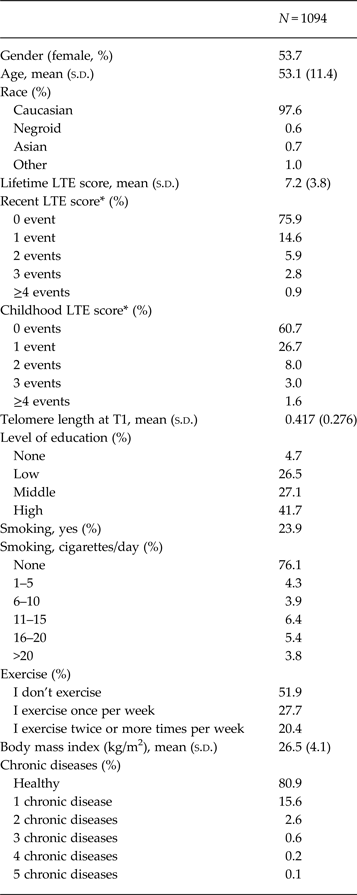
General characteristics of the study population can be found in Table 1. As mentioned above we used a decrease in TL > 15% and an increase in TL > 15% between baseline and follow-up measures as a definition of telomere attrition and lengthening respectively. Over an average time of 6.0 years between baseline (T1) and follow-up (T3) 63.0% of participants showed decrease in TL, 6.3% remained stable, and 30.7% showed lengthening of telomeres.
General characteristics of the study population at T2

s.d., standard deviation; LTE, List of Threatening Events.
* Data not normally distributed thus for descriptive purposes only we created categories.
Adverse life events in adulthood and telomere attrition
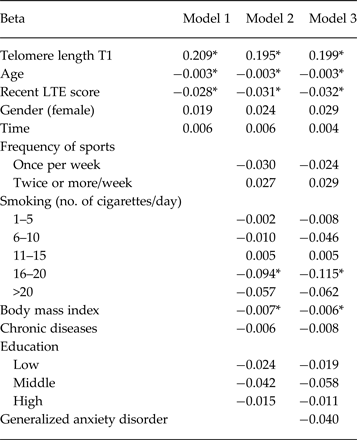
The results of the analysis of the model testing the hypothesis that recent adverse life events in adulthood are associated with telomere attrition adjusted for confounders and mediators can be found in Table 2. The recent LTE score was a significant predictor of telomere attrition (B = −0.028, s.e. = 0.011, p = 0.012) in a random intercept model adjusted only for baseline TL and gender and age. Likewise, in a random intercept model that was additionally adjusted for lifestyle variables, the recent LTE score predicted a significant decrease in TL (Table 2). Age, BMI, and smoking 16–20 cigarettes a day compared to none were also significant predictors of telomere attrition. The other categories of smoking status, gender, and level of education, however, did not predict changes in TL (Table 2). In a post-hoc analysis we also assessed if the effects of recent adverse life events were mediated by the presence of a generalized anxiety disorder by adding generalized anxiety disorder as a time-varying predictor to our final model. The recent LTE score remained a significant predictor of telomere attrition and the presence of a generalized anxiety disorder could not significantly explain the variance in telomere attrition (Table 2). We also tested the hypothesis that the effect of life events in the previous year (recent LTE score) was dependent on the lifetime LTE score by adding an interaction term between these two variables to the model. There was no significant interaction between the recent LTE score and the lifetime LTE score (p = 0.716).
Three mixed models predicting telomere length at T2 and T3 by recent life events adjusted for various mediators and confounders

LTE, List of Threatening Events.
The recent LTE score = the sum score of adverse life events that took place in the year before T2 and the sum score of life events in the year that took place before T3.
* Significant at α<0.05.
Childhood and lifetime adversity and TL in adulthood
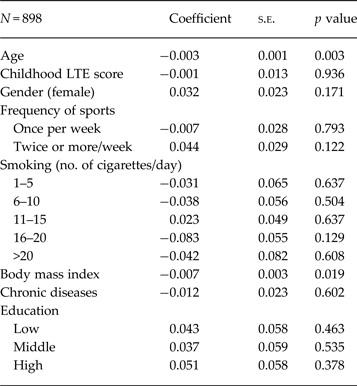
To assess whether exposure to adverse life events between the ages of 0 and 12 years has a long-lasting effect on TL that can still be detected in adulthood, we investigated whether the childhood LTE score was negatively associated with TL in adulthood at T3. Multivariable regression analysis showed no relationship between the childhood LTE score and TL at T3 in model adjusted for confounders and mediators (Table 3), nor in a model adjusted only for gender and age (B = −0.001, s.e. = 0.012, p = 0.880).
Multivariable regression analyses predicting telomere length at T3 by the childhood LTE score, adjusted for confounders and mediators

s.e., Standard error.
Childhood LTE score = the sum score of adverse life events that took place in the 0–12 years age group.
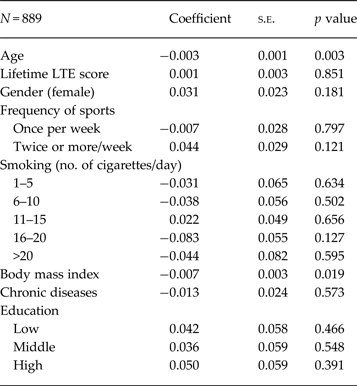
Furthermore, we tested if the cumulative exposure to stressful life events over life was associated with TL. The results of multivariable regression analysis showed that the lifetime LTE score was not significantly associated with TL at T3 in model adjusted for confounders and mediators (Table 4), nor in a model adjusted only for gender and age (B = 0.000, s.e. = 0.003, p = 0.959). Only age and BMI were significant negative predictors of TL at T3.
Multivariable regression analyses predicting telomere length at T3 by the lifetime LTE score, adjusted for confounders and mediators

s.e., Standard error.
Lifetime LTE score = the sum score of adverse life events experienced over the entire life.
Discussion
To our knowledge, this is the first longitudinal population-based study demonstrating that exposure to adverse life events in adulthood is associated with telomere attrition. The effect of recent life events on telomere attrition was not moderated by the cumulative exposure to stressful life events over life, and not mediated by the presence of a generalized anxiety disorder. In addition to the effect of life events on telomere attrition, we have also found that age, BMI, and smoking between 16 and 20 cigarettes a day compared to none, are associated with increased telomere attrition. Strangely enough we did not find that smoking >20 cigarettes a day was associated with telomere attrition. At T3 the group that smoked >20 cigarettes a day (2.3%) was only half the size of the group that smoked between 16 and 20 cigarettes per day (4.9%). Perhaps we were underpowered to find an effect of smoking >20 cigarettes a day. We did not find a cross-sectional relationship between the lifetime LTE score or the childhood LTE score and TL.
There are several strengths and limitations of the current study that need to be taken into consideration when interpreting our results. The first major strength of this study is that it was conducted in a large population-representative cohort, which increases the generalizability of our findings. The second strength is the prospective nature of the design, allowing us to adjust for TL at baseline (T1) and therefore estimate change in TL over time.
Our finding that recent life events are prospectively associated with telomere attrition is in agreement with the results from the only two other prospective studies in this area of research, which were performed in children (Shalev et al. Reference Shalev, Moffitt, Sugden, Williams, Houts, Danese, Mill, Arseneault and Caspi2012) and post-menopausal, non-smoking, disease-free women (Puterman et al. Reference Puterman, Lin, Krauss, Blackburn and Epel2015). It is interesting that, although the life events in our study were of a very different nature than the ones of Shalev's study on child abuse, and took place in very different age groups, the effects on TL are the same. As opposed to the results of our longitudinal analysis, we did not find a cross-sectional relationship between the lifetime LTE score or the childhood LTE score and TL. Several explanations for this difference in findings might be offered. First, at birth there is already a high variability in TL between individuals (Takubo et al. Reference Takubo, Izumiyama-Shimomura, Honma, Sawabe, Arai, Kato, Oshimura and Nakamura2002). This limits the power to detect environmental effects and might explain the often small effects reported in cross-sectional study psychophysiological research. A longitudinal study may focus on within-individual change and is thus less affected by large natural differences in TL between individuals. Some authors even claim that a cross-sectional study on TL would require five times the sample size a longitudinal study would need (Aviv et al. Reference Aviv, Valdes and Spector2006). Nonetheless, also for the cross-sectional part of our study the sample size was fairly large.
Second, the lifetime LTE is a retrospective questionnaire that asks participants to report events that happened sometimes decades ago. Results from retrospective questionnaires suffer from recall bias. The literature shows that retrospective questionnaires mainly carry the risk of underreporting of events (Hardt & Rutter, Reference Hardt and Rutter2004). This would lead to a loss of power to demonstrate a true effect of lifetime LTE score or the childhood LTE score on TL. We have tried to obviate this drawback by administering the same questionnaire twice and by scoring any event that was reported either at the first or second time the questionnaire was completed. Another limitation of the lifetime LTE score is that every event could only be scored once in every age group. Especially at old age it is not unthinkable that some events happen more than once. This would lead to an underestimation of the true number of life events. These limitations might in part explain the discrepancy in our findings between the cross-sectional and longitudinal part of our study, as the longitudinal part suffers less from recall bias.
Thirdly, TL is said to be dynamic and might depend upon both eroding (e.g. oxidative stress) and protective factors (e.g. antioxidants and telomerase). This is illustrated by the fact that telomere attrition per month is larger in the short term (after 6 months follow-up) than in the long term (after 10 years follow-up) (Svenson et al. Reference Svenson, Nordfjall, Baird, Roger, Osterman, Hellenius and Roos2011), indicating that repair mechanisms might play a role. In rats and humans there is evidence that exposure to uncontrollable stress (Beery et al. Reference Beery, Lin, Biddle, Francis, Blackburn and Epel2012) or depression (Wolkowitz et al. Reference Wolkowitz, Mellon, Epel, Lin, Reus, Rosser, Burke, Compagnone, Nelson, Dhabhar and Blackburn2012) leads to higher blood cell telomerase activity than in healthy unstressed controls. In contrast, there is also a study in which telomerase activity was reduced in caregivers v. non-caregiving controls (Epel et al. Reference Epel, Blackburn, Lin, Dhabhar, Adler, Morrow and Cawthon2004). It might be that the body is able to counteract telomere erosion for a certain amount of time, such as during a short-term depression or after a stressful life event, but that repair systems become exhausted as stress exposure becomes more chronic. Although upregulation of the telomerase enzyme under certain conditions is a possibility, there is great controversy of whether telomere lengthening as reported in many studies (Aviv et al. Reference Aviv, Chen, Gardner, Kimura, Brimacombe, Cao, Srinivasan and Berenson2009; Nordfjall et al. Reference Nordfjall, Svenson, Norrback, Adolfsson, Lenner and Roos2009; Chen et al. Reference Chen, Kimura, Kim, Cao, Srinivasan, Berenson, Kark and Aviv2011; Svenson et al. Reference Svenson, Nordfjall, Baird, Roger, Osterman, Hellenius and Roos2011), including ours (van Ockenburg et al. Reference van Ockenburg, de Jonge, van der Harst, Ormel and Rosmalen2014) really exists. A recently published study demonstrated that the reported telomere lengthening in longitudinal studies is most likely an artifact of laboratory measurement error, which is exacerbated by a short follow-up time (Steenstrup et al. Reference Steenstrup, Hjelmborg, Kark, Christensen and Aviv2013). In our study we used monochrome multiplex quantitative PCR and had an average follow-up time of 6 years. Although our measurement error was not that large and we demonstrated good reproducibility of results (Huzen et al. Reference Huzen, Peeters, de Boer, Moll, Wong, Codd, de Kleijn, de Smet, van Veldhuisen, Samani, van Gilst, Pasterkamp and van der Harst2011), our method has a larger measurement error than for instance southern blot (Aviv et al. Reference Aviv, Hunt, Lin, Cao, Kimura and Blackburn2011). From the graphs in the paper of Steenstrup and colleagues it becomes clear that if we had run our samples in duplicate we would have misclassified about 30% of the population as telomere lengtheners. However, we ran our samples in triplicate, therefore reducing measurement error further than is exemplified in their paper. Furthermore, Steenstrup et al. classify any increase above zero as lengthening. We classify only those people that have at least a 15% increase in TL from baseline as lengtheners, which should reduce the chance of misclassification. Nonetheless, we acknowledge that measurement error is a problem in our field that deserves much more attention as a possible explanation for the reported results than is currently the case. We propose that future prospective studies should measure both TL and telomerase activity simultaneously. If telomerase activity is indeed higher in telomere lengtheners, this would give support for a biological explanation for telomere lengthening in addition to the role of measurement error.
In conclusion, this is the first study to demonstrate that exposure to recent adverse life events in adulthood is associated with decreased TL prospectively. Telomere attrition might thus be one of the mechanisms by which psychosocial stress exerts negative effects on health.
Declaration of Interest
None.
Acknowledgements
This study was financially supported by a grant of the Innovational Research Incentives Scheme Program of The Netherlands (NWO, VENI, P. van der Harst, grant no. 916.76.170). The PREVEND was funded by the Dutch Kidney Foundation (Grant E033). The authors thank those that participated in the PREVEND study.