Clostridium difficile is the main causative agent of healthcare-associated colitis. Although the vegetative form under anaerobic conditions produces toxins associated with pathogenicity, it is in the endospore form that C. difficile is transmitted.Reference Lawley, Croucher and Yu 1 C. difficile spores can be acquired from the environment near a contaminated patient, through direct contact with a symptomatic patient, or via the hands of healthcare workers. Spores may persist on surfaces for months.Reference Otter and French 2 However, eradication through traditional disinfection techniques or through relatively new decontamination methods such as hydrogen peroxide or ultraviolet radiation remains a challenge. Furthermore, hydrogen peroxide and ultraviolet radiation are associated with substantial limitations such as toxicity, the need to vacate the area of patients and staff, unsuitability with some materials, and relative cost.Reference Nerandzic, Cadnum, Pultz and Donskey 3 , Reference Barbut, Menuet, Verachten and Girou 4 Preliminary work in our laboratory has demonstrated the bactericidal activity of a cold-air atmospheric pressure plasma (CAPP) single-jet plume against vegetative bacteria.Reference Cahill, Claro and O'Connor 5 Such CAPP systems are sources of reactive atoms and molecules—for example, atomic oxygen, ozone, superoxide, oxides of nitrogen, and intense electric fields. These properties disrupt and etch the cell wall, interfere with transport within the cell, and/or induce DNA damage.
We present an in vitro evaluation of a CAPP single- and multi-jet for the decontamination of C. difficile spores from 2 surfaces found in hospitals in the absence and presence of human serum albumin (HSA), a marker for organic load.
METHODS
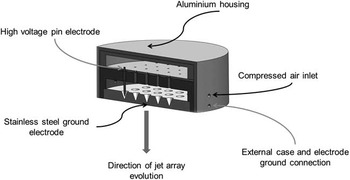
C. difficile spores ATCC 700057 (Cruinn Diagnostics) were prepared as previously described.Reference Claro, Daniels and Humphreys 6 Spore numbers and purity were determined by microscopy using the Schaeffer and Fulton Spore Stain Kit (Sigma Aldrich). Suspensions were adjusted to a concentration of approximately 1×10⁶ to 1×10⁸ colony-forming units (CFU) per mL (1 colony equivalent to 1 spore) and 100 µL were added to sections of mattress (Meditec Medical), the surface of which is polyurethane coated, permeable to vapour but water resistant, and sections of stainless steel; the size for both mattress and stainless steel was 25 cm2 (5×5 cm). Sections of mattress and stainless-steel were decontaminated beforehand as described previously.Reference Cahill, Claro and O'Connor 5 Three percent HSA (Sigma Aldrich, Ireland) was also added to the inoculum to mimic the organic load characteristically found in the hospital inanimate environment.Reference Speight, Moy and Macken 7 All surfaces were air-dried more than 1 h before CAPP treatment in a laminar flow cabinet. The artificially inoculated sections were exposed for 30 s, 60 s, and 90 s to the CAPP single-jet Reference Cahill, Claro and O'Connor 5 and CAPP multi-jet (9 jets arranged in 10×10 cm array) (Figure 1).
Multi-jet cold-air pressure plasma prototype schematic diagram.

In the CAPP multi-jet prototype each plasma jet is driven by a separate sinusoidal, high-voltage power supply. The drive frequency is 8 kHz, the amplitude of the voltage is approximately 1.5 kV, and each supply consumes an average of 15 W. The operating gas is air that flows into the device at 13 standard liters per minute. The air was drawn from the ambient into a compressor that contained a water trap to actively remove moisture before the air entered the plasma source cavity. No further treatment of the air took place, the room in which the plasma was operated was well ventilated, and no modification of the immediate environment was observed. The plume temperature did not exceed 45°C, the distance between the plume and the test surface was 1 cm, and the plume was moved around to cover the entire surface, to mimic as far as possible the potential use of such a prototype. All experiments were carried out on 3 independent occasions in duplicate. The entire area of treated and untreated surfaces was sampled using phosphate-buffered saline premoistened nylon flocked-swabs (Copan) and placed in 3 mL phosphate-buffered saline, vortexed, and cultured on to C. difficile–selective plates (Oxoid).Reference Claro, Daniels and Humphreys 6 One-in-ten serial dilutions were performed when needed to determine the total viable count—that is, the number of CFU/mL. All plates were incubated anaerobically for up to 48 hours at 37°C for spore enumeration.
Statistical analysis was performed using the GraphPad Prism, version 5.00 (GraphPad Software). The means of the C. difficile spore log reduction following CAPP single- and multi-jet treatment with and without HSA were compared by 1-way analysis of variance and further Tukey’s multiple comparison tests when significant (ie, P<.05).
RESULTS
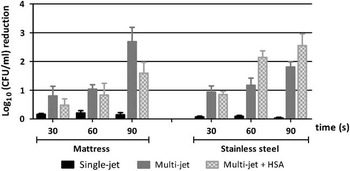
Unlike for vegetative cells,Reference Cahill, Claro and O'Connor 5 the CAPP single-jet had very little consistent effect on C. difficile spores over 90 s on either mattress or stainless steel (Figure 2). In contrast, the CAPP multi-jet prototype treatment resulted in a time-dependent reduction of the C. difficile spore load on both materials. Maximum log10 reductions expressed in CFU/mL of 2.69±0.50 and 1.81±0.18 were achieved following 90 s treatment on mattress and stainless steel, respectively. The CAPP multi-jet prototype was more effective in reducing the load of C. difficile spores compared with the single-jet (P<.01). The addition of HSA to mimic the clinical environment had minimal impact on the effectiveness of the CAPP multi-jet (P=nonsignificant) (Figure 2). Maximum log reductions varied from 2.69±0.50 to 1.59±0.38 on mattress and 1.81±0.18 to 2.55±0.41 on stainless-steel following the addition of HSA. Although the differences between these results on the 2 surfaces were not statistically significant, they may in part be explained by the porosity of the mattress compared with the stainless steel. Furthermore, the effects of the CAPP multi-jet in the absence or presence of HSA were also independent of the type of material surface used.
Single- and multi-jet cold-air pressure plasma sporicidal activity, expressed in log10 (colony-forming units [CFU]/mL) reduction, against Clostridium difficile spores on mattress and stainless steel over 90 s in the presence and absence of 3% human serum albumin (HSA). Each bar represents the mean of at least 3 individual experiments (n≥3), and error bars represent the standard error of the mean.

DISCUSSION
Recent studies evaluating decontamination systems against C. difficile spores showed maximum reductions of 4 log10. The use of hydrogen peroxide, however, involves significant contact and aeration time (>1 h 30 min), and requires the evacuation of the clinical area to be decontaminated.Reference Barbut, Menuet, Verachten and Girou 4 In the case of chemical disinfectantsReference Speight, Moy and Macken 7 and ultraviolet radiationReference Nerandzic, Cadnum, Pultz and Donskey 3 the presence of an organic load significantly limits efficacy. In the present study, the single-jet CAPP had minimal effect on C. difficile spores whereas the CAPP multi-jet system reduced C. difficile spore counts by 2–3 log10. This is not surprising because in the multi-jet configuration, the effective treatment areas of the jets will overlap and the effect of the plasma in a unit area will be multiplied on the surface being treated. The efficacy of the plasma was not significantly affected by the presence of organic material as represented by HSA, and the log reduction was accomplished in just 90 s. However, its potential future use would be to complement and not replace routine decontamination.
The low temperature, nontoxicity, and fast working conditions of this type of technology have been studied by others with encouraging results. Gas discharge plasma inactivated C. difficile spores in less than 3 min,Reference Tseng, Abramzon, Jackson and Lin 8 dielectric barrier plasma achieved log reductions of Geobacillus spores of greater than 6 log10 in 20 min,Reference Mastanaiah, Johnson and Roy 9 and recently surface micro-discharge CAPP removed C. difficile spores in less than 6 min.Reference Klämpfl, Shimizu and Koch 10 The results achieved in this study using CAPP multi-jet against C. difficile spores on both mattress and stainless-steel dry surfaces are promising and may provide a potentially rapid and practical measure to augment traditional decontamination methods in hospitals. Nonetheless, further improvements are needed in order to achieve the best efficacy in the shortest time. Additional studies are required with alternative markers for organic loads, with mixed bacteria including C. difficile spores, with smaller inocula that may better reflect the bioburden in hospitals, and over shorter contact times. Finally, the technology needs to be evaluated in a busy clinical setting.
Acknowledgments
Financial support. Translational Research Award from Science Foundation Ireland and the Health Research Board (TRA/2010/10).
Potential conflicts of interest. H. H. reports that he has research collaborations with Steris Corporation, Inov8 Science, Pfizer, and Cepheid and has also received lecture and other fees from Novartis, AstraZeneca, and Astellas. All other authors report no conflicts of interest relevant to this article.