Before the development of electronic amplification, the transmission of the sound of a performance through a space was primarily a function of architecture. The acoustics of archaeological sites are integral for an understanding of events that might have taken place in them. A ritual chant cannot be isolated from its reverberation in a rock-cut cave, nor a public speech from its dissemination in an open-air marketplace. Music, dance and theatre practices have evolved in relation to their sonic environments.
Umashankar Manthravadi assembled his first radio in the 1950s, before entering his teenage years, and this is when he began his project of listening. As a hobbyist, he has been building audio technology – loudspeakers, amplifiers, microphones – ever since. Through the course of his career, he has worked as a journalist, a sound recordist, an audio technician and an archivist. He retired in 2015 after serving for thirty-three years at the Archives and Research Centre for Ethnomusicology in Gurgaon, near New Delhi. As a self-taught acoustic archaeologist,Footnote 1 he began measuring the acoustic properties of an archaeological site in the mid-1990s, and has been building ambisonic microphones since the early 2000s in order to carry out his project in other premodern performance spaces. His has been an attempt to shift the discourse of archaeology – especially as it has evolved through the Archaeological Survey of India (ASI), in various stages since its establishment in 1861, as a primarily visual study – from its focus on iconography, numismatics and inscription, towards thinking about social forms and their actualization in performance. Umashankar points out that while there are worldwide efforts to record performance traditions under threat (intangible heritage) and to physically preserve archaeological sites (conservation and restoration), no significant endeavours had been made to document or understand the acoustic conditions of erstwhile and still-in-use performance spaces. Any effort to document and preserve present-day remnants of premodern performance traditions and spaces necessitates an archaeology of sound as well. His approach asserts that we cannot just look for theatres in landscapes of the past; we must listen for them.
A Slightly Curving Place is an exhibition that took place from July to September 2020 at the Haus der Kulturen der Welt (HKW) in Berlin.Footnote 2 Centred on an audio play, a video installation, and material in vitrines, the exhibition brought together writers, choreographers, actors, dancers, musicians, field recordists, sound, light and graphic designers, who responded to Umashankar's practice and proposed possibilities for listening to the past and its absence which remains.Footnote 3 The exhibition was accompanied by Coming to Know, an online public programme co-convened with Brooke Holmes, a hellenist at Princeton University.Footnote 4 It set aside the convention of the public programme as a didactic supplement to an alien, premodern place and time, and instead asked how the process of coming to know a premodern past together could transform the sense of the knowledge held in common.Footnote 5 The exhibition and programme were preceded by workshops that took place at HKW in May 2019 and at the Classics Department at Princeton University in January 2020.Footnote 6 The exhibition and programme will each be followed by eponymous volumes in 2021 and 2022 that inaugurate a publication series called An Archaeology of Listening, designed by and published with Archive Books.Footnote 7 These components are all part of an ongoing project called An Archaeology of Sound that draws its inspiration from propositions entailed in Umashankar's life and work.
The four short essays by Umashankar Manthravadi, Moushumi Bhowmik, Alexander Keefe and Padmini Chettur that comprise this dossier are indicative of the range of practices and positions in which these propositions reverberate. Umashankar Manthravadi's essay reflects on his practice of measuring the acoustic properties of archaeological sites. He reveals how the sounding of an amphitheatre at the Ranigumpha caves (in Odisha, India), and the techniques of recording its acoustics, invite us to recognize the potential for performance still inherent in the material archive that is the site itself. Moushumi Bhowmik's essay comes out of audio notes made during a field trip to Shailagachi in Naogaon district of northern Bangladesh in November 2018. Here, she reflects on her meeting with a performer of pallagaan, a genre of song debate, improvisatory in nature, in which social, political or religious questions are contended for hours, and resolved, through communal practices of listening. Bhowmik focuses on how the ethics of listening to folk song performers and their lived experiences is enmeshed in a culturally coded exchange between speakers. Alexander Keefe listens to the acoustics of one ancient and artificially enhanced cave known as Sita Benga (in Sarguja district, Chhattisgarh, India), which nearly begs for song: its own inscription, sounded there, dances in air and, in being shared, turns listeners into audience, cave into theatre. Padmini Chettur's essay lays out three recurrent values that root the sound–movement relationship in her choreographic practice and collaboration with composer Maarten Visser: tension, transition and density. She also draws attention to materiality and texture in a body–sound–site relationship explored through filming at the amphitheatre in Nagarjunakonda at Anupu (Andhra Pradesh, India) for her two-channel video installation for the exhibition A Slightly Curving Place. Taken together, the contributions to this dossier extend the notion of listening to an archaeological site to include practices of listening to text, textures, technologies and the fields of recording, and in so doing explore a range of epistemic technologies – body and cultural techniques – involved in the labour of listening.
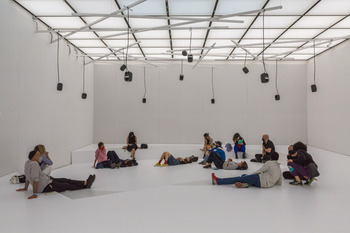
Exhibition view of A Slightly Curving Place at Haus der Kulturen der Welt (HKW), Berlin (2020). Image courtesy of HKW. Photograph by Laura Fiorio/HKW.

To ask what it means to listen to the past draws awareness both to sound as a social event – music, theatre and dance as forms of corporeal relations – and to an absence which remains. This attention to absence entails a capacity to disrupt the focus on visual, material and technological evidence that has, at least since the advent of archaeology, structurally conditioned the ways in which the past has come to be known. As a vector of modernity, the discipline of archaeology can be charged with colonizing the past and corroborating with the museum by collecting it for display. But what if an archaeological site was to be considered the extant record of everything that happened there? Do echoes that bounce off of walls, floors, columns, chambers, and ceilings and never entirely fade carry traces of a bygone event that did not enter history? Not like facts to be accumulated into the apparatus of knowledge, but like a latent memory of a collective experience of social relations that defy ownership.
It is at this frontier of possession and legibility that posits orality against inscription, bodily movement against physical architecture, that an archaeology of sound can be situated. Listening for a forgotten social imaginary challenges the dominant ways of conceiving the premodern against the modern and disturbs contemporary mythologies that ceaselessly partition the past into isolated languages, designating certain sovereignties as matters of history. Tuning in to static of the past in order to reckon with the noise of the present is also an invocation to listen to the dramatic changes in our own acousmatic landscapes. Can we hear that which has become unavailable to us, namely the historical transformation of our senses in modernity?
Sometime around 1995 or 1996, I was asked by Cecil Thomas Ault, a theatre historian from the US,Footnote 1 if I could take measurements at Ranigumpha, an ancient archaeological site in Odisha, and prove that it was a theatre built according to the Natyashastra.Footnote 2 I thought it looked like an interesting project – particularly as I did not know much about acoustic measurements at the time (I was a sound recordist working in music archives). I read the book written by Dhiren Dash to prove that Ranigumpha is a theatre built on Natyashastra principles,Footnote 3 which was a source used by theatre scholars such as Tom Ault and John Emigh.Footnote 4 Although I studied mathematics in college, I had read the Natyashastra as well. But thirty years later I could not remember what it said about theatre construction, so I read it again.
There is very little. Obscure terms, not explained. Proportions, but not dimensions. A theatre can be square, rectangular or triangular. It can be small, large or medium. The text gets to specifics only when it mentions precious metals and stones to be buried at the four corners, and very specific when it warns of dangers during measurement: if the thread used to measure out the theatre breaks, it will bring disaster. If it breaks in the middle, it portends the death of the king. All the terms used must have had specific meanings for users in the period in which the Natyashastra was written, and the practitioners would have been told by their teachers what the terms stood for. In the tenth century, Abhinavagupta wrote a commentary on the Natyashastra,Footnote 5 and it sounds like he too had trouble understanding certain terms in the treatise, which was perhaps almost a thousand years old by then. What was shad daruka (‘six wooden sticks’)? What was mattavarani (‘border of elephants’)? Some words, like nepadhya (‘backstage’) have survived in use, and we know what it means, but other terms remain unknown.
I agreed only to try to make measurements, but not to prove that Ranigumpha had been a theatre (I never liked this idea that non-scientists have of ‘proof’). After a lot of reading, I decided to make a series of sine wave measurements, an octave apart, and impulse tests, recording with an omnidirectional microphone. I was not sure whether the site would amount to very much. But Ranigumpha opened my mind (and ears) to an entirely new world of listening.
First there was the audacity of the structure. I saw Ranigumpha as a mountaintop, half removed to provide space for an audience of over a thousand, the other half carved out into a two-storey theatre. As I stepped into the site, the acoustics changed into that of a well-designed auditorium. Years later, I can still remember the intensity of the sound experience. Ranigumpha has no odd echoes or whispering spaces. I found a large amount of amplification of the voice, but only when onstage – if I stood and spoke anywhere in that area, I was heard all along the audience space. A loud sound, very clear and detailed, with just enough hint of reverberation to give body to the sound. This was certainly not the kind of sound I expected from an outdoor space. Speech from the audience area sounded normal, like anywhere in open air.
I have been to Ranigumpha many times since then, most recently two years ago with a team of students who wanted to learn the techniques I use for acoustic measurements. My many trips to this and other archaeological sites, including to the Vadakkamnathan Koothambalam in Thrissur (Kerala), the amphitheatre at Anupu in Nagarjunakonda (Andhra Pradesh), the Karli caves near Mumbai (Maharashtra), and the Sita Benga cave in the Ramgarh hills (Chhattisgarh), have allowed for a deeper understanding of how we can listen to premodern theatres. This has formed the basis of the exhibition A Slightly Curving Place.
Ranigumpha, 20–23 November 2018. Set up for acoustic measurements with Umashankar's Brahma microphone and balloon. Video still by Nida Ghouse.

Ranigumpha, 20–23 November 2018. Members of the archaeoacoustics training workshop in one of Ranigumpha's side elements (right to left): Konstantin Wenslaff, Murali Basa, Babita Pandey, Meena Mahesh, Umashankar Manthravadi and Nida Ghouse. Photograph by Sharmila Chhotaray.

It was a regular day for her; she had returned from an all-night concert, and she was coming out of the bathroom, in one corner of her rectangular courtyard, rubbing her wet hair with a gamchha (towel). There were two printed saris hanging on the line. Bright yellow and pink I see as I write.
She looked up as I was entering through the tin gate. I looked at her. The courtyard, my field of recording, became the stage. We were about to act out an unwritten script. I would act, as well as record.
I apologized for being in her home, asked for permission to enter; I was performing the conventions of field recording. But I was also performing the conventions of everyday life – you knock before you enter someone's home, or at least call out if the door is half-open: Ektu shunben? (‘Can you hear me out for a moment please?’). I am an outsider; she is a seasoned performer, so my presence does not scare her. She does not notice my recorder, or maybe she does.Footnote 1 It is small and inconspicuous. But she certainly notices my phone when I take a photograph.
‘I have come here because many years ago someone made some recordings of some fakirs (itinerant singers in the Sufi tradition). Perhaps some of them were from your village. There was a woman too, her name was Jaura Khatun. Perhaps someone here will know, someone old and who has seen other older times.’
‘My name is Kabari Dewan. Husband Abu Bakkar Dewan, he died a few months ago, we used to sing together … My daughter died too …’
The two of us have been thrown into a most intimate conversation. Apa is how she addresses me; calls me sister.
‘But how, how did she die?’
‘Fate. Bandhal dei, bandhal thake na (I build a bund, the river comes crashing),’ she says.
Was that in the script? Is she improvising?
Suddenly, Kabari the performer is conscious of her looks after a night of work. ‘You want to take a photo? My eyes are so swollen, I was singing all night. You know I am very good, Shilpi Kabari Dewan, I know many “VIP songs”, no one can beat me at these pallagaan sessions … my opponent was rubbish. They paid me extra. Please delete the other photos …’
Pallagaan performer Kabari Dewan, November 2018, Bangladesh. Photograph by Moushumi Bhowmik.

‘How did you come into singing?’
That's the longest line I allow myself.
‘From when I was small you know, I had such a passion for music, but it was not easy. They kick your ass, kick again, but you don't give up, you keep trying. Then I found him, he was my tree in whose shade I stood. But, my fate was against me.
‘If only someone would give me a chance now! Some daradi (someone with compassion) …’
She talks the language of bichchhed gaan,Footnote 2 picking words from songs of separation and longing.
…
As I listen, I hold the recording in my hands, its face toshtosha (swollen) from a night of singing, its voice broken. But her eyes look straight at the camera with confidence. She has a stock of VIP songs after all.
If left to themselves, elephants do not dance to music in the human sense; elephant-headed gods very much do, at least according to eleventh-century Sanskrit court poet Somadeva, who introduces the eighteen books of his Kathāsaritsāgara, or ‘Ocean of the Streams of Story’, a sprawling compendium of embedded narratives, with verse invocations to the god Gaṇeśa.Footnote 1 Each is an exquisite miniature, a twilight glimpse of a god in dynamic, choreographic motion: sprays of droplets from the dancing lord's trunk sizzle into sound and spawn worlds, mountains bend in time to his movements, stars fall like rains of flowers.Footnote 2 His motion is such that boundaries between senses, scales, materials and skins blur: before Gaṇeśa's dancing, all becomes audience and then, inexorably, all begins to move with him like a shadow, just behind: ‘May that lord of obstacles protect you! Whom, dancing in the twilight intervals between ages, all the worlds, falling and rising, dance after.’
Somadeva imagines a universe in which the motion of the planets and everything on them is no more than a mimetic commotion, an after-dancing deriving from Gaṇeśa's own, as though obeying a metakinetic impulse akin to that subtle twitch you sometimes feel deep in your own body while watching another move. Somadeva's verse expands that innate capacity for kinetic empathy into cosmogonic principle, reflecting its author's immersion in the non-dualist, heavily tantric Shaivism of his Kashmiri milieu.Footnote 3 So too does his focus on the responses of Gaṇeśa's imagined audience: this was a period of intense speculation on the nature of aesthetic reception in the valley, much of it focused around the central, liquid metaphor of rasa. Footnote 4
Fittingly, in the very first of Somadeva's invocations, the dancing god generates sonic mists, drenching aural sprays comprising one special tone: ‘May that victor over obstacles protect you, who having swept clear the stars with his trunk in the joy of his evening dance, seems to create new ones with the drizzling sprays of his śītkāra.’
Śītkāra indicates ‘an imitative sound expressing pleasure and trembling’, as one Victorian-era dictionary delicately leaves it; others are more direct: ‘a sound made to express a sudden thrill of pleasure or pain, (particularly applied to the sound of pleasure during sexual enjoyment)’.Footnote 5 ŚŚŚĪĪĪ. Spurting from the dancing Gaṇeśa's mouth in clouds, and repeating inside the verse itself (in Sanskrit sītkārasīkarair, or ‘with drizzling sprays of pleasure-hiss sound’), Somadeva's contemporary Abhinavagupta deemed the śītkāra a uniquely powerful mantra, ‘produced neither by meditation nor by mental concentration. If one applies one's mind to it wholly, one suddenly becomes master of the universe’.Footnote 6
An extraordinary invocation that opens Book 12 playfully freezes Gaṇeśa mid-motion: his trunk, held aloft, petrifies into a great stone victory pillar, the buzzing bees that swarm around it into lapidary syllables inscribed upon the same.Footnote 7 His audience, after dancing, slows to reading. The difference is a matter of tempo and perceptual effect, as though architecture and body, swarm and inscription, commotion and commemoration, were all manifestations of the same stuff, merely apprehended at different speeds, as water into ice or steam.
Sita Benga, 26–29 February 2020. Members of the project team (right to left): Tyler Friedman, Sukanta Majumdar, Umashankar Manthravadi and Nida Ghouse. Photograph by Alexander Keefe.

As a choreographer, my trajectory had its origins in Bharatanatyam – an Indian dance form which is deeply entwined with Carnatic music from southern India. This dance is traditionally composed to the music, its narrative lyrics as well as its rhythmic structures. However, it was always my intention to disrupt this music–dance relationship, to think through the possibilities for a new physicality and form, and to develop a contemporary practice that was not pre-made, learnt or derived from a Euro-American canon. Instead, I was interested in developing a practice through research and questions that dancers and artists were asking in a post-nationalist, newly liberalized India in the early 1990s.Footnote 1
The composer Maarten Visser and I began our work together in 1998.Footnote 2 Our first conversations were around aesthetics. It was apparent from the start that the new ‘music’ for the dance I was choreographing had to be a rethinking of sound itself, not merely a reorganization of known compositional ideas. For us, both sound and movement required an equally thorough justification to replace silence or stillness. The relationship of the visual and the sonic lay at the heart of this thinking. The question of aesthetics was also key in avoiding the pitfalls of a ‘fusion’ approach. Maarten came from an education in Western music composition, and my work was framed – whether I agreed or not – within the realm of the ‘Indian contemporary’.Footnote 3 We both agreed to consider aesthetic properties that would move and linger outside recognizable and binding clichés, to think about sound and movement rather than music and dance, and to think about functionality over expression.
There are essentially two functionalities for dance music. There is the grid that holds the dancers together in time, gives them cues and so on, and there is a second affective layer that generates meaning for the dance, placing it in a narrative and emotional context – and this is for its spectatorship.
Structure plays an important role in my choreographic processes and my work is conceived and composed in silence, or to a metronome track. It is then interpreted through Maarten's work with sound, which is then proposed back to the dance work. This becomes a cyclical movement, one where sound and movement are in a relation of speaking to each other, or not. They operate as two layers or voices that deliberately glide over each other, or slide away from each other, neither fighting for hierarchy, but rather engaging in a shared space of conversation.
There are a few recurrent values that root the relationship between sound and movement in our practice. The first and most evident is ‘tension’. The sense of holding and extending time – through repetition, through the building of a single line in space, through the steady modulations of pitch.
The second is a great attention to ‘transition’. A movement away from the episodic, the literal. A sound idea possibly pre-empting the image, preparing its context, our anticipation of it. Working with an abrupt and surprising arrival of an image. Or the image being sounded long after its disappearance, so sound being the movement's trace.
The third is ‘density’ as a property. If we think of density as a result of the dancer's imagination of space, then density in sound is likewise a result of sound's movement through time, not just its temporality, but its way of opening up or closing intervals within it. Compression and decompression, sound's weight and pressure.
The sound/image propositions in the two-channel video installation A Slightly Curving Place: A Study, is composed of footage from a research visit to a transplanted archaeological site, a premodern amphitheatre from the historical town of Nagarjunakonda now in Anupu (Andhra Pradesh).Footnote 4 It draws our attention to two shared terms – material and texture. The sounding of skin on stone during a barefoot walk on gravel. The sense of shifting sunlight altering the body's proportion in the space. The flatness of a shadow's line against the jagged staircase. The images are heard through a score that asks us to listen to the textures of a potentially unravelling time and timelessness – a slightly curving place. These frictions of time past and time present, the inevitability of the day passing, become the details that inform a soundscape that was created with electric drills, sandpaper, broken violin bows and rusty bells. The axes of a dancing body in the mandala-like geometry of the space bring the cosmic time of the solar system, the geological time of a site on a hillside, and the corporeal time of the human body into an alignment that is held together in the image by a moment of sound that also reverberates far beyond it.
Padmini Chettur, study for A Slightly Curving Place (2020). Video still by Sara.