


Introduction
Several studies suggest that there are different subtypes of OCD. While some researchers have conducted symptom-based factor- and cluster-analyses to identify subgroups of patients with certain clinical profiles (Calamari, Wiegartz and Janeck, Reference Calamari, Wiegartz and Janeck1999; Leckman et al., Reference Leckman, Grice, Boardman, Zhang, Vitale, Bondi, Alsobrook, Peterson, Cohen, Rasmussen, Goodman, Dougle and Pauls1997; Summerfeldt, Richter, Antony, and Swinson, Reference Summerfeldt, Richter, Antony and Swinson1999), others found different responses to drug treatment depending on whether or not OCD patients showed comorbid tics (McDougle et al., Reference McDougle, Goodman, Leckman, Holzer, Baer, McCance-Katz, Heninger and Price1993, Reference McDougle, Goodman, Leckman, Lee, Heninger and Price1994). In addition, Riddle (Reference Riddle1998) proposed a distinction between familial and non-familial, as well as tic-related and non-tic-related subtypes. The approach of dividing patients according to their age of onset into a subgroup with early (EOCD) or late onset (LOCD) has just recently emerged in research, yet seems to be very promising in bringing together the current multiple perspectives.
Studies that compared adult patient populations with early versus late onset of OCD symptoms found that patients with EOCD were characterized by experiencing a greater diversity of obsessions and compulsions, familial aggregation and more comorbid tic-disorders (Delorme et al., Reference Delorme, Golmard, Chabane, Millet, Krebs, Mouren-Simeoni and Leboyer2005; Do Rosario-Campos et al., Reference Do Rosario-Campos, Leckman, Mercadante, Shavitt, Prado, Sada, Zamignani and Miguel2001; Fontenelle, Mendlowicz, Marques and Versiani, Reference Fontenelle, Mendlowicz, Marques and Versiani2003; Millet et al., Reference Millet, Kochman, Gallarda, Krebs, Demonfaucon, Barrot, Bourdel, Olie, Loo and Hantouche2004; Nestadt et al., Reference Nestadt, Samuels, Riddle, Bienvenu, Liang, LaBuda, Walkup, Grados and Hoehn-Saric2000; Pauls, Alsobrook, Goodman, Rasmussen and Leckman, Reference Pauls, Alsobrook, Goodman, Rasmussen and Leckman1995; Sobin, Blundell and Karayiorgou, Reference Sobin, Blundell and Karayiorgou2000; Jänsch et al., Reference Jänsch, Zaudig, Röper, Hauke, Piesbergen and Butollo2007). Genetic and neurophysiological differences with respect to LOCD patients have been found (Rauch, Savage, Alpert, Fischman and Jenike, Reference Rauch, Savage, Alpert, Fischman and Jenike1997; Busatto et al., Reference Busatto, Buchpiguel, Zamignani, Garrido, Glabus and Do Rosario-Campos2001; Hemmings et al., Reference Hemmings, Kinnear, Lochner, Neihaus, Knowles, Moolman-Smock, Carfield and Stein2004). An early onset seems to be associated with superstitious obsessions, body-related obsessions, hoarding obsessions and compulsions, as well as with counting and “miscellaneous” compulsions according to the Y-BOCS-Symptom-Checklist (Geller et al., Reference Geller, Biederman, Faraone, Agranat, Cradock, Hagermoser, Grace, Frazier and Coffey2001, Millet et al., Reference Millet, Kochman, Gallarda, Krebs, Demonfaucon, Barrot, Bourdel, Olie, Loo and Hantouche2004). LOCD patients on the other hand show more depression before OCD onset and a less severe course (Noshirvani, Kasvikis, Marks, Tsakiris and Monteiro, Reference Noshirvani, Kasvikis, Marks, Tsakiris and Monteiro1991; Millet et al., Reference Millet, Kochman, Gallarda, Krebs, Demonfaucon, Barrot, Bourdel, Olie, Loo and Hantouche2004).
In most of the above mentioned studies the cut-off-age to differentiate between EOCD and LOCD was set between 10 and 18 years. Delorme et al. (Reference Delorme, Golmard, Chabane, Millet, Krebs, Mouren-Simeoni and Leboyer2005) were able to validate the bimodal distribution concerning age of onset in OCD. The mean age of the first distribution was found to be 11.1 (SD = 4.1) years while the one for the second distribution turned out to be 23.5 (SD = 11.1) years. Though their results are very promising, further empirical and theoretical research is needed to define a cut-off age to distinguish most appropriately between early and late onset. The cut-off age set in the current study was based on clinical developmental theory and research. The cut-off age of >15 for the LOCD group and ≤12 for the EOCD group was chosen on the grounds of developmental stage-models (Erikson, Reference Erikson1974; Kegan, Reference Kegan1982), as the age of the beginning of the conformist and post-conformist stages (Loevinger, Reference Loevinger1976). Affective-cognitive development at the conformist stage is characterized by the ability to accept and negotiate emotions on the intra-individual and inter-individual level and to interpret social situations out of one's own perspective and those of others. The following post-conformist stages include a growing flexibility to adapt to changes in outer circumstances and the ability to tolerate ambiguity (Loevinger, Reference Loevinger1976). The epistemological stage from which a person's life is burdened by obsessive-compulsive symptomatology is seen to be of major importance for the understanding of the individual disorder (Röper, Reference Röper, Röper, von-Hagen and Noam2001). Since age is not clearly related to affective-cognitive development (Noam and Röper, Reference Noam, Röper, Oerter, von Hagen, Röper and Noam2001) and in order to avoid overlap, we included patients who had reported an onset at the age of 12 and younger into the early-onset group.
By subtyping OCD, researchers hope to find more accurate projections of future outcomes and implications for improving treatment. In the current study we set out to contribute to both those aims in trying to identify predictors of therapy outcome in EOCD and LOCD patients. Quite a variety of studies (Basoglu, Lax, Kasvikis and Marks, Reference Basoglu, Lax, Kasvikis and Marks1988; De Haan et al., Reference De Haan, van Oppen, van Balkom, Spinhoven, Hoogduin and van Dyck1997; Leonard, Lenane, Rettew, Gershon and Rapoport, Reference Leonard, Lenane, Rettew, Gershon and Rapoport1992; Stewart et al., Reference Stewart, Geller, Jenike, Pauls, Shaw, Mullin and Faraone2004) have found predictors of treatment outcome for adults and children, but so far no attempts have been made to predict outcome in certain OCD subtypes. The literature on predictors presents a rather heterogeneous picture at the moment. Definitions of outcome, choice of variables included in the analysis, instruments and procedures often vary between the studies. It therefore seems important to continue to add empirical findings to the field of predictor research in order to eventually identify stable predictors of therapy outcome. The goal of our study was to identify common and specific predictors of treatment outcome for both OCD subtypes. Predictors were chosen with respect to the current state of the art in predictor research.
Material and methods
Procedure
The study was based at the hospital of Windach, a psychotherapeutical treatment facility in Bavaria, Germany. Clinic Windach offers an inpatient treatment program especially developed for the needs of obsessive-compulsive patients. Based on a behavioural self-management concept (Kanfer, Reinecker and Schmelzer, Reference Kanfer, Reinecker and Schmelzer2000) treatment includes single and group behavioural therapy including cognitive elements and exposure. In cognitive therapy a strong emphasis is placed on psycho-education. First a detailed individual model of acquisition and maintenance of the disorder is established together with the patient. Also, the dual existence of reality based fears (objective problem) and obsessive fears (subjective problem) is discussed and the necessity of confrontation with the fears (exposure) is derived from there. Throughout treatment, dysfunctional schemata following Beck (Reference Beck1995) are addressed, for example appropriateness of feeling and expressing anger. Patients received individual sessions twice weekly, a 2-hour group therapy was conducted daily, and one session in mid-week took place without guidance of a therapist. Group therapy is believed to be especially important to meet the deficits in social functioning often seen in obsessive-compulsive patients and takes place on a daily basis (Hauke, Reference Hauke, Zaudig, Hauke and Hegerl2002; Hauke and Zaudig, Reference Hauke, Zaudig, Zaudig, Hauke and Hegerl2002). Therapy was conducted by experienced therapists who were assisted by psychotherapists in training and nurse therapists. Patients received supportive medication when needed.
Participants and measures
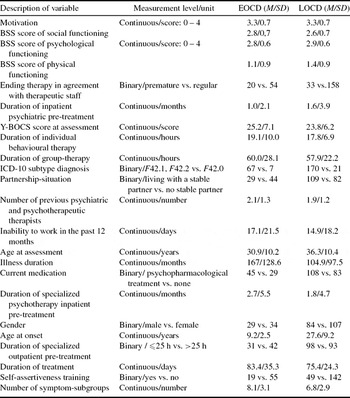
Case records of 254 patients who met ICD-10 criteria for OCD were included in the current study. The EOCD group consisted of 63 case records (29 male and 34 female patients) and the LOCD group of 191 case records (84 male and 107 female). Pre-treatment measure of the Y-BOCS was 25.6 (SD = 7.0) for the EOCD group. The LOCD group had a score of 23.8 (SD = 6.2). Of the early onset group 45 patients were on medication at intake and of the late onset group108 patients were on medication, mostly SSRIs.
The onset was determined by the first phase of obsessive-compulsive symptoms accompanied by distinct feelings of anxiety/discomfort (Jaisoorya, Janardhan Reddy and Srinath, Reference Jaisoorya, Janardhan Reddy and Srinath2003; Do Rosario-Campos et al., Reference Do Rosario-Campos, Leckman, Mercadante, Shavitt, Prado, Sada, Zamignani and Miguel2001). This information was gained on the basis of a series of biographical questions, doctors' reports of the referring psychiatrist or general practitioner and in many cases information from a parent.
The Y-BOCS (Goodman et al., Reference Goodman, Price, Rasmussen, Mazure, Fleischmann, Hill, Heninger and Charney1989) was administered at admission to the clinic and at conclusion of treatment to specify the type of symptoms, quantify the severity of OCD a patient presented and evaluate treatment outcome.
Severity of impairment (BSS: Beeinträchtigungs-Schwere Score; Schepank, Reference Schepank1995) is measured along three dimensions (physical, psychological and social). Inter-rater-reliability is 0.90 (Brickenkamp, Reference Brickenkamp1997). Norms are available for in- and out-patient populations and general public (Brähler, Holling, Leutner and Petermann, Reference Brähler, Holling, Leutner and Petermann2002).
Motivation was rated by the therapist after intake assessment plus presentation of treatment procedure and treatment rationale on a 5-point scale representing the therapist's global impression on the patient's motivation. Case records included a structured self-report form to establish the history of the presenting complaints, occupational history, personal history as well as psychiatric and psychological history of treatment. For an overview of all variables see Table 1.
Variables of assessment

Analysis
The definition of therapy outcome as a certain percentage of reduction in Y-BOCS scores between beginning and end of the treatment has already been used in other studies (Goodman, Reference Goodman, Hand, Goodman and Evers1992; Hiss, Foa and Kozak, Reference Hiss, Foa and Kozak1994). Following these we defined outcome in two ways: first, we defined it as a binary variable where treatment responders showed a reduction of a minimum of 30% in Y-BOCS scores and non-responders declined less than 30% in symptom severity. Likewise, we defined a second outcome variable where treatment responders showed a 50% reduction in the Y-BOCS scores. The first outcome measure with a reduction of 30% will be referred to as group A, and the second outcome measure with a reduction of 50% will be called group B.
Initial analyses of the variables' associations with outcome were performed by using chi-square tests for categorical variables and t-test comparisons of means for continuous variables. For the analysis of rating scale data Mann-Whitney U-tests were utilized (p < .05 in all cases). This allowed for the identification of all variables in which treatment responders and non-responders varied significantly or according to a trend (p < .05 – .1). These variables were entered into binary logistic regression analyses. All analyses were performed both forward and backward, based on the significance of their scores (p < .05). In cases of good model fit both methods should show the same results.
To verify our results we used an alternative approach to select the particular variables that would be entered into the regression analyses. We used correlations (Pearson-, Spearman- or point-biserial correlations depending on the quality of the data) between the variables and the Y-BOCS score at conclusion of treatment to find variables that correlated significantly or according to a trend with Y-BOCS scores. Thus in a second set of binary regression analyses slightly different sets of variables were entered. Regression procedures were the same as described above. For all of the statistical analyses the computer software package SPSS was employed.
Results
At the time of admission to the hospital 51 (81.0%) EOCD patients suffered from both obsessions and compulsions (F42.2), while 8 (12.7%) from mainly compulsions (F42.1) and 4 (6.3%) from mainly obsessions (F42.0). The mean Y-BOCS score at assessment was 25.6 (SD = 7.1) and patients stayed at the clinic for an average of 83.4 days (SD = 35.3). Of the 63 patients, whose OCD began before the age of 12, 34 (54.0%) were female and 29 (46.0%) were male. Mean age at assessment was 30.9 years (SD = 10.2), mean age at onset was 9.2 years (SD = 2.5). Of the 191 patients with LOCD, whose age at onset was 15 or later, 84 (44.0%) were male and 107 (56.0%) were female. On average they were 36.3 years (SD = 10.4) old at assessment and their mean age of onset was 27.6 years (SD = 9.2).
At the start of their treatment LOCD patients suffered mainly (62.8%) from both obsessions and compulsions (F42.2), 50 patients (26.2%) only from obsessions (F42.1) or 21 (10.9%) from compulsions (F42.0). The mean Y-BOCS score at assessment was 23.8 (SD = 6.2) and on average patients stayed at the hospital for 75.4 days (SD = 24.3). Post treatment measures of the Y-BOCS were 15.25 (SD = 7.1) for the EOCD group and 12.7 (SD = 7.8) for the LOCD group. At discharge from hospital fewer patients were on medication than at intake; 29 patients of the early onset group and 83 of the late onset group were still on medication.
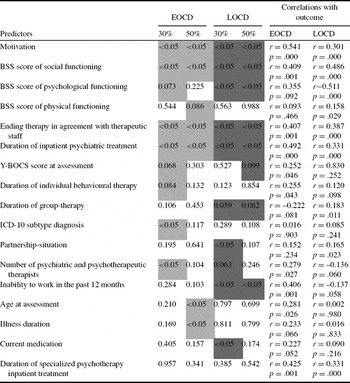
Table 2 shows the variables in which treatment responders and non-responders of both OCD-subtypes differ depending on the definition of outcome as a 30% or a 50% decrease in Y-BOCS scores. Significant variables or variables that varied according to a trend (p < .05˗.1) are marked. In addition all variables that correlated with therapy outcome, defined by the Y-BOCS score at conclusion of treatment, are presented.
Correlations and variables, shaded when differing significantly

For EOCD patients within group A (30% criterion), the binary logistic regression analyses revealed that a good outcome was predicted by high motivation and high initial Y-BOCS scores, while a poor outcome was predicted by a longer duration of psychiatric inpatient treatment before assessment and a low BSS score of social functioning. Depending on the particular estimate these four variables explained between 44.2% (Snell and Cox) and 59.1% (Nagelkerke) of the variance of treatment outcome. The Nagelkerke R Square is an adjusted version of the Snell and Cox R2.
To confirm the results, we always conducted another binary logistical regression analysis. In this second step (for all groups) variables that correlated significantly with therapy outcome were examined with the following results: For group A (30% criterion) all regression analyses presented exactly the same models and amount of explained variance that was previously found. For EOCD patients within group B (50% criterion), a good outcome was predicted by high motivation, while a poor outcome was predicted by a higher age at assessment. These two variables explained between 24.9% (Snell and Cox) and 34.0% (Nagelkerke) of the variance of treatment outcome. For group B (50% criterion), the second step regression analyses showed that a good response was predicted by high motivation and high Y-BOCS scores at assessment, while becoming a non-responder was predicted by a higher age at assessment and a low level of social functioning (BSS). These four variables explained between 34.2% (Snell and Cox) and 46.8% (Nagelkerke) of the variance of treatment outcome. For all groups and variable-sets the mode of application (forward or backward) did not lead to a change in outcome.
For LOCD patients within group A (30% criterion), predictors of a desired therapy outcome were a lower initial BSS score of psychological functioning (indicating lower level of impairment), higher motivation and living in a stable relationship. Additionally, ending the treatment as planned was linked to a positive therapy outcome. These four variables explained 22.9% (Snell and Cox) to 32.9% (Nagelkerke) of the variance of treatment outcome. When the binary logistic regression was applied backwards, an additional predictor was found: duration of inpatient psychiatric treatment. The longer a patient stayed in psychiatric treatment, the higher the probability of him/her being a non-responder. The amount of explained variance changed to 24.1% (Snell and Cox) and 34.6% (Nagelkerke). Applying the second step logistic binary regression for those variables that correlated with therapy outcome resulted in the same model and percentage of explained variance described above for the forward method. The additional predictor (duration of in-patient psychiatric treatment) found via the backwards method was not found again.
For LOCD patients within group B (50% criterion), both versions of the binary logistic regression lead to the same model. Again, a lower initial BSS score of psychological functioning, a higher motivation and the scheduled ending of therapy lead to a desirable therapy outcome. In addition, a shorter duration of inpatient psychiatric treatment added to the chances of being a responder. The amount of explained variance differs from 20.8% (Snell and Cox) to 27.8% (Nagelkerke). Repeating the binary logistical regression for variables that correlated significantly with therapy outcome resulted in the same model with the same amount of explained variance.
Discussion
In this study we aimed to identify possible predictors for therapy outcome in patients with EOCD and LOCD. We defined therapy outcome as either a reduction of 30% (group A) or 50% (group B) in the Y-BOCS scores. While retrospective acquisition of information from case records is never ideal, the biographical material available in the files was comprehensive and had been obtained following a structured format. The problem of retrospective identification of OCD onset was addressed by validating the patients' information through other sources such as doctors' reports of the referring psychiatrist or general practitioner.
When discussing our results in the light of previous predictor research, one has to bear in mind that studies so far have been based on samples that were not divided into age related subgroups. Nevertheless, we have attempted to relate our results to the current literature. With the exception of De Haan et al. (Reference De Haan, van Oppen, van Balkom, Spinhoven, Hoogduin and van Dyck1997), no other author examined the effect of motivation on therapy outcome. This factor proved to be a highly significant predictor for both EOCD and LOCD patients: the higher the motivation, the more likely it was that patients benefited from treatment. According to our findings it is imperative for therapists to begin therapy with assessing and possibly working on a patient's motivation, for a sufficient amount of motivation will increase the chances of successfully ending the treatment (Miller and Rollnick, Reference Miller and Rollnick2002).
Consistent with former studies neither gender nor level of education nor age of onset proved to be a predictor of therapy outcome (Ackerman, Greenland, Bystritsky, Morgenstern and Katz, Reference Ackerman, Greenland, Bystritsky, Morgenstern and Katz1994; Black, Reference Black and Beech1974; Castle et al., Reference Castle, Deale, Marks, Cutts, Chadhoury and Stewart1994; De Araujo, Ito and Marks, Reference De Araujo, Ito and Marks1996; Rachman and Hodgson, Reference Rachman and Hodgson1980; Ravizza, Barzega, Bellino, Bogetto and Maina, Reference Ravizza, Barzega, Bellino, Bogetto and Maina1995; Reinecker, Reference Reinecker1994; Steketee and Shapiro, Reference Steketee and Shapiro1995). The same can be said for duration of illness, the specific ICD-10 subtype and number of symptom-groups determined through the Y-BOCS-Symptom-Checklist (Ackerman et al., Reference Ackerman, Greenland, Bystritsky, Morgenstern and Katz1994; Arrindel et al., Reference Arrindel, Basoglu, Lax, Emmelkamp, Kasvikis, Sanderman and Marks1986; Buchanan, Ko and Marks, Reference Buchanan, Ko and Marks1996; Castle et al., Reference Castle, Deale, Marks, Cutts, Chadhoury and Stewart1994; De Araujo et al., Reference De Araujo, Ito and Marks1996; Foa et al., Reference Foa, Grayson, Steketee, Doppelt, Turner and Latimer1983).
Living in a stable relationship, defined as being married or having lived with one partner for a minimum of 3 years, proved to be a predictor for positive outcome for LOCD patients. Similar results were found by Buchanan et al. (Reference Buchanan, Ko and Marks1996) and Steketee, Eisen, Dyck, Warshaw and Rasmussen (Reference Steketee, Eisen, Dyck, Warshaw and Rasmussen1999). This factor did not emerge as relevant for EOCD patients. This may have to do with the fact that they were already impaired by OCD symptoms when they met their partners. In the LOCD group these findings may be explained by a stronger positive expectation of overcoming the illness and return to the previous OCD-free state. A higher age at assessment predicted an unfavourable outcome in EOCD patients. Presumably a high age at assessment is associated with longer duration of illness and in all likelihood also with the experience of unsuccessful treatments, causing desperation and diminishing therapy motivation. Thus our results confirm the importance of an early correct diagnosis and initial effective treatments addressing the special therapeutic requirements for adolescent patients (Treadwell and Tolin, Reference Treadwell, Tolin, Storch, Geffken and Murphy2007; Barrett and Healy, Reference Barrett and Healy2003).
We also found that high Y-BOCS scores at assessment predicted a good treatment outcome. This result had also been found by Ackerman et al. (Reference Ackerman, Greenland, Bystritsky, Morgenstern and Katz1994) and can probably be attributed to the definition of the criterion as a certain percentage of decrease in symptoms. Naturally, with higher initial Y-BOCS scores there is more room for improvement. Of course, it could also be due to regression towards the mean. Neither the amount of out-patient treatment, nor the duration of inpatient treatment in specialized cognitive-behavioural facilities before assessment had an impact on therapy outcome. However, the more time a patient had spent in psychiatric hospitals without the benefit of specialized cognitive-behavioural treatment, the more likely he or she was to belong to the group of non-responders. Hospitalization without specialized treatment clearly has no positive impact on the alleviation of obsessive-compulsive symptoms. Also, one can assume that persons with a long history of inpatient treatments suffer from especially severe OCD, possibly combined with severe or multiple comorbidities. The latter have frequently been linked to a bad prognosis (Dressen, Arntz, Luttels and Sallaerts, Reference Dressen, Arntz, Luttels and Sallaerts1994; Hermesh, Shahar and Munitz, Reference Hermesh, Shahar and Munitz1987; Minichiello, Baer and Jenike, Reference Minichiello, Baer and Jenike1987; Rasmussen and Tsuang, Reference Rasmussen and Tsuang1987; Ravizza et al., Reference Ravizza, Barzega, Bellino, Bogetto and Maina1995; Steketee and Shapiro, Reference Steketee and Shapiro1995). In accordance with Black (Reference Black and Beech1974) and Reinecker (Reference Reinecker1994) LOCD patients were more likely to belong to the group of non-responders if their level of overall psychological functioning was low. Also, finishing therapy – not prematurely, but in agreement with the therapeutic staff – contributed to a better outcome in LOCD patients.
EOCD patients presenting a lower level of social functioning had a higher probability of being a non-responder, which had also been reported by Basoglu et al. (Reference Basoglu, Lax, Kasvikis and Marks1988), De Araujo et al. (Reference De Araujo, Ito and Marks1996) and Skoog and Skoog (Reference Skoog and Skoog1999). These findings thus suggest that OCD treatment, in particular for those patients with an early onset, should always include some kind of group therapy or training of socials skills in order to help compensate deficits that might additionally impair the success of other treatment elements. As social functioning was only a predictor in the case of EOCD patients, it seems probable that the early onset itself leads to an inhibition of the development of social competence during childhood and adolescence. Castle et al. (Reference Castle, Deale, Marks, Cutts, Chadhoury and Stewart1994) had detected an association between duration of treatment and a good prognosis, while Steketee et al. (Reference Steketee, Eisen, Dyck, Warshaw and Rasmussen1999) found a negative influence of current medication on the outcome of behavioural therapy. In our study, however, the two variables had no predictive value.
In summary, our investigation of a broad and diverse set of variables has shown a small set of variables to be linked to therapy outcome. Irrespective of onset age high motivation at the beginning of treatment proved to be a strong predictor for positive treatment outcome, while long duration of hospitalization in a psychiatric institution (with only medication treatment) and no specialized psychotherapeutic treatment showed up as a negative predictor. A number of predictors were only relevant for one of the subgroups, such as living in a stable relationship emerging as a protective factor only for patients with a late onset, while a low level of social functioning was of negative predictive value for patients with an early onset and a low level of overall psychological functioning for patients with a late onset. Our results point out both the necessity of an early correct diagnosis as well as a specialized treatment program addressing motivation for treatment and deficits in social functioning along with the established methods. Differentiating between subgroups of OCD into early and late age at onset seems promising with respect to the goal of improving and developing more specified treatment programs.



Comments
No Comments have been published for this article.