What is the authentic Maya? Is it the dress? Is it performing a [Mayan] religious ceremony? No, it is our communal organisation: although it keeps changing, it remains the same.
Pedro Ixchíu, Indigenous Mayor of Totonicapán in 2000, speaking at a regional seminar to his fellow communal mayorsIntroduction
For the almost 2,000 men that make up the indigenous, or Mayan, government of the 48 communities or cantons of Totonicapán – a municipality in the western highlands, and Guatemala's fifth-largest, with a capital city of the same name – the months of November and December are the busiest of the year. That is when they pass power from the incumbents to the new duty holders in a series of significant events such as jointly reviewing the assets of the community, receiving their ‘orders’ (consignas) on how to govern, and climbing the pine-covered hillsides that rise from the valley floor to check boundary markers and the extensive pipe system that brings water from the many springs in Totonicapán's great communal forest. Details may vary from one canton to another, but generally the process starts with well-attended general assemblies where the new authorities are elected and ends with a public ceremony when the staffs of authority (varas) change hands. On 1 January, the municipal mayor welcomes all the new communal mayors (alcaldes comunales) in Totonicapán's main square, thus acknowledging the sovereignty of each community in selecting leaders who through this last act are also appointed as the state's representatives and named ‘auxiliary mayors’. Footnote 1
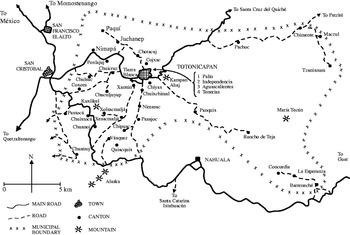
Map showing the municipality of Totonicapán and the location of the 48 cantons.

Since the ‘fall of the elders (principales)’ in 1987, community government is no longer a matter of whom the elders quietly appoint, and nowadays, in most cantons, all the ‘children of the community’ participate in the process. Elections, boundary inspections and investiture are, moreover, festive occasions, characterised by an atmosphere of both joy and solemnity, bigger than any national Guatemalan celebration. As a kind of civic fiesta, they portray how Mayan practices of government create collective identities and preserve local autonomy through leadership and communal work. They also demonstrate how leadership and community are closely interrelated phenomena in Mayan political practice and thinking.Footnote 2
The system of governance in Totonicapán is complex and includes Guatemalan state and municipal authorities as well as a set of institutions that represents the 90 per cent or so of the approximately 125,000 inhabitants who speak K'iche' and consider themselves to be indigenous or Mayan according to individual preferences and social circumstances. Generally, use of the term ‘indigenous’ signals a conservative attitude, whereas presenting oneself as ‘Maya’ indicates a will to reform along multicultural lines a society long dominated by Spanish-speakers (ladinos). Being expressions of a community-based Mayan authority system as well as political offices recognised by the state as auxiliary mayoralties, the 48 canton governments that annually rotate their ‘civil servants’ in the manner described above occupy an intermediary position in a world of changing and contrasting images of community, state and what it means to be a Mayan or an indigenous person.
After a period of rapid change that culminated with the fall of the elders in 1987 and the rise to power of their erstwhile helpers, the communal mayors, this community government now usually incorporates a range of local development committees, parents' associations, and so forth, in addition to cargos (community positions) with longer histories such as forest rangers (guardabosques) and constables (alguaciles). Today, each communal mayoralty is typically made up of a team of 12 to 15 men, led by the communal mayor. Furthermore, the mayors as well as the constables and a few other categories of cargo-holders form pan-municipal federations that also function as a division of the municipality, known as the Indigenous Mayoralty (Alcaldía Indígena) of Totonicapán.
Historically, these mayoralties – at the cantonal as well as the municipal level – can be seen as contemporary versions of one or several overlapping institutions generally known as ‘Mayan civic–religious hierarchies’ that have functioned as organs of indirect rule as well as a way of ordering a local community. Scholars used to investigate the origins and nature of the Mayan community and its position within larger political and economic systems,Footnote 3 focusing on the community's peculiar mix of religious and civic offices (cofradías, or religious ‘brotherhoods’, and alcaldías indígenas, respectively), which offered career paths for the community's married men, ending with the status of principal or elder.Footnote 4 The present debate, however, focuses on the way in which changing identities – from indigenous peasants to Mayan citizens – transform communities as well as their political representations.Footnote 5
This article analyses the relationship between changing collective identities and a political transformation from rule by elders to an increasingly democratic political system, at least on the cantonal level, in Totonicapán. It argues that this change has been possible because the community's sovereignty has been maintained. The premise is that the political representations involved are closely tied up with local ideas about ‘respect’ and ‘right order’ which, when pursued through the exercise of local government, enable new political practices as well as collective identities to take hold. Even as the actual forms of local rule change, autonomy is preserved through the art of making government because governing is closely linked to the art of living properly and guiding the community through changing circumstances. The distinct element of Mayan thinking on proper authority concerns how ‘truthful’ leadership connects a community and its leaders and gives the community direction independently of labels and procedures; in this way, the very act of practising Mayan government perpetuates the creation of a sovereign body. In this art of combining leadership and community, the communal mayors of Totonicapán have been noticeably successful by providing for a ‘right order’ even as identities and formal systems change. This article examines the details of how Mayan leadership is built and poses the question of how to repeat this local success in municipal, regional or even nationwide contexts.
Theoretical Perspectives
The assertion that truthful leadership produces autonomy points to important debates in various fields of research. Anthropology's concern with identities and political representations has already been mentioned. The interplay between canton, state and nation among K'iche'-speakers in Totonicapán is also a good case for discussing how ‘state languages’Footnote 6 recreate the state ‘at the margins’.Footnote 7 The sovereign bodies that I see maintained in the cantons of Totonicapán exist where competing Mayan and national Guatemalan political practices meet. In the same way that Das and Poole focus on the margins as ‘sites of practice on which law and other state practices are colonised by other forms of regulation that emanate from the pressing needs of populations to secure political and economical survival’, I focus on the way in which Guatemala's marginalised Mayan communities perform local government and, in the process, reappropriate the state's ‘modes of order’.Footnote 8
The way in which interaction between the authorities and residents of the 48 cantons of Totonicapán maintains a high ‘level of ethnic sovereignty’Footnote 9 also points to related debates in law and political science. Discussing indigenous peoples in international law, Anaya takes us a long way in ‘decentring’ the ‘Westphalian model’ of ‘mutually exclusive spheres of territory, community and centralised authority’ by claiming that the ‘attributes of statehood or sovereignty are at most instrumental to the realisation of [self-determination]’.Footnote 10 From his discussion of how human rights, in contrast to states' rights, can be used to ground autonomy, there is a clear link to similar debates among political scientists and philosophers about what Ivison et al. refer to as the ‘appropriate political structures for the expression of sovereignty’ and for re-negotiating the relations between the nation-state and indigenous peoples.Footnote 11 In both cases the traditions and present situations of indigenous peoples serve to show the limitations of positivist international law and of liberal political philosophy. The Totonicapán case directs our attention to independent decision making as what Anaya calls a ‘foundational principle’ for realising self-determination.
Furthermore, the changing practices of local government described here are easily situated in many recent studies of indigenous revival in Latin America that centre on state recognition of indigenous people's identities and rights, on how this multicultural turn came about and on what it actually means for the indigenous peoples in question as well as for the host states. Yashar's discussion of the varying strength of the indigenous movement from one country to the next draws attention to how ethnicity is a political instrument whose muscle will depend on an historically constituted range of accepted representations (‘citizenship regimes’). Today neoliberal reforms close down previous forms of collective integration such as state-sponsored peasant unions, but open up new ‘political associational spaces’ in which the same groups may redefine themselves as ‘ethnic’ within multicultural states with the help of ‘trans-community networks’ such as indigenous movements and international aid agencies.Footnote 12
Sieder notes that the politics of cultural recognition have profound consequences for governance and democracy in the region because they ‘impl[y], at least potentially, a new national project’; she adds that this ‘ultimately involves rethinking the existing terms of political participation’.Footnote 13 At the same time, she claims that the key question must be to what extent these policies will ‘contribute to an increase or a decrease in overall democratic accountability and guarantees’ and thus the extent to which ‘recent multicultural initiatives and reforms support or impede the development of a shared citizenship or civic identification in the countries of the region’.Footnote 14 Like Sieder, Van Cott looks for ways in which increased indigenous presence might democratise existing arrangements. Her analysis of the changes that are taking place in local government in predominantly indigenous regions in Ecuador and Bolivia nevertheless suggests that, whereas communal Andean traditions facilitate increasing levels of participation, ‘radical democracy’ is held back by authoritarian patterns of traditional leadership.Footnote 15 The importance she gives to leadership and flexible legislation concerning local rule in facilitating change has many parallels with my Guatemalan material, the difference being the importance of community construction in the latter case.
Sieder, Van Cott and Yashar bring themes from the general debates about state formation to two issues on which much scholarship about indigenous movements and multiculturalism in Latin America focuses. The first is the relationship between the larger processes of democratisation and neoliberal reform that have swept the continent since the 1980s, and the second is the question of whether existing indigenous autonomies do contain the seeds of alternative social and political orders. Starting with the latter I wish to mention Varese who, in his observations of indigenous longue durée in several countries, sees ‘culture’ as the central resource with which, for instance, Zapotec communities in Oaxaca, Mexico, have negotiated historically varying forms of coexistence with state power. In 1985 he reified indigenous tradition when he imagined culture as a unique ‘reproductive reference matrix’ or ‘system of cognition’ providing Zapotec leaders with the necessary sovereignty to keep negotiating with the Mexican state. Nevertheless, when he referred to ‘the socially accepted definition and use of goods, work and time that are not directed towards subsistence and reproduction’ as one of the factors making up a ‘central core of an ethnic group's way of life’, Varese anticipated today's focus on sovereignty as hinging on contested ideas of authority and propriety.Footnote 16
As for the impact of neoliberal reform, Sieder stresses that ‘while the colonial state in Latin America recognised subordinate autonomies, the guiding ethos of the republican state was the negation of difference and the unity of political and legal jurisdiction’.Footnote 17 The actually existing indigenous autonomies in Latin America have always been embedded in larger political and economic structures, and one result of this is the intertwining of ‘national-republican’ and ‘local-indigenous’ practices of government that makes it very difficult, if not impossible, to isolate anything purely ‘ethnic’ – a problem that the case of Totonicapán will demonstrate. Thus, as Sieder also concludes, there is no alternative to an ‘empirically grounded examination of [the politics of cultural recognition] and the specific political and economic contexts in which they are implemented’.Footnote 18
Method and Argument
My focus here is on the ‘site’ where community representations meet with leadership, forming a nexus of individual agency and images of the collective. I argue that the autonomy indigenous leaders (and promoters of multiculturalism) seek is best realised as a kind of dynamic, created and kept alive when and where career paths, identities and collective representations overlap in a shared, if contested, discourse about legitimate or ‘truthful’ leadership. Conversations with numerous Mayan leaders suggest that ‘true’ leadership is a kind of energised unity between the leader and the community which ensures that the local ‘way of life’ is maintained and given direction even though actual arrangements might change.
Throughout 2000 and during subsequent visits I accompanied Mayan leaders from 17 of the 48 cantons of Totonicapán as they directed all kinds of communal work, including the maintenance of community patrimony such as forests and water pipes, and took on responsibility for the upkeep of social order by executing local justice and liaising with state and municipal authorities. The mayors referred to their tasks as ‘defending the community’; as I realised how intimately connected their career paths were to local understandings of authority, propriety and community, I came to call it ‘making government’. I also worked extensively with the leaders of the municipality-wide federations of duty holders and visited the indigenous mayoralties of neighbouring municipalities. In addition to participant observation at scores of meetings and collective events, the main tool was ‘shared reasoning’Footnote 19 with individual leaders – that is, discussing how to cope with the plethora of committees carrying out development projects, the omnipresent personal and family rivalries, the need to keep up ‘respect’ and ‘order’, and meeting ‘our needs’ in an age when ‘the young no longer obey’, in addition to the exigencies of working under an ‘alien government’. I also collected a dozen autobiographies of community and NGO leaders that were very useful for understanding the interplay between career paths and shifting community representations. The conclusion to all this is that by now, in a large majority of the cantons, the work of those I call ‘reformist leaders’ – that is, the ones that refer to themselves as Mayan – has been successful in the sense that they have managed to retain (and possibly expand) a site for building autonomy.Footnote 20
The lack of such a site for reproducing Mayan sovereignty at levels above that of the canton is probably a fundamental reason why the Mayan movement has had little success in building a national political movement. In terms of Yashar's model, instead of hitherto state-supported peasant unions reconstructing themselves as ethnic movements, what we have in Guatemala are municipality-based institutions of indirect rule shaped by a hostile state which, after a period of conservative military rule and civil wars (1954–96) nevertheless has ceded discursive power to an international community with a strong multicultural vocation. This power is vested in the Acuerdo sobre Identidad y Derechos de los Pueblos Indígenas (Agreement on the Identity and Rights of the Indigenous Peoples, AIDPI), one of 11 agreements in different fields that comprise the 1996 Peace Accords. These accords, which became law in 2005, can together be read as a blueprint for how to modernise the Guatemalan state. Through the AIDPI various parts of the Mayan movement were given an internationally sanctioned opportunity to engage with the state. Importantly, as a text the AIDPI was produced by Mayan intellectuals; this is particularly relevant with regard to the tendency known as ‘cultural activism’, which has focused on symbolic issues such as language use and education in contrast to the ‘popular’ wing, which has prioritised social and economic issues.Footnote 21 In Totonicapán, the national Mayan organisations have little presence and the communal mayors take great care not to appear aligned with any Mayan organisation.
Whereas the cultural issues that the AIDPI espouses have had notable successes in the fields of education and law, the results in politics have been more modest.Footnote 22 A referendum that would have amended Guatemala's Constitution was lost in 1999, and several attempts at establishing Mayan political parties have so far had little success. The exception is the victorious Mayan civic committee Xel-jú, which has won several local elections in Quetzaltenango, the country's second-largest city and the capital of the western highlands. As Dueholm Rasch argues, however, the representations of ‘Mayan’ Xel-jú projects have so far not quite managed to resonate with how the city's rural and poor Mayas imagine themselves.Footnote 23 From this perspective what the Totonicapán mayors are doing takes on additional interest, for the political reforms they pursue are more in tune with how the rural population perceives local politics.
The Indigenous Mayoralty in Totonicapán
In many ways the approximately 50 per cent of the country's population that speaks a Mayan language and resides in one of the 166 (out of 333) municipalities predominantly inhabited by Mayas live in a dual society. Historically, this is a legacy of the ‘two republics’ of Imperial Spain insofar as the arrangement with separate government for Indians and Spaniards that emerged in the late sixteenth century continued well into the nineteenth and twentieth centuries. Formally, the office of alcaldía indígena was abolished in 1927, and the country's first law on municipalities dating from 1947 only deals with a single class of citizens electing their mayors on party-political lists.Footnote 24 Even so, all over the western highlands an ‘indigenous branch’ of local government continued to exist in various combinations with the ‘elected’ mayor. In Totonicapán, until 1987, the fourth councilman (cuarto regidor) of the Municipal Board (Concejo Municipal) was both a party-nominated municipal politician and a deputy for the federations that form the Indigenous Mayoralty. That year, when it was shown that a group of urban elders (the principals from the four quarters of the town always presided over the Mayan federations) were involved in illegal logging in the communal forest, the political parties stopped the practice through which the elders designated the fourth councilman on the electoral lists, and all over rural Totonicapán the cantons ceased sending their representatives to the federation of principals.Footnote 25 Thirteen years later the federation of auxiliary mayors, now appearing as communal mayors, had their leadership acknowledged by the other federations, and the president of the board of the Communal Mayors had taken the place of the head principal from the town quarter of Palín, but with a very different mandate and vision.Footnote 26
Within Totonicapán, people will refer to themselves as sons or daughters of one of the 48 cantones. The typical canton (komon in K'iche') has between 1,000 and 3,000 inhabitants; in Mayan politics the four quarters or ‘zones’ of the town are also thought of as cantons. Historically, the cantons are clan-based social units as well as state-imposed administrative divisions; this system presents a duality that is reflected in the way it combines cargo-based Mayan elements with modern and bureaucratic practices, as well in the ways it is perceived, either as ‘our order’ or as a ‘state language’. Further, some cantons are richer and more ‘developed’ – that is, they have more schools and infrastructure as well as a more diversified economy. Generally more development goes in tandem with a reformed mayoralty, meaning it contains more cargos and is run by reformist leaders who have replaced the conservative and inward-looking elders who continue to dominate local politics in conservative cantons. Here, at the margins, state practices are being colonised and reappear as a Mayan order.
In all cantons, all married men, or couples, are obliged to ‘serve the community’; this is done when the husband takes on a cargo and the wife assumes the resulting extra workloads at home. (By 2006, two women had served as communal mayors, in both cases in quite urbanised cantons). A duty lasts a year and is referred to as a ‘service’ or ‘sacrifice’ (K'iche': k'axk'ol)Footnote 27 to be performed at least three times during one's life, with intervening periods of rest. In addition come the frequent sessions of communal work through which the patrimony of the community is maintained; in reformed cantons women and youth may also participate in these tasks. Generally, young men begin with the least prestigious services and climb to the top, which is now the position of communal mayor. In conservative cantons the candidate may then take a seat among the elders (K'iche': kamalb'e). Previously, the power of the elders hinged precisely on their ability to ensure that this was done in accordance with ‘the word of the ancients’ (K'iche': ojer tzij). In both conservative and reformed cantons, failure to participate amounts to breaking the law of the community, in effect endangering everyone's existence. In this way, to live as an indigenous or Maya is to live a communal life. In terms of local thinking, living communally is in fact necessary for developing the social part of human intelligence (K'iche': etam), a point to which we shall return below.
As noted, large numbers of cargos indicate much development: the more schools a community constructs, the more parents' associations exist and the more development committee presidents take their seats in the local mayoralty. The reformed mayoralties are those that have managed to integrate the heads of the development committees in their government structure, and these cantons are often referred to as ‘strong’ or ‘advanced’. In addition to changing electoral practices, reforming the ancient elder-appointed hierarchy is done either through enlarging the hierarchy by including the presidents of the development committees or by including municipality-related services in a new development association; in both cases the elders ‘will have to take just another seat in the assembly’, as a young leader in a very strong canton put it.
In 2000 there were perhaps 20 ‘strong’ mayoralties; around ten could be termed conservative, while the other ten were weak in the sense that their governments, reformed or not, counted for little in daily life, and these cantons were often torn by internal conflicts. The interesting detail is how a majority of the weak cantons, among them the four zones of the town, were as developed as the strong ones in terms of infrastructure and economic diversity but were socially very fragmented, and Spanish was as common as K'iche' at public meetings and in the street. Following Varese one could say that their levels of ethnic sovereignty were substantially lower. Whereas locally this difference between, for instance, the neighbouring and economically prosperous cantons of Chotacaj and Juchanep to the west of the town centre was conceived of as the result of ‘high levels of unity’ and strong and intelligent leaders, it was also a striking fact that in Chotacaj the canton's forest and water resources continued to be administered jointly (by a development association of the type mentioned above) whereas in Juchanep the communal forest has ended up as the possession of a select group of direct descendants of the five original clans.Footnote 28
Every second Saturday morning, all communal mayors from all the cantons meet in the building of the Indigenous Mayoralty in the town centre. During 2000, around 30 of the 42 mayors attended regularly.Footnote 29 Each November, the newly elected mayors and the departing authorities meet to form a grand assembly and elect a board (junta directiva) with a president, vice-president, secretary, treasurer and two members. The person who receives a plurality of the votes becomes the new president and the de facto Indigenous Mayor. Before 1987, there was also a federation of elders led by the principals of the four town quarters; in those days the communal mayors were the liaisons between the principals and the elected mayor.
The ‘orders’ the new authorities receive when they take office are a catalogue of norms for how to govern, including procedures for resolving conflict and detailed information about the community's borders and assets. The ‘first order’ is always to ‘defend the community’ – this refers to guarding its ‘way of life’ (uk'aslemal) by ensuring that everyone participates and that transgressions are sanctioned. ‘Respect’ (nim ilik) is perhaps the local concept that best catches the qualities of what it is to be a good canton-dweller; for example, not to participate is showing ‘lack of respect’, which is a serious accusation. In addition to acquiring respect, the K'iche's of Totonicapán also maintain identity by not crossing the boundaries to the world of ladinos. Historically, ladinos have staffed all national government positions and thus, as a group, have come to embody old colonial arrangements in which Mayas played the role of servants. Hence the ‘right order’ and ‘respect’ are favourite metaphors not only for good government, but also for the construction of the Mayan person, in contrast to the amoral ‘aliens’ (k'axla'n) or ‘dandies’ (mu's), as ladinos are generally known.
Comparing Indigenous Mayoralties
Comparisons with nearby Momostenango show that the Totonicapán mayoralty in effect fuses two overlapping councils – one is formed by clan elders, while the other is an auxiliary municipality imposed by successive governments.Footnote 30 For instance, the office of auxiliary mayor came into being in the 1930s, when municipalities in Guatemala were charged with running the civic registries and needed literate assistants (known as empíricos) in the countryside. Furthermore, by comparing the historical sequencing of reform in different cantons it becomes clear that the communal mayors first replaced the elders in the cantons that were also first to acquire modern infrastructure (by building roads and schools, for example) and where Catholic Action and later various Protestant churches first established congregations at the cost of the cofradías and the religious and kin-based privileges of the elders.Footnote 31 Thus political reform is an expression of new visions of community identity as Mayas come to see themselves as citizens.
Since the mid-1990s, reform-oriented and mostly town-based mayors have endeavoured to renew the Indigenous Mayoralty as a Mayan and equal rather than an indigenous and subordinate institution. Conscious of the formally auxiliary status of the institution within the state, at times scornful of the way in which the principals acquiesced to ladino power – for instance, by allowing themselves to become military commissioners before and during the civil war (between 1960 and 1990) – and inspired by the Mayan movement, their project is to recreate and cultivate Mayan political autonomy. When in 1998 the communal mayors elected an urban teacher (Alfredo Tzic) as president, they were for the first time choosing a professional with one foot on each side of the urban/rural cultural boundary because by then there existed a critical mass of reformed cantons with educated citizens and a vision of being equal to Guatemala's Spanish-speakers – that is, cantons with a high level of ethnic sovereignty.
The fall of the elders and the transformation of the cargo system had a clear parallel in events in the neighbouring municipality of Santa María Chiquimula when, in 2003, the rural cantons stopped taking turns in serving in the ‘Constables and Mayors of the Corridor’, the municipality-wide cargo institution that provided for order and security in the town centre.Footnote 32 In this smaller municipality, with far fewer ladinos than Totonicapán or Momostenango, being elected to sit on the Municipal Board was also seen as a way of ‘serving’, and the political parties accepted this by relying on the principals to find candidates. In terms of state-defined local politics, however, such arrangements stood increasingly at odds with a municipal administration that in the late 1990s was supplemented with a police force and a Mayan Community Court staffed by legal specialists, as well as with an increasingly educated and religiously diversified community. The power of the elders was challenged both internally and externally.
In two other small neighbouring municipalities – San Bartolo and Santa Lucía La Reforma – state-defined tasks and elected officials were until recently even more thoroughly incorporated into the cargo system.Footnote 33 The differences between the practices and collective representations associated with cargo-based systems and electoral politics are thus crucial for understanding how local government in Mayan Guatemala is evolving. Focusing on how to represent ‘Mayas’, in Santa María Chiquimula and Quetzaltenango, Dueholm Rasch sees this contrast in terms of competing political representations of K'iche'-speakers. Focusing on leadership in Totonicapán, I observed a sharp moral boundary between Maya and ladino, with important implications for community construction. In Mayan thought, political legitimacy emanates from the ‘truthfulness’ of the bonds between a leader and his community that form by following a career path leading from one cargo to the next, whereas those who are elected through competitive party politics or perform public work on the state's payroll derive their power from unseen sources. The latter is the world of ‘politics’, full of ladinos and amoral dealings, while the former is not politics at all but simply ‘custom’ or ‘our way of life’.
Principles of Mayan Leadership: A Question of Balance
Three concepts surfaced in my research whenever people assessed leaders in terms of Mayan custom. A prolonged struggle between a group of young reformers who had founded an NGO called Ajpú and the elders in the conservative canton of Quiacquix provides a good case. For Ajpú, development was a question of catching up with neighbouring cantons and obtaining new social and economic opportunities for the children of their community – that is, they defended the community by reforming it. Community survival also topped the agenda for the elders, but for them maintaining order was the first priority. One day I asked a development promoter from the reformed and strong canton of Nimasac to interpret events in Quiacquix. He had no first-hand knowledge about ‘the people up there’, but he immediately recognised the state of affairs:
Apparently, Totonicapán is a well organised community. However, this is not really the case; what happens is that there is too much leadership. In any segment this division exists, it is a question of charisma, not whether someone is from here or there. One doesn't really know where a person stands – this is an unknown – and that is how an organisation behaves as well. The ancients were always right!
This seasoned practitioner immediately zoomed in on the complexities of personal rivalries and their ‘unknowns’, and found support for his ideas in the eternal wisdom of the ancients. Accusations of power abuse are standard fare among contending leaders, and in political discussion there is an enormous preoccupation with the honesty and truthfulness of leaders. My fieldwork notes are full of examples of how leaders constantly resorted to expressions such as ‘everyone has their own way of being’ to explain and justify why it had not been possible to execute a specific plan, as well as constant hints about ‘personal agendas’ (Spanish: intereses personales, K'iche': itzel winaq, itzel uk'u'x, literally ‘bad person, bad force’, meaning ‘does not cooperate’) to explain negative action or inaction. The obsession with honesty in fact appears as a kind of principled scepticism: we cannot know other selves.Footnote 34 So I asked the man from Nimasac what Ajpú should do, knowing well that he had been in similar situations many times himself. His response was quick and firm:
There must be consent. There are always young people who would like to press ahead. Perhaps they have an education, but find themselves without opportunities. The young have no credentials. The people do not know them. Suddenly it turns out that they have a political connection and one sees their personal agendas. Or perhaps they really want a change. The first question to ask, then, is: who are they really? What are their motives? With what do they want to help when they say ‘improve’? I would look into their faces and see if they are not hiding anything. If I see that this is truly the case, I would no longer heed the negative opinions.
In other words: Ajpú had to accumulate respect, best acquired through many years of communal service, and, to combat the unknowns, demonstrate its true intentions. The reformers in Quiacquix were acutely aware of this. In 2003, thanks to a worsening of relations with the big neighbouring canton of Chipuac, Ajpú finally won the day and the mayoralty and council of elders transformed themselves into a development association. It had become known that the development association that rules Chipuac was going to take legal action against Quiacquix in order to win back a strip of land that an accord from 1891 allegedly showed to belong to Chipuac. As the members of Ajpú explained:
This awoke the minds of many people, and realising that in other communities the bylaws of their organisation circulate freely, people went to the board, where [at last] they understood the need for sharing. We mobilised our organisation, presented copies of the Chipuac claim, and with proof of having participated in all boundary inspections during the last 15 years, our help was accepted.
Thus, by following how Ajpú managed to reform its mayoralty and similar conflicts between reformers and conservatives in other cantons, as well as through conversations with dozens of leaders and in particular Efraín Tzaquitzal,Footnote 35 I learned that the unknowns and the truthfulness to which the Nimasac leader alluded refer to common Mayan ideas about personality formation and a type of dialectic between a leader and the community. ‘True’ or ‘truthful’ (Spanish: nato, verdadero) leadership is a question of balance and dedication. It is a talent that must be cultivated continually, and can be either genuine or insincere. Further, leadership seems to be a necessary condition for the existence of a community because without the dynamics produced by the interplay between community and leadership, chaos and fragmentation will ensue.
Explicitly, a Mayan leader's legitimacy (and his respectability as a ‘child of the community’) is closely connected to how well he conjugates three fundamental elements of the Mayan person: (1) k'u'x, meaning ‘centre’, ‘heart’ or ‘life force’, (2) etam, meaning ‘knowledge’ or ‘sensibility’ or social intelligence, and (3) no'j, meaning ‘intelligence’ or problem-solving capability. If a man displays proper understanding and use of these elements, he is ‘complete’ or ‘good’ (utz'akat winaq, utz'alaj winaq) and eligible for leadership.Footnote 36
K'u'x is possibly the most basic element and the one that is most difficult to render in Spanish or English, not only due to conceptual distance but also because, as one informant put it, ‘Spanish has so many words where we use only one’. Other common translations are ‘essence’ or ‘force’, either weak or strong, and used with either benign or evil intentions. Furthermore, all things in nature possess k'u'x, including the community itself. The k'u'x of a town (uk'u'x tinimit) can be the patron saint of that town, although informants also used the concept to represent a town's communal solidarity (that is, its ‘spirit’), as is also common in European languages. In any case, the crucial point, suggested here in a typical quote, centres on how ‘it is the task of the good leader to create a good komon because there is an intimate relationship between the k'u'x of the people and of the community’.
As the k'u'x of a person is either weak or strong – in accordance with the sign or correlation of forces of the day one is born, some claim – it has to be cultivated. This is where knowledge and intelligence enter the equation. Watanabe refers to etam (naab'l in Mam) as a kind of ‘soul’ which, in contrast to k'u'x, is human and moreover an eminently social creation.Footnote 37 He describes it as a social intelligence that produces both ‘sense and sensibility’, and it is by sharing this soul that the community he investigates is constructed socially. This vision of a place-bound human ‘way of being’ or ‘way of thinking’ (k'aslemal) was regularly confirmed in Totonicapán; I was constantly assured that people in neighbouring cantons were ‘different’ or ‘thought differently’ and therefore, when conflict arose, were ‘not human’. Etam was typically defined as ‘knowing how to relate with others’ and thus the concept of ‘culture’ might be as fitting as ‘soul’. Indeed, when one workshop owner defined etam as ‘mastery through experience, just like the elders teach the young’, I felt that the general idea was ‘being educated’.
It is the responsibility of the parents to form and educate the child in a way that enables it to mature or broaden its etam, but community life is also vital, through carrying out one's duties and taking advice from the elders. When a man marries, and thus acquires ‘two mothers and two fathers’, he becomes a ‘complete’ person. This is why marriage is a prerequisite for taking up community service and why living in a community is essential for being considered a fellow Mayan and a prospective leader. It also follows that the issue of reforming government simultaneously becomes a question of representation: what sort of people are we really? In such a perspective, the issue of whether women and youth can serve in government takes on renewed urgency.
Tzaquitzal, the teacher, stressed that the task of bringing up children above all consists in ‘creating spaces for utilising the no'j’ and defined this third and final personal faculty as ‘the inherent capacity to receive etam’. One conservative town elder defined no'j as ‘understanding, for instance, the ability of a communal mayor to work in accordance with the law and think in a good way’; another elder defined it as ‘reasoning’ or ‘the ability to find solutions to problems’. All my informants stressed the need to balance all three faculties; leadership is thus a question of centring one's self, demonstrating no'j, and guiding it for the benefit of the community. At an electoral assembly people will discuss the merits of each candidate in terms of k'u'x, etam and no'j, and to this end they scrutinise personal behaviour and evaluate past works. If the outcome is good, people will say ‘utz'aqat kanjob'al’ (‘his thinking is complete’) or ‘utzalaj uk'u'x’ (‘great is his heart’) and bestow leadership upon him.Footnote 38
Reform at the Canton Level
With Ajpú and the challenge of winning popular support for toppling the rule of the elders in Quiacquix in mind, I asked a successful reformist leader from the strong canton of Chuatroj how he had been able to convince people to pave the access road to his canton whereas in a neighbouring, conservative canton the same road remained a nightmare to drive along. He answered:
Well, I think it's the mentality they have … it's still closed [cerrado]. They think that if one improves the road, one will also become its owner. They still don't understand that a road is a public thoroughfare … that no one can be the owner of a road, because it is public; its very name says so. In their community, when a path is cleared and maintained, [those who do it] become its owner. So there is a need to educate these people so that they understand that development will benefit not only [their neighbours] but also the members of their own community. Why? Take for instance the question of health; yes, let us begin here: with a paved road, there is less dust. The dust affects the respiratory tracts. And when we speak about the respiratory tracts we are speaking about health … Apparently simple things, but they don't see it like that.
Listening to this explanation I saw a clash between alternative representations of ‘community’, with different images of, for instance, ‘roads’ and ‘public’. By focusing on the meaning of the word ‘public’ and the need to enlighten people about how less dust means better health, this leader managed to move beyond the usual negative references to conservative thinking that reformist leaders make and turn the problem into one of different thinking. Where this reformer saw a backward mentality in need of reform, however, I as an anthropologist caught glimpses of an alternative worldview in which the family that clears a path also becomes its owner. So at the same time as his account tells us that only things made or worked on in cooperation can become communal, we are also advised that in the conservative canton, paved roads are not (yet) part of the commonly accepted community imagery.
Another fascinating aspect of this exchange is how the competing discourse in which a road becomes a thoroughfare and a communal possession is sustained by scientific reasoning about health. Together with a group of like-minded visionaries, this leader had by then worked for 20 years on building schools, securing communal ownership to the local forest, acquiring formal status for their canton as an aldea (village) and building access roads to the nearest main roads. In the process this group renewed the local career path so that by the late 1990s the ‘pro-development committee’ had eclipsed the elders, with the result that it is now far easier to use scientific arguments in this canton than in the other. Through a dialectic between reform-oriented leaders and an increasingly educated population, in Chuatroj the ‘community’ has come to refer to a vision of a modern place, with all the technology hitherto only possessed by ladinos, for modern individuals.Footnote 39 Extending communal services in tandem with changing community imagery and career paths emerges as the method that can reform government because of the way it maintains an unbroken, living connection between leadership and community. In local parlance, this consensus-ensuring aspect of truthful leadership is known as unificando criterios, ‘unifying [the] criteria [of competing proposals]’. The conversion of Chuatroj into a Mayan community lies in the way in which the reformers maintained the equilibrium between the ‘self’ of the leader and the ‘self’ of the community as much as in the content of their propositions, for it is this balance that makes everyone realise how the proposed activity actually benefits the entire community rather than ‘only a little group’ (sólo un grupito), as the expression goes.
Tellingly, all reformist leaders insisted that their rule was in conformity with the examples laid down by the ancients, and that in fact the conservative elders whom they had defeated were the ones who had deviated from the community's true path. Moral failings or ladino temptations had led them astray, and the result was fragmentation and strife. Being unable to unify alternative discourses and being out of harmony with the true spirit of the community resulted in disintegration and a weak canton. This claim also shows how leadership qualifications continue to be produced with the help of old categories after reform, always grounded in Mayan conceptions of personhood, even as actual practices were changing.Footnote 40 In this perspective, Mayan sovereignty endures as ongoing, meaningful decision making. As Varese has intuited, sovereignty rests on keeping alive a ‘matrix’, but this is a medium rather than a format.
Reforming at the Municipal Level
When Pedro Ixchíu and his team assumed the Indigenous Mayoralty in 2000, the newly elected board agreed to launch a series of sweeping reforms, including hiring a secretary, defining fixed office hours and establishing a Council of Elders. In this way the reformers hoped to overcome both the ‘problem of transitoriness [transitoriedad]’ – that is, the lack of a structure capable of providing continuity – and the ‘problem of the heads’ – that is, concerns about power abuse among young mayors with too much k'u'x and too little etam. They also hoped that a renewed ‘upper chamber’, to use the corresponding term in European political philosophy, would counteract such tendencies. The agreements were presented at the first general assembly the following Saturday, and on this occasion it was also decided to proceed with a series of seminars in cooperation with a Mayan NGO called the Centro Pluricultural de la Democracia (Pluricultural Centre for Democracy, CPD) through which all mayors and duty holders were to receive training on issues such as conflict resolution, ILO Convention 169/89 on Tribal and Indigenous Peoples and the new Law on Municipalities promulgated in 2002.Footnote 41
With the exception of the seminars none of the points on the reform agenda were carried out, for reasons intimately connected to precisely those conditions that enable reform at the canton level. The continuing sociality that exists in the cantons and that provides local leaders with a medium with which they can renew the leadership–community dynamic does not exist at the municipal level. As Dueholm Rasch also observed in Quetzaltenango's rural areas, in contexts where ‘ladino ways’ (that is, a party-political system) dominate politics, it is much more difficult to reconstruct politics in tandem with changing collective representations.
Several of the issues were indirectly raised at the seminars, however, insofar as the seminars always included group discussions on three preselected themes: leadership criteria, women's role and the Law on Municipalities.Footnote 42 The first seminar took place in the conservative canton of Chimente, where some 30 men from the four cantons in this remote corner of the municipality participated. President Ixchíu was quite direct about the need to uphold the independent authority of the mayoralty, and he ended with a warning:
Who named us? It was the community, not the elected mayor. Are we auxiliaries? No, we're not the assistants of anyone. We are the mayors of the communities! … [And] we have taken note of an important problem. When the auxiliary mayors are sleeping, the committees seize leadership. But committees are just ad-hoc entities. They are just resolving particular cases. It is the mayor who is the authority. You must be very careful about this point.
With this last observation the president tapped into the shared and difficult experience of maintaining authority when confronted with a multitude of committees and people with different criteria for how to engage with the future. But onto this perception of powerlessness he projected an image of purposeful action: the adoption of reforms. He then gave the floor to the representative from the CPD, who guided the participants through a plenary lecture about the 1988 Law on Municipalities. The group work concluded with the participants presenting their answers to three questions: (1) Who should be auxiliary mayors? (2) Should they be men or women? (3) Do we subscribe to what the Law on Municipalities says about our actual practice?
In Chimente, as well as at the following eight seminars, the most frequently mentioned qualifications for a mayor were found to be respect, the ability to represent the community, literacy, and the absence of a relationship with political parties. In other words, high priority was given to personal maturity and community identification. As for female participation, around 30 per cent of the groups concluded that women could not serve ‘because their tasks don't permit’, 50 per cent said they could serve ‘as long as their tasks permit’ (after preparing food and taking care of the children), and the remaining fifth were of the opinion that the two sexes have equal capabilities and therefore are equally eligible. I take these figures to be indicative of the growing power of the discourses of modernisation, for it is still exceedingly rare to see a woman ‘serve’ (although in conservative thinking it is of course a couple of complementary humans who serve).
The final question was the easiest. No one was in any doubt about the inappropriateness of the Law on Municipalities. Moreover, Ixchíu, a lawyer by training, took every opportunity to stress the relationship between law and authority, to explain how alien rule had broken this connection and relegated Mayan authorities to inferior positions, and finally to propose a way to re-establish Mayan authority on levels above the canton:
Before, the auxiliary mayor was [named by the ladinos]. However, in our own culture it was the calendar that decided who was to serve as authority, and the elders prepared them and ordained them, passing on the consignas. What is important is that they recognise this authority and that we carry out our service. The service gives you the faculty to be an authority. Someone who doesn't serve is worth nothing … A law is like a mirror. If we don't recognise what is in its image, how can we understand what is there? How can we respect that law? … The auxiliary mayor is the representative of the community, but he is down below, always inferior. The elders aren't there any more, the principals have gone. We lack the Council of the Elders. What we have today is a situation in which everyone wants to decide.
The year before, in cooperation with a capital-based NGO, the mayors (of 1999) had visited Guatemala's Congress and handed over a reform proposal.Footnote 43 Article 56 of the new (2002) law can be read as a complete victory for this initiative, and is moreover a good example of the politics of cultural recognition. It reads: ‘The Municipal Council … shall recognise the communitarian or auxiliary mayoralties as entities representing the communities … The naming of the communitarian or auxiliary mayors shall be done by the municipal mayor, based on the designation or election that is done in the communities’.
The proposals to build continuity by establishing an upper house and hiring a permanent secretary were too contentious to appear openly on the seminar agenda. While the practice of annually rotating all duties ensures the growth of a shared etam, it severely restricts attempts at setting up a bureaucracy to administer a modern canton or, of course, any community larger than the canton. Nevertheless, during breaks and meals there were frequent mutual consultations about issues such as the practice of exonerating duty holders from monetary contributions during the year in office as well as the first year of ‘rest’ (the period between performing services), and whether to offer a compensation or salary while serving as mayor. (I found that on average, communal mayors dedicated 30 to 35 hours every week to their duty.) Already it is common practice in many cantons to accept mozos or ‘replacements’ in minor positions through which labour migrants and businessmen may serve by paying stand-ins. Hiring mozos is deemed morally unacceptable in the case of the mayor, however. Proposals about economic compensation invariably lead to accusations about hidden personal agendas; adopting practices of this type is also controversial because office work has strong ladino connotations.
Thus the problem is to construct a legitimate Mayan authority at the apex of a system designed to share the burdens of subordination. To a large extent, this has been possible at the canton level, as can be seen when periodic elections replace the cargo system and the annual power transfer rituals are turned into civic fiestas. Compared with the situation at the canton level, however, the communal mayors have little in the way of communal work or service delivery that might nurture a municipal, collective identity. What the communal mayors do possess is direct access to the municipal mayor, but it would be hazardous to assume a role as distributors of development projects together with the latter office holder – that would amount to ‘doing politics’ and colluding with ladinos. The job of breaking new ground is far easier in the more self-assured and less ‘ethnicised’ atmosphere of a reformed and strong canton.
Comparing municipal politics in San Bartolo, Santa María Chiquimula, Totonicapán and Quetzaltenango, and the different mixes of cargo-based and state-imposed political systems evident in these areas, it seems we have a case of decreasing presence of cargo-based ‘indigenousness’ coupled with increasing presence of democratic political arrangements and ‘Mayanness’. This is a gradient that in the latter case starts to fall off again insofar as the ‘Mayanness’ projected by Quetzaltenango's urban Mayan elite in the form of Xel-jú does not resonate with the rural K'iche'-speaking population of that city. Against this background, canton politics in Totonicapán is the locality where ‘Mayan’ representations can be and are associated with modern political practices because local leaders have managed to transform the cargo system and convince people that the innovation is ‘ours’. This feat has been possible because the leaders have had a medium in which to do it, in the form of the continuing sociality of making government together, which permits them to show how change is the way to defend the ‘right order’ of their community. Conversely, the use of ‘Mayan’ symbols alone or the introduction of democratic procedures without reference to local identities is not sufficient to build a Mayan polity or a multicultural Guatemala.
Conclusions
Strategically exploiting the images of a developed community, the communal mayors of Totonicapán have replaced elders' councils with popular assemblies and promoted a vision of the children of the community as fellow Mayan citizens, all the while preserving community cohesion and external boundaries. In maintaining a sovereign body at the margins of the Guatemalan state, the role of leadership has been crucial because it is a dialectical, mutually supportive relationship, or in the words of one Mayan leader, ‘a thing that the community bestows upon you once it sees that your guidance is truthful’.
The first corollary to this assumption is that successful leadership is what functions as the ‘lever’ around which an autonomous community can be recreated and political practices reformed. The second corollary is that establishing such a union at the regional or national levels – that is, constructing Mayan electoral power – will require constructing a site where a similar dynamic can be enacted. When autonomy is a thing sustained through locally meaningful practices, even Totonicapán's community leaders cannot easily reproduce their transformed canton government at the municipal level. Researchers and policymakers might establish more or less specific lists of core functions for inclusion in a formal autonomy arrangement, but the crucial detail will be whether associated practices are perceived to be meaningful and real, or in Mayan terminology, whether they allow for the joint pursuit of ‘respect’ and the ‘right order’.
There are several implications of these findings. Firstly, the decisive factor for maintaining ethnic identity is the upkeep of sovereignty. There is nothing intrinsically ‘alien’ or ‘indigenous’ in the different political arrangements we discuss; the question is whether the actual practices resonate with the representations of the collective in question.Footnote 44 Secondly, the question of finding an ‘appropriate’ structure for autonomy or sovereignty appears to be a matter of maintaining (or creating) spaces for exercising meaningful leadership, understood as a kind of spiritual union between a community and its leaders. This point supports Van Cott's observations about the importance of creative leadership for accommodating indigenous communal authoritarianism with bureaucratic and democratic rule.
The experiences from Totonicapán also underline the importance of a supportive associational space and transcommunity networks. Outside multiculturalism-inspired backing has been crucial for the communal mayors, and they have made good use of the space offered through the travaux préparatoires of the 2002 Law on Municipalities. The present stalemate at the municipal level suggests, however, that in order to move further, the bottom-up reformers in Totonicapán will need more support in the form of additional top-down action.Footnote 45
The fate of the reform agenda of the communal mayors in Totonicapán, as well as of Xel-jú in Quetzaltenango, is thus intimately linked to state policies and cultural boundaries between Mayas and ladinos. In a broader perspective, the struggles between ‘conservatives’ and ‘reformists’ that I observed in Totonicapán are critical also in national politics insofar as the former stance corresponds well with the position of the conservative Frente Republicano Guatemalteco (Guatemalan Republican Front, FRG) party that has dominated local politics in the western highlands during the last two decades. For whereas among young professionals who compete with ladinos for jobs the boundary between indigenous persons and Spanish speakers is unequivocally referred to as ‘ethnic’, among older people and those who live farther away from national political life the line tends to be seen as a case of natural hierarchy and the result of different technological levels. Where reformists link the survival of a ‘Mayan’ culture to the existence of a separate organisation and press for reconstructing the Indigenous Mayoralty as an ethnically defined space, conservatives are inclined to defend tradition by bracketing it off from politics, to concentrate on development as purely project acquisition, and in the process cooperate with the political parties. In terms of debates in the Mayan movement about how to reconstruct Guatemala as a state inhabited by different ethnic groups, as well as about the role and possibilities of this movement in ongoing Guatemalan state formation, the implication is that the struggle between conservatives and reformers is won by the latter only to the extent that would-be national leaders connect with a critical mass of educated locals.
In general terms, the main argument of this article might be formulated thusly: changes in Mayan government in Totonicapán have been achieved by utilising a positive feedback loop between visionary leadership and changing community imagery, a loop that upholds sovereignty and produces autonomy. Sustaining this perspective is the observation that social life in the communities is increasingly penetrated by state language through institutions such as schools, health clinics, the army, political parties and other agencies of development (in addition to nationwide and global economic and ideological forces). These influences foster visions of a modern Mayan community that reformist leaders use to unite differing ‘criteria’ and in the process change the practices of governing. Furthermore, by contrasting the canton and the municipality as communities, it seems the process requires the existence of cultural boundaries – that is, the demarcation of a unit capable of containing and carrying the ‘sovereignty’ produced through the feedback loop in question.
As people in the cantons know that they are different from those who govern Guatemala, local leadership still has to be built locally. The reformed governments over which the communal mayors preside are not simply local expressions of a global or nationwide development process. They remain autonomous because a distinct, collective identity is preserved in the form of a unique etam produced through sharing the burdens of keeping up the order. The strong connections between identity and community, between individual selves and the collective self, allow reformist leaders to make the necessary adjustments to traditional ways of exercising authority while projecting acceptable visions of future communities and patrolling a boundary now turned ethnic. The Indigenous Mayoralty which fell in 1987 was a colonial and subordinated construct. The accession of Tzic and Ixchíu in 1998 and 2000 marked the ascendancy of the reformers who want to institutionalise a Mayan Mayoralty. However, this can only happen if a municipality (or region) acquires the characteristics necessary to communicate with a leadership recognised as Mayan, a process which in turn depends on what Guatemala's associational spaces permit.Footnote 46
The ‘feedback loop’ perspective gives equal weight to community and leadership by stressing their interaction and analysing the social practices involved in connecting them. It sees an ‘internal legitimacy’ produced by living in the community and partaking of its collective self as well as an ‘external legitimacy’ produced by maintaining the boundary against ladinos. The picture of leaders as exploiters of feedback loops, or levers around whom changes in the political order can take place, is sharpened by adding the concept of k'u'x, the ‘life forces’ or ‘energies’ of the collective and individual selves in question. Positing the existence of k'u'x implies that leaders are bound to relate to a community's social life in order to accumulate leadership. Political enterprise appears as a way of ‘creating’ community.Footnote 47 With k'u'x, the community automatically includes a purpose. Leadership is necessary for human communities everywhere in order to give direction to the basic forces of life and invest them with a meaningful form.