INTRODUCTION
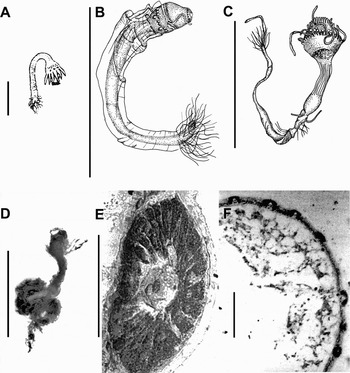
Gymnogonos was described by Bonnevie (Reference Bonnevie1898, Reference Bonnevie, Sars and Mohn1899) from the collection of the Norwegian North Sea Expedition. The type-species of this genus is Gymnogonos crassicornis, described by Bonnevie (Reference Bonnevie1898) from a tiny, solitary polyp from the Trondheim Fjord (Norway), at 400 m deep (Figure 1A).
Gymnogonos crassicornis Bonnevie, Reference Bonnevie1898. (A) holotype; Trondheim Fjord, 400 m; after Bonnevie, Reference Bonnevie1898; (B) juvenile specimen from the Barents Sea, collected by ‘Romuald Mukhlevich’, 15 August 2003 (material is in bad condition); (C) juvenile specimen from the Barents Sea, collected by ‘Andrey Pervosvanniyi’, 25 June 1900; (D) small polyp from the Barents Sea, collected by ‘Romuald Mukhlevich’, 17 August 2003; (E) transversal section of the papilla; (F) transversal section of head of polyp, on the level between gastral cavity of head of polyp and papillae level. Scale bars: A–D, 5.0 mm, E, 100 µm; F, 400 µm.

About this time and later new species from the southern hemisphere were described: Corymorpha antarctica (Pfeffer, Reference Pfeffer1889; Hartlaub, Reference Hartlaub1905) and Tubularia cingulata (Vanhöffen, Reference Vanhöffen1910). Judging from the short descriptions and illustrations these species are similar to Gymnogonos crassicornis, but faulty illustrations (T. cingulata) or their absence (G. antarctica), and lack of description of the typical species characters and differential diagnosis allow us to consider these species as ‘species inquirendae’ (International Code of Zoological Nomenclature, 1999, Glossary). Myriothela sp. (Hickson & Gravely, Reference Hickson and Gravely1907) was described based on the small juvenile specimen from the Ross Sea (see below). Finally a new Antarctic species Corymorpha ameriensis was described (Stepanjants, Reference Stepanjants and Scarlato1979). Later, the aforementioned species from the southern hemisphere were preliminarily classified as belonging to the genus Gymnogonos (Stepanjants & Svoboda, Reference Stepanjants and Svoboda1999).
Another species similar to Gymnogonos crassicornis, Corymorpha obvoluta, is known from the northern hemisphere (Kramp, Reference Kramp1933). In the context of the redescription of the Antarctic species Corymorpha ameriensis, this and the other species were added to Gymnogonos (Stepanjants & Svoboda, Reference Stepanjants and Svoboda2001).
In the collection of the Zoological Institute of the Russian Academy of Sciences additional material from the North Pacific (the Kurile Islands area) was found. It consists of an aggregate colony and solitary polyps, evidently from the same colony (see Materials and Methods section), belonging to the genus Gymnogonos. The morphological description suggests that the colony belongs to a new species which we name Gymnogonos pacificus. It is the first representative of Gymnogonos from the North Pacific.
MATERIALS AND METHODS
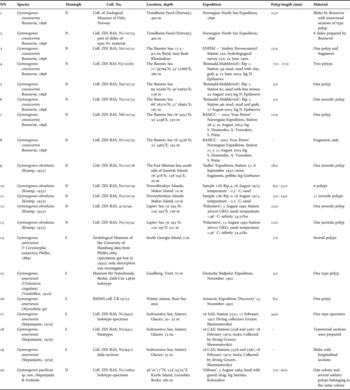
The material was collected by the Norwegian North Sea Expedition by dredging in the Norwegian Sea at the end of 19th Century, by the Russian expeditions to the Barents Sea with the vessels ‘Andrey Pervosvanniyi’ (1900), ‘Romuald Mukhlevich’ (2003), ‘Ivan Petrov’ (2003), from the East Siberian Sea with ‘Sadko’ (1937), and close to the Novosibirskiye Islands (1973) by diving. The collections of Gymnogonos of The Natural History Museum, London (one specimen of Myriothela sp.) and of the Museum für Naturkunde of the Humbold University Berlin (type-specimen of Tubularia cingulata) were investigated. Slides of Gymnogonos ameriensis from the collections of the Zoological Institute of the Russian Academy of Sciences (ZIN RAS) were considered too. Finally the type colony and separate polyps of a new species G. pacificus were investigated in detail and illustrations were prepared. Details of the dredging stations of the specimens are described in Table 1.
Investigated material of Gymnogonos species.

In Table 1: NN, column of ordinal number of investigated collection; Hemisph, column of N /northern/ and S /southern/ hemisphere; Coll. No, deposition of investigated collection and its number.
RESULTS AND DISCUSSION
Solitary polyps 5.0–17.0 mm length and diameter of head of polyp about 1–2 mm. Polyps covered by very thin, membranous, transparent perisarc. Constriction between head of polyp and caulus clear (Figure 1A–D). Head of polyp with two sets of hollow, cylindrical (oval in cross-section) filiform oral tentacles, up to 20 in number, distributed in 2–3 compact whorls around mouth; their length up to 1 mm. Up to 12 moniliform, hollow aboral tentacles, each 3–4 mm in length, distributed in one row. Gonophores styloids, distributed between oral and aboral tentacles, solitary, each attached to its own style. There are no branched blastostyles. Solid papillae below aboral tentacles, distributed in several rows (Figure 1A–C, E, F). Rooting filaments on basal part of caulus; no longitudinal gastral canals in caulus. No parenchymatous diaphragm between gastral cavity of head of polyp and caulus (Figure 1F).
Nematocysts (µm): stenoteles 14.0–16.0 × 10.0 (Stepanjants & Svoboda, Reference Stepanjants and Svoboda2001); 15.0–21.0 × 11.0–19.0 (new specimens); desmonemes 5.0–10.0 × 5.0–7.0; unidentified rhabdoids 16.0–20.0 × 5.0–6.0; euryteles were not found.
Gymnogonos crassicornis specimens were found in Norwegian Sea (400 m deep), near Iceland (about 209 m) and in the Barents Sea (17.5–9.0 m; 260 m; 136 m; 167 m). It is a typical high boreal west-Arctic species.
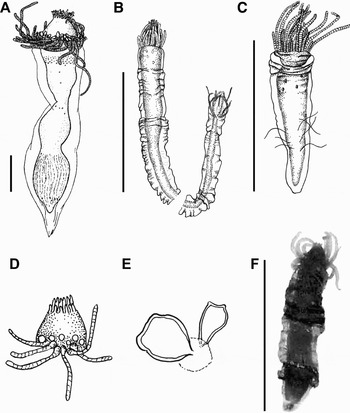
Solitary polyps 3–18 mm in length and 1–3 mm in diameter (in our juvenile polyps) and up to 32 mm in length and about 6 mm in diameter of the caulus. Polyps covered by thick, transparent, membranous perisarc, extending to border of base of aboral tentacles. There is no constriction between head of polyp and caulus. Head of polyp with two sets of tentacles: oral set, up to 20 tentacles, distributed in one whorl around mouth. They are filiform, hollow, cylindrical (oval in cross-section), their length of up to 1 mm. The up to 28 aboral tentacles are distributed in one row. In our material, the oral and aboral tentacles are moniliform, i.e. tentacles have transversal nematocyst bands (Figure 2A, C, D). Below the aboral tentacles, there are small solid papillae, which are poorly recognizable in juvenile polyps. Gonophores are cryptomedusoids and have a large manubrium (spadix), rudiments of 4 marginal tentacles, a bell cavity and no radial canals. The gonophores distributed between oral and aboral tentacles. They are not located on branched blastostyles, but in clusters of 2–3 gonophores on a common style (Figure 2E). There are no typical rooting filaments at the base of caulus. Occasionally such structures can be seen in the middle of caulus, but they are occasionally located at the base of caulus. There are longitudinal gastral canals in type-polyp (Kramp, Reference Kramp1933: p.6; this paper Figure 2A). In our material, there are poorly distinguishable longitudinal gastral canals of caulus in one of the polyps. There is no parenchymatous diaphragm between gastral cavity of the head of polyp and caulus.
Gymnogonos obvolutus (Kramp, Reference Kramp1933). (A) type-specimen from the Kangerdluggsuak Fjord (south-eastern Greenland, 175 m deep—after Kramp, Reference Kramp1933); (B) elongated specimen from the Novosibirskiye Islands area (the East Siberian Sea, 10 m deep); (C) short specimen from the same place; (D) oral tentacles distributed around the mouth; aboral tentacles distributed under gonophores; schematically; (E) cryptomedusoid gonophore group on common style, schematically; (F) short specimen collected at Makar Island, 18 August 1973, near Novosibirskije Islands. Scale bars: A–C, F, 5.0 mm.

Nematocysts (µm): stenoteles: 25.0 × 20.0 (Stepanjants & Svoboda, Reference Stepanjants and Svoboda2001); 8.0 × 10.0 (new specimens); (?)rhabdoids: 7.0–8.0 × 4.0–4.5 (Stepanjants & Svoboda, Reference Stepanjants and Svoboda2001); 16.0–18.0 × 6.0–7.0; 11.0 × 4.0; (?)euryteles were not found.
Gymnogonos obvolutus was found near south-east Greenland (175 m; Kramp, Reference Kramp1933), in the Laptev and the East Siberian Seas (10–106 m). It is a west-boreal high Atlantic and Arctic species.
Solitary polyps up to 34 mm in length, about 4–5 mm in diameter and light yellow in coloration. Constriction between the head of polyp and caulus visible. Polyp covered with thin, membranous, transparent perisarc, secreted below aboral tentacles. Head of polyp with two sets of tentacles. Up to 50 oral tentacles grouped in several compact whorls around hypostome; they are filiform, hollow, cylindrical (oval in cross-section), up to 1.5 mm in length with nematocyst rings and up to 40 aboral tentacles 2.5–4.5 mm in length, distributed in two rows and have markedly expanded basal parts. Below whorl of aboral tentacles there is a deep annular furrow, followed by closely packed solid papillae. Few papilla groups or solitary papillae are scattered along caulus. Basal part of caulus with many thin perisarcal rooting filaments. About 30 styloid gonophores (only male in our material) are situated in the upper part of head, between oral and aboral whorls of tentacles. Each gonophore attached to head of polyp with its own short leg. There are no branched blastostyles and no longitudinal gastral canals usually visible on caulus.
Nematocysts of type-specimen (µm): stenoteles: 12.0–19.0 × 9.0–12.0; desmonemes 6.0–10.0 × 6.0–7.0; rhabdoids(?) 16.0–18.0 × 6.0–7.0; euryteles(?) 28.0 × 25.0.
The older literature contains the descriptions of several species from the southern hemisphere which are comparable with G. ameriensis. The first one is Corymorpha antarctica from the South Georgia area (Pfeffer, Reference Pfeffer1889, Hartlaub, Reference Hartlaub1905). The description of this species suggests that it is a juvenile polyp (not fully developed gonophores and small size—only 7 mm in length). Both polyps have a yellow coloration, no evident constriction between the head of the polyp and caulus. They have hollow, filiform oral tentacles (about 20 in number) and a large number of aboral tentacles (40 in G. ameriensis and about 80 in G. antarctica). The gonophores are not fully developed (according to Pfeffer, Reference Pfeffer1889) but more or less mature, with radial canals, but without tentacles and ring canal (Hartlaub, Reference Hartlaub1905). No branched blastostyles. There is no possibility to draw a final conclusion, because the type specimen of Corymorpha antarctica was lost after 1945 and there are no illustrations or species-specific details in previous publications. We suggest C. antarctica as ‘species inquirenda’ and consider C. antarctica with doubt as synonym with G. ameriensis.
Two juvenile specimens, probably belonging to Gymnogonos, were found later in the Antarctic region. We could obtain both related specimens from the British Museum of Natural History and from the Museum für Naturkunde, Berlin. One of them, collected near the Ross Sea area, was described as Myriothela sp. by Hickson & Gravely (Reference Hickson and Gravely1907: 18). This specimen (8 mm in length) lacks mature gonophores and has short tentacles, but bears papillae around the basal part of the head of polyp below deep annular furrow and rooting filaments at the base of caulus. The aboral tentacles of this polyp are distributed in two whorls, what may be concluded both in the illustration of Myriothela sp. (Hickson & Gravely, Table III, figure18) and after investigation of the type-polyp. These morphological details suggest that it is a juvenile specimen of G. ameriensis (Figure 3C). The second juvenile specimen was found by the Deutsche Süd-Polar-Expedition at Gauss-Berg and described as Tubularia cingulata by Vanhöffen (Reference Vanhöffen1910). The illustration shows only the head of the polyp, but the specimen (3 mm in length) shows more details than were described originally (Figure 3D). The polyp consists of a tiny head, the aboral tentacles (about 20) are distributed in 2 whorls. There is a deep annular furrow and papillae below the aboral tentacles and rooting filaments at the caulus. The incomplete description and unclear illustration allows us to classify this species as ‘species inquirenda’ and it is probably a juvenile polyp of G. ameriensis. New additional material is needed to decide this question ultimately.
Gymnogonos ameriensis (Stepanjants, Reference Stepanjants and Scarlato1979). (A) Holotype specimen (after Stepanjants, Reference Stepanjants and Scarlato1979); (B) head of holotype; (C) polyp of Myriothela sp., Hickson & Gravely, Reference Hickson and Gravely1907; (D) type-specimen of Tubularia cingulata Vanhöffen, Reference Vanhöffen1910; (E) papilla in longitudinal section, entodermal axis penetrating lamella, surrounded by ectodermal gland cells; (F) papilla in transversal section; Scale bars: A, B, 5.0 mm; C, D, 2.0 mm; E, F, 100 µm.

Nematocysts of these juvenile polyps (µm). Myriothela sp: stenoteles 18.0 × 17.0; desmonemes 6.0–10.0 × 6.0–7.0; (?)rhabdoids 11.0–13.0 × 6.0–10.0; (?)euryteles19.0–20.0 × 17.0; Tubularia cingulata: only (?)rhabdoids 11.0 × 5.0.
In sum, we conclude that at the moment there is only one valid species of Gymnogonos in the Antarctic and Subantarctic —G. ameriensis with a circumantarctic distribution.
Material examined
Holotype specimen N 1/10850. Aggregate colony and its fragments—6 separated polyps of different age; 2 heads of polyps and, accordingly, 2 hydranths, possibly from the same colony. Type locality Kuril Islands; Rocks Lovushka Island 48°02′17″N, 154°24′05″E; ‘Odissey’ e/s; voyage 33; 3 August 1984; depth 580 m; sand with gravel; drag; leg. Sirenko, Kolesnikov (Table 1).
Diagnosis
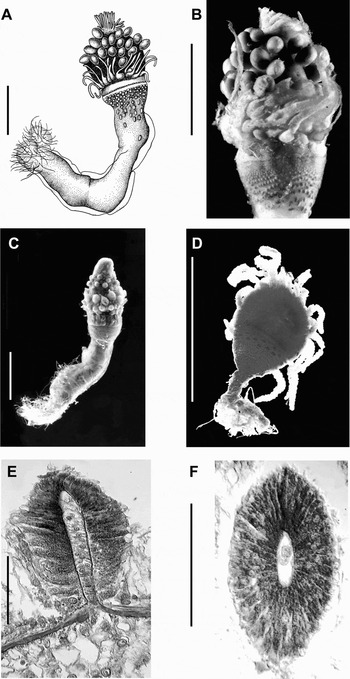
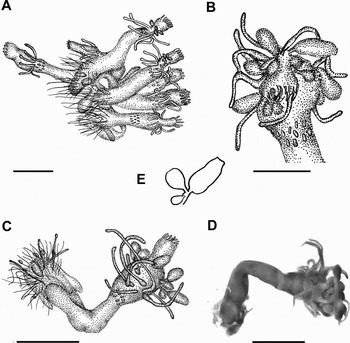
The first distinctive character is presence of the aggregate colony which consists of several polyps of different ages: from juvenile to mature stages. Each polyp has either no or a poorly recognizable constriction between head and caulus of hydranth. The oral tentacles are short and distributed around the mouth at the end of remarkable elongated hypostome. Elongated hypostome is the second character of this species. The aboral tentacles are much longer and distributed in two rows. Between the oral and aboral tentacles there are whorls of gonophores: 2–3 gonophores in each group on joint style One gonophore of each group is significantly larger than the others (Figure 4E) (the third character of this species). They are cryptomedusoids (undifferentiated sex) and display several (~4) tentacles buds. Below the aboral tentacles, there is a poorly visible annular furrow. Below this furrow there are numerous papillae (typical for Gymnogonos). Another typical feature of this genus is the thin membranous, transparent perisarc covering the caulus up to the base of the polyp head.
Gymnogonos pacificus sp. nov. holotype: (A) aggregate colony; (B) head of a specimen with papillae, hypostome turned downwards; (C, D) separated, solitary specimens of the holotype colony; (E) gonophores, schematically; Scale bars: A, C, D, 5.0 mm; B, 2.0 mm.

Description
Aggregate colony (unstable colony, Stepanjants et al., Reference Stepanjants, Svoboda and Anokhin2002), sometimes separated into solitary polyps after fixation, consists of several polyps in all stages of age (Figure 4A). Size of polyps ranges from 2.0–20.0 mm in length. Each mature polyp has two sets of tentacles on its head: oral tentacles (about 20 in number) are very short (about 0.5 mm in length) and distributed in one row around mouth on oral part of elongated hypostome (Figure 4B), The aboral tentacles (more than 20 in number) are filiform, hollow, about 8.0 mm in length and distributed into two rows. Each mature polyp has an inconspicuous annular furrow at the base of head (Figure 4D). Below this furrow there are numerous papillae (Figure 4C). The perisarc covers the caulus up to border of head. It is membranous, thin and transparent. The gonophores distributed between the oral and aboral tentacles. They are in groups (2–3–4 in each group), but only one of each group is fully matured, and probably male. Each gonophore group is attached to a common style. Gonophores are cryptomedusoids and display tentacle buds. It is impossible to recognize other gonophore structures (Figure 4E).
Nematocysts (µm): stenoteles 18.0–23.0 × 12.0–20.0; desmonemes 7.0 × 10.0; (?)rhabdoids 11.0–15.0 × 4.0–6.0; (?)euryteles 17.5–20.0 × 15.0–16.5.
Differential diagnosis
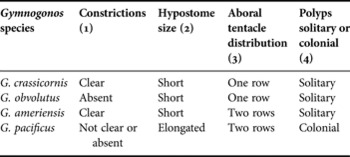
The species of Gymnogonos are very similar to each other. There are only few features of Gymnogonos that differ among species: presence or absence of clear constriction between the head of the polyp and caulus (1); size of the hypostome (2); the character of aboral tentacle distribution (3) and colonial or solitary polyp organization (4) (Table 2).
Comparison of species-specific parameters of Gymnogonos species.

The new material extends the diagnosis of Gymnogonos compared with the original one from Bonnevie (Reference Bonnevie1898): ‘Der Hydrocaulus (ist) von einem membranartigen Perisark bedeckt, an dessen proximalem Ende Haftfädchen befestigt sind. Ein Kreis von Papillen am Übergang zwischen dem Hydrocaulus und Hydranthen. Styloide Gonophoren werden vom Hydranthen selbst entwickelt. Kommt einzeln vor’.
The new Gymnogonos diagnosis
Corymorphidae with solitary or colonial polyps covered with a more or less thin, transparent, membranous perisarc extending to base of the head of polyp. The hollow filiform tentacles are arranged in two—oral and aboral sets. The oral tentacles are arranged in one or several rows around the mouth; aboral tentacles longer than oral ones, arranged in one or two rows. The styloid or cryptomedusoid gonophores are solitary or in groups of 2–4 on a common style, distributed between oral and aboral tentacles of the head of polyp. No branched blastostyles.
Below aboral tentacles there is an annular furrow often poorly visible. Under furrow many solid entodermal papillae with ectodermal cover of glandular cells, probably secreting perisarc. Rooting filaments at the base or middle of the caulus. Gymnogonos cnidom consists of stenoteles, desmonemes, unrecognizable rhabdoids and euryteles. Capsule types not a characteristic feature for this genus, but dimensions of nematocysts are more or less specific for each species (Table 3).
Nematocyst size of each Gymnogonos species.

As it was said, species-specific characters of Gymnogonos species are not so clearly marked. To have the possibility to identify species an identification key is required.
KEY FOR GYMNOGONOS SPECIES IDENTIFICATION
1 (4). Aboral tentacles of polyp arranged in one row
2 (3). Constriction between head of polyp and caulus is clear. … … … G. crassicornis
3 (2). Constriction between head of polyp and caulus is absent… … … .G. obvolutus
4 (1). Aboral tentacles of polyp arranged in two rows
5 (6). Hypostom of polyp is elongated … … … … … … … … … … … … … .G. pacificus
6 (5). Hypostom of polyp is short … … … … … … … … … … … … … … …G. ameriensis
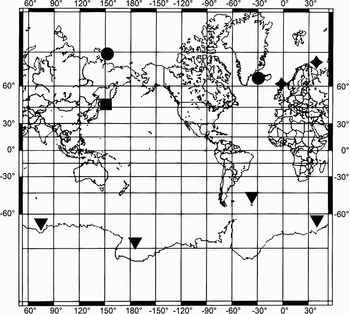
The Gymnogonos species were found in the northern hemisphere, as indicated in the world map (Figure 5): G. crassicornis and G. obvolutus were discovered in the North Atlantic and Eurasian Arctic Seas; G. pacificus in the North Pacific and G. ameriensis in the Antarctic and subantarctic. The genus has a typical bipolar distribution in the classical meaning of this term (Stepanjants et al., Reference Stepanjants, Cortese, Kruglikova and Bjorklund2006).
Map of Gymnogonos distribution. ★, G. crassicornis; •, G. obvolutus, ▾, G. ameriensis; ■, G. pacificus.

In spite of missing fossils of Corymorphidae, the aforementioned material suggests that Gymnogonos is a relict genus which, possibly, originated from the warm water family Corymorphidae with the largest part of warm water species (~11; see Svoboda & Stepanjants, Reference Svoboda and Stepanjants2001; Stepanjants et al., Reference Stepanjants, Cortese, Kruglikova and Bjorklund2006) by neoteny. This idea is supported by the morphological similarity of the Gymnogonos juvenile polyp with the larvae of some species of Corymorphidae, for example, Corymorpha forbesi (see Brinckmann-Voss, Reference Brinckmann-Voss1970). It is possible to assume that the tropical zone is possibly the centre of origin of this family. During the Quaternary cooling of the tropics during the glacial period the larvae of several warm water Corymorpha species were forced to migrate northwards and southwards of both hemispheres and adapted to the new environments with cold water. We hypothesize that closely related cold water Gymnogonos species originated by this way in the northern and southern hemispheres (Stepanjants et al., Reference Stepanjants, Cortese, Kruglikova and Bjorklund2006).
CONCLUSIONS
1. The genus Gymnogonos is characterized by several specific morphological features and its representatives are easily distinguishable from other Corymorphidae by the presence of a transparent perisarcal membrane and papillae at the base of the head of polyp.
2. The cnidome of Gymnogonos (capsule types) is not a genus specific feature, since all four capsule types are known from most Corymorphidae. On the other hand, the size of capsules may be used as characteristic for each Gymnogonos species.
3. Today 4 valid species of Gymnogonos are known.
4. Several species described earlier from the southern hemisphere on juvenile polyps, such as Corymorpha antarctica and Tubularia cingulata we suppose to be ‘species inquirendae’ and as possible synonyms of G. ameriensis. The juvenile polyp described as Myriothela sp. we consider a synonym of G. ameriensis without doubt.
5. The distribution of Gymnogonos species suggests that they belong to bipolar genus.
6. It is possibly a relict genus. Its origin may rise from tropical Corymorphidae by neoteny in the period of glacial cooling.
ACKNOWLEDGEMENTS
We would like to thank all our colleagues of the Hydrozoan Society, especially Dr Elaine Robson and the late Dr Francesc Pages, for their help to S. Stepanjants to participate in the VI Hydrozoan Workshop at Plymouth. We are thankful to colleagues from Oslo Zoological Museum, especially the late Bengt Christiansen and Marit Christiansen for offering the opportunity to investigate Bonnevie's slides of type-polyp Gymnogonos crassicornis. We are grateful to Mrs Miranda Lowe (The Natural History Museum, London) and Dr Carsten Lüter (Museum für Naturkunde, Humbold Universität zu Berlin) for the loan of their old Antarctic material. We are thankful to H. Svoboda for his help with illustrations and English corrections. Our thanks to Drs Dale Calder (Canada) and Izjaslav Kerzner (Russia) for the important advice concerning questions of nomenclature, and to the anonymous referees for the manuscript criticism. S. Stepanjants was supported by the Russian Foundation of the Fundamental Researches (N 07-04-08059-3) and the Russian Project N11 ‘Antarctic Biota’ in the subproject ‘Investigation of the Antarctic’ of the General Programme ‘World Ocean’. A. Svoboda and S. Stepanjants were supported by a grant from the DFG (Sv 4-4-1, RUS 17/134/94).