

Introduction
Party systems differ in a variety of ways: effective number of parties, ideological polarization, social cleavages, patterns of competition, alternation in government formation—to name just a few (see Blondel, Reference Blondel1968; Duverger, Reference Duverger1954; Laakso and Taagepura, Reference Laakso and Taagepera1979; Sartori, Reference Sartori1976). Importantly, these aspects vary both between elections within the same system and across party systems in different countries. Perhaps one of the most understudied aspects of party systems is the extent to which they exhibit nationalization (or alternatively, regionalization). The relative neglect of this aspect of party systems, however, has begun to change within the last two decades, specifically with the publication of two books: Chhibber and Kollman's (Reference Chhibber and Kollman2004) The Formation of National Party Systems and Caramani's (Reference Caramani2004) The Nationalization of Politics. While the party nationalization literature originated in the United States (see, for example, Stokes, Reference Stokes, Chambers and Burnham1967; Claggett et al., Reference Claggett, Flanigan and Zingale1984; Kawato, Reference Kawato1987), the phenomenon of party nationalization has more recently been studied in a variety of countries and, increasingly, from a comparative perspective (Jones and Mainwaring, Reference Jones and Mainwaring2003; Lago and Montero, Reference Lago and Ramon Montero2014).
The Canadian literature is no stranger to the study of party systems or the regionalization of political life (see Blake, Reference Blake1985; Jackman, Reference Jackman1972; Schwartz, Reference Schwartz1974; Young and Archer, Reference Young and Archer2002). There have been studies of incongruent party systems across federal and provincial jurisdictions (Stewart and Carty, Reference Stewart, Carty and Dunn2006), the regionalizing tendencies of the single member plurality electoral system (Cairns, Reference Cairns1968), the increasingly decentralized nature of the federation (Erk, Reference Erk2008; Rocher, Reference Rocher and Gagnon2009), regional political parties (Bélanger and Nadeau, Reference Bélanger, Nadeau, Pammet and Dornan2016), regional political cultures (McGrane and Berdahl, Reference McGrane and Berdahl2013; Simeon and Elkins, Reference Simeon and Elkins1974), the regionalization of electoral results (Bickerton et al. Reference Bickerton, Gagnon and Smith1999; Carty et al., Reference Carty, Cross and Young2000; Clarke and Kornberg, Reference Clarke and Kornberg1996; Cross, Reference Cross, Young and Archer2002) and the relationship between federal and provincial parties (Esselment, Reference Esselment2010; Pruysers, Reference Pruysers2016).
A focus on regionalization was particularly evident in the Canadian political science literature after the 1993 federal election, which resulted in historic breakthroughs by two regional parties. The success of the Bloc Québécois and the Reform party, and the altered patterns of competition they relied on, signalled for many scholars the beginning of the fourth Canadian party system. This new party system diverged from previous ones in important ways, particularly in the regionalization of party competition. Following the turbulence of the 1990s, for instance, Bickerton et al. (Reference Bickerton, Gagnon and Smith1999: 194) wrote: “These shifts have increased the balkanization of the Canadian electorate and party system. The divisions between parties and voters have been magnified and multiplied; regional bases of party support and activity are more sharply delineated; and the pattern of voter loyalties and preferences is more spatially differentiated.” This sentiment was echoed by Young and Archer (Reference Young and Archer2002: 4), who argued that “never in Canadian history has regional differentiation in the parties’ support bases been so pronounced” and by Carty et al. (Reference Carty, Cross and Young2000), who argued that national election campaigns, as well as the parties that contested them, had been replaced by a set of regionally distinctive party systems in which elections were fought and lost based on local issues in different regions across the country.
Despite interest in the regionalization of political life, there has yet to be any examination of regionalization in the party system throughout the entirety of Canadian electoral history. While there undoubtedly have been periods of significant regionalization and while these periods have been well documented, we are unaware of any study that systematically documents the nationalization (or lack thereof) of the Canadian party system across time. Although the elections of the 1990s have been the focus of considerable academic attention, it is unclear to what degree this period of regionalization was atypical. Nor is it clear how the Canadian party system compares with those in other federations with regard to its level of nationalization. We address these shortcomings in the literature by exploring the degree of regionalization in each federal election, taking a systematic and historical approach to the study of regionalism in the Canadian party system.
In doing so, we diverge from the traditional Canadian party systems literature (for example, Carty, Reference Carty, Throburn and Whitehorn1988) insofar as we are not concerned with organizational and structural changes to individual parties, changing campaign techniques, or similar factors that have typically been used to distinguish Canadian party systems. Instead, we focus our attention on the level of nationalization. First, we explore the extent to which the parties themselves behave in a nationalized manner, insofar that they nominate candidates across the entire country (Caramani, Reference Caramani2004; Lago and Montero, Reference Lago and Ramon Montero2014); in other words, we consider the geographic coverage of their electoral machine. Second, following the approach adopted by Jones and Mainwaring (Reference Jones and Mainwaring2003), Bochsler (Reference Bochsler2010) and Pruysers (Reference Pruysers2014), we employ a relatively underused measure of nationalization to explore the extent of regionalization in the Canadian party system. Applying the Gini coefficient to study the distribution of vote shares across the various provinces, we track the nationalization (or lack thereof) of the major Canadian parties and the Canadian party system as a whole from 1867 to 2015.
Our analysis reveals a number of important findings regarding the nationalization of the Canadian party system and its development and evolution more generally. First, it took about five elections, or around 20 years, for the initial two-party system consisting of the Liberals and Conservatives to stabilize across the country. Second, while the level of regionalization is moderately low across the whole period, nationalization peaks in the early 1900s and gently denationalizes afterward. The persistent fluctuations and (gentle) denationalization in the Canadian case can be contrasted with that of the European experience, which is characterized by considerable stability post–World War II (Caramani, Reference Caramani2004). Third, the turbulent elections of the 1990s are not entirely atypical, as there have been other periods with similarly high levels of regionalization (see 1945, 1921 and pre-1887). Finally, regionalization is not simply a story about Quebec. Regional parties (particularly in the west), as well as the historic struggle of the major parties in other provinces such as Ontario, have also contributed to the regionalization of the Canadian party system.
Empirical examinations of nationalization such as this one are important for at least three reasons. First, the degree to which a party system is nationalized has consequences for how parties govern once in office, for the policies and programs that are adopted, and for the overall health and stability of the federation (Jones and Mainwaring, Reference Jones and Mainwaring2003; Hopkins, Reference Hopkins2018). Second, nationalization (or regionalization) is a useful lens through which to view the long-term development of the Canadian party system insofar as it can capture changes not recognized by other commonly used markers of party system change. Finally, uncovering the extent and historical patterns of regionalization in the Canadian party system is an important first step that will allow researchers to explore the consequences of regionalization (for example, it will allow them to use nationalization as an independent variable).
Nationalization of Parties and Party Systems
The literature on parties and party systems has yet to come to a clear consensus regarding the precise meaning of nationalization or how best to measure it. In fact, we suggest that the most widely used approaches tend to measure distinct aspects of nationalization. Some measures focus on the supply side of the equation, while others focus on the demand side.
On the one hand, there are those who regard nationalization as a party strategy (supply) that is completely within the domain of party decision making. Parties can choose to be regionally based; they can adopt a less coherent strategy, competing in scattered districts across the country; or they can be national, competing in all (or virtually all) possible districts. Lago and Montero (Reference Lago and Ramon Montero2014), for instance, measure nationalization by the proportion of districts in which a party runs a candidate. A party is considered national “when it runs candidates in every district of an electoral system. The higher the number of districts where a party fields candidates, the more national the party is” (Reference Lago and Ramon Montero2014 192; see also Caramani, Reference Caramani2004).
On the other hand, there are those who regard nationalization as a product of voter decisions (demand). Jones and Mainwaring (Reference Jones and Mainwaring2003: 140), for example, define a nationalized party system as one in which “the major parties’ respective vote shares do not differ much from one province to the next.” Similarly, Bochsler (Reference Bochsler2010: 155) writes that “party nationalisation is high if party support is equally distributed across the territory of a country,” and Kasuya and Moenius (Reference Kasuya and Moenius2008: 126) argue that a party system is nationalized when parties compete “with similar strength across sub-national geographic units.” Of course, this approach implicitly acknowledges the importance of party strategy and territorial coverage. After all, a party cannot win votes across the entire country if it does not field candidates nationwide. Other methods of exploring the demand side of nationalization include the degree to which subnational units (provinces, states, and so forth) mirror national-level voting patterns (Schattschneider, Reference Schattschneider1960) and how closely the direction of electoral change in subnational units (electoral swings) approximates national electoral change (Stokes, Reference Stokes, Chambers and Burnham1967).
It should not be surprising, then, to find that different measures of nationalization produce different results and conclusions. While a party may choose to run candidates in all districts across the country, as the Canadian Alliance did during the 2000 Canadian election, it may nonetheless experience very regionalized or uneven electoral support. These two measures would therefore produce very different conclusions regarding the same party in the same election. For Lago and Montero (Reference Lago and Ramon Montero2014), the Alliance would be considered a highly nationalized political party, as it competed in 99 per cent of the country's electoral districts. For others, such as Jones and Mainwaring (Reference Jones and Mainwaring2003), the Alliance's regional character is revealed in its significantly greater electoral success in the west, particularly Alberta, compared to the rest of the country.
Given these conflicting results and the subsequent tension in the literature, we argue that a single measure of nationalization is insufficient. At best, a single measure can either illuminate party strategy or voter response: supply or demand. A more complete picture of the phenomenon requires that multiple measures be combined. In the next section, we highlight our approach to the study of nationalization, which incorporates multiple measures into a single analysis.
Despite a lack of clear consensus in the literature regarding the precise definition (and therefore measurement) of nationalization, there does seem to be widespread agreement on the importance of studying it (Jones and Mainwaring, Reference Jones and Mainwaring2003; Kasuya and Moenius, Reference Kasuya and Moenius2008; Lago and Montero, Reference Lago and Ramon Montero2014). From a scholarly standpoint, for instance, examining nationalization can help distinguish party systems. Two systems that have the same number of parties, the same degree of polarization and many other similar features may nonetheless differ with regard to the nationalization of the system. Uncovering the degree of nationalization within a party system not only helps to compare it to other systems but can also highlight change over time within the same system.
In the Canadian case, studying nationalization illuminates important changes in the party system (and therefore the underlying politics of the country) that are not fully revealed by other indicators of party system change. While the effective number of parties (ENP) was “basically stuck at an ENP of 3” between 1935 and 1993 (Johnston and Cutler, Reference Johnston, Cutler, Grofman, Blais and Bowler2009), considerable party system change occurred during this time nonetheless. By considering the degree of nationalization, we can therefore uncover important, and often overlooked, differences in the party system.
There are, of course, practical implications to the study of nationalization as well, particularly with respect to those parties that form government. Nationalization has been linked to good governance and federal stability. A government with a low level of nationalized support may pursue policies that favour regions where its support is high, punishing voters elsewhere (Jones and Mainwaring, Reference Jones and Mainwaring2003). A government with relatively uniform support throughout the country is, on the face of it, more likely to adopt and promote policies that are beneficial nationwide. As Hopkins (Reference Hopkins2018: 24) writes, “nationalization influences both the political agenda and the likely outcome on a given issue.” While regionalized politics are not inherently problematic for democracy or representation, they may pose a potential challenge to normative conceptions of how governments should behave if one or a subset of regions receives special treatment in comparison with other parts of the country.
Nationalization: Conceptualization, Measurement and Data
As we have suggested, a clearer picture of nationalization requires more than one indicator. Schattschneider (Reference Schattschneider1960), Urwin (Reference Urwin, Rokkan and W1982) and Caramani (Reference Caramani2004) each note that the most basic measure of nationalization is the degree of statewide party competition. Parties and party systems are to be considered national if the major parties compete throughout the country rather than focusing their efforts only on regional strongholds. The higher the percentage of districts that are covered, the more nationalized is the party or party system (Lago and Montero, Reference Lago and Ramon Montero2014). Thus, our first indicator of nationalization is a measure of party coverage that considers the percentage of electoral districts in which a party nominates candidates in a given election (see also Johnston and Cutler, Reference Johnston, Cutler, Grofman, Blais and Bowler2009).
We complement the territorial approach with an indicator of nationalization that focuses on the degree of party electoral support across provinces and territories. Consistent with recent literature, we consider a nationalized political party one that wins a uniform (or homogenous) share of the vote across the different territorial units. Following the work of Jones and Mainwaring (Reference Jones and Mainwaring2003), Bochsler (Reference Bochsler2010) and Pruysers (Reference Pruysers2014), we utilize the Gini coefficient, a measure of statistical dispersion that is widely used to measure income inequality across geographical units in the field of economics.Footnote 1
When applied to party nationalization, the Gini coefficient measures the inequality in a party's vote share across the various territorial units (provinces and territories). It is based on the Lorenz curve, which, in the case of this analysis, plots the cumulative proportion of jurisdictions against the cumulative percentage of vote shares. The Gini coefficient is 0 when the Lorenz curve matches the perfect equality (or homogeneity) line, and it increases as the curve moves further away from the perfect equality line (reflecting greater inequality). The coefficient is 1 when the curve matches the perfect inequality line (see Bochsler [2010] for a graphical explanation).
The Gini coefficient therefore can range from 1 in cases of perfect inequality to 0 in cases of perfect equality. Applying this measure to the nationalization of parties can reveal the extent to which political parties receive an equal share of the vote across all the geographical units. The level of nationalization can be obtained by subtracting the Gini coefficient from 1: a higher value indicates a high level of nationalization, whereas a lower value indicates a low level of nationalization. Jones and Mainwaring (Reference Jones and Mainwaring2003) term this the Party Nationalization Score (PNS).
A party system level score can also be calculated using this approach. By multiplying the PNS for every party by its share of the popular vote and then summing across the various parties, the Party System Nationalization Score (PSNS) can be calculated. This approach has two distinct benefits. First, the contribution of every party to the PSNS (by virtue of the way it is calculated) is proportionate to its share of the vote. In other words, smaller parties are not weighted the same as larger parties, providing a more accurate picture of the system as a whole. Second, both the PNS and PSNS, which range from 0 to 1, are easily interpreted and can be compared both across time within the same country and across multiple countries.
Our analysis, therefore, focuses on the geographic distribution of party candidacies and vote shares. It is important to note, however, that these are not the only possible measures of party or party system nationalization. Other indicators of the supply side, for instance, could include the (uneven) distribution of campaign spending or patterns in party leader visits and campaign effort. Similarly, alternative indicators of the demand side of nationalization could include votes aggregated at different levels (for example, at the constituency level rather than at the level of the province) or the distribution of parliamentary seats.
The data for this paper are largely drawn from the Canadian Elections Database, which contains detailed general election results since 1867 (Sayers, Reference Sayers2017). The data allow us to explore aggregate patterns of electoral competition across the country and identify how parties build national caucuses by concatenating district-level success in various provinces. We limit our analysis to those parties that routinely achieved approximately 5 per cent of the vote nationwide in a given election. This allows us to capture not only the major players but also those that might have an influence on the competitive dynamics of party competition. The final analysis therefore includes the Liberals, Conservatives, Progressives, New Democrats/CCF (Co-operative Commonwealth Federation), Social Credit, Reform/Alliance, Greens and Bloc Québécois.Footnote 2
Results
Territorial coverage
Federalized, majoritarian electoral rules in a parliamentary system offer political parties two strategic possibilities with respect to the geographic spread of their support (Golosov, Reference Golosov2018). A party may adopt a national approach to elections, aiming to win seats in all parts of the country with the goal of winning government—what might be thought of as a governance strategy. Alternatively, a party may be content to pursue only regional support in the hope of using this to reshape federal politics—a regional strategy. The mix of these strategies, along with how successfully they are pursued, shape the character of the national party system and its degree of nationalization.
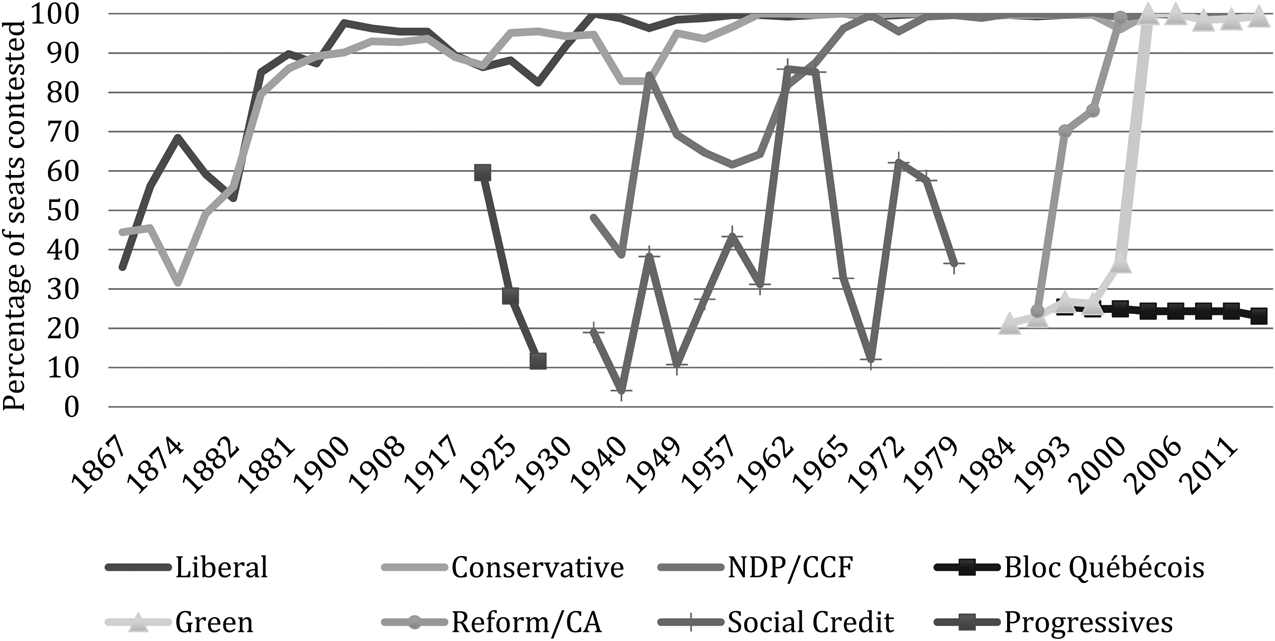
We therefore begin by exploring the territorial coverage of the major Canadian federal parties. Specifically, we examine the percentage of total electoral districts for which a party nominates candidates in each election. Figure 1 charts the territorial coverage of the major Canadian political parties throughout their electoral history.Footnote 3 Both the Liberal and Conservative parties—which are typically viewed as Canada's national parties—began their electoral careers competing in fewer than half of the available electoral districts in the country.Footnote 4 It took the Liberal and Conservative parties five and six elections, respectively—approximately 20 years—to run candidates nationwide in 75 per cent or more of the ridings. Remarkably, after 1887, neither the Liberals nor the Conservatives have presented a slate of candidates in less than 80 per cent of all electoral districts.
Percentage of Seats Contested by Party (1867–2015).

Both parties mapped a similar trajectory (with perhaps the exception of strong Liberal results in 1904 and 1908) until the 1930s. The Liberal party's 1935 full slate of candidates under W. L. Mackenzie King indicates its arrival as a truly nationalized party in terms of coverage. It took another 20 years for the Progressive Conservative (PC) party to reach this point, when the 1958 election (which resulted in a majority government led by John Diefenbaker) saw a PC candidate in each electoral district.Footnote 5 By the 1960s, the Liberals and Conservatives routinely nominated candidates in (virtually) every possible district. In fact, even when vote-splitting on the right resulted in significant Liberal gains in the 1990s, the PCs rejected an initiative to jointly run candidates with the Reform party. Rather, party delegates endorsed the so-called 301 rule, which was a resolution to field candidates in each district (Woolstencroft and Ellis, Reference Woolstencroft, Ellis, Pammett and Dornan2009).Footnote 6
Figure 1 also maps insurgent parties hoping to gain enough coverage to influence federal politics and reveals the effects of critical elections across the century and a half covered by our data (see also Johnston, Reference Johnston2017).Footnote 7 The downward trajectory of the short-lived Progressives after 1921 captures a party in terminal organizational decline. Although the party ran 137 candidates (60% of seats) at its first election in 1921, this number essentially halved at each of the next three elections and was down to 15 in the last election the party contested in 1930. The parties that arguably replaced it, Social Credit and the CCF, each had distinctive trajectories that contributed to the denationalizing election of 1945. Social Credit struggled mightily with electoral coverage. Starting from a low base, it did briefly match the New Democratic party (NDP) for coverage in the 1960s, contesting 85 per cent of seats, before collapsing and covering just 30 per cent of seats in its last election, 1980. While more successful than Social Credit, the CCF also struggled to extend its electoral coverage across the nation. Although the reach of the CCF expanded to compete in 205 districts (80%) in 1945, it slowly declined with each subsequent election. The CCF never really threatened to become a national party, fielding candidates in an average of only 62 per cent of seats in the last seven elections it contested before being disbanded.
At a time when politics was becoming increasingly nationalized, both in terms of campaign messaging and tactics (Carty, Reference Carty, Throburn and Whitehorn1988), the CCF leadership sought a solution to its inability to create stable and healthy local party organizations across the entirety of the country. Its alliance with labour, formalized in the establishment of the NDP in 1961, created an organization capable of extending the CCF's electoral reach into new territory. The NDP adopted a much more nationalized approach than its predecessor, nominating candidates in 82 per cent of districts in 1962 (the party's first election). It continued this trajectory in the elections that followed and within a decade was competing across the country. In the 16 elections between 1965 and 2015, for example, the NDP covered an average of 99 per cent of districts, although it was not until the 1984 election (after the end of Social Credit) that it nominated a candidate in every single district.
The Reform party of 1988 was clearly regional, fielding candidates in western Canada and in only 24 per cent of the total available districts. It quickly signalled its intent and ability to pursue a governance strategy, increasing its coverage at each subsequent opportunity and contesting 99 per cent of seats after re-forming as the Canadian Alliance (CA) prior to the 2000 election. Its success in nominating candidates countrywide was key to its later merger with the PC party. Broad electoral coverage demonstrated that the party had the organizational wherewithal to maintain a national presence, matching similar levels of coverage enjoyed by the older PC party and placing both right-wing parties in jeopardy by forcing them to compete against each other nationwide.
While nearly entirely unsuccessful in winning seats, the Green party has also pursued a national coverage strategy to remarkable effect. Within six elections, the party went from contesting one in five districts to competing in them all. As Pruysers (Reference Pruysers2014) suggests, nationwide competition may have been incentivized by institutional rules. In this case, the Greens likely found it much easier to reach public financing thresholds by competing nationwide than by increasing their vote totals where they were already fielding candidates.Footnote 8
Figure 1 demonstrates that political parties of all stripes strive to nationalize their territorial coverage, even after experiencing setbacks. Nationalization has strong appeal for any party interested in governing. Contesting as many seats as possible maximizes potential vote share; makes available all possible opportunities for building a winning electoral coalition; and can demonstrate widespread electoral appeal, leading to recursive gains as a party appears as a serious contender for government. It also brings challenges. Internalizing potentially competing regional political demands may test the organizational strength of a party. Some parties, of course, are more successful than others (as can be seen in the comparison of the Progressives and the CCF). The only major exception to this trend in Canada is the Bloc Québécois, which has been truly content to pursue a regional strategy, targeting only seats in Quebec.
Territorial coverage therefore tells us a great deal about party strategy and the extent to which a party strives to be national in its organizational character. This measure, however, tells us very little about a party's relative electoral strength throughout the country; that is, it does not tell us how voters respond. A party may field candidates everywhere and nonetheless have a regionalized base of support. This is especially the case if parties are nominating stopgap or paper candidates who have little to no organization or support on the ground (Pruysers and Cross, Reference Pruysers and Cross2016; Sayers, Reference Sayers1999). To address this issue, we turn now to consider patterns of party support as another means of understanding the relative regionalization or nationalization of the party system.
Uniformity of electoral support
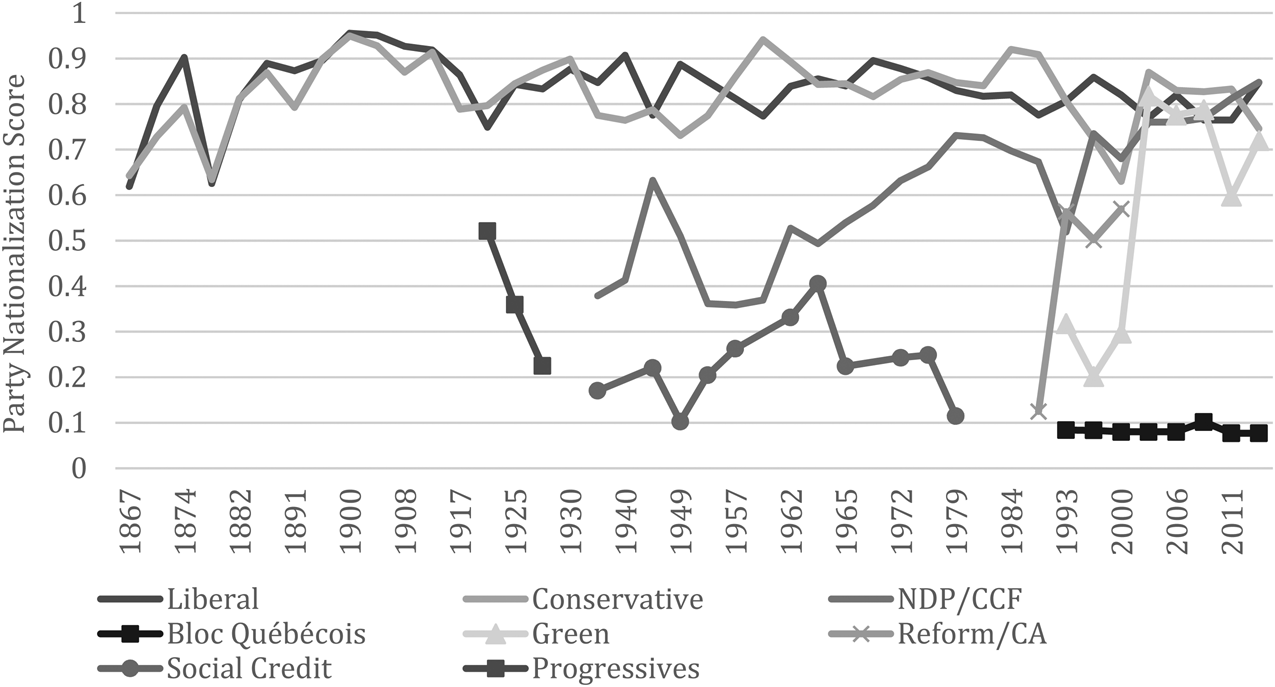
The Party Nationalization Scores shown in Figure 2 are calculated by applying the Gini coefficient to federal electoral results aggregated at the subnational level. The approach captures the relative success of each party by province/territory. It is therefore sensitive to the similarity in support from one province to the next. This measure helps us to understand how well political parties internalize and manage the pronounced and often conflicting regional interests that characterize Canadian politics. Which parties have concentrated regional support and which perform consistently across the country?
Party Nationalization Score (1867–2015).

The results highlight why the Liberals and Conservatives have been the core governance parties in Canada: both parties enjoy widespread support throughout the entire country. The Liberals, however, have been marginally more successful at attracting a uniform base of support from one province to the next, with an average PNS of just over 0.83, while the Conservatives have managed to score 0.82. The Liberals have also been more consistently successful across the entire period, with an average deviation of 1 point less than that of the Conservatives. For the latter, this may reflect the challenges faced by a party that has spent most of its history as the formal opposition to successive Liberal governments, with only occasional periods in government (see Perlin, Reference Perlin1980). However, the results also reveal challenges faced by the Liberals since 1980, with only 2 of 11 scores above their long-term average compared with 7 for the Conservatives (see also Carty, Reference Carty2015; Johnston, Reference Johnston2017).
The Party Nationalization Scores provide a demand-side view of the fortunes of various insurgent parties. The rapid decline in the scores for the Progressives in the 1920s matches the decline in its coverage scores, suggesting that the party was struggling to sustain a consistent appeal even within the limited set of seats it contested. Social Credit sustained itself for four decades, but despite some success in gaining electoral coverage in the 1960s, it always struggled to sustain consistent electoral support, only occasionally reaching above a PNS of 0.30. Failure to stabilize electoral support has been a common theme, even among parties that have enjoyed moments of substantial success.
The NDP and its precursor, the CCF, have doggedly pursued government for over 70 years, beginning in the 1930s. The CCF's struggle to garner consistent electoral support is evident in the PNS data, which substantially lags its limited electoral coverage (see Figure 1). Rebranding as the NDP in 1961 helped it to achieve national coverage by the 1970s but did not allow the party to sustain a PNS over 0.70. The somewhat diverging trends for the party suggest a broadly competent organization lacking stable nationwide electoral support.
Figure 2 reveals variation in initial NDP electoral support across the country, followed by a period of gentle stabilization in the 1970s, which was then followed by instability, leading to collapse at the watershed election of 1993. This left it outside the club of successful national parties. It recovered in the late 1990s, reaching a PNS of over 0.80 for the first time in 2011, when it formed the official opposition. NDP success in 2011 (notably in Quebec) reaffirms the importance of coverage and electoral support across the country for parties seeking government. The reduction of the Liberal party to just 34 seats in the same election captures the potentially disruptive effect of a third party on elections in single member plurality districts. The NDP's much-reduced electoral support in 2015 was relatively constant across the country, leaving it with a PNS of nearly 0.85. This may yet mark the arrival of a competitive three-party system.
As with the NDP, the insurgent Reform/CA generated organizational change after its breakthrough at the 1993 election. The limited regional appeal of the Reform/CA in the late 1980s is evident in the data. While its territorial coverage quickly moved to nearly 100 per cent, its electoral support remained uneven across the elections of the 1990s. While its main competitors experienced PNS scores typically above 0.8, Reform/CA achieved its highest PNS of 0.57 in the 2000 election. But its arrival altered politics on the right of the political spectrum. The stability of electoral support for the PC party declined precipitously at the 1997 and 2000 elections. PNS results of 0.73 and 0.62 in those elections respectively suggested that while it enjoyed modest nationalized support, all was not well with the party.
Uneven electoral support—the PCs stronger in the east, the Reform/CA in the west—and the presence of two right-wing candidates in each electoral district helped to sustain a series of Liberal governments across the 1990s. Eventually, pressure to end this vote-splitting led to the merger of the two parties via the formation of the Conservative party of Canada in 2003. As with the organizational change forced on the CCF, the appeal of a merger between Reform/CA and the Progressive Conservative party as a solution to the PNS challenge was obvious. The newly formed Conservative party immediately joined the Liberals as a nationalized party, outperforming the latter in this regard from 2004 to 2011, coterminous with its success in forming government (2006–2015).
The flatness of PNS results for the Bloc are distinctive and consistent with its regional strategy of only running candidates in Quebec. As a result, and unlike insurgent parties pursuing a governance strategy, its low PNS outcomes are not an indicator of failure, but consistent with success. Between 1993 and 2008, it was extremely successful, winning between 38 and 54 seats (out of a total in the mid-70s) across six elections. The Bloc's regionalizing effects extend beyond itself in many ways. As Pruysers (Reference Pruysers2014: 30) writes, “The party's very presence in Quebec alters the strategies of the other parties that compete in Quebec … forcing the Liberals, Conservatives, and to a lesser extent the New Democrats, to engage in regional politics.” Moreover, by virtue of the Bloc's popularity, the appeal (and vote share) of other parties in the province is diminished in a way that is not uniform across the country—indirectly influencing the nationalization scores of other parties. That said, recent electoral and organizational challenges threaten the continued viability of the Bloc (see, for example, Bélanger and Nadeau, Reference Bélanger, Nadeau, Pammet and Dornan2016).
Despite its modest electoral and legislative results, the Greens quickly built consistent support after 1993 and largely sustained it from 2000 to 2015. Wide but shallow support for the Greens is a testament to its broad appeal and modest organizational presence, but in a single member plurality electoral system, it hampers its capacity to gain seats (Harada, Reference Harada, Pammet and Dornan2016). The future of the party rests on the degree to which environmentalism comes to provide a basis for higher levels of nationwide support.
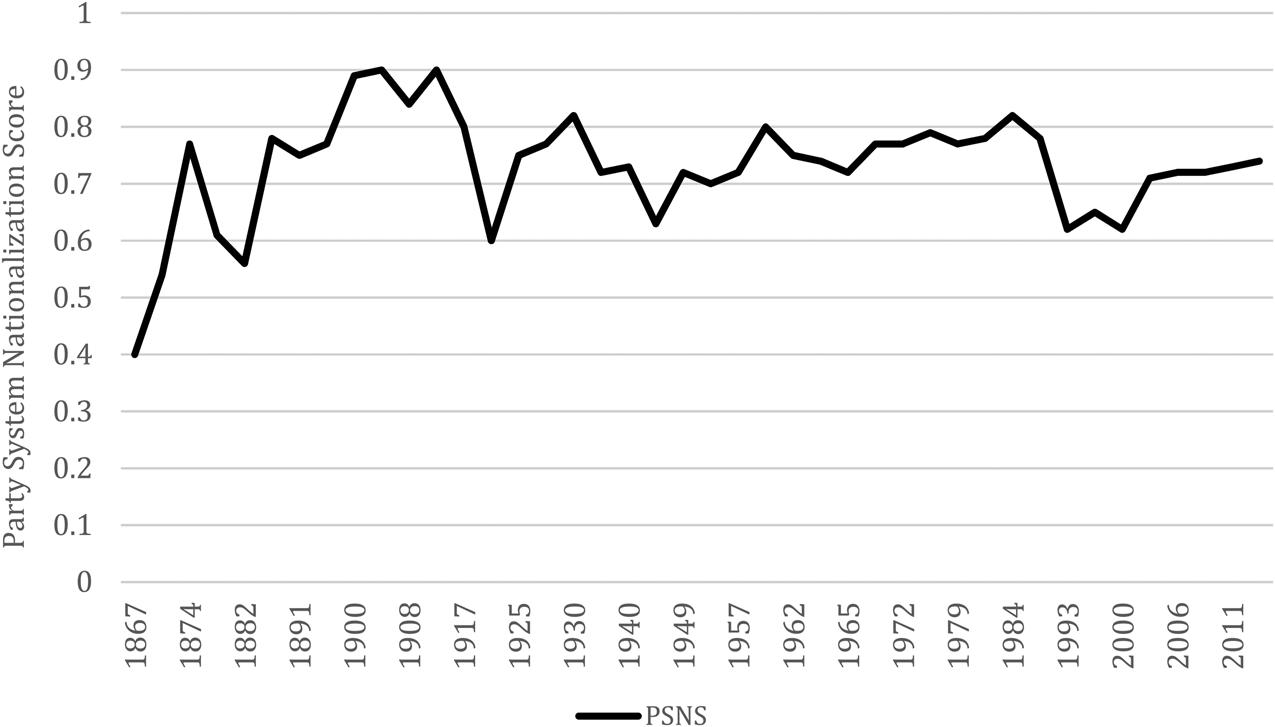
Thus far, we have examined individual parties. The PSNS, which provides a wider perspective, is detailed in Figure 3. Recall that the PSNS is calculated by multiplying a party's PNS score by its share of the popular vote and then summing across parties. This provides a party system view of nationalization and ensures that minor parties (those with relatively low vote shares) are not weighted the same as larger parties. The overall PSNS suggests a somewhat stable level of nationalization over time.
Party System Nationalization Score (1867–2015).

Aside from the first five elections in which the party system emerged and began to stabilize, the most sustained period of lower nationalization for the series encompasses the three elections from 1993 to 2000 (around 0.64), but scores have since increased, if not yet to previous levels. The five elections from 2004 through 2015 produced the second most intense period of sustained low nationalization scores, with the highest in 2015 (0.74) still below the long-term average (since 1887) of 0.75. It may be too early to know whether the system has returned to pre-1993 levels or will continue to experience lower than average levels of nationalization.
The elections of the 1990s are not completely atypical when put into historical perspective. Equally low Party System Nationalization Scores can be found during the 1921 (0.60) and 1945 (0.63) elections. The difference, however, is in the sustained levels of low nationalization during the 1990s. The 1925 election experienced a considerable inter-election change of + 0.15, resulting in a PSNS of 0.75 compared to 1921. Similarly, the 1949 election witnessed an inter-election change of + 0.09, resulting in a PSNS of 0.72. In other words, while 1921 and 1945 were indeed regionalized elections, they were not indicative of a larger trend. The 1990s, by contrast, witnessed an entire decade of sustained low PSNS scores.Footnote 9
Whatever the geographic spread of the entire party system, the degree of nationalization among political parties that form government is a critical feature of party politics in federations. Legitimately claiming and exercising government authority is particularly important in a regionally and ethno-linguistically diverse federation such as Canada. The executive-dominated Canadian parliament, combined with majoritarian electoral rules, typically delivers all government power to one winning party (Russell, Reference Russell2008). Though there are a series of conventions, practices, customs and norms surrounding government formation (Lagassé, Reference Lagassé2019), in practice, government is typically formed by the party that places first in more seats than any of its rivals, with the official opposition formed by the party with the second most wins.Footnote 10
The geography of support can be a key to success in forming government or opposition. Winning government usually requires substantial and geographically widespread support sufficient to deliver first place in a large number of districts. On the other hand, it is possible for a party to gain votes across the country but only place first in a limited number of districts. Effectively, it wastes votes by failing to turn them into seats. Geographically concentrated support may allow a party to gain seats in a particular region but is unlikely to provide sufficient seats to deliver government.
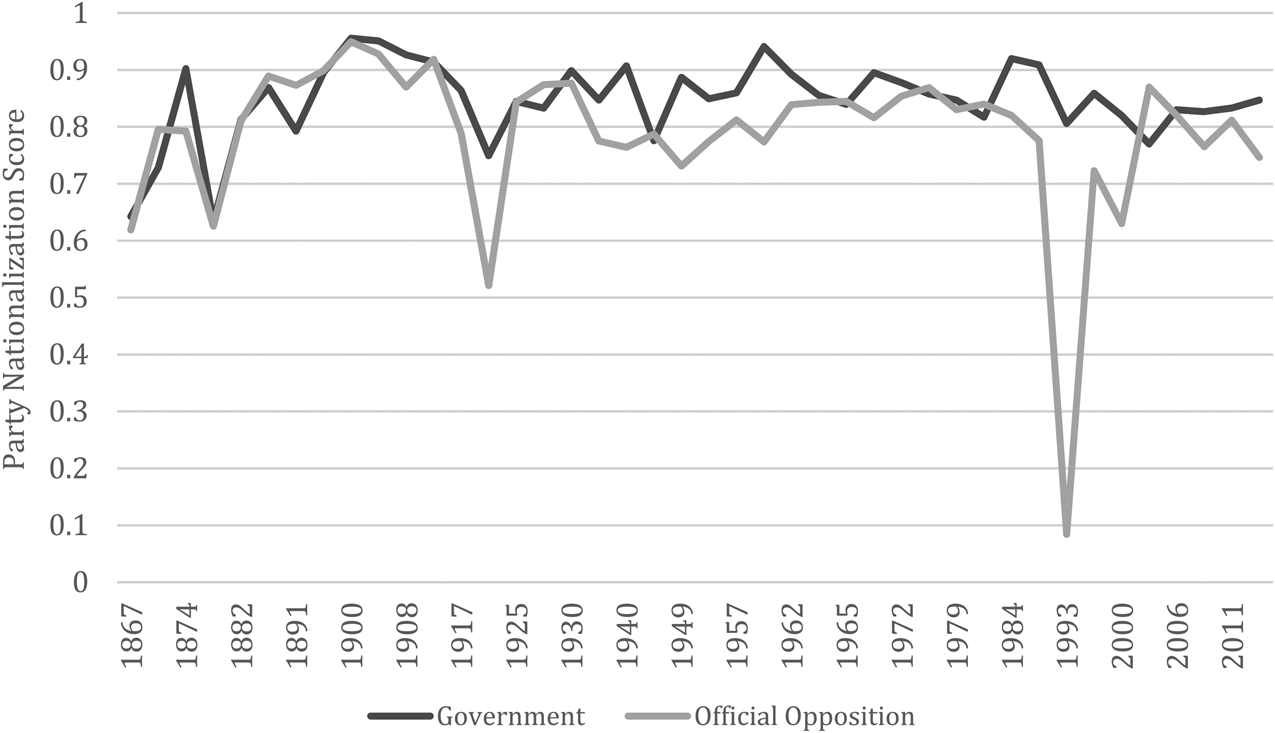
Given the success of the Liberals across the twentieth century, the effects captured in Figure 4 largely belong to that party. As expected, governing parties are generally better at presenting themselves to voters across the country, although in a quarter of the cases, the opposition is actually more nationalized that the winning party. Yet regionalized support has been critical to electoral outcomes and has at times been enough to deliver either official opposition or government status to political parties (Cairns, Reference Cairns1968; Johnston, Reference Johnston2017). A good example is the 1993 election, which saw the Bloc become the official opposition thanks to its sweeping of Quebec, and Quebec alone. In the same election, Reform and the PC party attracted roughly the same number of votes as each other. Reform won 51 seats because its regionally concentrated western support delivered first- place finishes there. It turned this support into 60 seats and official opposition status in the 1997 election. The PCs won just two seats in 1993, as their nationally distributed vote left them running second or third in most districts, marking the end of its role as a contender for government.
Party Nationalization Score: Government and Official Opposition (1867–2015).

Discussion and Conclusion
The literature on the Canadian party systems has often considered the extent of its national or regional character. Our analysis adds to this literature by exploring both supply and demand measures of nationalization and highlighting the two strategies made possible by a federalized, majoritarian parliamentary system. A governance strategy aims to garner support across the country, while a regional strategy aims to maximize support in some part—province or region—of the country. At the extremes, parties have two stark choices with profoundly different implications for how parties and the party system operate. Not just whether the system is nationalized but the degree to which patterns of competition, and the constellation of parties seeking government are similar for voters across the country. Moreover, and as we suggest, the decisions of individual parties have implications for the strategies and behaviours of competing parties as well.
Our analysis reveals that in terms of the geographic spread of district candidacies, it took about five elections, or around 20 years, for the initial two-party system to stabilize across the country, even as new provinces were added to Confederation. Coverage is seen to be crucial to long-term success. The failure of the Progressives to maintain a viable, broad presence after their 1921 breakthrough and the collapse in the coverage of Social Credit after its success in running in over 80 per cent of districts in the early 1960s are cases in point. On the other hand, the long-term success of the CCF/NDP has only been possible because its organization has been sufficient to provide for full coverage despite electoral setbacks. Similarly, the coverage success of the Reform/CA was key to the eventual rapprochement between it and the PCs that produced the Conservative party of Canada that went on to form government.
Party Nationalization Scores, which account for the uniformity of electoral success, indicate widespread support for the Liberals and Conservatives. Only since the 1990s have other parties—really only the NDP—challenged the Liberals and Conservatives as truly national parties in terms of electoral support. The Reform/CA governance strategy was unsuccessful, with its support remaining largely limited to the west. Its merger with the PC party resulted in a highly nationalized new party, the Conservative party of Canada. The Bloc Québécois chose to pursue a regional strategy, limiting itself to Quebec in the hope of using its support there to reshape the federation.
The Party Nationalization Scores of the government and opposition allow us to consider the degree of nationalization of the contest for government in the broad sense. In is not surprising that the two largest electoral parties have widespread electoral coverage and success, although the consistency with which they each score above 0.8 suggests a strongly nationalized contest for government. The figures reveal the powerful disruption to this pattern associated with the First World War and the arrival of Reform/CA and the Bloc in the 1990s, the latter indicating the peculiar role that successful regional parties may have in a federation.
Party system nationalization (Figure 3) after 1878 is heavily shaped by insurgent parties, many with regionally limited appeal. The Progressives in the 1920s and Social Credit and the CCF in the 1930s, all with regionalized support, are associated with a secular drop in party system nationalization, particularly after 1945. The construction of the NDP produced a party that by the late 1960s was able to compete everywhere, generating a national three-party system, as measured by coverage. Its uneven electoral appeal, however, continued to contribute to reduced system nationalization scores across this period. The appearance of the Reform/CA and Bloc in the 1990s produced another secular drop in system nationalization scores despite the more even electoral success of the NDP. The initially limited coverage and appeal of the Green party in the last decade of the twentieth century reduced system nationalization, although its later success in coverage and its attraction of a constant, if low, level support now works to sustain nationalization.
An important theme throughout our results is that the dynamics of regionalization are not simply the by-product of party competition in Quebec. This can be seen in early struggles among the major parties to field candidates across the entire country. In the 1874 election, for instance, the Conservatives ran just 29 candidates in Ontario, approximately 34 per cent of the districts in the province. Western “protest” parties have also been a perennial source of regionalization. During the highly regionalized 1945 election, for example, the Social Credit party won a plurality of the vote in Alberta, limiting the appeal and success of the more nationalized parties in the province. Even much of the regionalization of the 1990s can be credited to parties and politics outside of Quebec. The Liberal party held government for the decade after 1993 by dominating Ontario, while a split on the right and the sequestering of Quebec votes by the regionally focused Bloc cut off other routes to power (Sayers and Denemark, Reference Sayers and Denemark2014; Johnston, Reference Johnston2017). While the Bloc is a powerful reminder of enduring and contemporary regionalism in Canadian politics, the story of party and party system nationalization in Canada is about much more than just Quebec.
While the results offer an important contribution to our understanding of Canadian party and electoral politics, there are some limitations worth noting. First, a party may appear nationalized in its electoral support (for example, receive a similar vote share from one province to the next), while simultaneously behaving in a regionalized manner (for example, running regional advertisements). That is, the Gini approach cannot reveal how parties achieve their nationalized support. Underlying this nationalization may, in fact, be regionalized party strategies (Pruysers, Reference Pruysers2014; see also Jones and Mainwaring, Reference Jones and Mainwaring2003). Second, the Gini approach cannot pinpoint the underlying reasons for voting differences across provinces (for example, whether it is a compositional effect, provincial effect, and so forth). Third, although the Gini method has become the most common measure of nationalization, there are debates regarding whether it should be standardized to account for the number and size of jurisdictions (see Bochsler, Reference Bochsler2010; Golosov, Reference Golosov2016; Jones and Mainwaring, Reference Jones and Mainwaring2003) and whether the measure is overly sensitive to changes in the middle of the distribution (see Gastwirth, Reference Gastwirth2017). Finally, the measures of supply and demand presented here are not completely independent of one another: a party can win votes only where it fields a candidate; parties are most likely to field candidates where they think they will win votes; and the more candidates a party fields, the more votes it will win.
Limitations aside, the data and analysis presented here represent an important step in understanding the dynamics of the Canadian party system since Confederation. It lends itself to several future research projects that explore these effects in different ways and begin to identify the causes of the patterns identified here. First, our understanding of party system dynamics and nationalization would benefit from replicating this analysis with seat share rather than vote share. While vote share tells us a great deal about the spread of party support throughout the country, seat share provides insight into what happens after the electoral system has translated votes into seats. The spread of seats may have important implications for how parties govern once in office and in shaping opportunities for insurgent parties. Second, conducting PNS and PSNS calculations at the constituency level (rather than at the subnational level) may provide new insight into the nationalization of Canadian party politics. Third, while the federal party system remains broadly nationalized, it continues to be subjected to episodic, regionalist shocks. This suggests that, in contrast to the pattern noted in recent work on the United States (Hopkins, Reference Hopkins2018), centrifugal pressures remain live in the Canadian federation. Exploring the causes and consequences of these forces as expressed in elections that disrupt existing patterns of party competition is therefore important. Fourth, a more thorough exploration of party strategy is required to understand party system, and even government, dynamics. If parties are achieving nationalized support, how are they doing so?Footnote 11 Finally, does the level or pattern of coverage and electoral success enjoyed by the governing party shape government policy? Future research may consider using the level of nationalization (as measured here with the Gini) as an explanatory variable—perhaps exploring government behaviour or spending patterns