Management Implications
Seeds of noxious and other invasive plant species can spread to new regions through a variety of avenues. Identifying methods of dispersal is a critical step in preventing the spread of these species into new geographies where they did not previously occur. This study examined the commercial bird feed trade as a pathway for weed seeds to travel long distances into new regions. A total of 98 bird feed mixes were purchased from various retail locations in the eastern portion of the United States. Each feed mix was screened for weed seed contaminants. Seeds were identified and Amaranthus spp. were planted to determine their germinability. A total of 29 species of weed seeds were identified in the feed mixes. Amaranthus spp. were identified in 96% of bird feed mixes at an average of 384 seeds kg−1 of feed mix, but were also determined to reach levels as high as 6,525 seeds kg−1 of feed mix. Of these mixes, 71% contained Amaranthus spp. seed capable of germination. The Amaranthus spp. identified included Amaranthus palmeri (Palmer amaranth), Amaranthus tuberculatus (common waterhemp), Amaranthus hybridus (smooth pigweed), Amaranthus retroflexus (redroot pigweed), and Amaranthus albus (prostrate pigweed). Additional analyses identified proso millet as an ingredient most likely to contribute Amaranthus spp. seed to feed mixes. Mixes containing processed ingredients such as dried fruits and hulled nuts contained the lowest amount of weed seeds. Bird feed mixes are not subject to any seed laws, as they are not intended for planting. It is difficult to estimate the role bird feed plays in the spread of weed species to new regions; however, bird feed is typically placed outdoors where conditions are favorable for germination. It is also possible that endozoochory, the dispersal of weed seed by animals, could play a role in weed seed dispersal from the bird feeder. Managing weed infestations in crop fields designated for bird feed would be a practical approach for mitigating weed seed contamination in commercial bird feed. Implementing weed seed limits in feed mixes has proven effective in reducing contamination in countries outside of the United States. Additional sieving by packaging companies would likely be effective in reducing contamination of many weed species as well.
Introduction
A survey conducted by the U.S. Fish and Wildlife Service (USFWS) in 2016 reported that 56.8 million homeowners own a bird feeder as an attractant for avian wildlife (U.S. Department of the Interior et al. 2016). Henke et al. (Reference Henke, Gallardo, Martinez and Bailey2001) estimated that 289 million kg of bird feed were distributed across the United States in 1999. However, this number is likely even higher today, as the number of people that feed birds around their homes has increased by 8.8 million in the most recent USFWS survey (U.S. Department of the Interior et al. 2016). While homeowners may have good intentions with bird feeding, this popular hobby may have unintended consequences. For decades, bird feed has been examined as a source for weed seed introduction into new areas (Chauvel et al. Reference Chauvel, Vieren, Fumanal and Bretagnolle2004; Frick et al. Reference Frick, Boschung, Schulz-Schroeder, Russ, Ujčič-Vrhovnik, Jakovac-Strajn, Angetter, John and Jørgensen2011; Hanson and Mason Reference Hanson and Mason1985; Vitalos and Karrer Reference Vitalos and Karrer2008). Hanson and Mason (Reference Hanson and Mason1985) surveyed bird feed mixes in Britain and reported on 438 weed species that they believed to have been introduced through the bird feed industry. Bird feed was also identified as a vector in the introduction of common ragweed (Ambrosia artemisiifolia L.) into England, where it was reported at levels as high as 531 seeds kg−1 mix (Vitalos and Karrer Reference Vitalos and Karrer2008). Brandes and Nitzsche (Reference Brandes and Nitzsche2006) also reported that bird feed was the main source for the establishment of A. artemisiifolia in Germany. Additionally, a Swiss study reported that 22% to 57% of samples screened from 2005 through 2009 were contaminated with A. artemisiifolia and that contamination reached as high as 303 seeds kg−1 of bird feed mix (Frick et al. Reference Frick, Boschung, Schulz-Schroeder, Russ, Ujčič-Vrhovnik, Jakovac-Strajn, Angetter, John and Jørgensen2011). Chauvel et al. (Reference Chauvel, Vieren, Fumanal and Bretagnolle2004) identified a correlation between the presence of A. artemisiifolia in bird feed mixes when sunflower (Helianthus annuus L.) was used as an ingredient. Similarly, Wilson et al. (Reference Wilson, Castro, Thurston and Sissons2016) reported that proso millet (Panicum miliaceum L.), sunflower, and grain sorghum [Sorghum bicolor (L.) Moench ssp. Arundinaceum (Desv.) de Wet & Harlan] used in bird feed is unlikely to undergo any processing to remove weed seed or alter its ability to germinate. The amount of weed seed that is present in grain after harvest can depend on a multitude of factors, including end of season weed control and combine sieve and fan adjustments (Clay et al. Reference Clay, Reitsma and Clay2009; Davis Reference Davis2008). Wilson et al. (Reference Wilson, Castro, Thurston and Sissons2016) indicated that separating weeds from crops would likely be more difficult in small cereal grains, flax (Linum usitatissimum L.), and proso millet than in larger-seeded crops such as corn (Zea mays L.) and soybean [Glycine max (L.) Merr.].
In Australia, the Queensland Agricultural Merchants have developed standards for bird feed that require all bird feed to be examined for weed seed contamination; they established that any presence of noxious seeds or weed seeds in amounts that exceed the tolerance levels are rejected (QAM 1998). In Switzerland, screening of bird feed mixes also resulted in regulations against A. artemisiifolia contamination, with a 10 seeds kg−1 threshold being established for bird feed. Additional members of the European Union (Germany, Denmark, and Slovenia) followed suit in the implementation of this threshold, and noticeable reduction of contaminated seed mixtures occurred in just 2 yr (Frick et al. Reference Frick, Boschung, Schulz-Schroeder, Russ, Ujčič-Vrhovnik, Jakovac-Strajn, Angetter, John and Jørgensen2011). In the United States, however, the Federal Seed Act enforced by the Department of Agriculture regulates agricultural seeds, which are defined as grass, forage, and field crop seeds that the Secretary of Agriculture finds useful for seeding purposes (USDA 1940). By definition, bird feed is not covered in the Federal Seed Act, and bird feed manufacturers are not required to reveal seed composition percentages such as the percentage of weed seed contamination, including noxious species. The Federal Drug Administration Center for Veterinary Medicine is the primary regulator of animal feed in the United States, but imposes regulations that are primarily directed toward contamination by pesticides or harmful foreign material such as metal shavings. Therefore, these regulations do not address weed seed contamination of bird feed. Additional guidelines were set forth by the Wild Bird Feed Industry in the Wild Bird Feed Industry Standards, which were adopted in 2004 and set guidelines for bird feed to be of a consistent quality (WBFI 2004). However, these standards also make no mention of weed seed contamination thresholds for bird feed distributed within the United States and Canada.
Palmer amaranth (Amaranthus palmeri S. Watson) has been documented as the most troublesome weed species present in agroecosystems today (VanWychen Reference VanWychen2016). Amaranthus palmeri was historically a weed of the southwestern United States and Mexico; however, over time it has moved into more northern and eastern geographies (Heap Reference Heap2019; Webster and Nichols Reference Webster and Nichols2012). The successful establishment of A. palmeri in new areas can be attributed to many factors, including its prolific seed production, highly competitive nature, and distinct ability to evolve resistance to herbicides (Legleiter and Johnson Reference Legleiter and Johnson2013). Human-mediated activities during the 20th and 21st century, such as movement of machinery contaminated with seed, animal feed, and manure, as well as contaminated pollinator planting seed mixes are largely to blame for the spread of this troublesome weed species across the country (Chahal et al. Reference Chahal, Aulakh, Jugulam, Jhala, Price, Kelton and Sarunaite2015). However, Farmer et al. (Reference Farmer, Webb, Pierce and Bradley2017) reported that waterfowl were capable of spreading A. palmeri long distances, and other studies have identified Amaranth species seeds in water runoff, so natural dissemination is possible as well (Wilson Reference Wilson1980). Human-mediated dispersal will often result in a more rapid dispersal of a new species into a geography than natural introduction, due to multiple introductions occurring across large areas simultaneously (Taylor et al. Reference Taylor, Brummer, Taper, Wing and Rew2012). No previous research has examined the potential for weed seed contamination of bird feed mixes that are commercially available in the United States, or more specifically focused on the possibility of A. palmeri contamination in these mixes. Therefore, the objectives of this research were to: (1) identify contamination levels of weed species in commercially available bird feed in the United States, (2) determine the viability and glyphosate-resistance status of any Amaranthus seed present in commercial bird feed mixes, and (3) determine the effects of ingredient composition and location of purchase on the presence and abundance of weed species in bird feed mixes.
Materials and Methods
Bird Feed Collection
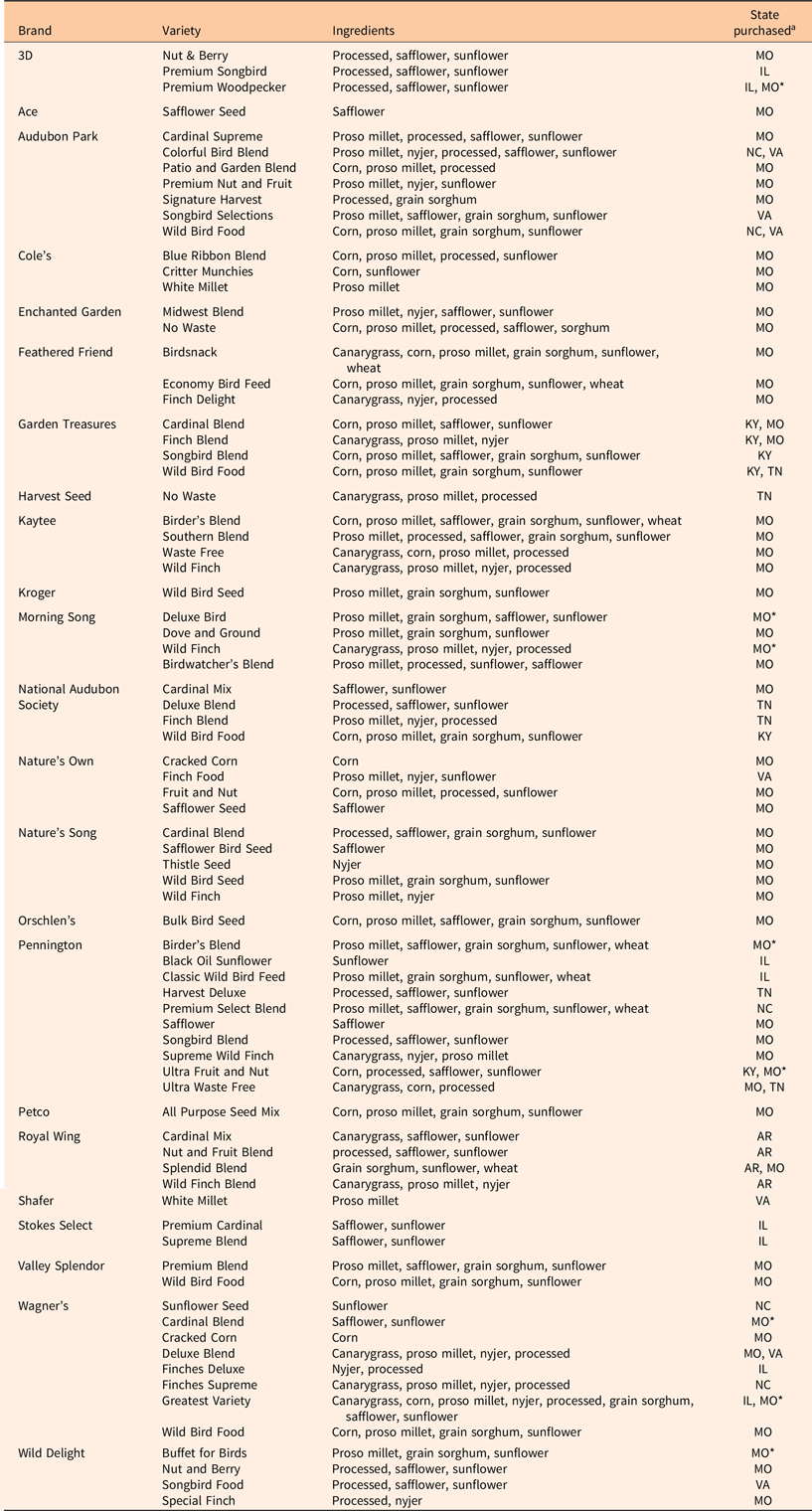
Results were compiled from bird feed mixes purchased from a variety of common retail locations in Missouri, Kentucky, Tennessee, Arkansas, Illinois, Virginia, and North Carolina in 2016 and 2017 that represented 22 different brands (Table 1). Mixes were selected at random from these retail locations similar to Henke et al. (Reference Henke, Gallardo, Martinez and Bailey2001). The majority of bird feed mixes were purchased in Columbia, MO (n = 62). Mixes ranged in size from 1 to 9 kg and ranged from single-ingredient mixes to combinations of multiple-ingredient feed mixtures (Table 1).
Ingredient composition and purchase location of feed mixes used in the experiment.

a Asterisk (*) indicates mix was purchased at two separate locations in the same state.
Bird Feed Screening
In all cases, the entire bag was examined to be certain all weed seed contaminants were extracted from the mix. All bird feed mixes were poured through a series of sieves to separate seeds by size for a more accurate assessment of contaminants. Large-seeded ingredients like sunflower and safflower (Carthamus tinctorius L.) were initially separated with a 10-mm2 sieve followed by the separation of medium-sized seeds like grain sorghum, proso millet, cracked corn, wheat (Triticum araraticum L.), and nyjer thistle [Guizotia abyssinica (L. f.) Cass.] with a 5-mm2 sieve. All remaining ingredients were passed through a 1-mm2 sieve, which allowed primarily for the passage of smaller-sized weed seeds like the Amaranthus species. Finally, remaining seeds and residue were placed in a 0.5-mm2 sieve, which allowed for the removal of dust and powder residues from larger seeds that could interfere with Amaranthus seed detection. Each stage of seed separation was examined for weed seed contaminants, which were removed for further identification. For this experiment, all seeds that were not listed as ingredients of a mix were considered weed seed. Bird feed ingredients commonly used in bird feed that were included in the analysis include sunflower, proso millet, grain sorghum, safflower, wheat, nyjer thistle, and annual canarygrass (Phalaris canariensis L.). Certain mixes contained dried fruits and hulled nuts, which were categorized as processed ingredients due to a significantly higher level of handling before incorporation into the final commercial bird feed mix.
Amaranthus Identification and Resistance Screening
For all weed species except the Amaranthus species, identification was possible without the necessity of seed germination. All Amaranthus species seeds collected from bird feed mixes were broadcast in 54 by 27 by 6 cm greenhouse flats (Hummert International, Earth City, MO) containing a commercial potting medium (Pro-Mix BX, Premier Tech Horticulture, Quakertown, PA) and were maintained in a greenhouse at 30 C. Natural light was supplemented with metal-halide lamps (600 µmol photon m−2 s−1) providing a 14-h photoperiod, and flats were watered as needed. Approximately 14 d after planting, a germination percentage was recorded to ensure any plants that did not survive until identification were accounted for. When Amaranthus species reached 5 cm in height, they were identified by species and transplanted into individual 10 by 10 cm diameter pots with a 1:1 ratio of the same commercial potting medium and field topsoil. Once plants reached 10 cm in height, identification was confirmed, and a discriminating dose of 3.3 kg ha−1 of glyphosate (Roundup PowerMax®, 540 g ai L−1, Monsanto, St Louis, MO) was applied to all plants using a CO2-pressurized backpack sprayer applying 140 L ha−1 water volume at 144 kPa with a XR 8002 flat-fan nozzle (TeeJet®, Spraying Systems, Wheaton, IL). Visual injury was estimated at 21 d after application on a 0% to 100% scale, with 0% indicating no phytotoxic effects present and 100% indicating complete plant death. If any mix contained plants that survived this application of glyphosate, that mix was marked as containing glyphosate-resistant seed. Survival was determined visually in a subjective evaluation of each plant’s ability to survive and reproduce following the application of glyphosate.
Statistical Analysis
A linear regression model (PROC REG, SAS® 9.4, SAS Institute, Cary, NC) was generated to determine what bird feed ingredients best predicted weed seed contamination. Feed mix ingredients were predictor variables and quantities of seed per weed species were response variables. Models were developed for each weed species detected, and weed species with significant regression models were analyzed further. Of the 29 weed species extracted from bird feed mixes, a significant model was developed for Amaranthus species, grass weed species, A. artemisiifolia, and kochia [Bassia scoparia (L.) A.J. Scott]. For each model, an equation could be developed to predict the abundance of each of these four weed species based on the ingredients present in the feed mix. An example equation for each weed species is represented by: [y=x(ingredient) + INtercept], wherein y is the weed species, x is the parameter estimate for seed abundance, and (ingredient) is 1 if present and 0 if absent from the feed mix. When ingredient parameter estimates were significant, the prediction of the increase or decrease in overall weed seed abundance from that ingredient is considered significantly different from zero. However, to predict contamination levels, all factors must be included in the equation regardless of significance. The B. scoparia and A. artemisiifolia data sets included a large number of zeros, as they were less common ingredients present in feed mixes than Amaranthus and grass weed species. The data sets could not be normalized through the use of data transformations, so to support linear regression, an additional binomial logistic regression was conducted for each weed species. This binomial logistic regression predicts only the probability of weed seed presence or absence. The binomial logistic regression also does not require the assumption that data are normally distributed, so significance is not impacted by the large number of bird feed mixes without contamination (Cox Reference Cox1958).
Certain bird feed ingredients are more common in feed mixes than others. For example, proso millet was used in 60 mixes, and grain sorghum was used in 38 mixes. However, grain sorghum was only present in three feed mixes in which proso millet was not. Because of this, it could be possible for a more common ingredient such as proso millet to conceal the true weed seed contribution of an ingredient like grain sorghum when all ingredients are included in the model. Therefore, an additional analysis was performed using independent-sample t-tests to evaluate how individual ingredients are associated with weed seed quantity present in bird feed mixes (PROC TTEST, SAS®). Variance equality was assessed using the folded F method, and for instances when variances were unequal, the Satterthwaite method was used to calculate t-values (Satterthwaite Reference Satterthwaite1946). The Satterthwaite method is appropriate when variances of two groups are unequal.
Finally, differences in Amaranthus species abundance from feed mixes purchased from different states were tested through a linear mixed-effects model using the PROC GLIMMIX procedure (SAS® 9.4). The states were treated as a random factor in this analysis to determine whether the origins of the bird feed mixes significantly affected the weed seed contamination.
Results and Discussion
Bird Feed Screening
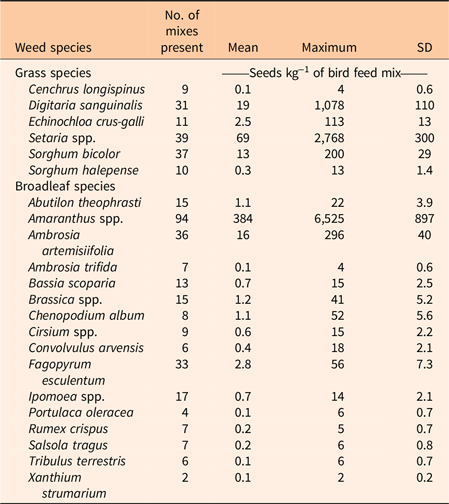
There was not a significant effect of the state from which bird feed mixes were purchased (P = 0.98); therefore, mixes from all locations were combined for analysis. From the 98 bird feed mixes evaluated in this research, 29 different species of weeds were identified (Table 2). The most frequently identified weed species were Amaranthus species, which were found in 96% of mixes and averaged 384 seeds kg−1 across all mixes. Certain mixes contained very high levels of Amaranthus seed, such as one sample that contained 6,525 seeds kg−1. Collectively, grass weed species were the second most abundant weed seeds present in the bird feed mixes, and these consisted of the foxtail species giant foxtail (Setaria faberi Herrm.), yellow foxtail [Setaria pumila (Poir.) Roem. & Schult.], and green foxtail [Setaria viridis (L.) P. Beauv.], large crabgrass [Digitaria sanguinalis (L.) Scop], barnyardgrass [Echinochloa crus-galli (L.) P. Beauv.], shattercane [Sorghum bicolor (L.) Moench ssp. verticilliflorum (Steud.) de Wet ex Wiersema & J. Dahlb.], johnsongrass [Sorghum halepense (L.) Pers.], and longspine sandbur [Cenchrus longispinus (Hack.) Fernald]. Grass weed species were identified in 76% of the bird feed mixes at levels ranging from 0 to 3,896 seeds kg−1 of feed mix. The third most frequently identified species present in bird feed mixes was A. artemisiifolia. Seed of this species was present in 43% of feed mixes and was measured at levels as high as 296 seeds kg−1 of feed mix. In a similar study, Vitalos and Karrer (Reference Vitalos and Karrer2008) reported A. artemisiifolia seeds in 37% of bird feed mixes screened at levels as high as 531 seeds kg−1. The next most common and abundant weed screened in our study was wild buckwheat (Fallopia convolvulus L.; syn: Polygonum convolvulus). Fallopia convolvulus was present in 30% of mixes and reached levels of 56 seeds kg−1 of feed mix. Additional weeds that were identified in bird feed mixes that have relevance as troublesome species (VanWychen Reference VanWychen2016) include B. scoparia, morningglory species (Ipomoea spp.), common lambsquarters (Chenopodium album L.), and velvetleaf (Abutilon theophrasti Medik.), which were identified in 13%, 17%, 10%, and 13% of mixes, respectively. Hanson and Mason (Reference Hanson and Mason1985) also reported each of these weed species in a bird feed screening conducted in Great Britain; however, they did not report on the quantities present in each mix.
Descriptive analysis of weed species detected in bird feed mixes.

Amaranthus Species Identification and Resistance Screening
Amaranthus species germination ranged from 0% to 78%, while 19% of all Amaranthus seeds planted were readily germinable. Five different Amaranthus species were identified. These included redroot pigweed (Amaranthus retroflexus L.), common waterhemp [Amaranthus tuberculatus (Moq.) Sauer], smooth pigweed (Amaranthus hybridus L.), A. palmeri, and tumble pigweed (Amaranthus albus L.). We were unable to identify Amaranthus seed at the species level when seed present in a mix was not viable. Of the 94 seed mixes that contained Amaranthus seed, 71% contained seed that was readily germinable. Amaranthus retroflexus was the Amaranthus species that was most common in seed mixes (50%); however, only 16 mixes contained Amaranthus seed of only one species. Bird feed mixes are most often composed of seed collected from more than one field and often from multiple crop species, so weed seed contamination was shown to vary greatly even within the same mix. Amaranthus albus was the second most common Amaranthus species identified (34%), followed by A. palmeri (28%) and A. tuberculatus (23%). The least common Amaranthus species identified was A. hybridus, which was present in only 4% of mixes screened. These results are consistent with previous research that reported A. retroflexus as the most common Amaranthus species present in a Canadian grain sampling program that took place from 2007 through 2015 (Wilson et al. Reference Wilson, Castro, Thurston and Sissons2016). Although A. retroflexus and A. albus were the two most common Amaranthus species identified in these experiments, neither of these species exhibited resistance to glyphosate in any of the bird feed mixes tested. All A. hybridus plants were also controlled by the discriminating dose of glyphosate and were not deemed resistant. To date, there are no known cases of glyphosate resistance in A. retroflexus or A. albus, and only three known cases of glyphosate resistance occur in A. hybridus in Argentina; therefore, these results seem consistent with the status of glyphosate resistance in these species in the United States (Heap Reference Heap2019). However, of the 26 bird feed mixes that contained readily germinable A. palmeri seed, four contained glyphosate-resistant A. palmeri plants. Similarly, of the 23 bird feed mixes that contained readily germinable A. tuberculatus seed, three contained glyphosate-resistant plants. An additional two mixes contained both A. palmeri and A. tuberculatus seeds that were resistant to glyphosate. It is important to note that in two of the three mixes that contained glyphosate-resistant A. tuberculatus and in all four mixes that contained glyphosate-resistant A. palmeri, all plants screened were determined to be resistant. This segregation in resistance suggests that in some cases, the Amaranthus species that are present in a bird feed mix could be originating from one source. To date, glyphosate-resistant A. palmeri has been documented in 26 states in the United States, as well as Argentina and Brazil, while glyphosate-resistant A. tuberculatus occurs in 18 states in the United States and also in Canada (Heap Reference Heap2019). These results not only demonstrate another possible avenue for the spread of Amaranthus species, but also another route for the spread of glyphosate-resistant Amaranthus species throughout the United States.
Prediction of Amaranthus Seed Contamination
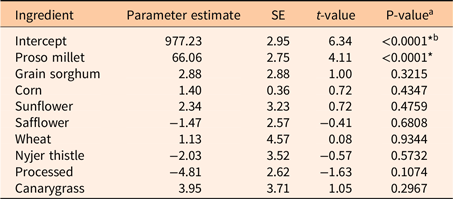
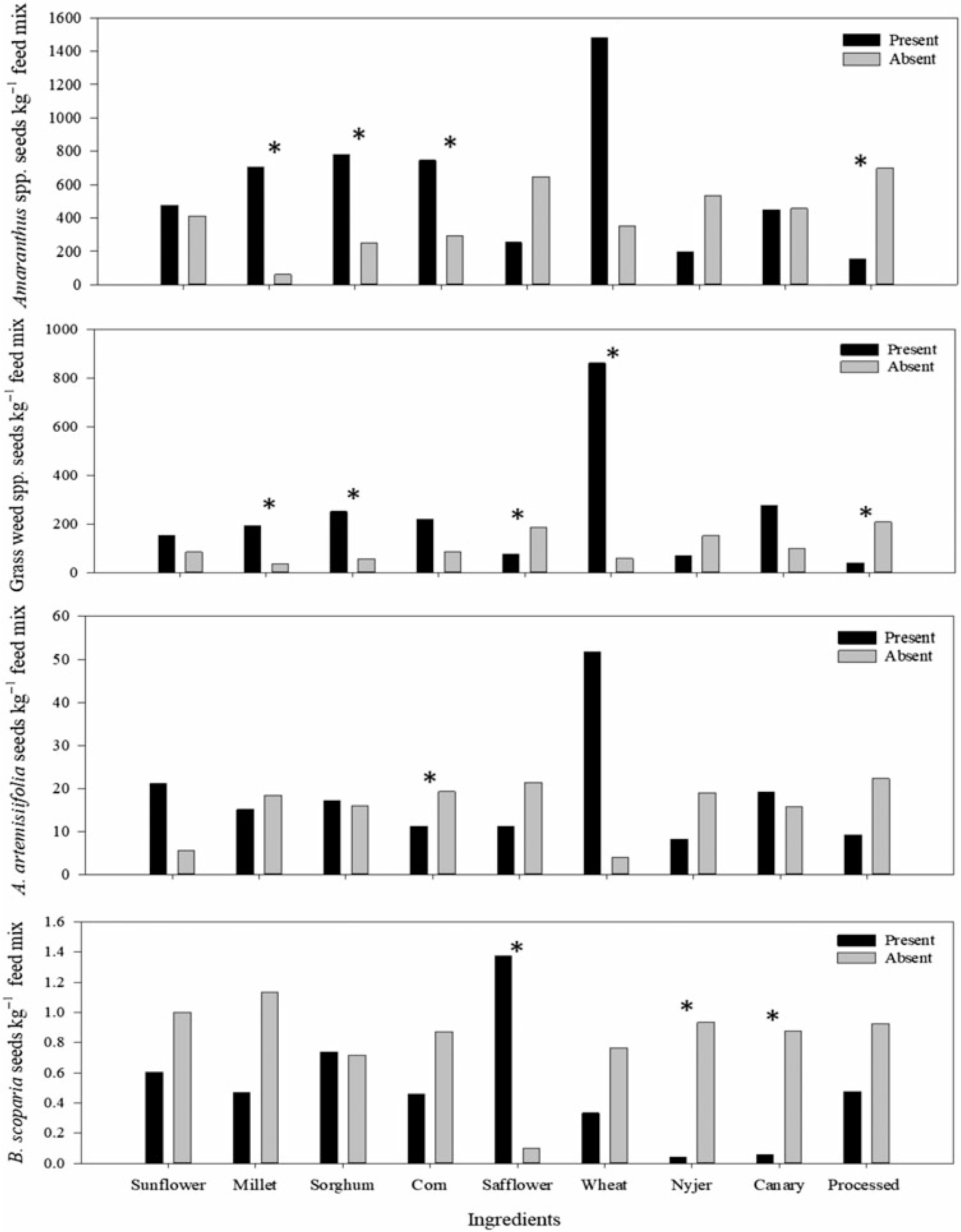
The equation [Amaranthus seed = 66.1(proso millet) + 2.9(grain sorghum) + 1.4(corn) + 2.3(sunflower) − 1.5(safflower) + 1.1(wheat) − 2.0(nyjer thistle) − 4.8(processed) + 4.0(canarygrass) + 977.2] (Table 3) best predicted the likelihood of Amaranthus contamination (P ≤ 0.0001). Additionally, from the t-test analysis (Figure 1), it was determined that when proso millet, grain sorghum, and corn were present in seed mixes, there was an overall increase in Amaranthus seed presence. While the results from the t-test analysis suggests several ingredients could potentially increase Amaranthus seed contamination, proso millet is the only ingredient that demonstrated a positive effect in both analyses. Amaranthus seed size varies from 0.32 to 0.63 mm2 (Farmer et al. Reference Farmer, Webb, Pierce and Bradley2017), and because proso millet is a small-seeded crop, mechanical separation will be especially difficult (Duary Reference Duary2014; Wilson et al. Reference Wilson, Castro, Thurston and Sissons2016). Additionally, proso millet that is used for bird feed is unlikely to undergo any additional processing or cleaning to reduce weed seed contamination (Wilson et al. Reference Wilson, Castro, Thurston and Sissons2016). Corn and grain sorghum also increased the contamination of Amaranth seeds in the t-test analysis (Figure 1). These results are in agreement with previous research in which grain sorghum was determined to be a major source of weed seed contamination, including contamination of Amaranthus species, in Japanese feed imports (Kurokawa Reference Kurokawa2001). Another study reported Amaranthus species were one of six species that were consistently present at harvest time in Illinois cornfields (Davis Reference Davis2008). In contrast, when processed ingredients were present in the feed mix, there was a decrease in Amaranthus seed contamination (Figure 1). The decrease in contamination as a result of the presence of processed ingredients is likely explained by the reduction in weed seed that will inevitably occur when grain products are subject to processing practices such as milling, shelling, or seed cleaning (Hoseney Reference Hoseney1994). Additionally, it is expected that processed ingredients such as raisins and nuts would be free of Amaranthus seed contaminants due to the differences in harvesting methods and processing elements in comparison with raw agronomic grain. These results indicate that contamination of Amaranthus species in bird feed mixes could be originating from proso millet, grain sorghum, and corn and that further processing of these feed ingredients to remove these seeds may have the potential to reduce Amaranthus seed contamination.
Prediction of Amaranthus species seed contamination in commercially available bird feed mixes based on linear regression analysis.

a Model is significant at P ≤ 0.0001. When P-value from individual ingredient is significant, the parameter estimate from that ingredient is different from zero.
b Asterisks indicate ingredient is significant at P<0.05.
Weed seed contamination based on the presence and absence of common bird feed ingredients. Dark bars illustrate weed seed contamination when a given ingredient is present; lighter bars illustrate weed seed contamination when that ingredient is absent from bird feed mixes. Canary, canarygrass. Asterisks indicates significant difference between paired bars based on t-test analysis. Values are averages.

Prediction of Grass Weed Species Seed Contamination
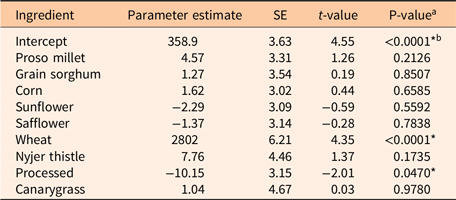
The equation [grass weed species seed = 4.57(proso millet) + 1.27(grain sorghum) − 1.62(corn) − 2.29(sunflower) − 1.37(safflower) + 2,802(wheat) + 7.76(nyjer thistle) − 10.15(processed) + 1.04(canarygrass) + 358.3] (P ≤ 0.0001) best predicted contamination of grass weed species (Table 4). The t-test analysis demonstrated an increase in grass weed seeds when wheat, grain sorghum, and proso millet were present in the mix (Figure 1). Shimono and Konuma (Reference Shimono and Konuma2008) reported similar results, with Poaceae species appearing the most often in wheat grain samples. Historically, the control of grass weeds in monocotyledonous crops like these has proven difficult due to the limited availability of selective herbicides used for grass control and lack of herbicide-resistant cultivars. Shimono and Konuma (Reference Shimono and Konuma2008) determined that in-field abundance of weeds and weed height were two factors that correlated to the number of weed seeds that contaminated wheat. Processed ingredients decreased weed seed in the model (P = 0.0470) as well as in the t-test analysis (P = 0.0027), similar to results with the Amaranthus species. Grass weed seed was also lower when safflower was in the mix. The relatively large seed size of safflower would allow for more effective mechanical separation of the desired crop and weed seed by harvesting equipment. Additionally, previous research has shown that the cyclohexanedione and aryloxyphenoxypropionate (WSSA Group 1) herbicides are highly effective in controlling grass weed species in safflower production (Blackshaw et al. Reference Blackshaw, Derksen and Muendel1990). These results suggest that the monocotyledonous crop species commonly used in bird feed mixes like wheat, grain sorghum, and proso millet are primary contributors to grass weed seed contamination in feed mixes. Therefore, bird feeders placed directly in homeowner yards could be responsible for the introduction of weeds such as D. sanguinalis and S. viridis. It is also worth noting that the amount of glyphosate- and multiple-resistant grass weed species continues to increase (Heap Reference Heap2019). To reduce the amount of grass weed seed transported in bird feed, mixes that incorporate processed ingredients or safflower should be promoted.
Prediction of grass weed species seed contamination in commercially available bird feed mixes based on linear regression analysis.

a Model is significant at P ≤ 0.0001. When P-value from individual ingredient is significant, the parameter estimate from that ingredient is different from zero.
b Asterisks indicate ingredient is significant at P<0.05.
Prediction of Ambrosia artemisiifolia Contamination
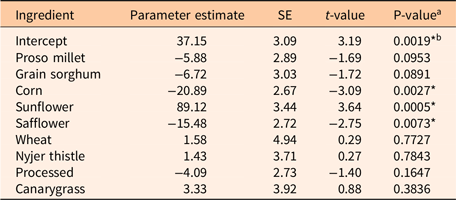
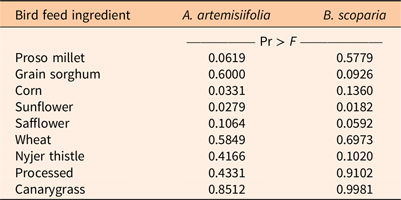
The model [A. artemisiifolia = −5.88(proso millet) − 6.72(grain sorghum) − 20.89(corn) + 89.12(sunflower) − 15.48(safflower) + 1.58(wheat) + 1.43(nyjer thistle) − 4.09(processed) + 3.33(canarygrass) + 37.15] (P = 0.0017) best predicted contamination of A. artemisiifolia. The logistic regression supported these results for all species except safflower (Table 5). Safflower was also not determined to decrease A. artemisiifolia in the t-test analysis, suggesting that the linear regression may have overestimated its contribution to A. artemisiifolia contamination due to large variance in the data set for this species. Corn decreased A. artemisiifolia levels in all analyses. This can likely be explained by the variety of corn herbicides that are effective in controlling A. artemisiifolia as well as the ability of most harvesting machines to mechanically separate corn grain from A. artemisiifolia seeds (Heap Reference Heap2019; Wilson et al. Reference Wilson, Castro, Thurston and Sissons2016). Sunflower increased contamination in both regression analyses but was not a factor in the t-test analysis (P = 0.0769). Many other studies have determined sunflower to be an important factor in A. artemisiifolia contamination. Vitalos and Karrer (Reference Vitalos and Karrer2008) reported that all samples that were contaminated with A. artemisiifolia seed contained sunflower. They also reported the highest levels of A. artemisiifolia seed (531 seeds kg−1) in bird feed mixes that contained only sunflower as an ingredient. Bohren et al. (Reference Bohren, Mermillod and Delabays2006) also reported that A. artemisiifolia was commonly identified in imported sunflower and deemed it nearly impossible to separate A. artemisiifolia from the desired crop. Brandes and Nitzsche (Reference Brandes and Nitzsche2006) also proposed that sunflower should routinely be checked for A. artemisiifolia contamination and also proposed a certified Ambrosia-free bird feed classification. Ambrosia artemisiifolia has been determined resistant to four classes of herbicides in the United States (WSSA Groups 2, 5, 9, and 14) (Heap Reference Heap2019), and the presence of this seed in feed mixes could provide a route for herbicide-resistant A. artemisiifolia seed to spread into new geographies.
Prediction of Ambrosia artemisiifolia seed contamination in commercially available bird feed mixes based on linear regression analysis.

a Model is significant at P ≤ 0.0017. When P-value from individual ingredient is significant, the parameter estimate from that ingredient is different from zero.
b Asterisks indicate ingredient is significant at P<0.05.
Prediction of Bassia scoparia Contamination
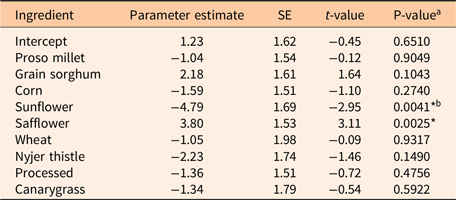
Bassia scoparia was identified in bird feed mixes at quantities much lower than any of the other weed species discussed, but is also an economically important weed on WSSA’s list of top 10 most troublesome weeds in the United States (VanWychen Reference VanWychen2016). The model [B. scoparia = −1.04(proso millet) + 2.18(grain sorghum) − 1.59(corn) − 4.79(sunflower) + 3.80(safflower) − 1.05(wheat) − 2.23(nyjer thistle) − 1.36(processed) − 1.34(canarygrass) + 1.23] (P = 0.0203) best predicted B. scoparia contamination in feed mixes (Table 6). Factors in the model of the linear regression align with results from the logistic regression, suggesting the linear regression was not affected by the nonnormalized data set for this species (Table 7). The t-test analysis determined that canarygrass and nyjer thistle reduced B. scoparia contamination. The control of B. scoparia in canarygrass production would likely be achievable with WSSA Group 4 herbicides, reducing any seeds present at harvest. The reduction observed with nyjer thistle is likely due to the fact that this species is often harvested by hand and not by mechanical means, which could allow for manual separation of B. scoparia from nyjer thistle plants (Duke Reference Duke1983). Safflower increased contamination in both analyses. Several previous studies have noted the problematic nature of B. scoparia in safflower production (Anderson Reference Anderson1987; Berglund et al. Reference Berglund, Reveland and Bergman2007; Blackshaw et al. Reference Blackshaw, Derksen and Muendel1990). These results indicate that B. scoparia contamination in bird feed mixes originates primarily from safflower. In fact, B. scoparia was the only weed species analyzed that did not result in a significant intercept in the model, which indicates that B. scoparia is not expected to be present in the mix unless safflower is used as an ingredient.
Prediction of Bassia scoparia seed contamination in commercially available bird feed mixes based on linear regression analysis.

a Model is significant at P ≤ 0.0203. When P-value from individual ingredient is significant, the parameter estimate from that ingredient is different from zero.
b Asterisks indicate ingredient is significant at P<0.05.
Logistic regression analysis of bird feed ingredient effects on Ambrosia artemisiifolia and Bassia scoparia seed contamination.

The results of this research draw attention to what may be an overlooked and underestimated pathway of seed spread of troublesome weed species. Many weed seeds are being transported in bird feed mixes, including Amaranthus species, which are some of the most troublesome weeds in the United States. Our screening has also proven that glyphosate-resistant Amaranthus seed is being transported in bird feed mixes. In an earlier similar study, Watts and Watts (Reference Watts and Watts1979) suggested that the series of chance events that would make it possible for a component of a bird feed mix to escape and ultimately settle in an area conducive for its germination may happen more than expected. Others doubt bird feed plays much more than possibly a minor role in the introduction of weed species into new territories (Vitalos and Karrer Reference Vitalos and Karrer2008). Regardless, endozoochory may be involved, as several studies have reported weed seeds to remain viable after alimentary excretion in cattle, waterfowl, and other avian species (Dowsett-Lemaire Reference Dowsett-Lemaire1988; Farmer et al. Reference Farmer, Webb, Pierce and Bradley2017; Lhotska and Holub Reference Lhotska and Holub1989; Powers et al. Reference Powers, Noble and Chabreck1978). When this issue was exposed in Europe, European governmental agencies imposed regulations for bird feed contamination, which subsequent data suggest led to decreased overall contamination levels. Perhaps similar regulations could lessen contamination levels in North American bird feed mixes. Across our entire screening, we measured an average of 363 Amaranthus seeds kg−1 of bird feed. Using the results from our study in conjunction with data from the USFWS survey, it could be possible that 105 million Amaranthus seeds are transported in bird feed mixes each year.
Acknowledgments
This research received no specific grant from any funding agency or the commercial or not-for-profit sectors. No conflicts of interest have been declared.