Introduction
Dementia is often complicated by manifestations of neuropsychiatric symptoms with the prevalence varying between 72% and 90% over the course of the disease (Selbeak et al., Reference Selbeak, Kirkevold and Engedal2007; Liperoti et al., Reference Liperoti, Pedone and Corsonello2008). Verbal and physical aggression, agitation, psychotic symptoms, sleep disturbances, depression, oppositional behavior, and wandering are the most frequently observed challenging behaviors (Brodaty and Arasaratnam, Reference Brodaty and Arasaratnam2012). Guidelines recommend non-pharmaceutical interventions as the first-line treatment for neuropsychiatric symptoms in dementia (Ypma-Bakker et al., Reference Ypma-Bakker2008). Pharmaceutical treatments should be administered with caution and only when non-pharmaceutical treatment appears to be ineffective. However, if pharmaceutical treatment is indicated, this should always be done in addition to or in combination with non-pharmaceutical treatments, and not as a substitute (Ypma-Bakker et al., Reference Ypma-Bakker2008).
In practice, psychotropic drugs are often prescribed as a first-line treatment for nursing home dementia patients with neuropsychiatric symptoms (Nygaard et al., Reference Nygaard, Ruths, Straand and Naik2004; Zuidema et al., Reference Zuidema, de Jonghe, Verhey and Koopmans2011; Gustafsson et al., Reference Gustafsson, Karlsson and Lövheim2013). Not following the guidelines will lead to overtreatment and, as a consequence, to unnecessary side effects (Trifiro and Spina, Reference Trifiro and Spina2011), which includes sedation, negative impact on (psycho) motor function – walking and swallowing, accelerated cognitive decline, and risk of falling (Schneider et al., Reference Schneider, Dagerman and Insel2005; Kleijer et al., Reference Kleijer2008; Ballard et al., Reference Ballard, Creese, Corbett and Aarsland2011).
Treatment decisions are often multifactorial (Zuidema et al., Reference Zuidema, de Jonghe, Verhey and Koopmans2011) but, four sets of attributes or treatment characteristics can be distinguished. First of all, attributes are directly related to the treatment itself such as clinical effectiveness, side effects, and costs (Schumock et al., Reference Schumock2004; Theodorou et al., Reference Theodorou2009). Second, treatment attributes can be distinguished based on the extent to which the treatment contributes to the patient's specific needs such as the severity of the health impairments (Lövheim et al., Reference Lövheim, Sandman, Kallin, Karlsson and Gustafson2006; van der Spek et al., Reference van der Spek2013). The third set of attributes is explicitly related to the range of options within the physician's. For instance, a treatment is chosen because it fits in with the limited amount of time available to evaluate a patient. Finally, treatment attributes can be distinguished on the basis of the effects that a treatment may have on an organization, such as consequences for the staff. Although clinical decisions are based on a set of clinical and patient criteria, it is widely known that, decision-making is not rational at all and prone to several biases. For instance, physicians seem to overestimate the effectiveness of antipsychotic drugs which therefore justifies their treatment choices (Cornegé-Blokland et al., Reference Cornegé-Blokland, Kleijer, Hertogh and van Marum2012). A lower level of familiarity with non-pharmacological interventions can also lead to more use of antipsychotic treatments (Cohen-Mansfield et al., Reference Cohen-Mansfield, Juravel-Jaffe, Cohen, Rasooly and Golander2013). Insufficient resources and the staff's insufficient knowledge form barriers for the use of non-pharmacological methods (Cohen-Mansfield et al., Reference Cohen-Mansfield2005; Cohen-Mansfield and Jensen, Reference Cohen-Mansfield and Jensen2008a; Reference Cohen-Mansfield and Jensen2008b) and were reported as reasons to prescribe psychotropic drugs (Wood-Mitchell et al., Reference Wood-Mitchell, James, Waterworth, Swann and Ballard2008). Also physicians think that non-pharmacological regimens require more time before they are successful (Cornegé-Blokland et al., Reference Cornegé-Blokland, Kleijer, Hertogh and van Marum2012).
In the Netherlands, as in many other countries, the physicians are responsible for writing the prescriptions. However, physicians’ decision may be strongly influenced by others (such as nursing staff and family members). Since physicians spend only a limited amount of time with the patient, they are also relying on the experiences of nurses, nursing assistants, and proxies and their expertise. Nurses and nursing assistants are the ones who spend most time with the resident and they have to monitor the patient's behavior. Therefore, physicians can contact or are contacted by the staff to discuss residents’ medication lists. Thus, in order to understand and improve treatment decisions, it is important to understand what physicians, nurses, and the patients’ representatives (proxies) consider important in the treatment of neuropsychiatric symptoms. In contrast to the physician perspective, almost no literature is available about the role of families (Jeste et al., Reference Jeste2008). Only one study has compared aspects influencing nurses, physicians, and proxies in the prescribing of psychotropic drugs in nursing homes (Cornegé-Blokland et al., Reference Cornegé-Blokland, Kleijer, Hertogh and van Marum2012) and one other study compared these aspects between nurses and physicians (Smeets et al., Reference Smeets2014). The current study explored the choices quantitatively for the treatment of neuropsychiatric symptoms in nursing homes made by physicians, nurses, and proxies and in addition, we compared the different treatment characteristics (i.e. attributes) that are considered important for making this choice.
Preference elicitation methods, such as various ranking methods, offer the potential to improve patient-centered healthcare decision-making. These methods help in identifying the importance of treatment characteristics when choosing a treatment. Consequently, possible discrepancies between stakeholders may be made explicit. Besides the use of preference methods in benefit-risk assessments and health technology assessments, these methods can also be used to elicit the patient's view when making clinical decisions. A review of the literature (Weernink et al., Reference Weernink2014) showed that preferences for therapeutic alternatives were mostly elicited by means of simple methods such as rating, ranking, visual analogue scale, and direct choice. Issues of concern while using these methods include biases such as social desirability responding, acquiescence, and scalar inequivalence (Adamsen et al., Reference Adamsen, Rundle-Thiele and Whitty2013). Therefore, this study uses case 1 Best–Worst Scaling (BWS). BWS is appropriate when the researcher is interested in the relative values associated with each item in a list used in clinical research (Flynn et al., Reference Flynn, Louviere, Peters and Coast2008; Najafzadeh, et al., Reference Najafzadeh2012). The use of this method in this study will therefore help to re-align the prescribed treatment with the preferences of the healthcare professionals and proxies.
Method
Attribute selection
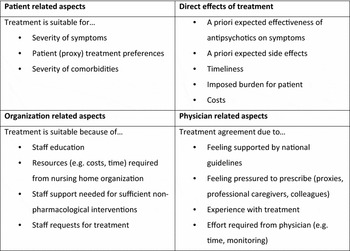
Treatment characteristics or attributes mentioned during interviews with three elderly care physicians and three proxies as well as those found in the literature were selected. The authors categorized the identified aspects in order to reduce overlap and ambiguity. The structure and phrasing of each attribute was developed through a consultative process with experts in the field. Attributes in this study included treatment related aspects (effects and side effects of antipsychotics, urgency), physician-related aspects (feeling supported by protocol, feeling pressured to prescribe, experience), nursing home-related aspects (staff education, resources, and the required staff support), and patient aspects (severity of symptoms, patient treatment preferences, severity of comorbidity). The attributes are shown in Figure 1 whereby 16 aspects represent the elderly care physicians and nurses’ view and 10 aspects represent the proxies’ view. The difference in the number of aspects is caused by the fact that nursing home-related aspects do not apply to proxies.
Classes of treatment attributes.

Survey design
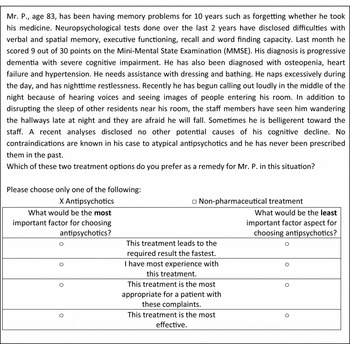
Three different questionnaires were developed for proxies, physicians, and nurses. The questionnaires for the physicians and nurses included socio-demographic questions such as age, gender, and years of experience. To ensure all respondents’ reflections were about the same patient, a hypothetical profile of a patient with dementia demonstrating problematic behavior was used (see Figure 2). The use of a hypothetical scenario is common for the elicitation of stated preferences (Poulos et al., Reference Poulos2016). Following the presentation of the patient profile, each participant was asked to choose between antipsychotic and non-pharmaceutical treatment which she/he thought most appropriate for the patient described in the scenario. Respondents then indicated which attributes they found most important in making this decision.
Case description of a hypothetical patient and an example of a BWS-set for physicians who selected antipsychotics as a treatment.

The proxies’ questionnaire was similar, but contained some additional questions about the relationship between patient and proxy as well as one question regarding the satisfaction with the patient's treatment and two questions about their involvement in treatment decisions. The proxies also received a simplified version of the scenario. The final questionnaires were pilot tested by two representatives from each group.
Preferences were elicited from all the respondents using a BWS, case 1 design. The BWS method was introduced by Finn and Louviere in 1992 (Finn and Louviere, Reference Finn and Louviere1992). BWS is built on the idea that when individuals evaluate a set of three or more aspects on a subjective scale, their choices of the top and bottom aspects should be more reliable than choices of aspects in between. It assumes that respondents make valid and reliable choices in relation to the two most extremes aspects in a set. For that reason, the respondents were provided with choice sets and they chose the most important and least important factor from each set (Louviere et al., Reference Louviere, Flynn and Marley2015). A balanced incomplete block design (BIBD) was used for the choice sets. This is an experimental design whereby each choice option appears equally often, and co-appears equally often with every other choice option. In this way, BIBD designs ensure that choice set sizes are always equal (Louviere et al., Reference Louviere, Lings, Islam, Gudergan and Flynn2013). The respondents were presented with 20 sets (one at a time; proxies with 15 sets) with four items and asked to identify the most and least preferred item.
Respondents
The questionnaire for the elderly care physicians was published on the website and distributed via the newsletter of the association of elderly care physicians in the Netherlands, “VERENSO” (Vereniging Specialisten Ouderengeneeskunde, 2016), in May 2015. We ended the data collection with a convenience sample of 41 physicians since we experienced difficulties in finding physicians to take the time to complete the questionnaire. In January 2016, 296 questionnaires were distributed via e-mail to the nurses/nursing assistants, to be referred to as nursing staff, working at one of the 23 nursing homes of a nursing home organization in the Netherlands. After the consent of the client advisory board of the same nursing home organization, 170 letters were sent to the proxies, the legal representative of the nursing home residents living in a psychogeriatric ward during the same period. The proxies were given the choice between filling in an online or a paper-based questionnaire. The letter contained information about the goal of the research and mentioned that the resident's care would not be influenced by taking part in the study or refraining from it.
All respondents filling in the online questionnaire had to read an informed consent and click an acceptance box to proceed further with the questionnaire. Respondents filling a paper-based questionnaire had to sign and return it.
Data analysis
The BWS required a specific analytic approach. We counted the number of times each factor was chosen as most important (best) and least important (worst) in all choice sets. This was done per group of respondents (elderly care physician, nursing staff, and proxies). Then, the level of importance was determined. For this purpose, the number of times a factor was chosen as worst was subtracted from the number of times that same factor was chosen as best in all choice sets (Louviere et al., Reference Louviere, Flynn and Marley2015). To allow a comparison between different groups of respondents, the B–W scores were transformed to standard scores again. The standard score could range from +1 to −1. A positive standard score for a factor means that it was selected as “most important” more often than selected as “least important” by the respondents and was therefore likely to be preferred to factors with a negative standard score.
Results
Respondents’ characteristics
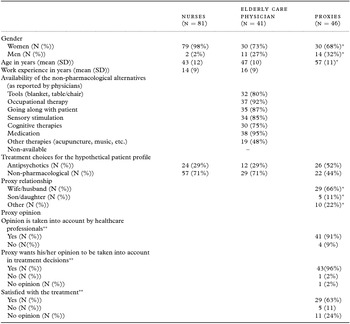
A total of 81 staff members, consisting of 31 nurses and 50 (certified) nursing assistants (not shown in the table), completed the questionnaire (response rate of 27%). Additionally, the questionnaire was filled in by 41 elderly care physicians (response rate of 3%). A total of 59 proxies (response rate of 35%) returned the questionnaires; however, 13 questionnaires were incomplete (possibly due to the paper-based version of the questionnaire which was not sent to the other groups) and were therefore excluded from further analysis. The elderly care physicians stated that various non-pharmacological options are available in their nursing homes. With regards to the distribution of the treatment choice for the hypothetical patient profile, non-pharmacological interventions were chosen over antipsychotic treatment by 71% of both the nursing staff and elderly care physicians and by 44% of the proxies. Additional characteristics of the respondents can be found in Table 1.
Respondents’ characteristics

*2 missing; **1 missing.
The majority of the proxies (88%) indicated that their opinion was taken into account by the healthcare professional while making treatment decisions (see Table 1). Moreover, almost all of the proxies (92%) indicated that they want the healthcare professionals to take their opinion into account in treatment decisions. The proxies varied regarding their satisfaction with the current treatment of their family member but the majority (64%) indicated that they were satisfied with the treatment.
Importance of certain aspects of antipsychotic drug treatment factors
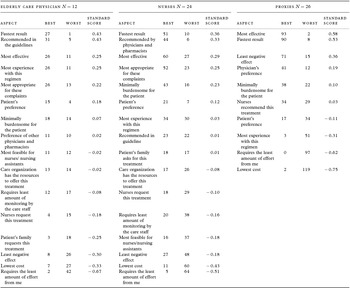
The respondents who chose antipsychotics as the appropriate treatment, clearly ranked the factors “fastest result” and “most effective,” as most important (see Table 2). Physicians ranked “most experience with this” as important, whereas proxies did not find this as important at all. The nursing staff and elderly care physicians also rated the factor “most appropriate” and “patient's preference” as important. The proxies ranked the factor “least negative effect on the patient” as important, whereas the elderly care physicians and nursing staff did not consider this as important. Two factors were consistently ranked as least important by the three groups, namely “low costs” and “requires the least amount of effort from me.”
The three groups’ standard scores per aspect in relation to the antipsychotic treatment

A standard score was calculated in order to compare the level of importance of each attribute between the different groups (with varying numbers). The level of importance for each choice was determined by subtracting the number of times the aspect was least important (worst) from the number of times it was most important (best) in all choice sets (e.g. 5N).
Importance of non-pharmacological treatment factors
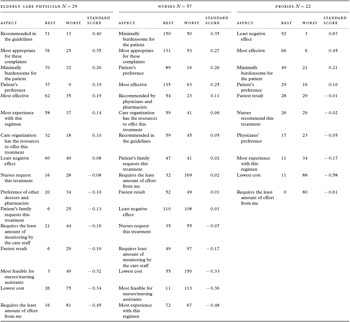
Nursing staff and elderly care physicians both ranked “appropriateness” and “least burdensome for the patient” as important factors when selecting non-pharmaceutical treatments (see Table 3). The proxies, on the other hand, ranked “most effective” and “least negative effect on the patient” as important factors. Additionally, the elderly care physicians rank “most experience with this” as an important factor, which is opposite to the nursing staff and proxies’ rankings. Again, the aspects “low costs” and “requires the least amount of effort from me” were consistently rated as least important by the three groups.
The three groups’ standard scores per aspect in relation to the non-pharmacological treatment

A standard score was calculated in order to compare the level of importance of each attribute between the different groups (with varying numbers). The level of importance for each choice was determined by subtracting the number of times the aspect was least important (worst) from the number of times it was most important (best) in all choice sets (e.g. 5N).
Discussion
The results of the study show the rankings of the decision criteria of the three stakeholder groups. The BWS results helped to detect what physicians consider important in their treatment. The inclusion of the nursing staff and proxy group enabled us to compare the preferences of the three. The results show that while the elderly care physicians’ and nursing staff rankings are mainly in agreement, the rankings of the proxies differ. Also, elderly care physicians and nursing staff primarily chose the non-pharmacological treatment approach, while proxies were more divided. Our results show that the nursing staff and physicians ranked the aspects related to expected clinical impact as most important.
Whereas previous studies found a number of differences in opinion between elderly care physicians and nursing staff, the results of the current study show more overlap. In the study by Smeets et al. (Reference Smeets2014), who interviewed physicians and nursing staff in order to propose a framework explaining how different aspects influence psychotropic drug prescription, the nursing staff chose antipsychotics more readily. Smeets’ et al. (Reference Smeets2014) framework offers four main topics which are important in the neuropsychiatric treatment: mindset, knowledge, and experience, communication and collaboration, and external possibilities/limitations. The aim was to understand all the determinants of the treatment choices, including psychological aspects of the prescriber. Our study, on the other hand, focused on what aspects of a treatment – the attributes- are regarded as important or unimportant.
Furthermore, the present study incorporates the important views of proxies and quantifies the importance of attributes. Since this is the first study ranking aspects influencing the treatment decision for neuropsychiatric symptoms of patients with dementia, it is difficult to compare these results or fit them into the existing literature. An interesting finding is that antipsychotics are still rated as effective by some elderly care physicians. However, research has shown that the risk of harm with antipsychotic treatment might outweigh the likelihood of benefit in most people with dementia (Corbett et al., Reference Corbett, Burns and Ballard2014). Therefore, prescribing antipsychotic or not prescribing them may mirror the treatment challenges faced by physicians. The elderly care physicians and nursing staff who chose the non-pharmaceutical treatment option ranked the attributes “most effective” and “fastest result” as a less important reason for choosing this type of treatment. However, studies have shown that personalized activities, such as social interaction and reminiscence therapy for the treatment of agitation, are significantly beneficial (Corbett et al., Reference Corbett, Burns and Ballard2014). Our finding might indicate that those physicians and nursing staff who opt for non-pharmacological treatment value the burden on the patient and the recommendations in the guidelines more than physicians and nursing staff who choose pharmacological treatment and who appear to primarily value the effectiveness of the treatment. Our finding that effectiveness is not regarded as the most important reason by those who chose non-pharmacological treatment might also reflect that these physicians and nursing staff are more willing to accept less optimal treatment effects. However, it could also reflect that they are not aware of the effectiveness of the non-pharmacological treatment. Whatever the reasoning behind the physicians and nursing staff, it may be necessary to either give a further explanation concerning the importance of patient burden and guideline recommendations, or to educate physicians about the effectiveness of non-pharmacological treatment.
While the expected clinical effectiveness was ranked as most important in antipsychotic treatment, the absence of side effects was ranked high or highest by those who chose for non-pharmacological treatment. This could imply that the choice for non-pharmacological treatment is for an important part a negative choice, i.e. it is chosen because of an expected absence of side effects rather than an expected effect. This could also explain why antipsychotic treatment is sometimes still preferred over non-pharmacological treatment. The expected positive effects might be more attractive than absence of side effects expected in non-pharmacological treatment.
In our study, physicians indicate they feel least influenced by the requests of nursing staff, even though it is mentioned in the literature that physicians feel pressured by nurses to prescribe antipsychotics (Cornegé-Blokland et al., Reference Cornegé-Blokland, Kleijer, Hertogh and van Marum2012). This might imply that they prescribe according to their own know-how and terms and not under pressure or that they have good reasons for not considering the request. Interestingly, physicians did value the preference of the patient/proxies in most cases. Moreover, the current study shows that proxies value the recommendations of physicians and like to be involved in the decision-making process. Therefore, it seems as if the involved groups are open to the opinions of the others, which indicates shared decision-making could be beneficial. Shared decision-making reinforces the right of individuals to participate in decision-making about a particular healthcare treatment in consultation with a clinician. Probably the most important topic in this shared decision-making process should be the expected clinical effects and side effects since these were both regarded important but were ranked differently by the groups. However, the degree to which patients or proxies are involved in the decision-making can vary. In our study, the majority of the proxies indicate that their opinion is taken into account in treatment decisions. This differs from findings in earlier systematic reviews (Petriwskyj et al., Reference Petriwskyj2014). Those studies suggest that family involvement is not used consistently in decision-making. The considerable differences might be a result of the specific situation in the Netherlands. The medical care in Dutch nursing homes is provided by specially trained elderly care physicians who practice mainly within the nursing homes and have all attended a two year training in psychogeriatric medicine. Therefore, they might be trained better in communicating with proxies and are more willing to involve the proxies in the decision-making process.
Limitations
Despite the relatively low response rates in our study, the physicians and nursing staff appear, at first sight, to be representative of the target group. Staff characteristics such as gender, age, and work experiences are also comparable to previous research on psychogeriatric wards in Dutch nursing homes (van de Ven et al., Reference van de Ven2013). Yet, we cannot rule out any selection bias and it might be that the respondents were the ones who were more critical of treatment. However, we were able to distinguish between those who opted for pharmacological treatment and those who opted for non-pharmacological treatment, thus the attributes that are regarded (un)important for both groups might not be affected. Although the nursing staff of only one nursing home organization was included, it actually comprises 23 nursing and residential homes located in cities as well as villages which provide small-scale as well as traditional care. Hence, we do not suspect that the answers of the nursing staff were influenced by this fact. However, future research should still confirm the results of this first study on the different ratings of attributes between stakeholders.
In our study, the choice for a treatment was based on only one patient scenario. We asked the participants to state preferences about hypothetical treatment choices rather than real decisions that they face. However, the aim of this study was to understand what physicians, nurses, and proxies consider important in the treatment according to their own norms and values as well as differences in available knowledge and to identify possible differences between the three groups. We show that the choices differ and need to be discussed. Communication between the three groups needs to be improved.
Conclusion
As far as we can see, differences between proxies and health professionals exist regarding important aspects in the treatment of neuropsychiatric treatments in patients with dementia. The results of this study show that the proxies choose antipsychotics more often than healthcare professionals to treat challenging behaviors. Therefore, the healthcare professionals need to provide more information about the expected benefit versus potential side effects for their relative. Additionally, more information about the different treatments, pharmacological and non-pharmacological, should be provided and different views about treatments should be discussed more in-depth. Shared decision-making could be an option for the best treatment procedure for the patient. Improved communication can lead to more appropriate treatments for behaviors encountered in patients with dementia.
Moreover, this study shows that opting for a non-pharmacological treatment is often a negative choice, since psychotropic drugs are associated with too many side effects. This perception needs to be challenged. The preference for a non-pharmacological treatment should be a positive one and it should be prescribed because of the existing evidence of its effectiveness. To achieve this change, more attention to the effectiveness non-pharmacological treatments is needed.
Conflict of interest
None.
Description of authors’ roles
Janus: study concept and design, data analysis, drafting of manuscript. van Manen, van Til: study design, data analysis, and manuscript revision. Zuidema, IJzerman: manuscript revision.