Introduction
Weaver ants (Oecophylla spp.) are highly territorial and aggressive, with a diet consisting of other small animals, honeydew and nectar (Hölldobler & Wilson, Reference Hölldobler and Wilson1983; Peng et al., Reference Peng, Christian and Gibb1999). Hence they are used as natural enemies against destructive crop pests, such as cashew-sucking pests and fruit flies (Way & Khoo, Reference Way and Khoo1992; Peng et al., Reference Peng, Christian and Gibb1999; Van Mel et al., Reference Van Mele, Vayssieres, Van Tillingen and Vrolijks2007). Recent research in Benin showed that abundant Oecophylla longinoda populations on mango can drastically reduce damage from fruit flies (Van Mele & Vayssieres, Reference Van Mele and Vayssieres2007). Similar research findings from east Africa suggest that O. longinoda imparts significant reduction in damages caused by cashew-sucking pests (Stathers, Reference Stathers1995; Olotu et al., Reference Olotu, du Plessis, Seguni and Maniania2013). Additionally, Oecophylla spp. are a human food source in many countries in tropical Asia, Australia, Congo and Cameroon (De Foliart, 2008 and references therein as cited by Sribandit et al., Reference Sribandit, Wiwatwitaya, Suksard and Offenberg2008; Offenberg, Reference Offenberg2011; FAO report, 2013; Van Itterbeeck et al., Reference Van Itterbeeck, Sivongxay, Praxaysombath and Van Huis2014). Larvae, pupae and adult stages of both the worker and the reproductive castes are sold as food but queen brood (larvae, pupae and virgin queen) are the most expensive (Sribandit et al., Reference Sribandit, Wiwatwitaya, Suksard and Offenberg2008). Owing to this dual utilization of Oecophylla spp., there is an increasing demand for developing weaver ant management methodologies.
One of the challenges of utilizing Oecophylla for biocontrol is obtaining enough colonies for large-scale transplanting into plantations (Ouagoussounon et al., Reference Ouagoussounon, Sinzogan, Offenberg, Adandonon, Vayssieres and Kossou2013), and this is also important for harvesting adequate amounts of queen larvae for human consumption. Therefore, there is a need for developing rearing methods. A key issue in this respect is knowledge of the phenology of sexuals as it is imperative to collect queens immediately after their nuptial flight, because newly mated queens suffer large mortalities during the founding stage (Offenberg et al., Reference Offenberg, Peng and Nielsen2012).
Some important details regarding Oecophylla reproduction have already been elucidated. Wild Oecophylla colonies produce thousands of new winged virgin queens each year that individually leave their natal colony, mate and start new colonies (Vanderplank, Reference Vanderplank1960; Hölldobler & Wilson, Reference Hölldobler and Wilson1990; Van Itterbeeck et al., Reference Van Itterbeeck, Sivongxay, Praxaysombath and Van Huis2014). The investment in sexuals increases with colony productivity, but the investment in reproductive females is proportionately much larger than the investment in males (Hasegwa, Reference Hasegwa2013).
Way (Reference Way1954) found the release of winged sexuals of O. longinoda in Zanzibar coincided with the beginning of prolonged periods of high humidity and frequent rainfall. Mated queens were commonly found on vegetation from February to March and from May to October. Nuptial flights were observed in Zanzibar after heavy rains in November and March (Vanderplank, Reference Vanderplank1960). Sexual production and timing of mating flights is similarly linked to rainfall and restricted to limited periods of the year for Oecophylla spp. (Vanderplank, Reference Vanderplank1960; Peeters & Andersen, Reference Peeters and Andersen1989; Peng et al., Reference Peng, Christian and Gibb1999; Van Mele & Vayssieres, Reference Van Mele and Vayssieres2007; Sribandit et al., Reference Sribandit, Wiwatwitaya, Suksard and Offenberg2008).
Here we have determined when O. longinoda colonies produce sexuals under a bimodal rainy season in eastern Tanzania, and estimated the yearly production of new queens.
Materials and methods
The study was conducted in citrus orchards in the Muheza district, Tanga region in eastern Tanzania (S 06°47′12.3″, E 37°39′01.7″, altitude 501 m). The rainfall in this region is bimodal, with a long rainy season from mid-March to May and a short rainy season from November to December with averages of 1200 and 650 mm, respectively. Thirty-five O. longinoda colonies were mapped in two adjacent citrus orchards that were similar with respect to cultivation, tree age and size. To optimize the conditions for O. longinoda, and to mimic their management as part of a biocontrol program, host trees belonging to the same colony were connected by ropes. This facilitates the movement of ants within colonies and discourages workers from moving between trees on the ground. The latter may expose O. longinoda workers to attacks from Pheidole megacephala, which was present in some parts of the study area. P. megacephala is a highly aggressive invasive ant species that is considered to be the most efficient and widely distributed competitor of O. longinoda (Perfecto & Castiñeiras, Reference Way and Khoo1998). We applied management actions to reduce the P. megacephala populations largely following the recommendations by Seguni et al. (Reference Seguni, Way and Van Mele2011), and the O. longinoda colonies were provided supplementary food twice a month during the dry season consisting of grounded fish and a 25% sucrose solution. The amount of fish and sucrose was not measured as the effect of feeding was not a topic of this investigation.
Twenty colonies from one of the citrus orchards were assigned to a nest sampling program and the remaining 15 colonies from the other orchards served as controls on the impact of removing nests. O. longinoda nests are assemblages of leaves woven together by major workers using silk produced by mature larvae. To determine the periods when sexuals were produced, one nest was sampled randomly from a randomly chosen colony every 2 weeks for 2 years from October 2011 to September 2012 (hereafter referred to as the first year) and October 2012 to September 2013 (hereafter referred to as the second year). Nest sampling was a two-step process, with the first step being an inspection of the randomly selected nest for the presence of brood, workers and the egg-laying queen. If the egg-laying queen was found the nest was returned to the colony. If there were both brood and workers present the second step was placing it in a plastic bag and storing it in a freezer. The ants were then sorted into queens, males, workers and immature forms. The latter were further sorted according to their developmental stage. The caste of eggs and first instar larvae could not be determined but were assumed to be workers. The numbers of each caste and developmental stages were counted and the wet biomass weighed on a four digit weighing balance (0.0001 g).
Artificial queen nests (rolled leaves fixed with a rubber band) were created on ant-free trees to monitor mating flights. After a mating flight founding queens settle in such nests (Peng et al., 2013), thus the presence of queens in the artificial nests indicated that a mating flight had occurred. The artificial nests were inspected by looking inside each nest every 2 weeks as well as each dry day following rain.
To assess the impact of nest harvesting on colony size, the number of nests in each colony was counted every 6 weeks. Daily rainfall data were obtained from Mlingano Agricultural Meteorological Station located at Muheza, approximately 7 km from the study area.
Data analysis
Repeated measures MANOVA was used to test the effect of nest harvesting on colony size by comparing the number of nests per colony between the sampled colonies and control colonies. Data were log transformed to obtain normal distribution and variance homogeneity. All analyses were performed with JMP 10 (2012).
Results
The effect of nest harvesting on colonies production
The harvesting rate of two nests per colony per month did not affect the number of nests per colony (treatment effect, F 1.31 = 1.87, P = 0.8; time effect, F 11.21 = 8.96, P < 0.0001, treatment × time F 11.21 = 1.18, P = 0.36) (fig. 1).
Number (±SE) of nests per colony of O. longinoda throughout the sampling period.

Presence of sexuals
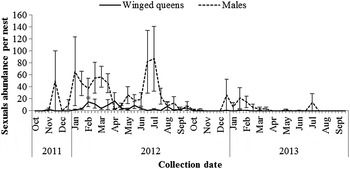
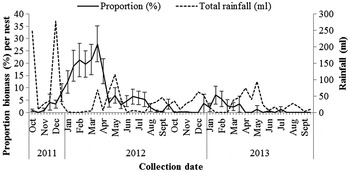
The presence of sexuals (larvae, pupae and adults) varied among years, being far more common in the first than the second year. Adult males or queens were found in at least one of the 2 years (fig. 2). Sexuals were produced throughout most of the year but were not present for short periods (mid-December 2012 and August/September, 2013). The largest proportions of sexuals were recorded between January and April during both years (fig. 3). A lower proportion of sexuals were recorded the second year compared to the first year. Production of immature sexuals occurred between November and December, which coincided with relatively high rainfall. During the dry months of January and February, the proportion of sexuals continued to increase until the onset of rains in March (fig. 3). At this time the proportion of the wet biomass of sexuals decreased, suggesting that dispersal flights had commenced. Similarly during the dry period of June/July 2012, there was a second smaller build-up of sexuals that declined at the onset of rain in August. The presence of queens in artificial nests indicated that six dispersal flights were recorded in both the years. These occurred from 29th March to 30th June in 2012 and from 2nd April to 30th August in 2013. The sexuals (all stages) from January to March accounted for 25% of the total biomass found in the nests in the first year and less than 10% the second year.
The mean abundance (±SE) of winged queens and males of O. longinoda per nest.

The mean proportion (±SE) of wet biomass contributed by O. longinoda sexuals per nest, and rainfall in Tanga, Tanzania. Rainfall is given as the sum of the daily rainfall totals between each sampling date.

Numerically, males were more abundant than queens (fig. 2) (6:1 males to queens, in the first year and 37:1 in the second year). In the second year new queens were only recorded three times with an average of less than one queen per nest. The average number of males per nests was 87 (±54) whereas the average number of queens was 17 (±6). In 2012, there were several peaks in the production of both males and queens. Peaks of males and queens were out of phase with the time between peaks being approximately 1 month, with new batches being laid only after the prior batch had matured and dispersed. Therefore, the number of queens produced per year equals the sum of the queens observed during the peaks. From January to October 2012 there were six peaks averaging 14.7, 16.7, 9.2, 2, 7.3 and 4.8 queens per nest in each peak, giving an annual average of 54.4 queens per nests. In the same period, the mean number of nests per ant-occupied tree was 8.3 (±0.3) and the mean number of nests per colony was 50.6 (±3.1). Thus, an average ant-occupied tree and ant colony produced 449 and 2753 queens, respectively. The average number of trees per colony ranged from 5 (±2) to 21 (±9).
Dynamics of workers abundance
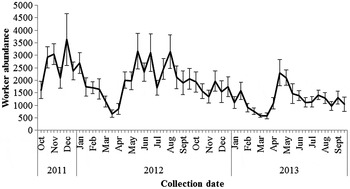
Worker abundance fluctuated seasonally, declining from January to March, when it reached an annual low (fig. 4) and was inversely proportional to the sexual biomass (fig. 3). Worker abundance was greater the first year than the second year. The highest and lowest average number of workers per nest was 3632 (±1041) in November 2011 and 581 (±112) in March 2013.
The mean abundance (±SE) of O. longinoda workers per nest.

Discussion
The effect of nest harvesting
We examined the population structure and dynamics of O. longinoda colonies to quantify the production and dispersal of sexuals. The destructive sampling of nests had no effect on the number of nests per colony, which indicates that colony size would not be affected by nest harvesting. However, there was an approximately sixfold decrease in number of nests of both groups from the beginning to the end of the study. This decline was probably caused by invasions of P. megacephala, a major enemy of O. longinoda (Seguni et al., Reference Seguni, Way and Van Mele2011), which invaded the study area in the second year. This population decline may in turn have resulted in the highly skewed sex ratio bias in the second year, where almost all sexuals produced were males. It is well known that smaller ant colonies invest mainly in males, rather than the larger, more costly queens (Hölldobler & Wilson, Reference Hölldobler and Wilson1990; Hasegwa, Reference Hasegwa2013). This suggests that only the first year of data reflects the production of sexuals in healthy, well-performing colonies. It also highlights that Oecophylla colonies (maintained for the harvest of founding queens) need protection from P. megacephala.
Presence of sexuals
We identified that the production of sexuals takes place almost throughout the year, which suggests that mated queens may be collected from nests most of the year. If the regular fluctuations of the abundance of sexuals throughout the year reflect dispersal flights, the collection of founding queens via artificial nests may also be possible most of the year, but collection efforts may show higher returns from February to April when the abundance of queens peak in the nests.
Sexuals were found in the nests for much longer periods in this study than that have been reported for Oecophylla spp. elsewhere. The winged individuals of O. longinoda have been shown to emerge from their nest in November and in March in Zanzibar (Vanderplank, Reference Vanderplank1960). Van Mele & Vayssieres (Reference Van Mele and Vayssieres2007) reported that queens of Oecophylla smaragdina were found from July to October in the Mekong Delta of Vietnam while in the Northern Territory of Australia queens were found in March (Peeters & Andersen, Reference Peeters and Andersen1989). However, these studies monitored mating flights and not the presence of sexuals inside nests. Sribandit et al. (Reference Sribandit, Wiwatwitaya, Suksard and Offenberg2008) reported that queens are harvested from nests for a period of 4–5 months in Thailand. In Darwin, Australia queens can be found in nests for only a few months during the rainy season (M.G. Nielsen, R. Peng and J. Offenberg, unpublished data).
The abundance of sexuals in nests would be expected to decline simultaneously if such a decline was caused by dispersal flights. It is unclear why male abundance peaks occurred when queen abundance was low as a temporal asynchrony would make it difficult for males and queens to locate each other for mating. One possibility is that males first fly to other colonies where they are adopted into nests containing queens, and mating subsequently takes place in the nest (Vanderplank, Reference Vanderplank1960). The already mated queens would then leave their nest on a ‘founding’ flight, rather than on a mating flight. However, ongoing observations on mating flights (N. Halfan, G. Rwegasira, M. Mwatawala and J. Offenberg, unpublished data) do not support Vanderplank's hypothesis.
The decline in the number of workers reconciled with a simultaneous increase in the proportion of sexuals. It appears worker production stops during the periods when sexuals are produced and is initiated again once the sexuals disperse from the nest. Similar results have been found with O. smaragdina in Darwin Australia where the wet biomass of the nests content was rather constant, but the ratio of sexuals to workers fluctuated seasonally (Christian Stidsen, unpublished data).
Rainfall appeared to play an important role in O. longinoda mating, because we found it to be very closely related with both the production of sexuals and the timing of dispersal flights. Production of sexuals commenced at the start of the rainy season (October/November) after the long dry season. This is supported by Vanderplank (Reference Vanderplank1960), Peeters & Andersen (Reference Peeters and Andersen1989), Peng et al. (Reference Peng, Christian and Gibb1999), Van Mele & Vayssieres (Reference Van Mele and Vayssieres2007) and Sribandit et al. (Reference Sribandit, Wiwatwitaya, Suksard and Offenberg2008) who also found that the production of sexuals and the timing of mating flights to be restricted to limited periods of the year for Oecophylla spp. Approximately 1 month after the rains began, the first adult sexuals emerged. One month is approximately the time taken for Oecophylla to develop from egg to adult (Vanderplank, Reference Vanderplank1960).
In Asia, O. smaragdina larvae are collected as a protein source for human consumption or as animal feed (Offenberg, Reference Offenberg2011; FAO report, 2013). In Thailand it is mainly the virgin queens that are targeted for harvesting (Sribandit et al., Reference Sribandit, Wiwatwitaya, Suksard and Offenberg2008). Therefore the protein harvest is compatible with the use of Oecophylla for biocontrol efforts, because only the workers control pest insects (Offenberg & Wiwatwitaya, Reference Offenberg and Wiwaitwitaya2010). Our study has shown that a similar practice does not seem feasible in Tanga as the number of queens in the nests was very low. We found an average of fewer than 17 queens per nest, whereas nests in Thailand and Australia contain hundreds of queens (J. Offenberg, unpublished data). In an extreme case in Thailand, 1.2 kg of queens was found in a single nest (J. Offenberg, unpublished data). However, the harvest rate of two nests per colony per month was not detrimental to the colonies. Thus, a limited amount of ant protein may be harvested sustainably.
Acknowledgements
This study was funded by DANIDA through project DFC No. 10-025 at Sokoine University of Agriculture. We are grateful to Semngano village leaders and farmers for allowing us to conduct our experiment in their village. Thanks to the village agricultural extension officer Mr Jimmy Mhina for guiding and supervising the farmers. Thanks to John Kusolwa for his assistance in the field work; Miss Saverina Tiba for assisting in the Laboratory work. Lastly our sincere gratitude to Dr Renkang Peng for his technical advice during this study especially on mapping weaver ants colony and Lars Bjørnsbo of ECOstyle A/S for providing spinosad.