Introduction
Adenoid cystic carcinoma is a rare salivary gland malignancy that is usually indolent, has a long natural history and frequently has late local recurrences and distant metastasis. The mainstay of treatment remains surgery with post-operative radiotherapy.Reference Bhayani, Yener, El-Naggar, Garden, Hanna and Weber1 Adenoid cystic carcinoma has a propensity for perineural invasion, which increases the late recurrence risk. The clinical outcomes of adenoid cystic carcinoma treatment in a single institution over a 20-year period are reported.
Materials and methods
All head and neck adenoid cystic carcinoma cases treated at the Edinburgh Cancer Centre between 1992 and 2013 were identified from an established audit database. A Microsoft Office Excel 2007 (Microsoft, Redmond, Washington, USA) database was created to record patient, tumour and treatment characteristics. These included sex, age, type of salivary gland involved, tumour–node–metastasis (TNM) stage, treatment modalities, surgical margins, tumour subtype, presence of perineural invasion, presence of vascular invasion, details of radiotherapy, and the time and site of recurrence. A tumour-free margin of at least 5 mm was defined as clear, a tumour-free margin of more than 1 mm and less than 5 mm as close, and a tumour-free margin of 1 mm or less as positive.
Tumours were clinically staged and patients were stratified into those undergoing radical treatment with the intent of tumour clearance (radical treatment group) or those for whom tumour clearance was unlikely to be successful because advanced disease was extending into critical structures (disease control group). Clinicopathological factors affecting disease-specific survival and overall survival were identified by univariate analysis using GraphPad Prism for Windows version 5.01 (La Jolla, California, USA). Disease-specific and overall survival rates were calculated using the Kaplan–Meier method, with log-rank analysis for univariate comparison.
Results
Fifty-one adenoid cystic carcinoma patients were identified: of these, 40 underwent radical treatment (radical treatment group) and 11 with stage IV disease were treated with the intent of tumour control (disease control group).
Radical treatment group
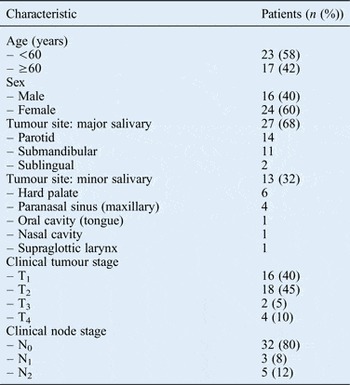
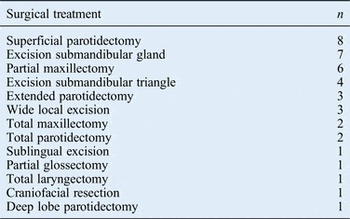
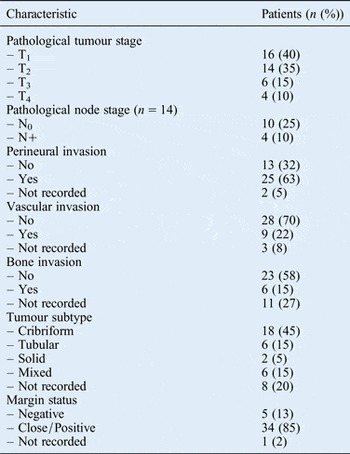
The 40 patients in this group had a median follow up of 81 months (range, 3–143 months): they comprised 24 women (60 per cent) and 14 men (40 per cent) with a median age of 56 years (range, 23–82 years). Patient characteristics are shown in Table I. Twenty-seven patients (68 per cent) had adenoid cystic carcinoma of the major salivary glands and 13 (32 per cent) had adenoid cystic carcinoma of the minor salivary glands. Thirty-four patients (85 per cent) had clinical stage I–II disease and six (15 per cent) had stage III–IV disease. Most patients (80 per cent) had clinically staged node-negative (N0) tumours. Treatment types are shown in Table II and tumour characteristics are shown in Table III. There was perineural invasion in 25 patients (63 per cent) and vascular invasion in 9 (23 per cent). Thirty-four patients (85 per cent) had close or positive margins, and pathological analysis identified 29 (73 per cent) T1–2 tumours.


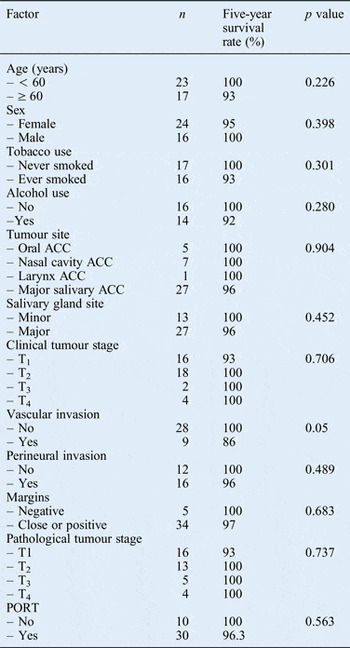
The histology pattern was solid in 15 per cent of tumours, tubular in 26 per cent and cribriform in 59 per cent. Vascular invasion was associated with poor disease-specific survival, but sex, clinical tumour stage, tumour site, tumour margin type, or histological subtype had no significant effect on this outcome (Table IV).
Radical treatment group*: factors predicting disease-specific survival

* n = 40. ACC = adenoid cystic carcinoma; PORT = Post-operative radiotherapy
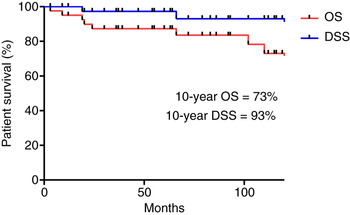
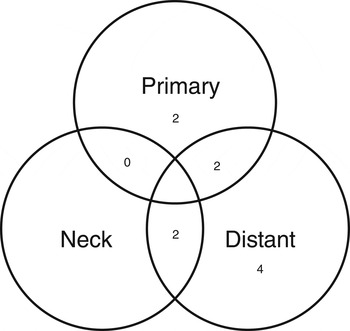
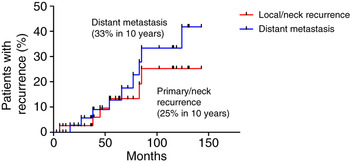
The 5-year disease-specific survival and overall survival rates were 97 per cent and 87 per cent, respectively; the 10-year disease-specific survival rate was 93 per cent (Figure 1). The mean time to recurrence was 56 months. Eleven patients in this group (28 per cent) had tumour recurrence: nine of these were distant pulmonary metastases. The recurrence pattern is shown in Figure 2 and the time to recurrence is shown in Figure 3.
Graph showing the 10-year overall survival and disease-specific survival rates for the radical treatment group (n = 40). DSS = disease-specific survival; OS = overall survival

Diagram showing the tumour recurrence pattern in the radical treatment group.

Graph showing the time to recurrence in the radical treatment group.

Disease control group
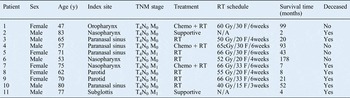
All 11 patients in this group had stage IV disease: 6 men (55 per cent) and 5 women (45 per cent), with a median age of 70 years (range, 47–83 years). Two patients had adenoid cystic carcinoma of the major salivary gland (parotid gland), and nine had adenoid cystic carcinoma of the minor salivary glands. Seven patients had stage T4N0 M0 tumours with intracranial and/or orbital involvement, and four had clinically staged T4N0M1 tumours with lung metastases. The histology pattern was solid in two tumours, tubular in one, cribriform in four and unrecorded in four. The treatment and survival times of these patients are shown in Table V.
Disease control group*: treatment and follow up

* n = 11. Y = years; TNM = tumour–node–metastasis; chemo = chemotherapy; RT = external-beam radiotherapy; F = fraction
The median follow up was 21 months (range, 2–172 months). Six patients received radiotherapy, three received chemoradiotherapy and two had supportive treatment. Five patients received radical radiotherapy (total dose of at least 60 Gy to the primary site over a four- to six-week period). Seven patients died and the median time to death was 8 months (range, 2–52 months): six deaths were due to disease and one to a rectal carcinoma. Of the four remaining disease control group patients, two had primary paranasal sinus tumours (one in the nasopharynx and one in the oropharynx). All four had radical radiotherapy. The median follow up was 96 months (range, 43–172 months).
Discussion
Adenoid cystic carcinoma is a rare salivary gland tumour that accounts for 1 per cent of all head and neck malignancies. It affects people in all decades of life and has no known risk factors. As it is a locally aggressive tumour, surgery is the mainstay of treatment. There is a tendency toward nerve involvement. Late metastases are a characteristic feature, with lung metastases developing as long as 10 years after the primary treatment. Tumours are classified into solid, cribriform and tubular histotypes: the solid type is considered a high-grade lesion with more aggressive biological behaviour and is associated with a poorer short-term survival rate.Reference Bhayani, Yener, El-Naggar, Garden, Hanna and Weber1–Reference Batsakis, Luna and El-Naggar3
Various clinicopathological factors are associated with a poor prognosis, including advanced age, site, nodal metastases, close or positive margins, tumour site, advanced pathological tumour and node stage, histological grade, extracapsular spread, bone invasion, muscle invasion, and distant metastases.Reference Amit, Binenbaum, Sharma, Ramer, Ramer and Agbetoba4–Reference Michel, Joubert, Delemazure, Espitalier, Durand and Malard7 As the case series was small (n = 40), limited conclusions can be drawn from the univariate analysis. The only risk factor approaching statistical significance for disease-specific survival was vascular invasion.
There was no significant difference in the overall patient survival rates for adenoid cystic carcinoma in the major and minor salivary glands (p = 0.106), and patient numbers were too small for stratification by tumour site. However, tumours arising in the major salivary glands may confer better overall survival rates.Reference Bhayani, Yener, El-Naggar, Garden, Hanna and Weber1, Reference Amit, Binenbaum, Sharma, Ramer, Ramer and Agbetoba4, Reference Ellington, Goodman, Kono, Grist, Wadsworth and Chen8 The disease-specific survival rate is better for patients with adenoid cystic carcinoma of the major salivary glands than for those with a minor salivary adenoid cystic carcinoma.Reference Lloyd, Yu, Wilson and Decker9 Although adenoid cystic carcinoma of the paranasal sinuses, in particular, is very rare, it is thought to confer the worst survival rates: the five-year overall survival rate is 62–68 per cent,Reference Amit, Binenbaum, Sharma, Ramer, Ramer and Agbetoba4, Reference Michel, Joubert, Delemazure, Espitalier, Durand and Malard7, Reference Sanghvi, Patel, Patel, Kalyoussef, Baredes and Eloy10–Reference Khan, DiGiovanna, Ross, Sasaki, Carter and Son12 and the five-year disease-free survival rate is 43 per cent.Reference Sanghvi, Patel, Patel, Kalyoussef, Baredes and Eloy10
Patients in this study had a five-year disease-specific survival rate of 97 per cent; those in other series had rates of 68–83 per cent.Reference Amit, Binenbaum, Sharma, Ramer, Ramer and Agbetoba4, Reference van Weert, Bloemena, van der Waal, de Bree, Rietveld and Kuik6, Reference Lloyd, Yu, Wilson and Decker9, Reference Duberge, Benezery, Resbeut, Azria, Minsat and Ellis13 However, the high late recurrence rate associated with this tumour means that the disease-specific survival rate can be as low as 54 per cent at 10 years.Reference van Weert, Bloemena, van der Waal, de Bree, Rietveld and Kuik6 In the present study, the 10-year disease-specific survival rate was higher at 93 per cent (Figure 1). Several reasons may account for this: 58 per cent of patients were aged under 60 years; 68 per cent had tumours located in the major salivary glands; 85 per cent had early stage (T1–2) disease; and 75 per cent had post-operative radiotherapy as well as radical surgery.
Minor salivary gland tumours are reported to have a regional recurrence rate of up to 37 per cent and a distant metastatic rate of 21 per cent.Reference Wang, Ge, Wang, Tan, Chen and Xu14 In this study, the recurrence rate in the radical treatment group was 28 per cent (11 patients, 9 with distant pulmonary metastases). The recurrence rates for minor and major salivary gland tumours were 31 per cent (four patients) and 30 per cent (seven patients), respectively. The pattern of local, regional and distant recurrence is shown in Figure 2. Seven of the 11 recurrent tumours were in patients with a primary adenoid cystic carcinoma located in the major salivary gland: 3 parotid, 3 submandibular and 1 sublingual tumour. All seven tumours had close or positive margins and perineural invasion treated with post-operative radiotherapy. The median time to recurrence was 66 months (range, 16–124 months). Only one patient had a primary site recurrence: the other six had regional recurrence and distant metastasis (mostly to the lungs). Five of the nine patients with lung metastases received palliative radiotherapy. No patients underwent metastasectomy, although there are contradictory reports that it provides a survival advantage. Advocates for lung metastasis resection reported good survival rates.Reference Liu, Labow, Dang, Martini, Bains and Burt15 However, solitary lung metastases are unusual and such patients can remain relatively stable for substantial periods of time.Reference Spiro16
For four recurrent tumours, the index primary sites were in the minor salivary glands: one in the palate and three in the paranasal sinuses. Information on perineural invasion and tumour margins was incomplete in the case records, thus precluding any meaningful observations. The median time to recurrence was 42 months (range, 6–85 months). Three of the four patients had recurrence at the index primary site. This finding is consistent with previous reports that adenoid cystic carcinoma arising from sites close to the skull base have a significantly higher risk of local recurrence. In such cases, surgical resection may be limited by adjacent critical structures. Radiotherapy appears to be less effective for macroscopic residual disease than for microscopic disease.
Eleven patients had stage IV disease (Table V): of these, four had lung metastases at presentation. Five patients with unresectable disease had definitive radiotherapy with a minimum dosage of 60 Gy over 6 weeks: of these, three remain alive (mean follow up, 78 months). While surgical resection is the mainstay of treatment for adenoid cystic carcinoma, resectability depends on the tumour size, location and extent, as well as the presence of co-morbidities. The optimal non-surgical management is undefined. However, in unresectable disease, radical radiotherapy with palliative intent can result in excellent disease control. Therefore, patients with unresectable adenoid cystic carcinoma with or without distant metastasis should be considered for definitive radiotherapy on an individual basis at the discretion of the local multidisciplinary team.
In a large international multicentre study of over 180 adenoid cystic carcinoma patients treated over 40 years, Iseli et al. reported local recurrence-free survival rates of 68 per cent at 5 years and 41 per cent at 10 years.Reference Iseli, Karnell, Graham, Funk, Buatti and Gupta17 In addition, local recurrence-free survival at 10 years was significantly worse following radiotherapy alone than after surgery either alone or combined with post-operative radiotherapy.Reference Iseli, Karnell, Graham, Funk, Buatti and Gupta17 Advanced tumour stage, perineural invasion, a solid subtype, or close or positive margins predicted local recurrence. Another large series reported a 17 per cent locoregional recurrence rate.Reference Amit, Binenbaum, Sharma, Ramer, Ramer and Agbetoba4 Spiro reported treatment failure in 62 per cent of patients, 38 per cent of whom had distant metastases. The high incidence of distant metastases with locoregional treatment failure set the precedence for aggressive initial surgery combined with post-operative radiotherapy for high-stage tumours or those with positive surgical margins.Reference Spiro16
The efficacy of radiotherapy alone as a primary treatment modality for adenoid cystic carcinoma in the head and neck has been debated. When used as a primary modality alone it does not confer a good overall survival rate.Reference Iseli, Karnell, Graham, Funk, Buatti and Gupta17 Most studies report that treatment of adenoid cystic carcinoma at multiple sites with surgery and adjuvant radiotherapy enhances local control.Reference Liu, Labow, Dang, Martini, Bains and Burt15, Reference Terhaard, Lubsen, Van der Tweel, Hilgers, Eijkenboom and Marres18–Reference Garden, Weber, Morrison, Ang and Peters21 However, others have reported better local control or no effect on overall survival rate with post-operative radiotherapy alone for those with advanced tumours or positive tumour margins.Reference Duberge, Benezery, Resbeut, Azria, Minsat and Ellis13, Reference Silverman, Carlson, Khuntia, Bergstrom, Saxton and Esclamado22 As a treatment adjunct, neutron beam radiotherapy seems to confer a slightly better outcome compared with mixed beam or photon radiotherapy.Reference Douglas, Laramore, Austin-Seymour, Koh, Stelzer and Griffin23, Reference Huber, Debus, Latz, Zierhut, Bischof and Wannenmacher24 A role for chemotherapy in adenoid cystic carcinoma treatment is still developing. Trials have shown that current chemotherapy regimens may improve the quality of life but not the overall survival rate for patients with distant metastases from adenoid cystic carcinoma of the head and neck.Reference Spiro16
Metastases usually occur in the lungs and bone: outcomes are worse for patients with bone involvement with or without lung metastases than for those with isolated pulmonary metastasis.Reference Sung, Kim, Kim, Min, Seong and Rok2 In this study, the mean time to recurrence was 56 months. This is much longer that the mean time of 36 months reported in a large study by Spiro.Reference Spiro16 In another study, 52 per cent of patients developed metastases within the first five years post-treatment.Reference van Weert, Bloemena, van der Waal, de Bree, Rietveld and Kuik6 Again, the present series has more favourable recurrence pattern, with a third of patients having distant metastases at 10 years and only a quarter having locoregional recurrence at 10 years (Figure 3). In the most recent large multinational study of recurrence patterns, Amit et al. reported that the presence of nodal metastases, a sinonasal origin, the presence of distant metastases, age 70 years and older, and close or positive margins were associated with a poor overall prognosis.Reference Amit, Binenbaum, Sharma, Ramer, Ramer and Agbetoba5
• Head and neck adenoid cystic carcinoma is a locally aggressive tumour with a tendency for nerve involvement
• Surgery is the mainstay of treatment for this tumour type
• Surgical intervention is usually feasible but local recurrence is common even with clear surgical margins and many disease-free years
• More than a quarter of the cohort treated with radical intent had tumour recurrence, mainly to the lungs
• Patients with unresectable adenoid cystic carcinoma may benefit from definitive radiotherapy
Management of adenoid cystic carcinoma of the head and neck remains challenging. This case series showed a 10-year disease-specific survival rate of 93 per cent. Many clinicopathological factors did not have a significant effect on outcome, unlike in other series. The presence of locally invasive and inoperable disease at presentation did not preclude radical treatment options. Definitive radiotherapy should therefore still be considered on an individual basis because it may provide local control and prolong survival. Long-term follow up is essential because late tumour recurrence is common. This remains a difficult disease to treat, and further studies are warranted to improve treatment outcomes.