Introduction
Root-knot nematodes (RKNs) are recognized as major agricultural pathogens, causing expressive losses in many crops (Jones et al., Reference Jones, Haegeman, Danchin, Gaur, Helder, Jones, Kikuchi, Manzanilla-López, Palomares-Rius, Wesemael, Roland and Perry2013). Among several species that parasitize coffee plants, Meloidogyne paranaensis (Carneiro et al., Reference Carneiro, Carneiro, Abrantes, Santos and Almeida1996) is especially important, hindering plant growth and causing losses of approximately 35% in yield (Lopez-Lima et al., Reference Lopez-Lima, Sánchez-Nava, Carrion, Monteros and Villain2015). The damage can be even higher depending on the level of attack and on the genetic variability within nematode population (Santos et al., Reference Santos, Correa, Peixoto, Mattos, Silva, Moita, Salgado, Castagnone-Sereno and Carneiro2018).
M. paranaensis is widely spread in Coffea arabica and C. canephora coffee growing areas in Brazil and other Latin American countries (Barros et al., Reference Barros, Oliveira, Zambolim, Ferreira and Coutinho2011; Barros et al., Reference Barros, Oliveira, Lima, Coutinho, Ferreira and Costa2014; Villain et al., Reference Villain, Sarah, Hernandez, Bertrand, Anthony, Lashermes, Charmetant, Anzueto and Carneiro2013). The alarming rise in the occurrence of this nematode in Minas Gerais State (Castro et al., Reference Castro, Campos and Naves2003; Castro et al., Reference Castro, Campos, Pozza, Naves, Andrade Junior, Dutra, Coimbra, Maximiniano and Silva2008; Salgado et al., Reference Salgado, Guimarães, Botelho, Tassone, Marcelo, Souza, Oliveira and Ferreira2015), the largest C. arabica-producing state in Brazil, requires management practices to ensure the sustainability of coffee production in these areas. The use of resistant cultivars is the best way to cultivate coffee plants in soils infested by RKNs. While most of C. arabica cultivars are susceptible to M. paranaensis, C. canephora shows genetic variability in their resistance to this nematode species (Bertrand et al., Reference Bertrand, Peña Durán, Anzueto, Cilas, Etienne, Anthony and Eskes2000; Fatobene et al., Reference Fatobene, Andrade, Gonçalves and Guerreiro Filho2018).
Some clones of Conilon coffee cultivar Vitoria Incaper 8142 of C. canephora exhibited multiple resistance to M. exigua, M. incognita, and M. paranaensis (Lima et al., Reference Lima, Furlanetto, Nicole, Gomes, Almeida, Jorge-Júnior, Correa, Salgado, Ferrão and Carneiro2015) under controlled conditions. Because Conilon coffee is recommended for regions at low altitudes, the goal of this study was to evaluate the agronomic performance of resistant clones of Conilon coffee cultivar Vitoria Incaper 8142 in areas infested by M. paranaensis in the west region of Minas Gerais.
Material and Methods
In this study, we evaluated five coffee clones 2V, 3V, 6V, 7V, and 13V resistant to M. paranaensis, and the susceptible clone 12V, previously screened by Lima et al. (Reference Lima, Furlanetto, Nicole, Gomes, Almeida, Jorge-Júnior, Correa, Salgado, Ferrão and Carneiro2015). Cultivar Catuaí Vermelho IAC 99 of C. arabica was used as a susceptible control. Clonal seedlings were formed from cuttings derived from orthotropic branches (OB) in polyethylene bags with commercial substrate (Fonseca et al., Reference Fonseca, Ferrão, Ferrão, Verdin Filho, Volp, Bittencourt, R.G., A.F.A., M.A.G. and L.H.2007).
The experiment was conducted for 4 years in Piumhi MG, Brazil (20°25′28″S; 46°1′10″W; 812 m a.s.l.), in a field previously cultivated with C. arabica and infested by M. paranaensis esterase phenotype P1 (Carneiro and Almeida, Reference Carneiro and Almeida2001). The soil texture was 61% clay, 28% silt, and 11% sand. The average air temperature and rainfall during the growing seasons were 20.5 °C and 1588 mm in 2011/2012; 21.1 °C and 1417 mm in 2012/2013; 21.0 °C and 924 mm in 2013/2014; and 21.3 °C and 1259 mm in 2014/2015. Clonal seedlings of the Vitoria Incaper 8142 and susceptible control Catuaí Vermelho IAC 99 were planted in a randomized block design with five replicates, that is, plots of seven plants, spaced 3.5 m between rows and 0.7 m between plants, in December 2012.
The infective population of M. paranaensis in the soil was evaluated twice: at the beginning of the experiment (Biotest 1) and at the first coffee harvest in June 2015 (Biotest 2). Soil samples from three equidistant spots in the plot were collected, mixed, and placed in 550 cm3 plastic pots to grow the susceptible tomato cultivar Santa Clara. Then, the population of M. paranaensis, eggs + J2, was quantified in tomato roots after 60 days. Extraction of nematodes was conducted according to Hussey and Barker (Reference Hussey and Barker1973), adapted by Bonetti and Ferraz (Reference Bonetti and Ferraz1981). The population of M. paranaensis (eggs + J2) was also evaluated in roots of coffee clones. Four subsamples of roots were collected in equidistant spots at 20 cm from the central axis of the plant and a depth of 30 cm, both perpendicular to the direction of the crop line. The samples were collected during the first coffee harvest in June 2015. Again, nematodes were extracted according to Hussey and Barker (Reference Hussey and Barker1973), adapted by Bonetti and Ferraz (Reference Bonetti and Ferraz1981) and counted using a Peter’s slide under a biological microscope. Population density was expressed as the number of eggs + J2 per gram of roots (NEM g−1).
Vegetative traits like plant height (PH), in centimeters from the stem base to the apex of the plants, number of OB, stem diameter (SD), in centimeters measured at the stem base 10 cm above the ground, and canopy diameter (CD), in centimeters measured at 50 cm above the ground, were evaluated 48 months after planting. The vegetative vigor (VV) was evaluated according to the scale proposed by Carneiro (Reference Carneiro1995), where the score 5 means plants with excellent VV while the score 0 indicates extremely depleted or dead plants. Plants that scored from 0 to 2 were considered susceptible, and from 3 to 5 were considered tolerant and/or resistant. They were also evaluated for the percentage of dead plants (%DP). Initial reproductive development was evaluated through fruit yield (FY) in liters and the percentage of fruit with at least one empty locule (%FEL). Fruit ripening was evaluated through the percentage of green fruits (%GF).
An analysis of variance (ANOVA) was performed using the ‘agricolae’ package of the R statistical software (R Core Team, 2016; Mendiburu, Reference Mendiburu2015). Data were transformed when they did not fit the assumptions of the ANOVA. The clone means were compared by Tukey’s test using the ‘HSD.test’ function from the ‘agricolae’ package (p < 0.05).
Results
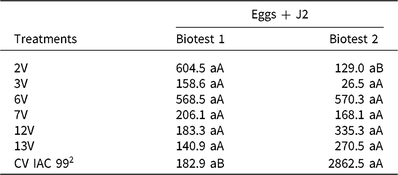
The presence and infectivity of M. paranaensis in the experimental field were confirmed in both biotests (Table 1). No significant differences (p > 0.05) were obtained between the number of nematodes in clone plots in both individual and joint variance analyses, indicating that the infestation of nematodes was homogeneous in the field. This condition was essential to the avoidance of erroneous evaluation of clone resistance. Significant effects were observed for the interaction years × clones in the joint ANOVA. There was a decrease in the nematode population in clone 2V, and an increase in the nematode population in the susceptible control Catuaí Vermelho IAC 99.
Average number1 of Meloidogyne paranaensis (eggs + J2) on roots of tomato plants grown in soil sampled in clone plot biotests

1 Means followed by the same capital letter in rows and by the same lowercase letter in columns do not differ at the 0.05 probability level according to the Tukey’s test.
2 Susceptible control Coffea arabica cultivar Catuaí Vermelho IAC 99.
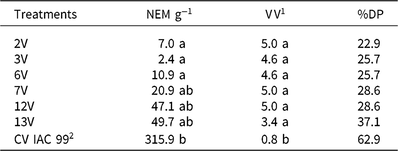
Clones 2V, 3V, and 6V showed low nematode population density and good VV (Table 2). Clones 7V and 13V showed intermediate means of NEM g−1 but also presented high scores of VV. Clone 12V, previously classified as susceptible to M. paranaensis, presented vegetative growth and FY similar to those of the other Conilon coffee clones. As expected, the susceptible control Catuaí Vermelho IAC 99 had the largest NEM g−1 and consequently the lowest VV and high %DP.
Number of eggs + J2 of Meloidogyne paranaensis per gram of root (NEM g−1), vegetative vigor (VV), and percentage of dead coffee plants (%DP)

For NEM g−1 and VV, means followed by the same letter in columns do not differ at the 0.05 probability level according to the Tukey’s test.
1 Vegetative vigor scores according to the scale of Carneiro (Reference Carneiro1995).
2 Susceptible control Coffea arabica cultivar Catuaí Vermelho IAC 99.
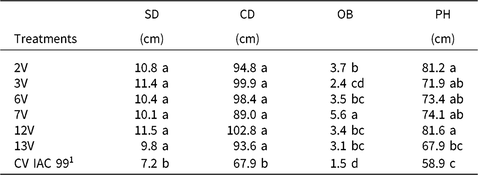
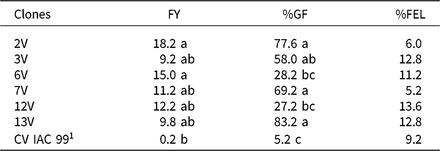
On average, the vegetative traits in clones of Vitoria Incaper 8142 were significantly higher than in the susceptible control Catuaí Vermelho IAC 99 (Table 3). While some of these differences could be influenced by the resistance to nematodes, others were caused by botanical characters intrinsic to each species, such as the higher number of OB in C. canephora clones. Clones of Vitória Incaper 8142 showed higher FY and later ripening than the susceptible control Catuaí Vermelho IAC 99 (Table 4).
Stem diameter (SD), canopy diameter (CD), number of orthotropic branches (OB), and plant height (PH) of Coffea canephora clone cultivar Vitoria Incaper 8142 and Coffea arabica cultivar Catuaí Vermelho IAC 99 in a field infested by Meloidogyne paranaensis

Means followed by the same letter in columns do not differ at the 0.05 probability level according to the Tukey’s test.
1 Susceptible control Coffea arabica cultivar Catuaí Vermelho IAC 99.
Average fruit yield (FY), percentage of green fruits (%GF), and percentage of fruits with at least one empty locule (%FEL) for clones of Coffea canephora cultivar Vitoria Incaper 8142 and Coffea arabica cultivar Catuaí Vermelho IAC 99 in a field infested by Meloidogyne paranaensis

For FY and %GF, means followed by the same letter in columns do not differ at the 0.05 probability level according to the Tukey’s test.
1 Susceptible control Coffea arabica cultivar Catuaí Vermelho IAC 99.
Discussion
The clones 2V, 3V, 6V 7V, and 13V of Vitoria Incaper 8142, classified as resistant to M. paranaensis under controlled conditions (Lima et al., Reference Lima, Furlanetto, Nicole, Gomes, Almeida, Jorge-Júnior, Correa, Salgado, Ferrão and Carneiro2015), also showed good performance in the field infested by M. paranaensis. The clones 2V, 3V, 6V, and 7V were also resistant to M. exigua (Lima et al., Reference Lima, Furlanetto, Nicole, Gomes, Almeida, Jorge-Júnior, Correa, Salgado, Ferrão and Carneiro2015), a valuable feature considering the widespread nature of this species within coffee plantations. In addition to the survival and good fitness of plants, integrated management of nematodes must consider the ability of plants to reduce the nematode population in fields as the extensive use of mechanization may promote the dissemination of nematodes. For this reason, clone 12V should not be planted in soils infested by M. paranaensis, despite its good performance.
The low FYs of C. arabica Catuaí Vermelho IAC 99 in the first harvest were also observed by Carvalho et al. (Reference Carvalho, Salgado, Mendes, Pereira, Botelho, Tassone and Lima2017) in areas infested by M. paranaensis. On the other hand, yields of clones were not affected by nematode parasitism, even in a distinct edaphoclimatic region at an altitude about 800 m. In fact, clones of the Conilon coffee-like cultivar Vitória Incaper 8142 were recommended for regions with average annual air temperatures between 22 and 26 °C and altitudes below 650 m (Taques and Dadalto, Reference Taques, Dadalto, Ferrão, Fonseca, Ferrão and Muner2017).
Most studies evaluating the performance of coffee genotypes cultivated in soil infested by Meloidogyne spp. were conducted under controlled conditions. Although requiring more time, the evaluation of genotypes in the field is extremely important for coffee breeding programs because the evaluation is more reliable (Oliveira et al., Reference Oliveira, Pereira, Silva, Rezende, Botelho and Carvalho2011) and the selection is more efficient. The use of coffee cultivars resistant to nematodes and adapted to specific environmental conditions can effectively contribute to the improvement of plant performance in infested areas, increasing yield, reducing production costs, and ensuring greater competitiveness and sustainability of coffee production (Carvalho et al., Reference Carvalho, Salgado, Mendes, Pereira, Botelho, Tassone and Lima2017).
Genetic control of nematodes has been implemented with relative success in coffee breeding. The first strategy adopted by breeding programs was the development of resistant C. canephora rootstocks Apoatã IAC 2258 (Gonçalves et al., Reference Gonçalves, Ferraz, Lima and Silvarolla1996) and Nemaya (Bertrand et al., Reference Bertrand, Peña Durán, Anzueto, Cilas, Etienne, Anthony and Eskes2000). Both are resistant to M. exigua but with different levels of resistance segregation to M. incognita and M. paranaensis. A more recent study identified clones of C. canephora with multiple resistance to M. incognita and M. paranaensis (Fatobene et al., Reference Fatobene, Andrade, Gonçalves and Guerreiro Filho2018) that could be used in the breeding of new rootstocks or ungrafted cultivars of C. canephora. Currently, some ungrafted cultivars of C. arabica resistant to RKNs are available, such as IPR 100 resistant to M. paranaensis (Sera et al., Reference Sera, Sera, Ito, Mata, Doi, Azevedo and Ribeiro Filho2007) and to M. exigua (Rezende et al., Reference Rezende, Andrade, Salgado, Rezende, Menezes and Carvalho2017), and IAC 125 RN (Fazuoli et al., Reference Fazuoli, Braghini, Silvarolla, Gonçalves, Mistro, Gallo and Guerreiro Filho2018) and IAPAR 59 (Salgado et al., Reference Salgado, Resende and Campos2005) resistant to M. exigua.
Considering resistance to RKNs and the increasing demand for ‘Robusta’ and ‘Conilon’ coffees in the international market, clones 2V, 3V, 6V, and 7V of Vitoria Incaper 8142 of C. canephora represent alternatives to coffee production in areas infested by M. paranaensis, as well as in areas traditionally cultivated with C. arabica.
Author ORCIDs
Bárbhara Joana dos Reis Fatobene, 0000-0002-8885-761X
Acknowledgement
The authors are grateful to Consórcio Pesquisa Café, CNPq, CAPES, FAPEMIG, and INCT-Café.