Understanding the complex relationships between social identities, long-distance exchange, and migration has long been an important issue in archaeology. In the central Andes, archaeologists have grappled with these issues to understand highland–coastal relationships since the inception of archaeological investigations more than 100 years ago. Here we present a case study of highland–coastal relationships in the coca-growing zone of the Moche Valley (the chaupiyunga zone between 200 and 1200 m asl) during the Early Intermediate period (EIP; 400 BC–AD 600).Footnote 1
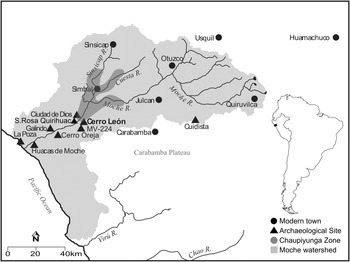
Our investigations focus on the reconstruction of the social identities of the people who lived at Cerro León through the study of daily life at the household level. Cerro León was a large hill town situated astride one of the main access routes into the chaupiyunga from the highlands. It is unusual in that most of the pottery at the site in terms of paste, firing, form, and decoration is highland in style (Billman Reference Billman1996; Ringberg Reference Ringberg2012). In addition to Cerro León, there are 113 sites in the Moche Valley chaupiyunga with highland-dominated pottery assemblages dating to the EIP (referred to as HEIP sites; Figure 1); these HEIP sites are highly unusual because highland-style pottery is rare in sites dating to the preceding and subsequent periods in the Moche chaupiyunga (Billman Reference Billman1996). With the exception of the HEIP sites, chaupiyunga pottery assemblages are consistent with the Virú Valley sequence (Collier Reference Collier1955; Ringberg Reference Ringberg2012; Strong and Evans Reference Strong and Clifford Evans1952).
Location of the chaupiyunga zone in the Moche Valley on the north coast of Peru, including sites mentioned in the text.

Too often in the central Andes, archaeologists have viewed ceramic styles as a direct indicator of social identity, migration, or even conquest. However, pottery alone is not sufficient to indicate group identities or to infer large-scale migration or regional political machinations. Consequently, we focus our research on the analysis of a broad range of quotidian and ritual activities manifested at the household level.
To understand the nature of highland–coastal relationships in the Moche chaupiyunga in the EIP, we examine three key questions: (1) When and for how long was Cerro León occupied? (2) What were the sources of the highland-style pottery found at Cerro León? (3) Was the site occupied by immigrants from the highlands? The results of our research indicate that Cerro León was occupied for 100–200 years between AD 1 and AD 350, during the Gallinazo and Early Moche phases. Petrographic analyses by Ringberg (Reference Ringberg2012) indicate that the sources of highland-style pottery were the adjacent highland areas of the Otuzco Basin and Carabamba Plateau (Figure 1). Our analysis of daily domestic activities, vernacular architecture, personal adornment, and ritual practices, including burial practices, indicates that most of the residents of Cerro León were highland immigrants. We refer to these highland people as Culle.Footnote 2 Evidence indicates that the Culle residents had extensive exchange relationships with local communities in the lower and middle Moche Valley. We refer to these local people as Yunga, the generic term used by the Spanish in the colonial era to refer to the Indigenous people living on the coast of Peru (0–200 m asl; Urban Reference Urban2019:20).
Cerro León and other HEIP sites in the chaupiyunga were abandoned in the Early Moche phase, just before formation of the Southern Moche polity and the construction of Huacas de la Luna and del Sol around AD 300. Although understanding the reasons for the abandonment of HEIP communities requires further investigation, our analysis demonstrates that the people living at Cerro León actively maintained a highland social identity throughout its multigenerational occupation while engaging in exchange and social relationships with Yunga communities.
Highland–Coastal Interaction in the Chaupiyunga
On the western slope of the central Andes, the chaupiyunga was a zone of intensive highland–coastal interaction in the EIP. The occurrence of intrusive sites with highland pottery assemblages dating to the EIP is not unique to the Moche Valley. Indeed, incursions of highlanders into the chaupiyunga during this period have been proposed for the Virú (Topic and Topic Reference Topic and Topic1982), Nepeña (Proulx Reference Proulx1982), Casma (Pozorski Reference Pozorski, Haas, Pozorski and Pozorski1987), Chillón (Dillehay Reference Dillehay1976, Reference Dillehay1979, Reference Dillehay1987), and Lurín Valleys (Patterson et al. Reference Patterson, McCarthy and Dunn1982). The occurrence of so many sites with highland ceramics in the chaupiyunga during the EIP begs these questions: What was the nature of highland–coastal interaction during that period, and what was its impact on the broader prehistory of the coast?
Consisting of a narrow band of irrigated bottomland flanked by steeply sloping mountains, the chaupiyunga ecozone lies between the highland and coastal agricultural zones in the foothills of the Andes. What sets it apart from other ecozones is that it is the only area on the western slopes of the Andes where coca can be grown. Coca has long served an essential role in Andean lifeways, from reciprocity and ritual to statecraft and quotidian labor (Allen Reference Allen1981, Reference Allen1988; Murra Reference Murra1980). The Moche chaupiyunga was, and still is, especially important, because it is one of the few areas in the Andes that is suitable for cultivating sweet coca (Trujillo coca, Erythroxylum novogranatense var. truxillense; Plowman Reference Plowman, Pacini and Franquemont1986). Also known as tupa or noble coca, it was highly valued for its flavor, which contrasts with the bitter taste of coca grown on the eastern slopes of the Andes (Erythroxylum coca var. coca).
Many scholars have noted that the chaupiyunga was an important locus of coast and highland interaction in the Indigenous and colonial eras because of the presence of coca fields, with various groups vying for their control (Dillehay Reference Dillehay1976, Reference Dillehay1979, Reference Dillehay1987; Netherly Reference Netherly and Keatinge1988; Rostworowski de Diez Canseco Reference Rostworowski1973, Reference Rostworowski1977, Reference Rostworowski1988). A key challenge for Indigenous communities in the central Andes was gaining access to resources in other ecozones, especially coca, with its highly restricted range. Ethnohistoric sources dating to the 1500s and 1600s describe three strategies used by highland communities to obtain coca and other chaupiyunga resources (Murra Reference Murra and Murra1972; Netherly Reference Netherly and Keatinge1988; Rostworowski de Diez Canseco Reference Rostworowski1988). John Murra (Reference Murra and Murra1972) proposed that Andean communities and polities controlled “vertical archipelagos” encompassing multiple ecozones as a way to acquire resources outside their home territory. He argued that this system of ecological complementarity resulted in mosaics of peacefully coexisting satellite communities in different vertical ecozones, each linked to their mother settlements. Although criticized as universalizing (Van Buren Reference Van Buren1996), Murra's work on vertical complementarity is among the most influential ethnohistorical works in the Andes. In this scenario, HEIP settlements might have been colonies established by highland communities by peaceful means to gain access to coca and other chaupiyunga resources.
María Rostworowski de Diez Canseco (Reference Rostworowski1978) proposed that another way in which communities in the central Andes gained access to goods from different ecological zones was through craft specialization and exchange between independent polities, or seniorios. She documented this type of interaction among highland communities in the Late Intermediate period in the Chillón, Rimac, and Lurín Valleys (AD 1000–1400s). Some highland households specialized in the production of pottery, which they exchanged for goods from other communities. The importance of specialization and exchange relationships may not have been solely economic, because exchange relationships in preindustrial societies often were an essential part of alliance negotiations (Marcus and Silva Reference Marcus, Silva and Rostworowski de Diez Canseco1988; Stanish Reference Stanish1992). In this scenario, highland pottery at HEIP sites could have resulted from craft specialization and exchange between highland and coastal communities, rather than colonization by highland groups, as suggested by Murra.
Rostworowski de Diez Canseco (Reference Rostworowski1973, Reference Rostworowski1978, Reference Rostworowski1988) also found evidence of violent conflict between coastal and highland groups over control of coca fields in court testimonies for a legal dispute over irrigated coca fields in the Chillón Valley in the 1500s. Members of highland communities testified that their ancestors had conquered the chaupiyunga, taking control of the coca fields from coastal communities, whom highlanders described as militarily weak and easily conquered. However, witnesses from coastal communities countered that their ancestors were fierce warriors who had always controlled the coca fields in the chaupiyunga.
Based on an analysis of settlement pattern data from the middle valley, Billman (Reference Billman1996, Reference Billman and Paine1997, Reference Billman, Billman and Feinman1999) similarly proposed that EIP highland–coastal relations in Moche Valley were violent. He concluded that in the early part of the EIP, there was a dramatic escalation of armed conflict between highlanders and coastal communities in the Moche Valley and elsewhere on the coast (see Daggett Reference Daggett, Haas, Pozorski and Pozorski1987; Pozorski Reference Pozorski, Haas, Pozorski and Pozorski1987; Proulx Reference Proulx1982). In Billman's reconstruction, highland polities conquered most of the Moche chaupiyunga, establishing a series of colonies. In the subsequent Middle Moche phase, highlanders were forcibly expelled from the middle valley by the emergent Southern Moche polity centered at the site of Huacas de Moche (Billman Reference Billman1996, Reference Billman, Billman and Feinman1999, Reference Billman2002).
In sum, archaeological and ethnohistoric sources indicate that HEIP sites may have been the result of one or more strategies used by highland communities to gain access to coca and other chaupiyunga resources. To evaluate these different scenarios, we excavated a sample of household compounds at Cerro León, the largest HEIP settlement in the Moche chaupiyunga. Our contextualized, practice-based approach allowed us to document two crucial interrelated phenomena: (1) the highland origins of the site's inhabitants and (2) the active multigenerational maintenance of Culle identity, which was negotiated in relation to local Yunga populations.
Examining the Social Identities of People of Cerro León
The identification of group identities in the archaeological record is rarely a simple or straightforward matter, as has been noted by many Andean scholars (Aldenderfer Reference Aldenderfer1993; Reycraft Reference Reycraft2005; Stanish Reference Stanish1989; Stovel Reference Stovel2013; Tsai Reference Tsai2020). Group identities are social constructions, forged in the crucible of shared histories. They are the products of collective social imaginations that are expressed and negotiated materially, spatially, and relationally (Holland-Lulewicz Reference Holland-Lulewicz2021; Hutson Reference Hutson2010; Jones Reference Jones1997; Robb and Pauketat Reference Robb, Pauketat, Robb and Pauketat2013; Wilson et al. Reference Wilson, Bardolph, Esarey and Wilson2020). They are also shaped by the shared practices of people who live together within households, neighborhoods, and settlements (Pacifico and Truex Reference Pacifico and Truex2019; Yaeger and Canuto Reference Yaeger, Canuto, Canuto and Yaeger2000).
Identities are expressed and negotiated through the structure of quotidian practices, as well as through special events, such as calendrical cycles of ritual events, pilgrimages, and fiestas (Bourdieu Reference Bourdieu1977; Holland et al. Reference Holland, Lachicotte, Skinner and Cain1998). Consequently, group identities are well represented in the material remains of domestic architecture, foodways, craft production, personal adornment, rituals, and burial practices (Aldenderfer Reference Aldenderfer1993; Bardolph Reference Bardolph2014; Robin Reference Robin2013; Stanish Reference Stanish1989; Voss Reference Voss2008). Although certain material indicators, such as ceramic sources, speak to regional origin of artifacts, other types of analysis can provide insight into identity.
To better understand the identities of the people of Cerro León, we used a practice-based, contextual approach (Allison Reference Allison1999; Billman Reference Billman, Johnson, Pacifico and Cutright2021; Billman et al. Reference Billman, Jennifer Ringberg, Briceño, Prieto and Boswell2019; Lightfoot et al. Reference Lightfoot, Martinez and Schiff1998). Practice-based archaeologists view activities and organizational patterns as key to understanding identity, with artifacts and artifact styles serving as a complement to the study of discursive social practices. The concept of communities of practice, defined both by their membership and the practices in which that membership engages (Eckert and McConnell-Ginet Reference Eckert and McConnell-Ginet1992:464), has gained popularity among archaeologists, including in the Andes (Roddick and Stahl Reference Roddick and Stahl2016). This concept is useful because it addresses the shortcomings of uncritical correlations of archaeological materials with identities and social (or ethnic) groups. A community of practice represents a group of people who come together by way of mutual engagement in certain endeavors.
In recent years, archaeologists studying identity and practice have focused much attention on the interpretation of quotidian life within households. However, we should not neglect the key role played by infrequent but regular public and private rituals in the negotiation of group identities and the construction of shared histories. Shared histories of sacred origins, immigration, wars, catastrophes, and other dramatic events bind people together in social groups and shape shared identities (Allen Reference Allen1988; Brumfiel Reference Brumfiel and Insoll2007; Tsai Reference Tsai2020). Such histories and identities are reinforced through the shared, repetitive experiences of calendrical cycles of rites of passage, feasting, fasting, pilgrimage, public rituals, and public spectacle. Consequently, our research considers both daily life and periodic ritual performances. We focus our investigations on five research domains: pottery manufacture and exchange, organization of domestic architecture and activities, ritual practices, foodways, and personal adornment.
History of Investigations at Cerro León
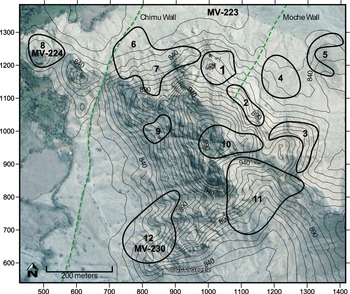
The prehistoric occupation of Cerro León was documented during a pedestrian survey of the middle Moche Valley in 1991 (Billman Reference Billman1996). Cerro León is the largest HEIP site complex in the middle valley (Figure 1), covering 43 ha, with 7 ha of domestic occupation. The site consists of dense concentrations of domestic architecture (Areas 1, 2, 3, 6, 7, and 8), fortifications (Areas 9–11), corrals (Area 4), and a ceremonial precinct (Area 5; Figure 2). Beginning in 2000, Billman and Briceño conducted nine field seasons of investigations at Cerro León (Billman et al. Reference Billman, Jennifer Ringberg, Briceño, Prieto and Boswell2019; Briceño and Billman Reference Briceño and Billman2018), which involved the detailed excavation of houses and the systematic recovery of household refuse through comprehensive screening of all deposits and systematic flotation sampling of all contexts. Excavations focused on three large domestic compounds (Compounds 1, 3, and 6) in Area 1 (Figure 2) and produced a large sample of artifacts and ecofacts. Although much analysis has been done to date (Bardolph Reference Bardolph2017; Billman Reference Billman, Johnson, Pacifico and Cutright2021; Billman et al. Reference Billman, Jennifer Ringberg, Briceño, Prieto and Boswell2019; Briceño and Billman Reference Briceño and Billman2018; Fariss Reference Fariss2012; Ringberg Reference Ringberg2012), analysis is ongoing. To examine the social identities of the occupants of Cerro León, we first sought to clarify the sources of pottery and the date and duration of occupation of the site.
Location of Areas 1–12 and Compounds 1, 3, and 6 within the Cerro León Archaeological Complex (sites MV-223, 224, and 230).

Date and Duration of Occupation of Cerro León
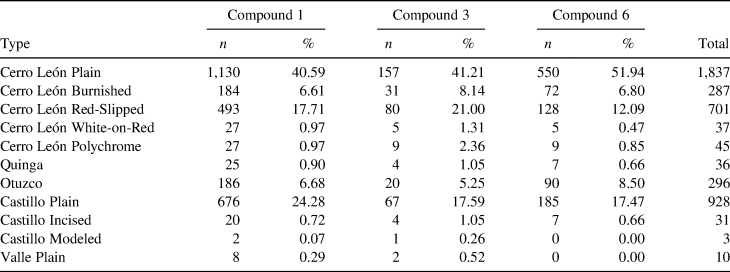
Ringberg's (Reference Ringberg2012) analysis of 162,000 sherds recovered from Cerro León indicated that the site was occupied sometime during the Gallinazo and Early Moche phases (AD 1–400). Absent are Salinar-phase pottery types (400–1 BC), such as Puerto Moorin White-on-red, Puerto Moorin Plain Red, and Huacapongo Polished (Brennan Reference Brennan1978; Collier Reference Collier1955; Strong and Evans Reference Strong and Clifford Evans1952). Consequently, the site was occupied at some point after the end of the Salinar phase. Castillo series types account for 23% of the pottery assemblage, the most common of which are Castillo Plain and Valle Plain (Ringberg Reference Ringberg2012:253), the primary utilitarian wares in the lower and middle Moche Valley from the Gallinazo phase through the end of the Late Moche phase in the AD 800s. Also present in the assemblage are Castillo Incised, Castillo Modeled, and Gallinazo Negative, types that were produced during a more limited period in the Gallinazo and Early Moche phases (AD 1–300; Collier Reference Collier1955; Strong and Evans Reference Strong and Clifford Evans1952). Early Moche-phase decorated pottery, such as Moche I and II stirrup-spout bottles (Donnan Reference Donnan1999; Larco Reference Larco Hoyle2001) and Huancaco Red and White (Strong and Evans Reference Strong and Clifford Evans1952:327–344), are absent. Also absent are Middle Moche phase decorated pottery, such as painted cántaros, single-spout or stirrup-spout bottles, floreros, and ceramic whistles, trumpets, and rattles (Donnan Reference Donnan1999; Donnan and Mackey Reference Donnan and Mackey1978; Russell et al. Reference Russell, Banks, Briceño and Shimada1998; Uceda and Armas Reference Uceda, Armas and Shimada1998). The only Moche-phase type recovered was one fragment of a hollow figurine in Compound 6 (Ringberg Reference Ringberg2012:179–180).
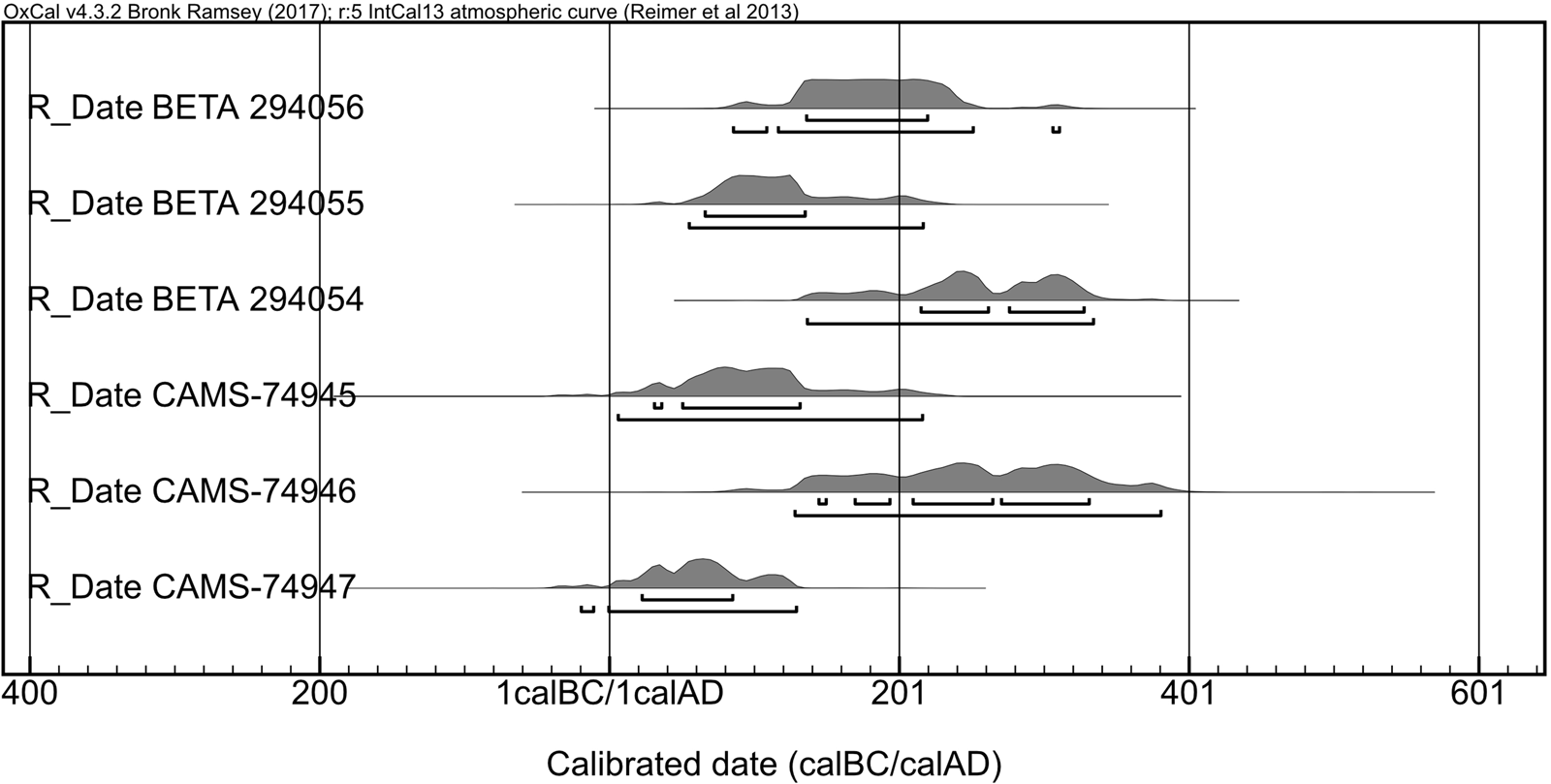
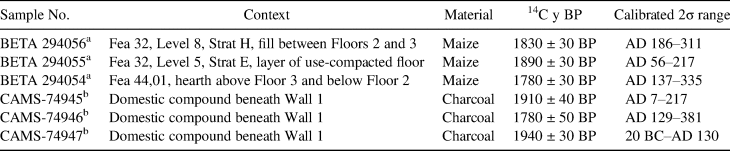
Six AMS dates corroborate the ceramic analysis (Table 1). All the samples were from undisturbed primary contexts, such as hearths and floors, and are associated with daily domestic activities. We dated fragments of maize cobs and charred twigs, rather than wood charcoal, to avoid problems caused by old wood and cross-sectional errors (Schiffer Reference Schiffer1986). Although the dates cluster between AD 1 and AD 350 (Figure 3), Cerro León probably was not occupied for that entire span. Analysis of remodeling events of Compounds 1, 3, and 6, combined with a pottery use-life study, indicates that the compounds were occupied for approximately 100–200 years between AD 1 to 350 (Ringberg Reference Ringberg2012).
Plot of calibrated radiocarbon dates from Areas 1 and 2, Cerro León (MV-225), based on SHCal13.

AMS Dates from Areas 1 and 2, Cerro León.

Note: Dates recalibrated on OxCal, using the ShCal13 curve.
a Ringberg Reference Ringberg2012.
b Huckleberry and Billman Reference Huckleberry and Billman2003.
Manufacture and Exchange of Pottery
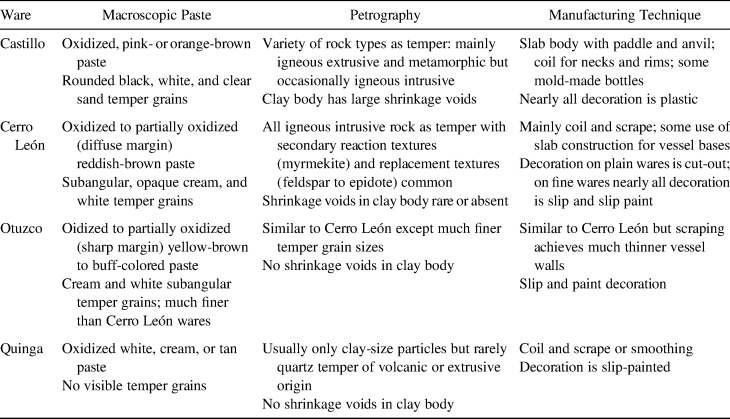
Our research indicates that only a small proportion of the pottery recovered from Cerro León was manufactured at or within 5 km of the site and that most of the pottery came from the adjacent highlands. Following Shepard (Reference Shepard1985; see Stoltman Reference Stoltman, Haliday, Goldberg and Reid Ferring2000; Velde and Druc Reference Velde and Druc1999), Ringberg conducted a petrographic study of pottery from Cerro León and other EIP Moche Valley sites, along with clay-source surveys within the Moche Valley. She also conducted a technological analysis (Rice Reference Rice1987; Rye Reference Rye1981) of rims, bases, and body sherds from Cerro León and defined four pottery wares: Castillo, Cerro León, Otuzco, and Quinga series (Table 2).
Descriptions of the Four Pottery Wares Identified at Cerro León.

Cerro León, Otuzco, and Quinga series pottery originated in the nearby highlands and were transported to Cerro León and other HEIP sites in the chaupiyunga. Cerro León and Quinga series pottery likely originated in the Carabamba Plateau, whereas Otuzco series pottery was from the Otuzco Basin in the upper Moche Valley. Clays and tempers of Castillo wares probably came from a massive source of alluvial clay near the Huacas de Moche in the lower Moche Valley. The highland origins of Cerro León, Otuzco, and Quinga wares, along with the coastal origins of Castillo wares, are indicated by petrographic differences in aplastic inclusions that connect these wares to source regions in the lower valley and the adjacent highlands (Ringberg Reference Ringberg2012:180). The three highland wares constituted 76% of the pottery from Cerro León, whereas 23% of the sherds were lower-valley Castillo wares (Table 3).
Frequencies of All Pottery Types per Residential Compound.

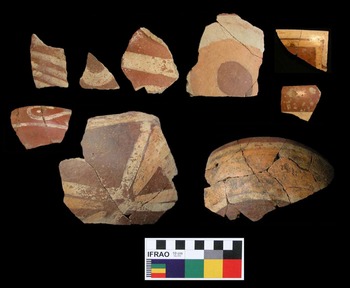
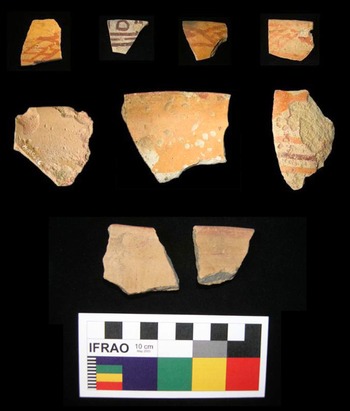
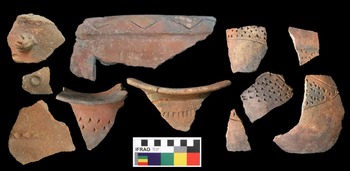
Cerro León, Otuzco, and Quinga series sherds are clearly distinct from Castillo series sherds in terms of manufacture, firing atmosphere, clay color, temper, surface treatment, and decoration (Figures 4–6). These distinctions probably were the result of discrete groups of highland potters learning their potting traditions while using local highland clays, tempers, and minerals for paints. Numerous large EIP fortified hill towns have been identified on the Carabamba Plateau and Otuzco Basin that contain Otuzco and Quinga series pottery (Topic and Topic Reference Topic and Topic1982). The nearest highland EIP hill towns are within 20–40 km of Cerro León, a short distance but a significant gain in elevation (>3,000 m). The distinct source regions and manufacturing traditions of the pottery assemblage at Cerro León indicate strong ties with potting communities in the highlands and significantly less engagement with Yunga potters.
Cerro León Series decorated pottery fragments.

Upper two rows, Quinga series white paste bowl fragments; bottom row, Otuzco series yellow paste cántaro fragments.

Castillo series vessel fragments with plastic decoration.

Group Identities at Cerro León
Having established a highland regional origin for the dominant wares in the pottery assemblage, we now consider various lines of evidence of the maintenance of Culle social identity. These inferences are based on our analysis of (1) the organization of domestic architecture and activities; (2) ritual practices, including burial practices; (3) foodways; and (4) personal adornment.
Domestic Architecture
High-status dwellings at Cerro León, such as Compounds 1, 3 and 6, were built in a distinctive style that is defined by three main elements. The first is the use of upright slabs with small, thin chinking stones. Second, massive unmodified stones, some which weigh more than 500 kilos, were used for door jambs, lintels, and thresholds. Exterior corners also often were formed by large upright rocks. Third, compounds were completely enclosed by masonry-and-quincha walls. Lower walls were masonry with the upper wall of caña brava (Gynerium sagittum) and wood posts, known as quincha. This vernacular style of domestic architecture is distinct from local Gallinazo and Moche-phase domestic architecture in the middle and lower Moche Valley, which was typically built from adobes or uncoursed stone (Bawden Reference Bawden1977, Reference Bawden1982; Billman et al. Reference Billman, Montero and Chunga2000, Reference Billman, Montero and Chunga2002; Chapdelaine Reference Chapdelaine, Isbell and Silverman2002).
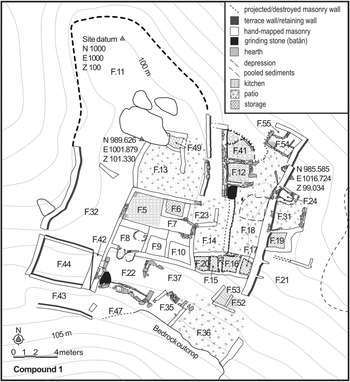
Furthermore, the spatial layout of Compound 1, the largest residential compound at Cerro León, was uncharacteristic of the middle and lower Moche Valley in the EIP. Divided into three distinct spaces (Figure 7), this triadic organization of domestic architecture is not found in Yunga-style domestic architecture in the Moche Valley (Bawden Reference Bawden1977, Reference Bawden1982; Billman et al. Reference Billman, Montero and Chunga2000, Reference Billman, Montero and Chunga2002; Chapdelaine Reference Chapdelaine, Isbell and Silverman2002). The largest of the three areas in the compound was the private residential space, which was surrounded by masonry-and-quincha walls. The only entryway into this domestic space led to a large patio built on two terraces (Features 14 and 18), with a retaining wall running down the center. On the lower terrace (Feature 18), we found evidence of three activities: maintenance of stone-hoe tips for farming, metalworking, and the small-scale manufacture of mudstone beads and pendants (Briceño and Billman Reference Briceño and Billman2018). On the upper terrace (Feature 14), there was a small kitchen with an attached ramada for shade (Feature 12 and 41, respectively). On the north end of the patio were four small rooms (Features 6, 15, 16, and 20), which were heavily plastered and probably used for food storage. From the upper terrace, steps led to another smaller patio (Feature 33) and to the entrance to Feature 5, the main cooking and sleeping area. Feature 5 was accessed through a small room and a corridor (Features 23 and 7, respectively). A storeroom (Feature 6) was located off the corridor.
Public, private, and ritual sectors in Compound 1, Area 1, Cerro León.

The second area of Compound 1 was used for public rituals associated with the high-status household that lived in the compound. Although adjacent to the enclosed private area, this public area had a separate entrance, which led to two large patios. The Feature 11 patio was a level, open space with a viewshed that encompassed most of the quebrada below and the surrounding middle valley. In contrast, the Feature 32 patio was enclosed by a masonry wall and had one entrance, accessed only by a trail leading up from the valley floor. The west end of the patio had two terraces constructed from massive boulders (Features 43 and 44). A stone staircase (Feature 42) provided access to the two terraces from the patio. These terraces appear to have been stages for performances presented to audiences in the patio below.
The third area of Compound 1 was located adjacent to those two stage-like terraces. An entryway on the lower terrace led directly to this part of the compound. This area consisted of a long terrace (Features 22 and 37) and three masonry rooms (Features 8–10). The terrace showed evidence of the production of large quantities of food. On it were a large batán (grinding stone), numerous large hearths with windbreaks, and a storeroom (Feature 35). The three adjacent rooms were constructed from thick masonry walls and were accessed through roofs, which were on the same level as the terrace. On the edge of the terrace were two slab-lined pits, each containing the remains of a camelid. Human phalanges, a dog burial, fragments of decorated pottery, and a crystal projectile point were found in these three rooms, which likely functioned as burial chambers or crypts. Although the crypts were adjacent to the private living space in the compound, they were separated by a massive masonry wall (80 cm thick and more than 1.5 m tall).
Domestic Rituals and Burial Practices
Ethnohistoric sources indicate that the Indigenous people of the coast and highlands of the central Andes had distinct religious and ceremonial practices before Spanish contact (Isbell Reference Isbell1997; Lau Reference Lau2002; Moore Reference Moore2004; Ramírez Reference Ramírez1996; Tsai Reference Tsai2020). Briefly stated, many Indigenous ethnic groups in the highlands of the central Andes venerated the physical remains of ancestors, which were periodically removed from crypts for ritual performances (Isbell Reference Isbell1997; Lau Reference Lau2002; Tsai Reference Tsai2020). In contrast, Indigenous religious traditions on the coast focused on the performance of public rituals for large audiences—often numbering more than 10,000 people—at massive ceremonial complexes consisting of plazas and mounds (Billman Reference Billman1996; Moore Reference Moore1996; Uceda Reference Uceda, Uceda, Mujica and Morales1997, Reference Uceda and Pillsbury2001).
The layout of Compound 1 indicates a unique set of burial and ritual practices unlike those known for Yunga people in the EIP. The arrangement of domestic areas, crypts, special-purpose kitchen areas, and performance space within the household structure reveals that the people residing at Compound 1 were living with their ancestors, who were placed in crypts that were readily accessible to the living. Based on the arrangement of space, we propose that the dead were periodically removed from their crypts and used in rituals that took place on the terrace-stages (Features 43 and 44) above the public patio (Feature 32). These rituals likely were accompanied by feasts, as indicated by the presence of adjacent cooking facilities and the many storerooms within the compound. Similar crypts also were found at other dwellings at Cerro León. Compound 3 had a large, slab-lined pit dug into its main terrace-patio. Although the pit had been looted, excavation and screening of fill and backdirt yielded fragments of decorated pottery and human phalanges. Other dwellings at Cerro León also had large, looted slab-lined pits.
Although there was variation in Gallinazo and Moche phase burials on the north coast, there was remarkable consistency in mortuary practices (Donnan Reference Donnan and Dillehay1995; Millaire Reference Millaire2002, Reference Millaire2004). In the overwhelming majority of cases, burials were sealed and never again opened (Donnan Reference Donnan and Dillehay1995; Millaire Reference Millaire2002, Reference Millaire2004). In rural areas such as the middle Moche Valley, Yunga people typically sequestered the deceased in cemeteries away from their settlements (Billman Reference Billman1996; Donnan Reference Donnan and Dillehay1995), whereas at urban settlements, the deceased were buried in cemeteries within settlements, in pits excavated into dwellings well after abandonment of the dwelling, or within dwellings in sealed graves below the floors (Donnan Reference Donnan and Dillehay1995; Donnan and Mackey Reference Donnan and Mackey1978; Millaire Reference Millaire2002:107–109). There were exceptions to these patterns; for example, Millaire (Reference Millaire2004) documented 65 cases of a sample of 507 Moche burials where the dead were moved after burial or decomposition. These examples include secondary burials where bodies were allowed to decompose and then buried. In other examples, tombs were reopened to add bodies or to remove bodies, body parts, or grave offerings. Secondary offerings of skulls and skeletal elements also have been found in a variety of contexts (Millaire Reference Millaire2004).
Millaire establishes that Moche people maintained relationships with the dead after they were buried; however, their relationship with the dead appears to have been different from what was uncovered at Cerro León. At Sipan, Huaca Cao Viejo, and Huaca de la Luna, some elite chamber tombs in large mounds were reopened, and bodies were removed or moved (Millaire Reference Millaire2002:377–382). However, chamber tombs in mounds were not designed to be reopened. To add or remove burials, tunnels had to be excavated to the tombs; then the tunnels were refilled, and the tombs resealed. At San José de Moro, Nelson (Reference Nelson1998) documented that some bodies in boot-shaped tombs were partially disarticulated due to their delayed burial. However, there is no evidence that bodies were periodically removed and returned to the tombs. This practice would have been difficult given the boot shape, and it would have resulted in more extensive disarticulation of bones.
The meticulous research by Millaire (Reference Millaire2004) and Donnan (Reference Donnan and Dillehay1995) of hundreds of Moche burials definitively demonstrates that the mortuary practices uncovered at Compound 1 differed from those found in Moche homes, huacas, and cemeteries. The treatment of the dead at Cerro León suggests a different worldview, one more akin to highland practices (Isbell Reference Isbell1997; Lau Reference Lau2002; Tsai Reference Tsai2020). The dead lived on and were active agents in the negotiation of identity and power relations. The physical remains of the dead were perhaps a means by which households at Cerro León proclaimed their identity and negotiated their status. It bears noting that when people left Cerro León, they may have taken the remains of their ancestors with them. We found no evidence of desecration of tombs or a violent abandonment of Cerro León. Tombs were empty except for a few phalanges, sherds, and small items, which may have been accidentally left behind when bundles of human remains and sacred objects were removed at abandonment of the community.
Foodways
Although evidence indicates that most of the pottery used at the site was highland in origin, this finding alone does not necessarily demonstrate that the people of Cerro León had a highland group identity. To fully understand the relationships between pottery and identity, we must examine how pottery was used. Studies in the prehispanic US Southwest, for example, have shown that foodways, domestic spatial organization, and the nondecorative traits of pottery vessels can be reliable indicators of group identities (Clark Reference Clark2001; Lyons Reference Lyons2003; Neuzil Reference Neuzil2008). Analysis of form and function of both utilitarian and ceremonial pottery from Cerro León indicates how the choices that people made structured their daily life and periodic ritual activities. Those choices enabled residents to materialize and maintain a multigenerational highland cultural identity throughout the occupation of the site.
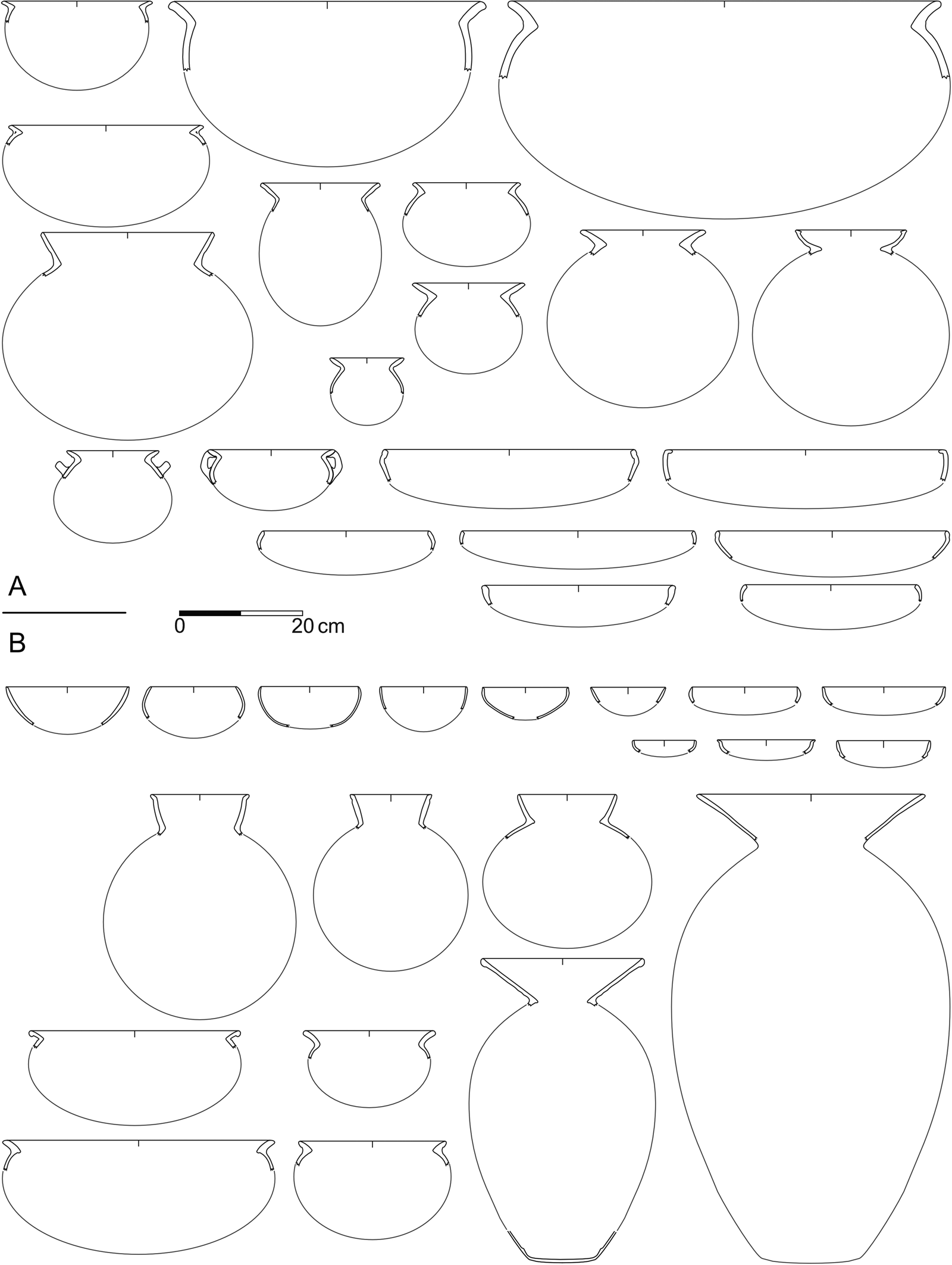
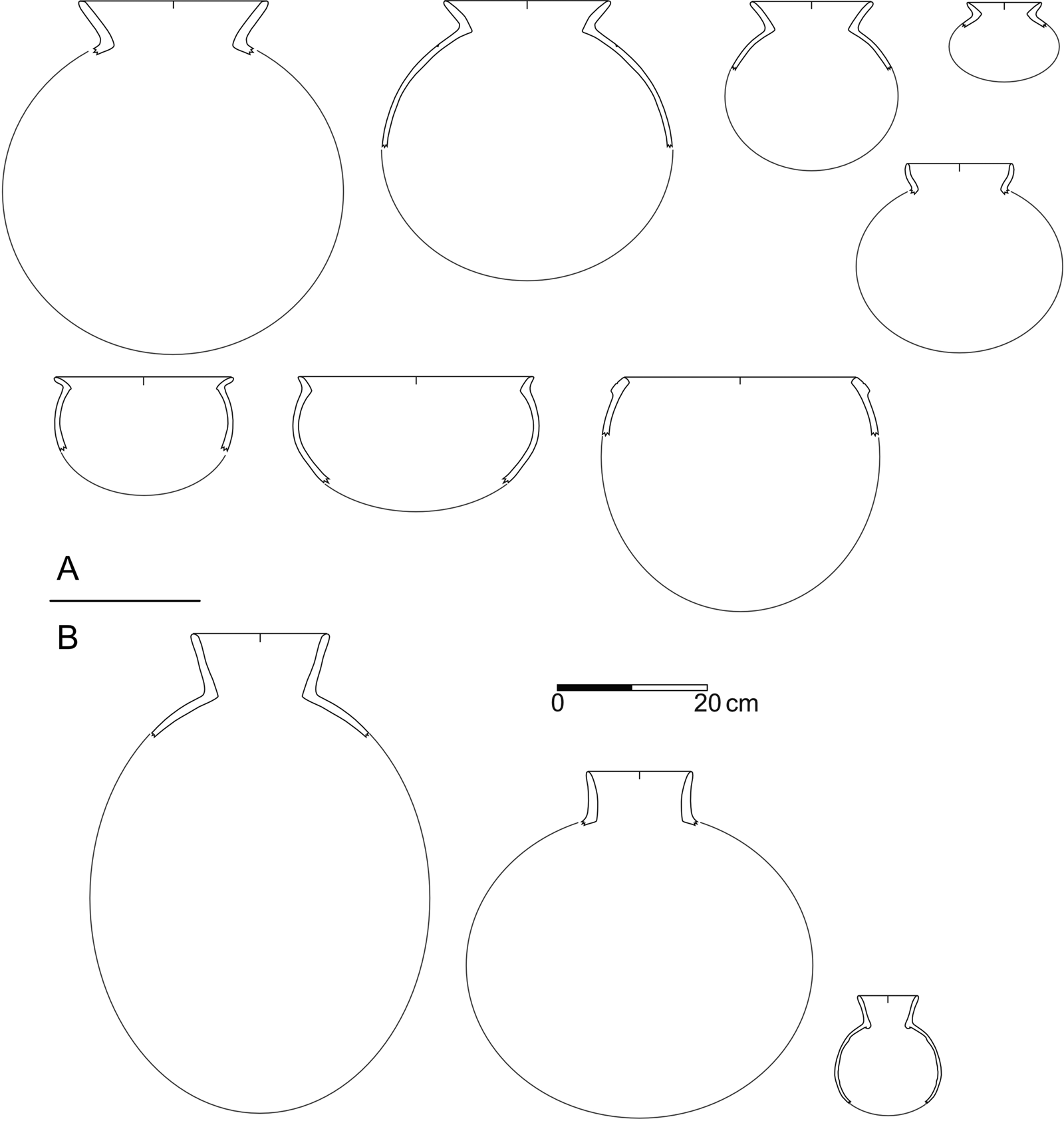
Residents preferred unique, highland-made vessels for a suite of tasks related to the preparation, cooking, serving, and storage of food (Figure 8). Highland wares at the site include the full range of vessel forms necessary for daily domestic life; in contrast, Castillo wares (manufactured on the coast) were limited to a few types of cooking ollas and large tinajas for liquid storage (Figure 9). No Castillo serving wares (neither bowls nor jars) were present. In addition, two functional types were found only in highland wares: bowls for toasting maize or beans, and colanders, possibly used for smoking meat (Ringberg Reference Ringberg2012:193). Collectively, the pottery assemblage indicates a culinary tradition that was different from assemblages of Castillo series pottery found at other contemporary EIP sites in the middle and lower valley.
Reconstructions of Cerro León series highland vessels: (A) cooking and toasting vessels; (B) liquid and semiliquid consistency food serving and storage containers.

Reconstructions of Castillo Series coastal vessels: (A) cooking vessels; (B) liquid storage and serving vessels.

Although plainwares were manufactured in both the highlands and coast, more than 90% of the fineware feasting assemblage was of highland origin. Residents of Cerro León preferred highland-made vessels, with highland-specific decorative motifs and decorative techniques, for special events, such as feasting and ancestor veneration. These finewares would have been highly visible, signaling to guests the household members’ ideas of place, origin, and worldview. Serving wares used within the home and on special occasions consisted of small, decorated, hemispheric bowls and polychrome or polychrome-resist jars for serving liquids. Individual serving bowls and decorated serving jars are rarely found at Gallinazo and Early Moche phase settlements in the valley with only Castillo series assemblages. Potters in the lower valley, who produced Castillo series pottery, rarely made bowls and decorated jars, perhaps because they had different traditions of household and supra-household commensality. Yunga potters did manufacture decorated finewares for grave goods and other ceremonial acts; however, these vessels were manufactured differently from highland finewares and had different decorative styles and motifs (Bennett Reference Bennett1950; Strong and Evans Reference Strong and Clifford Evans1952). The choices in the production and use of fineware pottery indicate that the residents of Cerro León habitually used highland-style pottery within households and at ceremonial occasions to signal and maintain their highland identity (sensu Wiessner Reference Wiessner1983).
An important feature of the large assemblage at Cerro León (162,000 sherds) is its absence of hybrid styles or forms. Furthermore, only a few examples indicate the production of highland vessel forms with coastal-sourced materials or the use of highland materials to produce coastal forms. Even though the site was occupied for between four and eight generations (100–200 years), manufacturing techniques, forms, and styles from the highlands and the coast did not mix. Materially expressing a highland identity and ties with mother communities in the sierra apparently was extremely important to households at Cerro León throughout the occupation of the site.
These findings raise the question of why certain types of Castillo vessel forms were present in household assemblages. There are several possible scenarios accounting for this pattern. Highlanders at Cerro León may have traded for certain Castillo-ware forms because they were useful for specific tasks, while retaining highland vessels for most utilitarian tasks and all ceremonial events. For example, Valle Plain tinajas were ideal for storing large quantities of water or chicha (maize beer) because their thick, well-fired walls are strong and their porous fabric cools the contents for drinking.
Another possibility is that Castillo-style vessels were received as a part of alliance-building exchanges made with neighboring Yunga settlements. Pottery may have been exchanged not only because of its utilitarian value but also to reinforce alliances between communities (Marcus and Silva Reference Marcus, Silva and Rostworowski de Diez Canseco1988; Stanish Reference Stanish1992). Marriage exchange is another a well-known means of building alliances in the Indigenous and colonial eras in the Andes. If Yunga women married into Culle households at Cerro León, then they may have retained aspects of their identities by using Castillo and Valle Plain pots in private, low-visibility contexts, such as interior kitchens. These nondiscursive spatial and material markers may have represented a distinct community of domestic practice, in contrast to public feasting contexts dominated by a highland culinary tradition where the use of fineware serving bowls and jars with highland design elements proclaimed both the status and social identity of the host.
Another distinct aspect of household foodways at Cerro León was the disposal of domestic trash. People at the site disposed of refuse and maintained kitchens in a manner different from Yunga people in the EIP. Across the valley from Cerro León, our excavations at the Middle Moche-phase Yunga settlement of Ciudad de Dios revealed that kitchens had plastered floors and were regularly swept clean, with domestic trash and cooking ash dumped outside household compounds in discrete middens (Billman et al. Reference Billman, Montero and Chunga2000, Reference Billman, Montero and Chunga2002). At Moche urban centers, residents often disposed of trash in abandoned rooms and reused trash as construction fill.
In contrast, at Compound 1 at Cerro León, trash and ash were spread out evenly across the floor and then compacted by wetting of the floor and by foot traffic. Occasionally, a few basketfuls of local silt-clay sediment were spread across the floor, forming a thin plaster-like floor on top of compacted layers of ash and trash. Looted kitchens at other compounds at Cerro León revealed the same pattern. The spreading of ash and trash may have been part of the maintenance of kitchens; ash might have reduced smells and infestations of rodents and insects. Although likely a quotidian act of kitchen maintenance, periodic capping of the kitchen floors with silt-clay sediment may have been part of a ritual of kitchen renewal, perhaps after important life events. Hauling sediment up from the quebrada required a considerable expenditure of energy. Whatever the case, differences in the maintenance of kitchens probably were another part of daily life that shaped and expressed Culle identity at Cerro León.
Personal Adornment
Because textiles did not preserve at Cerro León, our analysis focused on style, material type, and manner of manufacture of personal ornaments. We recovered a large sample of beads and pendants from households at Cerro León, which we compared to those recovered from Ciudad de Dios. Ciudad de Dios residents wore beads and pendants made from shell (including spondylus), turquoise, lapis lazuli, or fired clay. These types of ornaments were mass produced by households at Huacas de Moche (Uceda and Armas Reference Uceda, Armas and Shimada1998). In contrast, residents at Cerro León manufactured and used jewelry made from gray or red mudstone, sources of which are found along the primary footpaths between Cerro León and the Carabamba Plateau. The use of different materials and styles of beads and pendants indicates that households at Cerro León preferred a distinctive style of personal adornment.
Conclusions
All evidence to date supports the hypothesis that most of the residents of Cerro León were from the nearby highland areas of the Otuzco Basin and Carabamba Plateau and that they produced and reproduced a distinctive highland identity throughout the 100–200-year occupation of the site. Results of our study of the source materials and methods of manufacture demonstrate that most of the pottery recovered from households at Cerro León was imported from the Otuzco Basin and Carabamba Plateau in the adjacent sierra. The spatial organization of household activities, waste disposal and kitchen maintenance, household rituals, funeral practices, personal adornment, and the use of pottery, including the use of highland feasting assemblage, indicate that most of the people at Cerro León actively maintained a distinctive highland Culle identity throughout the occupation of the site, while maintaining social relationships with local Yunga communities.
In addition, our research demonstrates that the conquest scenario proposed earlier by Billman (Reference Billman1996, Reference Billman and Paine1997, Reference Billman, Billman and Feinman1999) is incorrect. Evidence points to peaceful relations between the Culle at Cerro León and Yunga communities in the valley. Culle households at Cerro León may have traded, brokered alliances, and perhaps even intermarried with households in Yunga communities. The presence of Castillo utilitarian pottery at Cerro León attests to the continued maintenance of some form of relationship with coastal people. In addition, small quantities of marine fish and shellfish were recovered from the household middens at Cerro León, and copper fishhooks were manufactured at the site. Fishhooks may have been exchanged for marine resources from lower valley Yunga communities.
This raises the question: How did highland immigrants negotiate access to land in the coca-growing zone, one of the most valued agricultural zones in the central Andes? One scenario is that Yunga communities invited Culle settlers into the chaupiyunga in exchange for protection from raiders from adjacent areas. Armed conflict sharply increased in the early EIP as evidenced by increased settlement size, shifts in settlements to defensible locations, and construction of the first fortifications in the valley (Billman Reference Billman1996, Reference Billman and Paine1997, Reference Billman, Billman and Feinman1999). HEIP sites cluster at access routes into the valley, and 98% of HEIP settlements were located in defensible settings. In exchange for access to irrigated coca fields, Culle settlers may have provided protection from raiders from the highlands and the Virú and Chicama Valleys.
Whatever the case, there is no evidence of a violent or catastrophic abandonment of Cerro León. All evidence points to a well-planned abandonment: nearly all objects of value were carried off. Most telling is the absence of human remains and grave goods in burial crypts, except for a few human phalanges and fragments of pottery. Apparently when the highland colonists left, they took their ancestors with them. Why highlanders left in the AD 300s remains an open question, although it is interesting that their exodus correlates with the rise of powerful leaders at Huacas de Moche in the lower valley.
Acknowledgments
Research in Peru was funded by the MOCHE-UNC-Chapel Hill Field School in South American Archaeology and grants from the Wenner-Gren Foundation, Heinz Foundation, Brennan Foundation, and the University of North Carolina Research Council. Research was conducted with the permission of the Instituto Nacional de Cultura (now the Ministerio de Cultura del Perú): Resolusion Directoral N° 987-INC 2002, N° 849-INC 2004, N° 995-INC 2005, N° 1025-INC 2006, N° 1167-INC 2007, N° 1102-INC 2008, and N° 357-2012 DGPC-VMPCIC-MC. Comments by four anonymous reviews greatly improved the final article. All figures are by Jennifer Ringberg.
Data Availability Statement
All project excavation forms and data files are housed at the Research Laboratories of Archaeology at the University of North Carolina, Chapel Hill, and may be accessed by contacting the first author.
Competing Interests
The authors declare none.