

I. Introduction
Economic theorists distinguish among search goods, experience goods, and credence goods (Darby and Karni, Reference Darby and Karni1973; Nelson, Reference Nelson1970, Reference Nelson1974). Search goods are products or services whose quality can be evaluated prior to purchase (e.g., a dress). In contrast, the quality of experience goods can be evaluated only after purchase and consumption (e.g., canned tuna). Credence goods are a special case of experience goods whose quality is difficult or impossible to evaluate immediately after purchase (e.g., automobile repairs), as some time may be required before quality can be ascertained. For experience goods and credence goods, consumers often rely on external cues such as reputation, warranties, advertising, expert opinion, and price to judge the good's quality (e.g., Allen, Reference Allen1984; Bagwell and Riordan, Reference Bagwell and Riordan1991; Mahenc and Meunier, Reference Mahenc and Meunier2003; Milgrom and Roberts, Reference Milgrom and Roberts1986; Riordan, Reference Riordan1986; Schmalensee, Reference Schmalensee1978; Shapiro, Reference Shapiro1983; Tirole, Reference Tirole1996).
Wine is a classic example of an experience good whose quality cannot be assessed prior to consumption. Wine can also be considered a credence good because its quality when fully mature is difficult to assess upon early consumption unless one is a wine expert or has tasted an extremely large number of wines. Consequently, as with other experience goods, cues such as reputation, experts' ratings, and price are often used by consumers to infer wine quality. In fact, several correlational studies document statistically significant (though small) relationships between wine prices and quality as assessed by professional wine critics, after controlling for other known determinants of wine prices (e.g., Dubois and Nauges, Reference Dubois and Nauges2010; Gibbs et al., Reference Gibbs, Tapia and Warzynski2009; Hadj Ali et al., Reference Hadj Ali, Lecocq and Visser2008; Hay, Reference Hay2010; Jones and Storchmann, Reference Jones and Storchmann2001; Lecocq and Visser, Reference Lecocq and Visser2006; Malter, Reference Malter2012; Miller et al., Reference Miller, Genc and Driscoll2007; Oczkowski, Reference Oczkowski1994; Roberts and Reagans, Reference Roberts and Reagans2007).
Price, however, is a problematic quality cue, as a substantial body of research finds the price-quality relationship weak on average and extremely variable across products. Among the scores of correlational studies on the price-quality relationship, the following are typical. Original studies by Riesz (Reference Riesz1979), involving 40 product categories, and Gerstner (Reference Gerstner1985), involving 145 product categories, find a mean correlation between price and quality of .09 and .12, respectively, with a range across product categories of −1.00 to .88. Similarly, reviews of dozens of earlier studies by Tellis and Wernerfelt (Reference Tellis and Wernerfelt1987), Hanf and von Wersebe (Reference Hanf and von Wersebe1994) and Rao and Monroe (Reference Rao and Monroe1989) find mean price-quality correlations of .27, .20 and .12, respectively, with a range of −1.00 to 1.00.
Although most studies of the price-quality relationship (for wines and other products) are correlational, some recent analyses of the wine market examine the issue of price dispersion and its relationship to wine quality. Schnabel and Storchmann (Reference Schnabel and Storchmann2010) consider whether prices serve as quality signals by analyzing the difference between two price samples for identical wines—prices for informed wholesalers who can taste prior to purchase and retail prices for uninformed consumers who cannot. They find the price difference to be positively related to wine quality and negatively related to increased information and that the information effect dominates the quality effect. Storchmann et al. (Reference Storchmann, Mitterling and Lee.2012) examine winery-specific price-quality dispersion, finding that expert reviews inject noise into the price-quality relationship, increasing price dispersion overall, with the result that after receiving favorable reviews wineries tend to overprice their low-end wines more than their high-end wines. In a similar vein, Ashenfelter (Reference Ashenfelter2010) calculates a “full-information price” based on weather-related variables for several vintages of Bordeaux wines and traces the auction-price history of these vintages over time. He finds that most vintages are overpriced when they first enter the auction market, especially vintages that weather-related variables predict to be of lower quality, but that prices converge toward the full-information price over time as more information about vintage quality becomes available.
Moreover, for average wine consumers, the price-quality relationship is likely to be variable because what is considered a quality wine by one consumer may or may not be so considered by another. Instead of quality as assessed by professional wine critics, average wine consumers are likely to be more concerned with a wine's taste or with the extent of pleasure or enjoyment that it provides.Footnote 1 Thus, from the average consumer's standpoint, the real issue is not the relationship between price and “quality” but that between price and enjoyment.
Research shows that when wine consumers are informed of prices before tasting wines, price exerts a strong positive effect on their sense of enjoyment: more expensive wines taste better than less expensive wines. This might not be considered surprising, as quality and price are positively correlated on average. What is remarkable, however, is that price exerts a strong positive effect on consumers' taste perceptions even when they taste the same wine that is described as costing different amounts. When consumers are told (or led to believe) that a particular wine is expensive, they perceive it to taste better than when they are told (or led to believe) the same wine is inexpensive. In this paper, I investigate consumers' enjoyment of expensive and inexpensive wines in the absence of information about price.
II. Prior Research
Prior studies by Brochet (Reference Brochet2001), Goldstein et al. (Reference Goldstein, Almenberg, Dreber, Emerson, Herschkowitsch and Katz2008), Plassmann et al. (Reference Plassmann, O'Doherty, Shiv and Rangel2008), and Weil (Reference Weil2001, Reference Weil2005) are relevant. Plassmann et al. (Reference Plassmann, O'Doherty, Shiv and Rangel2008) served two identical wines to consumers twice, describing them as expensive on one occasion and inexpensive on the other. Regarding one of the wines, participants were told on one occasion that it cost $45, but on the other they were told it cost $5. Regarding the other wine, participants were told on one occasion that it cost $90 but on the other that it was $10. Participants rated the “taste pleasantness” of the wines on a six-point scale. For both wines, the ratings were significantly higher when participants had been told that it was more expensive.
Similarly, Brochet (Reference Brochet2001) served the identical wine to consumers twice (an “average” Bordeaux superior), having first transferred the wine to a bottle bearing either a prestigious (Grand Cru) label, suggesting an expensive wine, or an unprestigious (vin de table) label, suggesting an inexpensive wine. The consumers strongly preferred the wine when they had been led to believe that it was a Grand Cru (describing it as full, complex, balanced, and long) instead of a vin de table (describing it as light, unbalanced, short, and faulty). Clearly, the preferences of the Brochet (Reference Brochet2001) and Plassmann et al. (Reference Plassmann, O'Doherty, Shiv and Rangel2008) consumers were determined not by the wines that they consumed but by their expectations about those wines, expectations that were a function of price.
In contrast to the Brochet (Reference Brochet2001) and Plassmann et al. (Reference Plassmann, O'Doherty, Shiv and Rangel2008) findings, Weil (Reference Weil2001, Reference Weil2005) provides insights into consumers' wine preferences in the absence of price information. In a large number of blind tastings involving knowledgeable wine consumers, Weil employed the “triangle test” (Amerine and Roessler, Reference Amerine and Roessler1983; Peynaud, Reference Peynaud and Schuster1987) to study not only the tasters' preferences but also their ability to discriminate more expensive from less expensive wines. The triangle test presents participants with three wines, two of which are similar along some particular dimension and one of which is different. The participant's task is to identify which of the three wines (the singleton) differs from the other two (the doubleton). Weil also had participants indicate which wine, the singleton or the doubleton, they preferred.
In Weil (Reference Weil2001), the more expensive wines were from vintages that Robert Parker had rated as excellent, while the less expensive wines were from vintages that Parker had rated as average to appalling. In Weil (Reference Weil2005), the more expensive wines were “reserve” bottlings, while the less expensive wines were “regular” bottlings from the same vineyard or producer. Sometimes, the more (less) expensive wine was the singleton (doubleton) and sometimes vice versa. A wide range of wines from France, Italy, Spain, Australia, New Zealand, and the United States was included in the tastings, but Weil was generally able to control for other factors that might influence consumers' perceptions.
Across all tastings, participants correctly identified the singleton about 41 percent of the time. This level of performance is significantly better than random guessing (33.3 percent), but is far from overwhelming. Moreover, even when participants did correctly distinguish the more expensive from less expensive wines, they preferred the more expensive wines only 51 percent of the time. Hence, only about one-fifth of the participants both correctly identified the more expensive wines and preferred them to wines that cost less.
While the Brochet (Reference Brochet2001) and Plassmann et al. (Reference Plassmann, O'Doherty, Shiv and Rangel2008) studies suggest that price has a strong influence on wine consumers' taste perceptions when price is known, and the Weil (Reference Weil2001, Reference Weil2005) studies suggest that price has little or no influence when it is not known, the most extensive evidence on this issue is that of Goldstein et al. (Reference Goldstein2008; see also Goldstein, Reference Goldstein2008). Goldstein and colleagues conducted 17 blind tastings in restaurants, bars, and private residences in New York, Connecticut, Massachusetts, and Texas between April 2007 and February 2008. More than 500 different wines were tasted, and more than 500 tasters participated, most of whom participated in at least two six-wine flights. There were about 6,000 combinations of wines and tasters. The tastings involved red, white, rosé, and sparkling wines from several countries, grape varieties, and vintages. A four-point scale of responses (bad, okay, good, great) was employed. About 12 percent of the participants had some wine training and experience (wine distributors, sommeliers, etc.), while the other 88 percent were described as “average wine drinkers.”
Goldstein et al. (Reference Goldstein, Almenberg, Dreber, Emerson, Herschkowitsch and Katz2008) first analyzed the full sample of more than 500 different wines, which ranged in price from $1.65 to $150. For the participants with some wine training and experience, there was a small but statistically significant positive relationship between prices and ratings. In contrast, for the average wine drinkers there was a small but statistically significant negative relationship between prices and ratings; in other words, average wine drinkers preferred less expensive wines. When wines in the top and bottom price deciles were excluded, leaving wines ranging in price from $6 to $15, the results were even stronger.
III. Method
The present study tests the robustness of Goldstein et al.,'s (Reference Goldstein2008) provocative results by adopting their basic approach but refining it in three ways. First, I control for country of origin, region within a country, grape variety, and vintage by conducting two blind tastings of 2006 red Bordeaux and two blind tastings of 2009 white Burgundy. Second, I focus on wines that are considerably more expensive than the $6–$15 range that produces Goldstein et al.,'s strongest results: the price range of the present wines is $20–$119, with a mean (median) of $63 ($60). Finally, I use a 10-point response scale that allows finer discrimination by participants than the four-point scale employed by Goldstein et al., I do not maintain that the present research approach is superior to that of Goldstein et al., only that it is a necessary complementary approach for increasing confidence in the earlier results.
The wines included in the present study are more homogeneous, and generally much more expensive, than those studied by Goldstein et al. Although undoubtedly many wine consumers often search for inexpensive wines, caring little about characteristics like country of origin or grape variety, many of these same consumers will sometimes wish to “stretch” for higher-priced wines, especially ones from renowned regions such as Bordeaux or Burgundy. There are, of course, many possible reasons for this, including impressing others or simply learning about wines that one does not normally consume. For most people, $20 is a much easier stretch than $119; thus, identifying less expensive wines that provide a level of enjoyment similar to that of more expensive ones is likely to be of great interest.
Four tastings were conducted, each involving six wines. One of the Bordeaux tastings focused on Right Bank wines (Pomerol and St. Emilion) and the other on Left Bank wines (St. Estephe, St. Julien, Medoc, and Pauillac). In each tasting, two wines were in the $99–$119 price range, with the other four progressively less expensive down to $22. The objective was to include wines across a substantial price range that are widely available to average wine drinkers.
A similar objective guided the choice of wines for the two Burgundy tastings, one of which focused on Corton-Charlemagne and “similar” wines and the other on Chassagne/Puligny Montrachet and “similar” wines. In choosing specific wines, I relied in part on a recent article in Decanter (Brook, Reference Brook2012) that maintains that some lower-priced white Burgundies can serve as good “substitutes” for expensive white Burgundies, such as Chassagne-Montrachet, Puligny-Montrachet, and Corton-Charlemagne. Brook (Reference Brook2012) does not claim that the less expensive wines are “as good as” the more expensive ones, but he does assert that they have similar styles that consumers may find appealing—especially at a much lower price.
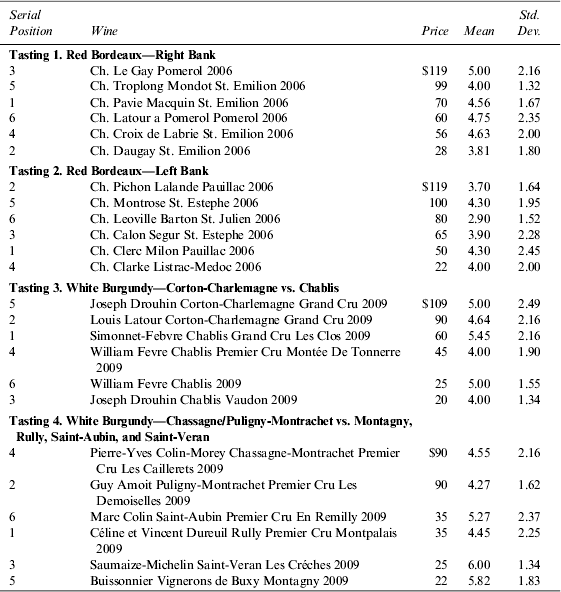
Brook proposes only Chablis as a substitute for Corton-Charlemagne. In contrast, he suggests that several less expensive Burgundies have “stylistic signatures” similar to those of both Chassagne-Montrachet and Puligny-Montrachet. Consistent with Brook's suggestions, one of the tastings included two Corton-Charlemagnes ($109 and $90) and four Chablis ($60–$20), while the other included a Chassagne-Montrachet and a Puligny-Montrachet (both $90) and one each of Montagny, Rully, Saint-Aubin, and Saint-Veran ($35–$22). The ratio of highest to lowest price varies from 4:1 to 6:1 across the four tastings. The specific wines and their retail prices are shown in Table 1.Footnote 2
Prices and Enjoyment Ratings in Four Blind Tastings

The tasters were full-time MBA students at the Fuqua School of Business at Duke University. They participated voluntarily and received no monetary reward for their participation.Footnote 3 All participants were members of the student-led Wine Appreciation Club, a group with great interest in and enthusiasm for wine. Participants were recruited by the club president, who was asked to channel participants who normally prefer red (white) wines to one of the red (white) tastings. There were 16, 10, 11, and 11 participants in Tastings 1, 2, 3, and 4, respectively.
Participants were seated at tables with six glasses, numbered 1 to 6, in front of them. The serial positions of the wines in each tasting are shown in Table 1. It was emphasized to participants that they could taste the wines in any order they wished, regardless of serial position. This is important because, while research has found serial position to have an impact on preference when tasters are required to taste wines in a particular order (Mantonakis et al., Reference Mantonakis, Rodero, Lessehaeve and Hastie2009), research has found no order effects when tasters are allowed to taste wines in whatever order they wish (Bodington, Reference Bodington2012).Footnote 4 Before they began tasting, the only thing that participants knew about each wine was its color. The four tastings occurred in late January 2013, around 5:00–6:00 p.m. Each tasting lasted about 50 minutes, divided roughly equally between the actual tasting and a follow-up debriefing.
Participants were instructed to rate the extent to which they enjoyed each wine on a scale from 1 (“I did not enjoy this wine at all”) to 10 (“I enjoyed this wine as much as or more than any [red or white] wine I have ever tasted”). A substantial body of social science research finds that rating scales with 7 to 10 response alternatives have optimal psychometric properties, including discriminability, and that respondents tend to prefer 10-point scales, followed closely by 7-point scales (for reviews, see Cox, Reference Cox1980; Preston and Colman, Reference Preston and Colman2000; see also Miller, Reference Miller1956).
Participants were told that (1) their ratings should reflect how much they personally enjoyed each wine, not how much they thought someone else might enjoy it or how highly they thought a professional wine critic might rate it, (2) they could taste the wines in any order they wished, including possibly tasting a portion of each wine, forming a preliminary response, and then tasting the remaining portion before marking the response scale, and (3) they should maintain silence throughout the tasting, where “silence” included the avoidance of both verbal and nonverbal expressions that might communicate to others the extent of their enjoyment (or lack of enjoyment) of the wines.Footnote 5
IV. Results and Discussion
Examination of the responses indicates that participants were able to discriminate among the wines in each tasting. For example, in each of the four tastings participants used the entire response scale with the exception of 10. However, only 7 percent of the 288 responses (48 participants×6 wines) were 1 or 9, which effectively resulted in a seven-point scale.
The mean and standard deviation of the enjoyment ratings for each wine are shown in Table 1, which appears to suggest that the mean enjoyment ratings do not align well with prices. One example is the Left Bank tasting, where the most expensive wine, the Pichon Lalande ($119), is rated below both of the two least expensive wines. Another example is the Chassagne/Pulginy tasting, where one of the two $90 wines, the Puligny-Montrachet, is rated below all of the less expensive wines.
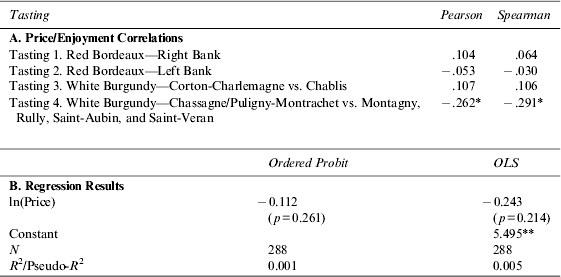
Moving beyond examples, Panel A of Table 2 shows the simple correlation between prices and enjoyment ratings across all the participants in each tasting. In three of the tastings, the price/enjoyment correlations are not significantly different from zero, suggesting no relationship between price and enjoyment. In the other tasting, there is a statistically significant negative relationship between prices and enjoyment ratings, suggesting that participants enjoyed the less expensive wines more.
Statistical Analyses
* Significant at .05; **Significant at .01.
Following Goldstein et al. (Reference Goldstein, Almenberg, Dreber, Emerson, Herschkowitsch and Katz2008), participants' enjoyment ratings were regressed on the natural logarithm of price, ln(Price), using both ordered probit and ordinary least squares (OLS) estimators with robust standard errors in both cases. The results, shown in Panel B of Table 2, reveal an overall negative relationship between price and enjoyment. Unlike in Goldstein et al. (Reference Goldstein, Almenberg, Dreber, Emerson, Herschkowitsch and Katz2008), this relationship does not reach conventional significance levels, due in large part to the lack of power in the present study (n=288) relative to the earlier one (n=5,986).Footnote 6 Taken together, the results generally agree with those of Goldstein et al. (Reference Goldstein, Almenberg, Dreber, Emerson, Herschkowitsch and Katz2008): When wine prices are not known, average wine drinkers do not find enjoyment to increase with price.
There are, of course, limitations to the present study that may restrict the generalizability of the results, including the specific wines tasted, the particular group of tasters who participated, and the research-oriented conditions in which the tastings occurred. It is possible that a different set of wines or another group of tasters or other tasting conditions would produce different results.
More generally, it might be argued that defining “enjoyment” solely in terms of a wine's sensory properties (as perceived by the taster) is too narrow a view of enjoyment and that a broader view that encompasses a range of psychological and experiential factors is more appropriate. Such an argument would maintain that the overall “wine experience” includes but is not restricted to the immediate sensory enjoyment of the wine itself. The essence of this broader view of enjoyment is captured by Lee et al.'s (Reference Lee, Frederick and Ariely2006, p. 1054) distinction between bottom-up and top-down processes: “The quality of an experience is jointly determined by bottom-up processes, which reflect characteristics of the stimulus impinging on the perceiver's sensory organs, and top-down processes, which reflect the perceiver's beliefs, desires, and expectations.”
This basic distinction is a central theme across many domains, including sensory science (e.g., Deliza and MacFie, Reference Deliza and MacFie1996) and consumer behavior (e.g., Keller, Reference Keller2009, Reference Keller2012). In the latter field, the importance of appealing to both the “rational” and “emotional” concerns of consumers is well accepted (Keller, Reference Keller2012, chap. 2). Rational concerns involve intrinsic attributes of a product that address utilitarian needs, while emotional concerns involve extrinsic attributes that address psychological needs. Successful products often evoke both positive judgments about the former (concerning, e.g., quality, performance, reliability, and price) and positive feelings about the latter (concerning, e.g., image, status, sophistication, and specialized knowledge).
In the case of luxury goods, the role played by image, status, and so forth in the overall “experience” of the product far outweighs that played by more immediate and tangible aspects of the product itself (Keller, Reference Keller2009). Brands such as Rolex, Sub-Zero, and Rolls-Royce are sought primarily because they address consumers' emotional/psychological needs, not their rational/utilitarian concerns related to time-keeping, refrigeration, and transportation. Analogously, the totality of a consumer's experience with expensive wines cannot be equated with sensory enjoyment.
A similar point is made by Ashenfelter and Jones (Reference Ashenfelter and Jones2013) in a study of the extent to which expert ratings predict subsequent wine prices in the auction market. Finding that experts' ratings of vintage quality are not efficient, in the sense that such predictions can easily be improved by including additional publicly available information about the weather, Ashenfelter and Jones suggest that expert ratings must be demanded, at least in part, for reasons other than their accuracy (e.g., collectibility or investment potential). In a similar vein, neither the present study nor Goldstein et al. (Reference Goldstein, Almenberg, Dreber, Emerson, Herschkowitsch and Katz2008) can deny the possibility that, for a variety of reasons, average wine drinkers often might prefer to consume more expensive wines. Both studies suggest, however, that such a preference is essentially unrelated to immediate sensory enjoyment.