Introduction: Studying Corruption
Interest in the links between corruption and politics has increased significantly since the early 1990s. Although the public widely sees corruption as a phenomenon that particularly afflicts the developing world—as reflected in the growing emphasis placed on anti-corruption initiatives by such international agencies as the World Bank, IMF, OECD, and Transparency International—the issue is also attracting significant attention in established democracies. Politicians, civil society activists, and media commentators have expressed concerns about a host of high-profile scandals contributing to a decline of trust in the political class, whilst a perceived “culture of corruption” in several of the post-communist countries of east-central Europe is seen as an obstacle to their full integration into the European Union. Indeed, corruption has started to become a powerful policy narrative in many countries, blamed for a host of shortcomings in democracies and non-democracies alike (Heywood and Krastev 2006).
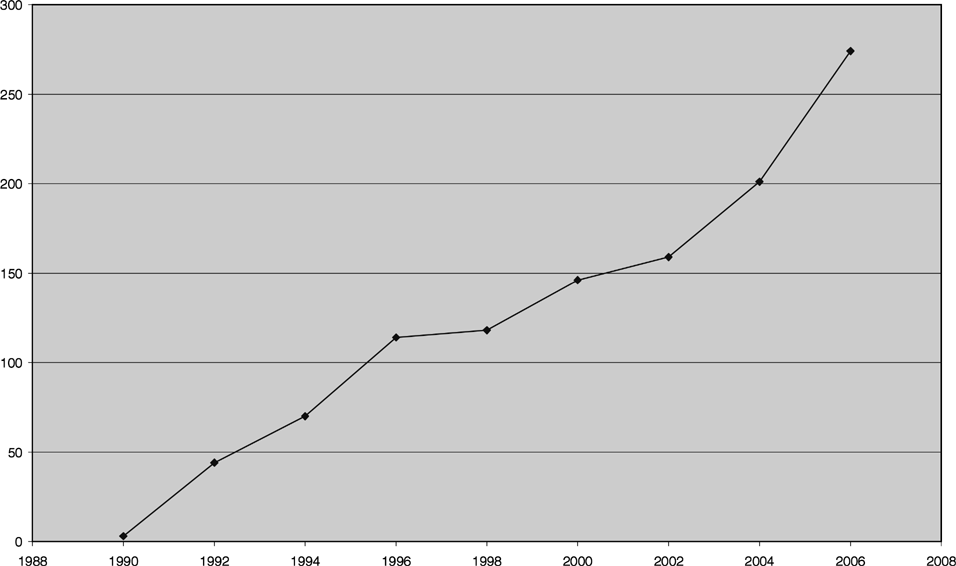
It is unsurprising, therefore, that there has been a surge in academic interest in corruption that has paralleled the political focus on the issue. As shown in Chart 1, there has been an exponential increase in the number of articles the Social Sciences Citations Index lists with “corruption” in the title, rising from just three in 1990 to 274 in 2006. Such an explosion of interest in the issue poses its own problems when it comes to analyzing corruption in any given country. Given that we cannot seek to cover every aspect of corruption, the temptation is to focus on specific scandals and corruption-related incidents in our chosen area—in this case, Spain. Moreover, there is a decent range of material, both in Spanish and English, that looks specifically at corruption in Spain (Martín de Pozuelo et al. 1994; Nieto 1997; Jiménez and Caínzos 2003; Fundación Alternativas 2007). It would thus be all too easy to base an approach to corruption in Spain around some of the many scandals that have hit the headlines there since the early 1990s. Yet, even for those most strongly committed to an area studies approach, it makes little sense to try to understand or explain corruption without reference to a wider analytic framework.

Chart 1: Number of Articles with “Corruption” in Title, 1990–2006
Source: ISI Web of Knowledge (accessed May 29, 2007)
Corruption is a highly complex and multi-faceted phenomenon, and so we need to help students understand some of the core issues that underpin political science perspectives on how to analyze and interpret the issue. By doing so, we can show that corruption in Spain is neither unique nor unusual; moreover, situating the country within a wider comparative perspective helps illuminate key lessons about its political organization and pathologies. Amongst the central questions that we can usefully address are: what do we mean by corruption; how do we measure corruption, and are southern European countries more corrupt than their northern neighbors; why does corruption take place; what is the political impact of corruption; and how are corruption-related scandals utilized for political ends? The rest of this paper addresses each of these questions in turn.
What Do We Mean by Corruption?
The debate on definitions of corruption stretches back over decades, with no satisfactory resolution in sight. Although there is reasonably widespread acceptance of a generic definition along the lines of corruption being the “abuse of public office for private gain” (Transparency International 2007), such a definition is of very little practical utility when it comes to understanding the reality of corruption in any given country. In practice, corruption takes a multiplicity of forms that cannot be sensibly captured within a single catch-all definition. Thus, to give one obvious example, we would want to draw a distinction between so-called petty corruption (for instance, a public servant's demand for a small bribe to deliver a basic service) and grand corruption (such as distortion of the policy process through illicit financial interests influencing decision-makers at the state level). Both kinds of activity are rightly seen as corrupt, but they differ in scope and impact. This is not to argue that petty corruption is somehow less serious than grand corruption, for in some countries it is so endemic as to blight the lives of nearly all citizens. Rather, the point is that different types of corruption may have different causes and consequences, and we therefore need to identify with more precision what kind of corruption we are dealing with when focusing on any given country.
A very useful approach is provided by Alatas (1990), who distinguishes between transactive and extortive corruption. The former refers to situations in which there is a mutually entered into arrangement between the donor and recipient of a corrupt exchange, and can be further broken down into a variety of sub-types, including “investive” (where good and favors are offered with a view to future returns), “nepotistic” (the unjustified appointment of friends and relatives to positions of authority), “autogenic” (where one person benefits from misuse of privileged information), and “supportive” (action to protect existing corruption networks, such as machine politics). Extortive corruption, meanwhile, involves some form of compulsion, often through the threat of violence. More recently, Johnston (2005) has drawn a distinction between different “syndromes” of corruption, according to the political and economic opportunities provided by different regime types. Thus, he identifies “influence markets” (mature democracies), “elite cartels” (consolidating or reforming democracies), “oligarchs and clans” (transitional regimes), and “official moguls” (undemocratic regimes). In the case of Spain, given the experience of transition from dictatorship to democracy, the focus would be on both elite cartels and influence market corruption.
Is There More Corruption in Southern Europe?
Despite the difficulties in establishing what we mean by corruption, there have been various attempts to measure the scale of corruption in different countries. The most well-known measure is provided by Transparency International through its Corruption Perceptions Index (CPI), published annually since 1995, which has been highly influential in shaping the debate about the issue. The CPI's seemingly precise ranking has allowed researchers to explore a variety of causal factors that promote corruption, the most widely cited of which include low levels of socio-economic and political development; extensive bureaucracy and red tape; trade restrictions and government regulation of economic activity; and low salaries for civil servants (Mauro 1998). We therefore might expect those European countries with a shorter experience with democracy and with lower levels of GDP to experience more corruption than their more developed neighbors—and a glance at the CPI would suggest that is indeed the case.
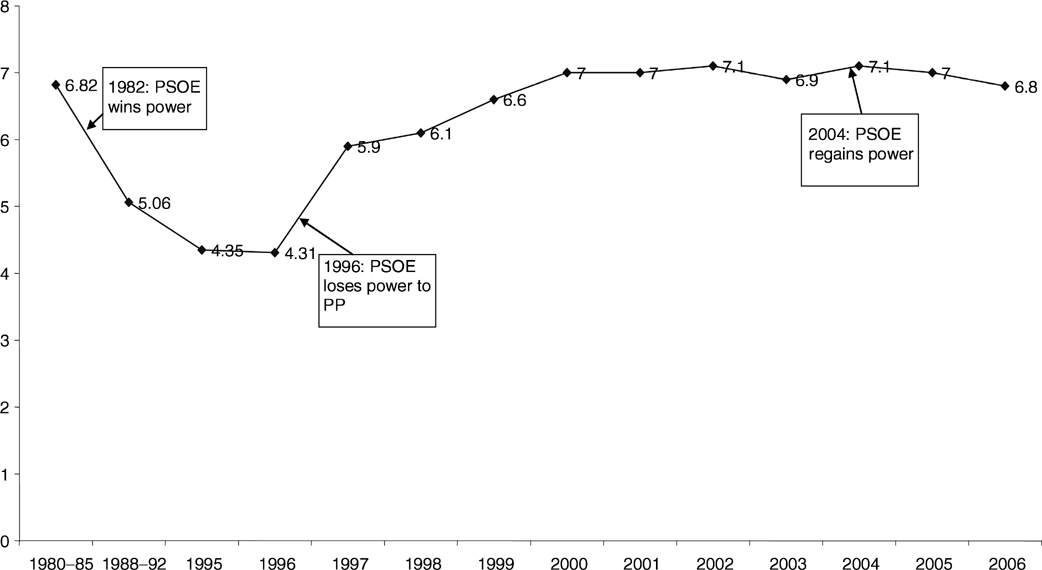
As can be clearly seen in Table 1, southern European countries rank below their northern neighbors—and most of them rank higher than the former communist countries of eastern Europe (with just a few exceptions, such as Slovenia and Hungary). Consistent with the view that bureaucracy and government involvement in economic management are linked to corruption is the argument that socialist administrations are more prone than conservative ones to be corrupt (Singer 1995). Again, a quick review of the evidence suggests that, in the case of Spain, such a view appears justified: perceptions of corruption have tended to worsen when the Socialist PSOE has been in power compared to its right-wing rival, the Popular Party (PP), as documented in Chart 2. Indeed, there have been many high-profile scandals associated with PSOE periods in office, especially under the administration of Felipe González.
CPI 2006 Rankings in “Established” European Democracies


Chart 2: Perceptions of Corruption in Spain, 1980–2006
Source: Data derived from Transparency International, Corruptions Perceptions Indices 1980–2006
Amongst the most notorious scandals during the González era were those involving his deputy prime minister, Alfonso Guerra, who was eventually forced to resign after his brother was accused of influence peddling and a host of high profile incidents involving “los beautiful,” a group of wealthy individuals with close links to the Socialist Party. Notably, the Ibercorp scandal in the early 1990s implicated both former Finance Minister Miguel Boyer and Governor of the Bank of Spain Mariano Rubio, alongside several leading figures in the world of finance. It came to symbolize, in some senses, the accusation that the PSOE had promoted a so-called “cultura del pelotazo” (effectively, sleaze culture) characterized by the ostentatious display of rapidly acquired wealth; indeed, Boyer's successor as finance minister, Carlos Solchaga, made the distinctly un-socialist sounding boast that Spain was the European country in which you could get rich most quickly (Heywood 1995). Other notorious scandals involved fraud and tax evasion by the head of the Civil Guard, Luis Roldán, and embezzlement by the high-profile chairman of Banesto bank, Mario Conde (nicknamed “The Shark”), who had close links to the Socialist government.
In addition to these examples of personal venality, a number of other corruption scandals involved scams designed to channel funds to the PSOE. For instance, the party was accused of receiving funds via inter-connected “front” companies such as Time Export, Filesa, and Malesa, which were established to prepare fictitious consultancy reports for a range of major clients from the public and private sector. Further accusations of corruption relating to party funding surrounded decisions over major infrastructure projects, such as the high-speed rail link between Madrid and Seville. However, the most damaging scandal was that related to a “dirty war” against the Basque separatist organization, ETA, carried out by the GAL (Anti-terrorist Liberation Groups). Financed by secret Interior Ministry “reserve funds,” the GAL were responsible for a series of assassinations and kidnaps between 1983 and 1987, and ultimately led to the imprisonment of the former minister, José Barrionuevo, and his secretary of state for security, Rafael Vera (Woodworth 2001). The GAL scandal, probably more than any other, contributed to the impression that the Socialist administration was mired in a seemingly never-ending catalogue of corrupt activity.
Certainly, the opposition PP made great play of perceived socialist shortcomings and promised clean government when it won power in the 1996 general election. And, if we judge by the Corruption Perceptions Index, it would seem that the PP was true to its word, as Spain moved from a score of 4.3 to 7.1 under the premiership of José María Aznar. But does this provide an accurate picture? It is certainly the case that corruption scandals did not hit the headlines with the same regularity as had been the case under the PSOE, but it would be naïve to believe that Spain experienced some form of moral renewal once the PP took office. Indeed, there were several important corruption cases under the PP, including the alleged involvement of Foreign Minister Josep Piqué in embezzlement and tax invasion; alleged insider trading by Juan Villalonga, the head of Telefónica and long-time friend of Aznar; a slush fund scandal at Spain's second largest bank, the BBVA, which implicated the PP treasury secretary, Estanislao Rodríguez Ponga; and a massive financial scandal in which Gescartera, a brokerage company, collapsed after the loss of $100 million of investors' funds, amidst claims that the affair revealed an “old boys network” at the heart of the Spanish establishment.
Corruption in Spain, therefore, can hardly be seen as a distinctly socialist disease; rather, more recent evidence suggests that it has been found across the whole political spectrum. Of particular note have been the revelations of endemic corruption surrounding real estate development and money laundering in the city of Marbella (estimated at some €3 billion), which led to a series of nearly 100 high profile arrests in 2006 following Operación Malaya, including the mayor (and several predecessors) and the chief of police. The mayor at the time, Marisol Yagüe, was a member of the independent liberal group, GIL, named after its founder Jesús Gil (convicted of corruption prior to his death in 2004), and headed a coalition administration that included the PP, PSOE, and the regional pro-Andalusia party. The Marbella scandal in turn sparked revelations of real estate-related corruption throughout Spain (Fundación Alternativas 2007). Another major scandal that surfaced in 2006 revealed that Luis Pascual Estevill, a former judge in Barcelona and one-time member of the General Council of the Judiciary, had accepted bribes and run an extortion racket in the early 1990s, which also involved a high profile Catalan lawyer, Joan Piqué Vidal. Both were sentenced to lengthy jail terms, and as a direct consequence the PSOE government of José Luis Rodríguez Zapatero announced plans to introduce a code of conduct to promote ethical behavior in public life.
Problems of Perception
Given that corruption in Spain appears to have been a fact of life under both PSOE and PP governments, and that some of the worst excesses have taken place at the regional level where neither party has been in power, how can we explain the dramatic improvement in the country's Corruption Perceptions Index (CPI) rating after 1996? Part of the answer has to do with the visibility of scandals: inevitably, over time their impact and capacity to shock tends to diminish as the public becomes increasingly inured to public officials committing misdemeanors. It is noteworthy that the most intense media focus on corruption occurred in the aftermath of the dramatic Tangentopoli scandals in Italy, which stimulated major interest across all European democracies.
But there are other reasons for treating the CPI results with caution. Three issues in particular are worth highlighting here. First, it should be stressed that the index seeks to capture perceptions, which may or may not correspond closely to reality. Research by Miller et al. (2001) on corruption in former communist countries demonstrated how perceptions of the extent and seriousness of the problem were similar in Ukraine and the Czech Republic, but that first-hand knowledge or experience of corruption was much more widespread in the former country. Corruption is an issue that, almost by definition, gives rise to hearsay and rumor, which accentuates the problem of reliability when dealing with perceptions.
Second, we have no way of knowing what respondents to surveys on perceptions of corruption actually understand by the term—what is seen as corruption by one person may not be by another. Equally, there may be an increasing degree of endogeneity in perceptions indices, since it is likely that one factor that influences perceptions of corruption is the position that countries occupy in existing perceptions indices. Moreover, Transparency International's CPI specifically builds in a degree of continuity by incorporating the results of previous indices, alongside its other survey measures, into the score assigned to countries each year.
Third, the kinds of questions used in the surveys that make up the CPI are usually pitched at business executives and tend to focus—either directly or by implication—on bribes rather than other forms of corruption. Additionally, the emphasis is on bribe-takers rather than those who offer bribes to secure deals or contracts. Thus, we may get only a partial picture of the reality of corruption in a given country, which could in part reflect the amount of infrastructural development taking place at a given stage in the economic cycle: if major public works contracts are prone to corruption (and there is some evidence to suggest they may be) then it would be unsurprising if there were more opportunities for corruption during periods of rapid growth. The key point, however, is that—as we have seen—different types of corruption have taken place at a range of levels in Spain, some of which came to light only several years after the event. It is therefore risky to place too much emphasis on a perceptions based index as a reliable indicator of actual levels of corruption; still less is it the case that such an index can give insight into the different types and locations of the corruption that do take place.
The question that remains in the case of Spain, therefore, is why there was such a marked change in perceptions of corruption between the periods when the PSOE was in office, up to 1996, and when the PP was in office, between 1996 and 2004. Part of the answer lies in the way that corruption has been used for political ends, to which we turn in the next section.
The Instrumental Use of Corruption: The Politics of Scandal
One of the reasons that corruption generates such concern is that it strikes at the very heart of one of the fundamental tenets of democracy: the idea that a “state of law” (Rechtsstaat) operates in a disinterested way to ensure that all citizens are treated equally and that public officials can be trusted to act in the public interest without prejudice or favor. As Dogan (2001,1) has observed:
a … wealth of data indicates that in most countries a large proportion of people are dissatisfied with the real functioning of the system, that they mistrust basic institutions and social organizations and that they have lost confidence in the “political class.” … One cannot emphasize strongly enough the corrosive effects of corrupt behaviour on the loss of confidence in institutions.
Thus, although we commonly recognize that corruption is particularly widespread in many non-democracies and developing societies, it is arguably in the established democracies that it has its most insidious and destabilizing impact. Whilst corruption does not necessarily involve public officials—and several recent scandals, such as the BBVA and Gescartera affairs, have taken place in the corporate sector—the real political damage to democracies occurs when the public loses trust in the probity of its public servants.
As polities are seen as increasingly mired in corruption scandals, levels of trust in institutions begin to decline—a process that can be traced in most established democracies (Pharr and Putnam 2000). From there it is but a short step to the emergence of protests against mainstream political parties and politicians. One manifestation of such protests has been the growth in populist political appeals—either in the shape of new movements, usually centered around a charismatic individual, or else in the use of language by mainstream politicians.
Whilst Spain has not seen the emergence of national level populist movements along the lines of Forza Italia or Austria's Freedom Party (such initiatives have been restricted to regional level, such as Jesús Gil's eponymous group in Andalucía), claims and accusations around corruption have certainly featured in the rhetoric of mainstream party leaders. The PP under Aznar made great play of allegations of corruption under the PSOE, promising clean government in place of the scandal-ridden González Administration.
However, as we have seen, for all its claims to rid Spanish politics of corruption, the record of the PP administration was hardly unblemished. Yet, the PP appeared to suffer far less from hostile or negative media reports on corruption than did the PSOE. How can we explain this? We need to understand how and why particular corrupt episodes are converted into scandals, whilst others are not. One possible answer is that post-Cold War politics in Western democracies have been characterized by a “cycle of contestation” that reflect “transversal” tensions between values and revealed behavior on the one hand, and “sectoral” tensions between the media, the judiciary, and the political class on the other (Pujas 2002). Developed to explain why corruption scandals emerged in Italy only in the early 1990s despite the widespread knowledge that corruption had been a problem in the country for decades, the approach is also applicable to the Spanish case. In essence, the cycle of contestation starts with the revelation of what is often a fairly small-scale wrongdoing, which is denounced and criminalized by judges. There then follows an escalation of public outrage through the media, fed by strategic leaks by the investigating authorities. In turn, public opinion becomes scandalized and the media mobilizes an upsurge of public indignation supporting self-styled crusading judges against the political class. Judges are then encouraged to continue indicting corrupt behavior and those in power are punished through the electoral cycle, when corruption becomes a key election issue.
However, over time, the media begins to tire of any given story and moves on. The legacy, however, is a growing disillusionment amongst the electorate towards mainstream politicians, and the opening of political space for the kind of populist appeal outlined above. There are two aspects to the cycle of contestation that should be stressed: first the frequency of cycles declines over time, with increasing delays between them. Second, their magnitude (in terms of impact) also declines, since previous cycles have a dampening effect on subsequent ones. Essentially, it is difficult to maintain the shock value of scandals, but once disillusionment with the political class has become established it is also difficult to rebuild trust. The difficulty for politicians is that, even if they understand the risks of undermining public confidence in political institutions, the temptation to level charges of corruption against opponents can be too strong to resist—particularly given the permanent electoral footing that characterizes contemporary democratic politics.
The key player in the generation and interpretation of scandal is therefore the mass media, which plays a pivotal role in how corruption is used for political ends (Jiménez 2004). In some eastern European former communist countries, corruption has become the dominant discourse in politics, characterized by the so-called politics of kompromat (the organized use of compromising material against opponents), which relies primarily on stories of sleaze and corruption (Heywood and Krastev 2006). Whilst Spanish politics have not reached such extremes, there has nonetheless been a concerted attempt by some to derive use from corruption scandals against opponents—notably, Pedro J. Ramírez, founder and director of the newspaper, El Mundo, which was at the forefront of campaigns against the PSOE González Administration in the early 1990s. In Spain, as elsewhere, the mass media has thus become an active political protagonist in its own right, rigorously framing issues and promoting particular interpretations of news stories (Gunther and Mughan 2000; Canel and Sanders 2006). This in turn means that questions of the media's ownership and regulation are of critical significance, highlighted by the accusations and counter-accusations of conspiracy and manipulation that were evident in the aftermath of the July 2004 bombings in Madrid. One of the main risks that follows from a public loss of trust in institutions is that, in a search to regain that trust, genuine debate about policy becomes increasingly replaced by appeals to the higher moral ground. The end result is a politics characterized by a new rhetoric in which claims of cleanliness are counter-posed to accusations of impropriety, with genuine political debate and public understanding of the political process being the real losers.
When studying corruption in Spain, therefore, we should keep in mind that the issues at stake have a much wider resonance. It is important to avoid looking at corruption in isolation, since even the most strongly committed area studies specialists have much to learn from situating their analyses in a wider contextual framework. Equally, however, comparative political science approaches to studying corruption have things to learn from the Spanish case, especially in regard to how perceptions of corruption are influenced by the generation of scandal.