Healthcare workers (HCW) can carry methicillin-resistant Staphylococcus aureus (MRSA) in their nares and on their hands, serving as reservoirs for transmission in the hospital setting.Reference Johnston, Stokes and Ross 1 – Reference Reboli, John, Platt and Cantey 6 Wide ranges of MRSA carriage rates in HCW, from 2% to 37%, have been reported,Reference Johnston, Stokes and Ross 1 – Reference Opal, Mayer and Stenberg 2 with most studies reporting rates closer to the lower end of the spectrum.Reference Suffoletto, Cannon, Ilkhanipour and Yealy 3 – Reference Reboli, John, Platt and Cantey 6 However, perceptions of HCW regarding their risk for MRSA carriage have been less well studied. Here, we determined the point prevalence of nares and hand colonization with MRSA in HCW at a Veterans Affairs hospital and contrast these with perceptions of colonization by the same individuals.
METHODS
The study was conducted in 2008 on medical, surgical, and spinal cord care units at a tertiary care inpatient Veterans Affairs medical center with 270 acute care beds and was approved by the hospital’s institutional review board. A total of 42 HCW were enrolled during the 2-day pilot period in May and the remainder in September of the same year. Each ward was visited at least twice during first and second shifts without prior notice and all available personnel were approached to participate. HCW were also asked to fill out an anonymous questionnaire describing occupation, work location, risk factors for MRSA, and perceptions about rates of MRSA carriage; the exception was that no data regarding perceptions of MRSA carriage were obtained from the 42 HCW enrolled during the pilot period in May, and 5 HCW from the study period in September declined the survey. This left 162 subjects with both surveys and cultures. HCW were classified into 3 occupational categories: physician (attending physicians, residents, nurse practitioners, and medical students); nurse (nurses, nursing aides, and nursing students); and other (all other personnel). Nares samples were obtained using the BBL CultureSwab collection and transport system (Becton-Dickinson). Samples were transferred onto cefoxitin-containing agar plates selective for MRSA (BBL CHROMagar MRSA; Becton Dickinson) and incubated. Representative colonies were also tested for coagulase production using a Staphaurex kit (Remel) to confirm S. aureus species. Handprint samples were collected by pressing HCW hands lightly onto premade CHROMagar plates for 5 seconds and incubating. To ascertain strain relatedness in cases of positive nasal and hand samples in a single individual, pulsed-field gel electrophoresis was performed according to our previously described methods.Reference Gries, Zemzars and Gibson 7
Pearson χ2 and Fisher exact tests were used to compare MRSA colonization frequencies and beliefs among HCW occupations and wards. Two-sided P values of .05 or less were considered statistically significant. Data were analyzed with SPSS Statistics, version 20.0 (IBM).
RESULTS
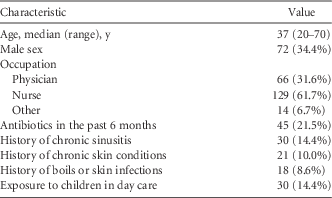
A total of 209 HCW were enrolled in the study; 7 HCW declined participation. Baseline characteristics are shown in Table 1.
Overall Characteristics of 209 HCW in Study of Perceptions of MRSA Carriage

NOTE. Data are no. (%) of subjects unless otherwise indicated. HCW, healthcare workers; MRSA, methicillin-resistant Staphylococcus aureus.
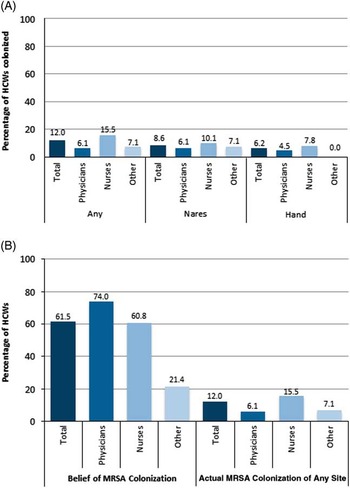
Eighteen HCW (8.6%) carried MRSA in their anterior nares, 13 (6.2%) on their hands, and 25 (12.0%) at either site. The breakdown of carriage rates by occupation fields is displayed in Figure 1A. Frequency of colonization did not differ significantly across type of HCW (P=.62, P=.41, P=.13 for nares, hand, and any carriage, respectively). There was no significant association between MRSA colonization at any site and ward location or self-reported MRSA risk factors. Patient MRSA colonization rates at the time of the study were 15%.
A, Proportion of all 209 healthcare workers (HCW) with methicillin-resistant Staphylococcus aureus (MRSA) cultured from anterior nares and/or hands, in the 3 different types of HCW. B, Discrepancies between predicted and actual rates of MRSA colonization from any site, among the 3 types of 162 HCW who completed the associated survey describing their beliefs about MRSA colonization.

Nasal carriage strongly predicted hand carriage. Of 18 subjects whose nares were colonized with MRSA, 6 (33%) also had MRSA on their hands. Conversely, of 191 subjects without nasal MRSA, only 7 (3.7%) had MRSA recovered from their hands (P<.001). However, it is worth noting that approximately half of HCW with MRSA on their hands were not concomitantly colonized in their nares. Pulsed-field gel electrophoresis of isolates from the 6 HCW carrying MRSA on both nares and hands demonstrated that 4 HCW had identical strains isolated from both sites (gel not shown). The remaining 2 HCW showed discordance between nares and hand strains, possibly indicating transient hand carriage acquired from the hospital setting.
Of the 162 subjects who completed the associated questionnaire, 100 (62%) believed that they themselves were colonized with MRSA. Belief in self-colonization varied significantly across the 3 occupational fields (P=.002) (Figure 1B), with physicians most likely to think themselves colonized (74.0%) and other ward staff least likely to believe this (21.4%). On average, physicians and nursing staff thought a higher proportion of HCW in the hospital were colonized with MRSA, compared with estimates made by nonphysician nonnurse ward staff (P=.02), with the latter estimates being much closer to the true prevalence of MRSA nasal carriage. There was no actual difference in colonization rates between those HCW who believed they were colonized and those who did not (11.1% vs 16.1%, P=.47).
DISCUSSION
Significant discrepancies exist between beliefs about MRSA carriage in HCW and actual rates of colonization. In our study, half of HCW believed that at least 50% of HCWs overall would be colonized with MRSA. This contrasted sharply with the actual prevalence in the same population because less than 9% of HCW sampled were nasal carriers of MRSA. Discrepancies also exist among HCW in terms of their propensity to believe that they themselves are colonized. Although rates of MRSA nasal carriage and hand acquisition were similar across HCW types, physicians and nursing staff were significantly more likely to believe that they were colonized with MRSA, compared with other nonphysician, nonnurse ward staff. Indeed, the rate of incorrect belief in MRSA colonization among physicians in our study was approximately 12 times higher than the actual rate of colonization. These data are particularly discouraging in light of the fact that appropriate hand hygiene rates at the time of the study ranged between 50% and 60%, suggesting that the belief that one is colonized and a potential vector for transmission of pathogens may not necessarily lead to scrupulous observance of best hand disinfection practices. Finally, other investigators have suggested inverse correlations between the level of professional education and the rate of handwashing adherence in teaching hospital situationsReference Duggan, Hensley, Khuder, Papadimos and Jacobs 8 ; our data suggest also some aspects of inverse correlation between knowledge of the epidemiology of healthcare-associated pathogens and level of professional education.
Our study has some limitations. Our observed rates of HCW MRSA carriage are consistent with previous reports, but it is possible that a difference in colonization rate or estimation of self-colonization would have appeared with continual sampling over time. Secondly, only first- or second-shift HCW were enrolled. Thirdly, the population studied was a “convenience sample,” in the sense that although a strenuous attempt was made to capture all ward personnel during the period under study, HCW not easily available to research staff may have been excluded.
Knowledge deficits among HCW regarding the epidemiology of MRSA colonization appear to be common. If it is possible that a widespread perception that “everybody is colonized” (a common opinion expressed by HCW) leads to a feeling of futility and disregard for best infection control practices among HCW, there is also the potential that by educating HCW about the actual epidemiology of healthcare-associated pathogens, harmful behaviors could be corrected and the transmission cycle broken. Future qualitative studies designed to explore reasons for nonadherence could shed light onto this paradoxical behavior.
ACKNOWLEDGMENTS
Financial support. US Department of Veterans Affairs (Research Career Development Award to U.S. and Merit Review Award to C.J.D.).
Potential conflicts of interest. All authors report no conflicts of interest relevant to this article.