Introduction
Solid-state systems provide an attractive option for safe and compact hydrogen storage. High volumetric and gravimetric hydrogen densities are realized if hydrogen is allowed to react reversibly with light metals, such as magnesium, to form metal hydrides. However, none of the light metal hydrides meets all practical hydrogen storage requirements, especially with respect to having fast release, full reversibility, and an equilibrium pressure in the desired range. In the past decade, nano-sizing metal hydrides using a porous scaffold has emerged as an effective strategy toward meeting these requirements.Reference de Jongh and Adelhelm1–Reference Vajo4 In this article, we give a brief overview of the impact of nano-sizing, especially by employing a nanoscaffold, on the hydrogen storage properties of light metal hydrides, highlighting fundamental aspects, giving practical examples, and discussing possible future developments.
Particle size effects
It is well known that the physicochemical properties of materials change if the particle size is reduced to the low nanometers range. A well-known example is gold, which changes from a golden colored inert metal into a red colored, low melting temperature, reactive, and catalytically active material once the particle size is reduced below 10–20 nm.Reference Roduner5
What can we expect when we decrease the size of metal hydride particles? In nanoparticles, a significant fraction of the atoms are located at the surface, while none of the interior atoms are very far from the surface. This means that we expect very fast kinetics for hydrogen release and uptake, as these are surface-mediated processes and typically involve diffusion through the solid state. Indeed this is generally observed, quite independent of the exact metal hydride system involved.
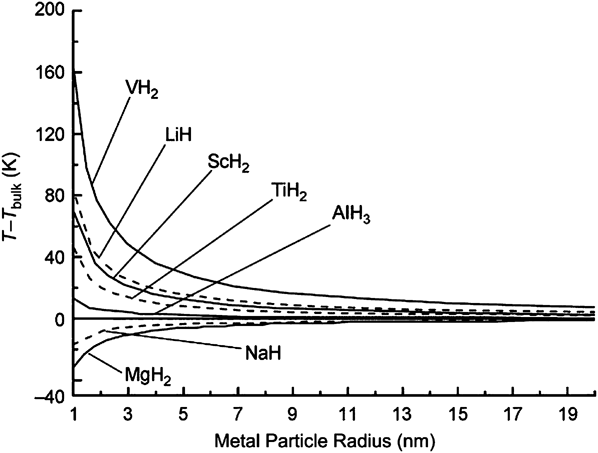
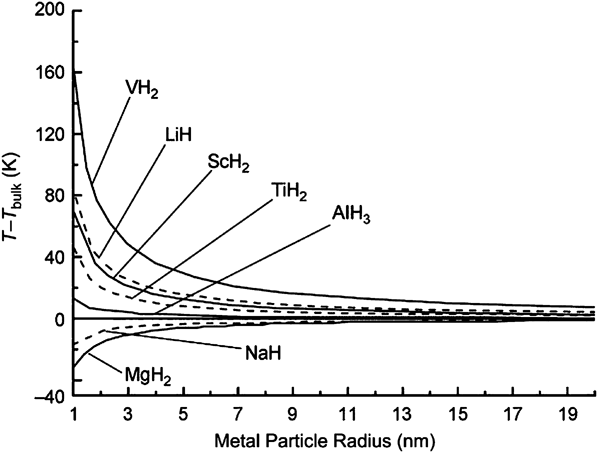
Importantly, the equilibrium between metal and hydrogen on one side and the metal hydride on the other side changes. For particles 2–20 nm in size, this is mostly related to the significant contribution of the surface energy term to the overall stability of the nanoparticles. If the metal hydride has a much larger surface energy than the metal, the equilibrium will shift toward the metal with decreasing size; however, if the metal has a higher surface energy, the situation is reversed. This is illustrated in Figure 1, which depicts the theoretically predicted change in equilibrium hydrogen release temperatures under 1 bar H2 pressure as a function of particle size for different metal-metal hydride combinations.Reference Kim, Dai, Johnson and Sholl6 For small clusters, even the atomic structure often deviates from the bulk structure, and changes in M–H and H–H interactions can play an important role. Large changes in equilibrium pressure are generally expected only below 2–5 nm particle size.Reference Kim, Dai, Johnson and Sholl6–Reference Cheung, Deng, van Duin and Goddard8 One of the earliest systems for which this has been calculated in detail is the MgH2 system, for which the equilibrium temperature (at 1 bar H2 pressure) based on the change in enthalpy of reaction is calculated to decrease from ∼300°C for µm-sized crystallites to 200°C for 0.9 nm clusters.Reference Wagemans, van Lenthe, de Jongh, van Dillen and de Jong7
The hydrogen release temperature T for nanometer-sized metal hydride particles is different than the release temperature T bulk for micrometer-sized particles. The figure shows calculated differences for a range of metal hydrides as a function of particle size. Reprinted with permission from Reference Reference Kim, Dai, Johnson and Sholl6. © 2009 IOP Publishing.
Palladium hydride as a model system to study size effects
The metal-hydrogen system for which particle size effects have been studied experimentally in most detail is Pd–H.Reference Oates9–Reference Zlotea, Cuevas, Paul-Boncour, Leroy, Dibandjo, Gadiou, Vix-Guterl and Latroche12 It is not considered to be a practical hydrogen storage system due to its low gravimetric hydrogen content (0.65 wt%) and high cost, but it provides very fast hydrogen release and uptake, and the hydrogen equilibrium pressure at room temperature is close to 1 bar, making it a convenient model system for interstitial metal hydrides.
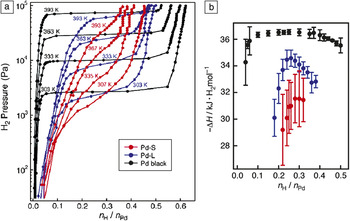
The equilibrium pressure-composition-isotherms show significant size effects (Figure 2a). The allowed hydrogen content in the solid solution phase (α) increases, whereas it decreases in the hydride phase (β) with reducing size. Consequently, the miscibility gap (two-phase region) narrows, and the critical temperature is lower for smaller particles.Reference Pundt and Kirchheim10–Reference Wu and Cheung13 Also, the equilibrium pressure in the two-phase region is not constant, but increases with increasing hydrogen content. The amount of hydrogen stored in the interior of Pd nanoparticles is lower than bulk Pd; however, this can be compensated for by a larger amount of hydrogen bound at surface and subsurface sites.
(a) Pressure-composition isotherms at different temperatures (as indicated) for bulk Pd powder (Pd black), 7.0 nm Pd particles (Pd-L), and 2.6 nm Pd particles (Pd-S). (b) Hydrogenation enthalpy derived from the measurements shown in (a). The x-axis (n H/n Pd) is the ratio of H to Pd. Reprinted with permission from Reference Reference Yamauchi, Ikeda, Kitagawa and Takata11. © 2008 American Chemical Society.

A plausible explanation is based on thermodynamic changes (enthalpy and entropy of mixing) in nano-sized Pd–H systems. Yamauchi et al. found that the thermodynamic quantities –∆Hα→β (enthalpy of hydrogenation) and –∆Sα→β (entropy) decrease by reduction of size (Figure 2b).Reference Yamauchi, Ikeda, Kitagawa and Takata11 It was argued that the nonconstant equilibrium pressure in the two-phase region is induced by a distribution of size-related surface tensions, interfacial stresses, or due to structural heterogeneities.Reference Pundt and Kirchheim10,Reference Yamauchi, Ikeda, Kitagawa and Takata11
Confining metal hydride nanoparticles in carbon scaffolds
Small particles are intrinsically unstable and prone to grow into larger crystallites. In suspensions, they can be stabilized by ligands, but in the solid phase, stabilization is typically achieved by placing the nanomaterial inside a porous host (a “support,” “scaffold,” or “matrix”). In the case of metal hydride storage systems, the host should comply with several requirements, including low weight, low cost, high porosity, and sufficient chemical inertness to limit reaction with the light metals.Reference Wu and Cheung13,Reference Adelhelm and de Jongh14 Porous carbon materials, such as carbon aerogels, high surface area graphite, and carbon replicas of ordered mesoporous materials basically satisfy all of these criteria, and hence have overwhelmingly been investigated as the scaffold of choice.Reference de Jongh and Adelhelm1
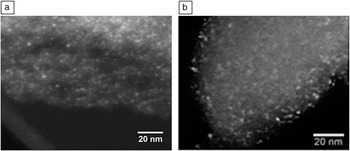
Different methods are used to prepare carbon-confined materials. Two representative resulting carbon-supported metal nanoparticulate samples are shown in Figure 3. Solution-impregnation based strategies involve several steps: (1) liquid impregnation of hosts by solutions of either the metal hydrides themselves or precursors (e.g., NaAlH4 or LiBH4 in THF, diethyl- or dibutylmagnesium in diethyl ether, hexane or heptane, palladium chlorides in aqueous solution); (2) if relevant, in situ reduction to the corresponding metals or hydrogenation to the respective hydrides (Figure 3a: dark-field TEM image of Pd nanoparticles in a carbon scaffold); and (3) removal of the solvent.Reference Baldé, Hereijgers, Bitter and de Jong15–Reference Zheng, Fang, Zhou, Chen, Ouyang, Zhu and Sun21 An alternative synthesis technique is melt infiltration with either the metal itself (Figure 3b: dark-field TEM image of Mg nanoparticles in a carbon scaffold), or the metal hydride (NaAlH4, LiBH4, NaBH4) in an inert or hydrogen atmosphere.Reference de Jongh, Wagemans, Eggenhuisen, Dauvillier, Radstake, Meeldijk, Geus and de Jong22–Reference Bogerd, Adelhelm, Meeldijk, de Jong and de Jongh28 Complex metal hydrides generally wet carbon matrices well and allow almost complete pore filling. It is more difficult to deposit light metal nanoparticles inside the pores, in some cases vapor phase transport also plays a role, and sometimes transition metals are predeposited to facilitate wetting/nucleation of confined particles.Reference Gross, Ahn, Van Atta, Liu and Vajo27,Reference Bogerd, Adelhelm, Meeldijk, de Jong and de Jongh28 Another technique is mechanochemical synthesis via a metathesis reaction. An example is the reaction between LiH and MgCl2, for which the final product is a dispersion of MgH2 nanoparticles in a LiCl matrix.Reference Paskevicius, Sheppard and Buckley29 Simply ball-milling scaffold and metal (hydride) generally destroys porous carbon structures and hence does not result in well-defined nanoconfined materials.
Dark-field electron micrographs (with the metal nanoparticles showing as bright dots) of (a) Pd nanoparticles and (b) Mg nanoparticles, both embedded in mesoporous carbon templates.Reference Zlotea, Cuevas, Paul-Boncour, Leroy, Dibandjo, Gadiou, Vix-Guterl and Latroche12,Reference de Jongh, Wagemans, Eggenhuisen, Dauvillier, Radstake, Meeldijk, Geus and de Jong22

The scaffold is essential to stabilize the nanoparticles and often facilitates their synthesis in the first place. Furthermore, it often has a profound impact on the properties of the confined phases. Physical confinement and chemical bonding between the scaffold and active material can induce mechanical stress and will certainly influence energetics, shape, and size of the active material after preparation but also during hydrogen cycling.Reference Wu and Cheung13,Reference Adelhelm and de Jongh14 Whether catalytically active metal nanoparticles such as Pd could significantly increase the hydrogen uptake of high surface area carbon materials at ambient temperature due to spillover remains under discussion.Reference Psofogiannakis and Froudakis30
Nanoconfinement of magnesium hydride to enhance kinetics
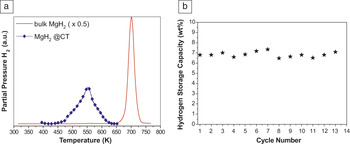
Magnesium hydride is the ionic hydride most studied for hydrogen storage. It has an appreciable hydrogen content (7.65 wt%) but slow sorption kinetics and high thermodynamic stability (∆Hf0 = –75 kJ mol–1 and ∆Sf0 = –135 J mol–1 K–1). Nano-sizing and nanoconfinement of MgH2 particles significantly improve the hydrogen desorption/absorption kinetics (Figure 4a), and faster hydrogen release is observed for smaller pore sizes.Reference Zhang, Gross, van Atta, Lopez, Liu, Ahn, Vajo and Jensen18,Reference Zlotea, Chevalier-Cesar, Leonel, Leroy, Cuevas, Dibandjo, Vix-Guterl, Martens and Latroche20,Reference Bogerd, Adelhelm, Meeldijk, de Jong and de Jongh28,Reference Konarova, Tanksale, Norberto Beltramini and Qing Lu31 Nanoconfinement can be combined with the addition of transition metals to enhance the desorption kinetics even further, as they act as hydrogenation catalysts and alloying elements.Reference Gross, Ahn, Van Atta, Liu and Vajo27,Reference Bogerd, Adelhelm, Meeldijk, de Jong and de Jongh28,Reference Zhao-Karger, Hu, Roth, Wang, Kubel, Lohstroh and Fichtner32 MgH2 nanoparticles embedded in porous carbon show rather good hydrogen cycling stability. The reversible hydrogen capacity is 5.5–7 wt% for more than 10 cycles (Figure 4b).Reference Zhang, Gross, van Atta, Lopez, Liu, Ahn, Vajo and Jensen18,Reference Zlotea, Chevalier-Cesar, Leonel, Leroy, Cuevas, Dibandjo, Vix-Guterl, Martens and Latroche20
Hydrogen sorption properties for MgH2 nanoparticles (mean size ∼5 nm) embedded into a carbon scaffold (MgH2@CT). (a) Hydrogen desorption compared with bulk MgH2 (10°C/min); (b) storage capacity over 13 hydrogen absorption/desorption cycles.Reference Zlotea, Chevalier-Cesar, Leonel, Leroy, Cuevas, Dibandjo, Vix-Guterl, Martens and Latroche20 Reprinted with permission from Reference Reference Zlotea, Chevalier-Cesar, Leonel, Leroy, Cuevas, Dibandjo, Vix-Guterl, Martens and Latroche20. © 2011 Royal Society of Chemistry.

Significant thermodynamic destabilization has been predicted theoretically for MgH2 particles of less than 1–2 nm size.Reference Wagemans, van Lenthe, de Jongh, van Dillen and de Jong7,Reference Cheung, Deng, van Duin and Goddard8 Experimentally, it is difficult to attain such small particle sizes. MgH2 nanoparticles (∼7 nm) embedded in LiCl show only slight thermodynamic changes (–∆Hf = 71 kJ mol–1 and –∆Sf = 130 J mol–1 K–1).Reference Paskevicius, Sheppard and Buckley29 Smaller MgH2 nanoparticles (∼3 nm) in a carbon scaffold show a larger shift in reaction enthalpy (–∆Hf = 63.8 kJ mol–1), but this is counteracted by a shift in entropy (–∆Sf = 117.2 J mol–1 K–1), hence the equilibrium temperature at 1 bar is only 11°C lower than for bulk MgH2.Reference Zlotea, Cuevas, Andrieux, Ghimbeu, Leroy, Léonel, Sengmany, Guterl, Gadiou, Martens and Latroche33 However, it should be noted that particle sizes of MgH2 after cycling are seldomly determined, while severe sintering can occur for Mg nanoparticles during cycling.Reference Zhao-Karger, Hu, Roth, Wang, Kubel, Lohstroh and Fichtner32 In general, we can conclude that in the case of MgH2, the kinetics of hydrogen sorption are greatly enhanced, but only limited thermodynamic destabilization of the hydride may be achieved by nanoconfinement.
Nanoconfinement of complex metal hydrides
Sodium alanate, NaAlH4, is one of the most studied complex metal hydrides (see the article by Graetz et al. in this issue). It decomposes in several hydrogen release steps via the hexahydride Na3AlH6 to NaH, giving a modest hydrogen capacity of 5.6 wt% (or 7.4 wt% if full decomposition to Na, Al, and H2 is considered). Interestingly, the desorption/absorption equilibriums under 1 bar H2 pressure are in the desired temperature range for compatibility with proton exchange membrane fuel cells (33°C for NaAlH4 and 110°C for Na3AlH6 decomposition), and it is the only complex metal hydride for which an effective catalyst (Ti-based) has been identified.Reference Bogdanović and Schwickardi34
The advantages of combining carbon supports with NaAlH4 were first mentioned in a patent application in 2004,Reference Schüth, Bogdanović and Taguchi35 but the first results in open literature appeared in 2006.Reference Baldé, Hereijgers, Bitter and de Jong15 Low loadings of NaAlH4 on carbon were prepared by impregnation with NaAlH4 in THF solution. Bulk NaAlH4 without a catalyst only starts to release a significant amount of hydrogen around the melting point of NaAlH4 (∼180°C). This essentially prevents reversible hydrogenation of bulk NaAlH4. In contrast, NaAlH4 nanoparticles on carbon nanofibers start to release hydrogen at room temperature, even without a Ti-based catalyst. A strong particle size dependence of the hydrogen release temperature was found, with an activation energy of only 58 kJ mol–1 for 2–10 nm particles, while 120 kJ mol–1 is reported for bulk NaAlH4, and ∼80 kJ mol–1 in the presence of a Ti-based catalyst.Reference Baldé, Hereijgers, Bitter and de Jong36
Melt infiltration allows high loadings of NaAlH4; it is possible to fill the pores of a carbon host almost completely. Hydrogen release in these highly loaded nanoconfined systems generally occurs at higher temperatures than for supported nanoparticles of similar size, and it does not depend strongly on host pore size.Reference Nielsen, Javadian, Polanski, Besenbacher, Bystrzycki and Jensen37 However, very good reversibility (>80–90%) under relatively mild conditions is obtained even without a catalyst, especially if care is taken to compensate or avoid side reactions with the host material.Reference Stephens, Gross, van Atta, Vajo and Pinkerton24,Reference Gao, Ngene, Lindemann, Gutfleisch, de Jong and de Jongh38 The scaffold prevents large-scale phase segregation upon decomposition, and most likely the carbon host surface also provides efficient surface-mediated transport of metal-based species.Reference Gao, Ngene, Lindemann, Gutfleisch, de Jong and de Jongh38 Furthermore, it has been postulated that carbon materials could act as “catalysts” for dehydrogenation involving electronic effects.Reference Berseth, Harter, Zidan, Blomqvist, Moyses Araujo, Scheicher, Ahuja and Jena39 Kinetics can be further enhanced by combining nanoconfinement with Ti-based catalysts.Reference Nielsen, Javadian, Polanski, Besenbacher, Bystrzycki and Jensen37
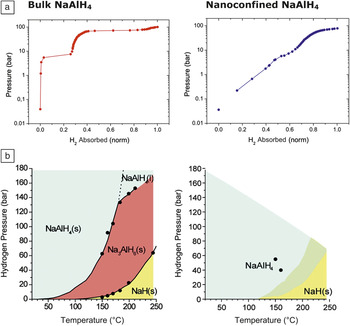
Nanoconfinement clearly changes the phase equilibriums in the Na-Al-H system (Figure 5). The two-phase equilibrium results in sloping rather than flat plateaus in the pressure-composition isotherms (Figure 5a).Reference Lohstroh, Roth, Hahn and Fichtner40 The NaAlH4 phase actually becomes more stable with respect to its decomposition products upon nanoconfinement in carbon hosts, and the formation of the Na3AlH6 phase becomes unfavorable (Figure 5b),Reference Gao, Adelhelm, Verkuijlen, Rongeat, Herrich, van Bentum, Gutfleisch, Kentgens, de Jong and de Jongh41 according to both experimental findings and theoretical calculations.Reference Stephens, Gross, van Atta, Vajo and Pinkerton24,Reference Lohstroh, Roth, Hahn and Fichtner40–Reference Majzoub, Zhou and Ozoliņš43
Equilibria for the Na-Al-H system, comparing bulk NaAlH4 (left frames) to carbon nanoconfined NaAlH4 (right frames). (a) Pressure composition isotherms, with two clear decomposition steps (forming first Na3AlH6 and then NaH and Al) for the bulk, while for the nanoconfined sample, a rather continuous hydrogen release is observed (figures courtesy of M. Fichtner).Reference Lohstroh, Roth, Hahn and Fichtner40 (b) Bulk phase diagram showing three clearly defined phase regions. For the nanoconfined sample, an indicative phase diagram is shown, with the markers representing conditions for which the presence of NaAlH4 and the absence of Na3AlH6 were confirmed by solid-state nuclear magnetic resonance. Reprinted with permission from Reference Reference Gao, Adelhelm, Verkuijlen, Rongeat, Herrich, van Bentum, Gutfleisch, Kentgens, de Jong and de Jongh41. © 2010 American Chemical Society.

A second interesting family of complex metal hydrides is the alkali metal borohydrides. LiBH4 has received much attention, as it contains 18.5 wt% hydrogen. However, the hydride is much more stable than NaAlH4 and also decomposes in several steps, with LiH and Li2B12H12 being reported as very stable phases.Reference Orimo, Nakamori, Kitagawa, Miwa, Ohba, Towatat and Züttel44 However, the most important impediment for practical use is the limited reversibility, which is most likely related to the inert boron phase being formed upon dehydrogenation. For bulk LiBH4, partial reversibility has been reported only at 600°C and 155 bar H2 pressure.
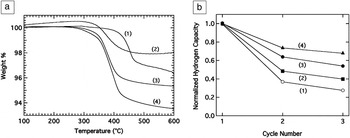
LiBH4 can be deposited in porous hosts from solution,Reference Cahen, Eymery, Janot and Tarascon16 but almost full pore filling is conveniently obtained by melt infiltration, as first reported by Gross et al.Reference Gross, Vajo, van Atta and Olson23 Again, hydrogen release kinetics are largely improved by nanoconfinement in carbon (Figure 6a). This improvement might be related to increased ionic mobilities at low temperatures for LiBH4 confined in nanoporous hosts, as evident from nuclear magnetic resonance measurements.Reference Shane, Corey, McIntosh, Rayhel, Bowman, Vajo, Gross and Conradi45,Reference Verkuijlen, Ngene, de Kort, Barre, Nale, van Eck, van Bentum, de Jongh and Kentgens46 The improvement in reversibility under mild conditions is spectacular (Figure 6b),Reference Gross, Vajo, van Atta and Olson23 especially if Ni is added.Reference Ngene, Verkuijlen, Zheng, Kragten, van Bentum, Bitter and de Jongh47 This is mostly attributed to physical confinement, keeping the phases small and with large interfacial areas during hydrogen cycling. However, suppression of the formation of gaseous decomposition products other than H2 also seems to play a role.Reference Cahen, Eymery, Janot and Tarascon16,Reference Liu, Peaslee, Jost, Baumann and Majzoub48
(a) Normalized hydrogen desorption and (b) cycling stability for LiBH4 incorporated in carbon scaffolds. Curve (1) LiBH4 mixed with nonporous graphite. Curve (2) LiBH4 incorporated into activated carbon. Curve (3) LiBH4 incorporated into 13 nm carbon aerogel. Curve (4) LiBH4 incorporated into 25 nm carbon aerogel. Reprinted with permission from Reference Reference Gross, Vajo, van Atta and Olson23. © 2008 American Chemical Society.

In some cases, specific interactions with the carbon host are observed. An interesting possibility is the formation of lithium-doped fullerenes (Lix-C60Hy) that are capable of reversibly storing 5 wt% hydrogen.Reference Teprovich, Wellons, Lascola, Hwang, Ward, Compton and Zidan49 Furthermore, reversible intercalation of Na into the carbon can occur, stabilizing the metal phase and lowering the equilibrium decomposition temperature of NaH under 1 bar H2 pressure from 425°C to 225°C.Reference Adelhelm, de Jong and de Jongh50
Recent developments beyond carbon scaffolds
The carbon hosts discussed until now are rather heterogeneous materials, and it would be desirable to attain smaller (<1–2 nm) metal (hydride) particles. Metal–organic frameworks (MOF) are attractive scaffolds in this respect, because their crystalline structure yields highly defined, monodisperse micropores (<2 nm). Since systematic tuning of both pore size and chemical environment is feasible,Reference Ferey51 the potential exists to isolate the effects of particle size from surface chemistry to a great extent.
Wet-chemical methods have been used to deposit Pd in MOF, showing a synergistic effect of hydrogen physisorption by the porous MOF, hydrogen uptake by the Pd, and possibly a contribution from spillover. However, the effective hydrogen uptake at room temperature is limited (∼0.35 wt%).Reference Zlotea, Campesi, Cuevas, Leroy, Dibandjo, Volkringer, Loiseau, Ferey and Latroche52 In a recent study, Lim et al. formed Mg nanocrystals by thermally decomposing bis-cyclopentadienyl magnesium (MgCp2) after exposing a MOF to vapors of this organometallic compound. The resulting hybrid material exhibits synergistic behavior in which the heat of H2 physisorption increases to as much as 11.6 kJ mol–1, while simultaneously, the release temperature for chemisorbed hydrogen decreases by >200 K relative to 50–100 μm Mg powder.Reference Lim, Roon, Ryu and Suh53
Bhakta et al. were the first to demonstrate that the 1.3 nm pore MOF Cu3(BTC)2 (benzenetricarboxylate) can be infiltrated with NaAlH4 from a THF solution without framework degradation, forming clusters with only eight formula units on average.Reference Bhakta, Herberg, Jacobs, Highley, Behrens, Ockwig and Allendorf17 The reaction to NaH, Al, and H2 proceeds by a single step, and H2 desorption is dramatically accelerated (the desorption activation energy is reduced by more than 60 kJ (mol-H2)–1) relative to the bulk.Reference Bhakta, Maharrey, Stavila, Highley, Alam, Majzoub and M. Allendorf54 This acceleration of desorption kinetics is observed across a range of metal hydrides. In the case of LiBH4 synthesized by confinement within the pores of Cu-containing MOFs, the enhanced hydrogen desorption rates are thought to result from interactions between the hydride and open coordination sites on the Cu(II) ions in the framework.Reference Sun, Li, Mao, Guo, Liu, Dou and Yu55
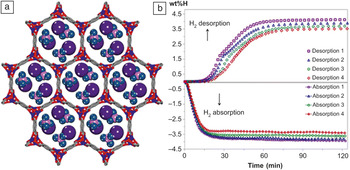
Reactions between confined metal (hydride) clusters and the metal–organic framework can be an issue. Recently, reversible cycling of nanoconfined NaAlH4 was reported (Figure 7).Reference Bhakta, Maharrey, Stavila, Highley, Alam, Majzoub and M. Allendorf54,Reference Stavila, Bhakta, Alam, Majzoub and Allendorf56 Bhakta et al. achieved reversible cycling with only a modest reduction in capacity from 4.1 wt% to 3.6 wt% over four cycles by melt infiltrating NaAlH4 into a titanium-modified MOF.Reference Bhakta, Maharrey, Stavila, Highley, Alam, Majzoub and M. Allendorf54 This suggests that the open coordination sites stabilize the catalyst, and the pore dimensions are sufficiently small to prevent agglomeration of product phases. Hopefully, the achievement of confining metal hydrides in porous MOFs and hydrogen cycling them without structural degradation will open new possibilities to gain a more fundamental understanding of particle size effects.
NaAlH4 confined in the nanopores of a titanium-functionalized metal–organic framework MOF-74 (Mg) forms clusters of formula units (a) and can reversibly store hydrogen with minimal loss of capacity. (b) wt% normalized to the NaAlH4 loading. Reprinted with permission from Reference Reference Stavila, Bhakta, Alam, Majzoub and Allendorf56. © 2012 American Chemical Society.

All scaffold materials discussed so far decrease the overall hydrogen capacity of the systems significantly by their added weight. Furthermore, nano-sizing metal particles enhances not only the kinetics of hydrogenation, but also the risk of oxidation (and hence passivation) as well as evaporation. As an alternative approach, air-stable Mg nanoparticles (∼5 nm) embedded in a hydrogen gas-selective polymer matrix (PMMA) were recently described, prepared by a one-pot reduction of an Mg organometallic precursor. The Mg nanoparticles (∼5 nm) incorporated in a polymer absorb hydrogen relatively fast at 35 bar and 200°C (6 wt% in 60 min).Reference Jeon, Moon, Ruminski, Jiang, Kisielowski, Bardhan and Urban57 Another intriguing option is a core-shell system. NaBH4 particles individually encapsulated in catalytically active Ni shells give hydrogen release rates and reversibilities unprecedented for NaBH4.Reference Christian and Aguey-Zinsou58
An open question is whether the changes in properties observed due to nanoconfinement might also be relevant for other applications. For instance, LiBH4 is proposed as a possible solid Li+ conductor for rechargeable lithium batteries. Generally, the hydrogen and lithium mobilities below the solid-solid phase transition temperature (110°C) are low. However, greatly enhanced hydrogen dynamics and lithium translational mobility are observed if the LiBH4 is confined in the nanopores of a carbon or silica matrix.Reference Shane, Corey, McIntosh, Rayhel, Bowman, Vajo, Gross and Conradi45,Reference Verkuijlen, Ngene, de Kort, Barre, Nale, van Eck, van Bentum, de Jongh and Kentgens46
Conclusion and outlook
In the past decade, confining metal hydrides inside nanopores has emerged as an intriguing strategy to influence the material characteristics that are essential for reversible hydrogen storage. Hydrogen release temperatures are lowered substantially by nano-sizing, and reversibility under mild conditions is often obtained, even for alkali metal borohydrides, which are notoriously difficult to hydrogen cycle. The strategy is also associated with disadvantages, most notably a lower gravimetric system hydrogen capacity and an increased sensitivity toward passivation by oxidation.
It is clear that particle size, physical confinement, and interfaces are important tools to change the functional characteristics of light metal hydrides. We have just started to explore and unravel the physical origin of the impact of nanoconfinement on fundamental physical-chemical properties. Nevertheless, the improvement in practical performance that has been achieved in such a short time span is impressive and holds great promise for future developments.
Acknowledgments
J.J.V. acknowledges support by the US Department of Energy (DOE contract DEE-FC36–05G015067). P.E.dJ acknowledges financial support from NWO-Vidi and NWO-ACTS/Sustainable Hydrogen.