Introduction
Tetranychid mite, particularly Tetranychus urticae Koch (Acari: Tetranychidae), are serious pests on many commercial crops worldwide and phytoseiid mites (Acari: Phytoseiidae) are the main biocontrol agents of the tetranychid mites in commercial greenhouses (McMurtry and Croft Reference McMurtry and Croft1997; Schausberger Reference Schausberger1997; Hatherly et al. Reference Hatherly, Bale and Walters2005; Cakmak et al. Reference Cakmak, Janssen and Sabelis2006, Reference Cakmak, Janssen, Sabelis and Baspinar2009; Abad-Moyano et al. Reference Abad-Moyano, Urbaneja and Schausberger2010; McMurtry et al. Reference McMurtry, De Moraes and Sourassou2013). Phytoseiulus persimilis Athias-Henriot (Acari: Phytoseiidae) is a highly specialised tetranychids predator (McMurtry and Croft Reference McMurtry and Croft1997; Walzer et al. Reference Walzer, Blümel and Schausberger2001; McMurtry et al. Reference McMurtry, De Moraes and Sourassou2013) and Typhlodromus bagdasarjani Wainstein and Arutunjan (Acari: Phytoseiidae) is a generalist indigenous widespread predator in the orchards of Iran (Daneshvar Reference Daneshvar1993; Kamali et al. Reference Kamali, Ostovan and Atamehr2001; Faraji et al. Reference Faraji, Hajizadeh, Ueckermann, Kamali and McMurtry2007; McMurtry et al. Reference McMurtry, De Moraes and Sourassou2013). Both of the above-mentioned phytoseiid mites are known to have an important role in control of T. urticae populations in laboratory and greenhouse conditions (Walzer and Schausberger Reference Walzer and Schausberger1999a, Reference Walzer and Schausberger1999b; Schausberger and Croft Reference Schausberger and Croft2000a, Reference Schausberger and Croft2000b; Cakmak et al. Reference Cakmak, Janssen and Sabelis2006, Reference Cakmak, Janssen, Sabelis and Baspinar2009; Ganjisaffar et al. Reference Ganjisaffar, Fathipour and Kamali2011a, Reference Ganjisaffar, Fathipour and Kamali2011b; Moghadasi et al. Reference Moghadasi, Saboori, Allahyari and Zahedi Golpayegani2013, Reference Moghadasi, Saboori, Allahyari and Zahedi Golpayegani2014; Daneshmandi et al. Reference Daneshmandi, Rahmani, Walzer and Jalaeian2014; Farazmand et al. Reference Farazmand, Fathipour and Kamali2015a, Reference Farazmand, Fathipour and Kamali2015b). It has been known that P. persimilis is sensitive to high temperatures and low humidity but T. bagdasarjani is well adapted to such conditions (Skirvin and Fenlon Reference Skirvin and Fenlon2003; Ganjisaffar et al. Reference Ganjisaffar, Fathipour and Kamali2011a, Reference Ganjisaffar, Fathipour and Kamali2011b). Moreover, T. bagdasarjani is a generalist predator that can feed and reproduce on pollen, plant exudates, honeydew, and fungi and can maintain its populations in conditions without prey (McMurtry and Croft Reference McMurtry and Croft1997; McMurtry et al. Reference McMurtry, De Moraes and Sourassou2013).
Several researches have reported that simultaneous release of various predator species could be more effective in reducing pest populations than release of a single species of predator (Schausberger and Croft Reference Schausberger and Croft2000a, Reference Schausberger and Croft2000b; Schausberger and Walzer Reference Schausberger and Walzer2001; Walzer et al. Reference Walzer, Blümel and Schausberger2001; Hatherly et al. Reference Hatherly, Bale and Walters2005; Cakmak et al. Reference Cakmak, Janssen and Sabelis2006, Reference Cakmak, Janssen, Sabelis and Baspinar2009; Lucas and Rosenheim Reference Lucas and Rosenheim2011). Therefore, knowledge of interactions within a predator complex is indispensable and intraguild predation is one of the most notable factors in such considerations. In planning a biological control programme it should be considered that predator interactions could be complementary and increase suppression of a pest population. In contrast, predator intraguild interactions may cause interference and lessen the rate of prey reduction (Rosenheim et al. Reference Rosenheim, Kaya, Ehler, Marois and Jaffee1995; Holt and Polis Reference Holt and Polis1997; Walzer et al. Reference Walzer, Blümel and Schausberger2001; Hatherly et al. Reference Hatherly, Bale and Walters2005; Negloh et al. Reference Negloh, Hanna and Schausberger2012).
Competition and predation/parasitism are both types of species interactions and intraguild predation is a combination of these (Polis et al. Reference Polis, Myers and Holt1989). This widespread interaction occurs among species with shared resources and influences abundance and distribution of communities used as biocontrol agents. Intraguild predation has been extensively documented for communities of natural enemies associated with arthropods (Polis et al. Reference Polis, Myers and Holt1989; Rosenheim et al. Reference Rosenheim, Kaya, Ehler, Marois and Jaffee1995). In terms of intraguild predation, the predator is defined as the intraguild predator and the competitor as intraguild prey and their shared food as extraguild prey (Polis et al. Reference Polis, Myers and Holt1989; Lucas et al. Reference Lucas, Coderre and Brodeur1998; Lucas Reference Lucas2005; Negloh et al. Reference Negloh, Hanna and Schausberger2012). Intraguild predation occurs predominantly in generalist predator communities that attack smaller conspecific and heterospecific individuals (Polis et al. Reference Polis, Myers and Holt1989). Based on Rosenheim et al. (Reference Rosenheim, Kaya, Ehler, Marois and Jaffee1995), generalist predators in the Acari are well represented in terms of intraguild interactions. Several studies have indicated that intraguild predation is usual existent among predator communities of phytoseiid mites (Schausberger Reference Schausberger1997; Walzer and Schausberger Reference Walzer and Schausberger1999a, Reference Walzer and Schausberger1999b; Schausberger and Croft Reference Schausberger and Croft2000a, Reference Schausberger and Croft2000b; Hatherly et al. Reference Hatherly, Bale and Walters2005; Cakmak et al. Reference Cakmak, Janssen and Sabelis2006, Reference Cakmak, Janssen, Sabelis and Baspinar2009; Momen and Abdel-Khalek Reference Momen and Abdel-Khalek2009; Lucas and Rosenheim Reference Lucas and Rosenheim2011; Walzer and Schausberger Reference Walzer and Schausberger2011; Guzman et al. Reference Guzman, Sahun and Montserrat2016).
The presence of shared prey (extraguild prey) can influence the nature of intraguild predation, for example when the common prey is rare or nonexistent the predator may extend its diet to new food resources such as other predator species in the same guild (Polis et al. Reference Polis, Myers and Holt1989; Lucas et al. Reference Lucas, Coderre and Brodeur1998; Guzman et al. Reference Guzman, Sahun and Montserrat2016).
The purpose of this research was to assess presence and absence of shared prey, T. urticae, as well as pollen on intraguild interactions between T. bagdasarjani and P. persimilis adult females and heterospecific immature stages under laboratory conditions. Comparison of prey consumption and fecundity of these predatory mites in presence and absence of shared prey conditions could lead to proper prediction of their predation potential in order to apply them together to control of T. urticae populations in greenhouses.
Material and methods
Plant species
Cucumber plants (Cucumis sativus Linnaeus cultivar Sultan; Cucurbitaceae) were planted in plastic pots filled with mixture of cocopeat: perlit (40:60 ratio) under greenhouse conditions (25±5 °C, 50±20% relative humidity and natural light duration).
Insect collection and rearing
Tetranychus urticae was originally collected from infested lima bean (Phaseolus lunatus Linnaeus; Fabaceae) leaves in the insect population ecology laboratory at the Department of Plant Protection, University of Tehran in Karaj, Iran and reared on cucumber plants in a growth chamber at 25±2 °C, 50±10% relative humidity and 16:8 light:dark hour photoperiod. Phytoseiulus persimilis was initially obtained from laboratory stock culture reared in population ecology laboratory at the Department of Plant Protection, University of Tehran in Karaj, Iran. Typhlodromus bagdasarjani was originally collected from black mulberry (Morus nigra Linnaeus; Moraceae) trees in the Faculty of Agriculture campus, Tarbiat Modares University, Tehran, Iran. The phytoseiid mites were reared on arenas consisting of a piece of green plastic on a water-saturated sponge in a plastic container (26×16×7 cm) maintained at 25±1 °C, 75±5% relative humidity and 16:8 light:dark hour photoperiod in a growth chamber. The plastic piece margins were covered with moistened tissue paper to supply water to the predators and to prevent their escape (Overmeer Reference Overmeer1985). The T. urticae-infested cucumber leaves were added to the arenas three times a week. In addition, some maize (Zea mays Linnaeus; Poaceae) pollen was added to T. bagdasarjani arenas as supplementary food two times a week.
Experimental unit
The cucumber leaves were cut into circular shaped discs and placed upside down on water-saturated sponge in 9-cm-diameter Petri dishes. The leaf disc margins were surrounded with circular wet tissue paper strips to provide a 5-cm-diameter arena on leaf discs to serve as an experimental unit and prevent the predators from escape. The lid of each Petri dish had a 1-cm-diameter hole covered with a fine mesh net. Additional water was added to the units, daily. The experimental units were kept at the same laboratory conditions as the predator rearing units.
Experimental procedure
A single one-day-old mated T. bagdasarjani and P. persimilis female were placed on each leaf disc. The predation and oviposition rate of each predator female (T. bagdasarjani and P. persimilis) as intraguild predator on eggs, larvae, protonymphs, and deutonymphs of heterospecific predator as intraguild prey was assayed in the absence and presence of T. urticae protonymphs as extraguild prey with and without maize pollen as supplementary food. Two basic experiments were prepared. In the first experiment, eight treatments were arranged as follows. Four treatments to investigate predation and oviposition of both phytoseiid species on each other in absence of T. urticae: (a) one phytoseiid adult female plus seven heterospecific eggs (<24-hour old), (b) one phytoseiid adult female plus seven heterospecific larvae (newly hatched), (c) one phytoseiid adult female plus five heterospecific protonymph (newly hatched), (d) one phytoseiid adult female plus five heterospecific deutonymph (newly hatched). In the other four treatments, 30 T. urticae protonymphs were added to each of the above-mentioned treatments to examine the presence of extraguild prey on intraguild predation. Eight treatments were applied in the second experiment as follows. Four treatments were set up to investigate intraguild predation of predators in absence of T. urticae and presence of pollen: (a) one phytoseiid adult female, seven heterospecific eggs (less than 24 hour old) plus maize pollen, (b) one phytoseiid adult female, seven heterospecific larvae (newly hatched) plus maize pollen, (c) one phytoseiid adult female, five heterospecific protonymph (newly hatched) plus maize pollen, (d) one phytoseiid adult female, five heterospecific deutonymph (newly hatched) plus maize pollen. In the other four treatments, 30 T. urticae protonymphs were added to each of the above-mentioned treatments to evaluate the presence of T. urticae and pollen on intraguild predation of the two predators.
Each treatment was replicated 15 times. Evaluations were examined every 24 hours in five days to record the number of prey consumed and eggs laid by the female predators. Consumed and survived individuals were replaced by new ones, daily.
Statistical analysis
All data were tested for normality with MINITAB 17 using the Ryan-Joiner method. The number of daily consumed prey and laid eggs by per female predators were analysed by one-way analysis of variance and differences among means were compared by Tukey’s multiple range test in SPSS 16. Comparison between predation and oviposition rates of predators in treatments was conducted using the t-test in SPSS 16.
Results
Effect of the absence or presence of Tetranychus urticae on the intraguild interaction between Phytoseiulus persimilis and Typhlodromus bagdasarjani
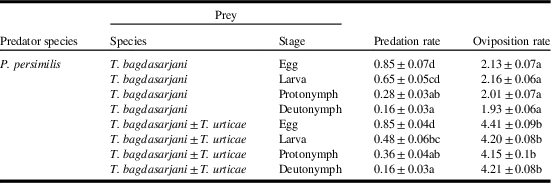
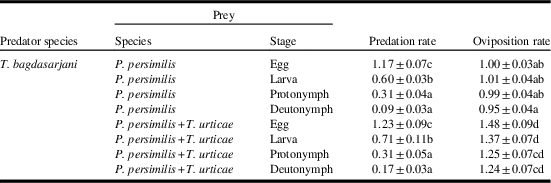
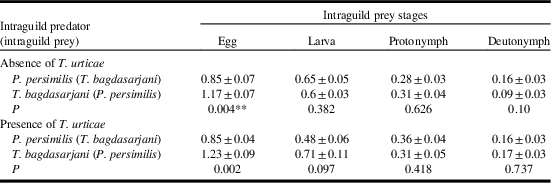
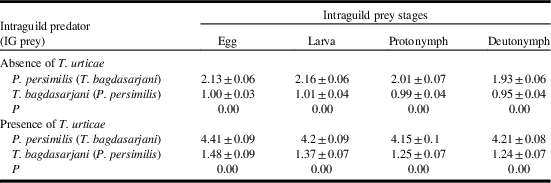
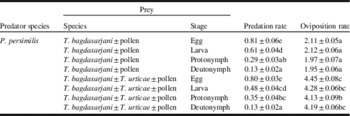
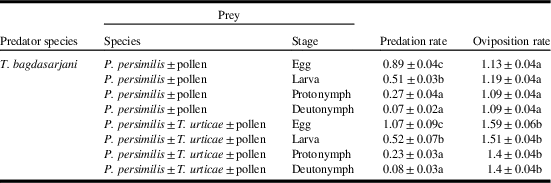
Females of both phytoseiid species fed on different stages of the other species both in absence and presence of T. urticae as extraguild prey (Tables 1–2). Based on results of one-way analysis of variance, the highest and least predation rates of both predators were on heterospecific eggs and deutonymphs, respectively in both absence and presence of T. urticae treatments (F(7,119) = 36.554, P<0.0001, Table 1; F(7,119)=43.129, P<0.0001, Table 2). The t-test results showed that females of T. bagdasarjani consumed significantly more heterospecific eggs than P. persimilis both in the absence and presence of T. urticae (Table 3). The oviposition of both predators was higher in the presence of T. urticae than in its absence (F(7,119)=217.716, P<0.0001, Table 1; F(7,119)=11.316, P<0.0001, Table 2). Based on results of t-test, oviposition of P. persimilis was significantly higher on heterospecific different stages than T. bagdasarjani both in absence and presence of T. urticae (Table 4).
Predation and oviposition (mean±standard error) of female adult Phytoseiulus persimilis when provided with different stages of Typhlodromus bagdasarjani in the presence or absence of Tetranychus urticae.

Note: Means followed by the same letters in each column are not significantly different (P<0.05, Tukey’s multiple range test).
Predation and oviposition (mean±standard error) of female adult Typhlodromus bagdasarjani when provided with different stages of Phytoseiulus persimilis in the presence or absence of Tetranychus urticae.

Note: Means followed by the same letters in each column are not significantly different (P<0.05, Tukey’s multiple range test).
Predation (mean±standard error) of an intraguild adult predator (Phytoseiulus persimilis/Typhlodromus bagdasarjani) on immature stages of intraguild prey (Phytoseiulus persimilis/Typhlodromus bagdasarjani) in the absence and presence of Tetranychus urticae.

Oviposition (mean±standard error) of an intraguild adult predator (Phytoseiulus persimilis/Typhlodromus bagdasarjani) on immature stages of intraguild prey (Phytoseiulus persimilis/Typhlodromus bagdasarjani) in the absence and presence of Tetranychus urticae.

Effect of pollen in the absence or presence of Tetranychus urticae on the intraguild interaction between Phytoseiulus persimilis and Typhlodromus bagdasarjani
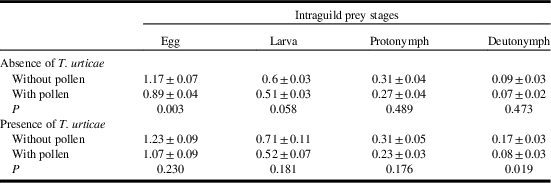
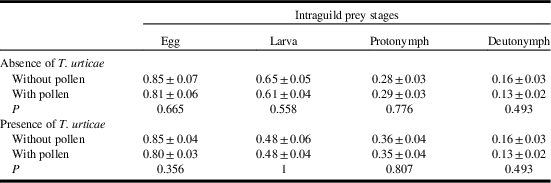
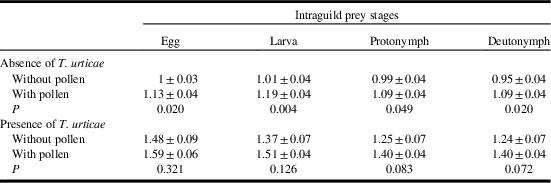
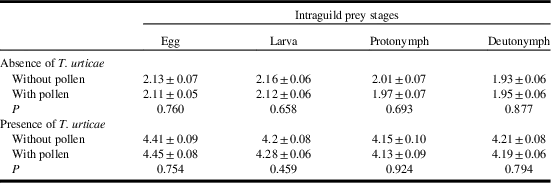
When pollen was added to treatments with and without T. urticae, the intraguild predation on heterospecific different stages was observed between both phytoseiid predators (Tables 5–6). Such as the experiments without pollen, the highest and least consumption rate of both phytoseiid predators were on heterospecific eggs and deutonymphs, respectively in both absence and presence of T. urticae treatments (F(7,119)=47.949, P<0.0001, Table 5; F(7,119)=56.903, P< 0.0001, Table 6). According to t-test results, pollen addition caused significant reduction in T. bagdasarjani predation on heterospecific eggs and deutonymphs in absence and presence of T. urticae treatments, respectively (Table 7). However, predation rate of P. persimilis on heterospecific stages was not significantly affected by pollen addition either in presence or in absence of T. urticae (Table 8). In treatments with and without pollen, oviposition of both predators was higher in presence of T. urticae than in its absence (F(7,119)=292.945, P<0.0001, Table 5; F(7,119)=19.261, P<0.0001, Table 6). The t-test analysis of T. bagdasarjani oviposition indicated the significant effect of pollen addition on increasing the rate of oviposition in absence of T. urticae (Table 9). However, T. bagdasarjani oviposition was not affected by pollen addition in presence of T. urticae (Table 9). Moreover, pollen addition had a nonsignificant effect on the oviposition of P. persimilis either in presence or in absence of T. urticae (Table 10).
Predation and oviposition (mean±standard error) of female adult Phytoseiulus persimilis when provided with different stages of Typhlodromus bagdasarjani in the presence or absence of Tetranychus urticae with pollen.

Note: Means followed by the same letters in each column are not significantly different (P<0.05, Tukey’s multiple range test).
Predation and oviposition (mean±standard error) of female adult Typhlodromus bagdasarjani when provided with different stages of Phytoseiulus persimilis in the presence or absence of Tetranychus urticae with pollen.

Note: Means followed by the same letters in each column are not significantly different (P<0.05, Tukey’s multiple range test).
Predation (mean±standard error) of Typhlodromus bagdasarjani on immature stages of Phytoseiulus persimilis in the absence and presence of Tetranychus urticae with and without pollen.

Predation (mean±standard error) of Phytoseiulus persimilis on immature stages of Typhlodromus bagdasarjani in the absence of Tetranychus urticae with and without pollen.

Oviposition (mean±standard error) of Typhlodromus bagdasarjani on immature stages of Phytoseiulus persimilis in the absence of Tetranychus urticae with and without pollen.

Oviposition (mean±standard error) of Phytoseiulus persimilis on immature stages of Typhlodromus bagdasarjani in the absence of Tetranychus urticae with and without pollen.

Discussion
This project studied the predation capacity and fecundity of phytoseiid mites, P. persimilis and T. bagdasarjani, on each other’s immature stages in the absence and presence of shared prey, T. urticae, as well as pollen addition. Tests were done under laboratory conditions. According to Lucas (Reference Lucas2005), intraguild predation can be unidirectional when one of the predator species is always intraguild prey and the other is always intraguild predator; it is bidirectional (mutual) when both predator species prey on each other and each predator is also prey and vice versa. The current research implies that predation occurred by two predator female species on all stages of the other species (bidirectional) not only in absence of T. urticae as food but also in its presence. Bidirectional intraguild predation between P. persimilis and T. bagdasarjani has also been reported by Ghasemloo et al. (Reference Ghasemloo, Pakyari and Arbab2016), in absence of T. urticae. Nevertheless, P. persimilis did not feed on the heterospecific nymph stages in interactions among P. persimilis, Amblyseius swirskii (Athias-Henriot) (Acari: Phytoseiidae), and Neoseiulus barkeri (Hughes) (Acari: Phytoseiidae) (Maleknia et al. Reference Maleknia, Fathipour and Soufbaf2016).
Both in absence and presence of T. urticae treatments, with no significant difference, the highest predation rate of both phytoseiid predators was on heterospecific eggs such that the greatest tendency to interspecific predation on eggs was by T. bagdasarjani females compared with P. persimilis. Therefore, T. bagdasarjani seems to be a stronger intraguild predator of heterospecific eggs than P. persimilis. Intraguild predation is particularly common in generalist predators as they consume other natural enemies as well as their main prey. In fact, generalist species in predator-predator interactions have greater tendency to interspecific predation than the specialist types (McMurtry and Croft Reference McMurtry and Croft1997; Schausberger Reference Schausberger1997; Janssen et al. Reference Janssen, Pallini, Venzon and Sabelis1998; Schausberger and Croft Reference Schausberger and Croft2000a; Cakmak et al. Reference Cakmak, Janssen and Sabelis2006; Meszaros et al. Reference Meszaros, Tixier, Cheval, Barbar and Kreiter2007; Momen and Abdel-Khalek Reference Momen and Abdel-Khalek2009). In this regard, studies have shown that intraguild predation between the specialist P. persimilis and the generalist Neoseiulus californicus (McGregor) was strongly asymmetric in favour of the generalist (Walzer and Schausberger Reference Walzer and Schausberger1999a, Reference Walzer and Schausberger1999b; Walzer et al. Reference Walzer, Blümel and Schausberger2001; Cakmak et al. Reference Cakmak, Janssen and Sabelis2006). Walzer et al. (Reference Walzer, Blümel and Schausberger2001) explained that in predator combination systems including P. persimilis and N. californicus with abundant prey (T. urticae), N. californicus displaced P. persimilis. Also, N. californicus persisted three to five times longer after prey depletion than did P. persimilis. In their opinion, intraguild predation was a stronger force than food competition in predator–predator interactions. Research by Abad-Moyano et al. (Reference Abad-Moyano, Urbaneja and Schausberger2010) demonstrated the generalist Euseius stipulatus (Athias-Henriot) (Acari: Phytoseiidae) as the stronger intraguild predator compared with P. persimilis and N. californicus.
The high predation rate of phytoseiid females on heterospecific eggs in this study was probably because eggs are immobile and unable to escape so they were more accessible to the predator at that stage than during the active stages. As a result, consumption of eggs required less time than other stages. Reports have indicated that the nutritional requirements of intraguild predator and the body size of intraguild prey were determining factors in intraguild predation (Polis et al. Reference Polis, Myers and Holt1989; Holt and Polis Reference Holt and Polis1997; Schausberger Reference Schausberger1997; Schausberger and Croft Reference Schausberger and Croft2000a; Walzer and Schausberger Reference Walzer and Schausberger2011; Negloh et al. Reference Negloh, Hanna and Schausberger2012). Farazmand et al. (Reference Farazmand, Fathipour and Kamali2015b) reported the highest consumption of N. californicus and T. bagdasarjani on each other’s larvae compared with heterospecific eggs and protonymphs and they considered N. californicus as the more prone predator to intraguild predation than T. bagdasarjani. According to Ghasemloo et al. (Reference Ghasemloo, Pakyari and Arbab2016), in the absence of T. urticae, both P. persimilis and T. bagdasarjani had a higher predation rate on the heterospecific larvae compared to eggs and protonymphs. The more feeding on heterospecific larvae compared with other stages in P. persimilis, A. swirskii, and N. barkeri was presented by Maleknia et al. (Reference Maleknia, Fathipour and Soufbaf2016). Such more predation on heterospecific larvae by P. persimilis and N. californicus was reported by Walzer and Schausberger (Reference Walzer and Schausberger1999a). However, the study by Abad-Moyano et al. (Reference Abad-Moyano, Urbaneja and Schausberger2010) supports our results that determined more intense predation of P. persimilis females on heterospecific eggs.
The lowest predation of T. bagdasarjani and P. persimilis, in absence and presence of T. urticae, with no significant difference, was observed on heterospecific deutonymphs. This may be due to bigger body size of deutonymphs and better ability of defense or escape at that stage compared with other stages, as well as it being a more active stage making them more difficult to catch (Holt and Polis Reference Holt and Polis1997; Schausberger Reference Schausberger1997; Schausberger and Croft Reference Schausberger and Croft2000a; Momen and Abdel-Khalek Reference Momen and Abdel-Khalek2009; Walzer and Schausberger Reference Walzer and Schausberger2011).
Investigation of the effect of pollen addition on interactions between two predators, in absence and presence of T. urticae, indicated similar results as treatments without pollen. The consumption rate of T. bagdasarjani, as a generalist phytoseiid mite, was significantly affected by presence of pollen, as pollen addition reduced predation on heterospecific eggs and deutonymphs in absence and presence of T. urticae treatments, respectively. Pollen is an important supplementary food for generalist predators and it has an effective role in reduced intensity predation on alternative prey (McMurtry and Croft Reference McMurtry and Croft1997; McMurtry et al. Reference McMurtry, De Moraes and Sourassou2013; Guzman et al. Reference Guzman, Sahun and Montserrat2016; Maleknia et al. Reference Maleknia, Fathipour and Soufbaf2016). However, when pollen was offered to T. bagdasarjani, the feeding rate on heterospecifics was not significantly different between presence and absence of T. urticae treatments.
In contrast, predation of P. persimilis, as a specialist phytoseiid mite, was not affected by pollen presence. A specialist predator has provided appropriate short time for prey suppression and a generalist predator had more ability to stand at low prey density, even with a lack of prey; that is, at the beginning and the end of the growth season (McMurtry and Croft Reference McMurtry and Croft1997; Hatherly et al. Reference Hatherly, Bale and Walters2005; McMurtry et al. Reference McMurtry, De Moraes and Sourassou2013).
According to our results, P. persimilis and T. bagdasarjani could lay eggs when provided with heterospesifics, both in presence and absence of shared prey. Some studies showed that P. persimilis was unable to produce eggs on some stages of intraguild prey (Walzer and Schausberger Reference Walzer and Schausberger1999a; Ghasemloo et al. Reference Ghasemloo, Pakyari and Arbab2016) but in agreement with our results, Farazmand et al. (Reference Farazmand, Fathipour and Kamali2015b) and Ghasemloo et al. (Reference Ghasemloo, Pakyari and Arbab2016) reported oviposition by T. bagdasarjani on intraguild prey stages. Research has reported that a generalist predator was able to sustain oviposition on heterospecifics (Schausberger Reference Schausberger1997; Walzer and Schausberger Reference Walzer and Schausberger1999a; Hatherly et al. Reference Hatherly, Bale and Walters2005; Meszaros et al. Reference Meszaros, Tixier, Cheval, Barbar and Kreiter2007; Momen and Abdel-Khalek Reference Momen and Abdel-Khalek2009; Negloh et al. Reference Negloh, Hanna and Schausberger2012).
The oviposition rates of both predators in presence of T. urticae were significantly higher than in its absence with no significant difference among heterospecific stages treatments in P. persimilis. The specialist predators such as P. persimilis were more prone to cannibalism than interaguild predation in view of aggressiveness and nutritional benefits (Walzer and Schausberger Reference Walzer and Schausberger1999a, Reference Walzer and Schausberger1999b; Schausberger and Croft Reference Schausberger and Croft2000a, Reference Schausberger and Croft2000b; Meszaros et al. Reference Meszaros, Tixier, Cheval, Barbar and Kreiter2007). It can be concluded that the nutritional value of conspecifics for P. persimilis was more than that of heterospecifics, and as a result, in intraguild predation case, the presence of main food (T. urticae) will be more affective on fecundity of P. persimilis adult females than heterospecifics.
In presence of T. urticae, number of eggs laid by T. bagdasarjani fed on heterospecific eggs and larvae was significantly more than that of on heterospecific protonymphs and deutonymphs. It is possible that T. bagdasarjani had more nutritional benefit from heterospecific eggs and larvae than two other heterospecific stages.
In this respect, pollen addition led to increased oviposition rate of the generalist predator, T. bagdasarjani, in an absence of T. urticae. As previously mentioned, pollen was an optimised alternative food source for generalist phytoseiids with an important effect on reproductive capacity, particularly in conditions that lacked main prey (McMurtry and Croft Reference McMurtry and Croft1997; McMurtry et al. Reference McMurtry, De Moraes and Sourassou2013; Guzman et al. Reference Guzman, Sahun and Montserrat2016). However, in presence of prey, pollen addition had a neutral effect on fecundity of T. bagdasarjani.
Results of this research revealed that intraguild predation between the specialist P. persimilis and generalist T. bagdasarjani was affected by presence and absence of shared prey, T. urticae as well as pollen addition with influence on predation and oviposition rates in treatments with different heterospecific stages.
Conclusion
In the current research, intraguild predation between two predator species was bidirectional not only in absence of T. urticae but also in its presence. Both in absence and presence of T. urticae treatments, with no significant difference, the highest and the lowest predation rates of both predators were observed on heterospecific eggs and deutonymphs, respectively. Based on results, T. bagdasarjani seems to be a stronger intraguild predator of heterospecific eggs than P. persimilis.
Effect of pollen addition on interactions between two predators, in absence and presence of T. urticae, was similar to results of treatments without pollen. The consumption rate of generalist predator, T. bagdasarjani, was significantly affected by presence of pollen, as pollen addition reduced predation on heterospecific eggs and deutonymphs in absence and presence of T. urticae, respectively. Moreover, P. persimilis and T. bagdasarjani could lay eggs when offered heterospesifics, both in presence and absence of shared prey and the oviposition rates of both predators in presence of T. urticae were significantly higher than in its absence.
Assessment of feeding and reproduction of intraguild predator species on heterospecific different stages with and without shared prey as well as alternative foods could present valuable information about co-occurrence qualifications of these predators to successful suppression of pest populations. For this reason, current study was done to address the effects of different food sources on interactions between P. persimilis and T. bagdasarjani – as two effective natural enemies of T. urticae – in laboratory conditions. On the other hand, the generalisation of laboratory experiment results to natural conditions is difficult because of their small scales and eventually, the possibility of changing behaviour of predators compared to the natural environment. Proper application of these predators together with correct management of T. urticae populations in the greenhouse and in the field, additional experiments in natural conditions with more detailed investigations are needed.
Acknowledgements
The project was supported by the Iran National Science Foundation and the Center of Excellence of Biological Control of Pests, Department of Plant Protection, College of Agriculture, University of Tehran, Karaj, Iran under Grant by project number 92025486, which is greatly appreciated.