Introduction
In the course of the increase in longevity and the related demographic changes affecting all Western societies, the meaning of retirement and the right balance between work and retirement are widely and sometimes fiercely debated issues. Correspondingly, paid work after pension age is no less debated, either as a welcome prolongation of working life that helps to ease old-age poverty, or as an undesirable exception to well-deserved retirement. However, little is known about the effects of this biographically late work on individuals. This is especially true for variations in these effects according to the kind of job in question and to nation-specific regulative settings.
One criterion for empirically assessing the actual effects of retirement and work in old age is individual wellbeing – e.g. physical, mental and cognitive health, and life satisfaction. Whereas the causal effect of health and wellbeing on quitting work and retiring has often been studied, the inverse relationship, i.e. the effects of retirement and resumed (or continued) work on wellbeing, is only sporadically the subject of empirical research. This is particularly true of the effect of taking up work in old age.
In this paper, we study German and British people of pension age who have stopped working at pension age or earlier and take up work again, our aim being to examine the effects that re-entering employment after pension age has on life satisfaction in different classes. Thus, the paper contributes to the literature on wellbeing and post-retirement work by assessing the satisfaction effects of post-retirement work in two different institutional settings. The focus on the specific group of pensioners who start to work again allows us to show the studied effects controlled for potential endogeneity. The empirical analyses are based on longitudinal data from the British Household Panel Survey (BHPS) and the German Socio-Economic Panel (GSOEP), including men and women around pension age. We apply fixed-effects regressions to those aged 65–75 in order to estimate the effects on life satisfaction of taking up work in different social classes.Footnote 1 The longitudinal approach allows us to examine the effects of interest net of all other time-constant (and some time-varying) influences, including those that lead to starting paid work in the first place. Furthermore, the class perspective reveals potential heterogeneity in the effect of work on life satisfaction, and the country comparison serves to verify whether the effects of taking up work are the same in two different institutional contexts shaping the transition into retirement and retirement itself.
In more detail, we proceed as follows. In the second section of the paper, we review the relationship between life satisfaction, retirement and work by summarising research results and discussing the implied causal mechanisms between work, retirement and social class, on the one hand, and life satisfaction, on the other. Furthermore, we outline the institutional differences between the two countries. In the third section, we present our methods, data and variables, and in the fourth section the results of our analyses. In the final section, we discuss our results and draw conclusions for policy and future research.
Theory and research so far
Post-retirement work
In recent years, the employment rates of people of pension age have increased considerably in many Western countries. The growing body of literature dealing with this ‘bridge employment’ finds a huge variety of reasons for and forms of post-retirement work. The majority of those working post-pension age in Germany and the United Kingdom (UK) do so part-time and receive a pension (Scherger et al. Reference Scherger, Hagemann, Hokema and Lux2012). Some work in their former job and/or for their former employer, some in a different job, which occasionally seems to involve downward mobility (Lain Reference Lain2012). More specifically and regarding the group we study in this paper, few male Britons return to work after having completely retired (Kanabar Reference Kanabar2012).Footnote 2 Although no systematic information about this is available for Germany, the corresponding percentages are probably also low. For both countries, it is also well known that older workers are much less likely to be newly recruited than to be retained (Brussig Reference Brussig2011; Daniel and Heywood Reference Daniel and Heywood2007). On average, German and British post-retirement workers tend to be better educated and healthier than non-workers of their age, and men and the self-employed are clearly over-represented (Brenke Reference Brenke2013; Lain Reference Lain2011, Reference Lain2012; Scherger Reference Scherger2013). The motives for post-retirement work are as varied as its forms and include enjoyment and fulfilment through work, the social contacts and social recognition it brings, the wish to stay fit and, of course, financial motives (Hokema and Scherger Reference Hokema and Scherger2015; Scherger et al. Reference Scherger, Hagemann, Hokema and Lux2012). The latter not only cover the financial necessity of working, but, probably more importantly, also the wish to earn extra in order to maintain a certain lifestyle. This range of motives is confirmed by qualitative research which also underlines the importance of work identities and the work role, at least for a considerable sub-group of working retirees (Barnes, Parry and Taylor Reference Barnes, Parry and Taylor2004). Thus, many of the motives imply the desire not to stop working from one day to another, to keep a sense of continuity and to retire gradually. Due to a lack of sufficient data, there is no representative evidence (for the UK and Germany) on the exact pathways into post-retirement work and on the numbers of people who stop working and then take up a job again. In our empirical analyses, we focus on the group who take up a job again after a time of not working for both theoretical and technical reasons; by focusing on this group we are able to limit the complexity of working post-retirement and to make more specific and targeted assumptions.
Evidence on life satisfaction, retirement and work
Research on life satisfactionFootnote 3 and other dimensions of wellbeing has been proliferating in the last decade, increasingly using large data sets and comparing countries. A number of unequally distributed characteristics and resources are known to affect individual wellbeing. Good health, having a family and other social relationships, favourable financial and material circumstances (at least up to a certain level), and activity are among the most important factors which are likely to increase individual life satisfaction in most societies (Brockmann and Delhey Reference Brockmann and Delhey2010; Margolis and Myrskylä Reference Margolis and Myrskylä2013). Correspondingly, the life domain approach has shown that overall life satisfaction is closely related to satisfaction in different domains of life (Diener, Oishi and Lucas Reference Diener, Oishi, Lucas, Snyder and Lopez2009: 189; see also Easterlin and Sawangfa Reference Easterlin and Sawangfa2007; Margolis and Myrskylä Reference Margolis and Myrskylä2013), in particular one's economic situation, health, family relationships and work (Margolis and Myrskylä Reference Margolis and Myrskylä2013: 116; van Praag, Frijters and Ferrer-i-Carbonell Reference van Praag, Frijters and Ferrer-i-Carbonell2002).
In this paper, we focus on the effect of paid work on life satisfaction at a particular stage of life: the time after pension age. Although activity generally tends to have positive effects on wellbeing, it would be over-generalising to assume that every activity under whatever circumstances and disregarding the individual life course stage enhances individual life satisfaction. Whereas unemployment (i.e. not having a paid job involuntarily) clearly has negative effects on life satisfaction during normal working age (see e.g. Ahn, García and Jimeno Reference Ahn, García and Jimeno2004; Lucas et al. Reference Lucas, Clark, Georgellis and Diener2004), the evidence is much less clear once people have reached pension age. In all Western countries, retirement is an institutionalised transition based on which people aged roughly between 58 and 67 (depending on national regulations) withdraw from the labour market. Pension systems, whose design varies considerably, provide the material basis for this withdrawal which structures and defines later life (see e.g. Kohli Reference Kohli1987; Kohli and Arza Reference Kohli, Arza, Binstock and George2011). Under this institutional arrangement, not working ‘because of’ old age is not at all comparable to the experience of being unemployed. This is also because the ‘moral economy’ of retirement (Kohli Reference Kohli1987; Scherger and Hagemann Reference Scherger and Hagemann2014) provides valid legitimisations for not working in old age: retirement can be seen as a deserved reward for a long working life backed by contributions to pension schemes and it ensures a regular and continuous generational succession in companies and elsewhere.
Unsurprisingly, retirement is often depicted as a time of leisure to be looked forward to, especially nowadays when many retirees can expect many more healthy years after they retire. Correspondingly, research on the actual experience of retirement paints a predominantly positive picture, although the results also point to the heterogeneity of this experience (Pinquart and Schindler Reference Pinquart and Schindler2007; van Solinge Reference van Solinge and Wang2013: 315–6; Wang Reference Wang2007). Continuity or (often only temporary) increases in life satisfaction seem to be the most common consequences of the transition to retirement (e.g. Emmerson and Muriel Reference Emmerson, Muriel, Banks, Breeze, Lessof and Nazroo2008; Pinquart and Schindler Reference Pinquart and Schindler2007). Specific unfavourable conditions of retirement go together with significant decreases in wellbeing – this applies to poor health and early retirement (Börsch-Supan and Jürges Reference Börsch-Supan and Jürges2006), involuntary retirement and lack of control over the decision (Dingemans and Henkens Reference Dingemans and Henkens2014; Shultz, Morton and Weckerle Reference Shultz, Morton and Weckerle1998; van Solinge and Henkens Reference van Solinge and Henkens2008), poverty (Matthews and Nazroo 2015) and a strong work identity (for an overview of these intervening conditions, see also van Solinge Reference van Solinge and Wang2013; Wang, Henkens and van Solinge Reference Wang, Henkens and van Solinge2011). However, many of these negative effects are short-lived and it is sometimes hard to disentangle what is the actual cause of a decrease in wellbeing, such as in the case of health shocks and early retirement. By contrast, if the former job was experienced as stressful and job satisfaction was low, or someone was unemployed before retirement, retiring is associated with gains in wellbeing (Wang, Henkens and van Solinge Reference Wang, Henkens and van Solinge2011).
Just because retirement is, in the long run, a neutral or even positive experience for the majority of retirees, this does not imply that re-entering (or continuing) work is necessarily connected to decreasing life satisfaction. The opposite tends to be true in the case of unpaid, voluntary activities: people volunteering after pension age are more likely to report a higher quality of life and life satisfaction than those who do not (Matthews and Nazroo Reference Matthews, Nazroo and Scherger2015; McMunn et al. Reference McMunn, Nazroo, Wahrendorf, Breeze and Zaninotto2009; Wahrendorf and Siegrist Reference Wahrendorf and Siegrist2010). Again, there is no positive effect under certain unfavourable conditions, e.g. if the efforts of volunteering or providing (unpaid) care for someone are not rewarded adequately on a subjective level (McMunn et al. Reference McMunn, Nazroo, Wahrendorf, Breeze and Zaninotto2009; see also Wahrendorf, von dem Knesebeck and Siegrist Reference Wahrendorf, von dem Knesebeck and Siegrist2006).
This differentiation also applies to paid work in retirement. According to McMunn et al. (Reference McMunn, Nazroo, Wahrendorf, Breeze and Zaninotto2009), it is connected to higher life satisfaction as long as the relationship between effort and reward (of whatever kind) is balanced. A similar beneficial effect on wellbeing is reported by Nikolova and Graham (Reference Nikolova and Graham2014) for part-time and full-time employment of retirees in Europe and the United States of America (USA), as long as the employment is voluntary. Dingemans and Henkens (Reference Dingemans and Henkens2014) find that the unfulfilled wish for bridge employment has negative effects on life satisfaction, while realised bridge employment tends to mitigate the negative satisfaction effects of involuntary retirement; however, they also report negative effects of paid work for financial reasons, compared to intrinsic motives. In a meta analysis, Matthews (Reference Matthews2014) shows that evidence for beneficial effects of working in terms of lower indices of depression is not strong, especially in the USA compared to Europe. Matthews and Nazroo (Reference Matthews, Nazroo and Scherger2015) find negative effects of working on the likelihood of depression and positive effects for self-rated health, provided again that there is a subjectively positive balance between effort and reward. Yet they also show that a good deal of the positive relationship between wellbeing and working is due to selection effects which most other studies do not account for adequately.
Theoretical links between wellbeing and work after pension age
To argue their case, the above-mentioned (psychological and sociological) studies on the effects of retirement or working in retirement employ a broad range of theories and approaches (for an overview, see Wang, Henkens and van Solinge Reference Wang, Henkens and van Solinge2011). Of particular interest for us are role theory, the notion of perceived effort and reward, as well as the psychological concept of individual control. As an additional theoretical framework the life course perspective is useful. Altogether, these approaches can be connected to an inequality-related perspective on paid work past pension age which (for example) differentiates by class positions.
If retirement is experienced as the loss of a role which is important to one's identity, there is a higher probability of an at least temporary decrease in wellbeing – which is more often the case for men and jobs with a high status. As supported by studies on motives for post-retirement work, work identities and social recognition are important drivers of post-retirement work. This work can potentially compensate or prevent the role loss, and therefore have neutral or positive effects on life satisfaction – as found by Dingemans and Henkens (Reference Dingemans and Henkens2014) for the (mitigated) negative effects of involuntary retirement. Furthermore, a productive activity – whether paid or not – is ‘a form of inter-personal exchange founded on the notion of reciprocity’ (Siegrist, von dem Knesebeck and Pollack Reference Siegrist, von dem Knesebeck and Pollack2004), more exactly an exchange of productive activities for related rewards. Some of these rewards, such as money or social recognition, are also important motives for post-retirement work, as seen above. If the efforts that are put into an activity are not subjectively matched by adequate rewards, i.e. if the activity is not valued socially or monetarily, then being active can harm wellbeing and health. Finally, the very general psychological concept of control offers a further possible link between activities and wellbeing (see e.g. de Quadros-Wander, McGillivray and Broadbent Reference de Quadros-Wander, McGillivray and Broadbent2014), which also ties in well with sociological thinking about agency in the life course: just as involuntary retirement is connected to a decrease in wellbeing, activities such as paid work might not alter or even decrease life satisfaction when they are pursued in situations with limited or no scope of action. This is probably often the case for paid work and providing care (for supportive evidence, see Dingemans and Henkens Reference Dingemans and Henkens2014; McMunn et al. Reference McMunn, Nazroo, Wahrendorf, Breeze and Zaninotto2009). At the same time, working after pension age can also be the consequence of a high degree of control over one's work life, when it is, for example, the realisation of the desire to retire gradually from a work position with which a person has strongly identified. Seen from the perspective of sociological life course approaches, the institution of retirement changes and in most cases increases the scope of action with regard to paid work in retirement. The pension system defines retirement institutionally and provides a financial basis (for most individual actors, and to differing degrees in different countries) which at least generally and in comparison to the main working age decreases the financial ‘need’ to work. This might be related to a positive effect of work on life satisfaction in this life phase.
Based on these approaches, it is likely that the experience of re-entering the labour market and its effects on wellbeing will be heterogeneous. The latter will depend on the conditions and circumstances of the decision and of the employment that is newly started, and on the experience of retirement itself as a comparative frame of reference. In particular, the status of the job, effort and rewards related to the job, and control over the decision to work are dimensions which moderate the relationship between paid work after pension age and its effects on life satisfaction. However, none of these are directly or sufficiently measured in the data available here. Therefore, we use social class of the job done in retirement as a proxy for these characteristics of the job and the decision preceding employment. We follow Erikson's and Goldthorpe's class scheme (1993: 29–47; Goldthorpe Reference Goldthorpe and Goldthorpe2007). In doing so, we assume that the retirement job and the job before retirement are closely related, which is particularly plausible for high-class jobs because jobs in these classes are mostly only open to actors with high educational qualifications. Working in a low-class job after retirement may in some cases be the result of downward mobility because these jobs are open to actors with low education and to actors with middle or high education.Footnote 4
Furthermore, we assume that jobs in ‘higher’ classes, which are regulated by a service relationship, provide higher individual status (Chan and Goldthorpe Reference Chan and Goldthorpe2004). They are only available to those who had similar jobs before and thus can avoid status losses by working again. Additionally, financial rewards are higher in these jobs, and the same tends to apply to non-financial rewards, such as social recognition or enjoyment. Finally, jobs in these classes also entail higher degrees of individual control regarding the job tasks and the organisation of the work (Evans and Mills Reference Evans and Mills1998). In the age group we examine here, they also provide higher degrees of control with regard to the decision to work because people in ‘higher’ classes usually receive higher pensions which makes them less reliant on extra income after pension age, while they have better and more opportunities to work if they want to. Most of these positive circumstances also apply to the majority of the self-employed. Jobs in the classes at the ‘low’ end of the class scheme (i.e. the unskilled and skilled manual classes and the low routine non-manual class) are regulated by a labour contract and provide considerably fewer or none of the advantages just described. Additionally, working in low-class jobs might be the result of downward mobility, and hence involve potential losses in status, control and income. The advantages of high-class jobs also apply at least in part to jobs in the ‘middle’-class range, whose contracts combine elements of the service relationship and a labour contract.
Based on this, our central assumption (Hypothesis 1) is the following: taking up a new job after pension age is associated with increases in life satisfaction if the new job is not a low-class job; there is no effect or even a negative effect if the new job is in one of the ‘lower’ classes.
Additionally, including the level of satisfaction with health and household income, two of the most important specific domains of satisfaction, helps us to unpack what exactly it is about working that increases or decreases life satisfaction. Remaining effects might be an indication of the role played by non-material gratifications of work such as social recognition, social contacts, etc.
Country comparison
We examine the effects hypothesised in a comparative perspective, contrasting Germany and the UK, because they differ considerably in the institutional arrangements surrounding work and retirement. First, for the period we study below (1996–2008/2011), state pension ages and effective retirement ages have tended to be lower in Germany, with the exception of the state pension age for women in the last decade and including the exceptions and possibilities of early retirement which have been mostly discontinued or are about to cease. This is relevant insofar as we study the same age groups in both countries which nonetheless differ as to the average time lapse since their transition to retirement. Second, and most importantly, the two pension systems and their interplay with the employment system differ. Germany has a stronger first pillar of public pensions than the UK, and combined with the UK's more flexible and deregulated employment system (Organisation for Economic Co-operation and Development 2013; Schulze and Jochem Reference Schulze, Jochem, Immergut, Anderson and Schulze2007; Schulze and Moran Reference Schulze, Moran, Immergut, Anderson and Schulze2007), this arrangement leads to a higher degree of inequality of old-age incomes in the UK. Although these differences are no longer so clear-cut, old-age poverty rates have differed for most of our observation period, with higher poverty rates in the UK (Zaidi Reference Zaidi2010). Furthermore, and connected to these institutional differences, retirement cultures also differ between Germany and the UK, that is, the norms and expectations surrounding retirement and the relationship of work and old age (Flynn Reference Flynn2010; de Vroom Reference de Vroom, Maltby, Mirabile, Øverbye and de Vroom2004). Whereas retirement tends to be more positively connoted as a well-deserved reward for a working life in Germany, the idea of retirement as forced exclusion from the labour market is (somewhat) more strongly rooted in the liberal tradition of the UK where old-age discrimination issues have been debated for longer than in Germany (Scherger and Hagemann Reference Scherger and Hagemann2014). In Germany, by contrast, strong norms of a fixed age for labour market exit still apply that are institutionalised in collective agreements, for example.
It is challenging to assess how these differing institutions affect the impact of working on life satisfaction. First, assumptions can be concluded from differences in the composition of those who retire and those who pursue work post retirement. As public pensions are less generous and (unequally distributed) private pensions are more important in the UK, the inequality of old-age incomes is higher in the UK than in Germany, at least in the period observed here. It is thus plausible to assume that more people re-start working for financial reasons in the UK and that they do so more often in the low-wage service sector (for evidence pointing in this direction, see Hokema and Lux Reference Hokema, Lux and Scherger2015). This should result more frequently in unchanged or even lower life satisfaction caused by paid work beyond pension age. Second, the difference in the retirement culture, which tends to frame work after pension age in a more negative way in Germany, would indicate a more negative effect of re-starting work in Germany, and the opposite or no effect in the UK.
In brief (see Table 1), taking into account the composition of working pensioners and the retirement culture, opposing assumptions are plausible regarding the direction of country-specific effects of post-retirement work on life satisfaction in the UK and in Germany. However, the differences in the retirement cultures are nuanced and it is unclear whether the collective debates and views impact on individual life satisfaction to an extent that is measurable by quantitative data. Therefore, we assume that the ‘hard’ influence of the assumed composition of old-age workers has the more sweeping effect (including class dynamics – see below), or is more likely to have an effect at all. Based on these systematic speculations, we can formulate an exploratory hypothesis (Hypothesis 2) regarding the country differences: taking up a new job after pension age is associated with increases in life satisfaction in Germany, whereas in the UK decreases in life satisfaction are more likely to result.
Assumed effects on life satisfaction of working after pension age

If the difference in the composition of post-retirement work is captured well by a broad (and dichotomous) differentiation of the class of the job, potential country differences should disappear after including this class differentiation. If they do not disappear, this speaks for working conditions within classes that differ between countries or for national differences in the circumstances that lead to the recruitment to the jobs of specific classes. If, for example, more people in Germany than in the UK take up low-class jobs in retirement without their finances being the main driver, this would result in a less negative (or more positive) effect of low-class jobs in Germany. A further and not unsimilar assumption is that class differences are stronger in the more deregulated labour market of the UK with its more polarised skill structure, at least at the time of our observation. In brief, we can formulate a third cautious assumption (Hypothesis 3) regarding country differences in the class effects: class differences in the effects of taking up work again are more likely to appear in the UK than in Germany.
Methods and data
Estimation strategy
For the analyses, we use country-specific fixed-effects regression models (FE models) in order to control for all time-constant individual characteristics. This is the method of choice as unobserved time-constant individual characteristics which simultaneously affect the life satisfaction of an individual and their propensity to work after pension age (such as optimism) are very likely to bias the effects of work beyond pension age on life satisfaction. With FE models, we avoid this endogeneity problem as we focus on the within-variation of individuals, that is, on how an individual's life satisfaction changes over time and under the influence of the time-varying independent variables. In this way, we control for all time-constant individual characteristics as well as for the included time-varying aspects. As within-variation can only be analysed for respondents who exhibit some variation in the central independent variable, we focus – for the estimation of the effect of work on life satisfaction – on respondents who start working again after having reached pension age. Other work-related patterns of change (such as stopping work) are excluded as they cannot easily be related to the effects of late employment; the same applies to respondents who continuously work and who, from a statistical point of view, have no work-related within-variation which we could analyse.
The FE models are formalised in the following way:
 $${y_{it\,\,}} - {\bar y_i}\, = \,\beta ({x_{it}} - {\bar x_i}) + ({u_{it}} - {\bar u_i}).$$
In these models, the person-specific mean of the dependent (
 ${\bar y_i}$
) and the independent variables (vector
 ${\bar x_i}$
) over the observed ages are subtracted from the observed values at specific ages (y
it
and vector x
it
), so that only within-person variation remains to be analysed (Allison Reference Allison2009; Brüderl and Ludwig Reference Brüderl, Ludwig, Wolf and Best2015). The coefficient for the independent variable (working status) thus shows the change of the dependent variable (life satisfaction) if a respondent has started working again after age 65. Due to this demeaning, the person-specific part of the error term (
 ${\bar u_i}$
) is also cancelled out and only time-varying errors (idiosyncratic errors) are left. To get unbiased coefficients in FE models, the independent variables must not be correlated with the time-specific error term (Wooldridge Reference Wooldridge2010: 281–315). Or to put it another way: there should be no omitted individual changes which affect the life satisfaction of an individual and at the same time their propensity to work after pension age. Therefore, we control for age and periodFootnote
5
in the FE models, as well as for change of marital status, change of satisfaction with health and change of satisfaction with household income. The variable of crucial importance, however, is the change of the working status which relates only to starting a job here. We apply panel-robust standard errors to allow for autocorrelation and heteroscedasticity (Brüderl and Ludwig Reference Brüderl, Ludwig, Wolf and Best2015).
Data
For the analysis, we use the GSOEP and the BHPS (for a description of the surveys, see Haisken-DeNew and Frick Reference Haisken-DeNew and Frick2005; Taylor et al. Reference Taylor, Brice, Buck and Prentice-Lane2010). Both surveys provide annual information on living conditions, employment status, attitudes and many other individual characteristics of respondents, who are aged 16 or older. For the UK, we use the waves 1996–2000 and the waves 2002–2008 because no questions related to life satisfaction were asked in 2001 and before 1996.Footnote 6 For Germany, we use data from the waves 1996–2011.
In the FE models, we only include respondents who have at least two respondent years (that is, interviews they participated in) and started a job between age 65 and 75.Footnote 7 For these respondents, we only look at the jobless years before the uptake of the job and the years in the job. We exclude the respondent years after the end of the first ‘new’ job as we do not want to include the within-effect of ending a (post-retirement) job in our estimations. Furthermore, respondents without any paid job between ages 65 and 75 are also included in the models in order to improve the estimation of the effects of our further independent variables in the FE models, especially that of age (Brüderl and Ludwig Reference Brüderl, Ludwig, Wolf and Best2015). In sum, our sample consists of respondents who start to work again after age 65 and respondents without any work between ages 65 and 75.
Only with these specifications do we approximate the estimation of the causal effect of working, independently of other factors correlated to this change, and thus (at least partly) avoid the problem of endogeneity.Footnote 8 This set-up of our fixed-effects analyses also implies that we study a specific and selective group of working pensioners, that is, those who go back to work after a time of not working (see the section ‘Post-retirement Work’ above; see also Kanabar Reference Kanabar2012). On the one hand, we thereby exclude people who simply continue working and defer pension receipt and who are not working pensioners in a strict sense. On the other hand, we also exclude pensioner jobs which directly follow after the end of a respondent's main career, or side jobs which are continued beyond pension age (for the implications of this approach, see the last section).
After this specification and the deletion of person years with missing valuesFootnote 9 in one of the variables mentioned below, we are left with 6,042 respondents (33,927 respondent years) in Germany and 2,941 respondents (14,032 respondent years) in the UK. Among these respondents are 390 Germans (1,492 respondent years) and 129 Britons (500 respondent years) who started a job between ages 65 and 75. With regard to the class position, we find 227 older German respondents who start to work in low classes and 163 who start to work in other classes. In the UK, the corresponding numbers are 41 (low classes) and 88 (other classes).
Variables
The measurement of life satisfaction, the dependent variable of our study, differs slightly between the two countries. In the UK, it is measured on a seven-point scale based on the question ‘How dissatisfied or satisfied are you with your life overall?’, with answer categories ranging from 1 (not satisfied at all) to 7 (completely satisfied). In Germany, life satisfaction is measured on an 11-point scale based on the question ‘How satisfied are you with your life, all things considered?’, with categories ranging from 0 (completely dissatisfied) to 10 (completely satisfied). As their scales are different, we transform the German variable to correspond to the British one, using a transformationFootnote 10 proposed by Proto and Rustichini (Reference Proto and Rustichini2012).Footnote 11
Our main independent variable is working status, which included every kind of paid employment. Respondents are defined as working if they state (a) that their current working status is full-time employed, part-time employed, self-employed or marginally/irregularly employed; or (b) that they currently have some kind of second job; or (c) if they have been engaged in paid work in the last seven days. Furthermore, we categorise the current job according to the class scheme of Erikson and Goldthorpe (Reference Erikson and Goldthorpe1993; Goldthorpe Reference Goldthorpe and Goldthorpe2007). For this purpose, we use the class variables provided by the GSOEP and BHPS.Footnote 12 The classes are then dichotomised into low classes (semi- and unskilled manual workers, low routine non-manual and skilled manual workers) and other classes (all other classes).Footnote 13
We include several further variables: change of marital status (married versus not married/widowed/divorced), satisfaction with health and satisfaction with household income (both seven-point scales in the UK and transformed eleven-point scales in Germany, with positive values indicating higher satisfactionFootnote 14 ), age and period (year of observation).
Results
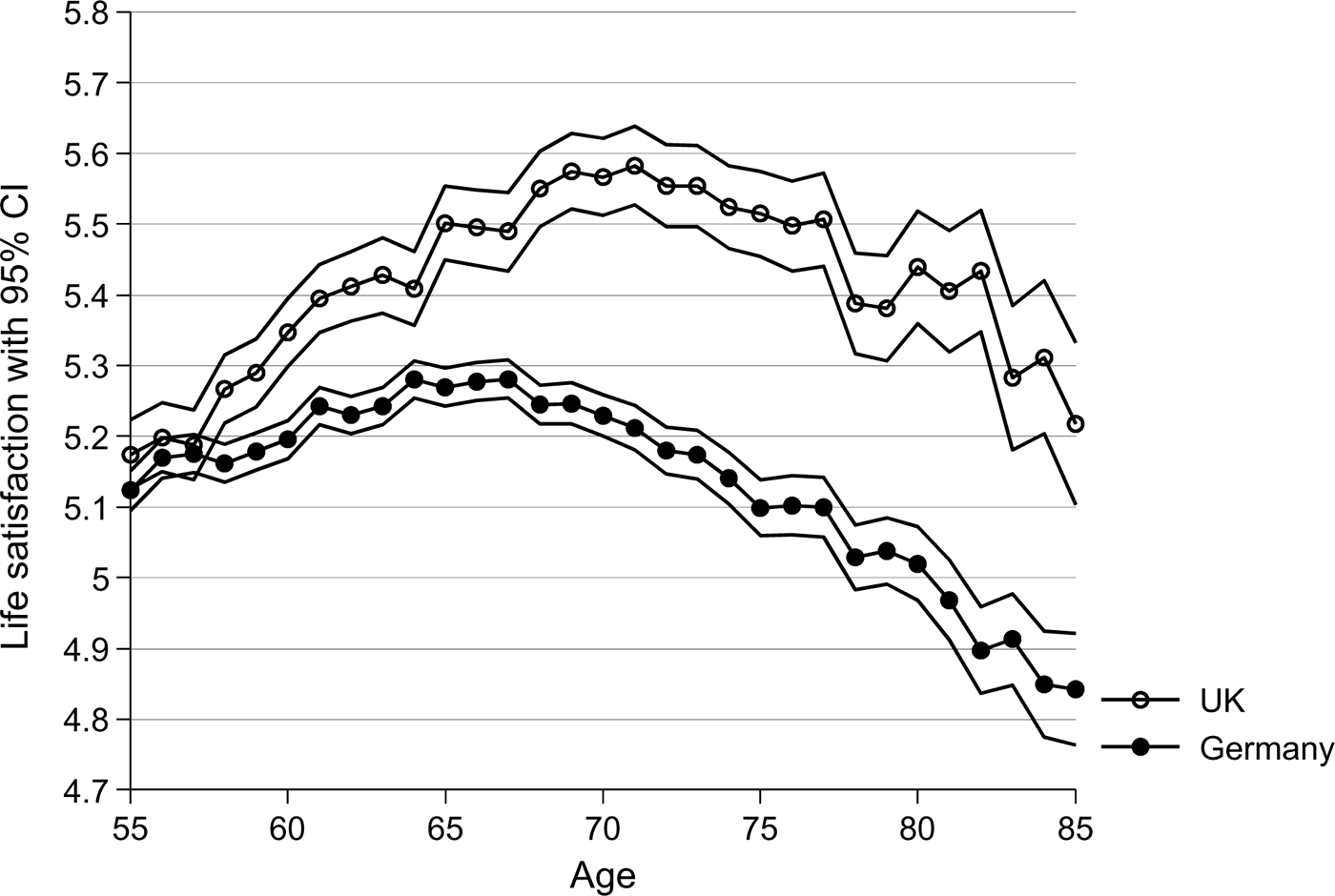
Before we present the results on the influence of taking up work after pension age on life satisfaction, it is useful to consider the general development of life satisfaction in later life. For this purpose, we plot the predicted values of life satisfaction and the corresponding 95 per cent confidence intervals of a random effects regression for all respondents aged 55–85 (Figure 1). This regression pools both data sets and includes the interaction of age and country, only controlling for period. Figure 1 reveals three important findings: first, in both countries, life satisfaction increases after age 55. This might be related to the experience of career achievements, decreasing everyday stress because of children growing up or the (anticipated) end of the main career (see also Brockmann Reference Brockmann2010). However, satisfaction increases only until the age of 65 in Germany while it continues to do so until age 70 in the UK. After this age, life satisfaction drops in both countries, which might be explained by age-related health problems, the more frequent loss of a partner or friends, or similar changes. The second finding refers to the level of life satisfaction: after having a similar satisfaction level as Germans at age 55, Britons grow on average (increasingly) more satisfied with life than Germans up to the age of 77, and then stay happier for the rest of the observed age range. Third, the variation of the satisfaction values is rather limited, which is a common phenomenon in satisfaction research (Frijters and Beatton Reference Frijters and Beatton2012; Wunder et al. Reference Wunder, Wiencierz, Schwarze and Küchenhoff2013). In both countries, life satisfaction varies within a range of 0.4 scale points and the standard deviations are also relatively small. This general stability of life satisfaction should be kept in mind when interpreting the following results.
Development of life satisfaction by age in the United Kingdom (UK) and Germany.

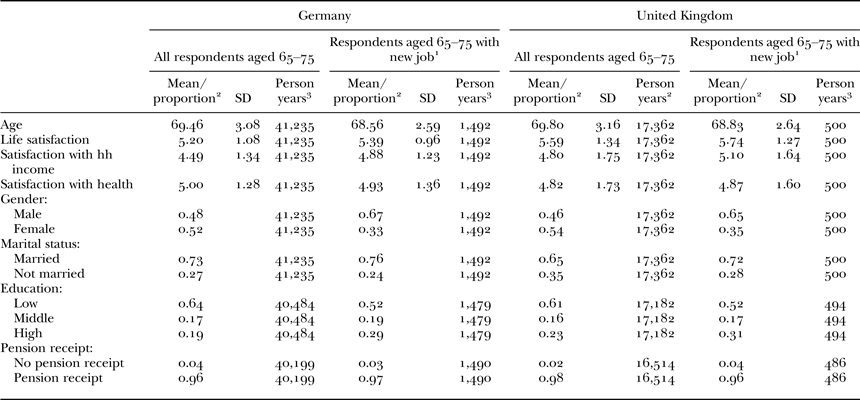
Against the background of this general development of satisfaction from age 55 to 85, we now only look at those aged 65–75 and examine the impact of starting paid work on life satisfaction. In both countries, those who recommence work after pension age are better educated, more often male and also slightly more satisfied with their lives than the population of that age in general (see Table A1 in the Appendix) – which needs to be borne in mind when interpreting results.
We estimate three country-specific FE models. In the first and basic model, we control for the time-varying characteristics marital status, age and period. In a second model, based on this first one, we add change in satisfaction with household income, and in a third one, satisfaction with health is added instead of satisfaction with household income.Footnote 15 By introducing the other satisfaction variables stepwise, we aim to capture the more detailed mechanisms underlying the observed changes in life satisfaction. In this way, we answer the question as to whether life satisfaction increases after taking up work again because of the additional income generated by this employment, and whether both changes (start of work and changed life satisfaction) are the result of a third variable, namely change in health satisfaction.
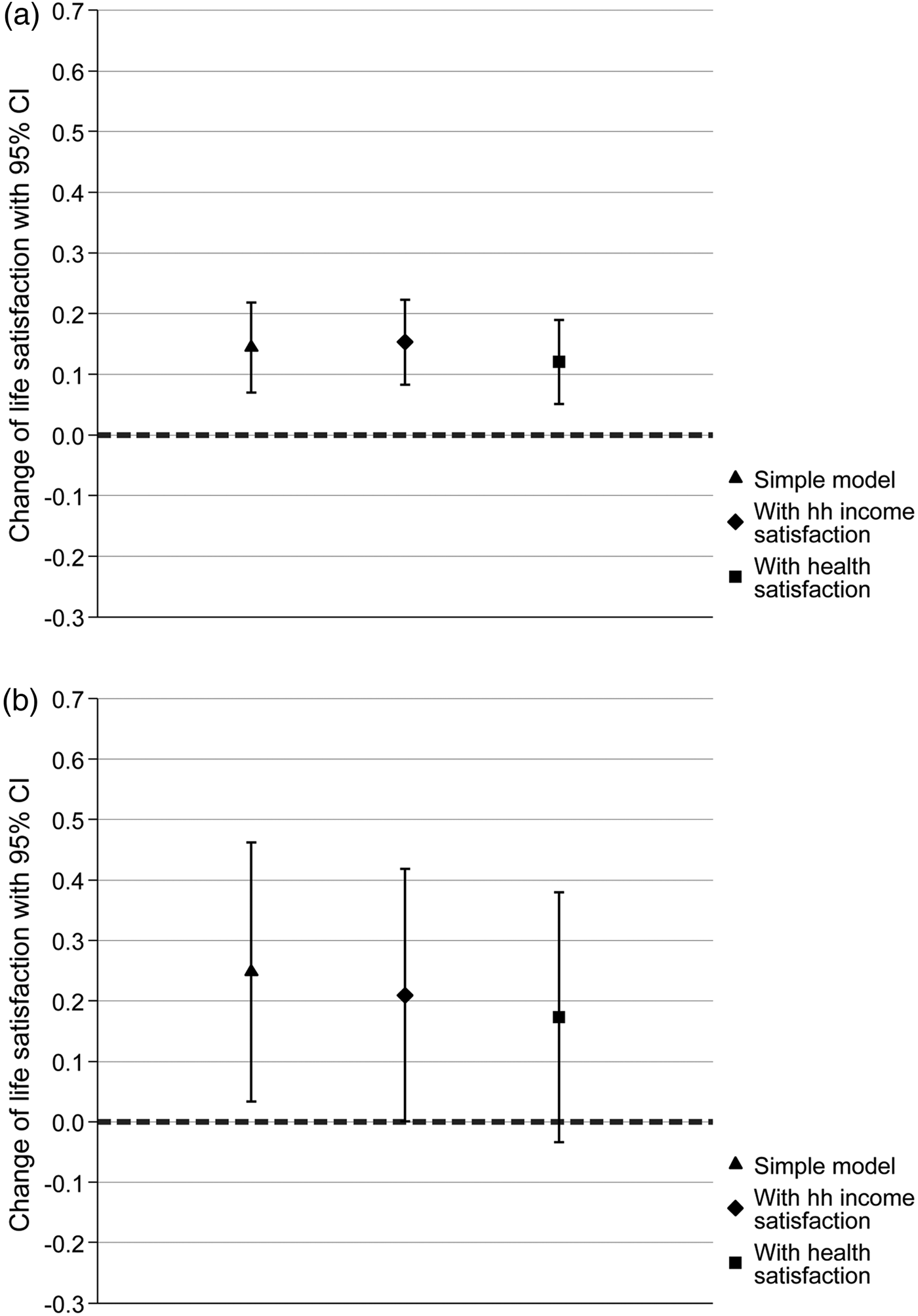
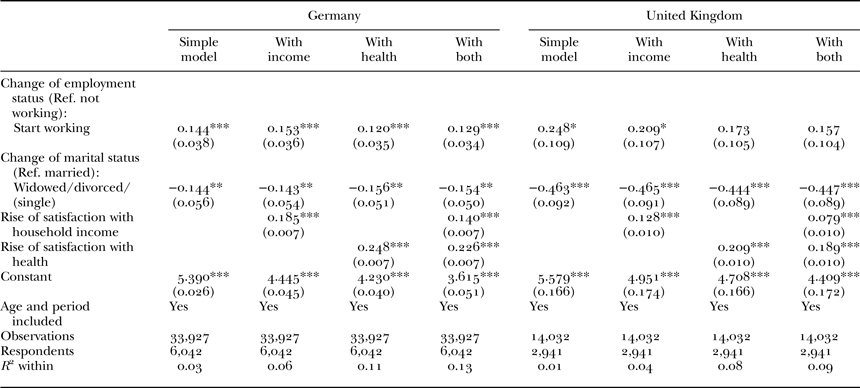
The results of these analyses are shown in Figure 2, where we have plotted the coefficients of the FE models with the corresponding 95 per cent confidence intervals. These coefficients show the change of life satisfaction for those individuals who, after a period of not working, started a job between ages 65 and 75. For Germany (Figure 2a), we find a positive effect of working in the first model. Individuals who recommence work after pension age improve their life satisfaction by 0.14 scale points. Controlling for changes in satisfaction with household income does not reduce this effect but enlarges it minimally to 0.15 scale points. This implies that changes in income satisfaction due to the additional income from the post-retirement job are not responsible for the work-related rise of life satisfaction. However, if we control instead for changes in satisfaction with health, the effect of working slightly declines from 0.14 to 0.12 scale points. This indicates that a small part of the work effect is actually a health effect: either people whose health improves are also more likely to start a job after pension age (and to become happier), or their health improves (and they become happier) because they have a post-retirement job. In all three models, the effect of work on life satisfaction is significant but seems rather small. When interpreting the size of the effects, it is, however, important to relate it to the limited variation of life satisfaction within individuals which we have seen above. In fact, the size of the effect of working corresponds to 78–107 per cent of the effect of a change in marital status and to 83 per cent of the effect for a full scale-point change in satisfaction with household income (see Table A2 in the Appendix). Thus, the size of the work effect is actually considerable.
Effects on life satisfaction of starting work again between ages 65 and 75 in (a) Germany and (b) the United Kingdom.

In the UK (Figure 2b), we also find a positive effect of working between ages 65 and 75 on life satisfaction: those who start work in this age range improve their life satisfaction significantly by 0.25 scale points. This effect is reduced to (still significant) 0.21 scale points if we control for changes in satisfaction with household income. Thus, contrary to Germany, part of the work-related increase in life satisfaction in the UK is generated by the additional income from this work. If we control for changes in health satisfaction (instead of satisfaction with household income), the effect of work is reduced to 0.17 scale points and is not significant at the 95 per cent level (and slightly misses the 90 per cent level). This means that part of the work effect is actually a health effect with the potential causal mechanisms described above. In sum, the size of the general effect is considerable in the UK as well: it equals 39–54 per cent of the effect of a change in marital status and 163 per cent of the effect for a full scale-point change in satisfaction with household income (see Table A2 in the Appendix).
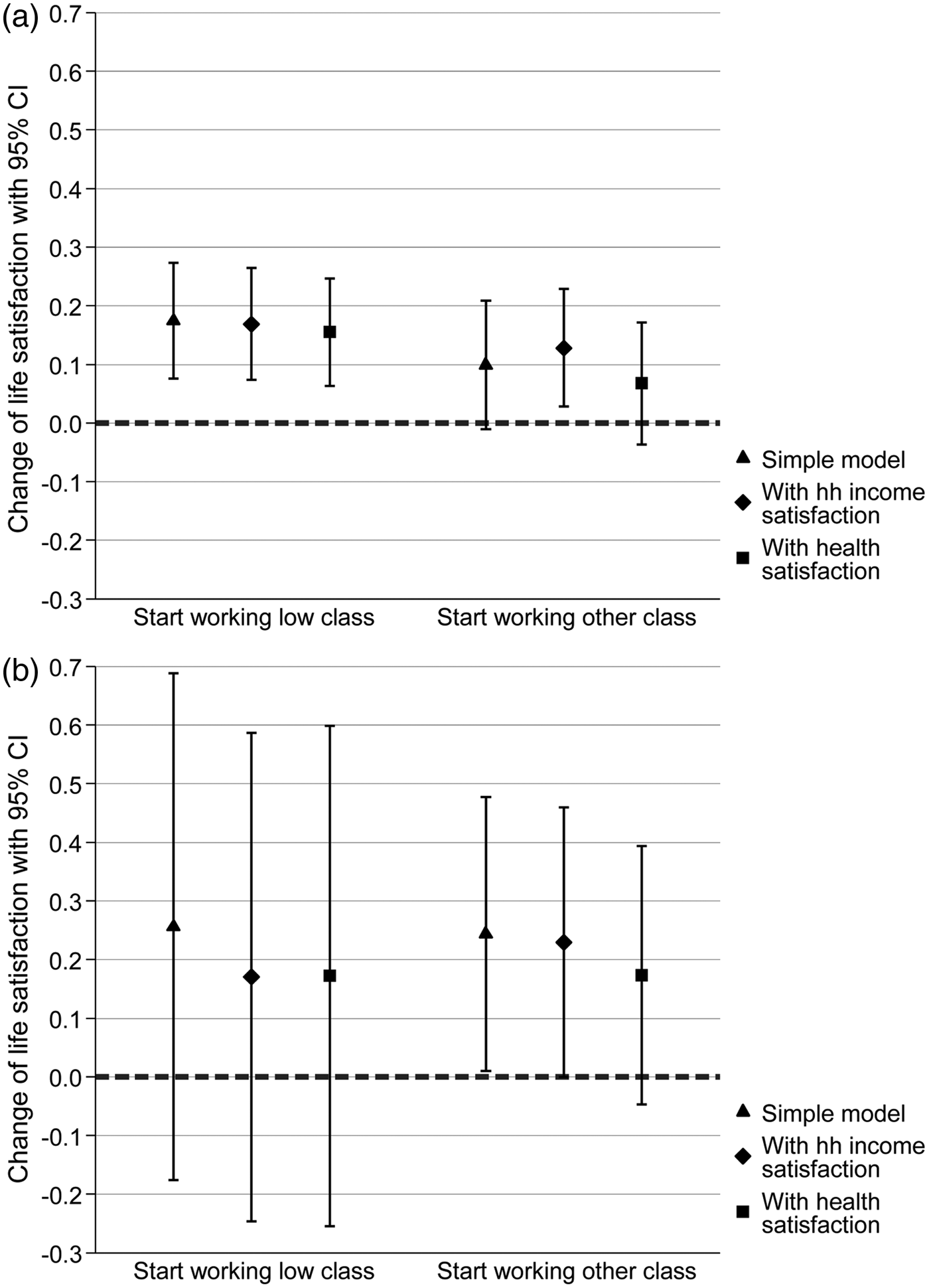
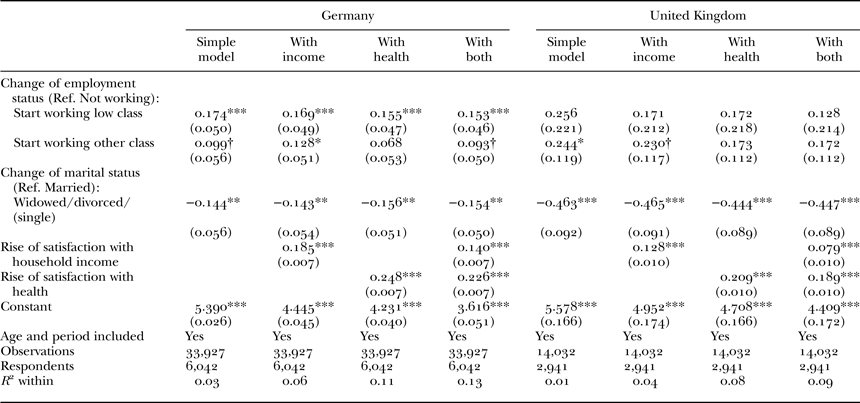
Having seen these positive effects of working beyond pension age, one might argue that they only occur in particular jobs, namely good jobs with good working conditions, good pay, etc., while working in other jobs that are not so good does not lead to positive effects on life satisfaction, or even leads to negative effects. To investigate this potential heterogeneity of the effects, we distinguish between those who start working in a ‘low’-class job, such as cleaners, salespersons and craftsmen, and those working in jobs in other classes. Based on this, we re-estimate the country-specific FE regression models with a modified version of the work variable, now indicating either the start of a job in a ‘low’ class or the start of a job in another class. The results of these analyses are shown in Figure 3, where we have again plotted the coefficients of the FE models with the corresponding 95 per cent confidence intervals (see also Table A3 in the Appendix). These coefficients show the change in life satisfaction for those individuals who have started a job in a ‘low’ class and those who have started a job in another class between ages 65 and 75.
Effects on life satisfaction of starting work again in low-class jobs and other jobs between ages 65 and 75 in (a) Germany and (b) the United Kingdom.

In Germany (Figure 3a), we find positive effects of re-starting work after pension age on life satisfaction in both classes: a 0.17 scale-point increase for those working in low-class jobs and a 0.10 scale-point increase for those in other classes (with the latter being not significant at the 95 per cent level, but significant at the 90 per cent level). This seems to indicate a larger effect for low-class workers; however, the difference between both classes is not significant (not even at the 90 per cent level; not shown). This surprising pattern of a similar effect of re-starting work on life satisfaction in both (broadly defined) classes might be the result of changed perceptions of jobs in the low classes in the phase of retirement: many of those who start to work in a low-class job might perceive a relatively high autonomy with regard to their job because they are much less economically dependent on it than before pension age as they now also receive income from pensions. Again, we find no indication in either of the classes that the positive effects are generated by the income earned in that job. However, for both classes, the effect decreases if we control for changes in health satisfaction, from 0.17 to 0.16 for the low classes and from 0.10 to 0.07 for other classes (the latter effect being insignificant, even at the 90 per cent level).
For the UK (Figure 3b), we also find positive effects of re-starting work after pension age on life satisfaction in both classes, with minimally larger effects for those working in low-class jobs in the simple model. Work in a low-class job increases life satisfaction by 0.26 scale points, while work in other classes does so only by 0.24 scale points. The difference between both classes is, as in Germany, not significant at common levels (of 90 or 95 per cent, not shown). If we control for changes in satisfaction with household income, we observe a reduction of the effect for working in low classes by 35 per cent (from 0.26 to 0.17 scale points) and only a 4 per cent reduction in other classes (from 0.24 to 0.23 scale points). This implies that those older Britons who re-start work in low-class jobs become happier partly because of the money they earn in their post-retirement job. Controlling for changes in health satisfaction also reduces the effects of working on life satisfaction (from 0.26 to 0.17 for the low class and from 0.24 to 0.17 for the other classes). This again shows that the uptake of a job is correlated with changes in health satisfaction and thus probably with underlying changes in health. Moreover, among all class-related effects for the UK, only two are significant at the 95 per cent level. These are the effects of those working in other classes in the simple model and in the model controlling for income satisfaction. However, in interpreting the significance levels, one has to bear in mind that the differentiation by the class of the job taken up produces very small sub-samples, especially in the UK, where the number of respondents and person years is less than half of that in the German sample. This necessarily leads to larger confidence intervals for the estimates.Footnote 16
Discussion and conclusion
Our results indicate that taking up work again beyond pension age is predominantly related to positive effects on general life satisfaction in the years 1996–2008/11, and this seems to be true for both those who started to work in low-class jobs and in jobs of other classes. It also seems to apply to two different macro social settings: Germany and the UK. Thus, our first hypothesis which assumed positive effects of working after pension age for non-low classes only is partly rejected. Even if the positive effect of taking up work again in ‘low’ classes in the UK cannot be generalised in inferential statistical terms, there is clearly no indication that taking up work again in a ‘low’ class has negative effects on life satisfaction in the UK. Our second and third hypotheses on country-specific effects of work after pension age are also refuted. However, and in connection with the third hypothesis, we find at least some indications of diverging class-specific mechanisms affecting life satisfaction in the two countries: in the UK, but not in Germany, the (non-significant) positive effect of working on life satisfaction might partly be driven by the increasing satisfaction with household income, and this particularly applies to those working in low-class jobs.
There are two possibly interconnected explanations for this indication of generally positive effects of taking up work beyond pension age on life satisfaction – a result that to some degree contradicts public perceptions and debates on working post retirement. First, taking up work again after retirement and (usually) while receiving a pension might be connected to a (more) positive re-interpretation of work and even of jobs that are not characterised by high status and good working conditions. Our own qualitative evidence supports this assumption, with many (though not all) working retirees seeing their paid work, in comparison to their main career jobs, as a more ‘voluntary’ and advantageous activity which they can also more easily and autonomously quit.Footnote 17 Additional financial flexibility might even add to this re-interpretation of work. This explanation of our findings underlines the distinctive experience of the life phase of retirement and the relevance of the surrounding institutions defining this life course stage.
The second explanation for the positive effects again points to the selection effects mentioned above: it is possible that those older people who take up work again are generally those who liked working in the first place and were always relatively satisfied with their work. If there are other working pensioners who tend not to like their jobs and forfeit life satisfaction, this only seems to be a very small group in our samples. Others perhaps do not take up work because they already anticipate that this would reduce their life satisfaction. Furthermore, our definition of working, namely taking up work again after at least a spell of inactivity, also implies the selection of a specific group of people working post-pension age: we exclude those pensioner jobs which directly follow after the end of a respondent's main career, side jobs which are continued beyond pension age, and those who simply continue working and (sometimes) defer pension receipt. It is possible that it is precisely these latter groups of working pensioners or people of pension age who experience working more negatively, because their financial needs are more pressing, for example – while the others only take up work again after a break from working, for example because they are bored.
Adding to this limitation in our dependent variable, social class of the retirement job is only one of several possible dimensions which might distinguish between work that has positive effects on life satisfaction and work that goes together with decreases in wellbeing. The social class before retirement, in particular, but also the amount of hours worked, other working conditions and whether someone defers pension receipt or not might account for further differences in the experience of post-retirement work. Due to case number limitations, we were not able to account for these additional aspects of the heterogeneity of working post retirement.Footnote 18
The fact that there seem to be no pronounced differences between countries (both generally and with regard to the effect of class) indicates that the institutional setting and the consequent economic conditions do not determine the experience of working after pension age, but, if at all, only lead to very fine and gradual differences which we cannot map adequately with our data. The absence of marked country differences may, however, also be ascribed to our at times crude definitions of variables, especially the class contrast.
Future research, ideally based on larger samples and more detailed information on (current and earlier) jobs, might be able to catch potential negative effects of working in retirement better, which – so far and in the two samples we have studied – are not manifest. In addition, more information on satisfaction with different aspects of work will help to unravel the exact mechanisms that generate the positive effects on life satisfaction. A broader longitudinal basis of data might also help to describe better the processes of returning to work (or of giving up work) and pathways of employment around retirement, including possible downward occupational mobility, and their implications for life satisfaction. There might be different stages of happiness going together with work-related changes, similar to what is assumed in stage theory in retirement research (Wang, Henkens and van Solinge Reference Wang, Henkens and van Solinge2011), and downward mobility might have negative effects on satisfaction. Finally, the effects of taking up work again should be compared to those in other countries, especially those where returning to work after complete retirement is more frequent, such as the USA.
As our results cannot necessarily be generalised to cover other groups of people working post retirement, and even less to apply to other countries and/or historical situations, we are cautious about deriving optimistic policy conclusions from them. On the contrary: the fact that those working post retirement are a very selective group of older people (for corresponding findings, see e.g. Lain Reference Lain2011; Scherger et al. Reference Scherger, Hagemann, Hokema and Lux2012) can be seen as an indication of the limited labour market opportunities for older people and of the individual limitations of working in terms of health that many older people face. Against the background of recent pension reforms and the crisis of the financial markets, it is probable that the composition of those working late in the life course will change in a less favourable direction. To provide good job opportunities for those who still want to work while at the same time continuing to provide decent pensions to protect those who cannot work will be the crucial task of current and future policies relating to old age and work.
Acknowledgements
The authors are grateful to the German Research Foundation (DFG), who funded the research on which this paper is based under its Emmy Noether programme, as part of the project ‘Paid Work Beyond Retirement Age in Germany and the UK’.
Appendix
Comparison of respondents aged 65–75 (all valid person years) with the group of those aged 65–75 with job uptake (respondent years specified as described in the ‘Methods and data’- section)

Effects on life satisfaction in Germany and the United Kingdom of starting work again between ages 65 and 75 (fixed-effects regressions)

Effects on life satisfaction in the United Kingdom and Germany of starting work again in low-class jobs and other jobs between ages 65 and 75 (fixed-effects regressions)