Introduction
Marijuana (Cannabis sativa) is the world's most widely used illicit drug (Watson et al. Reference Watson, Benson and Joy2000; Zuardi, Reference Zuardi2006). The principal psychoactive constituent of cannabis is Δ9-tetrahydrocannabinol (THC) (Hirst et al. Reference Hirst, Lambert and Notcutt1998). Other important components of the plant are cannabidiol (CBD), cannabinol (CBN) and cannabigerol (CBG) (Williamson & Evans, Reference Williamson and Evans2000). Except for CBD, cannabinoids act as agonists at specific endogenous cannabinoid receptors, CB1 and CB2 (Pertwee & Ross, Reference Pertwee and Ross2002). The CB1 receptor is largely expressed in the central nervous system with the highest concentrations in the basal ganglia, prefrontal cortex, anterior cingulate cortex (ACC) and hippocampus (Pertwee & Ross, Reference Pertwee and Ross2002). CB2 receptors are mainly present in immune cells and peripheral tissues. CBD has weak partial antagonistic properties at the CB1 receptor. It inhibits the reuptake and hydrolysis of anandamide, and exhibits neuroprotective antioxidant activity (Roser et al. Reference Roser, Vollenweider and Kawohl2008).
Cannabis intoxication is associated with a large variety of physiological and cognitive alterations (Hollister, Reference Hollister1986; Hall & Solowij, Reference Hall and Solowij1998; Lundqvist, Reference Lundqvist2005). Moreover, use of the drug has been associated with an increased risk for the onset of schizophrenia, especially in adolescent users (Arsenault et al. Reference Arseneault, Cannon, Witton and Murray2004; DeLisi, Reference DeLisi2008; Schneider, Reference Schneider2008). These effects may be related to the binding of cannabinoids to CB1 receptors (Freund et al. Reference Freund, Katona and Piomelli2003). CBD reverses some of the biochemical, physiological and behavioural effects of CB1 receptor agonists, attenuating the anxiogenic effect of THC (Zuardi et al. Reference Zuardi, Shirakawa, Finkelfarb and Karniol1982).
Neuroimaging has provided powerful tools to study the in vivo effects of cannabis on brain structure and function (Volkow et al. Reference Volkow, Fowler and Wang2003; Crippa et al. Reference Crippa, Lacerda, Amaro, Busatto, Zuardi and Bressan2005). These effects can be analysed in experimental settings following the administration of THC and CBD or indirectly by comparing subjects with and without a history of cannabis use. Recent reviews have examined this topic (Quickfall & Crockford, Reference Quickfall and Crockford2006; Chang & Chronicle, Reference Chang and Chronicle2007; Gonzalez, Reference Gonzalez2007). However, these reviews only examined papers published up to 2005 (Quickfall & Crockford, Reference Quickfall and Crockford2006) or 2006 (Chang & Chronicle, Reference Chang and Chronicle2007), and their selection criteria have not been clearly specified (Chang & Chronicle, Reference Chang and Chronicle2007; Gonzalez, Reference Gonzalez2007) or have not been sufficiently restrictive (Quickfall & Crockford, Reference Quickfall and Crockford2006). In present study, we conducted a systematic review to assess the evidence for specific effects of cannabis on brain structure and function, focusing on the cognitive changes associated with chronic or acute cannabis use. Papers published up until January 2009 have been included. Given the large number of variables that might influence the results of neuroimaging studies, we established a comprehensive search strategy and restrictive set of criteria for selecting articles.
Method
Search strategy
Electronic searches were performed using EMBASE (1980–January 2009), Medline (1966–January 2009), PubMed (1966–January 2009), PsycLIT (1974–January 2009) and LILACS (1982–January 2009) databases, reference searching, and chapters in books on substance abuse neuroimaging. We used the following key words: marijuana; cannabis; delta-9-tetrahydrocannabinol, THC; cannabidiol, CBD; neuroimaging; brain imaging; computerized tomography, CT; magnetic resonance, MRI; single photon emission tomography, SPECT; functional magnetic resonance, fMRI; positron emission tomography, PET; diffusion tensor MRI, DTI-MRI; spectroscopy, MRS. We included all studies published up until January 2009 without any language restriction.
Selection criteria
Initially we performed a general review of all neuroimaging studies that investigated brain structure or function in relation to cannabis use. Studies were only included if they met the following criteria. (1) For studies with a case–control design: inclusion of a control group of healthy volunteers (participants of both groups had to be matched for age, sex and handedness; users had to be abstinent for at least 12 h before brain scanning). (2) For studies involving experimental administration of cannabinoids: use of a parallel design with healthy controls or cross-over design; subjects had to be abstinent for cannabinoids at least 1 week before the experiment, 24 h for alcohol, and no smoking of tobacco or drinking caffeine on the day of the experiment (Gorelick & Heishman, Reference Gorelick and Heishman2006).
The exclusion criteria were: (1) non-neuroimaging studies of cannabis use; and (2) neuroimaging studies that involved participants <18 years of age, or subjects who had other neurological or psychiatric disorders, or individuals with substance abuse disorders who were not abstinent or who tested positive for drugs other than cannabis on urine screening.
When the data from a single subject sample were reported in separate publications, these were treated as a single study with multiple independent variables. Conversely, a publication that reported two forms of different imaging data from the same subjects (e.g. MRI and PET) or a study examining the same subjects with two different cognitive tasks (e.g. auditory attention and verbal working memory) were considered as two studies.
Finally, we defined chronic cannabis users as persons who used cannabis several times a week and who had done so for at least 2 years. Recreational (or occasional) cannabis users were defined as persons who used cannabis sporadically (less than four times a month) whereas naïve cannabis users or healthy controls were persons who had used cannabis less than 15 times in their lifetime, according to standardized strict criteria (Crippa et al. Reference Crippa, Zuardi, Garrido, Wichert-Ana, Guarnieri, Ferrari, Azevedo-Marques, Hallack, McGuire and Filho Busatto2004).
Recorded variables
Two of the authors extracted the data independently (A. F. and R. M. S.). When there was no agreement, a third author (J. A. C.) reviewed the paper independently. The recorded variables for each article were gender, age, number of joints (cannabis cigarettes)/week/years of use (to classify subjects as chronic, recreational or naïve cannabis users), handedness of subjects, type of design, exclusion criteria (for neurological, psychiatric or drug history), interval of cannabis and other drugs abstinence (as checked by urine tests), rest/active condition (for functional imaging studies), type of task performed during functional imaging, blinded design, randomization, doses of cannabis (percentage of THC of cannabis cigarettes or mg/mi, of THC intravenous administered or oral THC (in mg), or oral CBD (in mg), plasma concentration levels, pulse rate, respiratory rate, blood pressure and degree of intoxication. We also recorded all psychopathological variables, such as ratings of depersonalization, temporal disintegration, paranoid symptoms, anxiety or depression. For structural and functional imaging data, the primary measures of interest were global and regional volume and global and regional activity [cerebral blood flow (CBF), regional CBF (rCBF) or blood oxygen level dependent (BOLD) signal].
Results
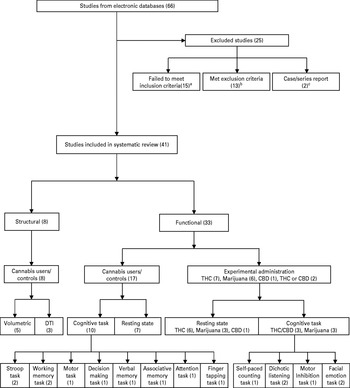
Of the 66 studies identified initially, three were published in the 1970s, four in the 1980s, 12 from 1991 to 1999, and 47 between 2000 and 2008. Twenty-five studies were eliminated because they did not meet a priori selection criteria (for excluded studies and reasons for exclusion, see Fig. 1). The remaining studies were grouped according to the neuroimaging technique used (structural/functional), effects of cannabis use (acute effects of THC/marijuana/CBD administration/chronic effects of cannabis use) and testing conditions (resting condition/cognitive task) (Fig. 1). The studies examined thus comprised: 15 studies involving experimental administration of THC/marijuana (nine in the resting state and six during a cognitive task), three studies involving experimental administration of CBD (one in the resting state and two during a cognitive task), eight structural imaging studies evaluating chronic effects of THC [five volumetric and three diffusion tensor imaging (DTI) studies] and 17 functional imaging studies on chronic THC effects (seven in the resting state and 10 during a cognitive task). The reviewed studies included a total number of 655 cannabis users and 402 healthy controls.
Flow diagram (selection strategy) of included studies. aNo age, sex or handedness matched: Campbell et al. Reference Campbell, Evans, Thomson and Williams1971; Co et al. Reference Co, Goodwin, Gado, Mikhael and Hill1977; Kuehnle et al. Reference Kuehnle, Mendelson, Davis and New1977; Hannerz & Hinmarsh, Reference Hannerz and Hindmarsh1983; Aasly et al. Reference Aasly, Storsaeter, Nilsen, Smevik and Rinck1993; Amen & Waugh, Reference Amen and Waugh1998; Yurgelun-Todd et al. Reference Yurgelun-Todd, Gruber, Hanson, Baird, Renshaw, Pope and Harris1998; O'Leary et al. Reference O'Leary, Block, Flaum, Schultz, Boles Ponto, Watkins, Hurtig, Andreasen and Hichwa2000; Ward et al. Reference Ward, Solowij, Peters, Otton, Chesher and Grenyer2002; Jacobsen et al. Reference Jacobsen, Mencl, Westerveld and Pugh2004; Sneider et al. Reference Sneider, Pope, Silveri, Simpson, Gruber and Yurgelun-Todd2006. No cannabis abstinence: Wiesbeck & Taeschner, Reference Wiesbeck and Taeschner1991; Aasly et al. Reference Aasly, Storsaeter, Nilsen, Smevik and Rinck1993; O'Leary et al. Reference O'Leary, Block, Flaum, Schultz, Boles Ponto, Watkins, Hurtig, Andreasen and Hichwa2000; Vorunganti et al. Reference Voruganti, Slomka, Zabel, Mattar and Awad2001; Hermann et al. Reference Hermann, Sartorius, Welzel, Walter, Skopp, Ende and Mann2007; Nestor et al. Reference Nestor, Roberts, Garavan and Hester2008; Weinstein et al. Reference Weinstein, Brickner, Lerman, Greemland, Bloch, Lester, Chisin, Mechoulam, Bar-Hamburger, Freedman and Even-Sapir2008. bPsychiatric, other abuse or medical disorders: Campbell et al. Reference Campbell, Evans, Thomson and Williams1971; Wiesbeck & Taeschner, Reference Wiesbeck and Taeschner1991; Yurgelun-Todd et al. Reference Yurgelun-Todd, Gruber, Hanson, Baird, Renshaw, Pope and Harris1998; Vorunganti et al. Reference Voruganti, Slomka, Zabel, Mattar and Awad2001; Ward et al. Reference Ward, Solowij, Peters, Otton, Chesher and Grenyer2002; Li et al. Reference Li, Milivojevic, Constable and Sinha2005; Schweinsburg et al. Reference Schweinsburg, Schweinsburg, Cheung, Brown, Brown and Tapert2005; Voytek et al. Reference Voytek, Berman, Hassid, Simon, Mandelkern, Brody, Monterosso, Ling and London2005; Jacobsen et al. Reference Jacobsen, Pugh, Constable, Westerveld and Mencl2007; Ashtari et al. Reference Ashtari, Cervellione, Cottone, Ardekani and Kumra2009. No healthy controls: Wiesbeck & Taeschner, Reference Wiesbeck and Taeschner1991; Wilson et al. Reference Wilson, Mathew, Turkington, Hawk, Coleman and Provenzale2000. Others: Volkow et al. Reference Volkow, Gillespie, Mullani, Tancredi, Grant, Ivanovic and Hollister1991; Mathew et al. Reference Mathew, Wilson, Humphreys, Lowe and Wiethe1992b. cCase/series report: Kuehnle et al. Reference Kuehnle, Mendelson, Davis and New1977; Vorunganti et al. Reference Voruganti, Slomka, Zabel, Mattar and Awad2001.

Because of the heterogeneity in the study design (case–control/parallel/cross-over) and the methods used (such as neuroimaging technique) we decided it would be impractical to perform a meta-analysis. Moreover, a systematic review without meta-analysis was chosen for several other reasons: (a) information needed to compute effect size was not always available, (b) the methods and extent of detailed information to define regions of interest vary widely in the studies, preventing accurate comparison, (c) there is a large difference in secondary variables across studies (i.e. gender), and (d) meta-analysis has intrinsic limitations in estimating negative findings that do not get published (the file drawer problem).
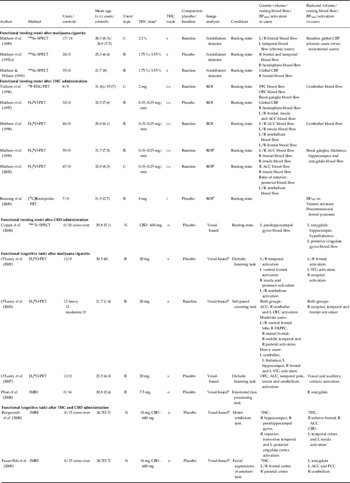
Acute effects (see Table 1)
Acute effects of cannabis on resting state activity
After smoking marijuana cigarettes
Three 133Xe-SPECT studies examined resting state CBF in chronic or recreational cannabis users before and after smoking marijuana cigarette with controlled THC dose (Table 1).
Acute effects of cannabis use: functional studies (resting state or with a cognitive task)

THC, Δ9-Tetrahydrocannabinol; SPECT, single photon emission tomography; PET, positron emission tomography; FDG, fludeoxyglucose; fMRI, functional magnetic resonance imaging; CBD, cannabidiol; s.d., standard deviation; i.v., intravenous; s, smoking; i, inhaled; o, oral; ROI, region of interest; C, chronic; R, recreational; N, naïve; BPND, non-displaceable binding potential; L, left hemisphere; R, right hemisphere; CBF, global cerebral blood flow; PFC, prefrontal cortex; DLPFC, dorsolateral prefrontal cortex; OFC, orbitofrontal cortex; ACC, anterior cingulate cortex; PCC, posterior cingulate cortex; STG, superior temporal gyrus;
a %THC of cannabis cigarettes or mg/ml of THC i.v. administered.
b Multiple comparison correction.
The studies included in this category described increased regional activity at rest relative to baseline or marijuana cigarette without THC. An increase in resting global CBF relative to baseline at 30–60 min following the smoking of a marijuana cigarette with THC in a proportion of 1.75% or 3.55% was reported in cannabis users 2 weeks after cessation of use (Mathew et al. Reference Mathew, Wilson, Humphreys, Lowe and Wiethe1992a, Mathew & Wilson, Reference Mathew and Wilson1993). Increased activity was also observed in the left temporal lobe after smoking a marijuana cigarette with 2.2% of THC (Mathew et al. Reference Mathew, Wilson and Tant1989).
Subjective levels of intoxication (Mathew et al. Reference Mathew, Wilson, Humphreys, Lowe and Wiethe1992a, Mathew & Wilson, Reference Mathew and Wilson1993), dissociative experiences [Temporal Disintegration Inventory (TDI)], measures of depersonalization [Depersonalization Inventory (DPI); Mathew & Wilson, Reference Mathew and Wilson1993)] and measures of confusion (Mathew & Wilson, Reference Mathew and Wilson1993) have been correlated with increased global CBF after marijuana smoking. Anxiety and confusion in chronic users following marijuana smoking have been inversely correlated with regional activity in several brain areas after controlling for multiple comparisons (Mathew et al. Reference Mathew, Wilson and Tant1989). The heart rate correlated positively with changes in global CBF following the smoking of a marijuana cigarette (Mathew et al. Reference Mathew, Wilson, Humphreys, Lowe and Wiethe1992a) and inversely with rCBF in the right frontal, bilateral temporal, parietal and occipital cortices (Mathew et al. Reference Mathew, Wilson and Tant1989). Increased global CBF has also been correlated with plasma THC levels (Mathew et al. Reference Mathew, Wilson, Humphreys, Lowe and Wiethe1992a).
After THC administration
Six studies examined resting state CBF and metabolism in chronic or recreational cannabis users before and after the experimental administration of THC. Four of these studies used 15OH2O-PET (Mathew et al. Reference Mathew, Wilson, Coleman, Turkington and DeGrado1997, Reference Mathew, Wilson, Turkington and Coleman1998, Reference Mathew, Wilson, Chiu, Turkington, DeGrado and Coleman1999, Reference Mathew, Wilson, Turkington, Hawk, Coleman, DeGrado and Provenzale2002), one used 18F-fludeoxyglucose (FDG)-PET (Volkow et al. Reference Volkow, Gillespie, Mullani, Tancredi, Grant, Valentine and Hollister1996) and one used [11C]raclopride-PET (Bossong et al. Reference Bossong, van Berckel, Boellaard, Zuurman, Schuit, Windhorst, van Gerven, Ramsey, Lammertsma and Kahn2009). All but the Volkow et al. study (Reference Volkow, Gillespie, Mullani, Tancredi, Grant, Valentine and Hollister1996) were controlled with placebo (Table 1).
All of these studies described increased regional activity at rest relative to baseline or placebo following administration of THC. An increase in resting global CBF relative to baseline at 30–60 min following THC administration was reported in cannabis users 2 weeks after cessation of use (Mathew et al. Reference Mathew, Wilson, Coleman, Turkington and DeGrado1997). Increased activity was also described in the ACC (Mathew et al. Reference Mathew, Wilson, Coleman, Turkington and DeGrado1997, Reference Mathew, Wilson, Turkington and Coleman1998, Reference Mathew, Wilson, Chiu, Turkington, DeGrado and Coleman1999, Reference Mathew, Wilson, Coleman, Turkington and DeGrado2002), the insula (Mathew et al. Reference Mathew, Wilson, Coleman, Turkington and DeGrado1997, Reference Mathew, Wilson, Turkington and Coleman1998, Reference Mathew, Wilson, Chiu, Turkington, DeGrado and Coleman1999, Reference Mathew, Wilson, Turkington, Hawk, Coleman, DeGrado and Provenzale2002), the prefrontal and orbitofrontal cortices (Volkow et al. Reference Volkow, Gillespie, Mullani, Tancredi, Grant, Valentine and Hollister1996) and the cerebellum (Mathew et al. Reference Mathew, Wilson, Turkington and Coleman1998, Reference Mathew, Wilson, Turkington, Hawk, Coleman, DeGrado and Provenzale2002). Findings in the basal ganglia, thalamus, amygdala and hippocampus have been inconsistent, with reports of both increased and reduced activity in these areas after administration of THC in cannabis users (Volkow et al. Reference Volkow, Gillespie, Mullani, Tancredi, Grant, Valentine and Hollister1996; Mathew et al. Reference Mathew, Wilson, Coleman, Turkington and DeGrado1997, Reference Mathew, Wilson, Chiu, Turkington, DeGrado and Coleman1999). Following administration of THC, the subjective level of intoxication was correlated positively with increases in the anterior/posterior ratio of brain activity (Mathew et al. Reference Mathew, Wilson, Turkington, Hawk, Coleman, DeGrado and Provenzale2002); and also activity in the ACC (Mathew et al. Reference Mathew, Wilson, Coleman, Turkington and DeGrado1997), frontal (Mathew et al. Reference Mathew, Wilson, Coleman, Turkington and DeGrado1997, Reference Mathew, Wilson, Chiu, Turkington, DeGrado and Coleman1999) and cerebellar cortices (Volkow et al. Reference Volkow, Gillespie, Mullani, Tancredi, Grant, Valentine and Hollister1996). TDI scores have also been negatively correlated with cerebellar activity (Mathew et al. Reference Mathew, Wilson, Turkington and Coleman1998). Moreover, the severity of paranoid symptoms following intravenous THC administration was correlated with the plasma level of THC (Volkow et al. Reference Volkow, Gillespie, Mullani, Tancredi, Grant, Valentine and Hollister1996).
Finally, Bossong et al. Reference Bossong, van Berckel, Boellaard, Zuurman, Schuit, Windhorst, van Gerven, Ramsey, Lammertsma and Kahn2009 studied the effects of THC inhalation on [11C]raclopride specific binding (a dopamine D2/D3 receptor tracer) in seven healthy subjects, finding a reduction in the ventral striatum and dorsal putamen, which is consistent with an increase in dopamine levels in these regions.
After CBD administration
One study explored the acute effect of CBD relative to placebo in a sample of healthy subjects (Crippa et al. Reference Crippa, Zuardi, Garrido, Wichert-Ana, Guarnieri, Ferrari, Azevedo-Marques, Hallack, McGuire and Filho Busatto2004). It showed reduced activity in medial temporal areas including the left amygdala–hippocampal complex, extending to the hypothalamus, and the left posterior cingulate gyrus and an increased activity in the left parahippocampal gyrus. No correlations were observed between subjective anxiety ratings (the Visual Analogue Mood Scale, VAMS) and the activity in the brain areas where the effects of CBD had been predicted a priori, or in the other unpredicted areas after correction for multiple comparisons.
Acute effects of cannabis on activation during cognitive tasks
After smoking marijuana cigarettes
Three PET studies have examined the acute effect of marijuana cigarettes with 20 mg of THC on rCBF while subjects were performing a cognitive task (Table 1).
(a) Attention. Two imaging studies used an attentional paradigm. O'Leary et al. (Reference O'Leary, Block, Koeppel, Flaum, Schultz, Andreasen, Ponto, Watkins, Hurtig and Hichwa2002) evaluated the effects of marijuana cigarettes with THC on rCBF in regular cannabis users while performing a dichotic listening task after 4 days of abstinence. Marijuana with THC use was associated with increased rCBF (relative to a cigarette containing marijuana with the THC removed) in the left ventral frontal cortex, right insula, bilateral temporal pole, ACC, temporal and cerebellar cortices, whereas there was decreased activity in the left superior temporal gyrus (O'Leary et al. Reference O'Leary, Block, Koeppel, Flaum, Schultz, Andreasen, Ponto, Watkins, Hurtig and Hichwa2002). In a subsequent study by the same group, 12 recreational cannabis users were tested (O'Leary et al. Reference O'Leary, Block, Koeppel, Schultz, Magnotta, Boles Ponto, Watkins and Hichwa2007). rCBF was measured during a tasks requiring attention to left and right ears in different conditions, after smoking marijuana cigarettes with or without THC, at least a week apart using a double-blind design. After smoking marijuana cigarettes with THC, there was an increase in rCBF increase in the orbitofrontal cortex, ACC, temporal pole, insula and cerebellum. On the contrary, smoking marijuana cigarettes with 20 mg of THC lowered rCBF in auditory cortices compared to marijuana cigarette without THC. However, THC did not alter the normal pattern of attention-related rCBF asymmetry (greater rCBF in the temporal lobe contralateral to the direction of attention) observed after subjects smoked marijuana cigarettes without THC. As attentional neuroanatomical networks are known to include prefrontal and posterior parietal regions (Berger & Posner, Reference Berger and Posner2000), these results suggest alterations of the functional anatomical substrate of attentional processes as a consequence of acute cannabis use.
(b) Motor performance. The above group (O'Leary et al. Reference O'Leary, Block, Turner, Koeppel, Magnotta, Ponto, Watkins, Hichwa and Andreasen2003) has studied the acute effects of smoking marijuana cigarettes with 20 mg of THC in heavy and moderate cannabis users while they performed a self-paced counting task. In both groups, marijuana with THC was associated with increased activation in the cerebellum, the left orbitofrontal cortex and the ACC; and decreased activation in the right temporal, occipital and dorsolateral prefrontal cortices. The magnitude of this effect on right ventral and dorsolateral frontal activation was greater in the moderate than in the heavy users. Smoking marijuana cigarettes was also associated with faster response times, which was related to the change in cerebellar clock activity (O'Leary et al. Reference O'Leary, Block, Turner, Koeppel, Magnotta, Ponto, Watkins, Hichwa and Andreasen2003).
After THC administration
Three fMRI studies have examined the acute effect of THC on rCBF while subjects were performing a cognitive task (Table 1). Two of them (Borgwardt et al. Reference Borgwardt, Allen, Bhattacharyya, Fusar-Poli, Crippa, Seal, Fraccaro, Atakan, Martin-Santos, O'Carroll, Rubia and McGuire2008; Fusar-Poli et al. Reference Fusar-Poli, Crippa, Bhattacharyya, Borgwardt, Allen, Martin-Santos, Seal, Surguladze, O'Carrol, Atakan, Zuardi and McGuire2009) compared the two main compounds of cannabis, THC and CBD, controlled by placebo.
(a) Motor response inhibition. Fifteen healthy volunteers performed a motor inhibition task (Go/No-Go) following oral administration of either 10 mg of THC or 600 mg of CBD or a placebo (Borgwardt et al. Reference Borgwardt, Allen, Bhattacharyya, Fusar-Poli, Crippa, Seal, Fraccaro, Atakan, Martin-Santos, O'Carroll, Rubia and McGuire2008). Relative to the placebo, THC attenuated activation in the right inferior frontal cortex and the anterior cingulate gyrus. Conversely, THC was associated with greater activation in the right hippocampus/parahippocampal gyrus, right superior and transverse temporal gyri and the left posterior cingulated cortex. These THC-induced changes were not associated with behavioural effects. By contrast, CBD deactivated the left temporal cortex and insula. These results suggested that THC modulates brain function during response inhibition, whereas the effects of CBD are evident in other regions that do not mediate this cognitive process.
(b) Emotional processing. Two studies evaluated facial emotional processing after the administration of cannabinoids. Fusar-Poli et al. (Reference Fusar-Poli, Crippa, Bhattacharyya, Borgwardt, Allen, Martin-Santos, Seal, Surguladze, O'Carrol, Atakan, Zuardi and McGuire2009) evaluated 15 healthy volunteers on three separate occasions while viewing faces that implicitly induced different emotional processing. Each scanning session was preceded by a single oral dose of 10 mg of THC, 600 mg of CBD or placebo. After CBD administration, reduced activation in the amygdala and the anterior and posterior cingulated cortices was observed while subjects processed intensely fearful faces. Conversely, THC administration modulated activation mainly in the frontal and parietal regions. Overall, the results suggested that both THC and CBD have effects on neural response to fearful faces. The second study (Phan et al. Reference Phan, Angstadt, Golden, Onyewuenyi, Popovska and de Wit2008) evaluated the effects of 7.5 mg of THC on amygdala reactivity to social signals of threat (fearful and angry faces) in 16 recreational cannabis users. The results suggest that THC significantly attenuated amygdala activation to threatening faces but had no effect on visual and motor cortex activation.
Non-acute effects (see Table 2)
Structural studies
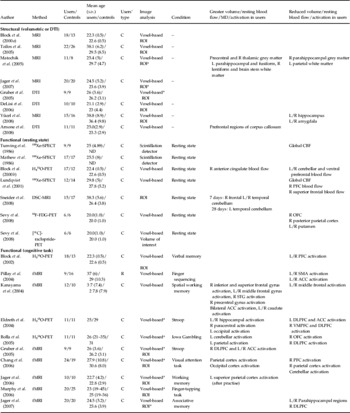
Eight structural MRI studies have investigated grey matter volume in chronic cannabis users (Table 2). Although all of these studies were methodologically rigorous, three of them did not find any significant abnormalities in cannabis users relative to the controls (Block et al. Reference Block, O'Leary, Ehrhardt, Augustinack, Ghoneim, Arndt and Hall2000a; Tzilos et al. Reference Tzilos, Cintron, Wood, Simpson, Young, Pope and Yurgelun-Todd2005; Jager et al. Reference Jager, Van Hell, De Win, Kahn, Van Den Brink, Van Ree and Ramsey2007). Two studies reported structural brain differences associated with chronic cannabis use (Matochik et al. Reference Matochik, Eldreth, Cadet and Bolla2005; Yücel et al. Reference Yücel, Solowij, Respondek, Whittle, Fornito, Pantelis and Lubman2008). Matochik et al. (Reference Matochik, Eldreth, Cadet and Bolla2005) found that cannabis users had a smaller grey matter volume than the controls in the right parahippocampal gyrus, and a larger white matter volume in the contralateral parahippocampal and fusiform regions. Differences in grey matter volume in the right lentiform nucleus, brain stem, precentral gyrus and right thalamus were also found. More recently, Yücel et al. (Reference Yücel, Solowij, Respondek, Whittle, Fornito, Pantelis and Lubman2008) report bilateral volumetric reductions in the hippocampal and amygdalar areas in a group of 15 chronic cannabis users compared with non-users. The volume of the left hippocampus was inversely associated with the severity of positive psychotic symptoms, as assessed by the Scale for the Assessment of Positive Symptoms (SAPS). Finally, three studies have used DTI to examine the integrity of white matter tracts in cannabis users. Two of them found no differences between cannabis users and controls (Gruber & Yurgelun-Todd, Reference Gruber and Yurgelun-Todd2005; DeLisi et al. Reference DeLisi, Bertisch, Szulc, Majcher, Brown, Bappal and Ardekani2006). The third study reported a significant reduction in mean diffusivity, but no decrease in fractional anisotropy associated with cannabis use, in the prefrontal section of the corpus callosum (Arnone et al. Reference Arnone, Barrick, Chengappa, Mackay, Clark and Abou-Saleh2008). Taken together, these structural neuroimaging studies provide minimal evidence of major cannabis effects on brain structure, both in regional grey matter volumes and in the integrity of white matter fibres. Subtle alterations may be easier to detected using functional methods.
Non-acute effects of cannabis use: structural studies (volumetric or DTI) and functional studies (resting state or with a cognitive task)

DTI, Diffusion tensor imaging; s.d., standard deviation; MRI, magnetic resonance imaging; SPECT, single photon emission tomography; PET, positron emission tomography; DSC, dynamic susceptibility contrast; FDG, fludeoxyglucose; fMRI, functional magnetic resonance imaging; L, Left hemisphere; R, right hemisphere; C, chronic; R, recreational; ROI, region of interest; CBF, global cerebral blood flow; MD, mean diffusivity; PFC, prefrontal cortex; DLPFC, dorsolateral prefrontal cortex; VMPFC, ventromedial prefrontal cortex; OFC, orbitofrontal cortex; ACC, anterior cingulate cortex; STG, superior temporal gyrus; SMA, supplementary motor area.
a Multiple comparison correction.
Non-acute effects on resting state activity
We included seven case–control studies that compared resting rCBF in cannabis users and healthy subjects. The imaging methods used were 133Xe-SPECT (Mathew et al. Reference Mathew, Tant and Burger1986; Tunving et al. Reference Tunving, Thulin, Risberg and Warkentin1986; Lundqvist et al. Reference Lundqvist, Jonsson and Warkentin2001), H215O-PET (Block et al. Reference Block, O'Leary, Hichwa, Augustinack, Ponto, Ghoneim, Arndt, Ehrhardt, Hurtig, Watkins, Hall, Nathan and Andreasen2000b), [18F]-FDG-PET (Sevy et al. Reference Sevy, Smith, Ma, Dhawan, Chaly, Kingsley, Kumra, Abdelmessih and Eidelberg2008), [11C]raclopride-PET (Sevy et al. Reference Sevy, Smith, Ma, Dhawan, Chaly, Kingsley, Kumra, Abdelmessih and Eidelberg2008) and dynamic susceptibility contrast (DSC)-MRI (DSMRI; Sneider et al. Reference Sneider, Pope, Silveri, Simpson, Gruber and Yurgelun-Todd2008). In a group of nine chronic cannabis users, assessed within 1 week of drug cessation, Tunving et al. (Reference Tunving, Thulin, Risberg and Warkentin1986) found a reduction in global CBF relative to controls that did not correlate with the duration of cannabis consumption. When four of the cannabis users were rescanned following a further abstinence period, an increase in CBF relative to baseline was observed. Lundqvist et al. (Reference Lundqvist, Jonsson and Warkentin2001) also report lower global CBF in cannabis users than controls after 5 days of abstinence, and described reduced rCBF in the right prefrontal and superior frontal cortex. Block et al. (Reference Block, O'Leary, Hichwa, Augustinack, Ponto, Ghoneim, Arndt, Ehrhardt, Hurtig, Watkins, Hall, Nathan and Andreasen2000b) report reduced bilateral cerebellar and ventral prefrontal activity but also greater right anterior cingulate rCBF in 17 young chronic marihuana users after 26 h of abstinence. Mathew et al. (Reference Mathew, Tant and Burger1986) assessed 17 chronic cannabis users after 12 h of abstinence and found no differences in either global or rCBF between cannabis users and controls. Sneider et al. (Reference Sneider, Pope, Silveri, Simpson, Gruber and Yurgelun-Todd2008) examined changes in regional blood volume (rCBV) in a group of 17 healthy controls and 15 cannabis users. Imaging data were collected between 6 and 36 h after the subjects' last cannabis use, and again after 7 and 28 days of supervised cannabis abstinence. Their findings demonstrated that, after 7 days of abstinence, cannabis users continued to display the same pattern of activation, characterized by increased rCBV in the right frontal, bilateral temporal lobes and the cerebellum. Nevertheless, after 28 days of abstinence only the temporal and cerebellar areas showed increased activity, suggesting that frontal regions begin to normalize with prolonged cannabis abstinence whereas other regions continue to show altered neural activity. Finally, a pattern of reduced metabolism in the right orbitofrontal region and striatum bilaterally was described in six subjects with cannabis dependence compared with six healthy controls. However, there were no differences between groups in striatal D2/D3 receptor availability. No correlations between striatal [11C]raclopride binding potential and glucose metabolism were observed (Sevy et al. Reference Sevy, Smith, Ma, Dhawan, Chaly, Kingsley, Kumra, Abdelmessih and Eidelberg2008).
Non-acute effects on activation during cognitive tasks
We included 10 studies that compared regional activation during performance of a cognitive task in cannabis users and healthy controls (Table 1).
Memory and attention
Cannabis is known to have robust effects on short-term episodic memory, which might be mediated by several mechanisms, including the inhibition of gamma-aminobutyric acid (GABA), glutamate and dopamine release (Ranganathan & D'Souza, Reference Ranganathan and D'Souza2006). Using 15OH2O-PET, Block et al. (Reference Block, O'Leary, Hichwa, Augustinack, Boles Ponto, Ghoneim, Arndt, Hurtig, Watkins, Hall, Nathan and Andreasen2002) report that 18 chronic cannabis users (after 26 h of abstinence) had worst performance with an associative memory task. This was associated with reduced activation in the right prefrontal cortex but greater activation in posterior cerebellum relative to 13 healthy controls. Similar activity in the right dorsolateral prefrontal cortex and attenuated bilateral parahippocampal activation were reported by Jager et al. (Reference Jager, Van Hell, De Win, Kahn, Van Den Brink, Van Ree and Ramsey2007) in 20 chronic cannabis users after 7 days of abstinence compared with 20 healthy controls. There were no differences in task performance between groups.
Chang et al. (Reference Chang, Yakupov, Cloak and Ernst2006) used fMRI to examine visual attention in 24 chronic cannabis users, abstinent for 24 h, relative to 19 healthy controls. Cannabis users showed decreased activation in the right prefrontal, medial and dorsal parietal cortices and medial cerebellar regions. They also showed greater activation in left frontal subgyral, right parietal subgyral and left occipital regions. Early age of first cannabis use and greater estimated cumulative use of THC were both associated with reduced activation in the right prefrontal cortex and medial cerebellum, brain regions that have high concentrations of CB1 receptors.
Working memory
Using fMRI, Kanayama et al. (Reference Kanayama, Rogowska, Pope, Gruber and Yurgelun-Todd2004) measured activation during a spatial working memory task in 12 heavy cannabis users, after 36 h of abstinence, and 10 healthy controls. There were no group differences in task performance but the cannabis users displayed greater activation than controls in the right superior, middle and inferior frontal gyri, the bilateral ACC, right precentral and superior temporal gyri, and in the basal ganglia. Jager et al. (Reference Jager, Kahn, Van Den Brink, Van Ree and Ramsey2006) measured activation during a modified Sternberg item recognition task in 10 chronic cannabis users, after 1 week of cessation of use, and 10 controls. Again there were no task performance differences between groups but the controls shown decreased activation in the left superior parietal cortex over repeated trials, which did not occur with the cannabis users, suggesting a compensatory effect in cannabis users.
Inhibition
Eldreth et al. (Reference Eldreth, Matochik, Cadet and Bolla2004), using 15OH2O-PET, and Gruber & Yurgelun-Todd (Reference Gruber and Yurgelun-Todd2005), using fMRI, examined the degree of inhibitory control during a Stroop task in chronic cannabis users 25 and 14 days after cessation of use, respectively. In both studies cannabis users produced more errors of commission (failing to inhibit appropriately) than controls and also showed an altered pattern of brain activation. Eldreth et al. (Reference Eldreth, Matochik, Cadet and Bolla2004) found that cannabis users showed relatively reduced left anterior cingulate, bilateral dorsolateral prefrontal cortex and right ventromedial prefrontal cortex activation but greater activation in the hippocampus bilaterally. Conversely, Gruber & Yurgelun-Todd (Reference Gruber and Yurgelun-Todd2005) report that nine users showed greater activation relative to nine controls in the midcingulate cortex and right dorsolateral prefrontal cortex. Consistent with the former study (Eldreth et al. Reference Eldreth, Matochik, Cadet and Bolla2004), cannabis users showed reduced anterior cingulated activation. These results suggest that alterations of cingulate and prefrontal circuits occur in chronic cannabis users, and leads to the hypothesis that they recruit alternative brain networks as a compensatory mechanism.
Decision making
Bolla et al. (Reference Bolla, Eldreth, Matochik and Cadet2005) report dysfunction in decision making and associated decreased cortical activation in 11 cannabis users, after 25 days of cannabis abstinence, compared with 11 non-users. Using 15OH2O-PET to study activation during the Iowa Gambling Task, they demonstrated that cannabis users not only had a poorer performance than controls but also showed less activation in the right orbitofrontal and dorsolateral prefrontal cortex and greater activation in the left parietal and cerebellar cortex. Within the cannabis user group, the number of joints smoked per week was also positively correlated with activation in the right parahippocampal gyrus but inversely correlated with activation in the right orbital gyrus and cerebellum (Bolla et al. Reference Bolla, Eldreth, Matochik and Cadet2005).
Motor performance
Pillay et al. (Reference Pillay, Rogowska, Kanayama, Jon, Gruber, Simpson, Cherayil, Pope and Yurgelun-Todd2004) reported decreased activation in the supplementary motor area and also in the ACC in nine cannabis users, 36 h after cessation of use, while they performed the finger sequencing task (a measure of fine motor function). No significant correlations between urinary cannabis level, verbal IQ, attention maintenance [the auditory Continuous Performance Test (CPT)], reaction time, memory [the Buschke selective reminding test (BSRT)] and brain activation were found. On the contrary, Murphy et al. (Reference Murphy, Dixon, LaGrave, Kaufman, Risinger, Bloom and Garavan2006) found no activation differences between 20 chronic cannabis users, after 24 h of cessation of use, and 25 healthy controls during a finger-tapping task using fMRI. Both studies were methodologically well-designed and although the cannabis abstinence period was slightly shorter in the first study, these differences between them do not fully explain the divergent results.
Discussion
We found 41 studies suitable for inclusion. The results of this systematic review have indicated some of the methodological limitations of the work conducted to date and demonstrate the high level of heterogeneity in the findings of these studies. Some of the functional studies in the literature had groups that were smaller than what would be usually regarded as an acceptable minimum (for PET or SPECT studies 10 subjects and for fMRI studies 15 subjects). Therefore, studies involving larger samples and incorporating longitudinal designs may prove useful. The resting state studies conducted so far did not control spontaneous neural activity and modulation of the BOLD signal. The functional studies that used cognitive tasks explored different brain functions, making it difficult to confirm the results obtained. Thus there is a need for replication of these findings. Although the strict inclusion and exclusion criterion of the protocol is one of this review's strengths, it is possible that some of the excluded articles contain interesting pieces of cannabis research.
However, several relatively consistent findings emerged from this review. Functional neuroimaging studies suggest that resting global, prefrontal and ACC blood flow are lower in cannabis users than in controls (Mathew et al. Reference Mathew, Tant and Burger1986; Tunving et al. Reference Tunving, Thulin, Risberg and Warkentin1986; Block et al. Reference Block, O'Leary, Hichwa, Augustinack, Ponto, Ghoneim, Arndt, Ehrhardt, Hurtig, Watkins, Hall, Nathan and Andreasen2000b; Lundqvist et al. Reference Lundqvist, Jonsson and Warkentin2001; Sevy et al. Reference Sevy, Smith, Ma, Dhawan, Chaly, Kingsley, Kumra, Abdelmessih and Eidelberg2008; Sneider et al. Reference Sneider, Pope, Silveri, Simpson, Gruber and Yurgelun-Todd2008). The localization of resting state differences between users and controls to these regions is broadly consistent with data from neuropsychological studies. Impairments in time estimation, attention, working memory, cognitive flexibility (Solowij et al. Reference Solowij, Stephens, Roffman, Babor, Kadden, Miller, Christiansen, McRee and Vendetti2002), decision making (Bechara et al. Reference Bechara, Dolan, Denburg, Hindes, Anderson and Nathan2001), and psychomotor speed (Bolla et al. Reference Bolla, Brown, Eldreth, Tate and Cadet2002) in chronic cannabis users are, at least partly, mediated by these cortical regions. Evidence of effects of THC on activity in these areas is also consistent with the relatively high concentration of CB1 receptors in the prefrontal and cingulated cortex (Freund et al. Reference Freund, Katona and Piomelli2003).
Functional imaging studies that compared activation in cannabis users and controls during cognitive tasks indicate that cannabis users make use of similar brain areas to controls while performing some cognitive tasks, although to a lesser degree (Block et al. Reference Block, O'Leary, Hichwa, Augustinack, Boles Ponto, Ghoneim, Arndt, Hurtig, Watkins, Hall, Nathan and Andreasen2002; Eldreth et al. Reference Eldreth, Matochik, Cadet and Bolla2004; Pillay et al. Reference Pillay, Rogowska, Kanayama, Jon, Gruber, Simpson, Cherayil, Pope and Yurgelun-Todd2004; Bolla et al. Reference Bolla, Eldreth, Matochik and Cadet2005; Gruber & Yurgelun-Todd, Reference Gruber and Yurgelun-Todd2005; Jager et al. Reference Jager, Kahn, Van Den Brink, Van Ree and Ramsey2006, Reference Jager, Van Hell, De Win, Kahn, Van Den Brink, Van Ree and Ramsey2007). Moderately greater task-related activation in these areas may reflect impaired efficiency of processing following cannabis use, such that more activation is required to maintain normal performance. This is broadly consistent with the cognitive efficiency hypothesis (Vernon, Reference Vernon1983) that proposes that more direct connections between task-critical brain regions may correspond to decreases in task-related neural activity and improvements in performance (Rypma & D'Esposito, Reference Rypma and D'Esposito2000). The recruitment of additional regions, such as the prefrontal cortex and hippocampus, also differentiates users from controls during cognitive performance (Block et al. Reference Block, O'Leary, Hichwa, Augustinack, Boles Ponto, Ghoneim, Arndt, Hurtig, Watkins, Hall, Nathan and Andreasen2002; Eldreth et al. Reference Eldreth, Matochik, Cadet and Bolla2004; Gruber & Yurgelun-Todd, Reference Gruber and Yurgelun-Todd2005; Jager et al. Reference Jager, Van Hell, De Win, Kahn, Van Den Brink, Van Ree and Ramsey2007). This may indicate that increased neurocognitive resources are required to maintain memory and executive processes in this group. However, despite these differences in brain activity, the level of performance of the cannabis users was equivalent to that of controls (Kanayama et al. Reference Kanayama, Rogowska, Pope, Gruber and Yurgelun-Todd2004; Jager et al. Reference Jager, Van Hell, De Win, Kahn, Van Den Brink, Van Ree and Ramsey2007). In this sense the brain seems to be capable of some degree of functional reorganization, activating brain regions not engaged in the non-users to achieve the cognitive demand. This interpretation implies that drug-related compensatory mechanisms may work, but the real impact of such alterations in daily users' life and its possibility to induce psychiatric disorders are still controversial.
With regard to structural neuroimaging studies, only two found significant differences between users and controls (Matochik et al. Reference Matochik, Eldreth, Cadet and Bolla2005; Yücel et al. Reference Yücel, Solowij, Respondek, Whittle, Fornito, Pantelis and Lubman2008). It is likely that volumetric effects would only be observed in heavy long-term users whereas functional effects would be much easier to detect. Only one DTI study found differences in the mean diffusivity, suggesting that cannabis users have a small but significant effect on white matter structural integrity (Arnone et al. Reference Arnone, Barrick, Chengappa, Mackay, Clark and Abou-Saleh2008).
Finally, more consistent results were evident in functional imaging studies that examined brain activity after the acute experimental administration of THC or marijuana cigarettes with THC. The most frequent finding was the increased resting prefrontal, insular and anterior cingulate activity (Volkow et al. Reference Volkow, Gillespie, Mullani, Tancredi, Grant, Valentine and Hollister1996; Mathew et al. Reference Mathew, Wilson, Coleman, Turkington and DeGrado1997, Reference Mathew, Wilson, Turkington and Coleman1998, Reference Mathew, Wilson, Chiu, Turkington, DeGrado and Coleman1999, Reference Mathew, Wilson, Turkington, Hawk, Coleman, DeGrado and Provenzale2002). Studies that combined the administration of THC or marijuana with a cognitive task also described modulated activation in these regions (O'Leary et al. Reference O'Leary, Block, Koeppel, Flaum, Schultz, Andreasen, Ponto, Watkins, Hurtig and Hichwa2002, Reference O'Leary, Block, Turner, Koeppel, Magnotta, Ponto, Watkins, Hichwa and Andreasen2003, Reference O'Leary, Block, Koeppel, Schultz, Magnotta, Boles Ponto, Watkins and Hichwa2007; Borgwardt et al. Reference Borgwardt, Allen, Bhattacharyya, Fusar-Poli, Crippa, Seal, Fraccaro, Atakan, Martin-Santos, O'Carroll, Rubia and McGuire2008; Phan et al. Reference Phan, Angstadt, Golden, Onyewuenyi, Popovska and de Wit2008; Fusar-Poli et al. Reference Fusar-Poli, Crippa, Bhattacharyya, Borgwardt, Allen, Martin-Santos, Seal, Surguladze, O'Carrol, Atakan, Zuardi and McGuire2009). The acute administration of CBD has been associated with increased resting activity in the left parahippocampus gyrus and a reduction in medial temporal cortex activity while subjects were processing intensely fearful faces (Crippa et al. Reference Crippa, Zuardi, Garrido, Wichert-Ana, Guarnieri, Ferrari, Azevedo-Marques, Hallack, McGuire and Filho Busatto2004). Of interest, two studies (Borgwardt et al. Reference Borgwardt, Allen, Bhattacharyya, Fusar-Poli, Crippa, Seal, Fraccaro, Atakan, Martin-Santos, O'Carroll, Rubia and McGuire2008; Fusar-Poli et al. Reference Fusar-Poli, Crippa, Bhattacharyya, Borgwardt, Allen, Martin-Santos, Seal, Surguladze, O'Carrol, Atakan, Zuardi and McGuire2009) showed, for the first time, different brain activation associated with THC and CBD in healthy volunteers, providing new insights into the pharmacodynamic effects.
Acknowledgements
This study was partly supported by the following grants: Psychiatric Research Grant: 2004/170 (UK); Plan Nacional Sobre Drogas: PNSD 2006/101(2007–2009) (Spain). J.A.C. and G.B.F. are recipients of a CNPq Productivity (2006–2009) fellowship (Brazil).
Declaration of Interest
None.