History of cardiothoracic surgical (CTS) training at Indiana University (IU)
Surgical training in CTS began at IU just after World War II in 1946, and CTS became a separate Accredited Council for Graduate Medical Education (ACGME)-approved specialty at IU in 1972. There has been a continuous evolution of cardiothoracic surgical training since then. General Surgery training included thoracic surgery and congenital heart surgery after World War II when Dr. Harris B Shumacker became Chairman of Surgery at IU and the first cardiothoracic surgeon in Indiana. Open paediatric cardiac surgical procedures started in the mid-1950s, and general thoracic procedures preceded congenital operations by a few years. From 1972 until 2002, we accepted two residents per year for 2 years of training in CTS after they had completed an ACGME-approved general surgery residency. After 2002, IU lengthened the CTS residency to 3 years. Since 2013, CTS training has been by two routes – the first is the traditional route where a resident spends 3 years in CTS after finishing General Surgery. In 2013, we began our I-6 Integrated Cardiothoracic Program, and take one resident per year as an integrated I-6 resident for 6 years. We graduated two residents from the conventional programme in June of 2016, and currently have three residents in the traditional programme and five in the Integrated I-6 program who are in successive years of their training.
My background as a CTS educator
My educational background began as follows. After my high school graduation, I attended Indiana University and obtained my undergraduate degree in 1967. After 1967, I attended the Indiana University School of Medicine in Indianapolis and obtained my MD degree in 1970. I was accepted into the General Surgery Residency Program at the University of Michigan in 1970 and completed my General Surgery education in 1976. Owing to my “Berry Plan” military deferment, I began my 2 years of military service at the National Institutes of Health in Bethesda, Maryland, as a Clinical Associate in Cardiovascular Surgery from 1972 to 1974. I returned to Ann Arbor and completed my General Surgery residency in 1976 and my Cardiothoracic Surgical Residency in 1978. I joined the faculty at the Indiana University School of Medicine as an Assistant Professor in 1978, and I was promoted to an Associate Professor in 1982 and full Professor in 1988. I have been on the IU faculty continuously for the past 39 years. I have had a strong interest in congenital heart surgery since medical school and during the first 15 years on the IU faculty I performed adult cardiothoracic and paediatric cardiovascular surgery in a 50:50 ratio. From 1991 until the present, the majority of my clinical activity has been in the paediatric cardiac surgical arena, and 85% of my practice has been congenital cardiac surgery. Many of my current adult patients have had their previous surgeries for congenital heart disease performed by me. During my IU tenure, I have been privileged to train more than 80 cardiothoracic surgical residents and 12 US and international paediatric cardiothoracic fellows. I served as Chief of the CTS division and as the residency Program Director from 1990 to 2010. I served on the American Board of Thoracic Surgery Residency Review Committee from 1995 to 2001 and was Chairman from 1999 to 2001. I also served as President of the Thoracic Surgery Directors Association from 2007 to 2009.
CTS volume, faculty, and resident rotations
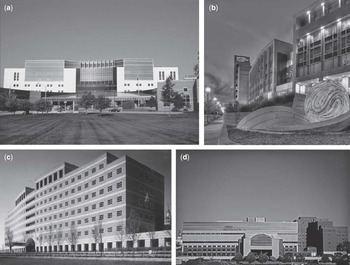
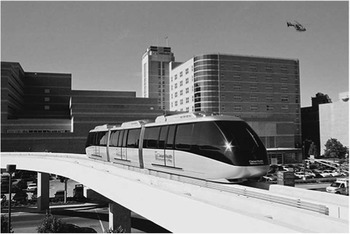
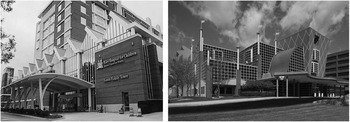
The surgical volume for training cardiothoracic surgeons at Indiana University has been quite balanced. We currently perform between 900 and 1000 adult cardiac cases at IU Health-Methodist Hospital and an additional 120–140 adult cardiac cases at our Veteran’s Administration Hospital. At the Indianapolis IU Health-University Hospital facility, Veteran’s Hospital, Eskenazi, and Methodist Hospital, our CTS faculty performs between 1000 and 1300 major thoracic cases. Our four adult facilities are shown in Figure 1. All four facilities are within six blocks of each other and are connected by a “State-of-the-Art” monorail (Fig 2). Our current paediatric surgical volume ranges between 650 and 700 cases, which are performed at two facilities – the IU Health-Riley Children’s Hospital and the Peyton Manning Children’s Hospital at St. Vincent’s (Fig 3) – with 80% of the volume being performed at the IU Health-Riley Children’s Hospital.
( a ) IU Health-University Hospital, ( b ) IU Health-Simon Cancer Center, ( c ) IU Health-Methodist Hospital, ( d ) Richard L. Roudebush Veterans Administration Medical Center.

IU-Health Monorail.

(Left) Indiana University (IU) Health-Riley Children’s Hospital; (right) – Peyton Manning Children’s Hospital at St. Vincents.

There are 17 cardiothoracic surgical faculty members at our institution – three who perform heart and lung transplantations and ventricular assist device surgeries (VADS). There are seven adult cardiac surgeons – five at the IU Health-Methodist facility and two at the veterans administration. Our adult cardiac surgical service also performs over 100 thoracic vascular cases per year. There are currently four congenital heart surgeons at IU Health-Riley Children’s Hospital who also perform congenital surgery at the Peyton Manning Children’s Hospital. We currently have four general thoracic surgeons who perform major thoracic cases at our four adult facilities, as mentioned above. The educational experience of our traditional cardiothoracic surgical residents who are in the cardiac surgical track are outlined as follows: during their 3 years, they spend 20 months on adult cardiac surgery, 10 months on general thoracic surgery, 4 months on paediatric cardiac surgery, 2 months on heart and lung transplantation and ventricular assist device services, and they have 4 weeks of vacation per year. Traditional cardiothoracic residents who are in the Thoracic track spend 14 months on adult cardiac surgical service, 16 months on general thoracic service, 2 months on paediatric cardiac service, and 2 months performing heart and lung transplantation. They also have 4 weeks of vacation per year.
The Integrated I-6 Cardiothoracic Surgical Program experience is as outlined as follows: during their first I-6 year, they spend 7 months on general surgery, 2 months on cardiothoracic surgery, 1 month on the general surgery transplant programme, 1 month on vascular surgery, and 1 month in the emergency room. The second year, they spend 5 months on general surgery, 4 months on cardiothoracic surgery (which includes experience in the Cath lab, echo lab, pulmonary function lab) and 1 month in the emergency room. The third year of the I-6 program consists of 7 months of general surgery, four of cardiothoracic surgical training, and 1 month performing critical care and/or transplantation. In the fourth I-6 year, there are no rotations in general surgery and all 12 months are devoted to cardiothoracic surgery with 6 months of adult, 2 months of paediatric cardiovascular surgery, and 4 months of general thoracic surgery. Year 5 is quite similar with 6 months on adult cardiac, 2 months on paediatric CTS, and 4 months on the general thoracic service. In their final I-6 year, residents spend 8 months on adult cardiac and 2 months on general thoracic service. During the final I-6 year, residents may substitute adult cardiac and general thoracic rotations for additional rotations on the thoracic transplant and ventricular assist device service as well as the paediatric CTS service.
The case volume for our residents varies from year to year, but each of our traditional and I-6 residents performs between 350 and 600 adult cardiac cases, 60–100 paediatric cardiac cases, and 150–200 cases as surgeon on general thoracic service. They also average five heart and five lung transplants as surgeon. If the resident elects the thoracic track, he does fewer rotations on adult and paediatric services but still performs 200–300 adult cardiac cases, 30–50 paediatric cardiac cases, and over 450 general thoracic cases as surgeon.
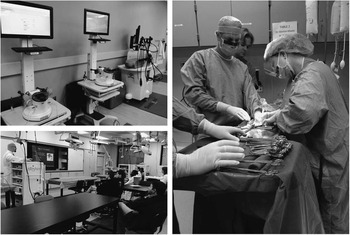
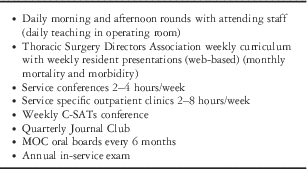
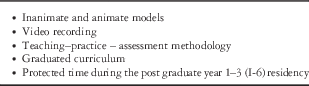
As a result of the 80-hour work week, our residents are doing 150–200 less cardiothoracic surgical cases during a 3-year traditional residency than they did before the 80-hour work week was instituted. We feel that our residents are less sleep deprived and have the opportunity for a better family life. Their surgical maturity and leadership capabilities seem quite satisfactory. The didactic teaching that our residents received is outlined in Table 1. In addition to didactic teaching, they routinely spend time in the cardiothoracic skills laboratory where they have the opportunity to operate on inanimate as well as animate models. We have the facility of video-recording residents’ performance in the Skills Lab and have organised an assessment methodology. There is a graduated curriculum and residents spend 1–3 hours of protected time per month in the Skills Lab. The skills curriculum for our residents is outlined in Table 2. In addition to vascular and cardiac suturing and fine coronary work, we have a cardio-pulmonary bypass simulator which allows us to educate our residents on the various aspects of cardiopulmonary bypass. Residents have opportunities to practice valve repair and replacement. In the Thoracic Surgery Skills Lab, residents learn bronchoscopy and oesophagoscopy, basic video assisted thoracic surgery skills, and perform pulmonary and oesophageal resections and anastomoses. They also have an opportunity two to three times a year to perform cardiothoracic surgery on human cadavers. Our Skills Lab is pictured in Figure 4.
Surgical Simulation Lab.

Cardiothoracic didactic teaching at Indiana University.

Skills curriculum Indiana University-cardiothoracic surgical simulation.

Throughout the training, our residents are graded on the six basic competencies and we have recently introduced a new clinical performance tool, which I will outline below.
We have recently adopted a new assessment tool for evaluating residents and fellows in the operating room. The impetus for adopting this new tool was the growing national concern that CTS trainees are not all reaching technical competency by the time they graduate from their training programmes. This may be because of multiple factors which include the 80-hour work week restriction, lack of night call, and tighter scrutiny on the surgical faculty for operative times and patient outcomes.
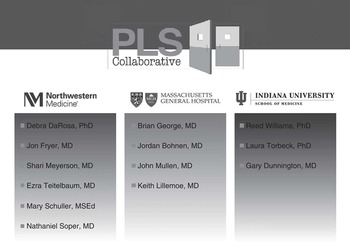
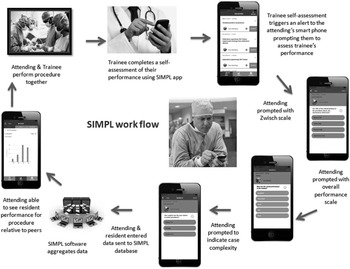
This new web-based tool is called SIMPL and was the collaborative effort of Indiana University, Massachusetts General and Northwestern Finberg School of Medicine. The collaborators and the developers of this tool are shown in Figure 5. This new web-based tool allows residents and staff to assess the resident’s performance on every operation they perform together. The process is outlined as follows: the resident completes a self-assessment of his or her performance during the operation using this SIMPL app on smart phones; the resident’s self-assessment triggers an alert on the attending surgeon’s smart phone, prompting him or her to assess the trainee’s performance on that particular operation; the attending is prompted with the Zwisch scale of resident involvement, which will be explained later in further detail.1 The attending will then score the resident’s performance and the complexity of the particular operation in question. The assessment can be completed by the resident and the attending staff in <4 minutes. The attending staff also has the option to input a short narrative on the operation and the resident’s performance. The attending surgeon and the resident data are then forwarded to the SIMPL database, where SIMPL software aggregates data for each resident and procedure, producing a report at the end of the rotation of the resident’s performance relative to his peers. Figure 6 shows the flow of SIMPL data.
Developers and collaborators of the SIMPL App.

Acquisition and flow of SIMPL data.

There are three basic questions that both the trainee and the attending staff need to answer concerning each operation that the resident and staff perform together. These three questions are listed below: the Zwisch score of the resident’s involvement for >50% of the critical portion of the operation being evaluated; the resident’s performance; and the operation’s complexity. I will go over each of these in detail.
Question 1: the Zwisch score is the level of the resident’s involvement in the operation
The Zwisch score of resident involvement was formulated by Jay Zwischenberger, a cardiothoracic surgeon and current Chief of Surgery at the University of Kentucky. The four levels of resident/staff involvement in an operation include the following: show and tell, active help, passive help, and supervision only in >50% of the most critical portion of the operation.
Question 2: resident performance score
Resident performance is graded “Poor” if the resident was unprepared and had critical deficiencies during the procedure or if the resident initiated critical performance errors. A performance score of “Fair” means that the resident was prepared, but inexperienced with the procedure and had technical problems performing the procedure. A performance rating of “Good” equates to an intermediate performance, but below the level expected for a graduating resident. A performance score of “Very Good” means that the resident had a “practice-ready” performance, he was safe, effective, and able to be independent in conducting over 50% of the critical portion of the procedure, and “Excellent Score” is reserved for a resident’s performance which is considered above the level expected for a graduating resident.
Question 3: complexity of the procedure
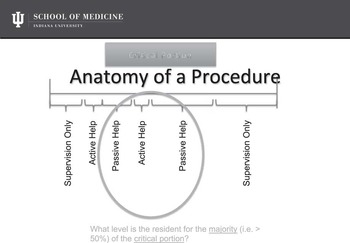
The third question that must be answered by the resident and the attending staff is the complexity of the operative procedure. Was this operation an easy procedure, meaning the patient had straightforward anatomy with a classic presentation? The second complexity level is average or intermediate, which includes the middle-third of operations of this type. The hardest one-third of operations called complex would include cases with abnormal anatomy, extensive pathology, previous surgery to the same area, excessively obese patients, or patients with previous radiation therapy to the operative field. Figure 7 outlines the anatomy of the evaluation process.
Anatomy of the surgical procedure being evaluated.

In summary, the SIMPL app tool evaluates the critical portion of a particular operative procedure. Both the resident and the staff are prompted in the App with the three basic questions and are given examples of the performance of the resident as well as the complexity of the particular surgical procedure. The most difficult area for the staff and the resident to distinguish is between active and passive help that the attending staff gives the residents during the crucial portion of the operative procedure. The key question in this regard is who is actually leading the operation during that critical portion. It is okay for the attending to coach the resident while giving passive help during the critical portion of the procedure in question?
Summary
In this report, I have outlined the history of the CTS training programme at IU, my educational background and experience as an educator of cardiothoracic surgeons, shown the IU facilities, and described the faculty and the volume of surgical cases our residents perform as surgeons. I have outlined the anatomy of the IU Cardiothoracic Training Program. I have described a new evaluation tool (SIMPL) that we have recently adopted for assessing CTS resident performance in the operating room.
Thoracic surgery education and training with all the complexities will continue to evolve and our responsibility towards our residents and their future patients is to ensure that they are “practice ready” when they complete their training at IU.