Introduction
The clinical utility of the DSM-IV eating disorder (ED) classification system has been critiqued insofar as the residual category, ED not otherwise specified (EDNOS), is the most common ED diagnosis in clinical settings. In contrast to the diagnostic categories of anorexia nervosa (AN) and bulimia nervosa (BN), EDNOS is phenomenologically heterogeneous (Thomas et al. Reference Thomas, Vartanian and Brownell2009) and few clinical trials support relevant treatment strategies. As a result, the upcoming publication of DSM-V has inspired a wave of research on empirical approaches to reconsider optimal ED nosology. To date, 10 published studies (Sullivan et al. Reference Sullivan, Bulik and Kendler1998; Bulik et al. Reference Bulik, Sullivan and Kendler2000; Keel et al. Reference Keel, Fichter, Quadflieg, Bulik, Baxter, Thornton, Halmi, Kaplan, Strober, Woodside, Crow, Mitchell, Rotondo, Mauri, Cassano, Treasure, Goldman, Berrettini and Kaye2004; Striegel-Moore et al. Reference Striegel-Moore, Franko, Thompson, Barton, Schreiber and Daniels2005, Reference Striegel-Moore, Franko, Thompson, Affenito, May and Kraemer2008; Wade et al. Reference Wade, Crosby and Martin2006; Duncan et al. Reference Duncan, Bucholz, Neuman, Agrawal, Madden and Heath2007; Mitchell et al. Reference Mitchell, Crosby, Wonderlich, Hill, le Grange, Powers and Eddy2007; Pinheiro et al. Reference Pinheiro, Bulik, Sullivan and Machado2008; Eddy et al. Reference Eddy, Crosby, Keel, Wonderlich, le Grange, Hill, Powers and Mitchell2009) have used latent class analysis (LCA) or latent profile analysis (LPA) to derive ED subtypes empirically based on the co-occurrence of attitudes and behaviors in symptomatic samples. These analyses have proved invaluable in highlighting the strengths and weaknesses of DSM-IV diagnoses. For example, although several LCA and LPA studies have confirmed the existence of latent classes resembling AN (Bulik et al. Reference Bulik, Sullivan and Kendler2000; Keel et al. Reference Keel, Fichter, Quadflieg, Bulik, Baxter, Thornton, Halmi, Kaplan, Strober, Woodside, Crow, Mitchell, Rotondo, Mauri, Cassano, Treasure, Goldman, Berrettini and Kaye2004) and BN (Sullivan et al. Reference Sullivan, Bulik and Kendler1998; Bulik et al. Reference Bulik, Sullivan and Kendler2000; Keel et al. Reference Keel, Fichter, Quadflieg, Bulik, Baxter, Thornton, Halmi, Kaplan, Strober, Woodside, Crow, Mitchell, Rotondo, Mauri, Cassano, Treasure, Goldman, Berrettini and Kaye2004; Striegel-Moore et al. Reference Striegel-Moore, Franko, Thompson, Barton, Schreiber and Daniels2005; Pinheiro et al. Reference Pinheiro, Bulik, Sullivan and Machado2008; Eddy et al. Reference Eddy, Crosby, Keel, Wonderlich, le Grange, Hill, Powers and Mitchell2009), others have identified subgroups not yet recognized as formal diagnostic categories in DSM-IV, including binge-eating disorder (Bulik et al. Reference Bulik, Sullivan and Kendler2000; Striegel-Moore et al. Reference Striegel-Moore, Franko, Thompson, Barton, Schreiber and Daniels2005; Mitchell et al. Reference Mitchell, Crosby, Wonderlich, Hill, le Grange, Powers and Eddy2007; Pinheiro et al. Reference Pinheiro, Bulik, Sullivan and Machado2008; Eddy et al. Reference Eddy, Crosby, Keel, Wonderlich, le Grange, Hill, Powers and Mitchell2009), purging disorder (Striegel-Moore et al. Reference Striegel-Moore, Franko, Thompson, Barton, Schreiber and Daniels2005; Mitchell et al. Reference Mitchell, Crosby, Wonderlich, Hill, le Grange, Powers and Eddy2007; Pinheiro et al. Reference Pinheiro, Bulik, Sullivan and Machado2008), and night eating syndrome (Striegel-Moore et al. Reference Striegel-Moore, Franko, Thompson, Affenito, May and Kraemer2008).
The generalizability of previous LCA and LPA findings to populations under-represented in mental health research may be limited, however, by the demographic homogeneity of the study samples. Specifically, only three studies have included participants from outside the USA, including Canada (Keel et al. Reference Keel, Fichter, Quadflieg, Bulik, Baxter, Thornton, Halmi, Kaplan, Strober, Woodside, Crow, Mitchell, Rotondo, Mauri, Cassano, Treasure, Goldman, Berrettini and Kaye2004), Europe (Keel et al. Reference Keel, Fichter, Quadflieg, Bulik, Baxter, Thornton, Halmi, Kaplan, Strober, Woodside, Crow, Mitchell, Rotondo, Mauri, Cassano, Treasure, Goldman, Berrettini and Kaye2004; Pinheiro et al. Reference Pinheiro, Bulik, Sullivan and Machado2008) and Australia (Wade et al. Reference Wade, Crosby and Martin2006), and only one study has included a large proportion of non-Caucasian participants (Striegel-Moore et al. Reference Striegel-Moore, Franko, Thompson, Barton, Schreiber and Daniels2005). To date, no LCA or LPA studies have investigated the latent structure of eating pathology among participants outside high-income countries. This lack of broad ethnic, social and cultural representation is consistent with meta-trends in the broader psychiatric literature, in which just 6% of articles published in the field's top journals originate from the global regions outside of Western Europe, the USA, Australia or New Zealand that represent more than 90% of the world's population (Patel & Sumathipala, Reference Patel and Sumathipala2001).
Designated a priority area for adolescent mental health by the World Health Organization (WHO, 2003), EDs have global distribution and public health significance. Because eating pathology may present differently outside of the USA and Europe, empirical typologies derived from previous ED LCA and LPA studies may not capture the full range of possible presentations. For example, epidemiological and case-finding investigations have found AN to be rare among majority Blacks in Curaçao (Hoek et al. Reference Hoek, Van Harten, Hermans, Katzman, Matroos and Susser2005), Kenya (Njenga & Kangethe, Reference Njenga and Kangethe2004) and Ghana (Bennett et al. Reference Bennett, Sharpe, Freeman and Carson2004). However, a non-fat-phobic variant of AN has been identified in Hong Kong (Lee et al. Reference Lee, Lee, Ngai, Lee and Wing2001), Singapore (Ong et al. Reference Ong, Tsoi and Chea1982) and Ghana (Bennett et al. Reference Bennett, Sharpe, Freeman and Carson2004). Of note, although two LCA studies (Bulik et al. Reference Bulik, Sullivan and Kendler2000; Keel et al. Reference Keel, Fichter, Quadflieg, Bulik, Baxter, Thornton, Halmi, Kaplan, Strober, Woodside, Crow, Mitchell, Rotondo, Mauri, Cassano, Treasure, Goldman, Berrettini and Kaye2004) have identified latent classes resembling AN, and five LCA and LPA studies have identified subgroups of low- to normal-weight participants exhibiting moderate weight concerns (Bulik et al. Reference Bulik, Sullivan and Kendler2000; Keel et al. Reference Keel, Fichter, Quadflieg, Bulik, Baxter, Thornton, Halmi, Kaplan, Strober, Woodside, Crow, Mitchell, Rotondo, Mauri, Cassano, Treasure, Goldman, Berrettini and Kaye2004; Wade et al. Reference Wade, Crosby and Martin2006; Mitchell et al. Reference Mitchell, Crosby, Wonderlich, Hill, le Grange, Powers and Eddy2007; Eddy et al. Reference Eddy, Crosby, Keel, Wonderlich, le Grange, Hill, Powers and Mitchell2009), none has identified a class clearly resembling non-fat-phobic AN. This pattern of findings is consistent with etiologic theories that link the core psychopathology of eating disorders (i.e. weight and shape concerns) to specific cultural and historical contexts (Lee et al. Reference Lee, Lee, Ngai, Lee and Wing2001; Becker et al. Reference Becker, Thomas and Pike2009).
The purpose of the present study was to conduct an LPA of ED phenotypes in an ethnic Fijian study sample to examine potential ethnic and cultural variation in optimal categorization. Ethnic Fijians, a small-scale indigenous Pacific Islander population, are ethnically and culturally distinct from Western populations used in previous LCA studies. Although there is no indigenous Fijian nosologic category for EDs, weight management strategies are common among Fijian youth (McCabe et al. Reference McCabe, Ricciardelli, Waqa, Goundar and Fotu2009), and ethnic Fijian cultural traditions support attention to appetite, eating and body size (Becker, Reference Becker1995; Mavoa & McCabe, Reference Mavoa and McCabe2008). However, in the setting of globalizing economic and cultural influences on the nutritional environment (Hughes & Lawrence, Reference Hughes and Lawrence2005), urban migration, and social norms for appearance, eating pathology (Becker et al. Reference Becker, Burwell, Gilman, Herzog and Hamburg2002) and obesity (Becker et al. Reference Becker, Gilman and Burwell2005; Mavoa & McCabe, Reference Mavoa and McCabe2008) have become more common in ethnic Fijian females. Weight management strategies include the use of an extensive traditional herbal pharmacopoeia (dranu) both to prevent weight loss (Becker, Reference Becker1995) and to prevent weight gain (Becker et al. Reference Becker, Thomas, Bainivualiku, Richards, Navara, Roberts, Gilman and Striegel-Moore2010 a), and suggest the potential for cross-cultural plasticity in ED presentation.
Therefore, our primary hypothesis was that an LPA using both conventional DSM-IV and uniquely Fijian ED symptoms as indicators would identify novel and culture-specific subgroups with possibly greater local relevance than those identified in previous ED LCAs and LPAs. Our secondary hypothesis was that symptomatic latent classes would differ from asymptomatic classes on external validators including eating pathology, clinical impairment, and general psychopathology. Finally, a post-hoc aim was to explore whether symptomatic latent classes were associated with differential social and cultural characteristics.
Method
Sample characteristics
Ethnic Fijian schoolgirls (n=523) enrolled in 12 secondary schools registered within one sector of the Fiji Ministry of Education participated in this study, which was part of a larger investigation on social transition and psychopathology risk. Girls aged 15 to 20 years were eligible for inclusion. All of the invited schools agreed to participate, and 71% of eligible students enrolled in the study. The participants' mean age was 16.67 (s.d.=1.09) years, and their mean body mass index (BMI) was 23.96 (s.d.=3.35) kg/m2. The participants were evenly divided between rural (50%, n=262) and peri-urban (50%, n=261) locations. Less than half (41%, n=216) lived in relative material affluence (i.e. operationalized as having household access to electricity, a gas stove, a refrigerator, and running water); the majority (59%, n=307) lived in relative material poverty (i.e. lacking one or more of these goods or services). Furthermore, 41% (n=216) reported having sometimes gone hungry in the past month because of insufficient food in the home.
Procedure
The study used data originally collected as part of a two-stage design described previously (Becker et al. Reference Becker, Thomas, Bainivualiku, Richards, Navara, Roberts, Gilman and Striegel-Moore2010 a, Reference Becker, Thomas, Bainivualiku, Richards, Navara, Roberts, Gilman and Striegel-Mooreb). In brief, all participants completed a self-report battery at Stage 1. Assessments were offered in either English (the language of formal instruction) or the vernacular (Fijian) language. For LPA indicators, we drew from Stage 1 self-report and anthropometric data available for the full sample (n=523). Stage 2 interview data were available for a subsample (n=215) selected by eligibility criteria specified in a related study identifying symptomatic (n=178) and asymptomatic (n=37) groups (described in Becker et al. Reference Becker, Thomas, Bainivualiku, Richards, Navara, Roberts, Gilman and Striegel-Moore2010 a, Reference Becker, Thomas, Bainivualiku, Richards, Navara, Roberts, Gilman and Striegel-Mooreb). The Partners Human Research Committee (PHRC), Harvard Medical School Human Subjects Committee, and Fiji National Research Ethical Review Committee approved the data collection. The PHRC approved the secondary data analyses.
Measures
Eating pathology
We assessed eating pathology with the Eating Disorder Examination Questionnaire (EDE-Q) version 5.2, adapted to include an item assessing herbal purgative use. The EDE-Q is a self-report measure evaluating the domains of Restraint, Eating Concern, Shape Concern, and Weight Concern (Fairburn & Beglin, Reference Fairburn and Beglin1994). All participants rated the frequency of ED symptoms over the past 28 days on a Likert scale ranging from ‘no days’ to ‘every day.’ Internal consistency, retest reliability and construct validity were adequate in our sample (Becker et al. Reference Becker, Thomas, Bainivualiku, Richards, Navara, Roberts, Gilman and Striegel-Moore2010 b).
Herbal purgative use
We evaluated herbal purgative use as a potential LPA indicator with the following item incorporated into the EDE-Q: ‘Over the past 28 days, how many times have you taken traditional Fijian dranu to cause diarrhea, clean out your stomach, or suppress your appetite as a means of controlling your shape or weight?’ We have previously reported that self-reported herbal purgative use was prevalent in our sample, and significantly associated with both eating pathology (Becker et al. Reference Becker, Thomas, Bainivualiku, Richards, Navara, Roberts, Gilman and Striegel-Moore2010 b) and eating-related clinical impairment (Becker et al. Reference Becker, Thomas, Bainivualiku, Richards, Navara, Roberts, Gilman and Striegel-Moore2010 a).
Evaluation of herbal purgative use to qualify it as a potential indicator of eating pathology
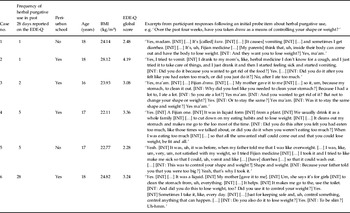
Because the phrasing of this single assessment item could conceivably encompass non-pathological (i.e. culturally sanctioned medicinal) use of dranu, we sought to ascertain that herbal purgative use was rationalized as a mode of weight management by at least some participants to justify its inclusion as an LPA indicator. To interrogate the rationales for herbal purgative use and confirm its local cultural relevance as a potential sign of eating pathology, we examined portions of Stage 2 interview transcripts from a convenience sample of 19 respondents who had endorsed this behavior on the EDE-Q. Transcripts were from a semi-structured interview based upon the EDE interview version 16.0 (Fairburn & Beglin, Reference Fairburn and Beglin1994) and adapted for this population by adding culturally and developmentally appropriate probe questions addressing the presence, motivation and context of herbal purgative use. Of the 19, 74% (n=14) confirmed using herbal purgatives specifically to influence their shape or weight, whereas 26% (n=5) exclusively provided rationales less clearly linked to, or even independent of, eating pathology, such as the alleviation of postprandial discomfort after overeating (n=1), the prevention of appetite loss (n=2) or the treatment of physical illness (n=2). Table 1 displays interview transcript excerpts from six participants who affirmed that their herbal purgative use was linked to weight management and purging, although some excerpts illustrate plural rationales. Indeed, herbal purgative use was compensatory for specific overeating episodes (e.g. cases 2, 3 and 4), in addition to non-compensatory, but still motivated by weight management goals (e.g. cases 1, 5 and 6). Notably, we found evidence that family members sometimes encouraged or enabled herbal purgative use (e.g. cases 1, 3, 4 and 6). Consistent with our study aim to encompass a broad range of behaviors that might reflect culture-specific variation in eating pathology, we conceptualized herbal purgative use as a possible ED symptom and used it as an indicator variable in our LPA.
Excerpted interview transcript data illustrating a rationale for herbal purgative use to compensate for episodes of overeating and/or control shape or weight among six study participants who self-reported herbal purgative use in the past 28 days

BMI, Body mass index; EDE-Q, Eating Disorder Examination Questionnaire; Dranu, a generic term for indigenous Fijian medicinal herbal preparations; kura, a specific Fijian herbal preparation; [INT], interviewer question omitted; […], participant comment(s) and/or participant and interviewer comment(s) omitted.
BMI
BMI was calculated as weight (kg) divided by height (m2), using height and weight estimates generated from measured values at Stage 1. We measured weight with an electronic scale to the nearest 0.2 kg and height to the nearest millimeter with a portable stadiometer in light clothing without shoes. Weight estimates were corrected for clothing by subtracting 0.5 kg, and height estimates were rounded to the nearest centimeter.
Impairment and co-morbid psychopathology
The Clinical Impairment Assessment (CIA; Bohn et al. Reference Bohn, Doll, Cooper, O'Connor, Palmer and Fairburn2008) evaluates the extent to which ED symptoms negatively impact mood, cognitive functioning and relationships, with four-point response options ranging from ‘not at all’ to ‘a lot’. The CIA was adapted and administered to Stage 2 participants (n=215) as a structured interview. Internal consistency was adequate in our sample (Becker et al. Reference Becker, Thomas, Bainivualiku, Richards, Navara, Roberts, Gilman and Striegel-Moore2010 a). The Center for Epidemiologic Studies Depression Scale (CES-D) is a self-report measure of depressive symptoms (e.g. low mood, hopelessness) over the past 7 days (Radloff, Reference Radloff1977) and was used to measure psychopathology that is often co-morbid with disordered eating. The items, which are scored on a four-point Likert scale ranging from <1 day to ⩾5 days, have been used successfully in non-Western adolescent populations (Ghubash et al. Reference Ghubash, Daradkeh, Al Naseri, Al Bloushi and Al Daheri2000; Yang et al. Reference Yang, Soong, Kuo, Chang and Chen2004). For the present study, participants received scores as long as they had responded to at least 90% of the CES-D items.
Cultural orientation
We assessed cultural orientation with composite measures derived from Likert items relating multiple dimensions of both Western/global and ethnic Fijian cultural orientation. Development, translation and psychometric evaluation of these measures is described elsewhere (Becker et al., in press). For the present study, participants received scores as long they had answered at least 80% of the scale items.
Indigenous practices: kava and dranu use
As an additional proxy for traditional Fijian orientation, we queried the use of indigenous health and social practices. We evaluated use of kava (a ceremonial and social traditional beverage prepared from dried Piper methysticum root) in the past 30 days on a Likert scale ranging from 0 (no days) to 5 (every day). We also assessed whether participants had used traditional herbal medicine to prevent and/or treat an indigenous illness, macake (characterized by loss of appetite; see Becker, Reference Becker1995), in the past month.
Peer eating pathology
We evaluated the perceived prevalence of peer eating pathology in participants' social networks by asking them to estimate the proportion of ‘your five or so closest friends’ who had engaged in dieting, fasting and vomiting/laxative abuse in the past 30 days on a four-point Likert scale ranging from ‘none of them’ to ‘all of them’. These items exhibited ‘moderate’ test–retest reliability (κ=0.41 for dieting, κ=0.48 for fasting, κ=0.53 for vomiting/laxative use) (Landis & Koch, Reference Landis and Koch1977).
LPA
LPA is a technique that uses maximum likelihood estimation to assign participants to mutually exclusive populations called latent classes. Classes are latent because membership is not observable directly, but instead can be inferred by evaluating the pattern of inter-correlations among indicator variables. The purpose of LPA is to identify the smallest number of classes that could account for these inter-correlations, thus minimizing the associations among indicator variables within each latent class and achieving a state of conditional independence. In contrast to LCA, which accepts only dichotomous indicator variables, LPA uses nominal, ordinal or continuous indicators.
Consistent with previous LCA and LPA studies using community samples (Sullivan et al. Reference Sullivan, Bulik and Kendler1998; Bulik et al. Reference Bulik, Sullivan and Kendler2000; Striegel-Moore et al. Reference Striegel-Moore, Franko, Thompson, Barton, Schreiber and Daniels2005), we included only symptomatic participants in our LPA to enhance statistical power to identify multiple pathological groups. Because the base rate of AN symptoms was fairly low in our sample (i.e. only 1% had a BMI<17.5 kg/m2 and 4% endorsed amenorrhea on the EDE-Q), we restricted our LPA to symptoms characterizing a diagnosis of BN. Therefore, we included only those participants who self-reported vomiting or herbal purgative use in the past 28 days through the EDE-Q (n=222)Footnote 1Footnote †. LPA indicator variables reflected the frequency of EDE-Q bulimic symptoms, with the addition of herbal purgative use. Because both symptom frequencies and Likert endorsement of our indicator variables were positively skewed, we transformed indicators into dichotomies or ordered categories based on natural breaks in the distributions. Our LPA indicator variables were as follows: (1) overvaluation of weight and shape [‘not at all’ (mean of EDE-Q overvaluation items <1), ‘slightly’ (mean of EDE-Q overvaluation items ⩾1, <3), ‘moderately’ to ‘markedly’ (mean of EDE-Q overvaluation items ⩾3)], (2) binge eating (0, 1–3, ⩾4 episodes), (3) vomiting (0 v. ⩾1 episode), (4) laxative use (0 v. ⩾1 episode), (5) fasting (0 v. ⩾1 episode), (6) driven exercise (0, 1–4, ⩾5 episodes) and (7) herbal purgative use (0 v. ⩾1 episode).
We conducted our LPA using Latent Gold 4.5 (Vermunt & Magidson, Reference Vermunt and Magidson2005). We evaluated conditional independence by identifying the class solution associated with the lowest values of the Bayesian information criterion (BIC) and the consistent Akaike information criterion (cAIC), and also the minimization of cross-classification probabilities. We examined bivariate residuals (indices of the remaining correlations among indicator variables within latent classes) to ensure that none was greater than 5. Because no more than 2% of participants had missing values on any indicator variable, all 222 participants who endorsed self-induced vomiting or herbal purgative use in the past 28 days were submitted to LPA, and the remaining 301 participants served as a non-purging control group in subsequent validation analyses.
Validation analyses
We hypothesized that, if purging is a valid marker of psychopathology among ethnic Fijian girls, then the latent classes would score significantly higher than non-purging participants with regard to (1) eating pathology (EDE-Q); (2) clinical impairment associated with disordered eating symptoms (CIA); and (3) depressive symptoms (CES-D). Furthermore, given the potential confounding effect of impoverished food environment on the cross-cultural assessment of eating pathology (le Grange et al. Reference le Grange, Louw, Breen and Katzman2004), we wanted to ensure that the classes did not differ from one another or from the non-purging group on the 1-month prevalence of hunger because of lack of food in the home. To evaluate these hypotheses, we conducted a series of ANOVAs and χ2 tests. To reduce Type I error, we set α to 0.01 for each omnibus test. To follow up statistically significant F tests, we used Fisher's least significant difference (LSD) post-hoc comparisons. To follow up statistically significant omnibus χ2 tests, we used a Bonferroni correction by dividing α=0.05 by the number of unique pair-wise comparisons. We conducted our validation analyses on SPSS version 16.0 (SPSS, 2007).
Post-hoc class comparisons of potential etiological variables
A third aim of the study was to generate hypotheses about the social and cultural characteristics that could provide insights into the potentially distinct etiologies of symptomatic latent classes. Therefore, we used t tests and χ2 analyses to compare levels of cultural orientation, indigenous health practices, and peer eating pathology, across classes. We again set α to 0.01 to reduce Type I error, and conducted these post-hoc analyses on SPSS version 16.0 (SPSS, 2007).
Results
LPA
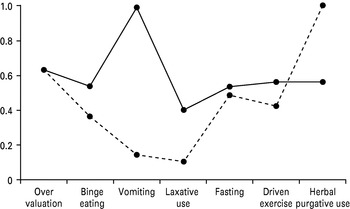
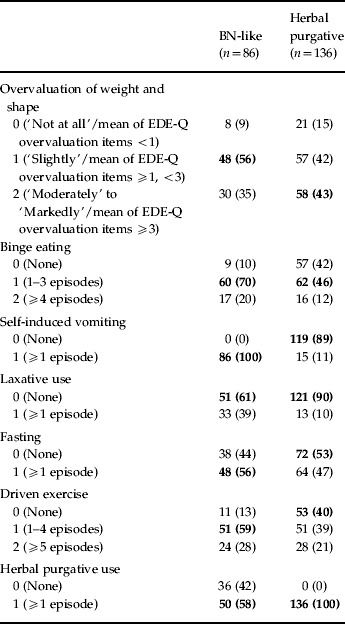
We evaluated models with one to five classes. To meet the assumptions of the LPA model, we allowed for the conditional dependence of three pair-wise correlations of indicators in which bivariate residuals were greater than 5: (1) herbal purgative use/laxative use; (2) driven exercise/overvaluation; and (3) laxative use/overvaluation. BIC and cAIC were lowest for the two-class model with 21 parameters (model fit indices available upon request from the first author)Footnote 2. Table 2 displays the relative endorsement of each indicator variable in the two latent classes, and Fig. 1 provides a graphical depiction of these data.
Relative endorsement of eating disorder (ED) symptom indicators in the bulimia nervosa (BN)-like class (–––) and herbal purgative class (- - -). For the dichotomous variables (vomiting, laxative use, fasting and herbal purgative use), relative endorsement is plotted as the percentage of participants in each class who endorsed that symptom. For the ordinal variables (overvaluation, binge eating and driven exercise), relative endorsement is plotted as the mean of the three ordered categories (assigned point values of 0, 1 and 2 for increasingly greater frequencies) divided by 2, so as to fit on a 0–1 scale.

Prevalence of eating disorder (ED) symptom endorsement in the LPA-derived BN-like class and herbal purgative class

LPA, Latent profile analysis; BN, bulimia nervosa; EDE-Q, Eating Disorder Examination Questionnaire.
Values given as n (%).
Within each cell, the bolded percentage indicates the modal response for that variable within that latent class. Numbers in some cells do not add up to the total number of participants in that latent class because of missing data on that variable.
The first class comprised 39% (n=86) of the purging sample and was characterized primarily by a high prevalence of self-induced vomiting (100%) and binge eating (90%). Members of this ‘BN-like class’ also had a moderate prevalence of herbal purgative use (58%) and laxative use (39%). In addition, the majority endorsed exercise for weight control (87%). Over half endorsed fasting (56%), and approximately one-third affirmed that weight and shape featured ‘moderately’ to ‘markedly’ in their self-evaluation (35%).
The second class comprised 61% of the purging sample (n=136). All members of this ‘herbal purgative class’ endorsed herbal purgative use. Other forms of purging, such as vomiting (11%) and laxative use (10%), were endorsed infrequently. Participants defined by this class also endorsed binge eating (58%) and exercise for weight control (60%) less frequently than members of the BN-like class. However, the prevalences of fasting (47%) and ‘moderate’ to ‘marked’ overvaluation of shape and weight (43%) were comparable to those observed in the BN-like class. Notably, had we not added this culturally relevant item to the EDE-Q, 71% of participants in the herbal purgative class would have been classified as non-purging because of their negative responses to the items probing self-induced vomiting and laxative use.
Validation analyses
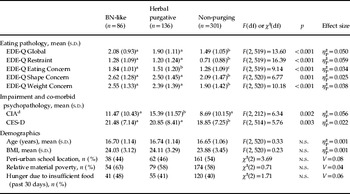
The results of the validation analyses are presented in Table 3; the p values in the following text represent Fisher's LSD post-hoc pair-wise comparisons, which we conducted to follow-up omnibus tests that already met our α=0.01 criterion for statistical significance.
Comparison of external validators in the LPA-derived BN-like and herbal purgative classes versus the non-purging group

LPA, Latent profile analysis; BN, bulimia nervosa; EDE-Q, Eating Disorder Examination Questionnaire; CIA, Clinical Impairment Assessment; CES-D, Center for Epidemiologic Studies Depression Scale; BMI, body mass index; η2p, partial eta squared; V, Cramer's V; df, degrees of freedom; s.d., standard deviation; n.s., not significant.
a, b, c Means and percentages with different superscripts within each row differ significantly from one another (using Fisher's LSD post-hoc comparisons to follow up significant omnibus F tests, and Bonferroni corrections to follow up significant omnibus χ2 tests).
d Data available for Stage 2 participants only (n=215).
Eating pathology
Participants in the BN-like and herbal purgative classes endorsed similar levels of eating pathology on the EDE-Q. As hypothesized, the BN-like and herbal purgative classes both endorsed significantly greater EDE-Q Global, Restraint, Eating Concern, Shape Concern, and Weight Concern scale scores than the non-purging group (all p's <0.05). The BN-like class, however, endorsed significantly greater Eating Concern compared with the herbal purgative class (p=0.03).
Impairment and co-morbid psychopathology
Contrary to our expectations, the herbal purgative class endorsed significantly greater clinical impairment related to disordered eating than the BN-like class (p=0.03), and the BN-like class did not differ from the non-purging group with regard to clinical impairment. In line with our predictions, the herbal purgative class endorsed greater clinical impairment than the non-purging group (p<0.001). As expected, both the BN-like (p=0.005) and herbal purgative (p=0.01) classes reported higher levels of co-morbid depressive symptoms than the non-purging group.
Demographics
The classes two did not differ from one another or from the non-purging group on demographic characteristics, including age, BMI, peri-urban school location, relative material poverty, and hunger.
Post-hoc class comparisons of potential etiological variables
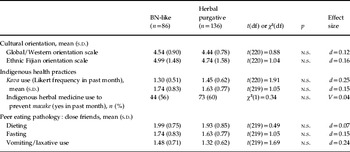
No significant sociodemographic or cultural differences were identified between BN-like and herbal purgative classes, including cultural orientation, indigenous practices or peer eating pathology (Table 4).
Class comparisons of selected potential etiological variables in the LPA-derived BN-like and herbal purgative classes

LPA, Latent profile analysis; BN, bulimia nervosa; Macake, indigenous illness characterized by appetite loss; d, Cohen's d; V, Cramer's V; df, degrees of freedom; n.s., not significant.
Discussion
To our knowledge, this study is the first LCA or LPA of ED symptoms in a small-scale indigenous population and outside a high-income country. Our LPA of ethnic Fijian schoolgirls identified two latent classes associated with comparable levels of eating and general psychopathology, which we have characterized as ‘BN-like’ and ‘herbal purgative’ classes, respectively. The BN-like class, with its high rates of binge eating and vomiting, is phenomenologically similar to the bulimic classes described in previous US and European LCAs and LPAs (Sullivan et al. Reference Sullivan, Bulik and Kendler1998; Bulik et al. Reference Bulik, Sullivan and Kendler2000; Keel et al. Reference Keel, Fichter, Quadflieg, Bulik, Baxter, Thornton, Halmi, Kaplan, Strober, Woodside, Crow, Mitchell, Rotondo, Mauri, Cassano, Treasure, Goldman, Berrettini and Kaye2004; Striegel-Moore et al. Reference Striegel-Moore, Franko, Thompson, Barton, Schreiber and Daniels2005; Pinheiro et al. Reference Pinheiro, Bulik, Sullivan and Machado2008; Eddy et al. Reference Eddy, Crosby, Keel, Wonderlich, le Grange, Hill, Powers and Mitchell2009). By contrast, the herbal purgative class, which was characterized primarily by the use of indigenous herbal purgatives, has not been observed in previous LCAs and LPAs, nor is it represented as a distinct subtype in DSM-IV. Although the two classes were distinguished by self-reported purging modalities, they seemed to share a core pathology by exhibiting remarkably similar profiles of eating and general psychopathology. Our results highlight the importance of including as LPA indicators locally meaningful behaviors that might be culture specific, such as herbal purgative use, to enhance the generalizability of empirically derived nosologic schemes.
Contrary to expectations, our post-hoc analyses of social and cultural characteristics did not find evidence that the herbal purgative class differed from the BN-like class on either Fijian or Western/global cultural orientation or perceived disordered eating among peers. However, our study was only sufficiently powered to detect medium to large effects. Moreover, the multiple dimensions of acculturation are likely to have heterogeneous impacts on health outcomes (Guarnaccia et al. 2009; Becker et al., in press) and the two classes may differ on a facet of cultural orientation that we did not assess. An alternative interpretation is that ethnic Fijian girls view the two types of purging as interchangeable. Indeed, given that herbal purgatives are used to induce vomiting or diarrhea, it is conceivable that there is more overlap in purging modality than the self-report responses suggest, reflecting a response bias related to the perception that herbal purgative use is more socially acceptable than other modes of purging. It is also possible that within-class variation with respect to purging confounds the relationship between sociocultural variables and class membership. For example, the BN-like class contains respondents who also use herbal purgatives, and the herbal purgative class may include respondents who do not explicitly link their herbal purgative use to weight management, or who espouse plural rationales for herbal purgative use. Moreover, the herbal purgative class we identified may not be culturally unique; surveys of ED patients in the USA indicate that 13% (Trigazis et al. Reference Trigasiz, Tennankore, Vohra and Katzman2004) to 64% (Steffen et al. Reference Steffen, Roerig, Mitchell and Crosby2006) have used herbal products to induce weight loss or vomiting. Of these products, the ingestion of ipecac syrup to induce emesis in Western populations (Silber, Reference Silber2005) bears some phenomenological similarity to the herbal purgative use observed in Fiji. Indeed, because no previous ED LCA or LPA has used ipecac or herbal product use as an indicator variable, we cannot be certain whether the emergence of a herbal purgative class in our ethnic Fijian sample reflects actual culture-specific phenomenologic heterogeneity or our more inclusive operational definition of disordered eating behaviors.
The substantial prevalence of herbal purgative use in our sample suggests local vulnerability to disordered eating that could benefit from additional research attention and clinical resources. However, there are several additional implications of our findings, beyond their immediate public health relevance for the local populace. First, these results suggest that the application of a ‘universal’ criteria set for EDs developed from a largely Euro-American evidence base may be insufficient to characterize the full range of phenomenologic heterogeneity across populations outside of these regions; indeed, a broader, and more culturally informed, scope of symptom phenomena should be considered (cf. Kleinman, Reference Kleinman1977). Second, indigenous nosologic categories may not identify all symptom profiles as culturally salient, even if they are associated with distress and impairment. Third, so-called ‘unsupervised learning techniques’ such as LCA (Magidson & Vermunt, Reference Magidson and Vermunt2002, p. 38), in which group size and composition is not known a priori, may mitigate some of the limitations inherent to the application of solely etic or emic perspectives in cross-cultural evaluation by identifying novel symptom patterns. Fourth, this study provides further evidence that social environment may promote unique symptom presentations. It would be misleading, however, to interpret these results to mean that cultural context results only in superficial epiphenomenal variants on universal core pathology. Additional data are necessary to establish whether the herbal purgative class represents a clinical phenomenon with a course and outcome similar to or distinct from EDs described in high-income countries. For example, our preliminary qualitative data analysis suggests that characteristics of Fijian girls' herbal purgative use, insofar as it is sometimes abetted by parents or temporally unrelated to overeating, may be distinctive from purging typical of BN.
Also of note, the BN-like class in our study endorsed EDE-Q scores substantially lower than those reported for BN-like classes identified in an American LPA (Eddy et al. Reference Eddy, Crosby, Keel, Wonderlich, le Grange, Hill, Powers and Mitchell2009) and European LCA (Pinheiro et al. Reference Pinheiro, Bulik, Sullivan and Machado2008), but comparable to the population median for American female undergraduates (Luce et al. Reference Luce, Crowther and Pole2008). Notably, more than half of participants in both classes endorsed the use of traditional herbal therapy to prevent an indigenous illness, macake, which is characterized by poor appetite. The juxtaposition of a weight-loss prevention strategy with purgative use suggests that weight and shape concerns may not be central to all ED presentations in Fiji. EDs resembling AN, but presenting in the absence of weight concerns, have also been described in non-Western populations (Ong et al. Reference Ong, Tsoi and Chea1982; Lee et al. Reference Lee, Lee, Ngai, Lee and Wing2001; Bennett et al. Reference Bennett, Sharpe, Freeman and Carson2004). Taken together, this cultural variation in the presentation of eating pathology supports the possibility that cultural context may attenuate or exacerbate the cognitive symptoms associated with disordered eating.
Our findings should be interpreted in light of design strengths and limitations. With regard to strengths, first, we developed and adapted assessments to be culturally appropriate and in the local vernacular language, drawing from foundational ethnographic data and expert local knowledge. Second, we considered and excluded potential confounding by impoverished food environment (le Grange et al. Reference le Grange, Louw, Breen and Katzman2004). Third, the mean CIA score for the herbal purgative class approached the clinical cut-off of 16 that separated ED cases from non-cases in the original validation sample (Bohn et al. Reference Bohn, Doll, Cooper, O'Connor, Palmer and Fairburn2008), which supports our interpretation of herbal purgative as an ED symptom.
One limitation is the use of primarily self-report data to identify and validate the latent classes. Moreover, our characterization of the heterogeneity and complexity of rationales for herbal purgative use in this sample is preliminary and incomplete. Indeed, in our evaluation of herbal purgative use through narrative data, a sizeable minority of respondents did not explicitly attribute their herbal purgative use to shape and weight. Therefore, it is likely that at least some of the herbal purgative use observed in the present study may have been motivated by alternative socially sanctioned indications (e.g. medicinal usage). However, it is also conceivable that individuals may not formulate herbal purgative use as motivated by weight concerns if they do not regard weight control as a socially legitimate pursuit. Relatedly, other investigators have commented on the validity of evaluating eating pathology with self-report versus interview assessment, highlighting the potentially greater candor evidenced in self-reports of socially stigmatized behaviors (Keel et al. Reference Keel, Crow, Davis and Mitchell2002; Mond et al. Reference Mond, Hay, Rodgers and Owen2007). A second limitation is that our selection of LPA indicators and validators, although informed by extensive ethnographic work with this population, necessarily reflects our Western conceptual models of disordered eating and related distress. A third limitation is that, because we did not observe the two respective classes longitudinally, we could not evaluate crossover between classes or the directionality of the relationship between class membership and external validators. Fourth, LPA cannot distinguish differences in kind versus differences in degree. Indeed, there were more similarities than differences between the BN-like and herbal purgative classes, and future taxometric work is needed to ascertain the nature of the boundary between groups.
This study augments empirical support for cultural variation in patterning of ED symptom presentation (Lee et al. Reference Lee, Lee, Ngai, Lee and Wing2001; Franko et al. Reference Franko, Becker, Thomas and Herzog2007) and also has implications for clinical practice. For example, without appropriate breadth to identify clinically relevant variation, clinical and research assessment of eating pathology can result in misclassification of true cases as non-cases (Lee et al. Reference Lee, Lee, Ngai, Lee and Wing2001; Bennett et al. Reference Bennett, Sharpe, Freeman and Carson2004) and non-cases as cases (le Grange et al. Reference le Grange, Louw, Breen and Katzman2004). Indeed, the majority of participants in the herbal purgative class would have been classified as non-purging by the EDE-Q had we not included an item referencing a culture-specific means of purging. In sum, the inclusion of populations with culturally distinctive traditions and symptoms in latent structure modeling may enhance the clinical utility of statistically derived nosological schemes in both diverse social contexts and multi-cultural populations.
Note
Supplementary material accompanies this paper on the Journal's website (http://journals.cambridge.org/psm).
Acknowledgements
We gratefully acknowledge the assistance of Dr L. Waqatakirewa, CEO, Fiji Ministry of Health, and his team; the Fiji Ministry of Education; J. Rokomatu, the late Tui Sigatoka; Dr J. Pryor, Chair of the FN-RERC; Dr T. Qorimasi; Professor B. Aalbersberg; A. Nisha Khan; A. Bainivualiku; Professor J. Murphy; L. Richards; A. Shivji; A. Heberle; K. Navara; and members of the Senior Advisory Group for the HEALTHY Fiji Study. We also thank all the Fiji-based principals and teachers who facilitated this study.
This project was funded by NIMH K23 MH 068575 (A.E.B.), a Harvard Research Enabling Grant (A.E.B.), and a Klarman Foundation Post-Doctoral Fellowship (J.J.T.).
Declaration of Interest
None.