INTRODUCTION
The mix of trees and grasses that characterizes savannas presents an unresolved ecological conundrum: what factors maintain the balance between these fundamentally different life forms? There is increasing recognition that recurrent fire disturbance limits the dominance of trees and that without fire, the grass layer in mesic savannas is very much reduced and tree cover increases (Bond Reference BOND2008, Bond et al. Reference BOND, WOODWARD and MIDGLEY2005, Swaine et al. Reference SWAINE, HAWTHORNE and ORGLE1992, Trapnell Reference TRAPNELL1959, Woinarski et al. Reference WOINARSKI, RISLER and KEAN2004). Saplings are thought to be particularly vulnerable because stems in this size class are readily defoliated or killed by grass fires, yet are too large for their above-ground biomass to be quickly replaced from below-ground carbohydrate stores following top-kill, as happens for smaller stems (Hoffmann & Solbrig Reference HOFFMANN and SOLBRIG2003). Mature trees, in contrast, have canopies above the zone of lethal temperatures and trunks with bark sufficiently thick to protect the cambium (Hoffmann et al. Reference HOFFMANN, ADASME, HARIDASAN, CARVALHO, GEIGER, PEREIRA, GOTSCH and FRANCO2009). Thus fire may restrict passage through the sapling stage into the small-adult size classes.
This ‘fire-mediated bottleneck’ in tree recruitment is thought to result in a dense ground layer of suppressed stems, which resprout after being burnt. Such ‘juvenile’ stems constitute large stored reproductive potential that enables substantial recruitment when conditions are favourable (Higgins et al. Reference HIGGINS, BOND and TROLLOPE2000, Warner & Chesson Reference WARNER and CHESSON1985). Higgins et al. (Reference HIGGINS, BOND and TROLLOPE2000) argued that the combined low adult mortality and limited recruitment results in the persistence of trees at low densities. Low tree densities are crucial for the development of a grass layer, which provides fuel for fires, which in turn limits tree densities. Thus the mesic savanna ecosystem may be maintained by the fire-mediated recruitment bottleneck of trees (Sankaran et al. Reference SANKARAN, RATNAM and HANAN2004).
While studies of savanna tree stand structures and some demographic modelling studies support the concept of a fire-mediated recruitment bottleneck (Gardner Reference GARDNER2006, Higgins et al. Reference HIGGINS, BOND and TROLLOPE2000, Prior et al. Reference PRIOR, BROOK, WILLIAMS, WERNER, BRADSHAW and BOWMAN2006), there are few field-based experimental tests of this idea. This reflects the logistical difficulties of undertaking landscape-scale fire experiments in tropical savanna environments. The Kapalga fire experiment in a north Australian savanna (Andersen et al. Reference ANDERSEN, COOK, CORBETT, DOUGLAS, EAGER, RUSSELL-SMITH, SETTERFIELD, WILLIAMS and WOINARSKI2005) provides a globally rare opportunity to test for the existence of a fire-mediated recruitment bottleneck in a mesic savanna. The key elements of the fire-mediated recruitment bottleneck are (1) abundant juveniles, which are able to persist even when fire frequencies are high (generally through resprouting); (2) vulnerable saplings, with high fire-induced stem loss, and adults that are fire-tolerant relative to the sapling size class; (3) low rates of recruitment from saplings into the small-adult size class; and (4) removal of fire leads to an increase in tree cover, i.e. maintenance of savanna structure by fire with conversion to dry forest in the absence of fire. We hypothesized that a fire-mediated recruitment bottleneck exists in mesic savannas in northern Australia, and tested whether all four elements of the bottleneck were present in the Kapalga fire experiment. Specifically, we addressed the following questions: (1) Stand structure – is there a demographic structure consistent with the bottleneck hypothesis (i.e. significantly ≫ juveniles than saplings)? (2) Stem mortality – is stem survival correlated with height for saplings and small trees? We specifically focus on the demographic transition most affected by a recruitment bottleneck: accession of the sapling size class (1.5–3 m high) to small-adult trees (≥3 m high). (3) Recruitment – are rates of recruitment from saplings into the small-adult size class reduced by fire? (4) Tree biomass – does reducing the frequency and/or intensity of fire lead to increases in tree density, tree cover and stand basal area? Existing publications based on the Kapalga dataset address this issue, and are drawn on in the discussion. In addition, it has been suggested that the success of the eucalypts in Australian savannas is related to their fire tolerance (Bowman & Prior Reference BOWMAN and PRIOR2005, Burrows et al. Reference BURROWS, HORNBY, WATERS, BELLAIRS, PRIOR and BOWMAN2008), an idea we investigated by asking (5) how does the fire tolerance of eucalypts compare with that of other savanna species?
MATERIALS AND METHODS
Study area
The study area was within Kakadu National Park at the former Kapalga Research Station (132°22′E, 12°34′S), about 180 km east of Darwin in the monsoonal tropics of northern Australia (Andersen et al. Reference ANDERSEN, COOK and WILLIAMS2003). Rainfall is strongly seasonal; the nearby town of Jabiru receives 94% of its annual total of 1591 mm during the months of November to April (Bureau of Meteorology, http://www.bom.gov.au/climate/averages/tables/cw_014198.shtml). Temperatures are high year round, with an annual mean of 28.4 °C. The study area was located in vegetation dominated by Eucalyptus tetrodonta and Eucalyptus miniata, two evergreen species that are widespread across northern Australia in areas with well-drained soils where annual rainfall exceeds about 800 mm (Fox et al. Reference FOX, NELDNER, WILSON and BANNINK2001). The midstorey consisted of largely deciduous broad-leaved woody species, and the understorey was dominated by a mixture of annual grasses such as Sorghum spp. Damage to trees caused by herbivores was negligible; there are no large browsers, and populations of the introduced Asian swamp buffalo (Bubalis bubalis) were eliminated from the area before the study began.
Experimental design
This study was part of a landscape-scale experiment in Kapalga examining the effect of fire treatments on flora, fauna and soils of north Australian mesic savannas, described in detail by Andersen et al. (Reference ANDERSEN, COOK and WILLIAMS2003, Reference ANDERSEN, COOK, CORBETT, DOUGLAS, EAGER, RUSSELL-SMITH, SETTERFIELD, WILLIAMS and WOINARSKI2005). It compared annual early dry-season (June) fires, annual late dry-season (September) fires, and no fire (control; Williams et al. Reference WILLIAMS, COOK, GILL and MOORE1999, Reference WILLIAMS, MULLER, WAHREN, SETTERFIELD, CUSACK, Andersen, Cook and Williams2003). Experimental fires were lit annually between 1990 and 1994 in three replicate compartments, each 15–20 km2. In addition to the prescribed fires, one of the control compartments, which had been unburnt for 7 y, was burnt by an unplanned, high-intensity fire in September 1994 (extreme fire). Our analyses used data from two of the 20 × 50-m permanent plots that Williams et al. (Reference WILLIAMS, COOK, GILL and MOORE1999) established in each compartment, giving a total of six plots per treatment (except for the unplanned extreme fire, which only burnt two plots); this represented a total area of 1.8 ha. Within these plots, all trees taller than 3 m were tagged and species, height and dbh were recorded. Trees <3 m high were recorded in a strip 5 m wide and 50 m long in three plots per fire treatment. In this study, we define juveniles as trees <1.5 m high, saplings as trees between 1.5 and 3 m high, and small adults as trees between 3 and 5 m high. New recruits to this size class were tagged at the start of the dry season each year before fires occurred.
Recorded species were assigned to the following three eco-taxonomic groups (sensu Werner Reference WERNER2005) based on evolutionary and ecological affinities. Nomenclature follows that of the Northern Territory Herbarium (http://www.nt.gov.au/nreta/wildlife/plants/checklist.pdf). (1) Myrtaceae (n = 3683). These trees dominate the canopy, and in the study area, were almost all eucalypts (Eucalyptus and Corymbia spp.). Myrtaceous species are particularly fire tolerant, exhibiting higher stem survival following fire than species from other groups (Williams et al. Reference WILLIAMS, COOK, GILL and MOORE1999). (2) Pantropical tree species (n = 1514). Species of genera with wide-ranging pantropical or Old World tropical distributions that occur in savannas and forests, and from a wide range of families, e.g. Anacardiaceae, Caesalpiniaceae, Sapotaceae, Combretaceae. The most abundant were Terminalia ferdinandiana and Erythrophleum chlorostachys. They are mostly deciduous and make up much of the subcanopy stratum. They are generally good resprouters, and survival of individuals following fire is similar to that of the eucalypts, although their stem survival is lower (Prior et al. Reference PRIOR, MURPHY and RUSSELL-SMITH2009, Williams et al. Reference WILLIAMS, COOK, GILL and MOORE1999). (3) Fast turnover (corresponding to ‘Australian affinities’ of Werner Reference WERNER2005, n = 441). These species from the Mimosaceae, Proteaceae and Sterculiaceae are small, short-lived trees with high intrinsic rates of growth (Murphy et al. Reference MURPHY, RUSSELL-SMITH and PRIOR2009) and recruitment and mortality (Prior et al. Reference PRIOR, MURPHY and RUSSELL-SMITH2009). The most abundant were Acacia latescens and Brachychiton diversifolius. They are generally poor resprouters and fire sensitive and can be considered as occupying the pioneer niche.
Demographic structure
We calculated the density of juveniles, saplings and adults in the three fire treatments in 1991, 1 y after fire treatments commenced.
Stem loss
Because of the difficulty in relocating individual stems, or their burnt bases after fire, survival of individual stems was not recorded. We defined stem loss as a decrease in height in consecutive years of >20%. Annual stem loss was then calculated for each of the following height classes: 1.5–3 m (saplings), 3–5 m (small adults), 5–10 m, 10–15 m, 15–20 m and >20 m (which corresponds to ~40 cm dbh). Because we needed to determine how fire-induced stem loss varies with size for small to medium trees (the putative demographic bottle neck) we used data from only those trees between 1.5 and 15 m high in our statistical analyses. Every stem that was alive at the start of each interval was assigned a value of 1 if it was dead at the end of the interval and 0 if it was still alive. Binomial generalized linear mixed-effects models (logit link), with plot and interval as random effects were used to analyse rates of stem loss. We compared a priori models containing combinations of the explanatory variables fire (no fire, annual early fire, annual late fire and the single extreme fire), plot basal area, eco-taxonomic group and tree height as well as the height by fire interaction term.
Recruitment
Recruitment rate was calculated for each of the four annual intervals. Every tree ≥3 m high that was alive at the end of each interval was assigned a value of 1 if it was a new recruit and had not been present at the start of the interval, or 0 if it had been present. We examined two measures of annual recruitment: (1) areal – recruits to the >3-m height class, on an area basis, which is of particular interest to land managers because it reflects absolute recruitment rates. The importance of fire and eco-taxonomic group on areal recruitment was tested using Poisson generalized linear mixed models (log link), with plot and interval as random effects. Each of the 72 year-by-plot combinations represented one observation in these areal analyses, so there were far fewer observations than for the proportional analyses; (2) proportional – new recruits to the small-adult size class as a proportion of all adult trees (≥3 m high) present in a plot. This measure is especially applicable to demographic studies. We tested the importance of fire, basal area and density of small adults (square-root-transformed to improve model fit) on proportional recruitment using binomial generalized linear mixed-effects models (logit link), with plot and interval as random effects The two measures of recruitment are related according to the following equation Rp = Ra/D, where Rp = proportional recruitment, Ra = areal recruitment and D = total tree density at the end of the interval. In the current study, r2 between the two measures was 0.69.
Preliminary comparisons of models containing all combinations of the explanatory variables fire, eco-taxonomic group and their interaction showed that eco-taxonomic group was important for both measures of recruitment, and that the fire-by-eco-taxonomic group interaction was important for areal recruitment. Therefore, the effects of fire, plot basal area and small-tree density were tested individually for the three eco-taxonomic groups as well as for all species combined. When modelling within eco-taxonomic groups we included main effects only, because testing for interactions rapidly increases the number and complexity of the models under examination; we acknowledge that such interactions may exist, but it was beyond the scope of our data to reliably detect them.
Initial tree densities and stand basal areas varied among plots, and the plots subject to no fire and the extreme fire had higher initial tree densities than those subject to annual early and late fires (Table 1). We therefore controlled for possible effects of stand basal area and density of small trees already present in our analyses.
Initial plot basal area, initial tree density (≥3 m high), density of small adults (≥3 m high and <5 cm dbh), the annual areal and proportional recruitment rates for each fire treatment and the number of observations (n = tree-years) the proportional recruitment is based on. Plot basal area and tree densities are at the time measurements commenced (1991 for all except the extreme fire, which was in 1994). The extreme fire was unplanned and occurred in only two plots in the final year, after they had been unburnt for 7 y (Williams et al. Reference WILLIAMS, COOK, GILL and MOORE1999). Proportional recruitment is for all trees in that fire treatment, and thus there is no associated error term. Standard errors are shown.

Data analyses
Our statistical analyses were based on generalized linear modelling, multi-model inference and model selection using Akaike's Information Criterion for small sample sizes (AICc), which balances model fit against parsimony (Burnham & Anderson Reference BURNHAM and ANDERSON2002). The AICc weights, calculated from AICc, represent the weight of evidence for a particular model being the best in the set (Burnham & Anderson Reference BURNHAM and ANDERSON2002). We used the weighted averaged coefficients of all models receiving ≥10% of the AICc weight to calculate the predicted values. All analyses were performed using R statistical software v. 2.4.1 and the package lme4 (R Development Core Team, http://www.R-project.org).
RESULTS
Stand structure
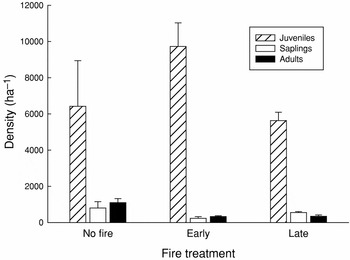
In all fire treatments, density of juveniles was an order of magnitude larger than that of either saplings or adults (Figure 1), reflecting the high number of resprouts present in the region's savannas.
Density of juveniles (<1.5 m high), saplings (1.5 to 3 m high) and adults (≥3 m high) in the three fire treatments in 1991, 1 y after fire treatments commenced. Bars show 1 SE.

Stem loss
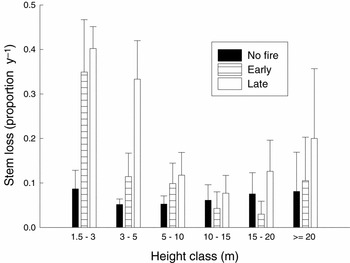
Stem loss was highest in the late fire treatment, and generally lowest in the unburnt treatment (Figure 2). The negative relationship between stem loss and stem height varied between fire treatments. In the early fire treatment stem loss was greatest in the smaller (1.5–3-m and the 3–5-m) height classes but in the late fire treatment, the 3–5-m and the 5–10-m height classes were most affected. Stem loss in both fire treatments increased above 20 m height (Figure 2). There was negligible effect of tree height on stem loss in the unburnt treatment.
Actual rates of stem loss in savanna trees during 4 y of the fire experiment at Kapalga, according to fire treatment and height class. Bars show the normal approximation confidence intervals for the binomial data presented here. Only those trees between 1.5 and 15 m high (in which stem loss decreased with tree height) were used in the modelling.

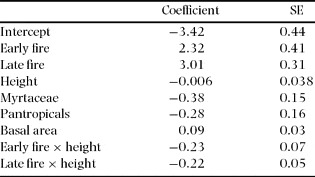
Our modelling showed that for trees between 1.5 and 15 m high, the fire by height interaction was extremely strong with no support for any model that did not include this term. Underscoring the strength of the fire by height interaction, the model height coefficient was close to zero (−0.01 ± 0.04) for the unburnt treatment, but strongly negative in the early (−0.24 ± 0.07) and late (−0.23 ± 0.05) treatments.
Recruitment
The proportional and areal recruitment rates of tree recruitment were substantially higher in the unburnt treatment than in the early or late fire treatment, with no tree recruitment after the extreme fire (Table 1).
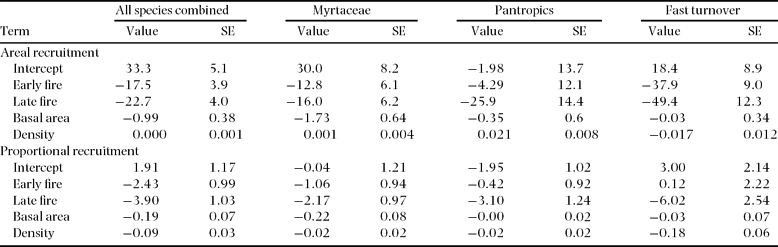
Modelling showed that areal tree recruitment was influenced by fire and plot basal area (Table 2). Early fire reduced areal recruitment rates, with late fires having an even stronger effect (Table 3). High basal areas were also associated with decreased areal recruitment. Density of small-adults had only a weak effect on tree recruitment.
Coefficients and standard errors of the best supported models, averaged according to the model AICc weights, to describe stem loss (proportion y−1) as a function of fire (no fire, early or late fire), height (m) and basal area (m2 ha−1). The intercept applies to the fast-turnover group and no fire.

Coefficients and standard errors of the best supported models, averaged according to the model AICc weights, to describe area-based and proportional recruitment as a function of fire, basal area and small-adult density. Values are shown for all species combined, and the three eco-taxonomic groups. Analysis of area-based recruitment used Poisson generalized linear mixed models with a log link, and no transformation of small-adult density was required. Binomial generalized linear mixed models with a logit link were used to analyse proportional recruitment, and a square root transformation of small-adult density gave the best model fit.
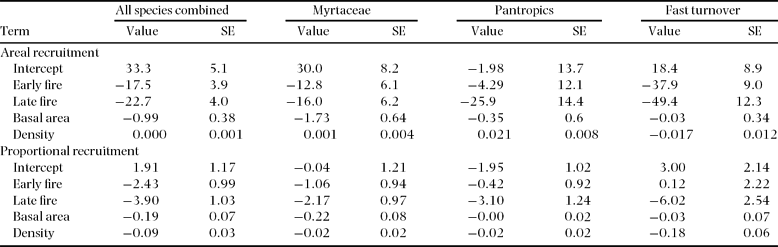
The analysis of proportional tree recruitment showed similar trends to the areal recruitment analysis (Table 2). High basal area and small-adult tree densities were associated with decreased proportional tree recruitment. Given that initial basal area and small-adult densities were higher in the unburnt and extreme fire treatments than in the early and late fire treatments, the fire effects apparent in the raw data are conservative (Table 1), because when controlled for by the models the effects of fire were even stronger. For example, with a small-adult density of 400 ha‑1 and a stand basal area of 10 m2 ha‑1, predicted proportional recruitment was 0.142, 0.014 and 0.003 y−1 in the unburnt, early and late fire treatments respectively (calculated from Table 3), compared with actual rates of 0.083 y−1, 0.068 y−1 and 0.026 y−1 (Table 1).
Eco-taxonomic group
Stem loss in the 3–15-m height class was higher in the fast-turnover group than for the Myrtaceae or pantropical species which modelling showed had similar predicted values (Table 2).
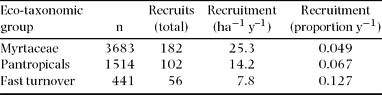
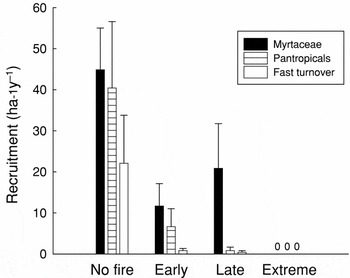
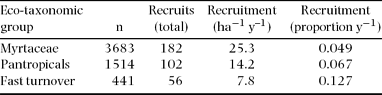
The areal recruitment rate was highest for the Myrtaceae (Table 4), reflecting the high densities of myrtaceous trees in this savanna. Fire effects on areal recruitment were largest for the fast-turnover group, and least for the Myrtaceae, especially for the late fire treatment (Figure 3, Table 3). High basal area was associated with lower areal recruitment of both Myrtaceae and all species combined (Table 3).
Number of observations (n = the number of trees, summed for each of the four years), number of recruits, areal and proportional recruitment rates for the three eco-taxonomic groups. Proportional recruitment is the proportion of trees >3 m high at the end of an interval that recruited to the size class during the interval.
Actual areal recruitment of trees per year during 4 y of the fire experiment at Kapalga, in relation to fire treatment and eco-taxonomic group. Areal recruitment was calculated for each plot, and averaged for each year; bars indicate 1 SE.

Overall, the proportional rate of recruitment was higher for the fast-turnover group than the pantropical or Myrtaceae eco-taxonomic groups (Table 4). Proportional recruitment of all groups was markedly reduced by late fire. The effects of early fire were weaker and less consistent among groups (Table 3) because there were low numbers of pantropical or fast-turnover trees in the early fire treatment (n = 41 and 2 trees respectively, compared with 245 and 79 trees respectively in the no fire treatment). Proportional recruitment of Myrtaceae, and of all species combined, was substantially lower in plots with a high basal area (Table 3).
DISCUSSION
We argue that our study has demonstrated that a recruitment-bottleneck model holds for eucalypt mesic savannas by demonstrating the existence of the following components of the model (1) juveniles were abundant in all fire treatments (Figure 1); (2) all fire treatments markedly increased stem loss of saplings (and late fire markedly increased stem loss of small adults); (3) adults were much more tolerant of fire than smaller stems (Figure 2); and (4) recruitment of saplings to the adult size class was greatest in the absence of fire (Figure 3). (5) There is also evidence of an increase in tree density with removal of fire due to increased recruitment of eucalypts (and other Myrtaceae), and pantropic and fast-turnover species. These aspects will be discussed in turn.
Relative juvenile abundance
Our study found that recruitment of savanna trees was not limited by a scarcity of juveniles, given there were far more juveniles than saplings or adult trees in our study area. Such high densities of juveniles relative to saplings is consistent with other studies in similar north Australian savanna (Bowman & Panton Reference BOWMAN and PANTON1993, Fensham & Bowman Reference FENSHAM and BOWMAN1992). Any negative effect of fire on sexual reproduction of savanna trees (Hoffman 1998, Setterfield Reference SETTERFIELD2002) appears to be offset by vegetative reproduction via the stimulatory effect on production of root or rhizome suckers (Hoffmann Reference HOFFMANN1998), and perhaps even enhanced survival of woody sprouts (Williams et al. Reference WILLIAMS, MULLER, WAHREN, SETTERFIELD, CUSACK, Andersen, Cook and Williams2003).
Stand structure analysis suggests that there are long periods without significant tree recruitment followed by pulses of recruitment into the sapling and tree layers (Fensham & Bowman Reference FENSHAM and BOWMAN1992). For example, there was a paucity of saplings in Kapalga in 1982, although by 1991, many saplings were evident, and stand structure exhibited a classic reverse-J curve (Prior et al. Reference PRIOR, BROOK, WILLIAMS, WERNER, BRADSHAW and BOWMAN2006). Lehmann et al. (Reference LEHMANN, PRIOR and BOWMAN2009a) examined stand structures of four major species in Kakadu National Park in 2003, and found no evidence of gaps in recruitment at a regional level, but noted that at a local level regeneration appeared episodic because some size classes were underrepresented.
Stem survival and demographic stage
Fire-induced stem loss decreased with tree height between 1.5 to 15 m, although when tree height exceeded about 20 m, rates of stem loss increased, especially in more intense late-season fires. Such a U-shaped loss response was also reported by Williams et al. (Reference WILLIAMS, COOK, GILL and MOORE1999) for trees subjected to the extreme fire treatment and by Prior et al. (Reference PRIOR, MURPHY and RUSSELL-SMITH2009) for savanna trees growing under ambient fire regimes in northern Australia.
Fire and recruitment into the tree layer
In the course of the Kapalga experiment the density of both saplings and adult trees in the unburnt treatment increased, as did stand basal area (Prior et al. Reference PRIOR, BROOK, WILLIAMS, WERNER, BRADSHAW and BOWMAN2006). The annual fires had the opposite effects. Annual burning regimes give little opportunity for small trees to grow into the more fire-resistant size classes, and trees have less time to recover their protective bark thickness and replenish carbohydrate stores. Recurrent annual fires have also been shown to significantly reduce the density of trees in mesic savanna in Brazil (Hoffmann & Solbrig Reference HOFFMANN and SOLBRIG2003). Tree recruitment rates also declined with increased fire severity and frequency in a study of ambient fires on savanna dynamics in permanent plots scattered over a wide area of similar savannas in northern Australia, including Kakadu National Park (Prior et al. Reference PRIOR, MURPHY and RUSSELL-SMITH2009). However, the effects were not as pronounced as those documented here in the experimental study, reflecting the lower frequency of burning in the ambient study (typically biennial rather than annual), and the fact that the experimental fires in the current study were fronting fires and therefore more intense than the ambient fires (Liedloff & Cook Reference LIEDLOFF and COOK2007, Russell-Smith & Edwards Reference RUSSELL-SMITH and EDWARDS2006). Our findings support the demographic modelling of Higgins et al. (Reference HIGGINS, BOND and TROLLOPE2000), which showed that frequency of escape of sprouts from the fire zone depends strongly on both stem growth rates and fire intensity. They also suggest that escaping the bottleneck would require a temporary relaxation of the annual fire regime.
Dominance of Myrtaceae in Australian savannas
The two measures of recruitment (areal and proportional) used in this study reveal different aspects of tree population dynamics. The recruitment rate per area necessarily reflects the abundance of a group or species, as well as its fecundity – this explains the higher recruitment per area of the Myrtaceae, which dominates these savannas. Compared with the other eco-taxonomic groups, the effects of late fire on recruitment were less pronounced in Myrtaceae, reflecting this group's success in such a fire-prone environment. Non-eucalypt species appear to require a fire-free interval of at least 5 y for release from the understorey (Russell-Smith et al. Reference RUSSELL-SMITH, WHITEHEAD, COOK and HOARE2003). There was a different pattern for proportional recruitment: the higher proportion of recruits amongst the fast-turnover group may be related to the shorter average life span of the Acacia species (Prior et al. Reference PRIOR, MURPHY and RUSSELL-SMITH2009). Successful short-lived species need to maintain a higher proportion of new recruits than do species with a long average life span, because they have less time in which to replace themselves.
Effects of high plot basal area and high small-adult density on proportional recruitment varied according to eco-taxonomic group. High densities of small adult trees reduced proportional recruitment of the fast-turnover group, while the presence of large trees (as indicated by high plot basal area) strongly suppressed recruitment of the Myrtaceae. These patterns are consistent with the lack of recruitment of eucalypts, even in the unburnt treatment, at nearby Munmarlary. Here, basal area was moderate to high (12, increasing to 18 m2 ha‑1) throughout the 23-y fire experiment (Russell-Smith et al. Reference RUSSELL-SMITH, WHITEHEAD, COOK and HOARE2003). It appeared that overstorey competition prevented release of understorey eucalypt sprouts (Russell-Smith et al. Reference RUSSELL-SMITH, WHITEHEAD, COOK and HOARE2003). Indeed, Fensham & Bowman (Reference FENSHAM and BOWMAN1992) reported an instance of a eucalypt resprout that grew from 1 to 5 m high in 12 mo following the removal of overstorey competition, which contrasts with mean height growth rates of around 0.1 m y−1 in intact savanna (Prior et al. Reference PRIOR, BROOK, WILLIAMS, WERNER, BRADSHAW and BOWMAN2006). Such extreme growth responses caution against using average growth rates in predicting recruitment to the tree layer.
Collectively these results suggest that the populations of the three eco-taxonomic groups will respond differently to various fire regimes at different growth stages. For example, when there are few large trees and no fire, the Myrtaceae will be at a relative advantage, but under a regime of early fire and when there are many small adults, the pantropicals will be favoured. These results also lend support to suggestions that the success of eucalypts in Australian savannas is related to their fire tolerance relative to other eco-taxonomic groups (Bowman & Prior Reference BOWMAN and PRIOR2005, Burrows et al. Reference BURROWS, HORNBY, WATERS, BELLAIRS, PRIOR and BOWMAN2008).
Maintenance of savanna by fire
Our short duration (5 y) study is unable to consider the longer-term consequences of the removal of fire-mediated bottleneck. However, an analysis of historical aerial photography spanning a 40-y period across the Kapalga experimental site provides insight into longer-term trends in tree canopy cover (Lehmann et al. Reference LEHMANN, PRIOR, WILLIAMS and BOWMAN2008). Statistical modelling of changes in canopy cover suggested that, without fire, tree cover would increase to about 77% before it reached the limit set by inter-tree competition (Lehmann et al. Reference LEHMANN, PRIOR, WILLIAMS and BOWMAN2008). This is equivalent to 13.5 m2 ha−1 of basal area (Lehmann et al. Reference LEHMANN, PRIOR and BOWMAN2009b), which is well above the average of the unburnt treatment in this study. The process-based FLAMES model, based on demographic data collected at the Kapalga field site, also predicts that without fire, the basal area of savanna trees would markedly increase (Liedloff & Cook Reference LIEDLOFF and COOK2007). It is important to note that when mesic eucalypt savannas are fire protected for more than 10 y they develop dense understoreys of broad-leaved shrubs (Russell-Smith et al. Reference RUSSELL-SMITH, WHITEHEAD, COOK and HOARE2003), effectively switching from savanna to dry forests. Rain-forest species may also start to establish (Woinarski et al. Reference WOINARSKI, RISLER and KEAN2004). Collectively these studies highlight that mesic eucalypt savannas are a fire-dependent system.
Studies in mesic tropical savannas elsewhere have also shown a tendency for increased cover of woody vegetation when fire is excluded from the system (Bond et al. Reference BOND, WOODWARD and MIDGLEY2005, Hoffmann et al. Reference HOFFMANN, ADASME, HARIDASAN, CARVALHO, GEIGER, PEREIRA, GOTSCH and FRANCO2009). For example, after 32 y without fire, savanna in Ghana had developed into a forest thicket (Swaine et al. Reference SWAINE, HAWTHORNE and ORGLE1992). In grassy woodland in Zambia, after 23 y sapling densities in the annual early and late fire treatments were 63% and 96% lower respectively than from an area in which fire was excluded (Trapnell Reference TRAPNELL1959). This finding is remarkably similar to the reductions in areal recruitment observed in our study.
Conclusion
This study is one of the first to quantify the effect of landscape-scale experimental fire treatments on recruitment of small-adult trees in eucalypt savanna. We found that annual fire, especially in the late dry season, reduced recruitment to the 3-m height class, while extreme fire prevented recruitment in the following year. These results are consistent with observations elsewhere in mesic tropical savannas. Our study strongly supports the existence of a fire-mediated recruitment bottleneck in eucalypt savannas in northern Australia. This conclusion has management implications given that currently about 50–60% of all lowland savanna in Kakadu is burnt each year, and about 70% is burnt at least once every 2 y (Andersen et al. Reference ANDERSEN, COOK, CORBETT, DOUGLAS, EAGER, RUSSELL-SMITH, SETTERFIELD, WILLIAMS and WOINARSKI2005). Such frequent fires and widespread burning could lead to long-term declines in tree cover because these fires create a recruitment bottleneck.
ACKNOWLEDGEMENTS
We thank the many staff and volunteers who helped set up and maintain the experiment, and in particular the late Jack Cusack. We thank Caroline Lehmann, Garry Cook, William Bond, Adam Liedloff and Rod Fensham for insightful discussions on this topic. Patricia Werner and Bill Hoffmann provided helpful comments on the manuscript. The Kapalga fire experiment was funded by CSIRO. L.D.P. was supported by Australian Research Council Grant DP 0343000.