I. INTRODUCTION
Carbon nanotubes (CNT)/polymer composites are an important class of materials because of their versatile applications.Reference Ajayan and Stephan1–Reference Grossiord, Loos, Regev and Koning4 This versatility arises mainly due to the unique combination of electrical and mechanical properties of CNTs and the polymer’s ability to act as a flexible matrix material. Depending on its final application, composites are usually fabricated as films, fibers, laminates, or powders. However, the final properties of the composites are largely dependent on the method of preparation.
The most critical issue in regard to the fabrication of CNT/polymer composites is the development of methods for homogenously dispersing CNTs throughout the polymer matrix.Reference Cadek, Coleman, Ryan, Nicolosi, Bister, Fonseca, Nagy, Szostak, Béguin and Blau3 There are various methods such as solution blending by combination of ultrasonic and ordinary mixing, melt blending to fabricate CNT/polymer composites. Each method has its own set of shortcomings. Ultrasonication produces metastable solutions of CNTs that tend to aggregate during the solvent evaporation process. Solution-cast films resulting from this ultrasonic treatment show an inhomogeneous distribution of CNTs throughout the polymer matrix.Reference McClory, Chin and McNally5 During the melt blending process, the large surface area of CNTs yields highly viscous CNT/polymer melts which are extremely difficult to process especially when higher concentrations of CNTs are used.Reference Ajayan and Tour6
An alternate processing method to compensate for highly viscous materials is to produce the final material as a powder that can be formed by powder processingReference Tran, Shaffer and Bismarck7 and spray drying.Reference Yun, Lo, Noorman, Davis, Russell, Holden and Gadd8 The drawback of these powder preparations is that they neither produce very uniformly sized polymer particles nor very well distributed CNTs in the polymer matrix. For overcoming these limitations, in this work, a very low-temperature-induced solvent-nonsolvent phase separation technique has been used to synthesize composite powders comprising CNTs and polyvinylidene fluoride (PVDF). In this study, PVDF has been selected as the polymer matrix because of its piezoelectric properties and one goal of this study is to investigate whether this property can be retained or enhanced in powder composite of PVDF with CNT. Piezoelectric property of PVDF is associated with its β crystalline formReference Kawai9, Reference Lovinger10 and among many ways to enhance the formation of β phase, such as crystallization from solution,Reference Lee, Kim, Oh, Kim, Hwang and Hong11, Reference Gregorio12 crystallization from melt blending,Reference Nam, Kim, Cho, Chae, Kim, Hong, Hwang and Hong13 through orientation by applying forcesReference Branciforti, Sencades, Lanceros-Mendez and Gregorio14 at 80–100 °C, several research groups reported the enhancement of β phase formation in PVDF composite filmsReference Levi, Czrew, Xing, Iyer and Carroll15–Reference Yu, Zheng, Yu, Zhang, Jiang and Zhao17 by the addition of multiwalled nanotubes (MWCNTs) into the PVDF matrix. Present research has demonstrated that both single-walled carbon nanotubes (SWCNTs) and MWCNTs have enhanced the β phase within PVDF powders. Although soft and hard piezoceramic powders are commonly reportedReference Dukat and Zaryicka18 to be used as sensors and in other applications, polymers are rarely reported to have been used as piezoelectric materials in powder form. The problem associated with the brittleness of ceramic composites can be overcome by the polymer-based composite. The process of ultrasonication coupled with low-temperature-induced phase separation and the presence of CNTs not only introduced the β phase in the powder form, but also enhanced the amount of β phase in most of the compositions. Thus this research not only generated a nanocomposite in powder form but also such a composite powder with piezoelectric properties. These composite powders can be further processed by melting or dispersion in a suitable solvent depending on the requirements of their final application.
Differential scanning calorimetry (DSC), Fourier transform infrared spectroscopy (FTIR), and wide-angle x-ray scattering (WAXS) measurements confirmed the presence of β phase in the powders at certain compositions. The morphology of the composite powders was obtained by electron microscopy. The micrographs show the formation of PVDF nanoparticles attached with CNTs. Piezoelectric response studies show that the composite powders have piezoelectric properties in certain compositions (up to 1% MWCNT loading and 0.5% SWCNT loading in composites) for both SWCNTs and MWCNTs.
II. MATERIALS
Commercially available powdered PVDF (melt viscosity = 26,000 poises, specific gravity = 1.75–1.78) was procured from Polysciences, Inc. (Warrington, PA). Both single-walled (diameter = 1.01 nm) and multiwalled (diameter = 6–9 nm) CNTs were obtained from SouthWest Nanotechnologies, Inc. (Norman, OK). The solvent N,N-dimethylacetamide (DMAC), anhydrous, 99.8% was obtained from Sigma-Aldrich (St. Louis, MO) and used without further purification.
III. EXPERIMENTAL TECHNIQUES
A. Preparation of composite powders
The CNT/PVDF composite powders were fabricated using a solvent-nonsolvent mixture-induced low-temperature-dependent precipitation method. The MWCNTs were mixed with DMAC by probe sonication for 1 h. The sonication output speed was set at 7.0 with the pulse on for 20 s and the pulse off for 10 s. Sonication was done in an ice bath and the temperature never exceeded 10 °C. This sonication profile was consistent throughout the entire experiment.
A 5% (w/v) solution of PVDF was made in DMAC by heating the mixture at 80 °C for 30 min with constant stirring. The MWCNTs/DMAC dispersion was added dropwise into the 5% PVDF/DMAC solution while sonicating at the same conditions used to make the MWCNT dispersions. The resulting MWCNT/PVDF mixture in DMAC solution was further sonicated for an hour. The nanotube loading levels were 0.05%, 0.15%, 0.3%, 0.5%, 1%, 2.5%, 5%, 10%, 20%, and 30% with respect to the weight of polymer. An identical procedure was followed for preparation of SWCNT/PVDF mixtures in DMAC using the same loading levels.
The CNT/PVDF in DMAC solution was added dropwise into 200 mL of ice water as it was sonicated for 5 min. The solution was then vacuum-filtered and repeatedly washed with deionized water until the pH was 7. The precipitate was placed into a vacuum oven and dried for 24 h at 70 °C.
Similarly, pure PVDF powder samples were prepared from the commercial PVDF powder using sonication and low-temperature solvent-nonsolvent mixture-induced crystallization. This processed sample of pure PVDF and the commercial powder of PVDF have been designated as PVDF-S and PVDF-P respectively throughout the rest of this article.
B. Morphological, structural, and thermal analysis
The composite powder sample was analyzed by both scanning and transmission electron microscopy (TEM). A JEOL 200 FESEM (field emission scanning electron microscope; JEOL Ltd., Tokyo, Japan) was used for scanning electron microscopy (SEM) study. The operating voltage was 5 kV for SEM and 30 kV for TEM. A very dilute dispersion of the powder samples in methanol was placed on aluminum stubs with carbon tape for SEM study. A drop of the same dispersion was placed on a carbon-coated copper grid for TEM study.
Thermal properties of the composite powders were studied by DSC. DSC was performed in a Q100 TA instrument (New Castle, DE) using TA advantage software with indium as the standard. Approximately 5–7 mg of sample were weighed and sealed in an aluminum pan. Then the sample was heated to 250 °C at the rate of 10 °C/min and cooled to 40 °C. The crystalline melting peak (Tm) and the cooling peak (Tc) were obtained by DSC. Wide-angle x-ray diffraction (WAXD) measurements were characterized using a Philips Wide Angle X-ray Diffractometer (Cu Kα radiation of λ = 1.54 Å with scanning range of 2θ = 5–60°; Phillips, Amsterdam, Netherlands) at room temperature operated at 40 kV and 30 mA. The scattering peaks and the crystalline planes were identified using MDI Jade software.
FTIR spectroscopic studies were performed at room temperature using a Nicolet Avatar 360 FTIR (Thermo Scientific, Philadelphia, PA) with a DTGS-KBr detector coupled with EZ omnic software. The absorbance spectra were obtained by averaging 72 scans with a resolution of 4.0 cm−1. The background spectra were collected under the same conditions and subtracted from the scan for each sample. The wave numbers investigated ranged from 400 to 4000 cm−1. Composite powder samples were pelletized with dehydrated potassium bromide (KBr) in certain proportions. Background spectra were obtained using a pure KBr pellet made in the same way.
Piezoelectric measurements for the composite samples were carried out by impacting their surfaces. The composite were positioned in a Teflon tube in between two nickel rods and placed on a steel block. To generate the mechanical energy, an impact hammer (MULTIRANGE IMPULSE HAMMER—Dytran—5850B, Dytran Instruments Inc., Chatsworth, CA) was used; the electrical response was observed by a voltage probe. The impact force and voltage were monitored with the help of oscilloscope (Agilent—DSO7034A, Agilent Technologies, Inc., Santa Clara, CA), using the data it was possible to determine the piezoelectric voltage coefficient (g 33). The stress was obtained by dividing the force measured using the impact hammer by the surface of the sample (1 mm of diameter).
IV. RESULTS AND DISCUSSION
A. Morphological characterization
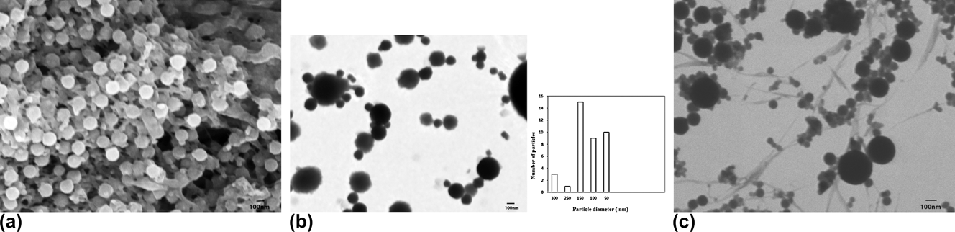
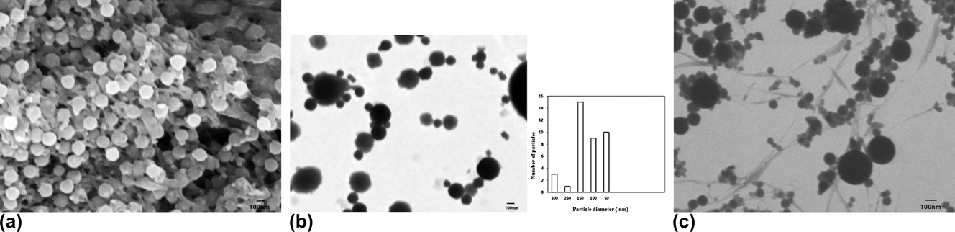
Figures 1(a) and 1(b) are the scanning and transmission electron micrographs for pure PVDF particles formed under the same conditions of ultrasonication and by low-temperature solvent-nonsolvent mixture-induced crystallization. Particle size distribution plot in Fig. 1(b) shows that the average polymer particle diameter is about 150 nm. At high magnification, the transmission electron micrograph, Fig. 1(c), shows very well dispersed SWCNTs attached to the spherical polymer particles. At very low temperatures, ultrasonication through the phenomena of ultrasonic cavitation and the subsequent crystallization from the nonsolvent part of the mixture probably played a predominant role over any significant contribution of CNTs to produce spherical particles.Reference Zhao, Zheng, Yu and Long19, Reference Zhang and Kumar20 This conclusion is also be supported by the TEM micrograph of pure PVDF particles. From Fig. 1(c) of the composite powders it is also observed that the most of the polymer particles in composite powder have become smaller (less than 100 nm) when compared with the pure polymer particles prepared in the same way [Fig. 1(a)]. The nucleation effect of CNT on PVDF crystallization could be a reason for faster crystallization, which resulted in large concentration of smaller particles in the composite.
(a) SEM for pure PVDF particles (PVDF-S) prepared under the same condition of sonication; (b) TEM for pure PVDF particles (PVDF-S) prepared under the same condition of sonication and the particle size distribution plot; (c) TEM for PVDF-SWCNT composite powder sample (CNT = 0.5% by weight of polymer).
B. Structural properties
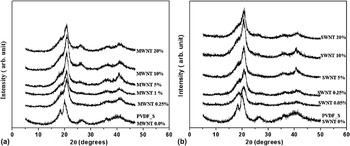
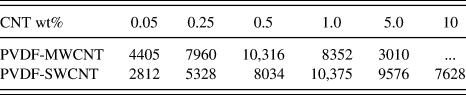
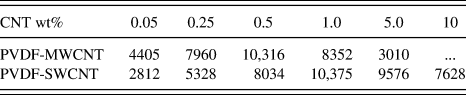
Figures 2(a) and 2(b) are the WAXS diagrams for PVDF-MWCNT and PVDF-SWCNT composites only. In both Figs. 2(a) and 2(b) the peaks at 2θ values of 18.4°, 20°, and 26.5° obtained for sonicated pure PVDF (PVDF-S without any CNT) can be assigned to the (100), (110), and (021) reflections of α phase of PVDF.Reference Gregorio and Ueno21−Reference Dutta and Nandi23 However, with increasing amounts of CNTs the β phase formation is favored in both cases. The peak at 2θ is 20.6° which can be assigned to the (110) and (200) reflections of β phase is observed in both MWCNT and SWCNT composites with 0.05%–20% loading. The area under the peak at 2θ = 20.6–20.8 (110/200), (as calculated by the peak analysis using MDI Jade Software) was increased with increasing CNT concentrations (Table I) indicating an enhancement of β crystalline phase for loading of 0.05–1% for MWCNT and for loading of 0.05%–0.5% SWCNT. Subsequently, DSC studies for both MWCNT and SWCNT composites have confirmed the nucleation effect of CNTs in these composites, which might have enhanced the β phase formation in these composites. Levi et al.Reference Levi, Czrew, Xing, Iyer and Carroll15 also observed that the addition of CNTs led to a β peak in the x-ray diffraction (XRD) pattern of PVDF by sonication. A possible explanation for β phase formation, attributing the same to the presence of CNT, was proposed by Manna and Nandi.Reference Manna and Nandi16 They assumed that the CNT surface has a zigzag configuration of carbon atoms, which matches with the all-trans conformations of PVDF β polymorphs. As a result, this may induce crystallization of PVDF in β-polymorphic structures. As in our case we have not seen any β phase formation for pure PVDF powders prepared under the same condition, addition of CNTs to polymers probably played most important role to form and enhance the β phase in composites. Subsequently, this interaction has also been confirmed by FTIR studies.
(a) WAXS for PVDF-MWCNT composite particles; (b) WAXS for PVDF-SWCNT composite particles.

Area (counts × degree) under the peak at 2θ = 20.6° for PVDF-MWCNT and PVDF-SWCNT composites.
C. FTIR study
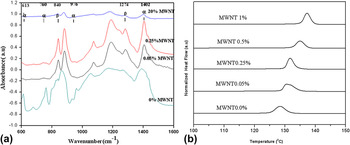
Results from the FTIR experiments are shown in plots of Figs. 3(a) and 3(b) respectively for MWCNT and SWCNT. FTIR results showed significant changes in the peak intensity for both types of composite powders with different loadings of CNT in the composites. A significant increase in the peak intensities characterizing the β polymorph (at 840 cm−1 and at 1280 cm−1) was observed for both composite powders from 0.05 to 1 wt% of CNT. These peaks, which were reported earlier, correspond to the asymmetric stretching motion of CF2 and CC, the skeletal bending motion of CF–CH–CF (1274–1280 cm−1), the rocking motion of CH2, and the anti symmetric stretching motion of CF2 (840 cm−1).Reference Kobayashi, Tashiro and Tadokoro24, Reference Huang, Edenzon, Fernandez, Razmpour, Woodburn and Cebe25 Similar increase of β peak intensity with MWCNT loadings were observed by Huang et al.Reference Huang, Edenzon, Fernandez, Razmpour, Woodburn and Cebe25 They suggested that MWCNT acts as a nucleation agent for β phase formation and its enhancement. In this work similar effect was observed with SWCNT as well and later the nucleation effect of both SWCNT and MWCNT have been confirmed by DSC study. Simultaneously α peak intensitiesReference Kobayashi, Tashiro and Tadokoro24, Reference Huang, Edenzon, Fernandez, Razmpour, Woodburn and Cebe25 at 976, 760–764, and 613 cm−1 started to diminish starting from 0.05% loadings of CNT and almost disappeared at 1% loadings of CNT. Thus, both SWCNT and MWCNT acted as nucleation agents for β phase up to 1% loadings of CNT. WAXS results also confirmed this beta phase enhancement in both types of composite powders up to 1% loading.
(a) FTIR spectra for PVDF-MWCNT composites; (b) FTIR spectra for PVDF-SWCNT composites.

D. Thermal properties
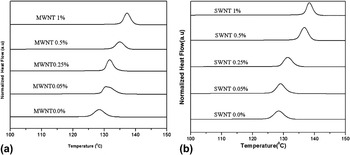
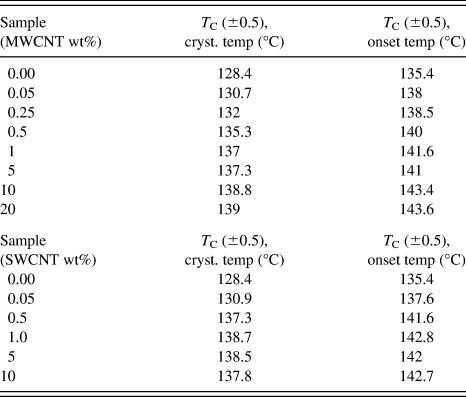
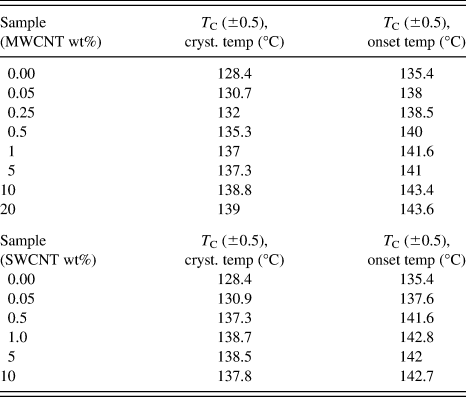
Polymer–CNT composite powder samples were first heated to 200 °C from room temperature at 10 °C/min and then cooled from 200 °C to 40 °C at 10 °C/min for studying the effect of CNT on crystallization. DSC scans for the cooling exotherms are shown in Figs. 4(a) and 4(b) for PVDF-MWCNT and PVDF-SWCNT composites. The Table II shows that as the CNT content increased, the crystallization peak position and extrapolated onset shifted to higher temperatures. Crystallization temperature (T C) shifted about 10 °C and the extrapolated onset shifted about 8 °C for both MWCNT and SWCNT composites. DSC thermograms confirm again the nucleation effect of both SWCNT and MWCNT. Table II also shows that there is no significant change in T C or in the crystallization onset temperature beyond 1% loading of CNT and probably up to 1% loading MWCNT and SWCNT acted as nucleation agents and beyond that loading CNT did not have any effect on PVDF crystallization. Damjanovic and NewnhamReference Damjanovic and Newnham26 have found similar increase of T C with increasing amount of MWCNT in polymer matrix and they proposed that the faster crystallization rate of composite with higher MWCNT concentration happened due to nucleation effect of MWCNT. Similar effect has been found in WAXS and FTIR studies.
(a) Normalized heat flow versus temperature plot for PVDF-MWCNT composite powder samples. Exothermic peak represent the crystallization temperature (T C, °C); (b) normalized heat flow versus temperature plot for PVDF-SWCNT composite powder samples. Exothermic peak represent the crystallization temperature (T C, °C).

Cryst. temp and Cryst. onset temperature for PVDF-MWCNT and PVDF-SWCNT composite powders.
E. Piezoelectric properties
Piezoelectricity is the property of some materials, which makes them electrically charged under mechanical stress and vice versa. This spontaneous behavior arises is due to the crystalline structure of the materials and mechanical action provokes the appearance of an electric dipole in each crystalline unit cell of the material. The characteristics of piezoelectric materials are classified by a number of coefficients. In this case the ratio of the electrical potential developed by the piezoelectric elements in response to an applied mechanical stress is denoted by the coefficient g 33 known as the piezoelectric voltage constant.

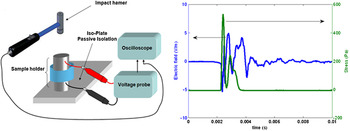
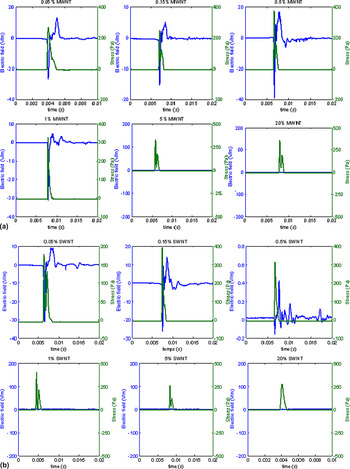
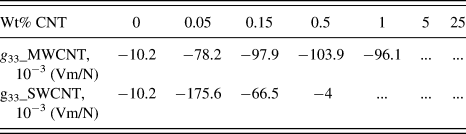
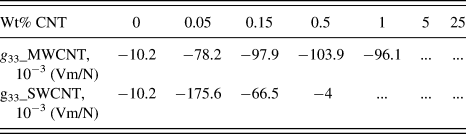
Figure 5 shows the combined picture for schematic diagram for the set up used to determine the piezoelectric response and typical electric field response under stress impact of pure PVDF. Residual vibrations, generated in the piezoelectric samples after impact, are evident due to the damping of the structure.27Figures 6(a) and 6(b) give the temporal response of the different samples with various concentrations. Using the data of Figs. 6(a) and 6(b) it is possible to determine the g 33 coefficient. Table III gives the value of g 33 coefficient for different weight percentage of MWCNT and SWCNT. The values of g 33 correspond to the typical value of PVDF coefficient.Reference Muensita and Rakbamrung28−Reference Das-Gupta30 When concentration of MWCNT or SWCNT increased, the piezoelectric coefficient was enhanced, due to the percolation effect in the material.Reference Li and Zhang31 There exist on optimal concentration where the coefficient is higher, and is equal to 0.15% in case of MWCNT and 0.05% for SWCNT. This difference of optimal concentration is due to difference of percolation threshold in case of MWCNT and SWCNT.Reference Hu, Zhao, Zhang, Yang and Wang32−Reference Slobodian, Lengálová, Sáha and Šlouf34 Moreover for concentration higher than 5% in case of MWCNT and 1% for SWCNT, there is no piezoelectric effect in the materials, the material has become conductive since the concentration is higher than the percolation threshold.Reference Hu, Zhao, Zhang, Yang and Wang32 The mechanical to electrical characterization demonstrates an enhancement of the g 33 coefficient, when the concentration of CNT, is near the percolation threshold. For the same stress the piezoelectric response was enhanced by a factor of 10.3 [taking the maximum value of g 33 from the Table III and dividing it by the lowest value of g 33 (103.9/10.2 = 10.3)] in case of MWCNT and 17.6 [taking the maximum value of g 33 from the table and dividing it by the lowest value of g 33 (175.6/10.2 = 17.6)] for SWCNT. The percolation threshold indicates the beginning of coagulation of CNTs around piezoelectric polymers, which results in networks that facilitates electrical conduction. CNTs coagulate more easily than the metal particles and form clusters with each other together with piezoelectric polymers. For composites below the percolation threshold the network formation is not complete, hence they do not show electrical conductivity. In this case, interfacial polarization also occurs when charges accumulate at the interfaces between inclusions and the host matrix.Reference Kang, Park, Gaik, Lowther and Harrison35 This leads to field distortion and gives rise to dipole moments. This effect is prevalent at low frequencies since the dipole relaxation time of this type of polarization is large. In this present system of study, there were abundant nanotube polymer interfaces, which resulted in significant interfacial polarization. This interfacial polarization was believed to be responsible for the increase in the piezoelectric activities.Reference Zhang, Li and Zhang36, Reference Liu, Xiong, Sun, Dong, Li and Liu37 The higher degree of dipole orientation, resulting from the interfacial polarization, assists the chain mobility in the case of composites with CNT, which finally produces an enhancement of the piezoelectric activities.
Schematic diagram of the test bench to measure piezoelectric coefficient and electric response of pure PVDF (PVDF-S) particles under stress impact.

(a) Piezoelectric response of MWCNT composite; (b) piezoelectric response of SWCNT composite.

Evaluation of g 33 coefficients for the PVDF-MWCNT and PVDF-SWCNT composite samples.
The concentration of the CNT has proven to be a significant parameter, governing the electrical behavior of the piezocomposite. It has been reported that the dielectric properties of composites depend on the volume fraction, size and shape of metal fillers including the preparation method, interface either between the fillers and matrix or between the conductive and nonconductive phases.Reference Qureshi, Mergen, Eroglu, Singh and Gulluoglu38−Reference Mitchell40 Composites with a variety of metallic fillers, e.g., Fe, Ag, W, Zn, Cu, and Ni, have also been reported to display increased electric properties.Reference Qureshi, Mergen, Eroglu, Singh and Gulluoglu38 Qureshi et al.Reference Qureshi, Mergen, Eroglu, Singh and Gulluoglu38 found that the dielectric constant of Cu-filled composites was higher than that of either Al-filled polyvinyl chloride (PVC) or polymethyl methacrylate (PMMA) composites. However, the potential of CNTs as conducting fillers in multifunctional polymer composites offer better perspective of research and application. For example several orders of magnitude enhancement in electrical conductivity has been achieved with a very small loading (0.1 wt% or less) of nanotubes in the polymer matrices,Reference Bryning, Islam, Kikkawa and Yodh41 while maintaining the other performance aspects of the polymers such as optical clarity, mechanical properties, low melt flow viscosities, etc. Thus the use of CNTs to make piezocomposite is clearly justified mainly due to its low percolation threshold.
V. CONCLUSION
The process of low-temperature solvent–nonsolvent mixture-induced crystallization for preparing CNT/PVDF nanocomposites powders demonstrated that they have some advantages over conventional composite fabrication methods. Large quantities of CNTs can be incorporated into the polymeric matrix without the viscosity-related problems associated with higher CNT concentrations. The presence of both MWCNT and SWCNT contributed to the enhancement of β phase formation.
Further studies with purified and functionalized CNTs will be done for increasing thermal stability. The structural and mechanical properties of the films formed by these powder composites will be also studied. They are expected to have better properties than conventional CNT/PVDF melt film composites.
Continued research is required for determining the magnitude of improvements that can be achieved and the tradeoffs that might occur by optimizing different material properties on the global piezoelectric response. Moreover, future work will be focused on the application of these powder composites for the realization of low cost sensors and actuators for smart applications.
ACKNOWLEDGMENTS
The authors acknowledge the financial support provided by the High-Performance Materials Institute of Florida State University. The corresponding author also expresses sincere thanks to Dr. Eric Lochner in the Department of Physics, Florida State University for his discussions on the WAXS results.