Significant outcomes
-
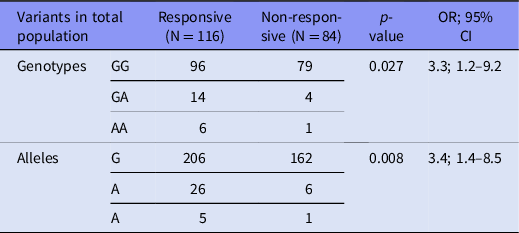
Significant response to SSRIs in MDD patients with AA and GA genotypes (p = 0.027; OR = 3.3, 95% CI = 1.2–9.2).
-
Significantly better response to sertraline in MDD patients with GA and AA genotypes (p = 0.0002; OR = 9.1; 95% CI = 2.4–33.7).
Significantly better response to sertraline in MDD patients with A allele (p = 0.0001; OR = 7.6; 95% CI = 2.5–23.3).
Limitations
-
Small population of enrolled patients.
-
Lack of genotype assessment in non-MDD patients and comparison with the MDD group.
-
Limited available data due to lack of previous studies in other psychiatric disorders as well as other ethnicities.
Introduction
Depression is a common and deleterious psychiatric disorder and accounts for 4.4% of the world’s total illnesses. More than 7.3% of people in the United States are affected by depression (Wakefield et al., Reference Wakefield, Schmitz, First and Horwitz2007). Drastically, the census rises to 43% among Iranian elderly (Sarokhani et al., Reference Sarokhani, Parvareh, Dehkordi, Sayehmiri and Moghimbeigi2018). Despite a vague understanding of the exact biological mechanisms for depression, there are numerous and effective therapies used to improve patients (McKay et al., Reference Mckay, Imel and Wampold2006). Many clinical pieces of evidence suggest that depression may be caused by dysregulation in neurotransmitters in different brain regions (Milak et al., Reference Milak, Parsey, Keilp, Oquendo, Malone and Mann2005). Along with the conventional neurotransmitters, the renin-angiotensin system (RAS) has gained much attention in the pathophysiology and treatment of psychiatric and neuropsychiatric illnesses in recent years (Saab et al., Reference Saab, Gard, Yeoman, Mfarrej, El-Moalem and Ingram2007; Murck et al., Reference Murck, Schüssler and Steiger2012; Kalra et al., Reference Kalra, Prakash, Kumar and Majeed2015; Firouzabadi et al., Reference Firouzabadi, Ghazanfari, Alavi Shoushtari, Erfani, Fathi, Bazrafkan and Bahramali2016; Vian et al., Reference Vian, Pereira, Chavarria, Köhler, Stubbs, Quevedo, Kim, Carvalho, Berk and Fernandes2017; Chrissobolis et al., Reference Chrissobolis, Luu, Waldschmidt, Yoakum and D’souza2020; de Melo & Almeida-Santos, Reference de Melo and Almeida-Santos2020).
Angiotensin-converting enzymes 1 and 2 (ACE1 and ACE2, respectively) are the two key enzymes of RAS found extensively in the central nervous system (CNS). ACE2 and its main product angiotensin (1–7) has been found in the brain regions responsible for the control of cardiovascular functions such as central regulation of blood pressure (Doobay et al., Reference Doobay, Talman, Obr, Tian, Davisson and Lazartigues2007). Additionally, ACE2 is highly expressed in the endothelial cells of the heart arteries and venules (Lovren et al., Reference Lovren, Pan, Quan, Teoh, Wang, Shukla, Levitt, Oudit, Al-Omran and Stewart2008). Hence, ACE2 has been considered as a therapeutic target for the management of hypertension and cardiac dysfunctions.
Angiotensin II, an important RAS neuropeptide, is the main product of ACE1 which facilitates the release of norepinephrine (Skidgel & Erdös, Reference Skidgel and Erdös2004). Angiotensins are involved in specialised brain functions such as memory, cognition and adaptive response to different stressful stimuli such as anxiety and depression (Voigt et al., Reference Voigt, Hörtnagl, Rex, Van Hove, Bader and Fink2005; Lazaroni et al., Reference Lazaroni, Raslan, Fontes, de Oliveira, Bader, Alenina, Moraes, dos Santos and Pereira2012). Recent research advocates the anxiolytic and antidepressive roles of brain ACE2/Ang (1–7)/Mas pathway (de Melo & Almeida-Santos, Reference de Melo and Almeida-Santos2020). Studies show that mice lacking Mas receptor, the main functional receptor of angiotensin (1–7), show increased anxiety-like behaviour which is suggestive of the anxiolytic property of this peptide (Almeida-Santos et al., Reference Almeida-Santos, Kangussu, Moreira, Santos, Aguiar and Campagnole-Santos2016). Chronic overexpression of angiotensin (1–7) also exhibits anxiolytic-like effects (Moura Santos et al., Reference Moura Santos, Ribeiro Marins, Limborço-Filho, de Oliveira, Hamamoto, Xavier, Moreira, Santos, Campagnole-Santos and Peliky Fontes2017).
Further evidence supporting the role of RAS in neuroregulation suggests that drugs which are clinically effective in treating depression antagonize angiotensin 1 receptors (AT1) (Gard et al., Reference Gard, Mandy and Sutcliffe1999). On the other hand, ACE inhibitors like captopril and angiotensin II antagonists (ARBs) such as losartan have anti-depressant effects in humans and animals (Braszko et al., Reference Braszko, Karwowska-Polecka, Halicka and Gard2003; Saavedra et al., Reference Saavedra, Sánchez-Lemus and Benicky2011; Diniz et al., Reference Diniz, Casarotto, Fred, Biojone, Castrén and Joca2018; Luo et al., Reference Luo, Wu, Cao, Jin, Shen, Wang, Huang, Han, He and Deng2020). Previous studies showed that angiotensin II negatively regulates ACE2 expression, but the expression can be restored by ARB administration. Since angiotensin II is in close interactions with other neurotransmitters, such as norepinephrine and serotonin, and the role of these neurotransmitters in depression are well documented, disruptions in RAS elements may also account for the pathophysiology of depression (Vian et al., Reference Vian, Pereira, Chavarria, Köhler, Stubbs, Quevedo, Kim, Carvalho, Berk and Fernandes2017). Inhibition of the classical RAS pathway is involved in the upregulation of ACE2, and as a result, angiotensin-(1–7)/Mas pathway is activated resulting in increased angiotensin (1–7) levels. Increased levels of angiotensin-(1–7) and activation of Mas receptors exhibit neuroprotective and mood stabilising effects (Almeida-Santos et al., Reference Almeida-Santos, Kangussu, Moreira, Santos, Aguiar and Campagnole-Santos2016; Kangussu et al., Reference Kangussu, Almeida-Santos, Moreira, Fontes, Santos, Aguiar and Campagnole-Santos2017).
As it is known, serotonin contributes to the pathophysiology of depression and decline in brain serotonin levels can cause relapse in recovered depressed patients (Cowen, Reference Cowen2008). ACE2 is proposed to indirectly modulate brain serotonin levels, a neurotransmitter involved in brain neurogenesis (Alenina & Klempin, Reference Alenina and Klempin2015, Klempin et al., Reference Klempin, Mosienko, Matthes, Villela, Todiras, Penninger, Bader, Santos and Alenina2018). As reported, ACE2 has a significant role in absorption of tryptophan, the precursor of serotonin, in the gut. Decline in plasma levels of tryptophan in ACE2-defcient mice has shown to reduce serotonin levels in the brain, affecting neurogenesis (Klempin et al., Reference Klempin, Beis, Mosienko, Kempermann, Bader and Alenina2013). It may be postulated that increased activity of ACE2 may result in higher serotonin levels in the brain.
Selective serotonin reuptake inhibitors (SSRIs) are one of the most prominent drugs used in the treatment of depression. Sertraline and fluoxetine are among the drugs of choice used in major depressive disorder (MDD) that selectively prevent serotonin reuptake from pre-synaptic neurones (Newhouse et al., Reference Newhouse, Krishnan, Doraiswamy, Richter, Batzar and Clary2000). Up to 40% of depressed patients fail to respond to first-line antidepressants (King et al., Reference King, Davidson, Taylor, Haines, Sharp and Turner2002; Arroll et al., Reference Arroll, Macgillivray, Ogston, Reid, Sullivan, Williams and Crombie2005) and among those who do respond, only a very few will attain complete recovery (Joffe et al., Reference Joffe, Sokolov and Streiner1996).
Among different contributors to the pathophysiology of depression and its treatment, genetics also plays a fundamental role (Levinson, Reference Levinson2006; Mullins & Lewis, Reference Mullins and Lewis2017). Genetic variants of RAS, especially the ones located on the ACE1 gene, are reported to be associated with depression (Baghai et al., Reference Baghai, Binder, Schule, Salyakina, Eser, Lucae, Zwanzger, Haberger, Zill and Ising2006; Firouzabadi et al., Reference Firouzabadi, Shafiei, Bahramali, Ebrahimi, Bakhshandeh and Tajik2012) as well as antidepressant response (Baghai et al., Reference Baghai, Schule, Zill, Deiml, Eser, Zwanzger, Ella, Rupprecht and Bondy2004; Bondy et al., Reference Bondy, Baghai, Zill, Schule, Eser, Deiml, Zwanzger, Ella and Rupprecht2005; Bahramali et al., Reference Bahramali, Firouzabadi, Yavarian, Shayesteh, Erfani, Shoushtari and Asadpour2016). ACE2 is a polymorphic gene in humans with approximately 140 SNP loci determined in the human genome. Among the SNPs identified on the ACE2 gene is the G8790A (rs2285666) polymorphism. This variant, which is located in an intronic position adjacent to an exon, might influence ACE2 gene expression with alternative splicing mechanisms. Substitution of a G with an A at the 8790th base has been reported to result in mRNA montage changes (Yang et al., Reference Yang, Zhao, Xing and Shi2015). The mutant variant of this polymorphism is proposed to show higher serum ACE2 levels, which is suggestive of the higher production of angiotensin (1–7). Some studies on the association of this variant with blood pressure suggest a significant link between rs2285666 polymorphism and higher blood pressure (Yi et al., Reference Yi, Gu, Wang, An, Xie, Shao, Ma, Fang, An and Wang2006; Zhong et al., Reference Zhong, Yan, Liu, Ni, Zhao, Zhu, Tepel and Zhu2006; Niu et al., Reference Niu, Qi, Hou, Zhou and Qiu2007). On the other hand, a report by Vangjeli et al., is suggestive of the protective role of this variant against fatal cardiovascular events in female subjects (Vangjeli et al., Reference Vangjeli, Dicker, Tregouet, Shields, Evans and Stanton2011).
Regarding the positive effect of higher ACE2 activity as well as antidepressant properties of angiotensin (1–7), it could be postulated that the mutant allele of G8790A might influence antidepressant response. No study to date has investigated the role of G8790A (rs2285666) polymorphism in association with depression and treatment response in depressed patients.
Based on previous reports that are suggestive of the role of special genetic variants of RAS as an indicator of better response to antidepressants, we examined the relationship between G8790A polymorphism of the ACE2 gene and response to sertraline versus fluoxetine in a group of MDD patients.
Material and methods
The pharmacogenetics project was conducted in 2019, and the study was approved by Ethics Committee of Shiraz University of Medical Sciences with the ethical code and grant number of 13096 and was in accordance with Declaration of Helsinki. This study was a part of a randomised clinical trial of MDD patients aged 17–62 years old who referred to Imam Reza Hospital, Shiraz, Iran. All participants were of Iranian descent (Persian ethnicity) and born from Iranian parents. All patients were diagnosed as new cases and did not have any history of previous mental and psychiatric illnesses. The diagnosis of MDD was made by a psychiatrist and based on the DSM-V criteria. Informed consent was signed by the patient or their guardian before entering the study.
Since these patients were newly diagnosed, they did not have a history of antidepressant medication. Patients with family history of any other psychiatric disorders such as schizophrenia; bipolar disorder, mania and psychosis in the first-degree relatives; active substance dependence or primary organic disease; current treatment with antipsychotics, mood stabilisers, ACE inhibitors or ARBs and cardiovascular diseases such as coronary artery disease, myocardial infarction or heart failure were excluded from our study. Notably, only patients diagnosed with MDD with no other medical comorbidities other than anxiety or sleep disorder were included in our study. The rate of anxiety in enrolled patients was 43%. The only medication other than an SSRI (sertraline or fluoxetine) that was received by the patients was a benzodiazepine. Patients were randomly categorised into two groups receiving either fluoxetine (FLUOXETINE-ABIDI®) or sertraline (SERTRALINEABIDI®).
A fixed dose of 20 mg of fluoxetine and 50 mg of sertraline per day for 6 weeks were used. A benzodiazepine was prescribed for patients experiencing sleep disorders. After completing the 6-week treatment period, patients were evaluated again by the Hamilton questionnaire. Patients were classified into responsive and non-responsive groups based on the score obtained from the 21-item Hamilton Rating Scale for Depression (HAMD-21) questionnaire. A minimum of 50% reduction in the initial score (before taking the medication) was considered as responsive to treatment. Five millilitre of whole blood was obtained from enrolled patients for further DNA extraction and genotyping.
Allocation of patients was based on the simple randomisation method in which two sets of envelopes were provided containing the name of the prescribed drugs inside. The psychiatrist sequentially opened the shuffled envelopes to assign the treatment group for each enrolled individual. The prescribing psychiatrist and the patients were not blinded to the treatment, but the analyst was blinded.
DNA extraction
The DNA obtained from each patient was extracted from whole blood samples using the salting-out method (Miller et al., Reference Miller, Dykes and Polesky1988). Yields of DNAs were evaluated using NanoDrop®.
Genotyping
G8790A polymorphism was genotyped using restriction fragment length polymorphism (PCR-RFLP) assay (Zhong et al., Reference Zhong, Yan, Liu, Ni, Zhao, Zhu, Tepel and Zhu2006). Oligonucleotide primers were synthesised based on GenBank for the PCR. The applied primer sequences included
Forward primer: 5′-TTCTCCCTGCTCCТAТAСТACCG-3′ and Reverse primer:
5′-TTCATTCATGTCCTTGCCCTTA-3′.
PCR procedure was conducted using 12.5 µl Master Mix (1X), 2.5 µl primer and 2 µl DNA at a primer annealing temperature of 60 °C. For RFLP, 5 µl of amplicons were digested with 0.8 µl of AluI restriction endonuclease over 16 h at 37°C. Then, the loading dye was added to the digested product and run on a 1% agarose gel for 30 min at a 100 (v). After electrophoresis, stained products were visualised using a UV trans-illuminator. All samples were genotyped at least twice for reconfirmation.
After digestion with AluI restriction enzyme, G allele band was observed at 817 bp, A allele was observed at 589 and 228 bp and GA heterozygote bands were observed at 817, 589, and 228 bp (Fig. 1).
Agarose gel electrophoresis of the PCR-RFLP products using AluI restriction enzyme. The GG genotype appeared as single-band at 817 bp. The AA genotype appeared as two-bands at 589 and 228 bp and GA genotype appeared as three-bands at 817, 589, and 228 bp.

Statistical analysis
Data were analysed using SPSS® 16.0 for Windows (SPSS Inc., Chicago, IL, USA) software. Power analysis was performed using the statistical program G*Power (http://www.gpower.hhu.de/; Faul et al., Reference Faul, Erdfelder, Lang and Buchner2007).
The frequency of alleles and genotypes is presented as percentages. For calculating the normality of the data, Kolmogorov−Smirnov test was used. Continuous variables were compared using a parametric test (Student’s t-test). Quantitative variables are demonstrated as mean ± SD (mean ± SD). Chi-square test (χ2) was used for comparing categorical parameters between groups. Logistic regression analysis was performed to assess the influence of sex on the role of different variants of ACE2 on response to treatment. To assess the association of genotypes and allele frequencies with response to treatment, odds ratio (OR) and the corresponding 95% confidence interval (CI) are reported. p < 0.05 was considered statistically significant.
Results
Table 1 shows the demographic data of MDD patients treated with sertraline and fluoxetine. Among 100 MDD patients treated with sertraline, 25 were men and 75 were women. The mean age and BMI of the sertraline group were 35.4 ± 12.9 years and 24.6 ± 4.0 kg/m2 , respectively. Regarding 100 MDD patients treated with fluoxetine, 33 were men and 67 were women. In the fluoxetine group, the mean age and BMI were 33.5 ± 10.7 years and 24.7 ± 3.8 kg/m2 , respectively. There was no significant difference in age, gender, and BMI between responders to sertraline and fluoxetine (p > 0.05). HAM-D scores were calculated at the beginning of the study, week 0, and after 6 weeks. Patients whose HAM-D scores were dropped to more than 50% after the 6-week treatment period were considered as responsive to treatment.
Demographic characteristics of patients receiving SSRIs (sertraline and fluoxetine)

BMI, body mass index; kg, kilogram; m2, meter square; HAM-D, Hamilton Depression Rating Scale.
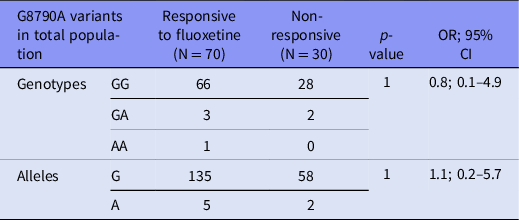
Genotype and allele distribution of ACE2 gene polymorphism are presented in Table 2. As shown, patients with GA and AA genotype responded significantly better to SSRIs (fluoxetine and sertraline) compared to GG genotype (p = 0.027; OR = 3.3; 95% CI = 1.2–9.2). The A allele was associated with better response to SSRIs than the G allele (p = 0.008; OR = 3.4; 95% CI = 1.4–8.5). As shown in Tables 3 and 4, subgroup analyses indicated that patients with GA and AA genotypes responded significantly better to sertraline (p = 0.0002; OR = 9.1; 95% CI = 2.4–33.7). Additionally, the A allele was significantly associated with better response to sertraline (p = 0.0001, OR = 7.6, 95% CI = 2.5–23.3). However, different genotypes of G8790A were not associated with response in patients treated with fluoxetine (p = 0.05).
Genotype and allele frequencies of G8790A variant in patients treated with SSRIs

CI, confidence interval; OR, odds ratio.
Genotype and allele frequencies in patients treated with sertraline

Genotype and allele frequencies in patients treated with fluoxetine

Discussion
Like most complex disorders, depression is a polygenic illness arising from the combined effect of many genetic variants (Wray et al., Reference Wray, Lee, Mehta, Vinkhuyzen, Dudbridge and Middeldorp2014). Pharmacotherapy of mood disorders such as depression has been significantly improved over the past decades by introducing SSRIs. As with all antidepressants, however, 30%–40% of depressed patients do not respond satisfactorily to SSRIs. Since MDD has a strong genetic base, pharmacogenetics may offer great promise for individualizing antidepressant therapy (Tsai & Hong, Reference Tsai and Hong2003).
Results of our study indicated a significant association between A allele of G8790A on ACE2 gene and better response to SSRIs. Subgroup analyses revealed a significant association between A allele and response to sertraline in MDD patients. Additionally, carriers of AA and GA variants responded significantly better to sertraline.
To date, no studies regarding the association between ACE2 activity and depression have been conducted in the human population. It has been reported that in a neurological disease-like multiple sclerosis, the level of ACE1 activity is significantly elevated compared to the control group, while the level of ACE2 activity is significantly decreased (Kawajiri et al., Reference Kawajiri, Mogi, Higaki, Matsuoka, Ohyagi, Tsukuda, Kohara, Horiuchi, Miki and Kira2009).
Regarding G8790A polymorphism and response to antidepressants in MDD, no reports have been released as yet. However, a report by Han et al. investigated the effect of ACE2 variants with comorbidity of depression and coronary heart disease and showed a significant association between rs2285666 variants and depression in depressed CHD patients. Moreover in the same report, association of rs2285666 variants with lower serum levels of Ang (1–7) was observed that confirmed the role of rs2285666 on Ang (1–7) levels and susceptibility to depression (Han et al., Reference Han, Wei, Dang, Guo, Zhang, Geng, Wang, Feng and Jiang2020). Regarding neurological complications, results of a study by Wu et al. (Reference Wu, Li, Wang, Zhang and Qiao2017) reported that G8790A polymorphism in the ACE2 gene in type 2 diabetes mellitus is significantly associated with cerebral stroke. Additionally, a study by Strafella et al. (Reference Strafella, Caputo, Termine, Barati, Gambardella, Borgiani, Caltagirone, Novelli, Giardina and Cascella2020) suggested a link between ACE2 variants and neurological complications observed in COVID-19.
Besides the periphery, all RAS elements are distributed in different brain regions. Angiotensins, the main RAS components, are involved in high brain functions including memory, cognition, anxiety and depression (Ciobica et al., Reference Ciobica, Bild, Hritcu and Haulica2009). Injection of angiotensin II induces anxiety-like behaviour in animal models (Georgiev et al., Reference Georgiev, Stancheva, Kambourova and Getova1990). Angiotensin (1–7), the product of ACE2, results from angiotensin II degradation. Mice lacking Mas, a functional receptor of angiotensin (1–7), exhibit elevated anxiety-like behaviour suggestive of anxiolytic-like effects of angiotensin (1–7) (Santos et al., Reference Santos, Silva, A.C., Maric, Silva, Machado, de Buhr, Heringer-Walther, Pinheiro, Lopes and Bader2003; Almeida-Santos et al., Reference Almeida-Santos, Kangussu, Moreira, Santos, Aguiar and Campagnole-Santos2016). An increase in antidepressants’ effects through a decline in levels of angiotensin II was reported in several studies (Gard et al., Reference Gard, Mandy, Whiting, Nickels and Meakin1994, Reference Gard, Mandy and Sutcliffe1999). Unlike angiotensin II, an increase in angiotensin (1–7) levels has been proposed to show antidepressant effects (Kangussu et al., Reference Kangussu, Almeida-Santos, Bader, Alenina, Fontes, Santos, Aguiar and Campagnole-Santos2013). Psychiatric disorders such as depression are associated with overactivity of ACE1 and the resultant, higher levels of angiotensin II (Baghai et al., Reference Baghai, Binder, Schule, Salyakina, Eser, Lucae, Zwanzger, Haberger, Zill and Ising2006; Firouzabadi et al., Reference Firouzabadi, Shafiei, Bahramali, Ebrahimi, Bakhshandeh and Tajik2012). Angiotensin II activates AT1 receptors expressed at BBB endothelial cells. Activation of AT1 receptors ends in the phosphorylation of a tight junction protein, called occludin. Hence, an increase in angiotensin II degradation and angiotensin (1–7) production through a rise in ACE2 activity in A allele carriers (Wu et al., Reference Wu, Li, Wang, Zhang and Qiao2017) decreases the expression of occludin protein leading to an increase in drug passage across BBB, increased CNS permeability of drugs and thereby increasing their effectiveness.
It is worth pointing out that since G8790A polymorphism is located on an intron of ACE2 gene, adjacent to an exon, it may influence ACE2 gene expression with alternative splicing mechanisms (Yang et al., Reference Yang, Zhao, Xing and Shi2015). Additionally, G8790Avariant is also in strong linkage disequilibrium with other functional SNPs in ACE2 gene that may contribute to physiologic actions of G8790A (Kramkowski et al., Reference Kramkowski, Mogielnicki and Buczko2006).
As a limitation of our study, we should point to rather the small sample size of enrolled patients and lack of comparison between MDD and non-MDD patients. In addition, since no previous studies was performed in other psychiatric disorders as well as other ethnicities, available data are limited. Therefore, no comparison can be made for discussing our findings. However, the results of our study may provide preliminary insights for further investigations. The results of our study and other pharmacogenetics studies may assist in the smarter selection of SSRIs for the management of MDD. Personalized medicine provides a better chance of treating patients as well as achieving remission.
At last, it is worth noting that depression is a heterogeneous illness both aetiologically and phenotypically, and two patients diagnosed with MDD may have few symptoms in common (Østergaard et al., Reference Østergaard, Jensen and Bech2011). GWAS studies have provided interesting clues for various diseases. However, they are mostly underpowered for complex traits such as MDD (Ripke et al., Reference Ripke, Wray, Lewis, Hamilton, Weissman, Breen, Byrne, Blackwood, Boomsma and Cichon2013). Moderate heritability, heterogeneity in genetics and also non-genetic factors and high prevalence of MDD make it a challenging disorder for GWAS. However, for common multifactorial illnesses, GWAS is considered the most promising method (Levinson et al., Reference Levinson, Mostafavi, Milaneschi, Rivera, Ripke, Wray and Sullivan2014). Another important fact is that besides the CONVERGE study, which was conducted in depressed Han Chinese women, MDD GWAS has been limited to the European ethnicity (Ormel et al., Reference Ormel, Hartman and Snieder2019). Therefore, no data regarding other ethnicities such as Iranian are at reach at present.
Our study investigated a rare susceptibility allele that are usually excluded in GWAS (Vadgama et al., Reference Vadgama, Kreymerman, Campbell, Shamardina, Brugger, Lee, Penkett, Gifford, Mercola and Nasir2021). The studied variant (rs2285666) affects ACE2 activity which is proposed to be altered in MDD and thus be associated with depression. However, this association should be studied in the future. It is noteworthy that other ACE variants such as ACE I/D, which have been vastly studied in MDD association studies, have not been reported in GWAS as well.
Conclusion
Here we showed that GA and AA carriers of G8790A polymorphism of ACE2gene and the A was associated with better response to SSRIs. Patients with GA and AA genotypes responded significantly better to sertraline. In conclusion, our results confirm the role of G8790A in response to some SSRIs.
Conflict of interest
The authors of the manuscript have no conflicts of interest to declare.
Funding
This study was supported by Shiraz University of Medical Sciences, Grant No. 13096.
Declarations
The protocol of this study was reviewed and approved by the Ethics committee of Shiraz University of Medical Sciences with the ethical code of 13096. Each patient signed an informed consent form approved by the local institutional Review Board.
All methods were carried out in accordance with relevant guidelines and regulations.
Data availability statement
The data sets used and/or analysed during the current study are available from the corresponding author on reasonable request.
Contributions of authors statement
N.F.: design of the work, analysis and interpretation of data for the work, writing the manuscript, revising the manuscript critically for important intellectual content, draughting the work and final approval of the manuscript.
M.H.: writing the draft of the manuscript, revising the manuscript critically for important intellectual content and final approval of the manuscript.
P.F.: conducting the project, analysis and interpretation of data for the work, draughting the manuscript and final approval of the manuscript.
V.G.: conducting the project, final approval of the manuscript.
A.A.-S.: data gathering from patients, revising the manuscript critically for important intellectual content, draughting the work and final approval of the manuscript.