1 Introduction
In this article we will investigate the development of noun-intensifying uses of adjectives. Prenominal adjectives can be used to intensify the gradable properties conveyed by the descriptive part of NPs, i.e. head nouns plus possible descriptive modifiers. Examples (1)–(4) illustrate the different types of properties that can be intensified, viz. qualitative and quantitative features (Bolinger Reference Bolinger1972: 58–60, 64), and different modes of intensification, viz. upscaling and downscaling (Quirk et al. Reference Quirk, Greenbaum, Leech and Svartvik1985: 590–7).
(1) But it was pure speculation. (CB)Footnote 2
(2) She feels a complete failure. (CB)
(3) And fatigue is a particular problem for women. (CB)
(4) What may be considered riches by one man may seem a mere pittance to another. (CB)
Examples (1)–(3) involve the amplification of the qualitative or quantitative features conveyed by the degree nouns (Bolinger Reference Bolinger1972: 58−60). In (1), pure amplifies the degree of speculation. In (2), the subject feels that she has failed in every respect. In (3), fatigue is a problem that makes itself felt extensively and to a high degree in women. In (4), we have downscaling of quantity. Mere makes the small amount of money described by pittance even smaller.
It is generally assumed that intensifying uses diachronically developed from other uses of adjectives. In influential contributions such as Traugott (Reference Traugott1989), Adamson (Reference Adamson, Fischer, Rosenbach and Stein2000) and Paradis (Reference Paradis, Bermúdez-Otero, Denison, Hogg and McCully2000, Reference Paradis2001, Reference Paradis2008), descriptive, or ‘propositional’ (Traugott Reference Traugott1989), uses of adjectives such as pure, terrible, total, complete have been argued to form the source of intensifying uses. However, earlier on, Bolinger (Reference Bolinger1972) had pointed out a second possible source of intensifiers, viz. identifying elements in the NP. The identification of entities functionally subsumes both the singling out of referents on which speaker and hearer jointly focus, i.e. identification in the strict sense (Langacker Reference Langacker1991; Diessel Reference Diessel2006) and the delineation of referents by measuring them, i.e. quantifying determination (Langacker Reference Langacker1991; Davidse Reference Davidse, Achard and Kemmer2004). According to Bolinger (Reference Bolinger1972: 59), possible sources of intensifiers are both identifiers, e.g. this, that, some, and quantifiers, e.g. a bit, little, less, much, more. Other possible sources discussed in Bolinger (Reference Bolinger1972) are secondary determiners, which ‘add further to the identification of the subset in question’ (Halliday Reference Halliday1994: 181) and which may precede the latter as predeterminers, e.g. such, what, or follow them as postdeterminers, such as the adjectives complete, total, true, very, real, particular, specific. So far, there has been little diachronic study of this second path leading to noun-intensifying uses of adjectives and of the precise mechanisms of change involved.
This article presents a systematic study of the two main paths that adjectives can follow to intensifying uses, to arrive at a new synthesis about their shift to intensifying meaning. Intensifying adjectives measure the degree of properties by locating them as points or intervals along some ordered dimension or scale. Our main question is how the source meanings of intensifying uses are transformed into scalar meanings. Is there a single mechanism of change? Which basic types of intensification scales have to be distinguished? These questions are more complex than they appeared in the standard treatments reckoning only with lexically specific, descriptive source meanings, because the quantifying and identifying sources pointed out by Bolinger (Reference Bolinger1972) are semantically schematic, grammatical meanings. It can be noted in this context that adjectives such as complete and total, which are treated as lexical descriptive sources by Paradis (Reference Paradis, Bermúdez-Otero, Denison, Hogg and McCully2000), are viewed as grammatical sources by Bolinger (Reference Bolinger1972). Nuancing both these authors, Ghesquière (Reference Ghesquière, Davidse, Vandelanotte and Cuyckens2010) argued, on the basis of detailed data study, that complete and total have developed along the path from descriptive to intensifying meaning, but whole on that from quantifying to intensifying meaning. Such controversies, and the recognition of multiple pathways, point to the need for a new synthesis about the development of scalar, noun-intensifying meaning by adjectives.
The main aim of this study is to arrive at a general conceptual framework that can analyse all the shifts leading to noun-intensifying uses of adjectives. We will pursue this aim with in-depth case studies of the adjectives complete, whole and particular, which were established by Ghesquière (Reference Ghesquière2009, Reference Ghesquière, Davidse, Vandelanotte and Cuyckens2010) to have followed the two main paths: complete from descriptive to intensifying, and whole and particular from identifying to intensifying. The earlier studies did not deal with the origin and type of the intensification scales in the intensifying uses, which this article will focus on, synthesizing and extending existing conceptual frameworks when the data call for it. Neither did the earlier studies systematically investigate the collocational development of the adjectives shifting towards intensifying meaning, which, we will argue, is an integral part of this change.
The structure of the article will be as follows. In section 2, we propose, in dialogue with the literature, our main hypotheses about intensification scales and the shift towards intensifying meaning. Section 3 provides a brief discussion of the data studied. In section 4, we will look at the shifts from descriptive to intensifying uses manifested by the adjective complete. In the next two sections we will closely analyse two cases in which intensifying uses developed from identifying uses: from quantifying-identifying uses in the case of whole (section 5) and from identifying uses in the strict sense in the case of particular (section 6). In the last section, generalizations about the various possible origins and forms of intensification scales will be formulated.
2 Theoretical preliminaries
The most developed theory of how adjectives shift towards noun-intensifying uses is that of Paradis (Reference Paradis, Bermúdez-Otero, Denison, Hogg and McCully2000, Reference Paradis2001, Reference Paradis2008). She proposes that the bounded or unbounded nature of the adjective's descriptive meaning predicts the type of intensifying meaning it will develop. In this shift, the ‘gradability mode’ of the descriptive meaning is foregrounded, while its specific lexical contents are bleached. In this section, we will synthesize Paradis's work and complementary studies on the boundedness of descriptive adjectives (2.1) and the intensification scales of noun-intensifying uses (2.2). In 2.3, we discuss and extend the hypothesis that the gradability mode of the source meaning determines the type of intensifying meaning.
2.1 Bounded versus unbounded descriptive adjective uses
In their property-describing uses, adjectives are generally accepted to be construed as either bounded or unbounded (Bolinger Reference Bolinger1967, Reference Bolinger1972; Paradis Reference Paradis, Bermúdez-Otero, Denison, Hogg and McCully2000, Reference Paradis2001). As Paradis & Willners (Reference Paradis and Willners2006: 1055, 1074) convincingly argue, adjectives are not intrinsically either bounded or unbounded. Rather, boundedness is a matter of construal. Adjectives may have a certain bias towards either one or the other reading, but ‘it is almost always possible to coerce a bounded reading into an unbounded reading’ (Paradis & Willners Reference Paradis and Willners2006: 1074). Bounded adjectival meanings are complementaries, i.e. properties that either apply or do not apply, e.g. dead – alive, while unbounded adjectival meanings are antonyms, properties inherently conceptualized as degrees, e.g. long – short. The difference is drawn out by the modifiers with which they can be used.
Bounded adjectives are modified by proportional modifiers expressing maximality, e.g. wholly dead, or approximation, e.g. almost/half dead (Kennedy & McNally Reference Kennedy and McNally2005: 352–4). The property described by these adjectives is assessed by comparing it to the boundary they imply, i.e. as either reaching or not reaching that boundary or as going some way towards reaching it. This shows that the meaning of adjectives such as dead is inherently bounded.
Unbounded adjectives cannot be modified by proportional modifiers: *wholly long, *half short. Rather they take modifiers that measure the actual degree of the quality on a scale with some form of assumed measuring units, e.g. rather/very long. In other words, these properties are inherently degrees which are measured on a scale going up or down from a reference point, e.g. highly/far from entertaining.
Paradis (Reference Paradis, Bermúdez-Otero, Denison, Hogg and McCully2000: 52) has drawn attention to adjectives such as terrible and excellent that are in some respects on the borderline between these two classes, viz. the ultimate points of a scale. As pointed out by Bolinger (Reference Bolinger1967: 4), adjectives representing extremes can be pulled off the ultimate points of the scale and compared, i.e. ‘laid out on a scale’, e.g. more excellent, most excellent. Because this is their marked construal, Paradis classifies these adjectives as basically bounded. Taking the opposite tack, Martin (Reference Martin1992: 303) focuses exclusively on the gradable nature of oppositions on a scale (Lyons Reference Lyons1977: 289), under which he subsumes both the ultimate and intermediate values. He characterizes all the adjectives on a scale such as excellent, good, fair, poor, awful as non-binary gradable oppositions.
In our view, it has to be recognized that adjectives describing extremes on a scale carry in them the possibility of being construed either as points (bounded) or as ranges (unbounded) on a scale. These observations about the hybrid nature of extreme adjectives are particularly important for our first case study, which deals with the extreme adjective complete of which not only bounded but also unbounded construals, such as more/most/very complete, are attested in both our diachronic and synchronic data. The analysis we will propose aims at doing justice to all the observed uses (see section 4).
2.2 Closed versus open intensification scales in noun-intensifying adjective uses
In this section we turn to the use of adjectives to intensify the degree of the properties conveyed by nouns or nominal descriptions. Kennedy & McNally (Reference Kennedy and McNally2005) view intensification, or degree modification, as inherently scalar. Their study applies primarily to degree modification of adjectives, but allows for extension to degree modification of nouns. Degree modifiers ‘measure’ (2005: 349) the degree of properties in terms of ‘points or intervals partially ordered along some dimension’, more precisely, in terms of two types of scales.
The first way of modifying the degree of properties invokes ‘open scales’ (Kennedy & McNally Reference Kennedy and McNally2005: 349), measuring the actual degree of the quality on a scale with some form of assumed measuring units. This is the mode of degree modification found in very short (of an adjective) and a mere pittance (of a noun). In both expressions the small size evoked by the word being modified is further reduced in size by the degree modifier. The degree modifier activates a range going up or – as in these examples – down from a reference point on a scale defined by measuring units, not by maximum or minimum values. Therefore, it is called an open-scale degree modifier.
The second way of modifying the degree of properties invokes ‘closed scales’ (Kennedy & McNally Reference Kennedy and McNally2005: 353), viz. comparing the degree to a boundary as either approximating or reaching it. This boundary may be either the maximum or the minimum, and closed scales may be defined by either an upper or a lower boundary, or by both. Closed-scale degree modifiers ‘calculate differences relative to minimum and maximum values on the scale’ (Kennedy & McNally Reference Kennedy and McNally2005: 353) of properties conveyed by adjectives, e.g. fully/half dead, more dead than alive, or by nouns, e.g. a complete/half failure, complete perfection. We can speak of a scale here, because the various values (half, almost, fully, etc.) that can be indicated for the difference between actual degree and maximum or minimum clearly involve scalarity.
2.3 The shift towards noun-intensifying uses: mechanism(s) of change
Paradis (Reference Paradis, Bermúdez-Otero, Denison, Hogg and McCully2000, Reference Paradis2001, Reference Paradis2008) is the only one to have proposed a clear hypothesis about the mechanism of change involved in the shift towards noun-intensifying uses of adjectives. She proposes that the gradability mode of the adjective in its source use is made prominent in the intensifying use, while its lexical contents are backgrounded. (It has to be remembered here that she is concerned only with lexical, property-describing source uses.) With extreme adjectives such as terrible, dreadful, horrible and awful, their ‘negative superlative property . . . is recruited for reinforcement’ (Paradis Reference Paradis, Bermúdez-Otero, Denison, Hogg and McCully2000: 236). With complementaries such as complete, perfect, total and absolute ‘a generalised property of the degree of totality has taken over completely’ (Paradis Reference Paradis, Bermúdez-Otero, Denison, Hogg and McCully2000: 236).Footnote 3
Paradis's insight that elements in the source meaning relating to ‘grading’ and ‘measuring’ are foregrounded in the new intensifying meaning seems very plausible to us, and we will assume it as our starting hypothesis. This hypothesis needs to be extended, however, to identifying source uses. For quantifying-identifying sources, we will reformulate it, starting from the two generally recognized basic types of quantification, viz. absolute and relative quantification (Milsark Reference Milsark1977; Langacker Reference Langacker1991; Davidse Reference Davidse1999). Absolute quantifiers measure the size of some set or mass by offering a direct description of its magnitude (Milsark Reference Milsark1977: 23; Langacker Reference Langacker1991: 82–3). This direct measurement refers to an implied scale with measuring units, either precise ones such as the cardinality scale (three/a hundred and one mice) or more schematic units (few/many mice). Absolute quantifiers thus imply an open quantification scale without an upper boundary. Absolute quantification is expressed by cardinal numbers and indefinite quantifiers, as well as by complexes of determiner and secondary determiner, such as the two/many/various girls he has known, the little/considerable knowledge he has.
Relative quantifiers make a quantitative assessment relative to a reference mass or reference set (Milsark Reference Milsark1977: 23; Langacker Reference Langacker1991: 108). They compare the mass or set they actually designate to a reference mass/set (Langacker Reference Langacker1991: 83), profiling the actually predicated mass/set as a proportion (part or all) of the reference mass/set, e.g. most/all parents. It is this comparative element, not an intrinsic indication of size, that is central to their quantifying meaning. Relative quantifiers hence imply a bounded, or closed, quantification scale. Relative quantifiers expressing coincidence with the reference set/mass such as all, every are known as universal quantifiers in logic. Quantitative comparison with the reference mass/set is also commonly expressed by complexes of determiner and secondary determiner, viz. predeterminers, as in all/half the family, all/half the chicken, and postdeterminers, as in the whole family/population/produce.
The shift from quantifying to noun-intensifying meaning can then be hypothesized to involve a semantic reconfiguration from the measuring of instances and sets of instances, as in (5) and (7), to the measuring of the degree of a property, as in (6) and (8).
(5) Too much of the time he misses the point. (Bolinger Reference Bolinger1972: 58)
(6) He's too much of a miser to give anything. (Bolinger Reference Bolinger1972: 58)
(7) we are a minority of the whole population. (CB)
(8) you get all this whole range of problems stuck in there. (CB)
On this pathway, no bleaching of lexically specific meaning is necessary and no foregrounding of the measuring mode. The source meanings of quantifying expressions are schematic and scalar to begin with. Their semantics incorporate either an open scale with conventional measuring units, as in (5), or a closed scale with different values for calculating the difference between the actual size and the reference boundary, as in (7). All that is needed for the change to happen is a shift of domain, from the size of the designated entities to the modified degree of the properties. We thus expect elements with relative quantifying meaning to shift in the first place towards noun-intensifying uses with a closed scale and absolutely quantifying sources towards open-scale intensifiers.
How an analogous shift can be conceptualized for sources with purely identifying meaning such as the secondary determiner adjective particular is less obvious. We will not start from a preconceived hypothesis here, but will see what emerges from the case study. However, we assume that, in this case too, elements pertaining to grading and scales in the source meaning are reconfigured towards intensifying meaning.
In setting up our hypotheses about the shift to intensifying meaning, we also have to account for the observed fact that the intensifying uses of adjectives starting off with one type of scalar meaning may later develop uses with the other type of intensification scale. For instance, the lexical source of intensifying sheer is the bounded, non-obsolete, meaning ‘pure, unmixed’. Yet, in its intensifying uses, sheer does not only invoke closed scales, e.g. sheer perfection (‘perfect in every respect’, ‘attaining the norm of perfection’) but also open scales, e.g. the sheer weight (‘very heavy’) (Brzyk Reference Brzyk2008: 29–36). How can intensifying uses unpredicted by the source meanings be explained? We propose that the key to this lies in the collocational history of the adjective in its development of intensifying meaning(s). The initial shift to intensifying meaning is bound to take place within a subset of collocates that the adjective has in its source meaning. Thus, we expect in the first place collocational overlap between source and intensifying uses (see also Vandewinkel & Davidse Reference Vandewinkel and Davidse2008 on the collocational overlap between descriptive and intensifying uses of pure). Once the intensifying meaning is acquired, the adjective may extend the sets of nouns it can intensify. In this second stage, its new collocates may invite a different type of degree modification, and associate the adjective with a different intensifying scale than the one it initially acquired.
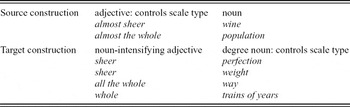
In this context, it has to be pointed out that, in shifting towards intensifying uses, the adjective is no longer the element determining the type of intensification scale, but the noun is. As descriptive modifier, an adjective designates a property that invites a specific type of measuring, for instance the closed scale of complementary sheer in the sense of ‘undiluted’. Likewise, as quantifying secondary determiner, an adjective such as whole inherently invokes a closed quantification scale. But when used as noun-intensifiers, their intensification scale is determined by the nouns they are used with, such as the closed scale of sheer perfection versus the open scale of the sheer weight. With intensifying whole, it is also the noun being modified that determines the intensification scale: closed in allthe whole way but open in whole trains of years. In other words, with the reanalysis to intensifying use, the control of the grading or measuring mode shifts in principle from the adjective to the noun. We can visualize this schematically as in table 1.
Elements controlling scale types in source and target constructions

We therefore extend the hypothesis that initially the grading or measuring mode of the source use of the adjective determines its scalar intensifying meaning with the point that the extension of its noun collocates may trigger other types of scalar meaning.
3 Data
In the following sections we will present three diachronic corpus studies of prenominal adjectives, illustrating the variety of source constructions that may lead to noun-intensifying adjective uses. The conceptual and chronological reconstructions of the rise of the intensifying uses of complete, whole and particular are based on the qualitative and quantitative analysis of systematic extractions on these adjectives from four diachronic corpora and one synchronic one. For Old English, examples were drawn from the York–Toronto–Helsinki Parsed Corpus of Old English Prose (YCOE, 1.5 million words). For Middle English, use was made of the second edition of the Penn–Helsinki Parsed Corpus of Middle English (PPCME2, 1.2 million words). For Early and Late Modern English, we consulted the Penn–Helsinki Parsed Corpus of Early Modern English (PPCEME, 1.8 million words) and the Corpus of Late Modern English Texts (CLMETEV, 15 million words) respectively.Footnote 4 For Present-day English, extractions were made from the COBUILD corpus (CB), via Collins WordbanksOnline, from The Times (5.7 million words) and UK Spoken (9.2 million words).
4 From quality-describing to noun-intensifying: the case of complete
In Present-day English, complete has at least four distinct readings in prenominal position: objective descriptive modifier (9), subjective descriptive modifier (10), noun-intensifier (11) and secondary determiner (12).
(9) The fossil skeleton, the most complete example of its kind (CB Times 1995).
(10) The new record feels like by far the most complete thing I have ever done. (CB Times 1996)
(11) open up any cupboard in the flat and you'll see complete chaos. (CB Times 1996)
(12) To care for your Retractable Brushes, follow washing instructions . . . taking care not to immerse the complete unit in the water. (CB UK Ephemera 1995)
In (9) complete describes the objectively recognizable property (cf. Quirk et al. Reference Quirk, Greenbaum, Leech and Svartvik1985: 1341) of an entity as including all the parts that are normally associated with it (OALD 2000: 247). In (10), in contrast, complete describes a property that is more a matter of subjective speaker assessment, which can roughly be paraphrased as ‘perfect’. In (11), it has a noun-intensifying function, indicating that the degree of chaos in the cupboards is ‘as great . . . as it possibly can be’ (Sinclair Reference Sinclair1990: 303). The secondary determiner use of complete in (12) serves an identifying function, clarifying the precise extent of the entity referred to in the given context. Both the intensifying and the secondary determiner uses are the result of grammaticalization, as shown in their loss of gradability (*the very complete chaos/unit). In all these uses, complete has distinct well-established subsenses. The question is what the genetic links between them are.
Paradis (Reference Paradis, Bermúdez-Otero, Denison, Hogg and McCully2000) links the intensifying use of complete to the first descriptive use, illustrated in (9). Complete is said to have been ‘originally descriptive of “completeness” in the sense of “having all its parts” and to have been subsequently recruited into the domain of degree and reinforcement’ (Paradis Reference Paradis, Bermúdez-Otero, Denison, Hogg and McCully2000: 235). Although our analysis of extended diachronic and synchronic corpus data confirms the general shift posited by Paradis (Reference Paradis, Bermúdez-Otero, Denison, Hogg and McCully2000) from fully lexical descriptive uses to intensification, we will argue for further refinement. First, we will posit two distinct noun-intensifying uses of complete, which have evolved from distinct descriptive subsenses. Second, we will emphasize the importance of collocational overlap between the source and target constructions and its influence on the developmental process undergone by complete.
4.1 Descriptive, lexical uses of complete
Two different descriptive uses of complete lie at the origin of its noun-intensifying uses. The first, objectively descriptive, source meaning invokes a boundary relative to which ‘completion’ or ‘completeness’ is assessed, as in example (13).
(13) The fourthe day compleet fro noon to noon. (OED s.v. Complete 2, c.1386, Chaucer, The Merchant's Tale)
‘The fourth day, complete from noon to noon.’
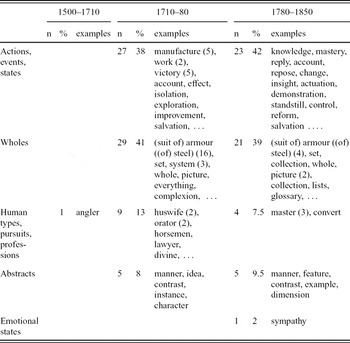
Complete, here in postnominal position, indicates that the day in question has come to completion, that it ‘has run its full course’ (OED s.v. Complete 2). In Middle English this (typically postnominal) use of complete is mostly restricted to nouns indicating a certain period of time, such as year. In Modern English, the collocational range of this sense is greatly extended to nouns referring to actions, events or states, which are then described as ‘realized in their full extent’ (OED s.v. Complete 3), such as exploration, cultivation, improvement and manufacture in (14). Throughout Modern English, this set of collocates accounts for around 40 per cent of the property-describing uses, as shown in table 2 below.
(14) It costs more labour, and therefore more money, to bring first the materials, and afterwards the complete manufacture to market. (CLMETEV Smith, 1766, An Inquiry into the Nature and Causes of the Wealth of Nations)
At the same time as the ‘fully realized’ subsense, we find the related bounded subsense ‘having all its parts or members’ (OED s.v. Complete 1.a), illustrated in (9) above. This sense collocates with holonyms, or ‘wholes’, as in the complete set/whole/picture and complete armour, which also represent around 40 per cent of the property-describing uses in Modern English, as can be seen in table 2.
Collocates of property-describing uses of complete in the PPCEME and CLMETEV corpora

Paradis (Reference Paradis, Bermúdez-Otero, Denison, Hogg and McCully2000: 236) holds that ‘in both [its] descriptive and its reinforcing readings complete . . . [is] associated with a bounded, “either-or” conceptualisation’. As mentioned in 2.1, we would like to argue that in specific collocational contexts complete can be attributed a second type of descriptive meaning, viz. an ‘extreme’ reading, which allows both bounded and unbounded construals. Such a reading seems plausible in (15), in which complete describes the NP referents as ‘perfect in nature or quality’ (OED s.v. Complete 4). Example (15) favours an unbounded interpretation of complete by the presence of the explicit comparative more in the NP. This ‘perfect’ sense of complete gave rise from Early Modern English on to the more specific sense ‘fully equipped or endowed’ (OED s.v. Complete 5), ‘consummate’, as in (16). When used as such, complete collocates primarily with nouns denoting professions, arts and pursuits, such as orator, huswife, horsemen, philosopher. In Late Modern English, these collocations form roughly 10 per cent of the descriptive uses, as shown in table 2.
(15) the book is more perfect and complete by wanting the chapter, than having it (CLMETEV Sterne, 1759, The Life and Opinions of Tristram Shandy)
(16) The Compleat Angler (PPCEME Walton, 1653)
In the ‘perfect’/‘consummate’ sense, complete hovers between a bounded and an unbounded reading. The following Present-day English examples taken from the internet illustrate the indeterminate nature of complete in terms of boundedness. In (17) complete is intensified by the proportional modifier almost, which ‘relate[s] to a definite and precise value of the property expressed by the adjective and [is] bounded’ (Paradis Reference Paradis2001: 50). In (18), on the other hand, complete is modified by the scalar degree modifier very, which ‘indicate[s] a range on a scale of the gradable property expressed by the adjectiv[e]’ and is ‘in that respect unbounded’ (Paradis Reference Paradis2001: 50).
(17) he is so strong, quick, accurate and an almost complete player. (www.onevalefan.co.uk/forums/showthread.php?t=31248)
(18) Del Potro is a very complete player. He has an unbelievable serve right now and from the baseline, he doesn't make any mistakes.
4.2 Noun-intensifying uses of complete
The two main lexical uses of complete discussed in 4.1 led, as we will show in this section, to two distinct noun-intensifying uses in Late Modern English. The main arguments for positing two paths of change are the bridging contexts allowing both a descriptive and a related intensifying reading specific to each path, and the collocational overlaps between the two readings on each path.
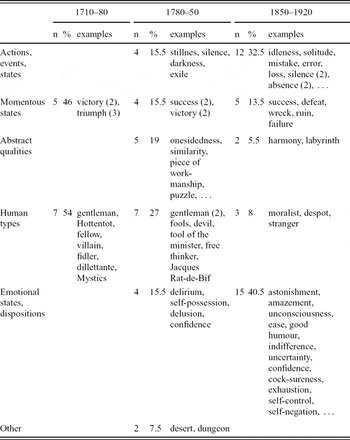
The first type of noun-intensifying use of complete, illustrated in (19), can be traced back to the descriptive sense ‘realized in their full extent’. This noun-intensifying use starts off in the period 1710–80 with nouns such as victory, triumph, success, defeat, wreck, which describe – momentous – final states. This set forms a specific subset of the actions, events and states used with complete in its ‘full realization’ sense. Once activated, this intensifying use also collocates with descriptions of more varied events and states, such as exile, silence, darkness, error, idleness in the period 1780–1920. This collocational overlap can be appreciated by comparing table 2 with table 3. The type specifications or characteristics inherent in nouns such as failure (19) and success (20) can easily be interpreted in a more evaluative, subjective manner, and are then intensified by complete along a closed scale. In (19), for instance, the NP complete failure indicates that the attempt failed in every respect (closed-scale intensification), not to a very high degree (open-scale intensification).
(19) when General Buonaparte wished to produce an effect upon the inhabitants, he not only made them a speech, but supplemented it with the ascent of a fire balloon. The attempt was a complete failure, for the French alone looked up to the clouds to see what became of the balloon. (CLMETEV, Booth, 1880, Papers on Aggressive Christianity)
This intensifying use of complete is still quite close to the original descriptive use from which it derives. The close connection between the two uses is reflected in the relatively high number of bridging contexts (Evans & Wilkins Reference Evans and Wilkins2000), which are structurally and semantically ambiguous between the old and the new meaning, and in which these two readings are supported by (different) contextual clues. For instance, in (20), complete in complete success can be interpreted both as ascribing full realization to the NP referent (which can be objectively measured by the number of difficulties overcome, perils encountered and results obtained) and as intensifying the positive, evaluative characterization of the described event.
(20) The operations conducted by Colonel Parsons thus ended in complete success. Great difficulties were overcome, great perils were encountered, great results were obtained. (CLMETEV Churchill, 1899, The River War, an Account of the Reconquest of the Sudan)
Collocates of noun-intensifying complete in the CLMETEV corpus

The source of the second noun-intensifying use of complete is the descriptive ‘perfect’ subsense, as in (15). There is a natural shift from ascribing perfection to a specific entity to upscaling and maximizing its inherent properties. This second use emerges in the period 1710–80 in specific collocational contexts, intensifying the positive or negative qualities invoked by nouns typifying people (‘human types’ in table 3), such as gentleman, dillettante, Mystics, villain, despot and Hottentot in (21).
(21) In genius the lowest, ill-bred and obscene; In morals most Wicked, most nasty in mien; . . . A dupe in each treaty, a Swiss in each vote; In manners and form, a complete Hottentot. (CLMETEV Walpole, 1742, Letters)
As descriptions typifying people, these collocates belong to a set similar to the human type nouns collocating with the descriptive ‘perfect’ sense such as huswife, orator, character, philosopher, master (table 2). From 1780 on, the collocational range of this intensifying use extends to nouns describing emotional states and dispositions, as in complete delirium/delusion/confidence/astonishment/cock-sureness/good humour/confidence, and nouns describing abstract qualities of affairs, e.g. complete groundlessness/one-sidedness/harmony (table 3). The extension to emotional states and dispositions is a particularly productive one, as in the last period of Late Modern English this subset accounts for 40.5 per cent of all the noun-intensifying uses of complete.
Like its ‘perfect’ source, the second noun-intensifying use of complete seems to vacillate between bounded and unbounded construals. The NP complete Hottentot in (21) can be read as characterizing someone as being very uncultured and uncouth. Similarly, the NPs good humour and harmony evoke qualities that are gradable along open scales, such as ‘pleasant’/‘friendly’ and ‘harmonious’ respectively. However, some of these contexts also evoke closed-scale interpretations (William Croft, p.c.). A complete Hottentot, for instance, could be understood as indicating that someone is or behaves like a typical Hottentot ‘in all respects’.
As with the first intensifying use, this second intensifying use of complete is generally still closely related to its descriptive source, which is reflected in the occurrence of bridging contexts such as (22) which simultaneously evoke a lexical and an intensifying reading. Even though degrees of comparison are typically associated with descriptive, gradable adjective uses,Footnote 5 the collocation one of the completest fools in (22) also invites an intensifying reading.
(22) an intelligent young man when he was sober; but, the moment the wine began to operate, he was one of the completest fools in christendom (CLMETEV Hunt, 182–22, Memoirs of Henry Hunt (vol. 1))
We conclude that the emergence of the noun-intensifying uses of complete can be accounted for by the mechanism of change posited by Paradis (Reference Paradis, Bermúdez-Otero, Denison, Hogg and McCully2000), viz. the foregrounding of the gradability mode associated with the descriptive source meaning. It was by this semantic reconfiguration that the bounded descriptive sense of ‘full realization’, as in the complete establishment, shifted to the closed-scale intensifying use as in a complete wreck. The descriptive ‘perfect’/‘consummate’ sense, e.g. a complete housewife, which vacillates between bounded and unbounded construal, led to intensifying uses such as a complete gentleman/Hottentot, which can invite either open- or closed-scale readings. Importantly, both shifts proved to be strongly collocationally driven, emerging with degree nouns from very specific collocational sets, which were related to the sets found with the descriptive uses. With the second intensifying use, which is indeterminate regarding intensification scale, the initial collocational overlap was followed by gradual extension to less collocationally specialized, but still restricted, sets of degree nouns.
5 From quantitatively identifying to noun-intensifying: the case of whole
The adjective whole is semantically similar to complete and has also developed descriptive, identifying and intensifying uses. However, as we will show, whole has developed its intensifying use along a different path of change than complete. We will argue that the noun-intensifying use of whole developed from the adjective's quantifying-identifying use rather than from a descriptive source. The evidence for this genetic link is formed by the critical contexts of change and collocational overlap found along this path. Unlike with complete, the lexical uses of the adjective, as in (23), did not have a direct part in the developmental process leading to the noun-intensifying uses of whole.
(23) For the nature of thynges toke neuer any begynnynge of thynges dymynished and vnparfitte but procedynge from hole and parfytte thynges, came downe or descended into these lower and baren thynges. (PPCEME Colville, 1556, Boethius’ Consolation of Philosophy,73)
5.1 Quantifying-identifying use of whole
The secondary determiner whole, which is attested in the data from the period 1350–1420 onwards, contributes to the identification of the NP referent by providing quantitative information: it indicates that reference is made to the entire entity referred to by the head noun, as in
- (24)
(a) the share of the landlord seldom exceeds a third, sometimes not a fourth part of the whole produce of the land. (CLMETEV Smith, 1766, An Inquiry into the Nature and Causes of the Wealth of Nations)
The precise quantifying meaning of secondary determiner whole in (24) is a type of relative quantification (see section 2.3). The actually designated instance, set or mass coincides with the full contextual instantiation of the category denoted by the NP (Langacker Reference Langacker1991: 108). When whole is used with the definite article, it makes explicit the implicature of ‘inclusive’ reference associated with the, viz. that maximal reference is made to the contextually given instances (cf. Declerck Reference Declerck1991: 292; Langacker Reference Langacker1991: 102). Whole merely reiterates and reinforces the meaning of the definite article. Leaving it out mostly does not make the utterance unintelligible, as shown by (24b), even though it pragmatically enhances the message, as illustrated by (24a) above, which refers more emphatically to ‘all’ of the contextually given ‘produce of the land’.
- (24)
(b) the share of the landlord seldom exceeds a third, sometimes not a fourth part of the produce of the land.
5.2 Noun-intensifying use of whole
On the basis of critical contexts of change (Diewald Reference Diewald2006) observed in the diachronic data we posit a shift from the quantifying secondary determiner use of whole, which reinforces reference to the whole contextual instantiation of the NP, to noun-intensifying uses of whole. These intensifying readings, which are found in the data from Early Modern English on, either emphatically stress the maximal extension of the NP referent, as in (25), or stress how large or important it is, most typically in contexts ‘where there is an implication of an unusually large quantity or number’ (OED s.v. Whole 7.c), as in (26). The former use intensifies quantity on a closed scale, emphasizing that reference is made to the totality of the designated entities or mass, whereas the latter use emphasizes large quantity on an open intensification scale. As we shall see, this open-scale use developed later than the closed-scale intensifying use.
(25) and that no man, of any nation, ever beheld her that did not fall in love with her; and that she had all the slaves perpetually at her feet; and the whole country resounded with the fame of Clemene, for so (said he) we have christen'd her: . . . (PPCEME Behn, 1684, Love-Letters Between a Nobleman and His Sister)
(26) the German FLOH with his knife and fork, insatiate, not rising from table; whole swarms from all the Russias, and Asiatic hordes unnumbered – all these were there, and all rejoiced in one great international feast. (CLMETEV Kinglake, 1844, Eothen, or Traces of Travel Brought Home from the East)
The closed-scale intensifying use of whole seems to find its origin in one very specific source construction, i.e. the all the whole N-construction (Ghesquière Reference Ghesquière, Davidse, Vandelanotte and Cuyckens2010). This construction, which was particularly common in the Late Middle and Early Modern English period, i.e. around the time the intensifying use emerged, is illustrated in (27).
(27) and yn especiall the ende of the seide Fyssh strete enchroched all the hole wey thurt over for a court place to the mancion of the Archideacon of Cornewaill as hyt apperyth openly (PPCME2 Shillingford, 1447–50, Letters and Papers) ‘and especially at the end of the said Fish Street [they] encroached all the whole way across a courtyard to the mansion of the Archdeacon of Cornwall, as it appears openly’
As discussed above, the combination of the and whole has a reinforcing effect on the quantification inherent in the determiner. When the explicitly quantifying elements whole and all co-occur, the intensifying meaning is foregrounded, stressing the size of the entity referred to. Later, whole can express this emphatic meaning on its own, even in the absence of a quantifying predeterminer such as all.
Originally, intensifying whole always invoked closed intensification scales. In (25), for instance, whole stresses that the fame of Clemene resounded in each and every part of the country. In other words, intensifying whole, like the secondary determiner, still expresses a type of relative quantification, only now not simply invoking but emphasizing the maximal extension of the reference mass by locating the NP referent on the ultimate point of a closed intensification scale.
From the last stage of the Early Modern English period onwards (1640–1710), whole also has an established open-scale intensifying use, as in (26). In this use, whole no longer describes the coincidence in quantity of the NP referent and the reference mass. Rather whole further stresses the large quantity inherent in the noun it co-occurs with, activating a range on an open intensification scale. Whole in whole swarms in (26), for example, emphasizes the large number of Russians attending the feast. The shift from relative to absolute quantification and hence from closed-scale to open-scale intensification is most clearly observable in plural NPs, as in (26) and (28), in which whole emphasizes the large size of these sets, and in combination with size nouns in the broad sense, as in (29)–(31). ‘Size nouns’ are nouns originally describing constellations of, or containers containing, things or stuff such as heaps, tons, classes, trains, lot (Langacker Reference Langacker1991: 88; Brems Reference Brems2003), which are prone to shifting from head to quantifier use (Brems Reference Brems2003). Whole is used to intensify quantity both in uses that still have many head characteristics (29) and in uses that have gone some way (30) or all the way (31) to quantifier use. As we will see, the rise of open scale intensifying whole is reflected in the collocational extension of the adjective.
(28) One self-approving hour whole years outweighs / Of stupid starers, and of loud huzzas (CLMETEV Pope, 1733–4, An Essay on Man)
(29) By means of two fortunate discoveries in the art of engraving, these graphic representations are brought within the reach of whole classes who were formerly precluded by the expense of such things from these sources of gratification and instruction. (CLMETEV Southey, 1829, Sir Thomas More)
(30) Is it not enough that you are one of those whose passions made this cap, and force me through whole trains of years to wear it low upon my brow! (CLMETEV Dickens, 1843, A Christmas Carol in Prose)
(31) He is speaking up for a whole lot of people who feel that the American dream has passed them by. (CB Times)
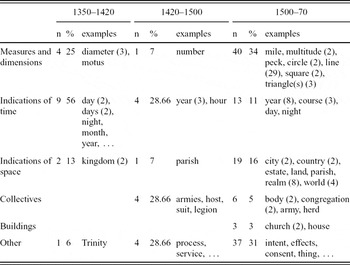
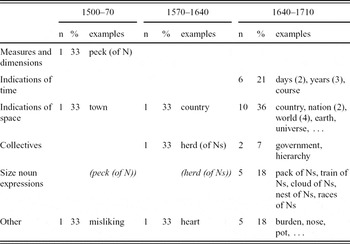
The genetic link between the secondary determiner and noun-intensifying uses of whole can be observed in the degree of overlap between the collocational sets of the two uses. Table 4 gives an overview of the different types of nouns with which secondary determiner whole collocates up until the period 1500–70, i.e. the time at which the first noun-intensifying uses of whole are found in the data. Comparison with table 5, listing the main semantic sets of collocates of noun-intensifying whole, shows that the original collocates of this intensifying use are subsets of the collocational range of the identifying use.
Collocates of secondary determiner whole in the PPCME and PPCEME corpora

Collocates of noun-intensifying whole in the PPCEME corpus

The quantifying meaning of secondary determiner whole is reflected in its collocational preferences. Table 4 shows that it originally occurred most often in combination with nouns referring to measures and dimensions and with nouns referring to measurable quantities of space and time. At first, the latter are mainly direct indications of time (day, month, year). From Early Modern English onwards, more associative ones appear in the data as well (course, sickness, dinner). Similarly, the indications of space with which secondary determiner whole collocates first straightforwardly refer to a certain stretch of land; later these nouns are used to metonymically refer to the inhabitants of the NP referent (kingdom, city, country). From 1420 onwards, identifying whole also collocates with other nouns referring to groups of people or animals. The latter can be straightforward collectives, such as group or family, or nouns designating buildings, such as house or school, which metonymically refer to the people that occupy them.
Table 5 shows that the original collocates of the noun-intensifying use of whole belong to the same semantic sets as the collocates of the secondary determiner uses. However, when whole is used as secondary determiner, the nouns are generally interpreted ‘literally’ as denoting clearly delineated and objectively measurable quantities (of space, of time, of people, etc.), as in (32), whereas when whole is used as a closed-scale quantity intensifier the (large) size implications of the nouns are foregrounded, as in (33).
(32) So the total internal force over the whole cross section is P and that then is the integral of D P over the area the integral of the stress times this D A over the whole area A. (CB UK Spoken 1991)
(33) There are whole areas where agriturismo, this hybrid of hospitality and set-aside, does not seem to have caught on. (CB Times 1995)
Table 5 also shows that the rise of open-scale intensifying uses of whole in the period 1640–1710 is reflected in the extension of the adjective's collocates. As mentioned above, open-scale intensification involves stressing the (unusually) large quantity inherent in the noun it co-occurs with. Accordingly, open-scale intensifying whole prefers plural nouns (days, years), nouns referring to large stretches of space (world, universe) and size noun expressions (pack, train, nest). The latter are not attested with secondary determiner or closed-scale intensifying whole and are thus a clear extension of the original collocational sets as a result of the reconfiguration of the intensification scale from closed to open-ended.
We can conclude that whole has developed two types of intensifying uses, a closed-scale and an open-scale one, an outcome which is reminiscent of that of complete. However, there are important differences between the paths followed by complete and whole. With complete, two distinct lexical subsenses led to intensifying uses in which, as predicted by Paradis, the boundedness configurations of the lexical uses were made prominent and the lexical contents bleached. The lexical and intensifying uses were connected by collocational overlap, involving specialized subsets of the original collocational ranges, followed by collocational broadening.
With whole, one grammatical use, viz. the quantifying secondary determiner with universal relative quantifier value, formed the source of the intensifying uses. The bounded quantification of the secondary determiner first led to closed-scale intensifying uses, from which, in turn, also open-scale intensifying uses developed. This path involved no bleaching of lexical content, but only reconfiguration of scales, viz. from measuring the designated set/mass to intensifying notions of quantity inherent in the accompanying nominal descriptions. This path too is driven by collocational overlap, i.e. both specialization and extension of collocates to degree nouns with quantitative features.
6 From identifying to noun-intensifying: the case of particular
In this section, we argue that the noun-intensifying uses of particular developed along the path from identification in the strict sense to intensification. Like whole, particular has both objective and subjective descriptive modifier uses, but these did not play a crucial role in the development of the adjective's noun-intensifying use. The objective lexical sense describes the degree of detail of the NP referent, meaning ‘exact, detailed, precise’, as in (34). As a subjective descriptive modifier, particular either indicates that something is ‘distinguished in some way among others of the same kind’ (OED s.v. Particular 5.a), as in (35), or it can refer to the intimacy or closeness of a relation or action (36).
(34) On making more particular inquiries respecting her family connexions, I found that they were strictly respectable, but of the middle class of life (CLMETEV Gore, 1824, Theresa Marchmont, or the Maid of Honour)
(35) I have said nothing but what I had from his own mouth, and have avoided the mentioning of the more particular Passages of his life of which he told me not a few. (PPCEME Burnet, 1680, Some Passages of the Life and Death of the Right Honourable John, Earl of Rochester)
(36) She is a sweet little creature, and my very particular friend. (CLMETEV Craik, 1850, Olive)
6.1 Identifying use of particular
From its occurrence in the data in the sixteenth century, particular is in prenominal position predominantly used as a secondary determiner, specifying or narrowing down the referential scope of the primary determiner (Ghesquière Reference Ghesquière2009).
In its main determining use, particular fulfils its identifying function by pointing to the connection between the referent of the NP it occurs in and alternative things or persons ‘as distinguished from’ it (OED s.v. Particular 3.a). In (37) particular indicates that that specific weekend and not another one is listed as a public holiday, thereby facilitating the identification of the referent. In (38) particular also serves a textual function, pointing to the referent intended by the speaker. The determiner complex a particular is, however, semantically quite general, simply preparing the hearer or reader for further identifying information. Additional information required to determine the exact NP referent is in this case provided by the following that-clause, which specifies the identifying information announced by the determiner complex and further restricts the number of possible referents.
(37) the tickets arrived with a booklet listing that particular weekend as a public holiday in France. (CB Times 1995)
(38) Often he would tell the dealer to collect his money from the stage door, so he felt he was dancing that evening for a particular painting or piece of furniture that he desperately wanted. (CB Times 1995)
Because of the semantic generality of secondary determiner particular, its collocational range is very wide, extending to nouns from very diverse semantic sets. Already in the period 1500–70 no clear patterns can be recognized in the collocates of identifying particular in this period: fault, person, part and law.
6.2 Noun-intensifying use of particular
As a noun-intensifying adjective, particular typically heightens evaluative notions inherent in the degree noun it is used with, as in (39) and (40). In other words, particular locates certain inherent characteristics of the NP referent very high on an open scale, such as the strength of the desire in (39), and the high degree of awareness with which the event was observed in (40).
(39) My husband now returned from church . . . and was, by my Lord's particular desire, ushered into the room. (CLMETEV Fielding, 1751, Amelia)
(40) I took particular notice of it, because it was at the house where you stood up that day on account of the mob that was waiting to see the malefactors go to Tyburn. (CLEMETEV Burney, 1782, Cecilia)
Ghesquière (Reference Ghesquière2009) argues that these primary noun-intensifying uses of particular developed from the secondary determiner use expressing that the NP referent is connected with one particular person only. Particular cannot in its secondary determiner use be modified directly in terms of degree (*that very/almost particular weekend, *a very/almost particular painting). However, when speakers want to further emphasize the connection, made explicit by particular, between the NP referent and a specific discourse participant, they can choose to insert a possessive such as own between (possessive) determiner and secondary determiner, as in
(41) Had every particular banking company always understood and attended to its own particular interest, the circulation never could have been overstocked with paper money. (CLMETEV Smith, 1766, An Inquiry into the Nature and Causes of the Wealth of Nations)
It is this emphatic construction that lies at the origin of the later noun-intensifying uses. The construction in which the close conceptual link between the NP referent and a specific-discourse participant is emphasized by the presence of a possessive construction and/or the emphatic identifier own (Saxon Reference Saxon, Georgopoulos and Ishihara1990) can then be considered the trigger context for the shift from identifying to intensifying meaning.
Sentence (42) is an example of a bridging context, which contextually supports the readings of both identifying secondary determiner and evaluative noun-intensifier. In the former interpretation particular has a distinctive reading, identifying the request as made by the speaker and not by any other party. Generally, this specifying function can be expressed by the possessive determiner my itself, but here the emphatic determiner own and the identifying adjective particular are added to the NP, both stressing the link between the NP referent and the speaker. As a consequence, an intensifying reading of its own particular is also plausible, indicating that the request was made with great emphasis, leaving little room for the addressee to refuse it.
Sentence (43) exemplifies a full-fledged intensifying use of particular. Reference is again made to the persons who formulated the request and who in their function as discourse participants help to identify the referent of the NP, but here the identifying meaning is pushed to the background in favour of the intensifying meaning, which receives primary focus through pragmatic strengthening. Particular locates the strength with which the request was uttered high on an open scale.
(42) no consideration whatever should make me run from the engagement which I had contracted with him, at my own particular request. (CLMETEV Hunt, 1820–22, Memoirs of Henry Hunt (Vol. 1))
(43) the Miss Dashwoods, at the particular request of the Middletons, spent the whole of every day, in every day at Conduit Street. (CLMETEV Austen, 1811, Sense and Sensibility)
As was the case with the path from quantifying secondary determiner to intensifier, the path from identifying secondary determiner to intensifying adjective has, to our knowledge, not yet been closely investigated in the grammaticalization literature. However, Nevalainen (Reference Nevalainen1991, Reference Nevalainen and Kastovsky1994) has studied the semantically similar path from ‘particularizer’ to scalar intensifier for adverbs such as just, particularly and exactly. Particularizing adverbs are a subtype of focusing adverbs (Nevalainen Reference Nevalainen and Kastovsky1994: 254). They ‘restrict the application of the utterance to the focused part by identifying it in terms of validity’ (Nevalainen Reference Nevalainen1991: 58). While they do not, in this use, have scalar meaning as such, scalarity is latent in them in two ways. Firstly, the particularizing function implies a higher ‘degree of precision’ of identification (Nevalainen Reference Nevalainen1991: 58). Secondly, if the particularizer is used in comparative contexts, where the identification of the focus excludes other possibilities (König Reference König and Weydt1989: 328, as quoted in Nevalainen Reference Nevalainen and Kastovsky1994: 255), this identificational comparison forms a possible source for scalar comparison (Nevalainen Reference Nevalainen1991: 59). It is on the basis of these semantic characteristics and the notion of scale that lurks in them that scalar intensifying uses can come into being via pragmatic strengthening (Nevalainen Reference Nevalainen and Kastovsky1994: 255).
The secondary determiner use of adjective particular contains the same basic semantic components, as transpired from the above discussion of examples (37) and (38). As particularizer, it adds a notion of greater precision to the identification expressed by the NP. A comparative implication is also often present: in (37) one specific weekend is singled out and all possible alternative weekends excluded. Both this degree of precision and the implied comparison carry in them the possibility of a meaning shift to intensifying scalarity, which came about in the trigger contexts with possessive determiner emphasized by own, such as (42). In these examples, the request is associated with one specific rather than with other agents. The pragmatic process of evoking alternative agents forms the basis for deriving scalar implicatures (Eckardt forthcoming): the request associated with this particular agent acquires the implication of being stronger than comparable instances of ‘request’ associated with other agents. The emphatic element in the original identifying sense reinforced by own, as in (41), comes to contribute in the trigger contexts, such as (42), to creating a qualitative scalar context (Eckardt forthcoming): my own particular request situates the strength of the request higher on the implied scale than the request of alternative agents. This makes (42) a pragmatic licensing context for scalar meaning, in which the new intensifier meaning emerged as a coded meaning.
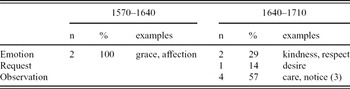
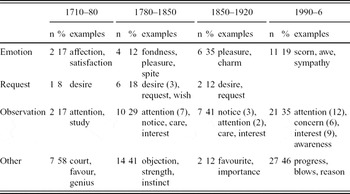
Two descriptive conclusions can be drawn from the corpus study of particular. First, as noted for the noun-intensifying uses of complete and whole, the development of intensifying particular is strongly collocationally driven. The original contexts in which noun-intensifying particular develops are specific subsets of the much wider collocational range of secondary determiner particular. Tables 6 and 7 give an overview of the main semantic sets of nouns with which intensifying particular collocates. As intensifying particular developed from the secondary determiner uses strengthening the connection between the NP referent and a specific person, its original typical collocates are nouns referring to concepts strongly linked to an experiencing human subject, viz. nouns referring to emotions (e.g. grace, affection, kindness), requests (e.g. desire, request, wish) and observations (e.g. notice, interest, attention).
Collocates of noun-intensifying particular in the PPCEME corpus

Collocates of noun-intensifying particular in the CLMETEV and CB corpora
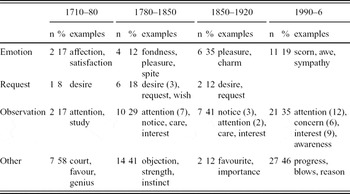
Second, from assuring the identifiability of the NP referent by connecting it to specific discourse participants, particular shifted to intensifying, on an open-ended scale, the degree of emotion (with emotion nouns), volition (with request nouns) or awareness (with observation nouns) evoked by the head nouns. We cannot say that in this case a scalar component that was part of the source semantics came to be foregrounded, as happened with the gradability mode of the descriptive source senses of complete and the quantification scale of the quantifying source meaning of whole. Scalar notions were derived as purely pragmatic processes in very specific licensing contexts of identifying uses involving emphasis and the evoking of alternatives. The general mechanism of change explaining the shift to scalar intensifying meaning thus has to be reformulated and extended: it involves not only the foregrounding of inherent semantic components but also the derivation of scalar meaning on the basis of pragmatic processes.
7 General conclusions from the case studies
This study was occasioned by the observation that noun-intensifying uses of adjectives develop not only from lexical, property-describing uses but also from grammatical, quantifying and identifying, uses (section 1). As case studies we chose the adjectives complete, whole and particular (the first two of which were associated with different pathways in Bolinger (Reference Bolinger1972), Paradis (Reference Paradis, Bermúdez-Otero, Denison, Hogg and McCully2000) and Ghesquière (Reference Ghesquière2009, Reference Ghesquière, Davidse, Vandelanotte and Cuyckens2010)) because, in our view, they instantiate these three paths.
We started off this study with a number of general questions and hypothesized answers (section 2). What general types of intensification scales need to be distinguished? Is there one mechanism of change leading to scalar, intensifying meanings? We assumed that all intensifying uses can be captured with the two basic intensification scales proposed by Kennedy & McNally (Reference Kennedy and McNally2005): open- and closed-scale ones. We also assumed that Paradis's (Reference Paradis, Bermúdez-Otero, Denison, Hogg and McCully2000) view on the shift to intensifying meaning is basically on the right track, viz. that the gradability mode associated with the lexical source use is foregrounded. However, this hypothesis had to be reformulated to also encompass the two paths with grammatical source meanings. Finally, an explanation had to be found for why adjectives often develop intensifying meanings with scale types not associated with their source uses. We conjectured that collocations are an integral part of the whole change. We expected the initial shift maintaining the original mode of grading or measuring to take place in collocational environments shared by source and target use; that is, we predicted that the first collocates of the new intensifying uses would overlap with collocates of the source uses. Once the intensifying meaning is acquired, the adjective may extend the sets of nouns it can intensify. In this second stage, its new collocates may invite a different type of degree modification. The three case studies have confirmed these initial hypotheses and put more descriptive detail on them.
Section 4 dealt with complete, whose noun-intensifying uses developed from fully lexical, quality-ascribing modifiers. We argued that the closed-scale intensifying uses of complete, as in complete success, derived from the bounded descriptive ‘full realization’ sense, as in the complete establishment. Similarly, the open- or closed-scale intensifying use of complete, as in a complete gentleman, developed from the descriptive ‘perfect’ sense, as in a complete player. In this descriptive use, complete denotes the ‘extreme’ on a scale, which can be construed in either a bounded or unbounded way. Conceptually, these shifts can be explained in terms of the foregrounding mechanism proposed by Paradis (Reference Paradis, Bermúdez-Otero, Denison, Hogg and McCully2000): the boundedness configurations of the lexical uses were foregrounded at the expense of their lexical content.
Section 5 looked at whole, whose intensifying uses developed from quantifying secondary determiners, more specifically from intensified secondary determiners. The precise developmental path ran as follows: the whole distance > all the whole way > the whole country > a whole bunch of. The source construction the whole + noun expresses relative quantification, as it compares the mass or set it actually predicates with a reference mass and indicates that it coincides with it. As such, whole evokes a closed scale, identifying the actual degree of a certain quantity as reaching the upper boundary of that scale. In its original intensifying use, whole retained this closed scale, but shifted it to the domain of degree modification. Later intensifying whole could also invoke an open-ended scale of magnitude, triggered by the collocational extension to (typically plural) nouns such as trains, classes, swarms. Conceptually, this path involved reconfiguration of scales. No scale had to be extracted and foregrounded from the source construction. Rather, the quantifying secondary determiner was itself defined by a quantification scale, which shifted into an intensification scale.
For particular we found that specifying secondary determiner uses led to intensifying uses in pragmatic licensing contexts of NPs identifying possessors, as in my own particular request. In these contexts, we found two pragmatic processes in the secondary determiner use, emphasis and the evoking of alternatives, from which scalar implicatures derived. My own particular request is implied to be stronger than comparable ‘requests’ by implied alternative agents. The general mechanism of shift to intensifying meaning therefore also has to incorporate scalar meanings pragmatically derived from the source uses.
Future studies, particularly of the hitherto neglected quantifying and identifying sources, will tell whether our findings for whole and particular can be generalized or will reveal that the shift to intensifying use can take different forms still. We also found that the different collocational histories of the individual adjectives are an integral part of the change. The initial shift takes place in collocational environments that overlap with those of the source uses. Due to later collocational extension, noun-intensifying uses may come to incorporate intensification scales unpredicted by their sources. This confirms the general point made in studies such as Lorenz (Reference Lorenz, Wischer and Diewald2002) and Brems (Reference Brems2010) that collocational processes, such as collocational continuity and collocational broadening, carried by the language community's awareness of ‘prior text’ (Hopper Reference Hopper and Tomasello1998), are an important facilitating factor in processes of language change.